Free, 16 pages, nothing to pay
Before you buy another seed bag
Pick three microgreens worth testing. Buy the seed without overpaying. Know what a tray costs you before you plant it.
Your First Profitable Tray Workbook is a printable PDF you write on, not another article. It arrives when you confirm your address.
Your address is only used to send this. See the privacy policy.
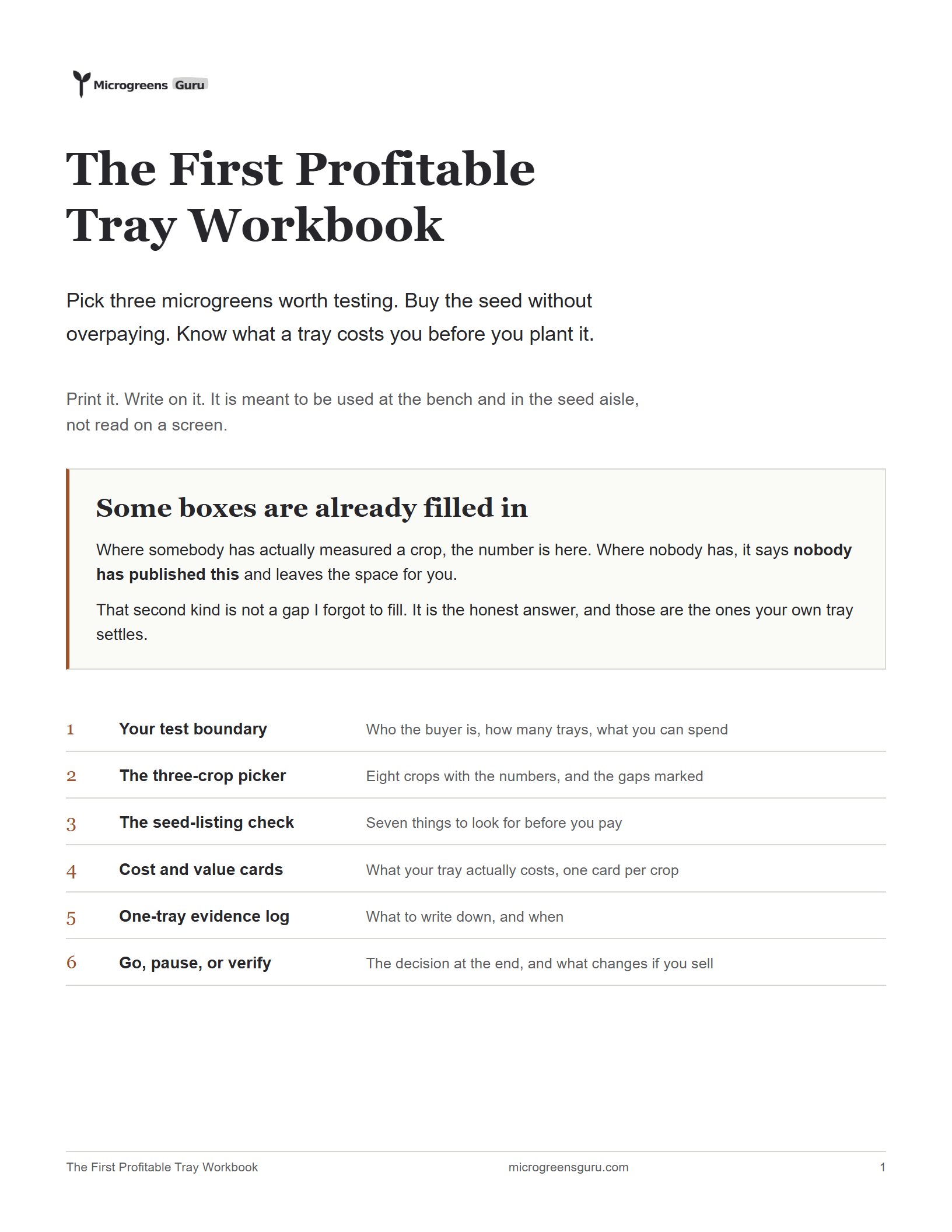
What is inside
- 1Your test boundaryWho the buyer is, how many trays you can really run, and what you can spend to find out.
- 2The three-crop pickerEight crops with the numbers filled in, and the gaps marked rather than guessed.
- 3The seed-listing checkSeven things to look for on the listing before you pay for a bag.
- 4Cost and value cardsOne per crop: what the seed costs you, and what your own tray actually returned.
- 5One-tray evidence logWhat to write down, and when, so a disappointing tray still tells you something.
- 6Go, pause, or verifyThe decision at the end, and what has to change before you sell any of it.
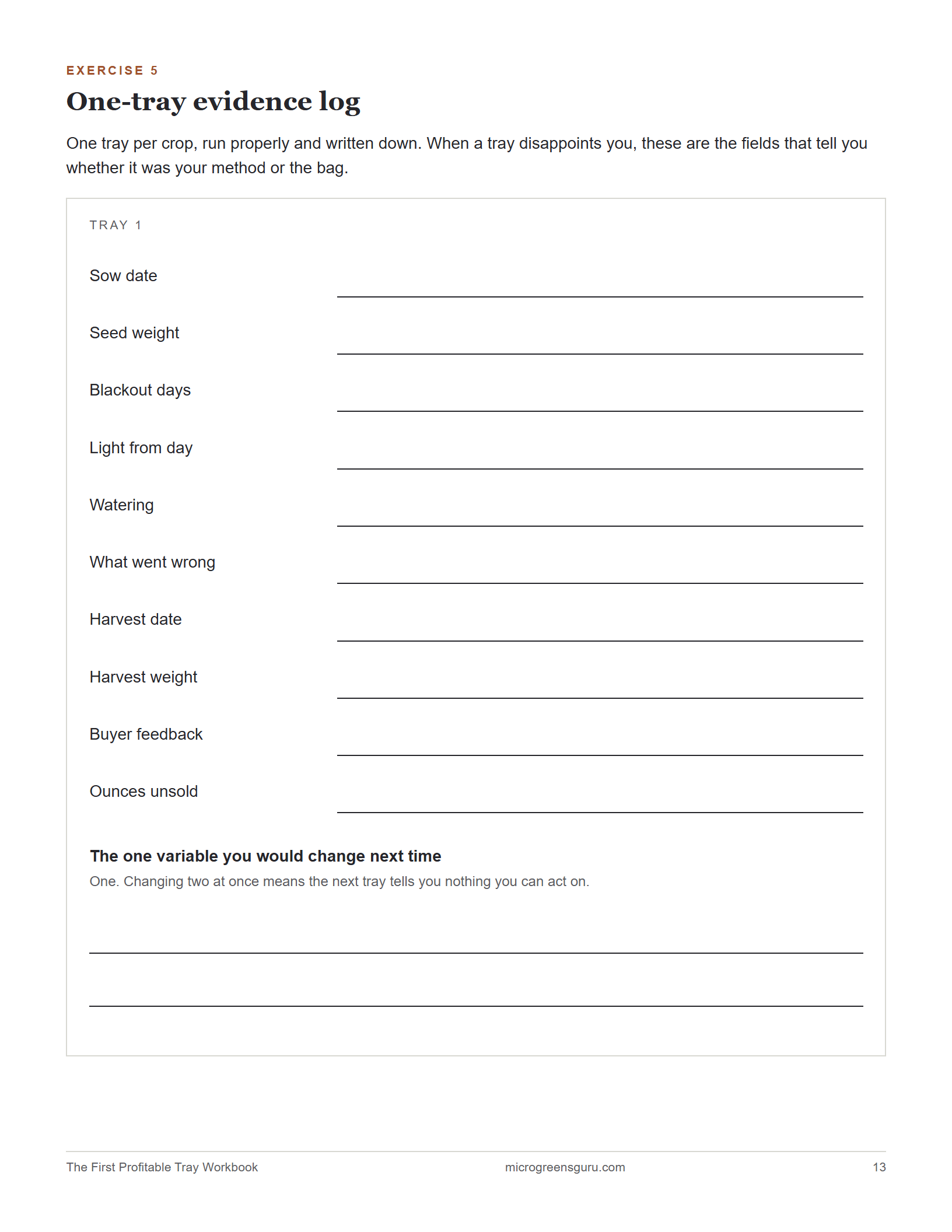
The evidence log. It is meant to be printed and written on at the bench.
The three-crop picker, with the gaps left in
Eight crops in two halves: four that every beginner list recommends, and four this directory rates Beginner with a complete published record that those lists never mention. Here are two from each half, with the real figures.
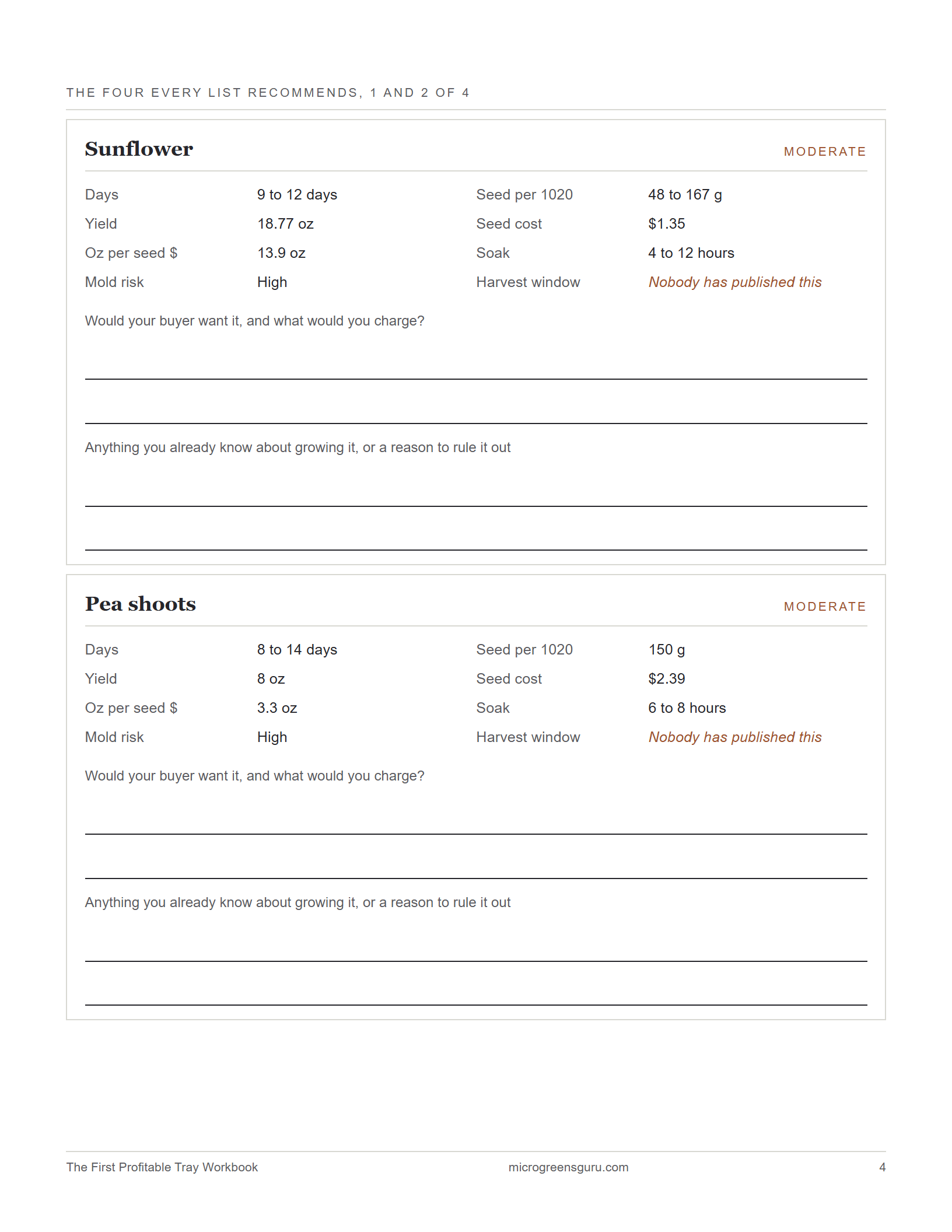
Sunflower
Moderate
- Days
- 9 to 12 days
- Seed per 1020
- 48 to 250 g
- Seed cost
- $1.35
- Harvest window
- No published figure
Pea shoots
Moderate
- Days
- 8 to 14 days
- Seed per 1020
- 150 g
- Seed cost
- $2.39
- Harvest window
- No published figure
Mizuna
Beginner
- Days
- 8 to 15 days
- Seed per 1020
- 9.5 g
- Seed cost
- $0.39
- Harvest window
- No published figure
Arugula
Beginner
- Days
- 6 to 19 days
- Seed per 1020
- 10 g
- Seed cost
- $0.48
- Harvest window
- No published figure
The harvest window is the line no other chart shows you. Of the eight crops, seven have no published harvest window at all. Where a figure does not exist the workbook says so rather than guessing, because a missing number is not zero and treating it as one is how a tray gets costed wrong.
And two of the four crops every beginner list recommends are not rated Beginner here. They need soaking, they go moldy more easily, and they take several times the seed weight of the cheapest option. Read how the beginner ratings were arrived at.
The seed-listing check
Run against the actual listing before you pay. Three of the seven are here, and they are useful on their own whether or not you ever hand over an address.
Check 1
The crop, not just the color name
Rambo, Sango, Triton and Hong Vit are all radish. In the one trial that measured them side by side, two bags both labeled radish differed by 44 percent in yield and by 6 g in what a tray takes.
Check 2
Untreated, and said plainly
Treated food-plot and farm seed carries fungicide and is not food. If the listing does not say untreated, that is the question to ask before the order rather than after.
Check 3
A lot number and a germination percentage
These are the two fields that make a bad tray diagnosable later. Without them, a failure could be your method or could be the bag, and you will never know which.
Who it is not for
It is not a profitability guarantee, a food-safety protocol, or legal advice, and it will not tell you which crop makes the most money, because that depends on a buyer in your town that no national document can see.
If you already run a farm with reliable yield records, you have better numbers than this. If you have never grown a tray, start with the growing guides instead. If you intend to sell, the workbook routes you to your state’s rules on selling microgreens after the crop decision, which is the right order.
Get the workbook
Confirm your address and the PDF arrives straight away.
Your address is only used to send this. See the privacy policy.