Which Microgreens Should a Beginner Grow? Start With Broccoli, Radish or Mustard
Cal HewittPublished Checked
- beginner
- growing
- method
- buying
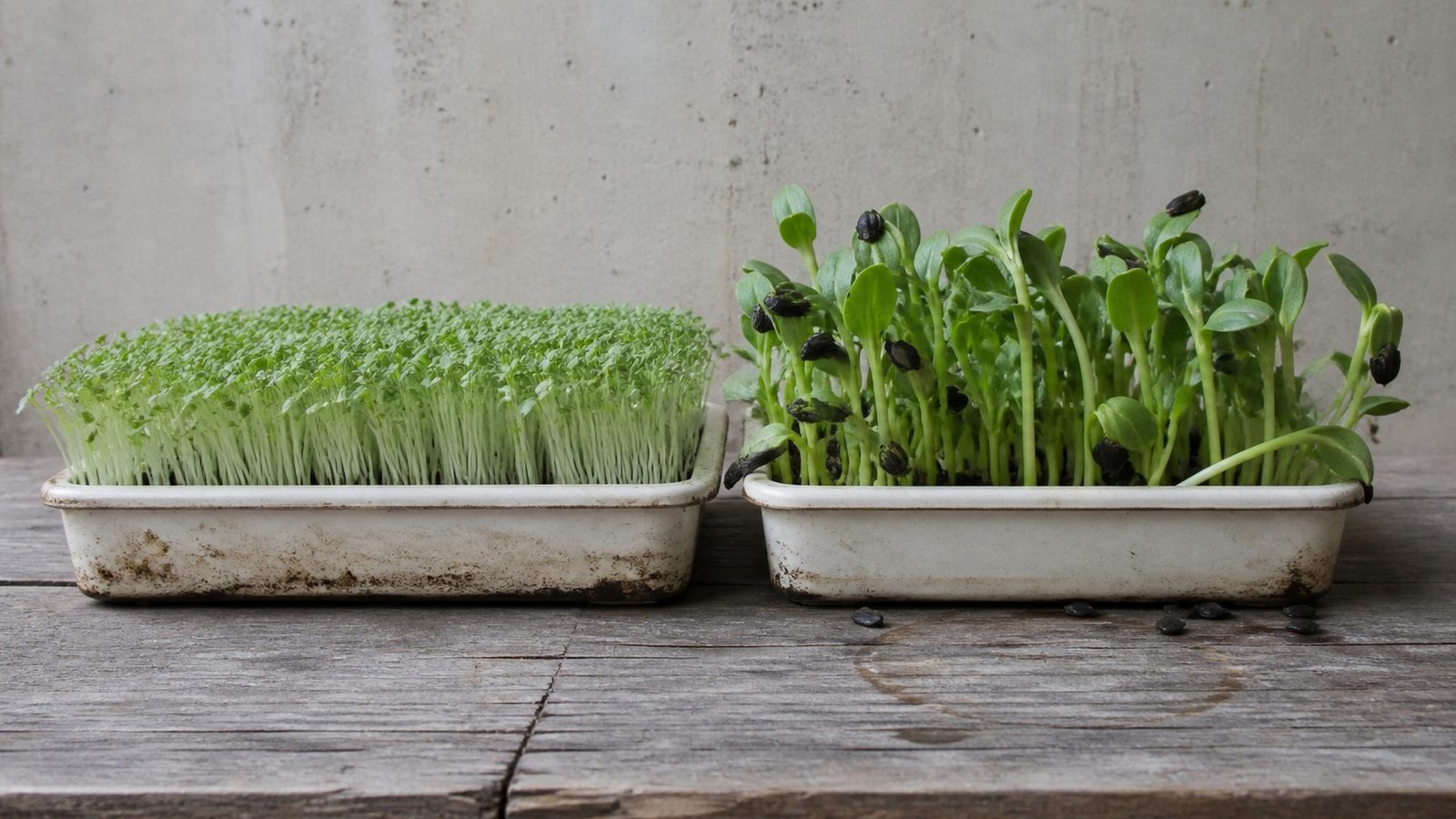
Start with a no-soak brassica: broccoli, radish or mustard. They need no soak, sow at a low seed rate so a failed tray costs almost nothing, and are the crops rated beginner here. Grow pea and sunflower second, once you know the tray, because they add a soak, a weighted cover, hull debris and the heaviest seed rates in the category.
That differs from the usual list, and it is worth knowing why. Radish, pea shoots and sunflower appear on nearly every beginner list you will find, with broccoli on most of them. That near-unanimity is the part of this subject with the least evidence behind it.
No extension publication found says "these are the crops for a first-time grower" and backs a ranking with comparative outcome data. Utah State tells a home grower to choose microgreen-labeled seed "such as" radish, broccoli, sunflower or pea shoots, which is an example list rather than a tested recommendation. Maryland calls the cabbage and mustard family especially well suited. Neither establishes which crop makes the best first tray.
So, the published crop fields are the closest thing to a check that exists, and they disagree with the usual list on exactly two crops.
What to actually do
- Start with a no-soak brassica. Broccoli seed is the mildest of the group, is rated beginner here, needs no soak, and sows at 13 grams so a failed tray costs almost nothing. Radish and mustard are the same shape with more bite.
- Pick the flavor before the speed. Radish is fast and it is peppery. If you will not eat peppery, being fast has bought you nothing.
- Grow pea and sunflower second, not first. They are genuinely worth growing, and they add a soak, a weighted cover, hull debris and the heaviest seed rates here. Learn the tray on a crop with fewer steps.
- One species per tray. Maryland and Penn State both say so, because mixed germination and growth rates give you an uneven harvest and no way to diagnose what went wrong.
- Treat mold as a tray problem, because that is what the data says. No beginner-rated crop here has low mold risk. Moist rather than saturated medium, airflow and a vented cover are the controls.
- Keep the light close. Clemson says about 4 inches above new sprouts, which is the fix for the legginess that makes a first tray look like a failure.
- Use one shallow food-grade container with drainage. Utah State says a repurposed pie tin or takeout tray works; Clemson specifies 1 to 2 inches deep with drainage. You do not need a rack to find out whether you like this.
- Use untreated seed sold for microgreens, and no garden soil, manure or compost. That is Clemson's food-safety line and it is not optional.
- Look past the list. Seventeen crops rated beginner here appear on none of the five pages, and most of them need no soak.
The usual five, against what the crops actually need
Hover or tap a row to highlight it.
| Crop | On how many of the four lists | Rated | Mold risk | Soak | Seed per 1020 | Days |
|---|---|---|---|---|---|---|
| Radish | 4 of 4 | Beginner | Medium | none | 22.5 to 28.5 g | 6 to 10 |
| Pea shoots | 4 of 4 | Moderate | High | 6 to 8 h | 150 g | 8 to 14 |
| Sunflower | 4 of 4 | Moderate | High | 4 to 12 h | 48 to 167 g | 9 to 12 |
| Broccoli | 3 of 4 | Beginner | Medium | none | 13 g | 7 to 15 |
| Mustard | 2 of 4 | Beginner | Medium | none | 8 g | 10 to 15 |
Utah State Extension names four of those same crops too, radish, broccoli, sunflower and pea shoots, but as an example of microgreen-labeled seed rather than as a starter ranking, so it is not counted as one of the four lists above.
Pea and sunflower are the only two of the five not rated beginner crops, and they are the two that appear on every single list.
They are also, on every mechanical axis, the two with more to go wrong:
- Both need a soak, 6 to 8 hours for pea and 4 to 12 for sunflower, while radish, broccoli and mustard need none. A soak is a step a first-time grower can forget, mistime or run too warm.
- Both carry high mold risk, against medium for the other three.
- Both sow heavy. Pea at 150 g and sunflower up to 167 g a tray, against broccoli's 13 g and mustard's 8 g. The median seed rate across crops is 23 g, so the two universal picks sow at roughly 6.5 to 7.3 times the median crop, and pea uses 18.8 times mustard's seed.
That last one is the money. A failed first tray of mustard costs 8 grams of seed. A failed first tray of pea costs 150. The full seed-rate range runs 409-fold, and this is the corner of it that lands on a beginner.
None of this says pea or sunflower fail more often, because nobody has measured that. It says the two crops recommended most universally are the two carrying the most steps, the most seed and the higher mold rating, which is the opposite of what "forgiving" is supposed to mean.
Seventeen beginner-rated crops are never named at all
Sixty-two crops carry a difficulty rating: 20 Beginner, 33 Moderate, 9 Difficult.
Three of those 20 are on the consensus list. The other 17 are named by none of the five pages: arugula, broccoli raab, cauliflower, clover, collard, garden cress, green cabbage, kale, kohlrabi, komatsuna, lentil, mizuna, pak choi, red cabbage, tatsoi, turnip and wheatgrass.
And 18 of the 20 beginner-rated crops need no soak at all, including most of that unnamed list. If the fewest steps is the criterion the beginner pages say they are using, the pages are not applying it.
One number is worth pausing on. Zero of the 20 beginner-rated crops carry a low mold risk. Not one. That is not a gap in the data, it is the answer: mold is a property of your tray, not of your crop. Maryland and Penn State both describe it that way, naming moist rather than saturated media, airflow and vented covers as the controls, and warm humid conditions as what favors damping off. No extension source found assigns a comparative mold ranking by crop, and the practice pages that do offer one supply no tray counts, conditions or comparator.
What "easy" actually means, and what nobody has measured
There is no published operational definition of an easy crop. These are the criteria the sources actually state, and what each is worth:
- Fast germination. Maryland puts cabbage-family germination at about 36 hours at 72°F and says the family germinates faster than the beet family. That is speed, not forgiveness, and they are not the same thing.
- Fewer special steps. Maryland lists pea, sunflower, corn, chickpea, beet, chard, cilantro, mung bean and buckwheat for a 6 to 12 hour soak. A no-soak crop removes a task. No study tests whether removing it makes a novice more likely to succeed.
- Tolerance of low light. Maryland says lettuce, arugula, mustards and Asian greens grow acceptably under less-than-ideal light. This is the closest thing to an extension-backed forgiveness criterion that exists, and note that it names almost none of the consensus crops.
- Something you want to eat. Clemson and Utah State both publish flavor tables: broccoli mild, sunflower nutty, pea sweet, radish nutty and spicy, arugula peppery. A technically perfect tray nobody eats is a failed recommendation.
What has never been measured is the thing the word actually means. No study found deliberately imposed the same novice mistakes, overwatering, missed watering, weak light, temperature swings and uneven sowing, across common crops and compared how many trays stayed usable. No source defines easy as the probability of a usable first tray, and none reports that probability.
Practice pages use outcome language without a denominator. "Usable harvest within two weeks" is not a success rate if nobody counts the failures.
Per-crop germination percentages do get published, and they will not settle it either, because germination is batch, temperature and treatment specific. Penn State's seed-density tool asks for the germinability of your own batch, which is the correct framing and the reason a permanent per-crop ease score does not exist.
Why the consensus list is not evidence
All four practice lists share the same core. Every one contains radish, pea and sunflower; three of four add broccoli; two add mustard. Exact agreement is zero of four, because list lengths and extras differ.
All four give reasons, and none gives evidence. The reasons offered are speed, vigor, no soak, large harvest, flavor and claimed tolerance. Not one links its specific "forgiving" assertion to a comparative novice trial, because none exists.
That is a shared recommendation tradition, not independent derivation. It is not proof of copying either. It is the ordinary situation where everyone draws on the same familiar core and nobody publishes failure data, and the honest reading is that agreement here carries much less weight than it looks like it should.
The pages get real things right, and dismissing them would be the opposite error. They separate flavor and purpose from growing mechanics, which matters. They warn that pea and sunflower carry an extra soak. They warn against mixing species in one tray, which Maryland and Penn State both support because germination and growth rates differ. Practice observations generate useful testable warnings. They just must not be restated as measured mold rates or success probabilities.
One more thing they get right: a retailer's product link is not a sales ranking, and none of these pages publishes units or revenue by crop. What crops beginners actually buy and grow first has never been surveyed.
What nobody has measured
- A novice usable-harvest trial. New growers randomly assigned one crop and a simple protocol, with "usable" defined in advance as safe, non-moldy, harvestable and actually eaten. This is the single most valuable missing study in this subject.
- Crop against imposed mistake. A replicated trial running normal, over-watered, under-watered, low-light, temperature-swung and unevenly sown treatments across crops, reporting usable harvest.
- A comparative mold ranking by crop under identical seed density, water, temperature and airflow, with diagnosed disease and tray-level incidence.
- Whether large seeds are genuinely easier to sow, measured as sowing time, density error, skipped steps and usable harvest, rather than assumed from visibility.
- Whether a short crop fails less often. Fewer days is less time for something to go wrong, and that has never been tested against actual losses.
- What beginners actually grow first, from a prospective survey recording crop, setting, prior experience, harvest and whether they ate it.
- Whether seed cost changes persistence after a first failure, which is the mechanism behind the 8-gram against 150-gram point above and is entirely untested.
Terms on this page
Tap a term to see what it means.
Germination rate. The proportion of viable seed producing a seedling under stated conditions. A property of your batch and your room, not a permanent property of the crop.
Sources
Opened 2026-08-12. The difficulty, mold risk, soak, seed rate and harvest figures for individual crops are this site's own variety fields, read across all 62 entries; the counts of 20 beginner, 33 moderate and 9 difficult, the 17 unnamed beginner crops, the 18 beginner crops needing no soak and the zero beginner crops at low mold risk are computed from those fields rather than taken from any source below. The list counts are from the five pages named here, audited on one date, and are not a count of every beginner page online. Two studies reporting per-crop germination percentages were opened and are deliberately not quoted, because a direct fetch returned 403 and their individual values could not be verified at source.
- Utah State University Extension, grow your own microgreens - the 20 February 2025 guidance naming radish, broccoli, sunflower and pea shoots as example microgreen seed choices, the dated crop table giving pea a 6 hour and sunflower a 12 hour soak with radish and broccoli at none, covered time from 1 to 2 days for radish to 7 to 14 for cilantro, a 2 to 5 lb weight over the first half of the dark period, flavors including arugula peppery, broccoli mild, pea sweet, radish nutty and spicy and sunflower nutty and sweet, and the note that repurposed pie tins or takeout trays can work.
- University of Maryland Extension, growing microgreens and baby greens indoors - the cabbage and mustard family named as especially well suited and germinating faster than the beet family, about 36 hours at 72°F for cabbage-family germination, the 6 to 12 hour soak list covering pea, sunflower, corn, chickpea, beet, chard, cilantro, mung bean and buckwheat, lettuce, arugula, mustards and Asian greens named as growing acceptably under less-than-ideal light, seed counts of 8,000 per oz for broccoli and 15,000 for mustard against 1,500 for beet, the advice against mixing species because germination and growth rates differ, and moist rather than saturated media with airflow and vented covers as the disease controls.
- Clemson Extension, growing microgreens - the 21 November 2018 guidance on a shallow 1 to 2 inch tray with drainage, keeping light about 4 inches above new sprouts to guard against leggy seedlings, avoiding garden soil, manure and compost and using untreated microgreen-labeled seed, the definition of microgreens as harvested when true leaves begin to form, and the harvest-time and flavor table covering broccoli, sunflower and pea among others.
- Penn State Extension, growing microgreens - the advice to select one type per tray, and damping off identified as the only disease encountered in its class with warm humid conditions favoring it.
- Penn State Extension, the ABCs of microgreens - the seed-density tool asking for the germinability of the grower's own batch, which is why a permanent per-crop germination score does not exist.
- Practice, four beginner pages audited 2026-08-12 as a record of what is recommended rather than as evidence, and the source of the list counts. Utah State Extension, listed above, names four of the same crops as examples rather than as a starter ranking and is deliberately not counted among them: Urban Harvest Lab, listing radish, pea, sunflower, broccoli and mustard with a reason for each and warning that mucilaginous chia, cress and basil are hard to spread and mold-prone; Wind River Greens, listing sunflower, pea and radish, warning that crowded wet sunflower can mold and that cilantro needs cracking or pre-hulling, and using outcome language without a denominator; Garden UK, listing pea, radish, sunflower and broccoli and using "taste good enough" as an explicit starter criterion; and CityRooted, an affiliate page ranking on speed, flavor, yield and cost. None publishes crop-level sales figures, and none links a forgiveness claim to a comparative trial.
- Opened but deliberately not quoted, because a direct fetch returned 403 and their values could not be verified at source: Plants, 2024, assessment of vegetable species for microgreen production in unheated greenhouses, Agriculture, 2023, evaluation of growth conditions, antioxidant potential and sensory attributes of six diverse microgreens species, and Agronomy, 2025, annual garden rocket and radish as microgreens, seed germination response to thermal and salt stress.
Keep reading
The journal
Herb Microgreens: Slower and Harder, and They Use Less Seed Than Everything Else
Herb-family crops take a median 19 days against 11.5 for everything else, and 8 of the 9 hardest crops are herbs. They also sow lighter, so the premium is bench time, not seed.
Read Herb Microgreens: Slower and Harder, and They Use Less Seed Than Everything ElseThe journal
Four Bags Labeled Kale, Two Species and a 227 Percent Price Gap: How Microgreen Seed Actually Gets Named
Federal law makes a seed packet state its kind and variety, not its species. One catalog's four kale microgreen listings span two different species and $25.73 to $84.25 a pound.
Read Four Bags Labeled Kale, Two Species and a 227 Percent Price Gap: How Microgreen Seed Actually Gets NamedThe journal
Best Potting Soil for Microgreens: Cost per Tray
Compare the best potting soil for microgreens by ingredients, bag size, trays filled per bag, and cost per tray, plus problems to expect from each mix.
Read Best Potting Soil for Microgreens: Cost per TrayThe journal
Grow or Buy Microgreens? The Answer Is an Hourly Rate, and It Is $23.60
Seed alone makes home growing look eleven times cheaper. Add medium, power, a failure rate and your own time at $20 an hour and the saving against the cheapest retail is 8 percent.
Read Grow or Buy Microgreens? The Answer Is an Hourly Rate, and It Is $23.60