How fast do microgreens grow? Take the number from your crop, not from a general range
Cal HewittPublished Checked
- method
- harvest
- beginner
- yield
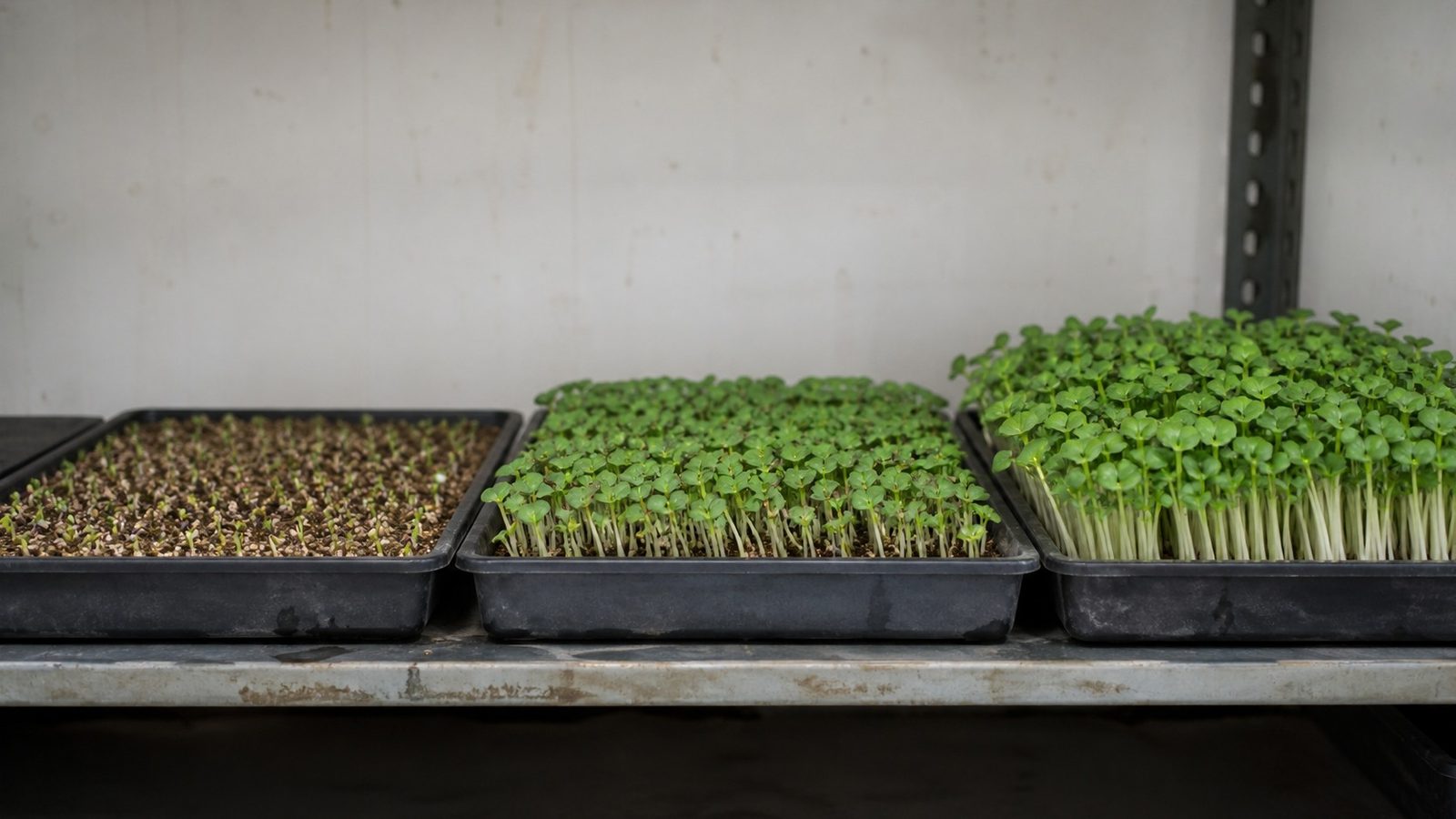
One figure dominates this question. In a dated snapshot of the first ten organic results, seven gave a single general duration and five used the exact words "7 to 14 days."
That range is checkable, because 61 of the 62 crops people actually grow publish a harvest range of their own. Set the claim against them and it does not hold.
Hover or tap a row to highlight it.
| What was checked | Count | Share of the 61 |
|---|---|---|
| Fits entirely inside 7 to 14 days | 15 | 25 percent |
| Can be cut before day 7 | 10 | 16 percent |
| Can still be unharvested after day 14 | 37 | 61 percent |
| Can still be unharvested after day 21 | 17 | 28 percent |
| Overlaps day 10, so could plausibly be cut then | 44 | 72 percent |
Three quarters of microgreen crops fall outside the range everybody publishes. The true span is 4 to 35 days. The median crop can first be cut at day 8 and is done by day 15.
"7 to 14 days" is not wrong so much as it is a description of the brassicas with the rest of the category quietly dropped. Radish at 6 to 10 days and arugula at 6 to 19 are in it. Parsley at 21 to 35 and cilantro are nowhere near it.
Hover or tap a row to highlight it.
| Fastest by earliest cut | Days | Slowest by latest cut | Days |
|---|---|---|---|
| Alfalfa | 4 to 6 | Parsley | 21 to 35 |
| Sesame | 5 to 10 | Thyme | 20 to 35 |
| Flax | 5 to 14 | Celery | 21 to 30 |
| Radish | 6 to 10 | Sorrel | 17 to 30 |
| Buckwheat | 6 to 12 | Shiso | 16 to 30 |
| Fenugreek | 6 to 12 | Chives | 14 to 30 |
What to actually do
- Look up your crop, not the category. The range in the entry here is a forecast; 7 to 14 days is a description of the brassicas.
- Write the harvest definition on the tray. "75 percent showing a first true leaf" is comparable between trays and between growers. "Ready" is not.
- Expect a window of about two days on a fast brassica. The USDA work put radish's best point two days past first true leaf and saw anthocyanins drop one day later.
- Do not harvest early to hit a date. Two extra days were worth 20 percent of the yield in the one trial that measured it, and the early tray also stored worse.
- If you want the calendar to move, start with tray temperature. It is the only lever with published day counts, it costs a probe thermometer, and it does most for the slow crops.
- Change one thing at a time. Light, density and medium all change the crop and none of them has a measured effect on the date, so altering two at once buys you no information.
- Keep one line per tray. Crop and lot, sow date, soak, grams and tray area, medium, cover dates, tray temperature, light hours, the date half of it emerged, your harvest definition, the harvest date and the weight. After a few cycles your own median beats every table on the internet, including this one.
- Plan the shelf, not the tray. At the median 0.500 oz per tray-day, a three-week crop has to earn about three times the price per ounce of a one-week crop to match it.
"Ready" is a stage, and the stage nobody agrees on moves every number
Before comparing any two day counts, check that they mean the same thing. They usually do not.
- UF and IFAS allow harvest at the cotyledon stage, or just as the first true leaves emerge.
- Maryland says to cut when the true leaves have expanded.
- A USDA controlled study used roughly 75 percent of plants showing a first true leaf.
Those are three different finish lines, and the gap between them is measured in days rather than hours. In that USDA work at 25°C, first true leaves emerged on day 8 for radish and day 11 for broccoli, while the best point for yield and quality was day 10 and day 13.
Waiting those extra two days produced 20 percent more yield than earlier harvests, and less visible decay in 4°C storage.
Later is not simply better. In the same study, radish anthocyanins fell significantly by day 11, one day past its optimum. Broccoli's glucosinolate content also moved with harvest day. So, the good window on radish is about two days wide, and a page that reports "radish, 8 days" and one that reports "radish, 10 days" can both be accurate and be answering different questions.
Write the finish line on the tray. "Cut when 75 percent show a first true leaf" is a standard. "Looked ready" is not, and it is why the published numbers cannot be reconciled. See when to harvest and what changes at each stage.
Temperature is the only lever with a measured effect on the calendar
Of everything growers adjust to speed a crop up, exactly one has a published day count attached, and it covers germination rather than the whole cycle.
A four-replicate assay measured days to 50 percent germination at three temperatures.
Hover or tap a row to highlight it.
| Crop | 15°C | 20°C | 25°C | Days saved from 15 to 25°C |
|---|---|---|---|---|
| Table beet | 5.1 | 2.9 | 2.1 | 3.0 days |
| Amaranth | 2.4 | 1.5 | 0.7 | 1.7 days |
| Arugula | 1.4 | 0.7 | 0.6 | 0.8 days |
The slow crop gains the most. The same 10 degree change saves three days on beet and under a day on arugula, which is worth knowing before heating a shelf full of fast brassicas.
Final germination stayed high at every temperature, so this is a speed effect and not a rescue. And it is germination only. No study has measured the full sowing-to-harvest effect of temperature, so this does not license "run it warmer and cut sooner."
The published operating ranges are recommendations rather than speed settings. Virginia Tech gives 60 to 70°F for general production, Maryland says microgreens germinate and grow well at 70 to 75°F, with cabbage-family crops germinating in about 36 hours at 72°F. Utah State's harvest table was produced under 74°F germination, 72°F with lights on and 68°F with lights off. See temperature and airflow and heat mats.
What does not have a measured effect on the day count
This is a longer list than the one above, and every item on it is routinely presented as a speed control.
- Light. Intensity, photoperiod and daily light integral all measurably change emergence, shape, biomass and quality. No located study reports a crop-specific change in days to the same harvest stage. A 2026 cabbage and arugula experiment across nine spectra and three photoperiods changed emergence and final biomass differently by crop, which supports crop-specific light responses rather than a longer-day rule.
- Seed density. Higher rates gave more shoots and more fresh weight per area, and less fresh weight per shoot and smaller first true leaves through competition. How many days density adds or removes has never been reported.
- The medium. In a randomized greenhouse comparison all harvested at the same 11 days, peat lite beat paper and wood fiber substantially on every crop. That is a growth comparison at a fixed date, not a change in the date.
- Soaking. A green lentil study compared 0, 12, 24, 48 and 72 hour soaks and measured on day 9, where 48 hours gave the tallest plants and highest germination and 72 hours was slightly worse. It never reported time to a shared harvest stage. Soaking is already crop-specific practice rather than a universal step: see soaking microgreen seed.
And seed size does not predict speed either. Radish at 6 to 10 days beats much larger pea and sunflower, both of which are also soaked first. One radish study found cultivar fresh mass inversely related to 1,000-seed weight. The seed reserve explains why a seedling reaches cotyledons without feeding. It does not rank crops by speed.
What "slow" actually costs, in shelf time rather than patience
Days matter because a tray occupies a shelf, and that is measurable here. Thirty-nine crop entries publish both a harvest range and a yield, so the tray-day can be computed directly.
Hover or tap a row to highlight it.
| Position | Crop | Yield and days | Ounces per tray-day |
|---|---|---|---|
| Fastest returning | Sunflower | 18.77 oz over 10.5 d | 1.788 |
| Radish | 9.75 oz over 8 d | 1.219 | |
| Komatsuna | 12.00 oz over 10 d | 1.200 | |
| The middle | Median of all 39 | 0.500 | |
| Parsley | 6.25 oz over 28 d | 0.223 | |
| Carrot | 2.00 oz over 19.5 d | 0.103 | |
| Slowest returning | Fennel | 1.00 oz over 20.5 d | 0.049 |
The spread from best to worst is 36.6-fold. A shelf running sunflower produces more than thirty-six times the weight per tray-day that the same shelf produces running fennel, and none of that shows up in a days-to-harvest number.
That 0.500 oz per tray-day checks out against the other figures. The median tray comes in at 7.055 oz, which at that rate implies about 14 days, and that sits neatly inside the median band of a first cut at day 8 and a finish by day 15.
Fennel is the extreme in both directions. Its entry publishes 28.3 to 43.0 g of seed and a 1.0 oz yield, so the tray returns less greens by weight than the seed sown into it, over three weeks of shelf time. That is what the two published figures say, and it is worth knowing before planning a bed of it.
None of this makes a slow crop a bad crop. Herbs sell on flavor and rarity rather than on weight, and the pricing guide is where that trade belongs. It does mean "how fast does it grow" and "what does it cost me to grow" are the same question, and only one of them is usually asked.
The number nobody published, which is the one that decides a delivery
Knowing when a tray is first cuttable is not the same as knowing how long it stays cuttable.
Read the harvest window field across all 62 entries here and 57 of them say "unestablished." Only five publish a numeric window: radish and endive at 1 to 3 days, fenugreek at 2 to 3, quinoa at 3 to 5 and lettuce at 4 to 7.
For about 92 percent of crops, nobody has published how many days a live tray holds a prime cut. What gets published instead is a stage, and a stage is not a holding window.
Which is exactly the figure a grower needs to promise a delivery date, and it is why there is no defensible universal scheduling buffer. Two days of slack is most of a six-day radish crop and almost nothing on a 28-day cilantro crop. Until you have your own record, quote the buyer the range rather than the midpoint.
What nobody has measured
- One agreed definition of "ready." Three reputable sources use three finish lines and all three call the result days to harvest.
- Whether light changes the day count. Everything else about light has been measured.
- Whether density changes the day count, or the medium, or soaking. All three change the crop and none has been followed daily to a fixed criterion.
- A full sowing-to-harvest temperature response. The only measured effect stops at 50 percent germination.
- How much crop speed varies between identical trays in one room. No replicate-tray study with logged conditions exists.
- Whether a delayed tray catches up. No trial has imposed a delay, corrected it, and followed days to market stage.
- A harvest window for 57 of the 62 crops, which is the number a delivery promise actually rests on.
Terms on this page
Tap a term to see what it means.
Days to harvest. Days from a stated start point, preferably sowing, to a stated harvest criterion. Both halves have to be stated or the number cannot be compared.
Sources
Opened 2026-08-11. The counts against the 7 to 14 day claim, the 4 to 35 day span, the ounces per tray-day and the harvest window tally were all computed for this page by reading the daysToHarvest, yieldOuncesPer1020 and harvestWindowDays fields across all 62 variety entries here, of which 61 publish a numeric harvest range, 39 publish both a range and a yield, and 5 publish a numeric window. The search snapshot is a dated, non-personalized count of one set of results and not a permanent fact about rankings.
- Virginia Cooperative Extension, introduction to microgreen production - the crop-by-crop harvest table gathering seed company and trial estimates including arugula at 6 to 14 days, radish at 6 to 10, broccoli at 8 to 13, kale at 8 to 14, beet at 12 to 23 and carrot at 14 to 20; a general production range of 60 to 70°F; a general daily light integral of 9 to 16 mol per m² per day; and the advice to trial settings by species, cultivar and facility with a thermometer and hygrometer recorded daily.
- Utah State Extension, grow your own microgreens - an independently produced harvest table under stated conditions of 74°F germination, 72°F lights on, 68°F lights off and 18 hours of light, giving arugula at 6 to 8 days, radish at 8 to 12, peas at 8 to 10, sunflower at 9 to 10, basil at 12 to 16 and cilantro at 21 to 28.
- USDA Agricultural Research Service, harvest timing in radish and broccoli microgreens - at 25°C under 16 and 8 hour light, first true leaves emerging on day 8 for radish and day 11 for broccoli, the highest yield and quality at day 10 and day 13 with about 75 percent of plants showing a first true leaf, roughly 20 percent higher yield than earlier harvests with less visible decay in 4°C storage, radish anthocyanins decreasing significantly at day 11, and broccoli glucosinolate content varying by harvest day.
- University of Delaware thesis - a four-replicate germination assay giving days to 50 percent germination of 5.1, 2.9 and 2.1 for table beet, 2.4, 1.5 and 0.7 for amaranth and 1.4, 0.7 and 0.6 for arugula at 15, 20 and 25°C with final germination staying high; a seeding rate comparison from a quarter to full recommended rate raising shoots and fresh weight per area while lowering fresh weight per shoot and first true leaf size, harvested at 14, 10 and 9 days at a stated first-true-leaf criterion; and a randomized four-replicate medium comparison harvested at 11 days giving peat lite 2,537 g per m² against 712 for paper and 1,050 for wood fiber on table beet, 2,544 against 1,986 and 1,504 on arugula, and 1,032 against 480 and 628 on amaranth.
- UF and IFAS Gardening Solutions, microgreens - harvest permitted at the cotyledon stage or just as the first true leaves emerge, the classification of basil, beets, carrots, chards, cilantro, dill, fennel, parsley and scallions as slow crops without attaching a number, and crop-specific soak recommendations of 8 to 12 hours for pea, 8 for sunflower, 24 for beet and 2 for cilantro.
- University of Maryland Extension, growing microgreens and baby greens indoors - the instruction to cut when true leaves have expanded, and that microgreens germinate and grow well at 70 to 75°F with cabbage-family crops germinating in about 36 hours at 72°F.
- Frontiers in Plant Science, radish microgreens, 2023 - that seed reserves are sufficient to reach the cotyledon stage, cultivar fresh mass inversely related to 1,000-seed weight, and day 10 judged optimal in a vertical system with earlier harvest costing yield and delay costing quality.
- Sustainable Food Technology, light spectra and photoperiod in cabbage and arugula microgreens, 2026 - nine spectra at 4, 8 and 16 hour photoperiods at constant intensity changing emergence and final biomass differently by crop, with a two-stage recipe producing 2.189 g of cabbage and 12.56 g of arugula fresh biomass.
- Altunbay, Doğan and Emsen, soaking duration in green lentil, 2025 - soaks of 0, 12, 24, 48 and 72 hours measured on day 9, with 48 hours giving the highest plant height at 9.85 cm, root length at 12.61 cm and germination at 90.7 percent, 72 hours slightly reducing outcomes, and no reported time to a shared harvest stage.
- Virginia Tech thesis dataset - crop-specific, weak or absent density and yield relationships for some crops, high-density carrot disease, and large yield standard deviations across repeated harvests such as a radish blend at 1,153 plus or minus 473 g per m², across varying conditions rather than one room.
- Utah State University plant pathology, damping off - Pythium, Fusarium, Phytophthora and Rhizoctonia named as causal agents, the symptoms of failure to emerge, brown water-soaked stem bases, root rot and collapse, and that spores can move in a film of water including between trays standing in water.
- Practice sample, counted 2026-08-11 in a dated non-personalized snapshot and used only as a record of what is being published: Savoring the Good, Agripure, London Microgreens, Seedboy and Wind River Greens, all carrying the 7 to 14 day figure; Wagner Greens, giving 5 to 10 days and attributing delay to overwatering and density among other factors; and RootedUrban, which does give crop ranges of 7 to 10 for radish and arugula, 10 to 14 for broccoli and kale and 14 to 21 for basil and herbs.
Keep reading
Growing guides
Do microgreens regrow after cutting?
A normal microgreen cut removes the growing point, so there is usually nothing left to regrow from. Roots do not make a new shoot; a surviving node does. The one documented path takes 3 to 4 weeks, about twice as long as sowing a fresh tray.
Read Do microgreens regrow after cutting?Growing guides
Day 8 against day 14: what you are actually trading by waiting
The largest yield gain in the harvest-stage literature is 80.1 percent. Divide it by the five extra days it cost and it is worth 5.1 percent. Nutrient concentration does not peak; some compounds rise, some fall, and nobody reports the total per tray.
Read Day 8 against day 14: what you are actually trading by waitingGrowing guides
How to harvest microgreens: where to cut, with what, and how to keep it clean
Cut height is the one harvest decision shown to change the microbiology: cutting higher above the medium measurably lowers bacterial counts. Here is where to put the blade, what to cut with, and how to keep the cut clean.
Read How to harvest microgreens: where to cut, with what, and how to keep it cleanGrowing guides
Do microgreens need fertilizer? It is worth 8 to 47 percent of the yield and up to 227 times the nitrate
In one peat trial, taking the feed away cost cabbage 7.9 percent of its yield and arugula 47.4 percent, while cutting nitrate in the cut crop by 98 to 227 fold. Feeding is the largest lever anyone has measured on either number.
Read Do microgreens need fertilizer? It is worth 8 to 47 percent of the yield and up to 227 times the nitrate