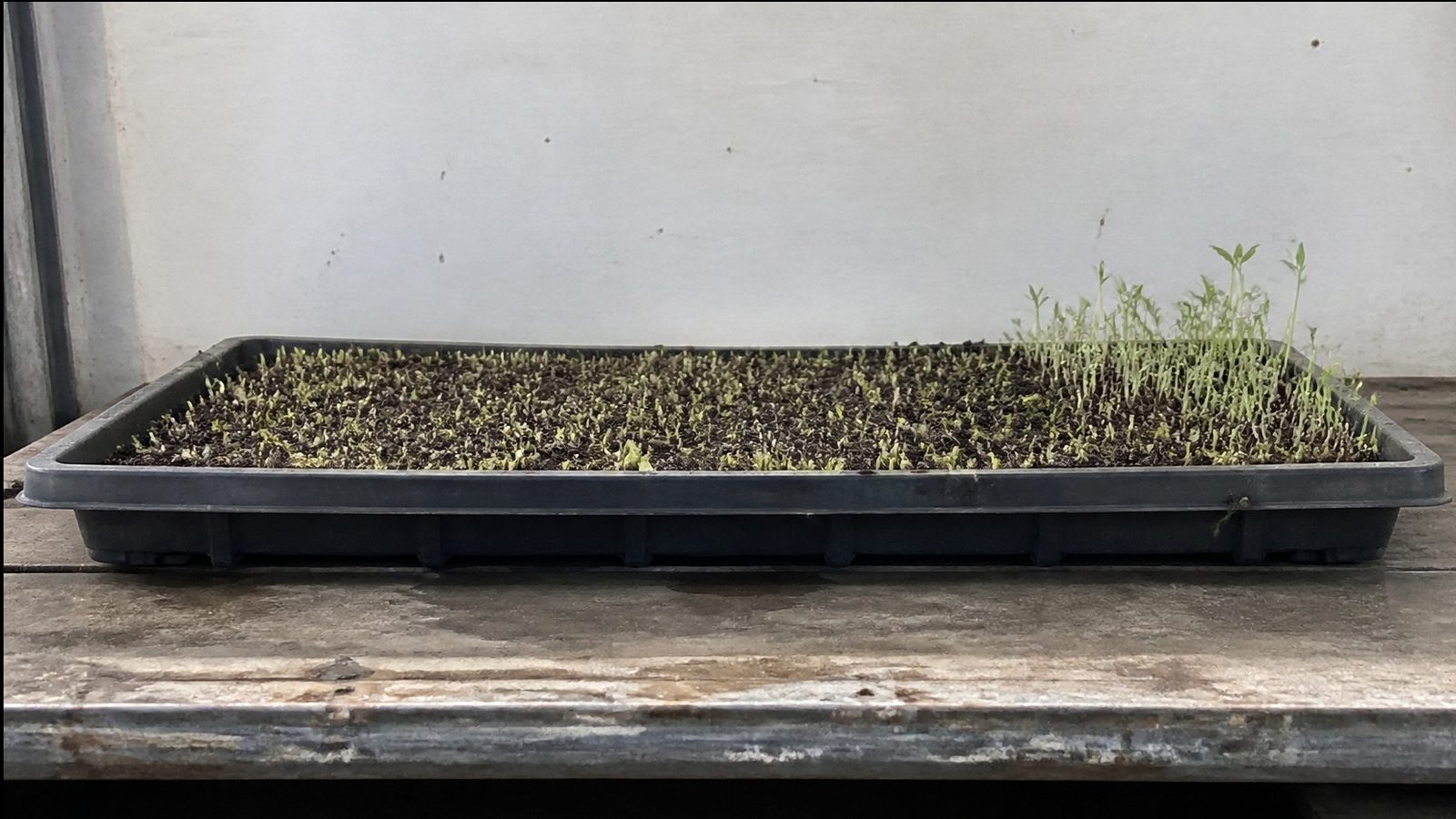
For almost anything cut at microgreen stage, no. Compost the tray and sow again. The bench space is worth more as a fresh crop than as a tray you are waiting on.
What decides it is what the cut takes away. A microgreen harvest goes in just above the medium, and that takes the growing point with it. Roots keep a plant fed and anchored, but they do not start a new shoot on their own. That has to come from a bud or a patch of growing tissue left above the cut, and on a low-cut broadleaf seedling there is usually nothing left to come from. Grasses survive mowing for the same reason in reverse: their growing tissue sits at the base, under the blade.
It is also why a tray that will not come back does not respond to more water. Water is not the input that is missing.
Crop by crop, the record is thinner than most growers expect. Of the 62 variety entries here, 26 carry a researched answer in the regrows field: 20 no, 5 partial, and one yes, which is chickpea shoots. The five partials are celery, nasturtium, pea shoots, purslane and wheatgrass.
Hover or tap a row to highlight it.
| Answer | Crops | Share |
|---|---|---|
| Unestablished | 35 | 56 percent |
| No | 20 | 32 percent |
| Partial | 5 | 8 percent |
| Yes | 1 | 2 percent |
| Not applicable | 1 | 2 percent |
The largest row is not an answer. Those 35 crops have not been tested either way, and they are not counted here as a no. So, the position to work from is that the mechanism above applies to any crop you cut low, 20 crops have that written down, chickpea shoots are the one clear exception, and the rest is open. If your crop is in the untested group and you want to know, the strip test below costs you one band of one tray to find out.
What to actually do
- Look up the crop before you plan a second cut. The regrow field here answers it for 26 of 62, and says yes to one.
- Treat a normal low-cut tray as one harvest. Brassicas, radish, sunflower and mixed trays are one-cut unless your own trial on your own cultivar says otherwise.
- Ask whether a node survived, not whether roots did. That is the question the plant is answering.
- If you want to try it, sacrifice a strip, not the tray. Cut one marked band high enough to leave a visible node and harvest the rest normally, so the experiment costs you a strip rather than a crop.
- Accept that a high cut costs first-cut yield. You are trading saleable product now for an unmeasured product later.
- Compare against a fresh tray sown the same day, not against nothing. A second cut only pays if it beats what that bench space would have grown from seed, and that is the comparison the question turns on.
- Count the tray-days. The one documented regrowth path takes 3 to 4 weeks against a median 11.5 day crop.
- Never sell a second cut on a schedule without your own records of saleable grams per tray-day and a customer who has accepted the uniformity.
- Do not water a tray to make it recover. If the growing point is gone, water is not the missing input.
Roots do not make a new shoot
A cut tray still has a full white root mat in it, and that is what makes the question feel open. The roots are alive and clearly doing something, so it seems reasonable that the crop should come back.
Roots take up water and anchor the plant. They do not ordinarily produce a replacement shoot. New growth has to come from a structure that can make one: a shoot meristem, or a node carrying a bud, sitting above the cut. A grass-type crop is the exception, because it can regrow from a basal or leaf-base meristem at or near ground level, which is exactly why a lawn tolerates mowing and a broadleaf seedling does not.
A normal microgreen harvest removes that structure. The cut takes the shoot tip, the stem, the cotyledons and any emerging true leaves, and what stays behind is roots and a short crowded stump. For a low-cut broadleaf seedling there is usually nothing left that is capable of growing.
So, the useful question after a harvest is not whether you left roots, it is whether you left a node. If you did not, the growing point is gone and watering cannot replace it. That is worth knowing before you spend a week keeping a finished tray wet and waiting.
The one documented case is not a microgreen
The clearest published evidence for regrowth is on pea shoots, and it is worth looking at because the plants are nothing like a tray of pea microgreens.
Washington State documents clipping the top 2 to 6 inches from plants already 12 to 18 inches tall and 6 to 8 weeks old, leaving the top leaf nodes behind. New vines then develop from those nodes, and the second harvest yields 2 to 3 shoots per plant against one at the first, after about 3 to 4 weeks.
Hover or tap a row to highlight it.
| WSU pea shoots | Microgreens | |
|---|---|---|
| Height at first cut | 12 to 18 in | 2 to 3 in |
| Age at first cut | 6 to 8 weeks | 7 to 21 days |
| What the cut leaves | The top leaf nodes | Usually nothing above the cut |
| Time to the next harvest | 3 to 4 weeks | A fresh sowing takes 7 to 21 days |
That plant is four to nine times taller and two to eight times older than a microgreen tray. What it demonstrates is node-mediated branching, which is a real mechanism and precisely the one a low cut removes.
The last row is the one that decides it. That regrowth takes 3 to 4 weeks, against a median microgreen crop of about 11.5 days, so waiting for a second cut ties the tray up roughly 1.8 to 2.4 times as long as growing a whole new crop from seed.
So, a second harvest is not free even when it works. It costs the bench time a fresh sowing would have used, which is why tray-days rather than trays is the unit to plan in.
How much a second cut actually yields
Nobody knows, and the figures you will find do not agree. No published trial has sown microgreen trays, cut them, re-cut the same trays and reported both harvests by weight, so there is no measured answer to quote.
Two grower figures circulate for peas. One puts the second harvest 70 to 80 percent below the first, leaving 20 to 30 percent; another puts it at about half. Those are a factor of two apart and neither describes a weighed, repeatable method. The WSU number people reach for is not a yield at all: it is shoots per plant, a count, and it does not convert into a percentage of first-cut mass.
Quality is in the same position. Growers describe second growth as more fibrous, tougher, more bitter, sometimes yellow or uneven, and that is consistent enough to take seriously as a warning. It has not been tested blind, measured for color, or compared for shelf life, so treat it as what to expect rather than as a specification.
If you have found both answers in print
You will, and neither source is being careless. UF and IFAS say some crops may give one additional small harvest. Mississippi State describes microgreen harvesting as a one-cut process.
Both statements are broad and neither publishes crop-by-crop measurements, which is how they can differ without either being wrong. Do not split the difference: the space between them is an untested question, not a middle value.
One related mix-up is worth heading off. "Cut and come again" is a real system, and it usually describes mature or baby-leaf production where the crown and nodes survive the cut. Salad mix harvested at three to five weeks is a different production system from microgreens cut at two to three weeks as close to the medium as possible. A lettuce that tolerates repeated cutting does not tell you what its cotyledon-stage microgreen will do.
When a source says a crop regrows, ask what age, what height, and which node was left. If it cannot answer, it is mixing systems.
Holding a cut tray is not a food-safety free pass
Between cuts the root mat and stubble stay wet for longer, and that is a real physical change.
Nobody has measured whether it raises risk. No study compares contamination in a first-cut tray against one held for regrowth.
What is established rules out the comforting assumption. A laboratory study found Salmonella, E. coli O157:H7 and Listeria monocytogenes transferring from contaminated seed or soilless substrate into 20 microgreen types, with recovered populations varying by organism and crop. A separate study found pathogens surviving differently across coir, peat and vermiculite, Biostrate and hemp over ten days.
Neither tests a second cut. Together they establish that a moist medium and a root mat are not automatically inert, which is enough to say that a clean-looking held tray is not safety-tested. See cleaning and sanitation.
Do not harvest around visible mold, an off odor or unexplained slime for sale. Discard the tray.
Where the evidence stops, and what to do about it
If you are deciding whether to try a second cut, these are the gaps that decide how much of it you are guessing at. None of them has been measured, so anything you read putting a number on them is practice rather than evidence, and the only figures you can rely on are the ones you record yourself.
- Second-cut yield as a percentage of the first, for any crop, from a weighed trial.
- Days to a second cut for a standard microgreen tray of any species.
- Any complete re-cut method at all, with seed weight, density, medium, environment, cut height and both harvests reported.
- Quality and shelf life of a second cut against a first, blinded.
- Whether holding a cut tray raises contamination, which needs a first-cut against held-tray comparison with inoculated and natural-background arms.
- Whether mold or damping off increases after a cut.
- Whether peas or legumes really give two or three cuts at microgreen stage, as opposed to on a six-week vine.
- A universal cutting height. "Cut one inch high" is folklore until it names the crop, cultivar, stage and node position.
- Whether it ever pays commercially, which needs saleable grams per tray-day against resowing.
Terms on this page
Tap a term to see what it means.
Growing point. The living region that produces new shoot growth. The thing a harvest either leaves or removes.
Sources
Opened 2026-08-11. The 62-crop tally was computed for this page from the regrows field across every variety entry here. The comparison between the documented 3 to 4 week regrowth and a fresh sowing uses this site's own median 11.5 day crop, from the daysToHarvest field. The two circulating yield figures are grower reports with no method published, and are presented as disagreeing rather than as a range.
- Washington State University, pea shoots (PDF) - clipping the top 2 to 6 inches from plants already 12 to 18 inches tall and 6 to 8 weeks old, leaving top leaf nodes from which new vines develop, a second harvest of 2 to 3 shoots per plant against one at the first, roughly 3 to 4 weeks to sufficient regrowth, the advice to check flavor and stop if it turns bitter, and shoots described as fragile and best used within 1 to 2 days.
- Oregon State University Forage Information System, regrowth - that documented grass regrowth comes from meristems at or near ground level, leaf-base intercalary meristems and basal buds, rather than from a severed leaf tip.
- University of Maryland Extension, growing microgreens and baby greens indoors - microgreens harvested at 7 to 21 days at cotyledon and emerging true leaf stage, against baby greens at 4 to 6 inches and 21 to 40 days and mature greens over 6 inches at 40 to 60 days.
- Penn State Extension, the ABCs of microgreens - the harvest stage and the cut above the medium.
- Penn State Extension, a step by step guide for growing microgreens at home - harvest treated as a cut near the medium with composting and resowing afterward.
- Iowa State University Extension, how to grow your own microgreens - harvest guidance to cut near the medium, that overwatering can lead to root rots and damping off, and watering from below to avoid wet foliage.
- University of Illinois Extension, growing microgreens (PDF) - harvest as a cut near the medium with a new crop started afterward.
- UF and IFAS Gardening Solutions, microgreens - that some crops may give one additional small harvest, and the standard cut near the medium.
- Mississippi State Extension, microgreens (PDF) - microgreen harvesting described as a one-cut process, which is the direct counterpart to the UF and IFAS position above.
- UMass Vegetable Management Guide, salad mix and microgreens - salad mix harvested at three to five weeks with some varieties regrowing, against microgreens harvested at two to three weeks as close to the soil as possible, and the note that repeat-harvest salad mixes can be less uniform and lower quality.
- Işık, Çetin and Topalcengiz, pathogen transfer to microgreens, 2024 - Salmonella, E. coli O157:H7 and Listeria monocytogenes transferring from contaminated seed or soilless substrate to 20 microgreen types, with recovered populations varying by organism and crop.
- Buehler and colleagues, pathogen survival on cultivation matrices, 2020 - pathogens surviving differently across coco coir, peat and vermiculite, Biostrate and hemp over ten days.
- Penn State Extension, ensuring food safety in microgreens production - that bacteria thrive in the moist warm conditions that also favor microgreen growth, that water, media and tools can introduce contamination, and that microgreens are commonly eaten raw.
- Practice sample, opened 2026-08-11 and used only as a record of what is claimed: On The Grow, the source of the 70 to 80 percent lower pea second yield; Seeds and Grain, the source of the about half figure and of reports of off-color and inconsistency; Home Microgreens, which lists lettuce, peas, cilantro, parsley, onions, leeks and celery as crops it has seen give a second harvest while warning it is slower and smaller, and reports more fibrous and more bitter regrowth; Wagner Greens, with the more modest position that second cuts are smaller, weaker and inconsistent; Biology Insights; Microveggy, the source of the claim that leaving one healthy leaf gives a good chance of regrowth; and Fern and Shelf.
Keep reading
Growing guides
How fast do microgreens grow? Take the number from your crop, not from a general range
Of the 61 microgreen crops that publish a harvest range, only 15 fit entirely inside the usual 7 to 14 days. The real spread is 4 to 35 days, and the shelf cost between the fastest and slowest crop is 36.6-fold.
Read How fast do microgreens grow? Take the number from your crop, not from a general rangeGrowing guides
Growing a mix: one blend has a one-day harvest window and another keeps for three days
One commercial brassica blend's five components overlap on exactly one harvest day, and a three-crop spicy blend keeps only 2 to 3 days because of its cress, while another component lasts 14.
Read Growing a mix: one blend has a one-day harvest window and another keeps for three daysGrowing guides
My microgreens are too short: telling a stunted tray from a naturally compact crop
Check the height against the crop before you treat it as a fault, because several crops simply finish short. If the tray is genuinely stunted, low light is the one cause it cannot be: too little light makes a tray taller.
Read My microgreens are too short: telling a stunted tray from a naturally compact cropGrowing guides
Day 8 against day 14: what you are actually trading by waiting
The largest yield gain in the harvest-stage literature is 80.1 percent. Divide it by the five extra days it cost and it is worth 5.1 percent. Nutrient concentration does not peak; some compounds rise, some fall, and nobody reports the total per tray.
Read Day 8 against day 14: what you are actually trading by waiting