Cleaning trays between crops: the sequence, and how long the sanitizer actually needs
Cal HewittPublished Checked
- sanitation
- food safety
- method
- mold
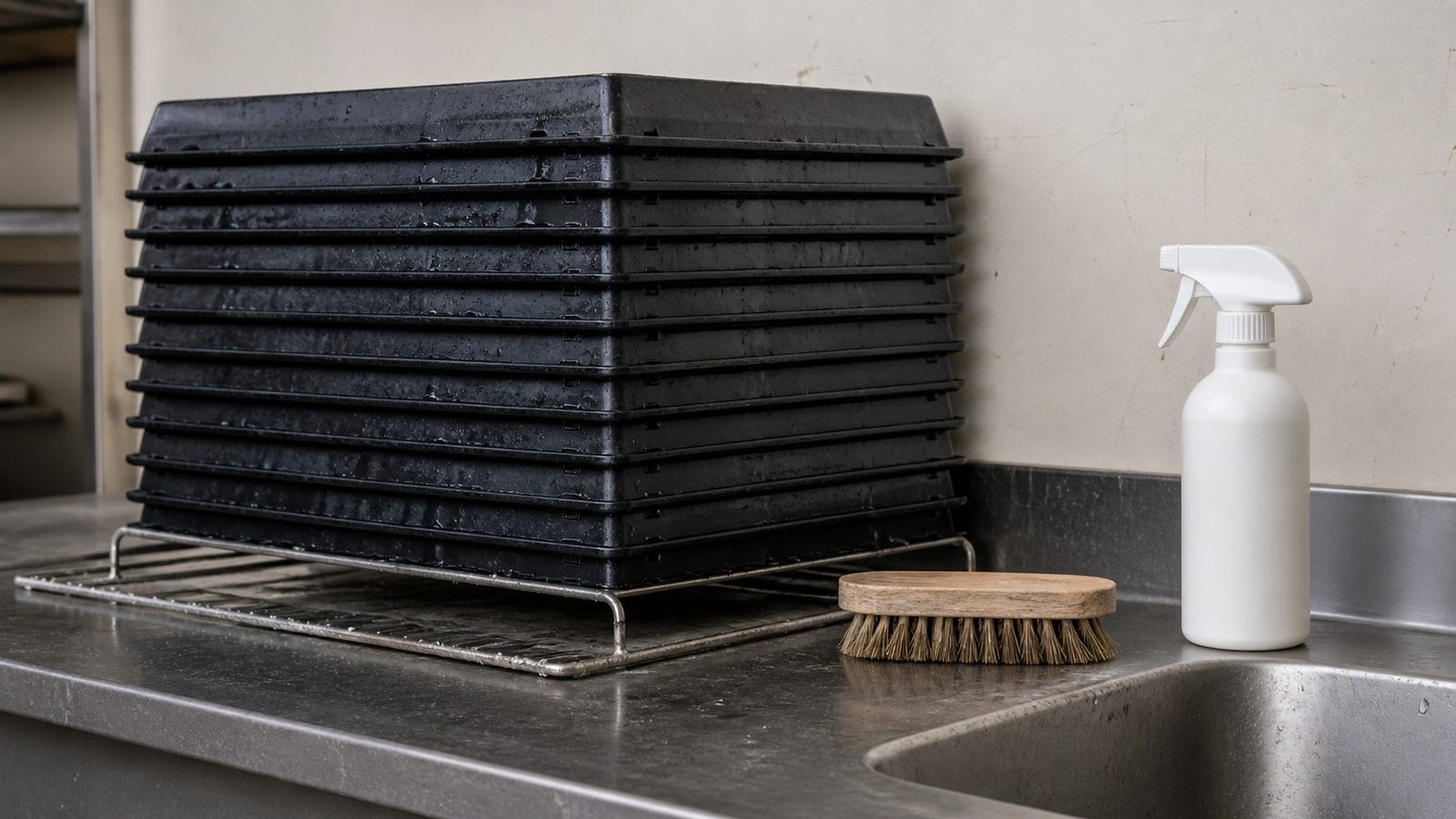
The sequence everybody publishes is correct. The numbers attached to it are not from where you would assume.
Empty the tray, scrape and rinse it, scrub it with detergent, rinse with potable water, then, if the tray touches the crop, apply a sanitizer labeled for food contact at its stated concentration, keep the surface wet for its stated contact time, and air dry. That is a defensible procedure and every authority agrees on the order.
What almost nobody states correctly is how long the wet contact time actually is.
What to actually do
- Empty it completely first. Medium, root mat, seed coats, everything. The chemical cannot reach what the debris is covering.
- Scrub with detergent, then rinse with potable water. Any detergent will wash a hard surface; one that contacts food has to be food safe.
- Use a product labeled for food contact sanitizing, at the concentration and wet contact time on that label. The label is the specification, not a web page and not this one.
- Buy chlorine test strips. They are the only way a spoon measure becomes a known concentration, and the Food Code requires a means of measuring. Check the range on the vial, because food service strips are sold at 0 to 200 ppm and also at 0 to 500 and above, and the higher scales read the doses here badly. Quat and QAC strips measure a different sanitizer and will not read bleach at all.
- Do not rinse after sanitizing. Air dry, unless that specific label tells you otherwise.
- Consider hot water instead. 171°F for 15 seconds sanitizes anything that will take it, with nothing to measure or rinse.
- Skip the vinegar. It is not a sanitizer, and mixing it with bleach is the one genuinely hazardous thing in this whole procedure.
- Replace scarred, cracked or permanently stained trays. A worn plastic surface does not come back, and no amount of extra soaking substitutes.
- If mold keeps coming back, stop escalating the tray protocol. Of everything on this list it is the one step with no evidence behind it for mold. Look at seed, moisture, density, humidity and airflow.
- If you sell, keep the log. Tray or area, date and time, product, measured concentration, label contact time, who did it, and anything corrected.
Seconds against minutes, and a gap of up to 170-fold
The FDA Food Code sets minimum wet contact times for manual warewashing, and they are short.
Hover or tap a row to highlight it.
| Sanitizer | Published condition | Minimum contact time |
|---|---|---|
| Chlorine | 50 to 99 mg/L at 75°F, pH 8 or less | 7 seconds |
| Chlorine | Other qualifying conditions | At least 10 seconds |
| Iodine | 12.5 to 25 ppm at 68°F or above | 30 seconds |
| Quats and other chemical sanitizers | Unless the label says otherwise | At least 30 seconds |
| Hot water immersion | At the required temperature | At least 30 seconds |
| Grower pages, bleach or 3 percent peroxide | Not stated | 10 to 20 minutes |
Ten to twenty minutes is 600 to 1,200 seconds. Against the 30-second general minimum that is 20 to 40 times longer. Against the 7-second chlorine figure it is 86 to 171 times longer.
A longer soak is not dangerous and this page is not telling anyone to hurry. The point is that the 20-minute number is not from the food code, is not on a product label, and no page recommending it says where it came from. If you believe you need 20 minutes, you are following a figure nobody sourced. The number that actually governs is the one on the bottle in your hand.
And a related figure worth knowing: hot water alone works. Minnesota gives 171°F for at least 15 seconds for heat sanitizing, which is an option for anything that will survive it and needs no chemical at all.
Which bleach strength, and for which job
There is no single correct bleach strength, because the published figures are for different jobs.
Hover or tap a row to highlight it.
| Source | Concentration | The job it is specified for |
|---|---|---|
| FDA Food Code, manual warewashing | 50 to 99 mg/L | The minimum that qualifies for the 7-second contact time |
| Minnesota Extension, harvest tools and containers | 50 to 150 ppm | Cleaning harvest tools and produce containers |
| Minnesota Extension, small scale hydroponics | 150 to 200 ppm | Sanitizing a growing system |
| FDA, via Virginia Tech | 200 ppm | The no-rinse ceiling on a food contact surface |
Across those, chlorine for food contact runs 50 to 200 ppm, a fourfold span, and the right end of it depends on what you are cleaning.
So, pick your dose by the job in front of you. For a growing system, Minnesota gives 150 to 200 ppm, about a tablespoon of unscented 5.25 to 6 percent bleach per gallon, and that is the figure on reusing medium and trays. For harvest tools and containers it gives a weaker one, 50 to 150 ppm, 2 teaspoons per gallon yielding 100 to 175 ppm. Same university, two jobs, two doses, and neither is wrong.
What the pair actually demonstrates is that a spoon cannot land you on a number. A tablespoon is exactly one and a half times two teaspoons, yet household bleach is itself sold at anywhere from 5.25 to 6 percent, so one spoon measure covers a wide band of real concentrations. That is why the Food Code requires a test kit or device to measure the concentration, and why both Minnesota pages say to verify rather than to trust the spoon. Chlorine test strips cost very little and they are the difference between a procedure and a ritual.
Two things not to move across. Minnesota's up-to-three-hour figure is a flush for a recirculating system, not a tray soak time, so do not apply it to a stack of 1020s. And the FDA no-rinse rule cuts both ways: after cleaning and sanitizing you do not rinse again before air drying, unless that specific product's label tells you to.
Vinegar is not a sanitizer, and most guidance agrees
Minnesota Extension says plainly that vinegar does not adequately sanitize surfaces. It can act as a cleaner or a descaler. It is not a validated food contact sanitizer and no source located makes it one.
Expect the guidance you find to get the sequence right and the specifics loose. Across the pages that come up for this question, all of them prescribe an antimicrobial step after washing and most tie it to mold, but fewer than half state both a concentration and a contact time. You will see 3 percent peroxide for 10 to 20 minutes and bleach at about 200 ppm for the same; peroxide diluted 1 to 10 for 10 to 15 minutes and a 1 to 1 vinegar solution for 15 to 20; and several that give an amount with no contact time, or neither. When a page gives you one without the other, use the label on your bottle.
Ordinary drugstore 3 percent peroxide is a separate question from a peroxide product labeled for food contact, and the two are not interchangeable. Peroxyacetic acid and hydrogen peroxide are real food contact actives when they arrive in a registered, labeled product. A brown bottle from the pharmacy has no food contact label and has not been validated for this.
Two shelf-life points the grower community gets right, and they matter more than the soak time. A mixed bleach solution loses strength within about a day, so a jug mixed last week is not the concentration written on it. And peroxide breaks down in light, which is the whole reason it is sold in a brown bottle: decanted into anything clear it degrades. Mix chlorine fresh, keep peroxide in its own bottle, and treat any stored dilution as unknown until a strip says otherwise.
And never mix cleaners, bleach with acids or with ammonia in particular. Both the CDC and Minnesota warn about it, and vinegar is an acid.
What a proper clean actually achieves on worn plastic
Cleaning must come before sanitizing, and the reason is mechanical rather than procedural. Soil, root fragments and seed coats physically block the chemical from the surface and consume the active as it arrives. The CDC states that dirt makes it harder for sanitizing chemicals to work, and the Food Code requires organic material to be removed first. Sanitizer is not a substitute for a brush.
Now the number that puts the whole subject in proportion. For food contact use, the efficacy standard a sanitizer is held to is a 5-log reduction, 99.999 percent.
In a 2008 study of 15 commercial plastic cutting boards, proper cleaning and sanitizing moved average aerobic plate counts from 1.31 x 10⁴ to 1.35 x 10³ CFU per 25 cm², about a 0.99-log reduction. Heavily scarred and discolored boards could still support biofilms afterward.
Those two figures measure different things and the difference is the lesson. The 5-log standard is what a product must achieve against a test organism in a laboratory. The 1-log result is what happened on fifteen real, worn boards in service. A worn plastic surface is not reprocessed back to new, which is why the correct response to a scarred, cracked or permanently discolored tray is to replace it rather than to scrub harder or soak longer.
Cutting boards are not microgreen trays, and this is transferable evidence about worn plastic rather than a measurement of anything in a grow room. Nobody has characterized what is actually on a used microgreen tray, by mass or by microbial composition.
Nobody has tested whether any of this prevents mold
If you are cleaning trays to stop mold coming back, know that nobody has tested whether it works.
No completed controlled study changes only tray sanitation and reports what happened to the crop. Not microbial load on the harvested greens, not visible mold, not yield, not failure rate.
The gap is a recognized one rather than an obscure corner. A USDA and NIFA project description for West Virginia State University proposed exactly this experiment: three production cycles, tray biofilm, edible-part microbial analysis, including an arm with trays that were not washed or sanitized at all. The public page supplies methods, not results.
So, the position to take is a narrow one. Cleaning and sanitizing trays is well supported as food safety hygiene, with a documented mechanism and a regulatory framework behind it. It has never been shown to cure or prevent microgreen mold, so do it for the food-safety reason and look elsewhere for the mold.
Which matters practically, because a grower with a recurring mold problem who keeps escalating the tray protocol is working on the one variable with no evidence behind it. Extension guidance for microgreens specifically names seed as a pathogen source, and names growing temperature and humidity, water, substrate, handling and harvest practice as the routes. Check mold or root hair first to confirm what you are actually looking at, then temperature and airflow, watering, seed density and the seed itself. No published work ranks those against tray hygiene.
Which surfaces this even applies to
A food contact surface is one that food normally touches, or that food can drain, drip or splash from into food or onto another food contact surface.
- The inside of the growing tray is one, because the crop sits on it.
- A humidity dome is one, because condensate drips off it onto the crop.
- A rack shelf becomes one if a tray or condensate above it can drip into an edible product, and otherwise it is a non-food-contact surface that still has to be kept clean.
- Knives, scissors and harvest containers plainly are. Hard, non-porous tools are easier to clean and sanitize than anything textured, which is a real reason to choose them.
FDA has not published a microgreen-specific classification of every tray, dome and rack arrangement, so the conservative reading above is an application of the definition rather than a ruling.
On whether any of this is legally required, microgreens harvested above the substrate without roots sit outside the sprout-specific part of the Produce Safety Rule but remain covered produce unless an exemption applies, and covered farms keep cleaning and sanitizing records. The thresholds and the record keeping, including why the coverage figure is not the same number as the traceability rule's, are set out in microgreens under the FDA Produce Safety Rule. Being under a threshold removes a federal duty, not the reason for the procedure.
Single use against reusable is not a safety ranking. The Food Code says single-use articles may not be reused and that reusable equipment must be cleanable, in good repair, and properly reprocessed. That is a food service rule. No microgreen comparison of new trays against correctly reprocessed ones exists for pathogen transfer, mold or illness, so decide on cleanability, wear, whether you can actually verify your process, and cost.
What nobody has measured
- Whether tray sanitation changes anything about the crop. No study varies it alone and measures harvested microbial load, mold, yield or failures.
- What is actually on a used microgreen tray, by mass or by microbial composition.
- A validated tray washing specification: detergent, temperature, soil load, concentration and contact time, tested on real trays with a crop outcome.
- Whether ordinary 3 percent peroxide works as a no-rinse tray sanitizer. It has never been tested against a labeled product for this.
- New trays against correctly reprocessed ones, on any endpoint.
- Biofilm on microgreen trays specifically, across repeated wash and sanitize cycles.
- Any ranking of tray hygiene against airflow, water, density or seed as a cause of mold, which is exactly what a grower with a recurring problem needs and cannot get.
Terms on this page
Tap a term to see what it means.
Cleaning. Physically removing soil, organic matter and many microbes, using detergent, water and scrubbing.
Sources
Opened 2026-08-11. The contact-time comparison is arithmetic on the Food Code minimums against the times stated by the grower pages listed below, and both sides are shown so it can be checked. That practice sample is five pages returned for three named searches on that date, not a census of the web. Each chlorine figure names the Minnesota page it comes from, because the two figures are for two different jobs.
- FDA, 2022 Food Code (PDF) - the food contact surface definition, the requirement to clean before sanitizing, chlorine at 50 to 99 mg/L at 75°F and pH 8 or less for 7 seconds, other qualifying chlorine conditions at 10 seconds, iodine at 12.5 to 25 ppm at 68°F or above for 30 seconds, other chemical sanitizers including quats at 30 seconds, hot water immersion at 30 seconds, the requirement for a test kit or device to measure concentration, the instruction not to rinse after sanitizing before air drying, and the single-use and reusable equipment rules.
- University of Minnesota Extension, cleaning and sanitizing tools, harvest containers and surfaces - the rinse, detergent wash, potable rinse, sanitize and air dry sequence, weak bleach solutions of 50 to 150 ppm for harvest tools and containers, the household mix of 2 teaspoons of unscented 5.25 to 6 percent bleach per gallon yielding 100 to 175 ppm with the instruction to verify with strips, and the statement that vinegar is not an acceptable sanitizer.
- University of Minnesota Extension, sanitizing equipment and food contact surfaces - the 5-log meaning of sanitizing for food contact, the product classes of peroxyacetic acid, iodophors, quats, chlorine and hot water, hot water at 171°F for at least 15 seconds, and the dependence of every figure on the product label.
- CDC, cleaning and disinfecting - the 2025 definitions separating cleaning, sanitizing and disinfecting, that dirt and impurities make it harder for chemicals to kill germs, and the warning against mixing cleaners.
- EPA, what are antimicrobial pesticides - sanitizers defined as reducing rather than eliminating organisms on inanimate surfaces, disinfectants as destroying or irreversibly inactivating infectious fungi and bacteria but not necessarily spores, and the food contact against non-food-contact distinction.
- EPA, food contact sanitizer label requirements - that a food contact sanitizer label must state wetting, contact time and whether and how to remove the solution afterward.
- University of Nevada Reno Extension, microgreens and produce safety, 2020 (PDF) - microgreen-specific guidance to establish cleaning and sanitizing procedures for food contact tools, harvest containers and equipment, hard non-porous tools as easier to reprocess, and seed handling, growing temperature and humidity, harvest practice and raw consumption named as the key food safety challenges with seed identified as a pathogen source.
- USDA and NIFA project description, West Virginia State University - a proposed three-cycle microgreen tray and biofilm experiment with edible-part microbial analysis, including trays with no washing or sanitizing. Methods only. This is the evidence that the question is a recognized open objective rather than merely an unsuccessful search.
- Neth, Girard and Albrecht, plastic cutting boards, 2008 - 15 commercial plastic cutting boards with average aerobic plate counts falling from 1.31 x 10⁴ to 1.35 x 10³ CFU per 25 cm² after proper cleaning and sanitizing, about a 0.99-log reduction, and heavily scarred or discolored boards still supporting biofilms.
- FDA, FSMA frequently asked questions - that microgreens harvested above the substrate without roots are not subject to the sprout-specific Subpart M but remain covered produce, the Subpart L treatment of equipment and tools, and the cleaning and sanitizing records at 21 CFR 112.140(b)(1) and (2).
- FDA, exemptions relevant to produce farms - the $25,000 coverage threshold, adjusted for inflation to $34,324 for 2023 to 2025 (FDA inflation-adjusted cut-offs), and the qualified exemption framework, which carries modified requirements rather than removing them.
- FDA, FSMA inflation adjusted cut-offs - the currently posted adjusted figures, set out in full on the Produce Safety Rule page linked above, along with the distinction from the traceability rule.
- Practice sample, audited 2026-08-11 and used only as a record of what is being recommended: On The Grow, the source of 3 percent peroxide for 10 to 20 minutes and bleach at about 200 ppm for 10 to 20 minutes, which also promotes its own reusable medium; Vegbed, the source of peroxide at 1 to 10 for 10 to 15 minutes and 1 to 1 vinegar for 15 to 20 minutes, which markets its own grow mats as reducing mold risk; Home Microgreens, amounts without a surface contact time; Microgreen Shop, a peroxide spray with no concentration or time; and HerbSpeak, a diluted vinegar recommendation with neither.
Keep reading
Growing guides
Can you reuse the medium? Reuse clean loose coir, replace the mat, never reuse a failed tray
Reuse loose coir or peat off a clean tray, screened and refreshed half with new mix, and throw fiber mats away. Reuse itself has never been tested, and the one pathogen study covers 4 of the 12 materials an extension service names.
Read Can you reuse the medium? Reuse clean loose coir, replace the mat, never reuse a failed trayGrowing guides
Watering a tray: how much, how often, and what overwatering actually means
Overwatering is blamed for more failed trays than anything else in this category and has no numerical definition anywhere. The published volumes disagree by four times, and the reason is the medium: hemp holds nearly three times as much water per gram as coir does.
Read Watering a tray: how much, how often, and what overwatering actually meansGrowing guides
Do microgreens need fertilizer? It is worth 8 to 47 percent of the yield and up to 227 times the nitrate
In one peat trial, taking the feed away cost cabbage 7.9 percent of its yield and arugula 47.4 percent, while cutting nitrate in the cut crop by 98 to 227 fold. Feeding is the largest lever anyone has measured on either number.
Read Do microgreens need fertilizer? It is worth 8 to 47 percent of the yield and up to 227 times the nitrateThe journal
Four Bags Labeled Kale, Two Species and a 227 Percent Price Gap: How Microgreen Seed Actually Gets Named
Federal law makes a seed packet state its kind and variety, not its species. One catalog's four kale microgreen listings span two different species and $25.73 to $84.25 a pound.
Read Four Bags Labeled Kale, Two Species and a 227 Percent Price Gap: How Microgreen Seed Actually Gets Named