Temperature, humidity and airflow: run the room at 70°F and it suits 39 of 44 crops
Cal HewittPublished Checked
- temperature
- humidity
- airflow
- method
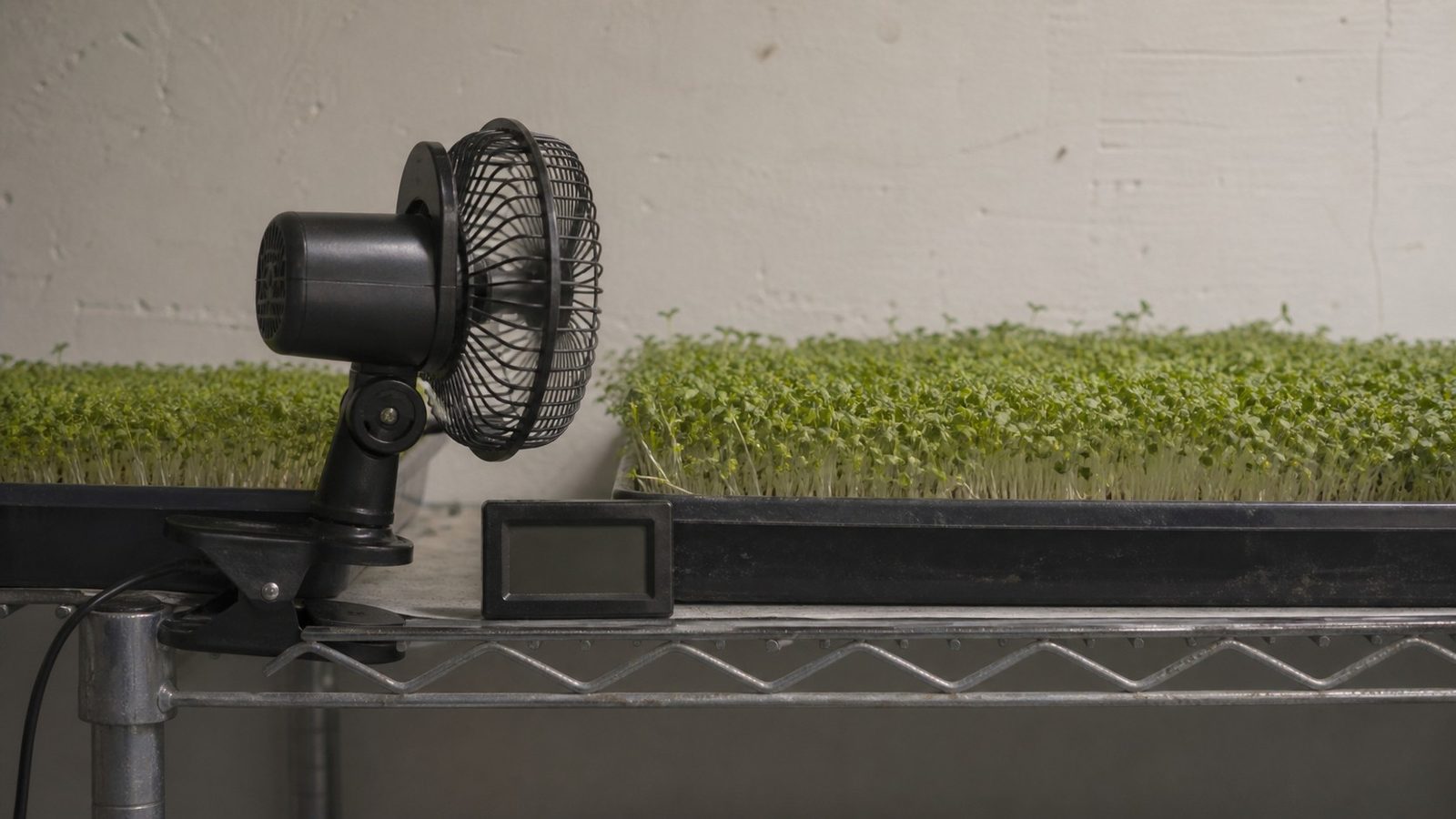
Set one temperature and it will suit almost your whole bench: 39 of the 44 published germination ranges land on a single number. Humidity and airflow are the two settings with no dose attached, and it is worth knowing which of the three you can actually dial in.
None of the extension, research or grower sources checked for this page gives an air speed at the canopy, a fan size for a shelf, or any airflow threshold tied to mold. The one airflow figure in circulation is a room-extraction calculation, covered below. So, use a fan for what it actually does, which is real even though the dose is missing.
The three settings, in short:
- The two extension services that publish a temperature band do not agree, and their bands do not overlap. Tested against the 44 crops with a published germination temperature, only 7 fit inside one band and only 3 fit inside the other. But 39 of the 44 contain 70°F, which is exactly where the two recommendations touch.
- The humidity instruction reverses halfway through the crop, and only the second half has a number. High humidity is the point of the cover; after the cover comes off it becomes the problem.
- Airflow has no published figure anywhere. Greenhouse ventilation numbers exist, they are real, and applying them to one tray on a shelf is a category error.
What to actually do
- Use the crop's own germination temperature from its entry when you are growing one thing. It is sourced per crop and beats any general band.
- Run the room at about 70°F when you are growing several crops at once. As of 2026-08-12 that is inside the published range for 39 of the 44 crops that have one, and it is the single point both extension services endorse.
- Stop chasing a narrow band. A room drifting between about 65 and 72°F is inside the published range for most crops.
- Treat the cover as a humidity device with an end date. Vent it, and take it off as emergence begins rather than on a fixed day.
- Aim for 50 to 70% humidity once the cover is off, which is the only published target and matches what surveyed growers actually run.
- Buy a thermometer and hygrometer and put them next to the trays, not on the far wall. Virginia Tech says checking them daily is adequate monitoring.
- Water the medium, not the canopy, and use bottom watering where you can, so leaf surfaces are not wet for hours.
- Add gentle indirect air movement across the space. Along the shelf, not at the crop. Then go and check the back and bottom trays, which is where stale wet pockets actually form.
- Do not treat a fan as a mold treatment. It changes the conditions that favor disease. It does not cure one.
The temperature answer, and where the two services disagree
Two extension services publish a working temperature for this crop, and they do not match.
- Virginia Cooperative Extension gives a general production recommendation of 60 to 70°F, or 16 to 21°C.
- University of Maryland Extension says microgreens germinate and grow well at 70 to 75°F, or 21 to 24°C, and notes cabbage-family crops germinating in about 36 hours at 72°F.
Those bands touch at a single point and share no interior. Neither is wrong. They are institutional recommendations written for different purposes, Virginia Tech describing a production setting and Maryland combining germination and growth in one sentence, and no shared experiment sits underneath either one.
Both can be tested, because each crop publishes its own sourced germination temperature rather than sharing one number for the category. As of 2026-08-12, 44 of the 62 crops carry a published range and 18 do not.
Hover or tap a row to highlight it.
| The band | Crops fitting entirely inside it | Crops whose range includes it at all |
|---|---|---|
| Virginia Tech, 60 to 70°F | 7 of 44 | 40 of 44 |
| Maryland, 70 to 75°F | 3 of 44 | 43 of 44 |
Read that as a verdict on the framing rather than on either service. A band that only 7 of 44 crops sit inside is not describing what the crops want. It is describing a room.
The useful question is not which band to pick but which single temperature satisfies the most crops, and that has an answer:
One number, tested against 44 published crop ranges
Hover or tap a card to highlight it.
39 of 44 crops include 70°F
More than any other temperature tested. At 65°F it is 35 crops, and at 72°F it is 34.
Which is where the two recommendations meet
70°F is the top of Virginia Tech's band and the bottom of Maryland's. The one number both services endorse is also the one the crop data supports.
And 5 crops sit outside it
Basil and bulls blood beet are published at a flat 75°F, sesame at 73 to 77 and thyme at 72 to 82, all wanting it warmer. Endive at 60 to 68 is the only one wanting it cooler.
Take the per-crop figure when you have one. Every crop entry here carries its own germination temperature with the source attached, and that number beats any general band for a crop you have actually chosen. The 70°F figure is what to do when you are growing several crops in one room and cannot give each its own.
One qualification on that 70°F. The 39 of 44 count covers only the crops with a published range at all, and 18 have none. For two of those, Colorado State publishes a soil temperature maximum of 70°F for pea and for spinach, and says high maximums can interfere with germination. So, a room held at 70 is comfortable for most brassicas and sitting at the ceiling for pea and spinach. If those are the trays failing in a warm room, the temperature is a real suspect, and reading a failed tray covers how to tell.
Your crops tolerate more than either band suggests
The other thing the 44 ranges show is that the published tolerances are wide.
- The median published range spans 10°F, and the mean is 10.3.
- Across the whole directory the ranges run from a low of 50°F (lettuce, whose seed goes spotty below that) to a high of 85°F (beet and leek).
- 38 of the 44 ranges are wider than Maryland's entire 5 degree band.
So, you do not need to hold a room inside a narrow window. A kitchen that drifts between 65 and 72°F across a day is inside the published range for the large majority of what you could grow in it. Chasing a two degree target with a heater is solving a problem the seed does not have.
What the temperature genuinely changes is speed and disease pressure, not viability. Maryland's 36 hours at 72°F for the cabbage family is a real benchmark for how fast germination happens when it is warm. And the University of Minnesota Extension is direct that damping-off pathogens thrive in cool, wet conditions, listing cool soil among the conditions associated with more of it, which is why the low end of a range is riskier than the number alone suggests. Minnesota recommends 70 to 75°F soil and 68 to 77°F water for indoor seedlings generally.
Nobody has published a microgreen cold threshold or a loss per degree. How many extra days, how much yield and what quality change you get from a colder room is unmeasured on this crop.
Humidity: a number for the second half only
The instruction reverses partway through the crop.
Early, the seed needs water. Maryland recommends covering after sowing specifically to trap warmth and humidity, and misting for the first few days. The cover is a humidity device, and that is its job.
After emergence, dense seedlings and a wet medium keep adding water vapor to a small volume of air, and a canopy that stays wet is what disease wants. So, the same humidity that was the goal becomes the hazard.
Only the second half of that has a published number. Virginia Tech gives 50 to 70% relative humidity for open growing conditions, and says a thermometer and hygrometer checked daily are adequate monitoring.
No opened source publishes an RH target inside a covered tray. Not a range, not a maximum, not a venting trigger expressed as a number. Maryland's instruction is to vent covers periodically so moisture does not encourage mold, which is a method and not a measurement.
That gap has a practical consequence. There is no in-tray humidity figure to vent to, so follow Maryland's method instead: vent the cover periodically, and take it off as emergence begins.
What real operations run is close to the published band. A 2021 survey of 33 growers who reported all three environmental variables found:
Hover or tap a row to highlight it.
| Setting | Mean relative humidity | Growers |
|---|---|---|
| Climate-controlled greenhouse | 65.8% ± 9.7 | 6 |
| Indoors, commercial | 60.0% ± 0 | 3 |
| Indoors, residential | 51.3% ± 12 | 24 |
Those are operating conditions, not proven optima. The authors summarize the observed range as 50 to 65%, which sits inside Virginia Tech's recommendation. It is worth knowing that most of that sample is residential and running at the bottom of it, apparently without disaster.
Why air movement is the thing that connects them
Temperature and humidity are not two independent dials. They are linked through dew point, and that link is the whole reason a fan is in the conversation.
Cool air holds less water. At a fixed amount of water in the air, dropping the temperature raises the relative humidity, and if a surface falls below the dew point, liquid water condenses on it. A leaf can be cooler than the room around it, which is why a comfortable room humidity reading does not prove the crop is dry.
That is the condition disease wants. UConn Extension puts numbers on it for Botrytis in greenhouse crops: spore germination and infection commonly need a moisture film for 8 to 12 hours, 93% humidity or above, and 55 to 65°F, with colonization continuing up to 70°F.
Air movement has four jobs, and none of them is drying the crop out:
- Mixing humid canopy air with drier room air, so the microclimate at the leaf is closer to the room than to a swamp.
- Keeping surfaces above dew point, which prevents the condensation that starts the 8 to 12 hour clock.
- Supporting transpiration, which is how water and nutrients move through the plant. The University of Arkansas explains that very low vapor pressure deficit means little evaporation and can impair that movement, while very high deficit pulls water out faster than the plant takes it up.
- Evening out temperature and humidity across a rack, so the back and bottom trays are not a different climate from the front.
All four are well supported as mechanisms in greenhouse and hydroponic guidance. None of them has been demonstrated on a microgreen tray with a measured air speed.
The airflow number does not exist, and the greenhouse numbers are not it
No opened study increased airflow while holding temperature, humidity, seed density, watering and pathogen pressure constant, then measured mold. There is no microgreen figure for air changes per hour, canopy air speed, fan size per shelf, direction or duty cycle. Research papers describing plant-factory experiments say only "fans," or "two fans, at roof and ground," with no velocity at the crop.
Greenhouse ventilation numbers do exist and they are not transferable. UF/IFAS gives a winter minimum of 2 to 3 air changes per hour and a summer minimum of one air change per minute, with fan capacity calculated from the whole building volume. A building's air changes and the breeze over one tray are different quantities. Sizing a clip fan from a greenhouse figure is not conservative, it is meaningless.
The one microgreen page that does publish an airflow calculation does not reconcile with itself. It proposes exchanging a room every 3 to 5 minutes and then works an example of 1,188 cubic feet times 2, giving 2,376 CFM. Those two claims describe different rates. Treat it as unvalidated practice.
What practice does agree on, without measurement, is direction. Grower and retailer guides consistently advise gentle indirect circulation across the space rather than a fan aimed at the crop, and report that direct flow dries the medium unevenly and pushes light seedlings over. Those are sensible warning signs from people who grow, and they are not measurements.
So, here is what you can do. Use a fan to stop persistent surface wetness and stale pockets. Point it along the shelf and not at the tray. You cannot claim to have reached a published "enough airflow" threshold, because there is not one.
What a fan cannot fix
There is no such thing as a low mold risk microgreen. Of the 59 crops carrying a mold risk rating on 2026-08-12, 30 are rated High and 29 Medium, and not one sits below Medium. Those are operational judgments rather than a measured ranking, but the shape is worth taking seriously: mold pressure is the normal condition of this crop, not an unlucky one.
And a pathogen in the tray is not an environment problem. The one controlled microgreen disease experiment here inoculated arugula, kale, radish and mustard with Pythium. Infected plants in one system were at least 28% smaller, and inoculated arugula and mustard in trays lost 74.4% of shoot dry weight. That is what an actual infection does. No fan setting was tested against it, and no fan would have been the answer.
So, when a tray shows spreading fuzzy growth, rotting stems or a sour smell, that is a disposal decision and not a ventilation adjustment. Isolate it, do not sell it or eat it, and clean the tray. Before you conclude anything, check whether you are looking at mold or root hairs, because the most common mold panic in this crop is not mold.
What nobody has measured
- Any air speed at a microgreen canopy, tied to any outcome. Not one figure exists.
- A humidity level inside a covered tray, at any point, under any cover.
- A separate post-emergence temperature, as distinct from a germination temperature, for any crop.
- A cold threshold or a loss per degree on this crop.
- Whether a fan prevents mold, as opposed to whether air movement reduces condensation, which is established in greenhouses and assumed here.
- Which condition fails first in an ordinary tray outbreak: temperature, humidity, standing water, sowing density or air.
- Anything at all for the 18 crops that carry no published germination temperature.
Terms on this page
Tap a term to see what it means.
Relative humidity. How much water vapor the air holds as a percentage of the most it could hold at that temperature. It changes when temperature changes even if the water content does not.
Sources
Opened 2026-08-11 and 2026-08-12. The per-crop germination temperatures and mold risk ratings are sourced individually on each crop's entry and recounted for this page on 2026-08-12.
- Virginia Cooperative Extension, introduction to microgreen production in indoor vertical farms and greenhouses - the 60 to 70°F production recommendation, the 50 to 70% humidity range, and the thermometer and hygrometer monitoring advice.
- University of Maryland Extension, growing microgreens and baby greens indoors - the 70 to 75°F figure, cabbage-family germination in about 36 hours at 72°F, the cover-to-trap-humidity instruction, periodic venting, and moist rather than saturated medium.
- University of Minnesota Extension, how to prevent seedling damping off - damping-off pathogens favoring cool wet conditions, the symptom sequence, and the 70 to 75°F soil and 68 to 77°F water figures for indoor seedlings.
- UConn Extension, Botrytis blight on greenhouse crops - the 8 to 12 hour moisture film, 93% humidity and 55 to 65°F infection conditions, colonization to 70°F, and the condensation and air-mixing mechanism. Revised 2024, and greenhouse evidence rather than microgreen evidence.
- University of Arkansas, greenhouse cooling systems - vapor pressure deficit, and what happens at both extremes of it.
- Virginia Cooperative Extension, hydroponic production of edible crops - circulation reducing cool high-humidity spots, and its effect on transpiration and nutrient movement.
- UF/IFAS, greenhouse ventilation - the definition of an air change and the winter 2 to 3 per hour and summer one per minute greenhouse minimums, calculated from building volume.
- Food Protection Trends, characterization of microgreen growing operations and associated food safety practices, 2021 - the survey of 33 growers reporting all three environmental variables, with the humidity means by setting quoted above.
- McGehee and colleagues, 2019, Pythium in microgreens - inoculation of arugula, kale, radish and mustard, infected plants at least 28% smaller, and the 74.4% shoot dry weight reduction in tray-grown arugula and mustard. Abstract record.
- Frontiers in Sustainable Food Systems, indoor vertical farming of microgreens review, 2026 (PDF) - the laboratory conditions reported across experiments, including 22 ± 1°C and 65 ± 5% humidity with unspecified "fans," and the differing harvest days by crop at one shared condition.
- Virginia Tech thesis, seed density and other factors in burlap-grown microgreens - background statement that humid conditions and dense sowing are common microgreen disease problems and that circulation can help. Literature background rather than an experiment.
- Grower and retailer guides used as practice only: Microgreens World on airflow, which supplies the unreconciled 3 to 5 minute exchange and 2,376 CFM example, Deliseeds on mold, Wind River Greens and HatchiSeeds on whether fans are required.
Keep reading
Growing guides
Growing microgreens year round: what actually changes indoors between summer and winter
At the same outdoor temperature, measured indoor temperatures across 327 homes spanned 8 degrees Celsius in summer and more than 10 in winter. Three of six year-round guides never mention room temperature at all.
Read Growing microgreens year round: what actually changes indoors between summer and winterThe test bench
Thermometers and Hygrometers for Microgreens: One for the Medium, One for the Room
Temperature has to be read in the medium at seed depth. Every instrument sold for the job reads air, and of ten product pages opened, exactly one publishes where its sensor actually sits.
Read Thermometers and Hygrometers for Microgreens: One for the Medium, One for the RoomGrowing guides
Outdoors and under glass: the tunnel is hottest exactly when you need it coolest
A high tunnel has been recorded at 120 to 140F in March and April and near 0F overnight in January, against a recommended 64 to 75F band. Ventilation cannot cool the air below what is outside.
Read Outdoors and under glass: the tunnel is hottest exactly when you need it coolestThe test bench
Fans for Microgreens: Buy a Small Clip Fan, and Check the Watts Not the CFM
Nobody makes a fan for microgreens. The only airflow figure ever published for this crop would take 4.1 of the biggest clip fan here, or 11.7 duct fans. The anemometer that would settle it costs less than the fan.
Read Fans for Microgreens: Buy a Small Clip Fan, and Check the Watts Not the CFM