Nothing came up: reading a failed tray instead of guessing at it
Cal HewittPublished Checked
- troubleshooting
- germination
- seed
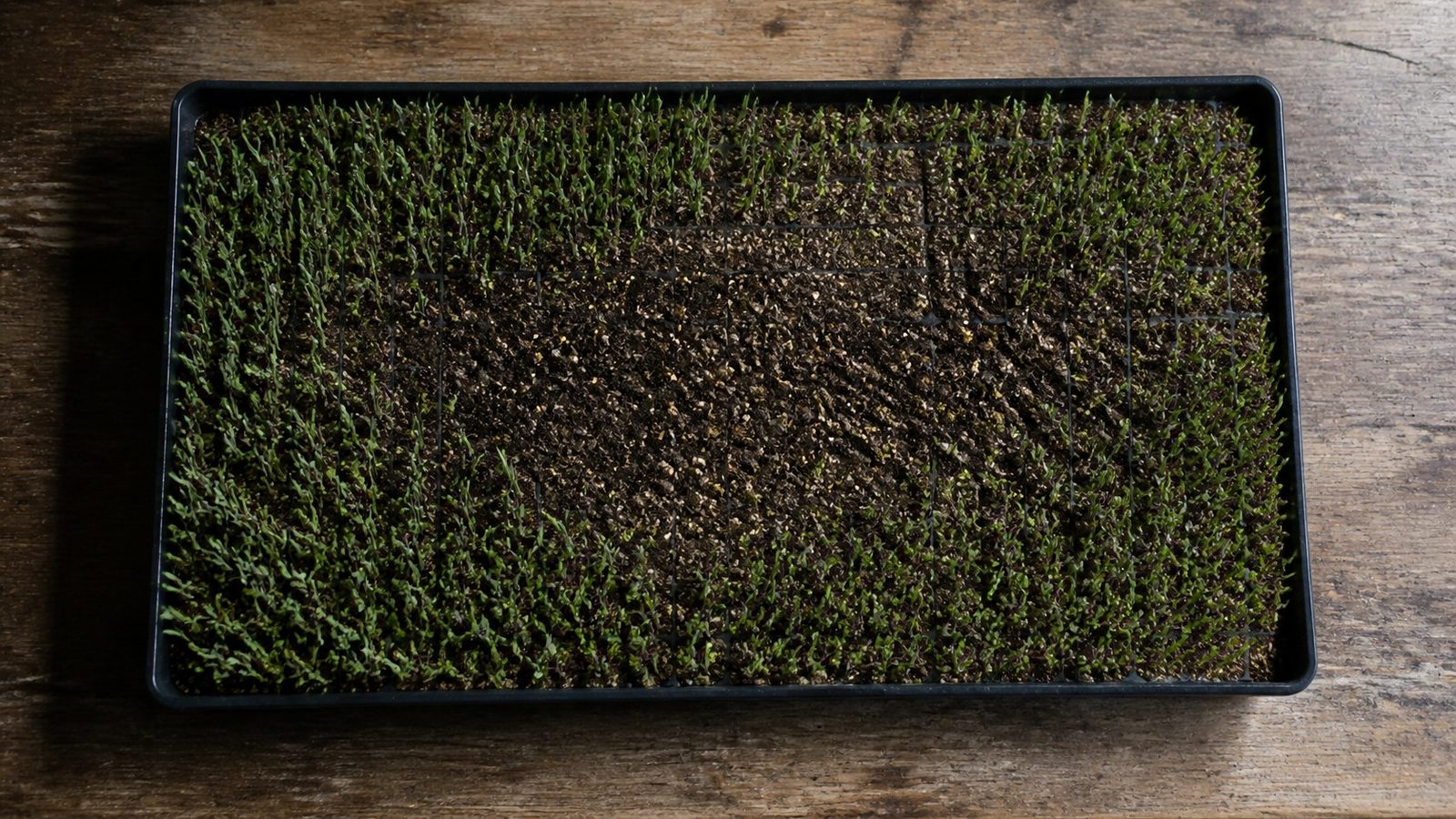
Look at where the bare patch sits, then lift ten of the missed seeds. Between those two observations you can rule out most of the usual causes in about two minutes.
Old seed, too dry, too wet, too cold, too hot, sown too deep and poor contact are all real causes, and knowing the list does not tell you which one happened to your tray. The position of the gap and the state of a missed seed do, and both cost nothing to check.
What to do mid-tray
Decide which of four states you are in before touching anything: late, dry but viable, rotted, or already germinated under the cover.
- Late, with intact dry seed and the crop window still open: restore even moisture and wait it out. Do not disturb healthy sprouts to inspect a few misses.
- Rot or collapse: do not try to fill in a diseased tray. Isolate or discard it, dispose of the affected seedlings with their medium, and watch the neighboring trays. Save it or compost it covers that decision properly.
- Already germinated under the cover: nothing is wrong. Give it light.
Do not oversow a patchy tray: nothing shows it works. The added seed is days behind the rest and will not catch up to the same harvest.
First, is it actually late
Do not call a tray failed on day three. Published germination windows are wider than most growers expect. Colorado State's figures, which are garden-sowing rather than microgreen-specific, run:
- Broccoli, cabbage, radish and turnip: 3 to 10 days
- Beet and Swiss chard: 7 to 10 days
- Cucumber: 6 to 10. Spinach and bean: 6 to 14. Pea: 6 to 15
A microgreen tray is warmer and wetter than a garden bed and will usually run faster than that, but the top of those ranges is a reasonable limit of patience. If you are three days into a crop whose window opens at six, you do not have a problem yet.
Where the bare patch sits
What the pattern rules in, before you touch anything
Hover or tap a card to highlight it.
A dead center
Something applied unevenly rather than a bad lot. Look for a heat mat footprint, a stack or weight contact point, a compacted or wet middle, or a mound in the medium. Growers report the center-of-tray failure specifically against mats.
Bare edges
An edge-specific difference in moisture, contact or temperature. The medium edge dries first, sits shallower, curls away from the wall, or takes less pressure. A sharp line matching a cover or weight edge points at the setup, not the seed.
Random scatter across a level tray
Makes a single local hot or dry patch unlikely. Now the lot and the sowing itself move up the list.
Total failure
One shared factor. A wrong or non-viable lot, a whole-tray temperature or moisture error, a bad medium, or pre-emergence disease. It does NOT prove old seed.
The general rule underneath that: a partial failure with a geometric or positional boundary points at a local physical difference. A failure with no pattern points at the lot or at something applied to the whole tray.
Then lift ten seeds
Excavate about ten missed spots spread across the tray and sort what you find into three states. It is the most informative check you have.
- Hard, intact, barely swollen, in loose dry medium. The seed never completed imbibition. It never started. Water and contact are in play; rot is not.
- Swollen, soft, brown, mushy, maybe sour. The seed took up water and died. That is decay, and in wet medium it points toward damping-off rather than toward old seed.
- A white radicle, or an empty split coat. It germinated. Whatever went wrong happened after, which is a completely different problem.
That last distinction changes what you do next. Non-germination means no root ever emerged. Post-germination death means it did, and then the seedling was lost. Utah State separates them by symptom: seedlings killed during germination leave circular bare spots, while seedlings that emerged and then failed show a brown or black lower stem and fall over.
The check that separates your seed from your tray
Run a paper-towel test on the same lot while the tray is still going. Illinois Extension's method: moisten a paper towel, put 10 or more seeds on it, fold it, seal it in a labeled bag, keep it around 70°F, and check every few days. Many seeds germinate within 7 to 10 days. Germinated divided by tested, times 100.
Illinois also gives a decision rule, which is home guidance rather than a microgreen standard: 70 to 90 percent is still usable if you sow more heavily. Below 50 to 60 percent, buy new seed.
There is no established acceptable percentage for microgreens specifically, because what counts as an acceptable stand depends on seed size, sowing rate and what you are selling.
What the test actually buys you is the discrimination, and this is the whole method on one line:
Hover or tap a row to highlight it.
| What you see | What it makes unlikely | What is still in play |
|---|---|---|
| Same-lot towel test germinates well | A lot-wide viability problem | Tray water, heat, depth, contact, medium, disease |
| Towel test also fails, and the tray zones all look alike | A local center or edge setup error | Lot quality, wrong test conditions, seed treatment |
| Missed seeds hard and intact, medium dry at them | Rot and damping-off | Water, contact, depth |
| Missed seeds swollen, soft and brown, medium wet | Simple dryness, and old seed as the sole cause | Overwatering, damping-off, medium contamination |
| Bare area has a straight edge matching a cover or weight | The seed lot entirely | Contact pressure, local temperature, local moisture |
Temperature: measure the medium, not the room
The crop experiences the medium at seed depth. Not the thermostat, not the bench air, and not what the heat mat's label claims. Put a probe at the depth the seed is sitting at, let it settle, and read the center and the edges, morning and late in the day.
The upper limit matters more than growers expect. Colorado State's soil-temperature figures give maximums, and it says explicitly that high maximums can interfere with germination: pea and spinach maximum 70°F, broccoli and radish 90°F, bean 90°F, cucumber 100°F.
That figure is worth setting against the usual room advice. About 70°F is the best single setting when several crops share a space, because 39 of the 44 crops with a published germination range include it, as temperature and airflow works through. Pea and spinach are not among those 44, because neither has a published germination figure of its own, and the one external source that covers them puts 70°F at their maximum rather than in the middle of their range.
So, a room held at 70°F is at the ceiling for pea and spinach and comfortable for most brassicas. If a pea or spinach tray is the one failing in a warm room, that is a real and checkable suspect, and no microgreen-specific figure exists for either crop to have warned you.
At the cold end, expect slower and less complete emergence rather than a clean failure, which is part of why cold is hard to diagnose after the fact.
Depth, contact and water
Buried seed is a documented cause and it is easy to do by accident. Colorado State's general rule is a maximum cover of about four times the seed diameter, and says covering too deeply can reduce or prevent germination. Utah State adds that a deeply sown seedling spends longer reaching the surface, which also lengthens its exposure to soil-borne pathogens.
Poor seed-to-medium contact is biologically obvious and has no published visual signature. The plausible pattern is missed seeds sitting on a dry ridge or an uncompressed area while the low spots beside them come up fine, and a cross-section showing an air gap under the seed. Leveling and tamping the medium is practice advice, and it is sensible practice, but nobody has demonstrated the failure looks a particular way.
Waterlogging is documented to limit germination, cause root rot and produce non-uniform stands. It is the failure mode with the clearest seed evidence, because the seed itself is swollen and rotten rather than dry and intact.
Watering a tray and sowing density cover both of those as decisions rather than as symptoms.
Seed age, storage and treatment
Old seed is easy to rule in or out, which is the point of the towel test: it takes minutes to set up and a week or so to read.
Published longevity for properly stored garden seed, from Illinois Extension: basil, broccoli, cabbage, lettuce, radish and sunflower around 4 to 5 years; bean, carrot, pea and pepper about 3; onion, parsnip and sweet corn 1 to 2.
Storage conditions matter more than age, and Colorado State puts numbers on it: below 8 percent seed moisture and below 40°F is favorable. Seed equilibrating at 15 percent relative humidity reaches about 6 percent moisture and stores safely for years. At 90 percent humidity it reaches about 19 percent and germinates poorly after a single year.
Practical consequence: seal it, keep it dry and cool, label it with crop, lot and date, and let a refrigerated container warm up before you open it so condensation does not form inside.
Two things about treated and contaminated seed. Under the Federal Seed Act, interstate seed labels must disclose any chemical treatment, and the germination percentage on agricultural seed and on vegetable seed in containers over 1 pound; vegetable packets of 1 pound or less that meet the germination standard can leave it off. And seed treatments applied at home, such as hot water or bleach for suspected contamination, can reduce germination of old or poor-quality seed rather than rescuing it.
What to actually do
- Check the crop window before declaring failure. Broccoli-family crops run 3 to 10 days even in garden conditions.
- Look at where the gap is. Center, edge, scattered or total. That alone eliminates most of the list.
- Lift ten missed seeds and sort them into hard-and-intact, swollen-and-rotten, or germinated. Two minutes, and it is the most informative thing available.
- Run a same-lot paper-towel test while the tray finishes. 10 seeds, around 70°F, count the percentage.
- Put a probe in the medium at seed depth, in the bare zone and a good zone. Not in the air.
- If a pea or spinach tray is failing in a warm room, treat the temperature as a live suspect. 70°F is their documented maximum.
- Do not oversow a patchy tray. Start the next one and change one thing.
- Write down what you changed, because the discriminating checks only work if you are not changing four things at once.
What nobody has measured
- Whether a bare center actually predicts a heat mat, or a bare edge actually predicts dryness. The positional diagnosis in this page is reasoning plus grower report, not a validated test.
- What poor seed-to-medium contact looks like in a way a grower could recognize.
- How long microgreen seed lots actually last, as opposed to garden seed of the same species.
- An acceptable germination percentage for microgreens, at any sowing rate.
- Whether oversowing a patchy tray recovers anything.
- A germination temperature for about eighteen of the sixty-two crops, including pea shoots, spinach and cucumber.
Terms on this page
Tap a term to see what it means.
Imbibition. The first uptake of water by a dry seed, which swells and softens the coat and precedes the root emerging. A seed that never imbibed is hard and intact.
Sources
Opened 2026-08-12. The per-crop germination temperatures and the count of crops without one were recounted across all 62 crops for this page on 2026-08-12.
- Colorado State University Extension, vegetable planting guide - the days-to-germination figures by crop and the soil temperature minimums, optimums and maximums, including pea and spinach at a maximum of 70°F and the statement that high maximums can interfere with germination. Garden-sowing figures rather than microgreen-specific.
- Colorado State University Extension, storing vegetable and flower seeds - storage below 8 percent seed moisture and below 40°F, and the worked example of 15 percent humidity giving 6 percent moisture and years of safe storage against 90 percent giving 19 percent moisture and poor germination after one year.
- Colorado State University Extension, growing annual plants from seed - the maximum cover of about four times the seed diameter, and that covering too deeply can reduce or prevent germination.
- University of Illinois Extension, are my seeds still good? Testing seed germination, 2023 - the paper-towel method with 10 or more seeds at about 70°F, the calculation, the 70 to 90 percent and below 50 to 60 percent decision rule, and the approximate longevity figures by crop.
- Utah State University Extension, plant pathology on damping off - Pythium, Rhizoctonia, Fusarium and Phytophthora as causes, the circular bare spots left by seedlings killed during germination against the brown or black lower stem of one that emerged and fell, disposing of infected seedlings with their medium, and the effects of too-deep sowing.
- Utah State University Extension, irrigation guidance - that waterlogged establishment conditions can limit germination, cause root rot and produce non-uniform stands.
- Penn State Extension, seed and seedling biology - imbibition as water uptake that swells and softens the coat before the radicle emerges, and damping-off as seed rot in the soil or destruction of newly emerged seedlings.
- USDA Agricultural Marketing Service, Federal Seed Act - that interstate seed labels must disclose any chemical treatment, and germination on agricultural seed and on vegetable seed over 1 pound.
- University of Minnesota Extension guidance that hot-water or bleach treatment of suspected contaminated saved seed can reduce germination of old or poor-quality seed.
- Practice pages, used as practice only: Bootstrap Farmer on common microgreen problems, which separates an uneven surface from low lot germination as topics without giving a visual discriminator, Nick Greens on germination-stage troubleshooting, which warns that prolonged soaking can sour large seed, Knowlya, and Wind River Greens, which mentions patchiness but not position and recommends 8 to 12 hours of soaking for sunflower, pea and radish.
Keep reading
Growing guides
Growing a mix: one blend has a one-day harvest window and another keeps for three days
One commercial brassica blend's five components overlap on exactly one harvest day, and a three-crop spicy blend keeps only 2 to 3 days because of its cress, while another component lasts 14.
Read Growing a mix: one blend has a one-day harvest window and another keeps for three daysGrowing guides
Do you need a heat mat? The arithmetic says probably not, and it can overshoot
A heated home runs about 68F and a mat adds 9 to 20 above ambient, which lands at 77 to 88. Spinach stops germinating at 75. Nothing shows a mat produces an earlier harvest or more crop in a room already in range.
Read Do you need a heat mat? The arithmetic says probably not, and it can overshootGrowing guides
How long to blackout microgreens, crop by crop
Take the blackout days from your crop, not from a general rule. Across the 55 crops here that publish a figure the range runs 0 to 14 days, and 29 of them top out at 4 or 5.
Read How long to blackout microgreens, crop by cropThe test bench
Microgreens Humidity Domes: The Free Alternative Beats Most of Them
A second 1020 tray and a few pounds of weight gives darkness, moisture retention and the seed-to-medium contact a dome cannot. Even the sellers say to take the dome off.
Read Microgreens Humidity Domes: The Free Alternative Beats Most of Them