Growing a mix: one blend has a one-day harvest window and another keeps for three days
Cal HewittPublished Checked
- method
- seed
- yield
- troubleshooting
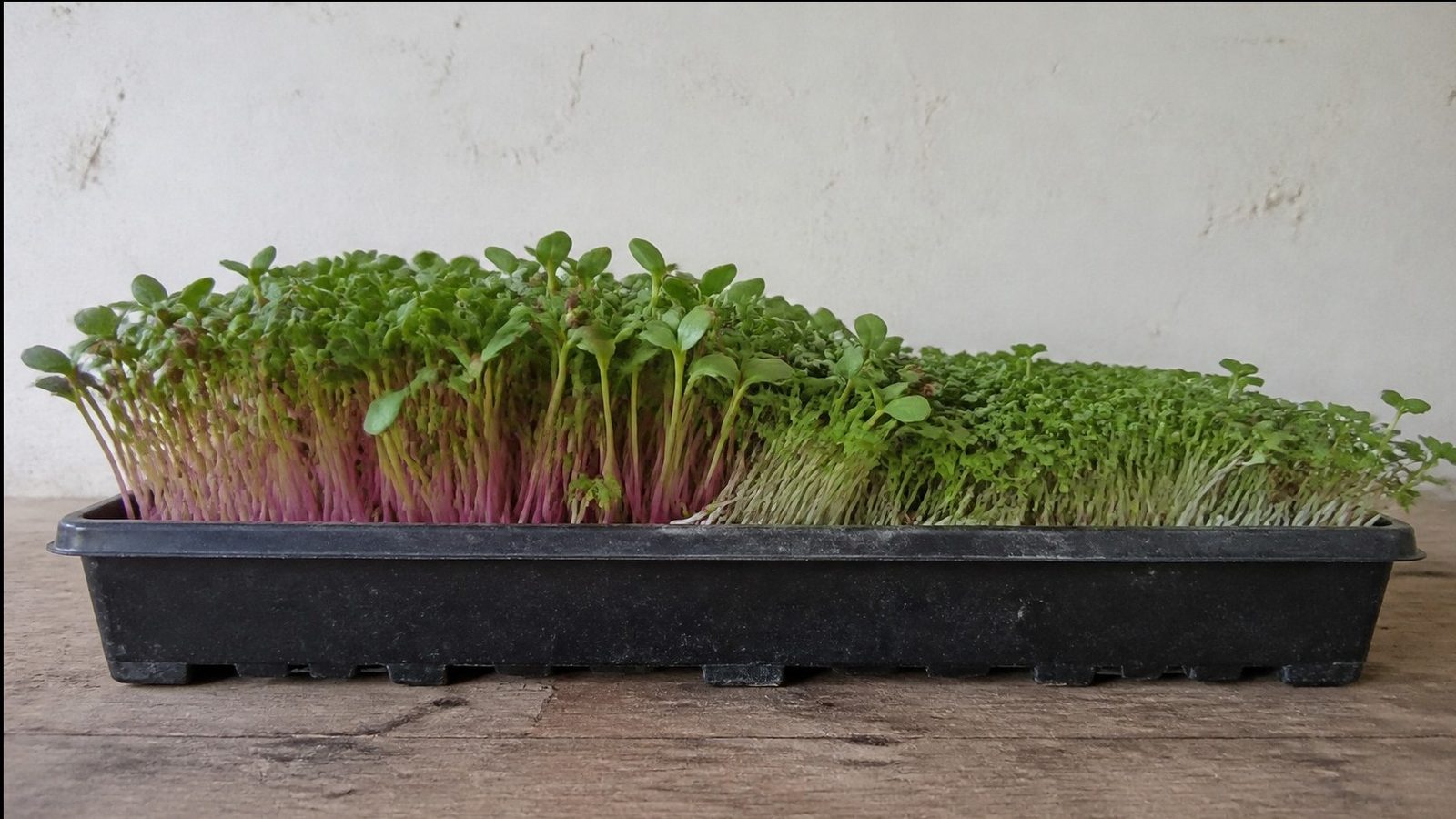
A bag of mixed seed is a packaging decision. It is not evidence that the crops inside belong in one tray.
One tray supplies exactly one of each thing that matters: one sow date, one soak, one seed rate, one blackout duration, one watering pattern, one light start, one cut. Every component gets the same one, whether it suits that crop or not.
Some blends really are designed around that, and the sellers say so explicitly. Others are just a flavor label. You can tell which is which before you sow, because every named component has a published harvest range, soak, seed rate and shelf life of its own. Look them up and see whether they overlap.
What to actually do
- Look the components up crop by crop before sowing, not after. Each one publishes a harvest range, a soak, a rate and a shelf life.
- Find the shared harvest day. Take the latest first-day and the earliest last-day across the components. If they cross, one tray cannot serve them.
- Treat a one-day window as a real constraint, not a target. The Broccoli Brassica Blend has exactly one, and it sits where radish ends and mustard begins.
- If the components need different soaks, soak separately and combine at sowing, or sow separate trays. A shared soak that fits nobody is the alternative.
- Check the shortest shelf life in the blend before you commit to a delivery schedule. One cress component caps the whole pack at 2 to 3 days.
- If the bag names only a family or a flavor, treat compatibility as unverified. You cannot check what you cannot look up.
- When in doubt, sow separately and combine after cutting. Growers report doing exactly this because germination and growth were too uneven, and the cost is trays and records rather than crop.
- Do not read the bag format as the finding. One bag is a packing choice; one tray is an agronomic commitment.
Five commercial blends, checked component by component
The working test is the one the evidence implies: do the components share at least one day on which all of them are at an acceptable stage?
Hover or tap a row to highlight it.
| Blend | Components resolved | Shared harvest window | What the seller states |
|---|---|---|---|
| True Leaf Basic Salad Mix | 5 of 5 | Days 10 to 12 | 8 to 12 days, 10 day target |
| True Leaf Spicy Salad Mix | 6 of 6 | Days 10 to 12 | 10 day target |
| Mumm's Spicy Microgreen Blend | 3 of 3 | Days 10 to 15 | One tray, no soak |
| Mumm's Broccoli Brassica Blend | 5 of 5 | Day 10 only | 7 to 10 days |
| Mumm's Microgreen Salad Mix | 3 of 3 | Days 9 to 12 | 9 to 10 days |
Start with the good news, because it matters. True Leaf's Basic Salad Mix works. Its five components share days 10 to 12, and the seller's stated 10 day target sits exactly at the start of that window. The compatibility claim on that bag is real, and a skeptical page should say so as plainly as it says the opposite elsewhere.
Now the Broccoli Brassica Blend. Its five components overlap on exactly one day: day 10. The seller says 7 to 10 days, so its window and the directory's touch at a single point.
The pinch is visible in the components. Radish finishes at 6 to 10 days and mustard does not start until day 10. Radish's last acceptable day is mustard's first. Cut on day 9 and the mustard is not there yet; cut on day 11 and the radish is past.
Which is exactly what growers report. A discussion of that specific blend says radish outgrows the others. The forum complaint and the directory's harvest field are describing the same collision, from opposite ends.
The seeding rate cannot be right for everyone either
Standalone seeding rates inside a single blend run a long way apart.
In the Broccoli Brassica Blend, the components' own rates span 8.0 g for mustard to 25.5 g for radish, 3.2 times apart. A shared tray gets one total rate, so every component is sown at some multiple or fraction of what it would get alone.
That is not necessarily wrong. The arithmetic is straightforward: pick a total rate for the tray, choose proportions that sum to one, and weigh each component to its share. Or scale every standalone rate by a common factor so the ratio survives and the total fits. What it is not is neutral. Somebody chose those proportions and the bag rarely says what they were.
And the bag may not pour the way it was filled. Dry granular mixtures segregate by size, shape, density and roughness when disturbed, with smaller grains filling voids beneath larger ones and pushing the larger upward. A shipped, handled bag of mixed seed is a granular mixture that has been disturbed.
The strongest evidence that this matters is the industry's own design choice. Johnny's says it selects its beet and chard mix varieties for similar maturity and similar seed size. The maturity criterion is about the harvest. The seed-size criterion only makes sense if segregation is a real concern, and a seller building it into the product is a better signal than any blog post.
Nobody has measured it on seed. No study transports a commercial mixed bag, samples successive sowings and reports each crop's fraction. So, the mechanism is established and the size of the effect on your packet is not.
The soak conflict the wide range hides
Mumm's large-seed Salad Mix is pea, fava, buckwheat and sunflower, and the seller gives one shared soak of 6 to 12 hours.
Three of those resolve here, and their own soak times do not all fit inside it.
Hover or tap a row to highlight it.
| Component | Its own soak | Against the shared 6 to 12 hours |
|---|---|---|
| Pea shoots | 6 to 8 hours | Fits only at the bottom of the range |
| Sunflower | 4 to 12 hours | Fits throughout |
| Buckwheat | 12 to 24 hours | Fits only at the very top |
There is no single duration that satisfies all three. The latest any component wants to start is buckwheat's 12 hour minimum. The earliest any component must stop is pea's 8 hour maximum. Those cross, so a shared soak is a compromise by construction: at 6 hours the buckwheat is under-soaked, and at 12 the pea is past its own upper limit.
The seller's wide range is not carelessness. It is the compromise, written down. See soaking microgreen seed for what a soak does and how little of it is settled.
The finding that actually costs money: a pack keeps to its worst component
A mixed pack is one package. It cannot hold the shorter-lived crop back.
Mumm's Spicy Microgreen Blend is mustard, arugula and cress. All three resolve here.
Hover or tap a row to highlight it.
| Component | Published shelf life |
|---|---|
| Mustard | 5 to 14 days |
| Arugula | 10 days |
| Garden cress | 2 to 3 days |
The pack keeps for 2 to 3 days, because cress does. Mustard on its own reaches 14. So, the blend gives up as much as four and a half times the shelf life of its longest-lived member, and nothing on the bag says so.
Do not add or average published shelf lives. The shortest one governs the pack. And these numbers are tighter than most people expect: across the 39 crops that publish a shelf life, none reaches 30 days and only five reach 14, which is worked through in subscriptions and delivery.
For a seller this is the whole decision. A blend containing cress cannot be a weekly delivery product no matter how well it grows.
No controlled study of a packed blend against its own components exists, so this is arithmetic on published component figures rather than a measured blend result. It is still the right way round, because a package cannot outlast the fastest thing decaying inside it.
What a blend actually costs
On one dated observation, the blend is much cheaper than assembling it in small packets.
A 1 oz packet of True Leaf's Basic Salad Mix was $5.61. Three of its five named components bought individually at 1 oz came to $16.63: broccoli at $5.96, kale at $5.63, arugula at $5.04. Before cabbage, before kohlrabi, before shipping.
That is about three times the price of the whole blend for three fifths of its crops.
Read it as a package-size effect, not a seed-price finding. The proportions are not matched, the varieties are not matched, and small packets carry a convenience premium in every category. What it does show is that the blend is not a markup, which is the opposite of the usual suspicion.
What the labels do and do not tell you
Disclosure is common and not universal. In a tight five-page scan, 5 of 5 named their component crops. Across the wider seven-page set, only 5 of 7 did. Johnny's Mild Micro is described as a Brassica-family mix; its Rainbow Sprinkles as beet and chard varieties, with a warning that varieties may change with availability. True Leaf notes substitutions can occur inside its Basic mix.
So "spicy," "mild" and "salad" are sometimes flavor labels rather than composition statements, and even a named blend may not be a fixed formula from one bag to the next.
Four of the five pages in the tight scan state or clearly imply a single compatible tray schedule. That claim is believable for a deliberately matched product and it is not transferable to every bag with a blend name on it.
What nobody has measured
- Whether a shipped mixed bag pours uniformly. The segregation mechanism is peer reviewed; its size in a seed packet is not.
- How many days apart components can be and still share one acceptable harvest. The overlap test on this page is an inference, not a trial result.
- What a mismatched blackout costs each component, in emergence, size or yield.
- Which soak compromise performs best for any pairing that disagrees.
- Whether a mismatched co-sow carries a distinct food safety risk. Quality unevenness is documented; a pathogen comparison is not.
- How a packed blend behaves against its own components in storage, which is the one that would replace the arithmetic above with a measurement.
- Any independent compatibility trial at all. Every "grows well together" claim located is the seller's own.
Terms on this page
Tap a term to see what it means.
Blend or mix. A combination of more than one crop, either sold as mixed seed or assembled by the grower. Sellers use both words for both things.
Sources
Opened 2026-08-12. The shared harvest windows, seeding spreads, soak conflict and shelf-life findings were computed for this page by resolving each blend's named components against the daysToHarvest, soakHours, seedGramsPer1020 and shelfLifeDays fields on the variety entries here; every component named above resolved to an entry except fava, which has none. Prices are single dated observations, not a per-gram comparison. Every compatibility claim quoted from a seller is labeled as the seller's own.
- True Leaf Market, Basic Salad Mix - broccoli, kale, kohlrabi, arugula and cabbage named, the statement that the crops grow well together, a 3 day dark period, an 8 to 12 day range with a 10 day target, no soak, 18 g per 10 by 20, the $5.61 price for 1 oz observed 2026-08-12, and the note that substitutions can occur.
- True Leaf Market, Spicy Salad Mix - the same five crops plus mustard, a statement that the crops have similar germination and harvest times, and a 10 day harvest target.
- True Leaf Market, Waltham 29 broccoli, Red Russian kale and Slow Bolt arugula - the $5.96, $5.63 and $5.04 single-component prices for 1 oz observed 2026-08-12, used only for the dated package-size comparison.
- Mumm's, Spicy Microgreen Blend - mustard, arugula and cress named, no soak, and the instruction to spread seed in one thin layer with a spoon or tool to separate clumps.
- Mumm's, Broccoli Brassica Blend - broccoli, clover, radish, mustard and arugula named, the instruction to spread the mixed seed in one tray and harvest at 7 to 10 days, 2 to 3 stacking days for cabbage-family seed against 3 to 5 for others, the direction not to soak small and medium broccoli and arugula, and general small-seed rate guidance of roughly 15 to 28 g.
- Mumm's, Microgreen Salad Mix - peas, fava beans, buckwheat and sunflower named, the statement that the four large-seed crops grow well together, a shared 6 to 12 hour soak, 3 to 5 stacking days, an approximately 9 to 10 day harvest, and the instruction to spread one mostly non-overlapping layer.
- Mumm's, seed blend collection - fourteen listed blends and starting prices.
- Mumm's, kohlrabi - small seed no-soak and general stacking and watering guidance.
- Johnny's Selected Seeds, Rainbow Sprinkles chard and beet mix - described only as beet and chard varieties with a warning that varieties may change with availability, a 16 to 25 day range, and the statement that varieties were selected for similar maturity and similar seed size.
- Johnny's Selected Seeds, Mild Micro Mix - described only as a Brassica-family mix, a 10 to 15 day range, and varieties selected to mature at roughly the same time.
- PNAS, segregation in dry granular mixtures, 2024 - that dry granular mixtures segregate by size, shape, density and roughness when disturbed, with smaller grains filling voids under larger grains and moving the larger ones upward. Mechanism only, on granular materials rather than on seed packets.
- Teagasc, establishment of multispecies swards - agency guidance to choose a seeder that avoids seed separation. Indirect and not microgreen-specific.
- FDA, guidance on sprouts (PDF) - the microgreens against sprouts distinction and covered-produce context, and that hydroponic sprout water can spread pathogens within a production lot.
- FDA, final guidance on seeds used for sprouting - 2022 outbreak context and seed safety recommendations, on sprouts rather than microgreens.
- Deliseeds, uneven growth in microgreens - grower-facing advice to separate varieties with different speeds or to mix after harvest.
- Houzz discussion, microgreen mix - a grower reporting that they grow each variety in separate trays and combine at harvest, citing uneven germination and growth, and another participant reporting post-harvest mixing.
- Reddit discussion, broccoli brassica blend - reports that radish outgrows the other components of that blend and that the questioner grows varieties in separate trays.
- Mustard microgreen storage study - that storage outcome varies by temperature and optimum storage temperature varies by species. This page returned a CAPTCHA when opened, so no numeric result from it is used here.
Keep reading
Growing guides
Do microgreens regrow after cutting?
A normal microgreen cut removes the growing point, so there is usually nothing left to regrow from. Roots do not make a new shoot; a surviving node does. The one documented path takes 3 to 4 weeks, about twice as long as sowing a fresh tray.
Read Do microgreens regrow after cutting?Growing guides
My microgreens are too short: telling a stunted tray from a naturally compact crop
Check the height against the crop before you treat it as a fault, because several crops simply finish short. If the tray is genuinely stunted, low light is the one cause it cannot be: too little light makes a tray taller.
Read My microgreens are too short: telling a stunted tray from a naturally compact cropGrowing guides
Nothing came up: reading a failed tray instead of guessing at it
Old seed, dryness, wet, cold, heat, depth and poor contact can all empty a tray. Where the bare patch sits, and what a missed seed looks like when you lift it, rules most of them out in about two minutes.
Read Nothing came up: reading a failed tray instead of guessing at itGrowing guides
Do microgreens need fertilizer? It is worth 8 to 47 percent of the yield and up to 227 times the nitrate
In one peat trial, taking the feed away cost cabbage 7.9 percent of its yield and arugula 47.4 percent, while cutting nitrate in the cut crop by 98 to 227 fold. Feeding is the largest lever anyone has measured on either number.
Read Do microgreens need fertilizer? It is worth 8 to 47 percent of the yield and up to 227 times the nitrate