At a glance
Fast, and the small seed broadcasts easily at a very light rate, but a dense mustard sowing kept saturated or hot turns into an uneven damping-off mat, which is the one way people lose it.
- Botanical name
- Brassica juncea
- Also sold as
- Garnet Giant, Red Giant, Ruby Streaks, Wasabina, Miz America F1, Red Katana
- Family
- brassica
- Difficulty
- Beginner
- Days to harvest
- 10 to 15 days
- Harvest window
- No published figure
- Soak
- None
- Blackout
- No published figure
- Germination temperature
- 65 to 75 °F
- Yield per 1020 tray
- 9.5 oz
- Mold risk
- Medium
- Hull shedding
- Not applicable
- Shelf life
- 4 to 14 days
- Eaten as
- raw
- Seed cost per tray
- $1.56
8 g at $88.30/lb, Johnny's organic Garnet Giant mustard microgreen seed, listed 2026-08-08. That is the dearest brassica seed per pound you are likely to price, and it still lands mid-pack per tray because the rate is so light. Seed only, excludes medium, tray, labor, light and loss.
Any field name above ranks every variety by it. No published figure means we researched it and nobody has established one, which is different from not yet researched. Every figure here is sourced at the bottom of the page. Compare every variety side by side.
Mustard goes onto the tray lighter than almost any other crop. Johnny's measured 8 grams per 1020 tray, about three and a half flats to an ounce of seed, returning 9.5 ounces at first true leaf in 12.5 days. Weigh that 8 grams rather than eyeballing a covering, because mustard seed is fine enough that a scatter which looks right by eye is easily several times the measured rate, and the extra seed buys disease pressure rather than yield.
One thing about this crop is settled, and it saves you work: it sheds no hulls worth managing, so there is no hull job on it at all. Its shelf life comes from packaged storage trials rather than a supplier's guess, and the two trials disagree: one held washed mustard 14 days at 5°C, with sensory quality holding up better at 5°C than at 10°C, while a trial of Indian mustard, the same species, found about 4 days at 4°C in zip-lock bags.
What growers are saying right now
Sampled from public posts and videos, 9 July to 8 August 2026. Every line links what it is quoting. How often something is repeated is not evidence that it is true, so every line also says what the sources actually establish.
Wasabi-like flavor in 8 days
Circulating The headline on a soil-free grow-along, 5,815 views, and the fastest figure circulating for this crop
Eight days is below every documented figure. Johnny's trial averaged 12.5 days to first true leaf and its product page gives 10 to 15. A number quoted faster than anyone has measured is the most reliable sign that nobody measured it, so plan the bench around twelve days and treat anything under ten as a bonus. Where each number comes from
How did they get that green without any light?
Circulating A viewer's question under a 41,042-view spicy mustard guide, and a fair one
The answer is that seedlings green up within hours of reaching light, so the tray in a video has already been uncovered. But the question exposes a real hole: nobody publishes a blackout period for mustard. The supplier page permits a light cover or a humidity dome for germination and then jumps straight to the harvest stage, with no number of dark days and no weight. That is the same gap kale has, on the two crops most often handed to beginners. The blackout nobody publishes
Grow it without soil
Circulating The dominant format again. Thirty thousand views on one, 16,913 on another, and the 8-day claim above is from a third
Perfectly good way to grow it, and not comparable to the numbers on this page. The one measured benchmark this crop has, 8 g and 9.5 oz at 12.5 days, comes from a soil-based greenhouse trial. Change the medium and you have changed the basis, so compare a soil-free result against your own soil-free trays and not against a trial that used neither.
A vibrant peppery kick
Circulating How a grower pitches it, and heat is the entire commercial proposition of this crop
True, and more variable than the pitch suggests. Johnny's describes Garnet Giant, the one cultivar with trial numbers, as only mildly spicy, while Wasabina is sold as sweet and spicy and Ruby Streaks and Red Katana are sold mainly on leaf shape and color. Johnny's does group the mustards as spicy against kale, broccoli, cabbage, kohlrabi and mizuna as mild. What nobody has measured is heat intensity by cultivar, or whether it climbs if you cut late, so treat "it gets hotter if you leave it" as folklore. What it tastes like
Nobody is asking for help with mustard
Circulating The help traffic in r/microgreens goes to sunflower, broccoli and monsoon mold, while the widest-reach mustard post anywhere pulled 185,744 views and a single comment
Both point the same way. Mustard travels as content and not as a problem, which fits a crop that goes on at 8 grams and comes off in twelve days. The one thing that does catch people is overwatering a dense small-seed sowing, and that failure looks like a watering habit rather than a mustard problem. What goes wrong
What it is, and how to tell you grew it right
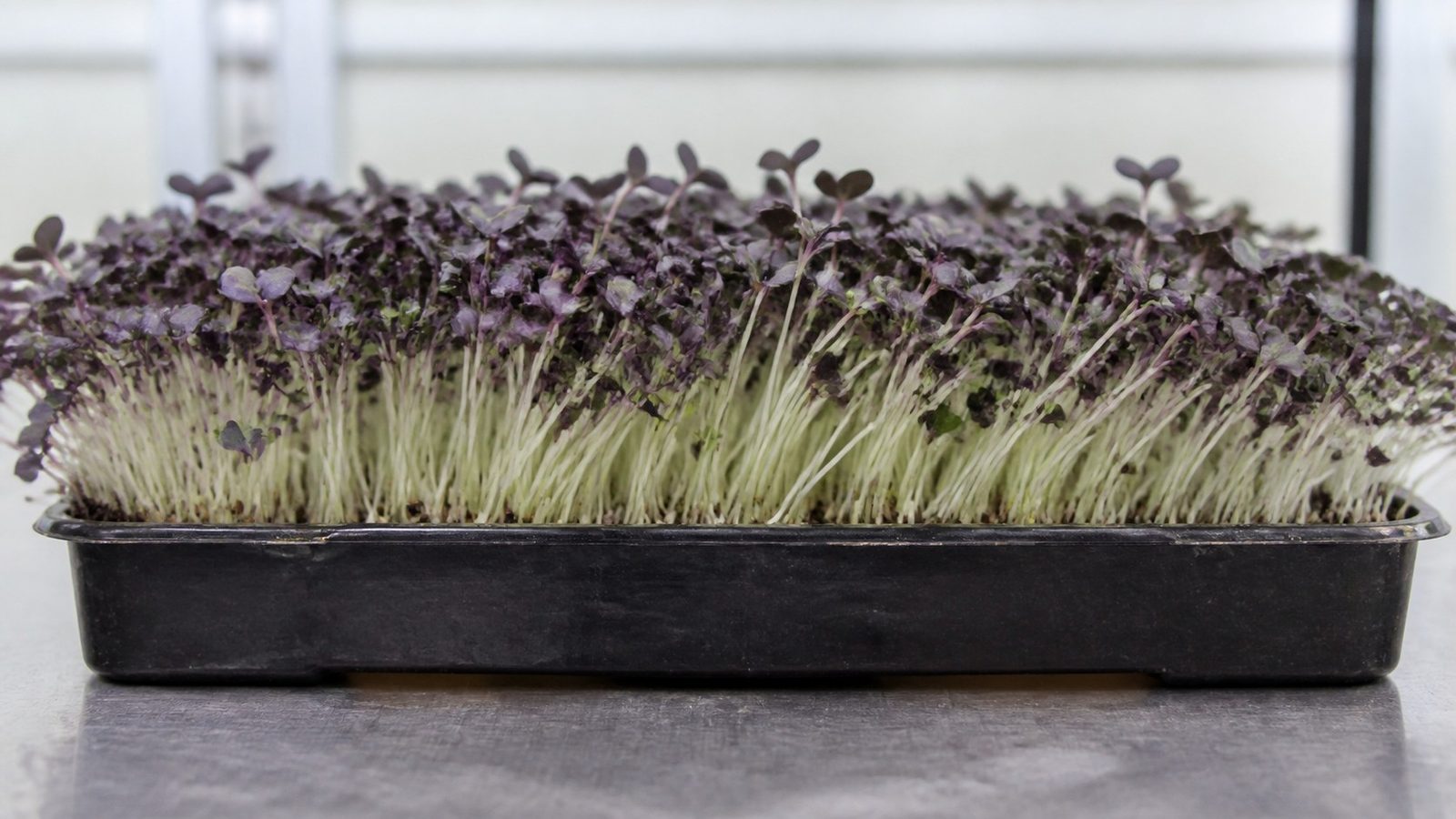
Mustard microgreens are seedlings of Brassica juncea, brown or Indian mustard, cut above the medium at cotyledon or first true leaf. Unlike most microgreen crops, the cultivar list is long and genuinely differentiated: Garnet Giant, Red Giant, Ruby Streaks, Wasabina, Miz America F1 and Red Katana are all sold specifically for the microgreen stage, and they look meaningfully different from one another.
A correct tray is a tall, sprawling canopy on fine pale stems with rounded cotyledons, filled evenly, with no collapsed stems and no bare medium showing. Sprawling is the word to hold onto: mustard does not stand to attention the way a broccoli tray does, and a canopy that leans and spreads is not a fault. On Garnet Giant specifically, dark purple cotyledons sit under green true leaves splashed with purple and slightly toothed at the margin. Johnny's general harvest range is half an inch to two inches, and exact height depends on cultivar and how late you cut.
It is confused with purple kale, red cabbage and mizuna, and honestly at cotyledon stage there is no reliable tell. What separates them is the true leaf plus the flavor: mustard's true leaf comes in toothy, lobed or frilled depending on cultivar, against cabbage's round glossy leaf and kale's more evenly serrated one. Before the true leaf arrives, rounded green cotyledons are rounded green cotyledons, and anyone claiming certainty is guessing.
What it tastes like, and what to do with it
Peppery to pungent, with the heat arriving in the nose rather than on the tongue, the way mustard and horseradish do rather than the way chili does. This is the crop's whole proposition.
The heat is more cultivar-dependent than the marketing suggests, and being precise here is useful. Johnny's describes Garnet Giant, which is the only mustard with trial numbers behind it, as only mildly spicy. Wasabina is sold as sweet and spicy. Ruby Streaks, Red Katana and Miz America are sold mostly on leaf shape and color, with no heat description attached and no published comparison between any of them. So, if a customer wants real wasabi-like heat, the cultivar you pick matters, and the one with the measured yield is not the hottest one.
What nobody has measured is whether the heat climbs as the tray ages. It is repeated constantly and no controlled sensory source opened for this page establishes it, so this entry does not claim it.
Use it where a small volume needs to actively season a dish: on egg dishes, tuna or roast beef sandwiches, tacos, grain bowls, salads, and on soups after plating. It is very good against rich, creamy or fatty food, which is where its heat does real work. It is the wrong crop as a large neutral salad base, because volume amplifies the bite and a bowlful is a different experience from a pinch.
People who dislike mustard, horseradish or wasabi heat will dislike this, and no growing choice changes that. Johnny's own grouping is the useful shorthand: mustards sit with the spicy microgreens, while kale, broccoli, cabbage, kohlrabi and mizuna sit with the mild ones. For a heat-averse customer, sell them one of those instead.
Growing it: only what differs from the standard method
Everything general about trays, medium, light and watering is on the standard tray method for growing microgreens. Mustard's deltas are few and mostly about restraint.
Eight grams per 1020, which is about as light as a microgreen sowing gets. Johnny's trial seeded Garnet Giant at 8 g, about three and a half flats per ounce of seed, and its current product page repeats the figure independently. That is lower even than the 10 to 13 g the same trial used for several milder brassicas, so if the tray looks sparsely sown after you weigh it out, that is the right look. Sow lower still if you intend to grow larger or longer, for airflow. Do not sow higher to force a heavier mat, because disease pressure rises with density and saturation and you will lose more than you gain.
No soak. The crop-specific instructions call for broadcast seed, firm contact, and a light cover or humidity dome. None of them prescribes soaking, and no source establishes a mustard soak protocol, so sow dry into evenly moist medium.
Broadcast, press, and cover only lightly. Fine seed moves. Excess top watering washes it into clumps, and a clump is a dense wet spot that becomes the failure. Bottom water or mist so the sowing stays where you put it, and do not bury it.
Warm to germinate, then cool. Johnny's specifies 75°F at the medium until germination then 60°F, with 65 to 75°F favorable ambient after germination, and warns that above 75°F germination can be inhibited and disease pressure rises. Virginia Tech's general production range is 60 to 70°F.
Give it real light, and this is one of the few crop-specific light figures anyone publishes. Virginia Tech lists mustard and mizuna at a daily light integral of 12 mol per square meter per day or possibly higher, against its general microgreen guidance of 9 to 16. Very few microgreen crops have a crop-specific light figure published at all, so this one is worth using. Humidity guidance is 50 to 70 percent, and airflow should be maintained rather than reduced.
The blackout is unpublished, same as kale. The supplier page permits a light cover or humidity dome for germination and then goes straight to the harvest stage, giving no number of dark days and no weight. The documented instruction is a signal rather than a schedule: remove the germination cover when emergence begins, so the spreading canopy gets light and air. Anyone quoting you a mustard blackout schedule is quoting a preference.
A mustard tray, and where the published instructions stop
- 1
Day 0, sow dry
8 g broadcast evenly on leveled, moist medium, pressed for contact, covered only lightly or domed. No soak. Medium at about 75°F.
- 2
Covered phase, length not published
Held humid for germination. No mustard source gives a number of dark days or a weight. The documented instruction is to uncover when emergence begins.
- 3
Uncover at emergence
So, the sprawling canopy gets light and airflow. Airflow is the control on this crop's one real failure.
- 4
After uncovering
Medium toward 60°F, ambient 65 to 75°F, humidity 50 to 70 percent, and a daily light integral of 12 or above, which is one of the few crop-specific light figures published for any microgreen. Bottom water so the fine seed and the canopy stay put.
- 5
Days 10 to 15, cut
Judge by the crop, not the calendar. Full cotyledons through first true leaf is the target, and the trial averaged 12.5 days.
What goes wrong with mustard specifically
There is one failure that matters on this crop and everything else is a variation of it: overwatering a dense small-seed sowing.
Clumped or uneven germination. Bare lanes beside dense islands, caused by seed washed into patches by top watering or poor seed-to-medium contact. You cannot reseed through an established mat, so this one is fixed on the next tray rather than this one.
Damping-off, which is where the clumps lead. The early warning is a persistently shiny or saturated surface, uneven emergence, or seedlings softening right at the medium line, then falling. Pythium and Rhizoctonia are the usual agents, and Johnny's names the conditions plainly: dense planting, poor air circulation, saturated media. Shift to careful bottom watering and restore airflow, and remove affected plants rather than trying to dry a rotting stand in place. A spreading wet rot means the tray is finished.
Heat, which makes both of the above worse. Above 75°F, germination can be inhibited and disease pressure rises. On a crop that is already a dense mat, a warm room is not a small problem.
Overmaturity, which is a quality loss rather than a disease. True leaves enlarge, the crop stops being uniformly tender, and a tray beyond its density starts shading its own understory. You can see it before cutting: a canopy well past first true leaf with uneven height and more mature-looking leaf shape. Johnny's trial warns that each day can materially change plant size and yield.
Root hairs against mold, with the mustard caveat. Normal root hair is a fine localized white fuzz that stays attached to roots at the moist medium surface. It is not a web spreading up stems and through the canopy. Improve airflow and let the surface dry slightly: root hairs stay root-bound. Growth that bridges between seedlings, spreads through the canopy, or comes with soft collapsing stems is disease, and the diagnostic sign is rot at or below the medium line rather than white fuzz on its own.
And one thing that genuinely does not go wrong. Mustard sheds no hulls worth managing. It is a small-seeded brassica and no source identifies hull retention as a production defect on it, so the hull job does not exist on this crop. That is worth knowing if you are coming to it from sunflower, where hull removal is the defining daily task and a reason to cull trays.
Nutrition, and what is actually established
There is no mustard microgreen record in USDA FoodData Central, and the mature mustard greens entry is not a substitute for one.
What exists is a broad government analysis rather than a crop-specific label: a USDA study measured minerals by ICP-OES across 30 varieties spanning 10 Brassicaceae genera grown as microgreens. Across that sampled set, macro-minerals ranged, in mg per 100 g fresh weight, calcium 39 to 98, magnesium 28 to 66, phosphorus 52 to 86, potassium 176 to 387 and sodium 19 to 68, with iron 0.47 to 0.84, zinc 0.22 to 0.51, copper 0.041 to 0.130 and manganese 0.17 to 0.48.
Those are pooled ranges across thirty brassica varieties. They are not values for Garnet Giant, or for mustard, and quoting them as though they were would be wrong. Virginia Tech makes the underlying point directly: microgreen nutrient content varies with species, cultivar, harvest stage and production method. So, an exact per-serving figure for mustard microgreens, a claim that they match mature mustard greens, or a claim that nutrient density holds regardless of how you grew them, are all unsupported here.
Which seed to buy
Six cultivars are sold for microgreen use and only one has been measured, which is the single most useful thing to know before ordering.
Garnet Giant is the one with numbers: 8 g of seed, 9.5 oz per 1020, 12.5 days to first true leaf, dark purple cotyledons, green true leaves splashed purple and slightly toothed, described as mildly spicy. If you want to plan against a benchmark, this is the only mustard that gives you one.
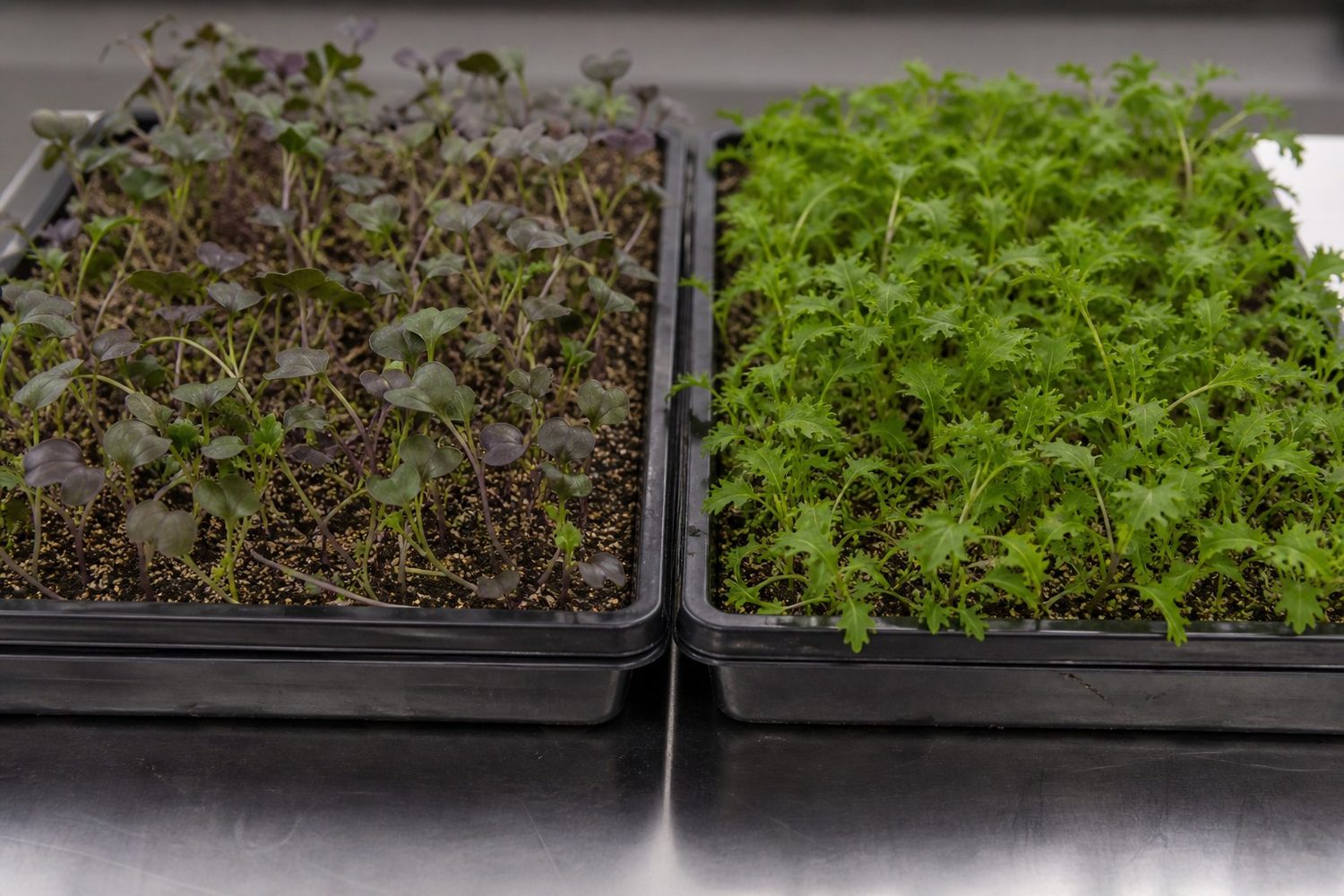
Wasabina is heavily frilled and ruffled and sold as sweet and spicy, which makes it the obvious pick when the kitchen actually wants heat. Ruby Streaks has an intricately lobed red and dark green leaf. Red Giant is green with a red blush. Red Katana has dark red leaves on light green stems. Miz America F1 is the hybrid in the set. For all five, relative tenderness, stem length, days to harvest and yield are simply not published, so treat the descriptions as accurate about appearance and silent about performance.
Order seed sold specifically for edible microgreen production, with the cultivar named, lot traceability, and untreated food-use status. Refuse anything labeled for ornamental or field use, or with undisclosed treatment, because the crop is cut and eaten within a fortnight.
A bad lot shows as poor or uneven germination despite even sowing, correct moisture and adequate temperature, and it costs you twice: the wasted seed, medium and labor, and then the lost or delayed harvest. Keep lot records, grams sown and yield, because Johnny's trial names seed lot among the causes of yield variation and excluded obvious poor-germination flats from its own averages. Without those records you will blame your watering.
Mustard microgreen seed on Amazon is the convenient route for a home grower. If you are selling on heat, buy by cultivar name from a supplier who states it.
Is it worth growing?
Yes, if you or your customers want heat, and the economics are better than they first appear.
Mustard seed prices high per pound, at $88.30, which sounds prohibitive until you notice the rate. At 8 grams a tray it works out to $1.56 of seed, which is mid-pack, cheaper per tray than radish. Seed price per pound and seed cost per tray are almost unrelated, and mustard is the clearest example: it costs nearly seven times more per pound than sunflower seed and roughly the same per tray.
It suits a beginner who can keep a tray evenly moist rather than wet, a market grower who now has a measured 9.5 oz benchmark to price from, and a home grower who likes the bite. It is the wrong crop for a heat-averse household, for a customer base that needs a neutral base green, and for anyone growing in a damp space with poor air movement, because a dense mustard mat is unforgiving there.
Its competition splits in two. Against the mild brassicas, broccoli, kale, cabbage, kohlrabi and mizuna, mustard wins only when the dish wants seasoning rather than volume, and loses whenever heat would overpower it. Against the other spicy crops, radish, arugula and cress, the choice is what kind of heat and what stem color, not whether there should be heat at all. Radish brings crunch and pink stems and clears the bench faster; mustard brings a nose-first pungency and purple, frilled or lobed leaves that radish cannot produce.
A note on the numbers above
Hover or tap a row to highlight it.
| Figure | Value | Source | What kind of number it is |
|---|---|---|---|
| Seed per 1020, Garnet Giant | 8 g | Johnny's 2017 trial | Measured, at first true leaf |
| Seed per 1020 | 8 g | Johnny's product page | Repeated independently of the trial |
| Yield per 1020 | 9.5 oz | Johnny's 2017 trial | Measured, at first true leaf |
| Days to harvest | 12.5 average | Johnny's 2017 trial | Measured, to first true leaf |
| Days to harvest | 10 to 15 | Johnny's product page | Published range, no stage stated |
| Days to harvest | 8 | A soil-free grow-along | Below every documented figure |
| Germination temperature | 75°F then 60°F | Johnny's | Crop guidance, not a trial |
| Daily light integral | 12 mol/m²/day or above | Virginia Tech | A genuine crop-specific light figure |
| Shelf life | 14 days at 5°C | Packaged storage study | MEASURED, with sensory scored at day 14 |
| Shelf life | 14 days at 10°C | Same study | Same duration, poorer sensory quality |
| Shelf life | About 4 days at 4°C | Indian mustard storage trial, 2022 | MEASURED, zip-lock LLDPE bags, salability limit |
| Shelf life | 5 to 10 days | Johnny's | No package or temperature stated |
| Blackout | No published figure | Nobody | No days, no weight, on either mustard or kale |
| Harvest window | No published figure | Nobody | 10 to 15 days is a range, not a holding window |
| Hull shedding | Not applicable | Researched | Small-seeded brassica; no hull job exists |
| Seed cost per 1020 | $1.56 | Calculated, Johnny's price | 8 g at $88.30/lb, listed 2026-08-08 |
The shelf life here is measured rather than estimated, and that changes how you store it. Most microgreen shelf-life figures are a supplier's undefined guess. Only a handful of crops have a packaged storage trial behind them: arugula at 10 days, broccoli raab at 13, mustard at 14, garden cress at 15 in modified-atmosphere packaging and buckwheat at 21. For mustard the trial ran 14 days at both 5°C and 10°C, with sensory quality at day 14 rated better at 5°C, and measured losses in weight, chlorophyll, electrolyte leakage and antioxidant activity along the way. Take 14 days as the ceiling and only at 5°C, because 5°C is not the same as "the fridge", and a domestic door shelf sits nearer 10. A second trial, on Indian mustard, the same species, found about 4 days at 4°C in zip-lock bags (Priti et al., 2022); the two measurements disagree, and nobody has established why. Johnny's undefined 5 to 10 days is what you get without that control.
Two numbers you will have to make yourself. Nobody publishes how long a mustard tray holds a good cut, and nobody publishes a blackout period or weight for it. So, cut one tray at first true leaf and leave the next two or three days longer, writing down what each one weighed and how it ate, and you will have your own holding window inside two cycles. For the blackout, uncover at emergence rather than counting dark days, because that signal is the only instruction anyone has actually written down.
Hover or tap a row to highlight it.
| Crop | Seed per 1020 | Yield | Days | Cost per tray | Oz per $1 | Oz per tray-day |
|---|---|---|---|---|---|---|
| Kale, Red Russian | 10 g | 11 oz | 13.5 | $1.07 | 10.3 | 0.81 |
| Arugula | 10 g | 10 oz | 6 to 19 | $0.48 | 20.8 | 0.80 |
| Mustard, Garnet Giant | 8 g | 9.5 oz | 12.5 | $1.56 | 6.1 | 0.76 |
| Broccoli raab | 12 to 37 g | 5.29 to 8.82 oz | 7 to 12 | $0.49 | 14.4 | 0.74 |
| Kohlrabi, Purple Vienna | 9.5 g | 11 oz | 10 to 16 | $0.89 | 12.4 | 0.69 |
All 62 crops, sortable, on the microgreen comparison.
Read the seed-price column against the cost column, because they barely relate. Mustard's seed is $88.30 a pound and cilantro's is $19.25, and mustard still costs only 46 cents more per tray. Seed can price far above mustard without the tray following it: mint lists at $1,394.50 a pound, oregano at $242.36, onion at $113.30 and basil Red Rubin at $93.40. The rate does the work, not the price tag: 8 grams against 26. Sunflower makes the same point from the other end, at $12.75 a pound and 48 to 167 grams a tray. If you are picking seed on shelf price you are comparing the wrong number, so multiply price per pound by your own grams per tray before you decide anything.
The two performance columns point at different crops, which is normal. Mizuna wins on seed cost at about 25 oz per dollar, with arugula second at 20.8, while sunflower wins on bench turnover at 1.79 oz per tray-day. Mustard sits mid-pack on both and earns its place on flavor rather than on either number. Prices move, so treat the dollar columns as dated and the rankings as the durable part.
Terms on this page
Tap a term to see what it means.
Cotyledon. The seed leaf. On Garnet Giant they are dark purple, which is the crop's main visual selling point.
Sources
- Johnny's Selected Seeds, mustard Garnet Giant organic microgreen seed - 8 g per 1020, 10 to 15 days, dark purple cotyledons with purple-splashed slightly toothed true leaves, mildly spicy, broadcast with firm contact and a light cover or dome, 75°F then 60°F with 65 to 75°F favorable and the above-75°F warning, dense planting and poor air circulation and saturated media named as the damping-off conditions, 5 to 10 days storage, wash before serving, and the $88.30/lb price behind the cost calculation, listed 2026-08-08.
- Johnny's microgreens yield trial results (PDF) - Garnet Giant at 8 g per 1020, 9.5 oz average yield, 12.5 days to first true leaf, about 3.5 flats per ounce of seed, seed lot named among the causes of variation, and the warning that each day changes plant size and yield.
- Johnny's microgreens yield trial, method and discussion - the 2017 greenhouse method, seeding by weight, first-true-leaf harvest, exclusion of poor-germination outliers, and the warning that one grower's system does not translate to another's.
- Johnny's microgreen vegetable listing - Garnet Giant, Red Giant, Ruby Streaks, Wasabina, Miz America F1 and Red Katana as distinct cultivars with their leaf descriptions, and Wasabina sold as sweet and spicy.
- Johnny's microgreens overview - the mustards grouped with the spicy microgreens against kale, broccoli, cabbage, kohlrabi and mizuna as mild.
- Virginia Tech Extension SPES-756 (PDF) - mustard and mustard wasabi identified as Brassica juncea microgreens, the daily light integral of 12 or above for mustard and mizuna within general 9 to 16 guidance, 50 to 70 percent humidity, the 60 to 70°F production range, and nutrient content varying with species, cultivar, harvest stage and production method.
- Packaged mustard microgreen storage study - 14 days at 5°C and at 10°C, sensory quality at day 14 rated good-fair at 5°C against fair at 10°C, with measured weight loss, chlorophyll loss, electrolyte leakage and antioxidant change. The microgreens were washed in water and drained before packing.
- Priti et al., 2022, mungbean, lentil and Indian mustard microgreens, PLoS One - Indian mustard, the same species, held about 4 days at 4°C in 51 µm LLDPE zip-lock bags before falling below the salability score.
- USDA ARS, minerals in 30 Brassicaceae microgreen varieties - ICP-OES mineral analysis across 30 varieties in 10 genera, with the pooled macro- and micro-mineral ranges quoted above.
- UC IPM, damping-off - Pythium and Rhizoctonia as the major agents, death before emergence or rot at and below the soil line, and Pythium often beginning at root tips.
- SDSU Extension, growing microgreens at home - surface sowing and watering practice that keeps fine seed from being displaced.
- USDA FoodData Central - searched 2026-08-08, no crop-specific mustard microgreen record located.
Keep reading
The variety directory
Arugula microgreens
Arugula is a seasoning green rather than a salad base: 10 g of seed makes 10 oz in 14 days, it is genuinely peppery, and its 10-day shelf life comes from a controlled storage study rather than an estimate.
Read Arugula microgreensThe variety directory
Broccoli microgreens
Broccoli takes 13 g of seed per 1020 tray and gives 11.5 oz at first true leaf, both from Johnny's trial. No soak, fast even germination, and the root-hair-or-mold test you will need in the first week.
Read Broccoli microgreensThe variety directory
Cabbage, red microgreens
Red cabbage is measured at 10.5 g per 1020 tray returning 8.5 oz, the lowest of the four mild brassicas measured in one trial. What it sells on is the purple veining, which no broccoli tray can give you.
Read Cabbage, red microgreensThe variety directory
Collard microgreens
The crop where more light did not buy more weight: collard was the documented exception in a controlled DLI study. Its mold risk is left blank because nobody has measured it.
Read Collard microgreens