At a glance
Fast even germination from small dry seed with no soak and a two-day cover, and the only real decision is density, because the published rates differ threefold and the high one crowds the canopy into a mold risk.
- Botanical name
- Brassica rapa var. nipposinica
- Also sold as
- Mizuna Microgreen Seed, Mizuna Organic Microgreen Seed, Mizuna, Red Kingdom (F1), Mizuna Green, Mizuna Mustard
- Family
- brassica
- Difficulty
- Beginner
- Days to harvest
- 8 to 15 days
- Harvest window
- No published figure
- Seed per 1020 tray
- 9.5 g
- Soak
- None
- Blackout
- 2 days
- Germination temperature
- 65 to 75 °F
- Yield per 1020 tray
- 10 oz
- Mold risk
- Medium
- Hull shedding
- Not applicable
- Shelf life
- 5 to 10 days
- Eaten as
- raw
- Seed cost per tray
- $0.39
9.5 g at $18.76/lb, Johnny's conventional Mizuna microgreen seed at the 1 lb size, listed 2026-08-09. THE BEST VALUE PER DOLLAR OF SEED IN THIS DIRECTORY at about 25 oz per dollar. The ladder runs 1 oz $5.94, 1/4 lb $8.49, 1 lb $18.76, 5 lb $57.00, 25 lb $216.00, so the same tray is $0.24 at 5 lb and $0.18 at 25 lb. Organic is a separate tier at $53.90/lb, or $1.13 a tray. Seed only, excludes medium, tray, labor, light and loss.
Any field name above ranks every variety by it. No published figure means we researched it and nobody has established one, which is different from not yet researched. Every figure here is sourced at the bottom of the page. Compare every variety side by side.
Mizuna returns more crop per dollar of seed than any other microgreen, and it is not close. Ten ounces from 9.5 grams of seed costing 39 cents works out to about 25 ounces per dollar, against arugula's 20.8 and broccoli's 14.5. It gets there the way arugula does, by being a small-seeded brassica that yields like a big one, and it was measured in the same trial as both of them.
The interesting problem on this crop is not the money. It is that two sources agree on the yield to within one percent while disagreeing threefold on how much seed to sow, which is a combination that should not happen and tells you something either way.
What growers are saying right now
Sampled from public posts and videos, 10 July to 9 August 2026. Every line links what it is quoting. How often something is repeated is not evidence that it is true, so every line also says what the sources actually establish.
The leaves are more nutritious than the mature plant
Circulating The opening claim of the most-watched mizuna microgreen tutorial the sweep found, at 4,183 lifetime views
For mizuna specifically nobody has established it. USDA FoodData Central has no mizuna microgreen record, searched 2026-08-09. What the research does show is that mizuna's composition moves enormously with how you grow it: in one controlled study, changing only the LED spectrum took ascorbic acid from 21.1 to 57.7 mg per gram of dry weight in the same cultivar. That is a bigger swing than most mature-versus-microgreen comparisons, and it means the number belongs to the system, not to the plant. What is actually measured
Day six and it has already shot up and is leaning over to the side
Circulating Filmed on day six of a day-by-day mizuna grow-along, at 75 views
Reaching for light after the cover comes off, and it is the third of mizuna's three failure modes. It is fixable while it is happening, by moving the light closer or more central, and not fixable afterwards: a leaning stem does not straighten. Worth knowing that this is the crop's characteristic complaint rather than a sign of anything wrong with the seed. What goes wrong
Harvest at day ten and it keeps about seven days in the fridge
Circulating The harvest episode of the same series, at 184 views
Both figures sit inside published ranges and neither is measured for this crop. Johnny's trial harvested at day 12 to first true leaf; day 10 is an earlier, smaller cut, so it is a different product rather than a faster one. On storage, the two published mizuna figures are up to 5 days and 5 to 10 days, neither with a temperature or a package stated, so seven is a reasonable guess and nobody has run the trial.
Sometimes they get a little bit of mold, and that is the windows being closed
Circulating Said over the germination stage of the same series, at 72 views
Correct, and it is the same problem as the seed-rate question one step downstream. Mold is what r/microgreens actually talks about: five of the twenty threads in the window are mold or root-hair panic, including a monsoon thread, a wheatgrass one and a first-timer at day four. Airflow and density are the two levers, and on mizuna the density lever has a threefold disagreement sitting on it. The seed rate question
Nobody is discussing it, but everybody is selling the seed
Circulating Twenty threads came back in full from r/microgreens in the window and not one mentions mizuna; they are kale, sunflower, pea shoots and mold. What did come back is five mizuna microgreen videos spanning 2020 to 2023, about 5,500 lifetime views between all five and nothing inside the window: the 4,183-view tutorial, an outdoor grow at 1,039, and the 72, 75 and 184-view episodes of one grow-along
Do not read the silence as a crop nobody supports. Fennel and mint both return zero microgreen listings on their seed searches. Mizuna returns seventeen on the first page alone, in real production sizes up to a pound. A well-stocked shelf does not imply a conversation, and an absent conversation does not mean you will struggle to buy seed.
What it is, and how to tell you grew it right
Mizuna microgreens are seedlings of Brassica rapa var. nipposinica, a Japanese mustard green. Catalogues also list it as var. japonica, and both names mean the same crop, which matters when you are matching a bag to a listing.
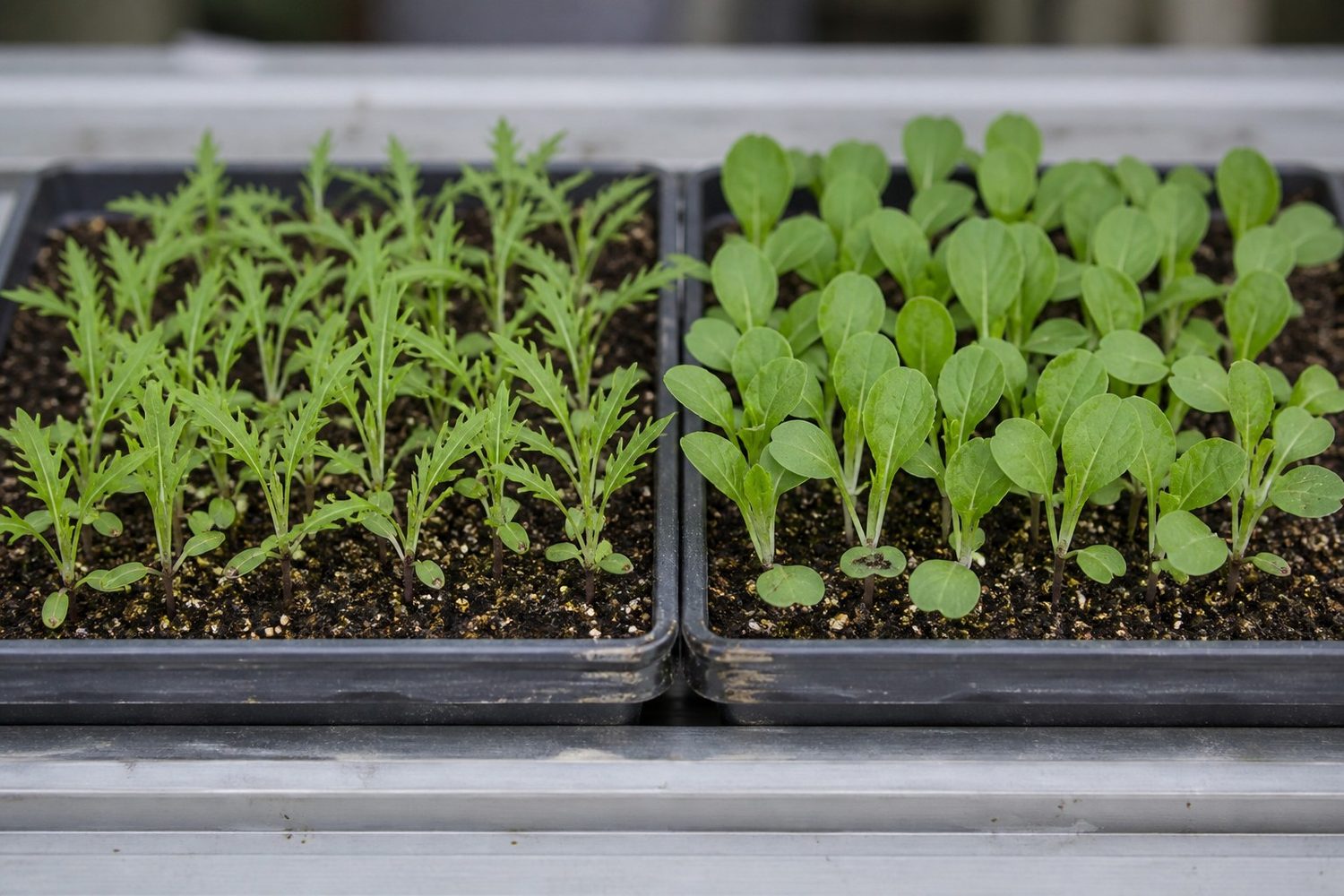
That puts it alongside komatsuna, pak choi and tatsoi, and **those Brassica rapa siblings cannot be told apart at cotyledon stage**. At cotyledons they are all rounded, mid-green and indistinguishable.
What separates mizuna is the first true leaf, and only the first true leaf. It comes in angular and toothed, almost feathery, where pak choi and tatsoi stay smooth and spoon-shaped. That is the whole tell, and it arrives at exactly the stage Johnny's harvests at. Anyone naming mizuna from a photograph of cotyledons is guessing.
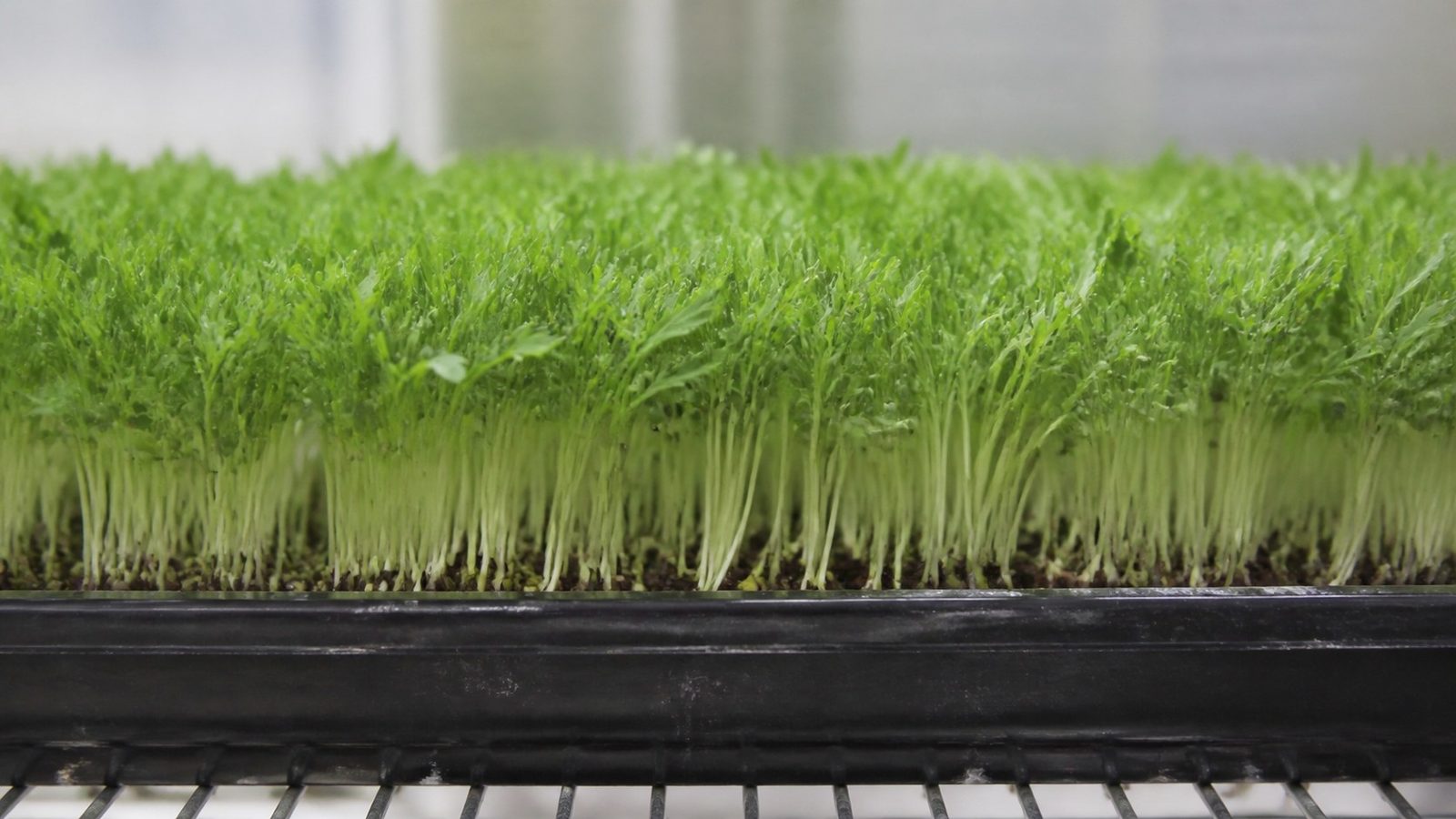
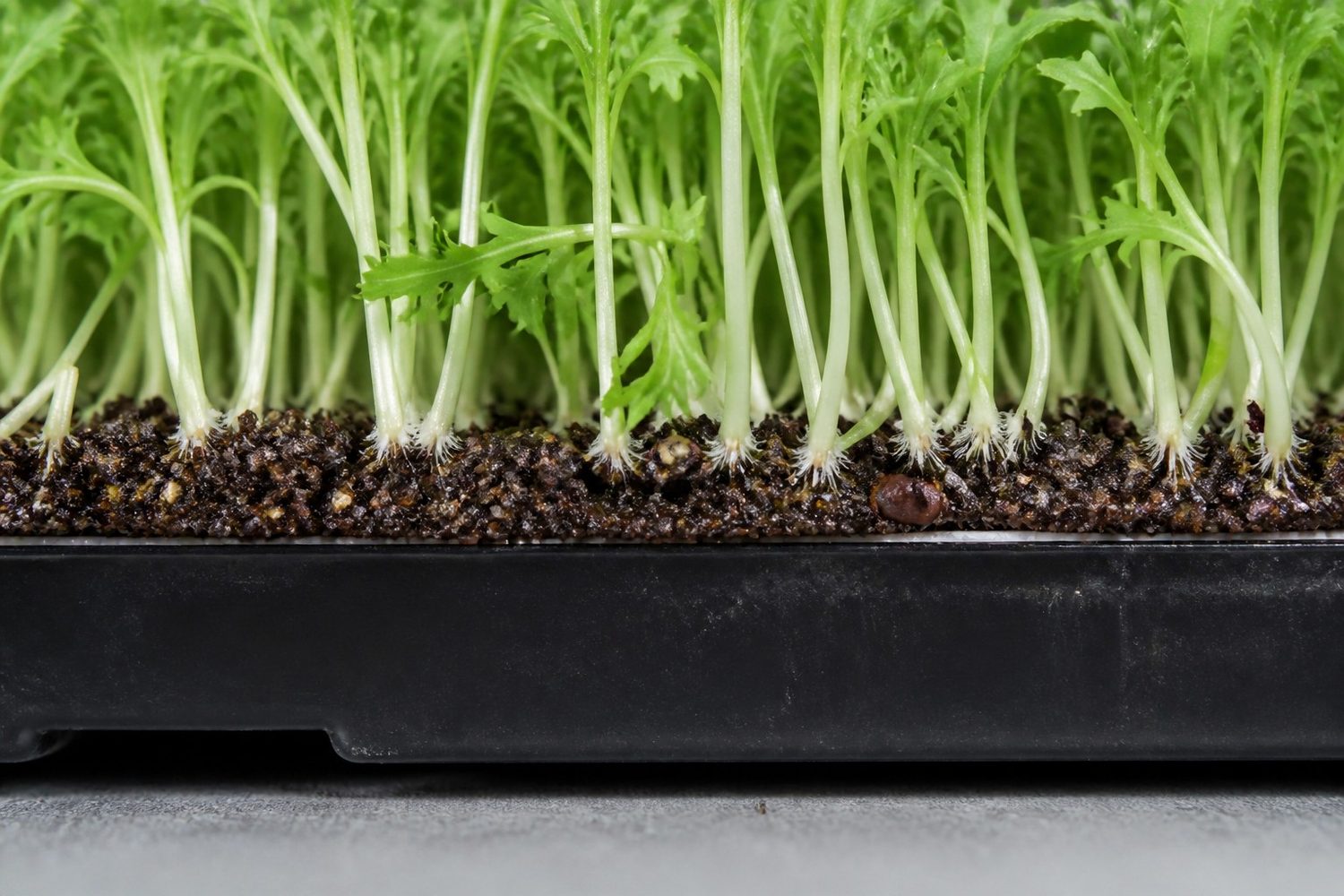
A correct tray at the trial's harvest point is dense, even and bright green, on fine pale stems, with the toothed leaves just showing above the cotyledon layer. Height is published only as the general brassica 0.5 to 2 inches, and one supplier gives 1.5 to 3 inches, both system dependent. At the medium there should be a fine mat of individual roots rather than any visible seed.
Red Kingdom F1 is the one genuinely different type: red true leaves over red-blushed cotyledons, at the same 9.5 g rate, and 14.5 days to first true leaf against green mizuna's 12. The red costs you two and a half days, which is the same trade kohlrabi asks for its purple.
What it tastes like, and what to do with it
Mild mustard with a light peppery edge and a little sweetness. It is a mustard green in the botanical sense and not in the culinary one: there is no heat here, nothing like mustard's bite, and nothing like radish's pepper.
That makes it a volume green rather than a condiment, which is unusual for a brassica. Fold it into a salad, layer it into a sandwich or a wrap, or scatter it over soup or noodles as they go out. Its selling point is the leaf shape: the toothed, feathery true leaf reads as deliberate on a plate in a way a rounded cotyledon does not, and that is worth more to a chef than another mild green.
It is the wrong choice twice over. If the dish needs a real mustard hit, mizuna will not deliver it at any density. And it will disappear under a hot dressing or a long sauté, because the stems are delicate and the flavor is quiet.
The person who will not like it is the person who dislikes even a faint mustard note, or the one who bought it expecting heat. Both are fit problems and neither is fixable in the tray. Nobody has run a consumer panel on this, so that is an inference from how the suppliers describe it rather than a measured preference.
Growing it: only what differs from the standard method
Everything general about trays, medium, light and watering is on the standard tray method for growing microgreens. Mizuna's deltas are short, and one of them is the whole page.
Nine and a half grams, not twenty-eight. This is the decision that matters and the sources disagree about it threefold. Johnny's measured 9.5 g in its 2017 trial and repeats the figure on the product page at about three flats to the ounce. An older Australian supplier guide specified 28 g per 10 by 20 tray for both green and red mizuna, without a harvest stage, but the same supplier's current chart gives 10 to 15 g and says the earlier 28 g for small-seeded crops was heavier than current references. Start at 9.5 g if you are growing to first true leaf. The arithmetic behind why is at the bottom of this page.
No soak, sown dry. The seed is small enough that soaking makes even distribution harder rather than easier, and no opened source establishes a mizuna soak that improves anything.
Two days of cover, and no weight. The cover is for dark, humid germination, and it comes off when germination is visible rather than on a schedule. Johnny's asks you to press the seed firmly into the medium for contact and allows a dome, and no source specifies a weight in pounds for a mizuna tray, so use enough for contact and treat a specific figure from anywhere as somebody's preference.
Broadcast at about an eighth to a quarter inch apart on level, pre-moistened medium. Level it more carefully than you think you need to: at this density a high spot dries and a low spot pools, and both show up later as patches you will blame on the seed.
Warm to germinate, then cool. Johnny's brassica guidance is 75°F at the medium until germination and 60°F after, with 65 to 75°F ambient generally favorable, and it warns that above 75°F disease pressure rises and germination can be inhibited. No mizuna-specific lower limit is published, so cold rooms are an unknown rather than a documented problem.
Bottom water, or mist finely. Splashing medium up onto seedlings this small is a real way to lose evenness, and a wet canopy is the front half of the mold problem.
A mizuna tray, day by day
- 1
Day 0, sow dry
9.5 g broadcast on leveled, pre-moistened medium, pressed firmly for contact. Cover on. Medium at about 75°F.
- 2
Days 1 to 2, covered
Germination is fast on this crop, reported at 1 to 2 days. The cover is for humidity and dark, and it carries no weight.
- 3
Day 2 or 3, uncover
Off as soon as germination is visible. This is where legginess is decided: light too far or off to one side and the stand leans, which is what the day-six clip in the pulse block shows.
- 4
Days 3 to 10, light and airflow
Drop toward 60°F, bottom water so the canopy stays dry, keep air moving. A dense stand that stays wet is the mold case.
- 5
Days 8 to 15, cut
Watch the true leaves, not the calendar. Toothed leaves just emerging above the cotyledons is the trial's stage, and the 9.5 g and 10 oz figures belong to it.
What goes wrong with mizuna specifically
Three failures, in the order they arrive.
Patchy or late emergence, before you can do anything about it. Uneven sowing depth or dry pockets in the medium, showing as bare areas once the usual one to two day germination has passed. There is no repair: you cannot seed into a running tray and get an even stand. The fix is the next sowing, and it is leveling and even broadcast rather than more seed.
Rot and damping-off at the medium line. Saturated medium, restricted airflow, too much seed, or dirty inputs. The early sign is collapse or rot at or just below the surface, and Pythium and Rhizoctonia are the usual organisms, general to seedlings rather than particular to mizuna. On a food crop this is a discard and a sanitize.
On a healthy tray the white fuzz at the medium line is root hair, not mold, and the rule is where it sits. Growth that stays at the roots and medium line is root hair; growth climbing the stems, spreading irregularly, running gray or green, or smelling sour, is not. Misting makes root hair collapse and reappear as it dries; it does nothing to mold. This is a grower's diagnostic and not an identification, and only a lab names an organism.
Leaning and stretching after the cover comes off. The characteristic mizuna complaint, and the one visible in the day-six clip above. The cause is light that is too far away, too weak, or off to one side. Correcting the light stops it getting worse and does not straighten what has already leaned.
The density question sits underneath two of those three. A 28 g tray is nearly three times a 9.5 g tray, and the cost of the higher rate is not seed money, it is airflow. The warning sign is a stand that stays visibly wet and crowded after germination rather than drying between waterings.
Late harvest is a product change, not a yield gain. Past first true leaf the crop stops being the compact tender thing the 10 oz benchmark describes and becomes a larger seedling. You can see it before you cut. No mizuna study measures what a day late costs in tenderness, flavor or shelf life, so the instruction is to watch the leaves.
Nutrition, and what is actually measured
Mizuna has more research behind it than most microgreens, and less than the headline claims suggest.
There is no USDA FoodData Central record for mizuna microgreens, searched 2026-08-09. The results are branded mature and baby mizuna and mixes. A mature mizuna entry is not a substitute, and neither is a mixed-greens one.
There are two real controlled studies, and both are about how you grow it. Di Gioia and colleagues (2023) grew Mizuna 'America' on a soilless fiber mat in a greenhouse, three replicates, harvested at 14 days, and measured a full mineral panel: fresh yield 1,211.7 g/m², potassium 341.34 mg and calcium 101.64 mg per 100 g fresh weight. Samuolienė and colleagues (2019) grew mizuna in a controlled chamber to 10 days under different LED spectra and found ascorbic acid moving from 21.1 mg per gram dry weight under blue and red to 57.7 under blue, red and orange, with beta-carotene, iron, magnesium and calcium shifting too.
Read those together and the useful conclusion is uncomfortable for the whole category. Nearly tripling the vitamin C by changing the light color, in one cultivar in one chamber, is a larger effect than most published mature-versus-microgreen comparisons. So, a nutrient number for mizuna microgreens describes a growing system, not a plant, and a claim that mizuna is "packed with" anything at a stated serving has no source behind it.
One measured number is worth stating plainly, because it points at how to eat this crop rather than at whether to. The same 2023 study recorded mizuna's nitrate at 4,602 mg per kg of fresh weight, the highest of the crops it compared. For scale, the EU caps fresh spinach at 2,500 to 3,000 mg/kg and most fresh lettuce between 2,000 and 4,500 depending on type and season. There is no microgreen limit anywhere, and those caps were written for vegetables eaten by the 100 grams.
That is the part that resolves it. A 20 gram garnish of mizuna at that concentration carries roughly 92 mg of nitrate; a 100 gram bowl of lettuce at its own legal cap carries around 350 mg. So, this is not a reason to avoid mizuna, and it is a reason not to treat leafy microgreens as a salad base you eat by the bowlful. It is one measurement, of one cultivar, in one hydroponic system, and it applies to the leafy-microgreen category rather than to mizuna alone. If you eat microgreens in quantity rather than as a finish, it is worth knowing that nobody has measured the exposure and that the crops with the highest leaf nitrate are the leafy ones.
Which seed to buy
Four things are sold and only two of them are real distinctions. Green mizuna, conventional or organic, is the same crop at two price tiers. Red Kingdom F1 is genuinely different: red true leaves, the same 9.5 g rate, 14.5 days rather than 12. Mizuna 'America' is the cultivar the research used and is worth naming if you want to compare your tray to a published figure. "Mizuna Green" on a packet is a color label, not a cultivar.
Specify untreated food-use seed, and check the label rather than the word organic. EPA labeling guidance requires treated seed without food or feed clearance to carry a "do not use for food or feed" statement, and microgreen production makes the seed part of the food crop from day zero. Organic is a separate production choice and not a substitute for reading the treatment disclosure.
Ask for the lot number, the germination test and its date. The research cultivar's lot tested at 95 percent germination, and Johnny's own conventional and organic pages list different seed counts per pound, 271,200 against 236,800, which is the practical reason not to dose by volume. A bad lot shows as patchy emergence under controlled moisture and temperature, and it costs the tray, the medium, ten days of shelf and the order, not just the seed.
Unusually, the seed house is cheaper than the marketplace here, and the shelf is genuinely well stocked. The Amazon search returns 129 results with seventeen mizuna microgreen listings on the first page, in real production sizes: Kitazawa 1 lb at $29.45 for about 208,000 seeds, Mountain Valley 1 lb at $31.34, Sustainable Seed organic 4 oz at $24.76, and a 4 oz bulk bag at $14.98. All of those are honest products and all of them are more expensive per pound than Johnny's $18.76. Buy the marketplace for a packet-sized trial and the seed house for a pound.
Mizuna microgreen seed on Amazon is the convenient route for a first tray. If you intend to sell what you grow, price the pound before you click.
Is it worth growing?
Yes, and for a beginner it is close to the ideal second tray after broccoli. It germinates in a day or two, wants no soak and no weight, carries a measured seed rate and a measured yield from the same trial as the crops you will compare it against, and it is the cheapest ounce of microgreen you can grow.
The catch is the one every mild brassica has: it is competing with the other mild brassicas for the same slot. Kale, green cabbage, kohlrabi, komatsuna and pak choi are all chasing the dense-tender-mild position, and most buyers cannot tell them apart on taste. Mizuna's argument is the leaf, which is the only one in the group that looks like something rather than like a generic green, and that is worth real money to a chef and nothing at all to a grocery buyer.
Choose something else if the buyer wants heat, if they want a second cut, or if they are buying by weight and will not pay for the shape. Mizuna does not regrow: the supplier says so outright, and succession sowing is the answer.
A note on the numbers above
Hover or tap a row to highlight it.
| Figure | Value | Source | What kind of number it is |
|---|---|---|---|
| Seed per 1020 | 9.5 g | Johnny's 2017 trial | Measured, at first true leaf |
| Seed per 1020 | 10 to 15 g | Seedmart's current seeding chart | Supplier chart, replacing its older 28 g |
| Seed per 1020 | 28 g | Australian supplier guide, older edition | Superseded by the same supplier |
| Yield per 1020 | 10 oz | Johnny's 2017 trial | Measured, at first true leaf, from 9.5 g |
| Yield per 1020 | 280 g, 9.88 oz | Australian supplier guide | Supplier estimate, from 28 g |
| Days to harvest | 12 | Johnny's 2017 trial | Measured, to first true leaf |
| Days to harvest | 10 to 15 | Johnny's product page | Published range, no stage stated |
| Days to harvest | 8 to 12 | Australian supplier guide | Estimate, no stage stated |
| Days to harvest | 10 to 15 | St. Clare | At 1.5 to 3 inches |
| Days to harvest, Red Kingdom | 14.5 | Johnny's | Measured, to first true leaf |
| Germination | 1 to 2 days | Australian supplier guide | Estimate |
| Seeds per pound | 271,200 conventional, 236,800 organic | Johnny's | Supplier counts, and they differ |
| Shelf life | Up to 5 days | St. Clare | Refrigerated, unwashed, airtight, paper-towel lined |
| Shelf life | 5 to 10 days | Johnny's | General microgreen guidance, no temperature or package |
| Fresh yield, research system | 1,211.7 g/m² | Di Gioia et al. 2023 | Measured, Mizuna 'America', 14 days, soilless mat |
| Nitrate | 4,602 mg/kg fresh weight | Di Gioia et al. 2023 | Measured, highest of the crops compared |
| Harvest window | No published figure | Nobody | Nobody has established it |
The seed rate is where the two sources part company, and the yield is where they meet. Johnny's measured 9.5 g and 10 oz. The supplier guide gives 28 g and 280 g, which is 9.88 oz. Three times the seed, and the same crop off the tray to within one percent. Only three explanations fit. Either mizuna's yield is genuinely flat across that range, which would be a real and useful finding and nobody has tested it. Or the two are harvesting at different stages, and the earlier, denser cut happens to weigh about the same as the later, thinner one. Or one figure is inherited rather than measured. The supplier has since lowered its rate to 10 to 15 g, close to Johnny's.
The one thing that is clear is which way to be wrong. If the yield really is flat between 9.5 g and 28 g, the higher rate costs you three times the seed for nothing and buys a crowded canopy on a crop whose main failure is a canopy that stays wet. Start at 9.5 g.
A sanity check on the rate, in seeds per square centimeter. Johnny's counts 271,200 seeds per pound, so 9.5 g is about 5,680 seeds. Spread over a 1020's 1,290 square centimeters that is roughly 4.4 seeds per square centimeter, which sits at the top of the two-to-four band a brassica tray runs at and well under the 12 per square centimeter the garden cress density study measured as peak biomass. The 28 g rate would be about 13 per square centimeter, just past the top of the range that study tested. So, the arithmetic does not condemn the higher rate outright; it puts it at the edge, which is consistent with it being an earlier-harvest number.
Mizuna gives the best value per dollar of any microgreen, at about 25 ounces per dollar of seed, ahead of arugula at 20.8 and lentil at 15.5. It gets there on the same route arugula does. Small brassica seed is cheap by weight, a light rate makes the tray cheap outright, and the yield does not scale down with the seed. Note that this is at the 1 lb price both crops are quoted at; at Johnny's 25 lb tier the same mizuna tray is 18 cents and the figure goes past 55, which is why the column is dated and the ranking rather than the number is the durable part.
On bench turnover mizuna is good and not exceptional, at 0.83 ounces per tray-day, fourth behind sunflower's 1.79, radish's 1.21 and broccoli's 0.92. The two columns disagreeing is the point cilantro's entry made first: cheap seed and fast benches are different questions, and which one matters depends on whether your constraint is cash or shelf space.
The harvest window is blank, and mizuna is the second flavor crop in a row that could not test the prediction. The lettuce entry proposed that crops sold on taste sharpen as they sit and get short windows, naming mizuna among the crops that should be narrow. Nobody has measured how long a mizuna tray holds, exactly as nobody has for mint. Two predictions, no data either time. As of 2026-08-09, 40 of the 44 entries written have no published window.
Hover or tap a row to highlight it.
| Crop | Seed per 1020 | Yield | Days | Cost per tray | Oz per $1 | Oz per tray-day |
|---|---|---|---|---|---|---|
| Broccoli | 13 g | 11.5 oz | 12.5 | $0.79 | 14.5 | 0.92 |
| Pak choi, Rosie | 10.5 g | 11 oz | 13 | $2.50 | 4.4 | 0.85 |
| Mizuna | 9.5 g | 10 oz | 12 | $0.39 | 25.4 | 0.83 |
| Kale, Red Russian | 10 g | 11 oz | 13.5 | $1.07 | 10.3 | 0.81 |
| Arugula | 10 g | 10 oz | 6 to 19 | $0.48 | 20.8 | 0.80 |
All 62 crops, sortable, on the microgreen comparison.
Mizuna is the second cheapest tray of seed here at 39 cents, behind only turnip at 31, and it is the one of the two that pairs a cheap tray with a measured double-figure yield. Recounted 2026-08-12: this sentence previously placed mizuna third behind celery at 14 cents, which is the sparse end of a calculated range rather than the $0.58 celery publishes, and behind lentil at 37 against its published 47. That combination is the whole reason it leads the value column.
Terms on this page
Tap a term to see what it means.
*Brassica rapa* var. *nipposinica*. Mizuna. Catalogues also write var. japonica, and the two names mean the same crop.
Sources
- Johnny's Selected Seeds, Mizuna microgreen seed - the 9.5 g recommendation at about 3 flats per ounce, 12 days to first true leaf, 10 to 15 days on the quick facts, 271,200 seeds per pound, the mild-flavored mustard description, and the price ladder from $5.94 for 1 oz to $216.00 for 25 lb, checked 2026-08-09.
- Johnny's organic Mizuna microgreen seed - the organic tier at $53.90/lb, 236,800 seeds per pound, and the toothed true-leaf description.
- Johnny's Mizuna Red Kingdom F1 microgreen seed - red true leaves at the same 9.5 g rate and 14.5 days to first true leaf.
- Johnny's microgreens yield trial results (PDF) - the 9.5 g, 10 oz, 12 day row for Mizuna OG.
- Johnny's yield trial, method and discussion - trial method, the first-true-leaf harvest standard, at least three seedings per variety, and the warning that one system's yields do not transfer.
- Seedmart, microgreen seeding density chart - the current 10 to 15 g per 1020 for mustard and mizuna, and the note that the earlier approximately 28 g per 1020 for small-seeded crops was heavier than current references.
- Seedmart Australia microgreen growing guide (PDF) - the conflicting 28 g per 10x20 rate, 280 g yield, 8 to 12 days, 2 days blackout, no soak, and 300 to 400 seeds per gram.
- St. Clare Seeds, Mizuna Green microgreen seeds - 10 to 15 days at 1.5 to 3 inches, the mild mustard and gentle pepper description, no regrowth after harvest, and up to 5 refrigerated days unwashed in a lined airtight container.
- Di Gioia et al., 2023, mineral composition of Brassicaceae microgreens, Frontiers in Plant Science - Mizuna 'America' at 14 days on a soilless fiber mat: 1,211.7 g/m² fresh yield, 341.34 mg potassium and 101.64 mg calcium per 100 g fresh weight, 95 percent lot germination, and nitrate at 4,602 mg/kg fresh weight, the highest of the crops compared.
- Samuolienė et al., 2019, LED spectra and microgreen composition, Frontiers in Plant Science - mizuna at 10 days with ascorbic acid at 21.1 mg/g dry weight under blue and red against 57.7 under blue, red and orange.
- EU Commission Regulation 1881/2006, nitrate maximum levels - the 2,500 to 3,000 mg/kg caps for fresh spinach and the 2,000 to 4,500 mg/kg range for fresh lettuce, and the absence of any microgreen category.
- UC IPM, damping-off - Pythium and Rhizoctonia, and symptoms at or below the medium line.
- LSU AgCenter, growing microgreens - the growth-up-the-stems rule for mold, and washing only immediately before use.
- US EPA pesticide label manual, chapter 18 (PDF) - the do-not-use-for-food-or-feed statement required on treated seed without food clearance.
- USDA FoodData Central - searched 2026-08-09, no mizuna microgreen record.
Keep reading
The variety directory
Arugula microgreens
Arugula is a seasoning green rather than a salad base: 10 g of seed makes 10 oz in 14 days, it is genuinely peppery, and its 10-day shelf life comes from a controlled storage study rather than an estimate.
Read Arugula microgreensThe variety directory
Broccoli microgreens
Broccoli takes 13 g of seed per 1020 tray and gives 11.5 oz at first true leaf, both from Johnny's trial. No soak, fast even germination, and the root-hair-or-mold test you will need in the first week.
Read Broccoli microgreensThe variety directory
Cabbage, red microgreens
Red cabbage is measured at 10.5 g per 1020 tray returning 8.5 oz, the lowest of the four mild brassicas measured in one trial. What it sells on is the purple veining, which no broccoli tray can give you.
Read Cabbage, red microgreensThe variety directory
Collard microgreens
The crop where more light did not buy more weight: collard was the documented exception in a controlled DLI study. Its mold risk is left blank because nobody has measured it.
Read Collard microgreens