At a glance
Fast reliable germination from unsoaked seed, but the 2 mm round seed rolls and bounces on an unlevel tray, so an even stand is a sowing-technique problem rather than a growing one.
- Botanical name
- Brassica oleracea var. gongylodes
- Also sold as
- Kohlrabi, Purple Organic Microgreen Seed, Purple Vienna, Early White Vienna, Purple Kohlrabi Micro-Greens
- Family
- brassica
- Difficulty
- Beginner
- Days to harvest
- 10 to 16 days
- Harvest window
- No published figure
- Seed per 1020 tray
- 9.5 g
- Soak
- None
- Blackout
- 4 to 6 days
- Germination temperature
- 65 to 75 °F
- Yield per 1020 tray
- 11 oz
- Mold risk
- Medium
- Hull shedding
- No published figure
- Shelf life
- 5 to 10 days
- Eaten as
- raw
- Seed cost per tray
- $0.89
9.5 g at $42.30/lb, Johnny's Purple Kohlrabi organic microgreen seed, listed 2026-08-08. A 1 lb bulk bag of Purple Vienna elsewhere runs $30.15, which works the same tray out at about $0.63. Seed only, excludes medium, tray, labor, light and loss.
Any field name above ranks every variety by it. No published figure means we researched it and nobody has established one, which is different from not yet researched. Every figure here is sourced at the bottom of the page. Compare every variety side by side.
Most crop comparisons you will read set numbers from different sources, systems and years against each other. Kohlrabi is one of the few where the comparison is clean, because the trade's 29-variety trial measured it alongside its two nearest rivals in the same greenhouse, in the same season, cut at the same stage.
Here is what that trial found:
- Kohlrabi: 9.5 g of seed, 11 oz, 16 days
- Kale, Red Russian: 10 g of seed, 11 oz, 13.5 days
- Broccoli: 13 g of seed, 11.5 oz, 12.5 days
Kohlrabi matches kale's weight from slightly less seed and takes two and a half days longer to do it. Broccoli gets marginally more in three and a half fewer days. On a bench, that is a straightforward loss to both.
So, nobody should grow purple kohlrabi for the yield. You grow it because the stems are purple, and the trial is unusually good at telling you what that costs: about 2.5 bench days against kale, for the same eleven ounces.
What growers are saying right now
Sampled from public posts and videos, 10 July to 9 August 2026. Every line links what it is quoting. How often something is repeated is not evidence that it is true, so every line also says what the sources actually establish.
Twenty grams a tray, and twenty grams is a very good rate
Circulating Said and weighed on camera by Princeton Microgreens, whose logo colors come from this crop, and matched across three filmed tests from On The Grow at 20 g, 25 g and about 15 g
Johnny's measured trial rate is 9.5 g. Four filmed runs from two commercial operations sit at 1.6 to 2.6 times that, which is about the widest trial-against-practice gap on any crop, wider even than broccoli's 13 g against 17 to 20. Neither side is careless and the systems differ, but the gap is large enough that a grower should know it exists before copying either number. What the two numbers are actually measuring
Purple kohlrabi is worth testing across media because the COLOR changes
Circulating A soils-versus-hydroponics comparison framed explicitly as a color test, one of four filmed kohlrabi trials from the same operation covering media, nutrients and grow mats
This is the strongest signal on the page about what the crop is for. Nobody runs four comparison trials on a crop they are growing for weight, and the thing being compared is how purple it comes out. It also means kohlrabi has a real filmed grower record behind it, which plenty of crops do not.
We use it on sandwiches in place of lettuce, and in smoothies
Circulating Said here by a commercial grower about their own crop
Worth taking seriously as a use, because it is a volume use rather than a garnish use, and it is unusual for a crop sold on color. Kohlrabi is mild enough to eat in quantity, which most of the visually striking microgreens are not. What it tastes like
What it is, and how to tell you grew it right
Kohlrabi microgreens are seedlings of Brassica oleracea var. gongylodes, the same species as broccoli, kale, cabbage and cauliflower and a different variety of it. The swollen stem that makes mature kohlrabi recognizable is irrelevant here; at eleven days there is nothing to swell.
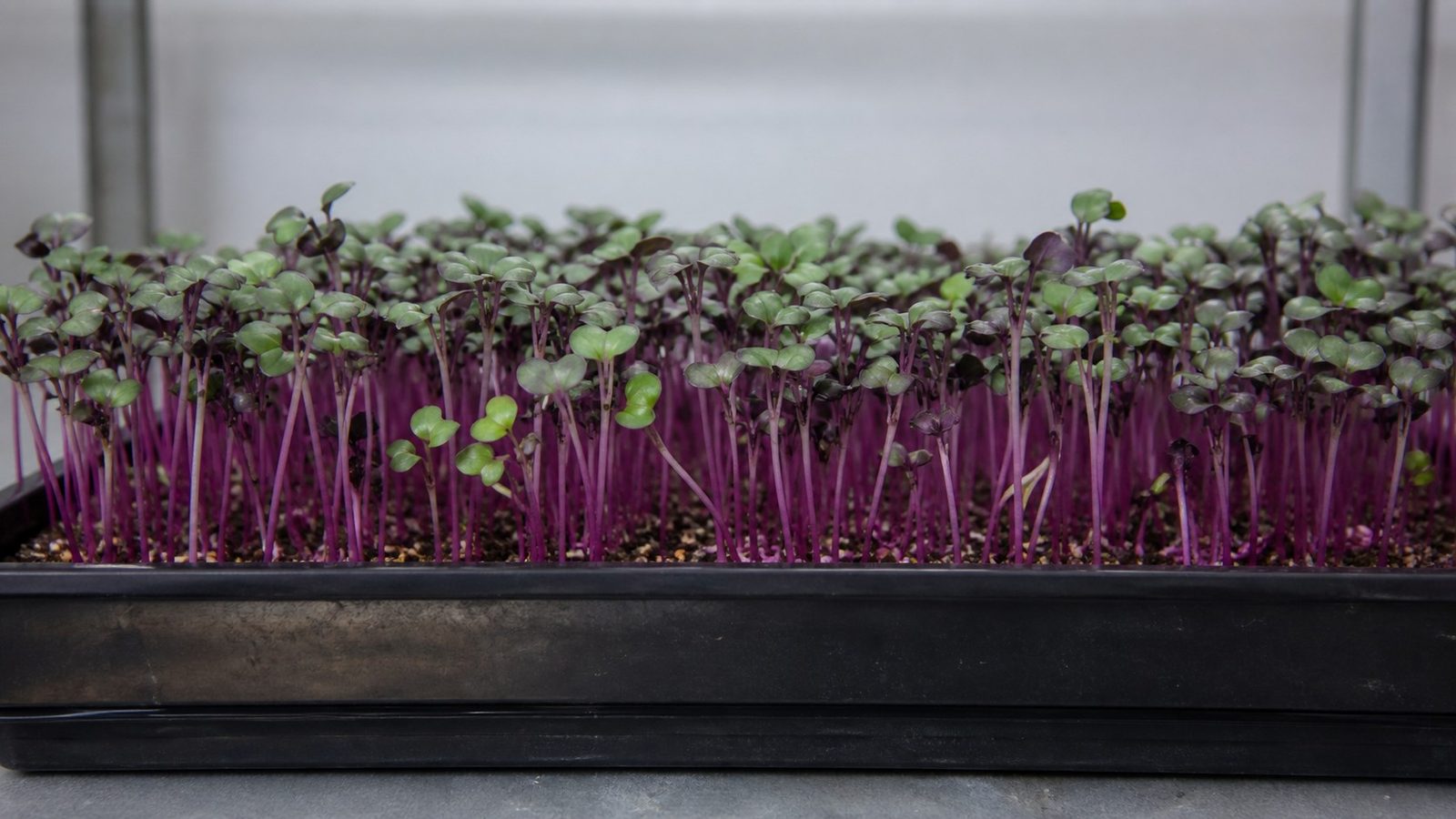
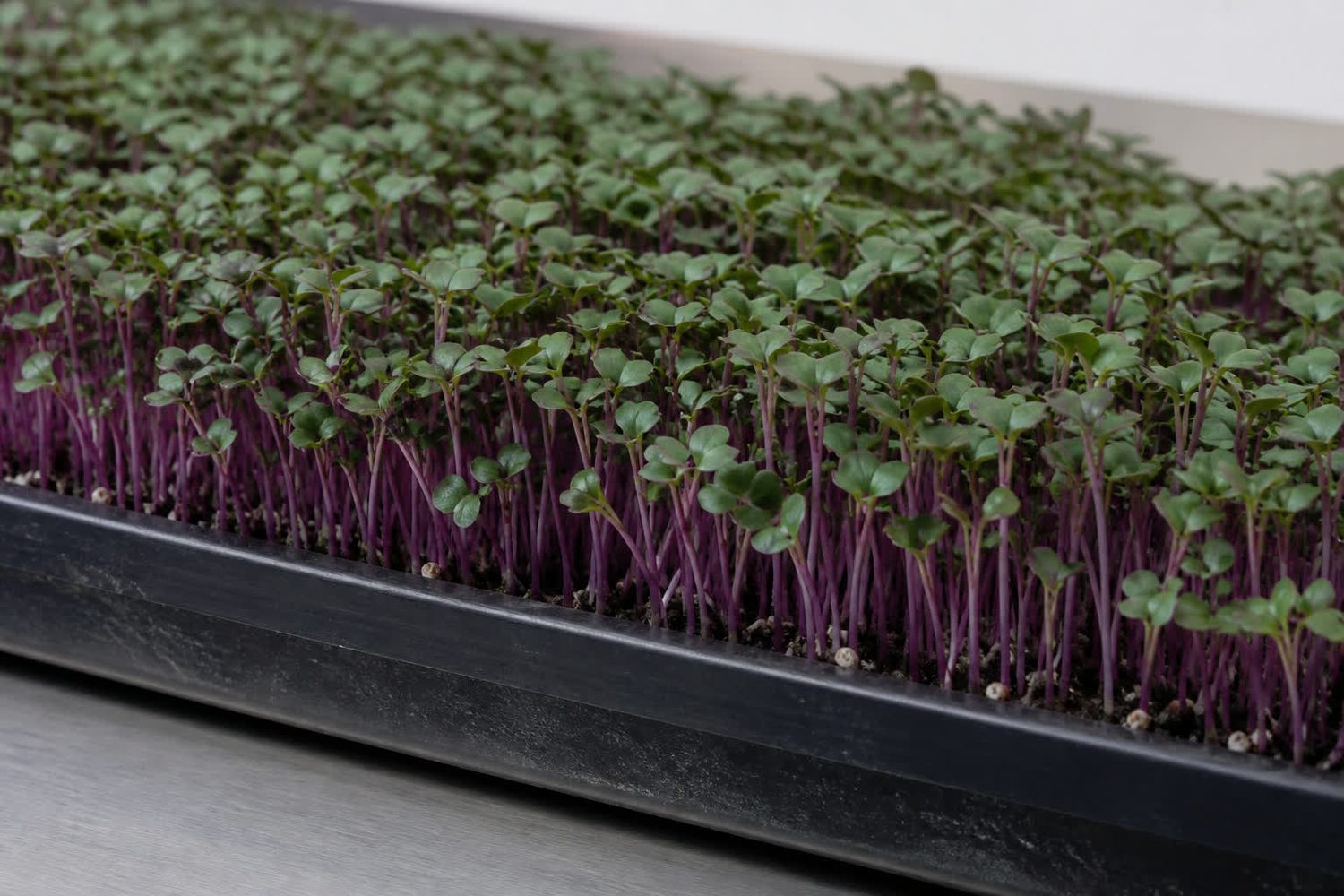
A correct tray is an even, dense stand of slender purple to rose stems carrying dark green cotyledons tinted purple, generally under six inches, and about three to four inches at a cotyledon-stage cut. The purple rises between the cotyledons and is strongest where the stem meets the leaf. The medium should be hidden by the stand rather than showing bare patches, and thin individual stems are normal while collapsed ones at the medium line are not.
There is no reliable way to tell it apart from purple cabbage or purple kale by looking at a tray, and no source opened for this page establishes one. Purple stems with green cotyledons are common across purple Brassica oleracea micros. Identify it from the labeled seed lot, not from a photograph, and be suspicious of anyone who claims otherwise.
The seed is round, hard and about 2 mm, which is large and mobile for a brassica. It rolls. That single physical fact drives most of the growing advice below.
What it tastes like, and what to do with it
Mild, slightly sweet cabbage, with much less pepper than radish or mustard. Johnny's calls it mild cabbage flavor and a second supplier calls it mild and sweet. It is tender rather than crunchy.
The color is louder than the flavor, and that is the point. Use it where a dish needs purple contrast without heat: through a raw salad mix, layered in a sandwich, over eggs, scattered on a pale soup or a grain bowl. A commercial grower quoted above uses it on sandwiches in place of lettuce and in smoothies, which tells you it is mild enough to eat by the handful rather than by the pinch. That is genuinely unusual for a crop grown on looks.
It is the wrong choice when a dish wants a spicy bite, where mustard or radish does the job, and when it wants bulk and substance, where pea or sunflower does. Anyone who dislikes cabbage-family flavor at any strength will not be won round by this one, and anyone hunting heat will find it underpowered.
Growing it: only what differs from the standard method
Everything general about trays, medium, light and watering is on the standard tray method for growing microgreens. Kohlrabi's deltas are short and most of them are about the seed rolling.
Level the medium properly before you sow, and press the seed in. A hard round 2 mm seed bounces off a dry or uneven surface and rolls into low spots and tray edges, which is how you get a stand that is crowded in the middle and bare at the rim. Pre-moisten, level, broadcast, then press for contact. Johnny's general brassica spacing is an eighth to a quarter inch apart with a firm press and only a light cover.
Do not soak. It germinates fast dry, some suppliers report within 24 hours, and wet seed is harder to spread evenly, not easier.
Use a weighted cover for two to three days, then blackout for two to three more. The weight is there so the radicles anchor into the medium rather than lifting the seed off it, which is the specific failure this crop has. Take the weight off when the germinated seedlings are lifting the tray above them. No controlled source gives a weight in pounds for a kohlrabi 1020; one grower guide reports 15 lb, and a filmed grower uses two bricks at about 14 lb, so treat those as reported technique rather than a standard.
Then bottom water. Nothing establishes that kohlrabi needs more or less light, water or airflow than a default brassica tray. The general microgreen light target is a daily light integral of 9 to 16, which is a baseline rather than a kohlrabi prescription.
Hold it at 65 to 75°F ambient, with 75°F at the medium until germination and 60°F after. Above 75°F, Johnny's warns that disease pressure rises and germination can be inhibited.
A kohlrabi tray, day by day
- 1
Day 0, sow dry
9.5 g on a LEVEL pre-moistened bed, pressed for contact. The round seed rolls, so leveling is the step that decides whether the stand is even.
- 2
Days 0 to 3, weighted cover
The weight anchors the radicles instead of letting them lift the seed. Off when the seedlings are pushing the tray above them.
- 3
Days 3 to 6, blackout
Two to three more dark days without weight. Pale bent stems at the end of this are normal and green up quickly.
- 4
Days 6 onward, light
Bottom water. The purple deepens in the stems from here, which is what you are growing.
- 5
Days 10 to 14, cotyledon cut
Fully open cotyledons, about three to four inches. The earlier commercial harvest.
- 6
Day 16, first true leaf
Where the trial's 11 oz was measured. Two and a half days behind kale for the same weight.
Nine and a half grams against twenty
You will meet both numbers within five minutes of searching, so it is worth knowing why they differ before you pick one.
Hover or tap a row to highlight it.
| Rate per 1020 | Source | What kind of number it is | Day of harvest |
|---|---|---|---|
| 9.5 g | Johnny's 2017 trial | Measured, seeded at least 3 times by weight, greenhouse | 16, first true leaf |
| about 15 g | On The Grow, grow-mat test | Filmed commercial practice, hydroponic mats | 12 |
| 20 g | Princeton Microgreens | Filmed commercial practice, weighed on camera | about 10 |
| 20 g | On The Grow, media test | Filmed commercial practice, soil and hydroponic | 11 |
| 20 to 25 g | Microgreen Silo grow guide | Written grower guidance | not stated |
| 25 g | On The Grow, nutrient test | Filmed commercial practice, hydroponic | 10 |
Neither side is wrong. The trial harvested at first true leaf on day 16; every filmed run cut at day 10 to 12, at or near cotyledons. A shorter crop cut earlier legitimately wants more seed, because less time in the tray means less growth per seedling to fill the same space. Johnny's own guidance says the same thing from the other direction: seed lower if you are holding for a larger true-leaf crop, because a thinner stand has better airflow and depletes water and fertility more slowly.
But the gap is bigger than that explanation comfortably covers. Two to two and a half times the seed is a lot to attribute to four days, and the same operation that sows 20 g reported a best harvest of 202 g, about 7.1 oz, from its four-media test at day 11. That is less weight than the trial's 11 oz from less than half the seed. The systems are not comparable, the harvest stages differ, and one filmed test is not a trial, so this is not a refutation. It is a reason to be curious rather than confident.
And there is one measurement that bears directly on it. Garden cress is the only crop where somebody has measured what sowing density actually costs: on cress, fresh biomass peaked at 12 seeds per square centimeter and did not improve at 14, while total aerobic bacteria rose about eightfold across that range. Cress is a different crop and that result does not transfer to kohlrabi by assertion. What it does establish is that "more seed" and "more crop" come apart at some point, and that the cost of overshooting is not visible in the tray.
What to actually do. Start at the trial's 9.5 g if you are holding to first true leaf, and somewhere in the mid-teens if you are cutting at cotyledons on day 10 or 11. Then weigh two trays at two rates in your own system, once, and stop guessing. That is an afternoon and it settles a question that the published record cannot.
What goes wrong with kohlrabi specifically
At sowing, bouncing and clumping. Seed collecting at the tray edges and in low spots, from a hard round seed on a dry or unlevel surface. This is the crop's signature failure and it is entirely preventable. Redistribute, press and re-mist before germination; afterward you are stuck with the stand you made.
Under the cover, lifted seed. Radicles and seedlings pushing the cover up instead of anchoring into the medium, from poor seed-to-medium contact. Recovery is limited once it has emerged. The short weighted phase is the prevention, and it is why this crop gets weight when several others do not.
From emergence, damping-off. Soft, pinched or rotting tissue at or below the medium line and seedlings simply missing. Pythium and Rhizoctonia under damp conditions, on a dense small-seed stand. A visibly rotting tray is not a trim-around-it recovery: remove the crop and fix the drainage, moisture and sanitation.
Root hairs, which look alarming and are not. Fine white fuzz on the roots that disappears when you water it, on firm upright stems. Mold does not vanish when wet, bridges between seedlings and the medium, and arrives with rot or collapse at the soil line. On this crop the watering test is documented in a supplier's own photo sequence, so it is more reliable here than on the mucilaginous crops where the gel confuses it.
After the cover, pale bent stems. Normal, and recoverable if the stems are intact. Get it under light promptly and it greens up.
Late, nothing measured. Past the stage you chose, no crop-specific source establishes what changes in flavor, fiber or saleability. True leaves beyond your intended stage are the observable signal that the tray has moved past the basis you planned on, and this page will not put a quality claim on top of that without evidence.
Nutrition, and what is actually established
There is no USDA record for kohlrabi microgreens, checked 2026-08-08. Mature kohlrabi values are a different food.
Two laboratory studies have measured this crop, and they are worth reporting precisely because they are so easy to misuse. A 2025 Brassicaceae study grew kohlrabi microgreens at 22°C under 16 hours of light and harvested at day 10, measuring phenols, flavonoids, anthocyanins, vitamin C, carotenoids and chlorophyll; within its purple group kohlrabi came out high in chlorophyll and moderate on the rest. A 2024 study compared six microgreens and reported kohlrabi at 23.30 mg GAE per gram dry mass of total phenolics and 1,495 mg per kg dry mass of vitamin C.
The part that needs care is the enzyme result. That same 2024 study put its samples through simulated digestion and found kohlrabi gave the strongest inhibition in its set of two digestive enzymes, alpha-amylase at about 63 percent and alpha-glucosidase at about 19 percent. Those enzymes break starch into sugar, and inhibiting them is roughly how one class of diabetes medication works, so this finding is one short step from "kohlrabi microgreens lower blood sugar".
It does not say that. It is an in-vitro assay on a dried, extracted sample in a tube. There is no dose, no food, no person and no measured blood sugar anywhere in it. A meaningful amount of the extract is not a portion of salad, and nothing establishes what quantity of fresh microgreen would do anything at all in a human. If you are managing blood sugar, treat this as a laboratory curiosity and not as a reason to change anything you eat or any medication you take. That is a conversation for a clinician, not a garnish.
And the claim you will actually meet is that kohlrabi microgreens supply over 100 percent of the daily value of vitamin C. No crop-specific serving-size source supports it, and the vitamin C figure above is per kilogram of DRY mass, which is not a serving of anything.
Which seed to buy
Two named types are sold, and choosing between them decides whether the crop has a point.
Purple Vienna is the microgreen type. It gives the purple to rose stems that are the entire reason to grow this instead of kale, and it is what Johnny's 9.5 g and 11 oz figures were measured on. Early White Vienna is the garden type, grown for pale bulbs, and as a microgreen it is a green-stemmed mild brassica with no color advantage at all. Buy that one by accident and you have bought a slower kale: the same mild brassica flavor and a similar stand, arriving two and a half days later, with nothing to show for the wait.
That distinction matters more than usual because of what the shelf looks like. Kohlrabi seed on Amazon checked on 2026-08-09 returns 162 results with 27 kohlrabi listings on the first page, and White Vienna outnumbers Purple Vienna roughly two to one. Only ten of the 27 mention microgreens or sprouting at all, and several of those are blends rather than kohlrabi on its own: a Mellow Microgreen Salad Mix, a Superfood mix, a bulk salad mix, a color bundle. Purple kohlrabi's most common role on that shelf is as an ingredient in somebody else's mix, which is itself a comment on what the trade grows it for.
This is a different shelf problem from the seed-crops. Fennel, fenugreek, flax and garden cress all have a large culinary SEED market, so their searches fill up with product sold to be eaten rather than sown. Kohlrabi has no seed-eating market. Its competition is the GARDEN market for the mature bulb, so the seed is the right plant, sold for the right purpose, in the wrong cultivar. Nothing on those White Vienna listings is misleading; they are simply for growing kohlrabi rather than for growing kohlrabi microgreens.
So: specify Purple Vienna, untreated, sold for edible microgreens or sprouting, with lot identity. Refuse treated field seed, because dyes, fungicides and insecticides on treated seed can be present in shoots eaten a fortnight later. And note that price varies a lot at bulk: Johnny's organic runs $42.30 a pound where a 1 lb bag of Purple Vienna elsewhere is $30.15, which moves the same tray from 89 cents to about 63.
A bad lot shows as low or uneven emergence despite a level, evenly distributed sowing. Johnny's publishes about 190,900 seeds per pound, but no lot-to-lot germination study exists for this crop, so ask for a documented germination test before committing a rack.
Is it worth growing?
Yes, for one reason, and it is a good enough reason.
Purple kohlrabi is easy, fast to germinate, needs no soak, costs under a dollar of seed, and gives a real measured 11 ounces to plan against rather than an estimate. It is a genuinely good beginner crop. And it is purple, where most of the mild, high-yielding, easy crops are uniformly green.
The cost is the one in the table above: 2.5 days more than kale for the same eleven ounces, and 3.5 more than broccoli for slightly less. If your bench is the constraint, grow kale. If your cash is the constraint, kohlrabi is actually the better of the two, at 12.4 ounces per dollar of seed against kale's 10.3, because its seed is cheaper per tray. Those two sentences point in opposite directions and both are true; which one applies depends on whether you are short of rack space or short of money.
Grow something else if you want heat, if you want bulk, or if sixteen days is too long for the slot. Grow this when a customer is buying with their eyes.
A note on the numbers above
Hover or tap a row to highlight it.
| Figure | Value | Source | What kind of number it is |
|---|---|---|---|
| Seed per 1020 | 9.5 g | Johnny's 2017 trial | Measured, about 3 flats per ounce |
| Seed per 1020 | 15 to 25 g | Four filmed grower runs | Commercial practice at an earlier cut. See the density section |
| Yield per 1020 | 11 oz | Johnny's 2017 trial | Measured, at first true leaf, 16-day average |
| Yield per 1020 | 202 g, about 7.1 oz | On The Grow, best of four media | One filmed test at day 11, from 20 g, different system |
| Days to harvest | 16 | Johnny's 2017 trial | Measured, to first true leaf |
| Days to harvest | 10 to 15 | Johnny's product page | Published range, no stage stated |
| Days to harvest | 10 to 14 | Gardyn | At fully open cotyledons |
| Germination temperature | 75°F then 60°F at the medium | Johnny's brassica guidance | Crop guidance, not a kohlrabi trial |
| Blackout | 2 to 3 weighted, then 2 to 3 | Grower guide | Reported technique. 15 lb reported, no standard exists |
| Shelf life | 5 to 10 days | Johnny's | No temperature or package stated |
| Total phenolics | 23.30 ± 2.44 mg GAE/g DRY mass | 2024 six-microgreen study | Laboratory, dried extract, not a serving |
| Vitamin C | 1,495 ± 17 mg/kg DRY mass | 2024 six-microgreen study | Same. Per kilogram of dry mass, not per portion |
| Enzyme inhibition | 63% alpha-amylase, 19% alpha-glucosidase | 2024 study, simulated digestion | IN VITRO. Not a blood-sugar result. See the nutrition section |
| Seeds per lb | About 190,900 | Johnny's | |
| Seed price | $42.30/lb organic, $30.15/lb Purple Vienna bulk | Johnny's and Amazon, 2026-08 | Current listings |
| Harvest window | No published figure | Nobody | How long a READY tray holds is unmeasured |
| USDA record | None for the microgreen | FoodData Central | Mature kohlrabi is a different food |
This is a within-trial comparison and that is rarer here than it sounds. Kohlrabi, kale and broccoli were seeded at least three times each by weight, grown in the same greenhouse between mid-August and late October, and all cut at first true leaf. Almost every other comparison in the table at the bottom of this page is assembled across different sources, systems and years, and carries the uncertainty that implies. These three can be read against each other directly, which is why this entry leads with them rather than with a claim about kohlrabi alone.
The 11 oz still comes with the trial's own warning. Johnny's says plainly that results vary with procedure, system, conditions, harvest stage and seed lot, and that one grower's data are unlikely to transfer perfectly to another's. Weigh your own trays.
The seed rate in the spec block is the trial's, not an average. Averaging 9.5 g with a filmed 25 g would produce a number that describes nobody's practice and no measurement. The two figures are kept apart, with their harvest stages attached, in the density section above.
Hover or tap a row to highlight it.
| Crop | Seed per 1020 | Yield | Days | Cost per tray | Oz per $1 | Oz per tray-day |
|---|---|---|---|---|---|---|
| Mustard, Garnet Giant | 8 g | 9.5 oz | 12.5 | $1.56 | 6.1 | 0.76 |
| Broccoli raab | 12 to 37 g | 5.29 to 8.82 oz | 7 to 12 | $0.49 | 14.4 | 0.74 |
| Kohlrabi, Purple Vienna | 9.5 g | 11 oz | 10 to 16 | $0.89 | 12.4 | 0.69 |
| Cabbage, Red | 10.5 g | 8.5 oz | 13.5 | $1.27 | 6.7 | 0.63 |
| Tatsoi | 7.5 g | 8.5 oz | 13.5 | $0.93 | 9.1 | 0.63 |
All 62 crops, sortable, on the microgreen comparison.
Kohlrabi is the clearest case in this table of the two money columns disagreeing. It sits below kale on tray-day, at 0.69 against 0.81, and above kale on value per dollar, at 12.4 against 10.3. Same weight, cheaper seed, slower bench. Carrot is the extreme version of the same split and the reason this table has two columns instead of one.
Terms on this page
Tap a term to see what it means.
*Brassica oleracea* var. *gongylodes*. Kohlrabi. The same species as broccoli, kale, cabbage and cauliflower, and a different variety of it.
Sources
- Johnny's Selected Seeds, microgreens yield trial results (PDF) - kohlrabi at 9.5 g per 1020, 11 oz, 16 days to first true leaf, alongside Red Russian kale at 10 g, 11 oz, 13.5 days and broccoli at 13 g, 11.5 oz, 12.5 days, all in the same trial at the same stage.
- Johnny's microgreens yield trial, method and discussion - the greenhouse method, at least three seedings per variety by weight, and the warning that one system's yields do not transfer.
- Johnny's Kohlrabi, Purple organic microgreen seed - Brassica oleracea var. gongylodes, purple stems with purple-tinted dark green leaves, mild cabbage flavor, 10 to 15 days, 75°F then 60°F at the medium with the above-75°F warning, 5 to 10 days storage, about 190,900 seeds per pound, and the $42.30 per lb price behind the seed-cost calculation, listed 2026-08-08.
- Princeton Microgreens, how to grow kohlrabi microgreens - 20 g per tray weighed on camera, a roughly 10-day crop, and purple Vienna kohlrabi as the crop in the channel's own logo.
- On The Grow, purple kohlrabi soils versus hydroponics color comparison - 20 g per tray across four media, day 11 harvest, a best total harvest weight of 202 g, and the framing of the whole test as a color comparison.
- On The Grow, MaxiGro versus OceanSolution on purple kohlrabi - 25 g per tray, day 10 harvest, and the grower's own use of the crop on sandwiches in place of lettuce and in smoothies.
- On The Grow, hemp versus bamboo grow mats for purple kohlrabi - about 15 g per tray, two bricks at about 14 lb as the cover weight, and a day 12 harvest.
- Microgreen Silo, purple kohlrabi grow guide - the roughly 2 mm round seed that bounces on an unlevel tray, 20 to 25 g per 10 by 20, the 2 to 3 day weighted phase then 2 to 3 blackout days, and 15 lb as a reported weight.
- Sproutpeople, purple kohlrabi micro-greens - the no-soak method, germination within 24 hours in its photo sequence, mild and sweet flavor, a 7 to 14 day seller range, and the root-hair-disappears-when-watered documentation.
- Gardyn, kohlrabi microgreens - 10 to 14 days at fully open cotyledons, a Beginner rating, and the explicit statement that harvested seedlings do not regrow.
- Home Microgreens, Purple Vienna kohlrabi - the photographed stand, the 3 to 4 inch cotyledon-stage height, and uneven sowing as the repeated handling error.
- 2025 Brassicaceae microgreens study, Antioxidants - kohlrabi grown at 22°C under 16 hours of light and harvested at day 10, high in chlorophyll and moderate in the other measured groups within its purple set.
- 2024 six-microgreen comparison with simulated digestion - kohlrabi at 23.30 ± 2.44 mg GAE/g dry mass total phenolics, 1,495.05 ± 16.57 mg/kg dry mass vitamin C, and the in-vitro alpha-amylase and alpha-glucosidase inhibition figures this page declines to read as a blood-sugar result.
- UC IPM, damping-off - Pythium and Rhizoctonia, and damp conditions favouring disease.
- Virginia Tech Extension SPES-756 (PDF) - the general microgreen daily light integral of 9 to 16, used as a baseline rather than a kohlrabi prescription.
- SDSU Extension, growing microgreens at home - about a week refrigerated in general, and the warning that seed treatments can be present in the shoots that are eaten.
- USDA FoodData Central - searched 2026-08-08, no kohlrabi microgreen record.
Keep reading
The variety directory
Arugula microgreens
Arugula is a seasoning green rather than a salad base: 10 g of seed makes 10 oz in 14 days, it is genuinely peppery, and its 10-day shelf life comes from a controlled storage study rather than an estimate.
Read Arugula microgreensThe variety directory
Broccoli microgreens
Broccoli takes 13 g of seed per 1020 tray and gives 11.5 oz at first true leaf, both from Johnny's trial. No soak, fast even germination, and the root-hair-or-mold test you will need in the first week.
Read Broccoli microgreensThe variety directory
Cabbage, red microgreens
Red cabbage is measured at 10.5 g per 1020 tray returning 8.5 oz, the lowest of the four mild brassicas measured in one trial. What it sells on is the purple veining, which no broccoli tray can give you.
Read Cabbage, red microgreensThe variety directory
Collard microgreens
The crop where more light did not buy more weight: collard was the documented exception in a controlled DLI study. Its mold risk is left blank because nobody has measured it.
Read Collard microgreens