At a glance
A short, forgiving window from germination to a first-true-leaf cut, and Johnny's lists the kales among its explicit easy starting picks, though a dense saturated tray can still damp off.
- Botanical name
- Brassica oleracea var. sabellica
- Also sold as
- Red Russian, Toscano, Bright Green Curly, KX-1, Unicorn, Kalefetti Mix
- Family
- brassica
- Difficulty
- Beginner
- Days to harvest
- 8 to 15 days
- Harvest window
- No published figure
- Seed per 1020 tray
- 10 to 10.5 g
- Soak
- None
- Blackout
- No published figure
- Germination temperature
- 65 to 75 °F
- Yield per 1020 tray
- 11 oz
- Mold risk
- Medium
- Hull shedding
- No published figure
- Shelf life
- 5 to 10 days
- Eaten as
- raw
- Seed cost per tray
- $1.07
10 g at $48.50/lb, Johnny's organic Red Russian kale microgreen seed, listed 2026-08-08. Seed only, excludes medium, tray, labor, light and loss.
Any field name above ranks every variety by it. No published figure means we researched it and nobody has established one, which is different from not yet researched. Every figure here is sourced at the bottom of the page. Compare every variety side by side.
Kale is measured at 10 grams of seed per 1020 tray returning 11 ounces at first true leaf, which puts it within half an ounce of broccoli on yield while using less seed. The two crops are close to interchangeable in a tray. What you are actually buying when you choose kale is Red Russian's purple stems and the word on the label, so pick on that rather than on a performance difference that is not there.
There is a wrinkle underneath all of it. Kale is generally Brassica oleracea var. sabellica, but Johnny's own Red Russian page labels that particular seed Brassica napus, a different species. Red Russian is also the only kale anyone has put through a trial. So, every published kale microgreen figure in existence, including the ones at the top of this page, comes from the cultivar whose botanical name does not match the crop it is sold as.
What growers are saying right now
Sampled from public posts and videos, 9 July to 8 August 2026. Every line links what it is quoting. How often something is repeated is not evidence that it is true, so every line also says what the sources actually establish.
Run the fan the moment they come out of blackout
Circulating The practical answer on the month's kale thread in r/microgreens, from u/jackbenway: "Run the fan as soon as they're out of blackout. 12 hour light cycle is adequate. Bottom water 1 or 2 times daily. Less water more frequently is better."
Worth knowing that this is filling a real hole rather than repeating a manual. Neither kale supplier page nor the yield trial publishes a blackout period, a tray weight, or a light schedule for this crop. The only documented instruction is the general one, uncover once most seedlings have germinated. On the most-recommended beginner crop in the category, the growers are ahead of the literature. The blackout nobody publishes
213 grams in 9 days
Circulating The headline number on a soil-free Red Russian grow-along, and the kind of figure that gets compared against everything else
Not in conflict with the trial, and not comparable to it either. Johnny's measured 11 oz, about 312 g, at 13.5 days from a full 1020 sown at 10 g. A different tray size, a different medium and an earlier cut produce a different number for good reasons. Read the tray size before you compare two yields. Where each number comes from
Everybody grows Red Russian
Circulating It is close to the only kale on camera. A step-by-step, an easy-grow walkthrough, another, and a recent how-to
They are right to, and it matters more than it looks. Red Russian is the only kale with a measured seed rate and yield behind it, so it is the only one you can plan against. It is also the one Johnny's labels Brassica napus rather than B. oleracea, which means the entire published evidence base for kale microgreens rests on a cultivar whose species does not match the name on the bag. Which seed to buy
All of those microgreens in one scoop
Circulating The biggest-reach microgreen content of the month by a wide margin, and none of it is about growing. A powder promotion at 138,609 views and 1,762 likes, and a second at 96,663 views
There is no kale microgreen record in USDA FoodData Central at all, only a branded mix. And the one accessible kale study cuts both ways rather than one: comparing 15-day microgreens against 60-day adult kale, the microgreens came out higher in minerals and one antioxidant measure while the adult kale came out higher in phenolics and total carotenoids. "More nutritious" is not uniformly true even against mature kale. What is actually established
Grow it without soil
Circulating The dominant format in the window. Kratky hydroponics at 19,309 views, a hydroponic tray on TikTok, and dino kale on a silicone medium
No opened source establishes a kale-specific advantage to a soilless medium, and the one benchmark this crop has, 10 g and 11 oz at 13.5 days, came from a soil-based greenhouse trial. Growing without soil is a perfectly good choice. Comparing its yield against that benchmark is not, because you changed the basis. Where each number comes from
What it is, and how to tell you grew it right
Kale microgreens are seedlings of kale, cut above the medium once the cotyledons are fully developed or the first true leaf begins to emerge. The trade sells at least six of them for microgreen use: Red Russian, Toscano, Bright Green Curly, KX-1, Unicorn, and a Kalefetti mix.
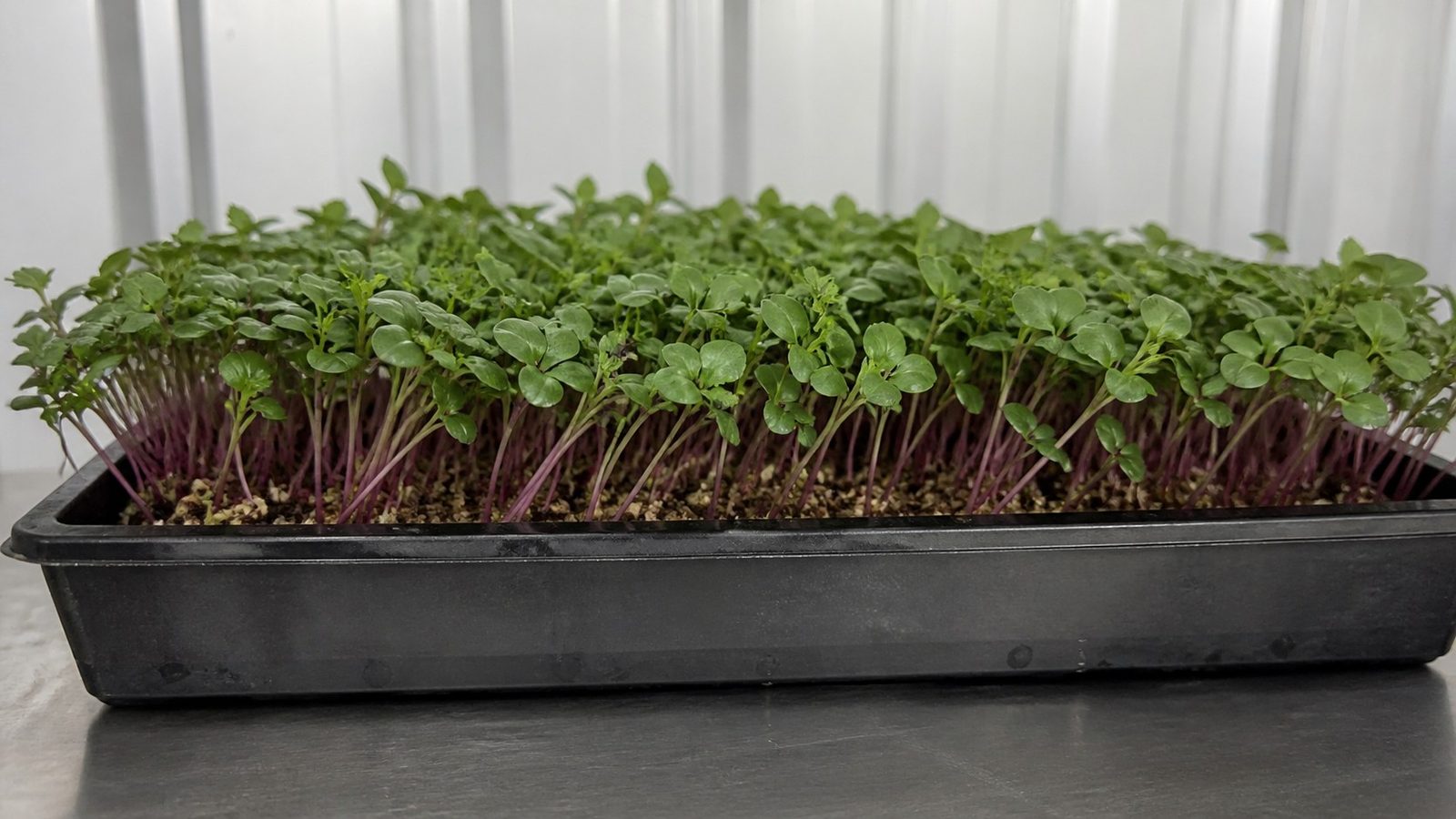
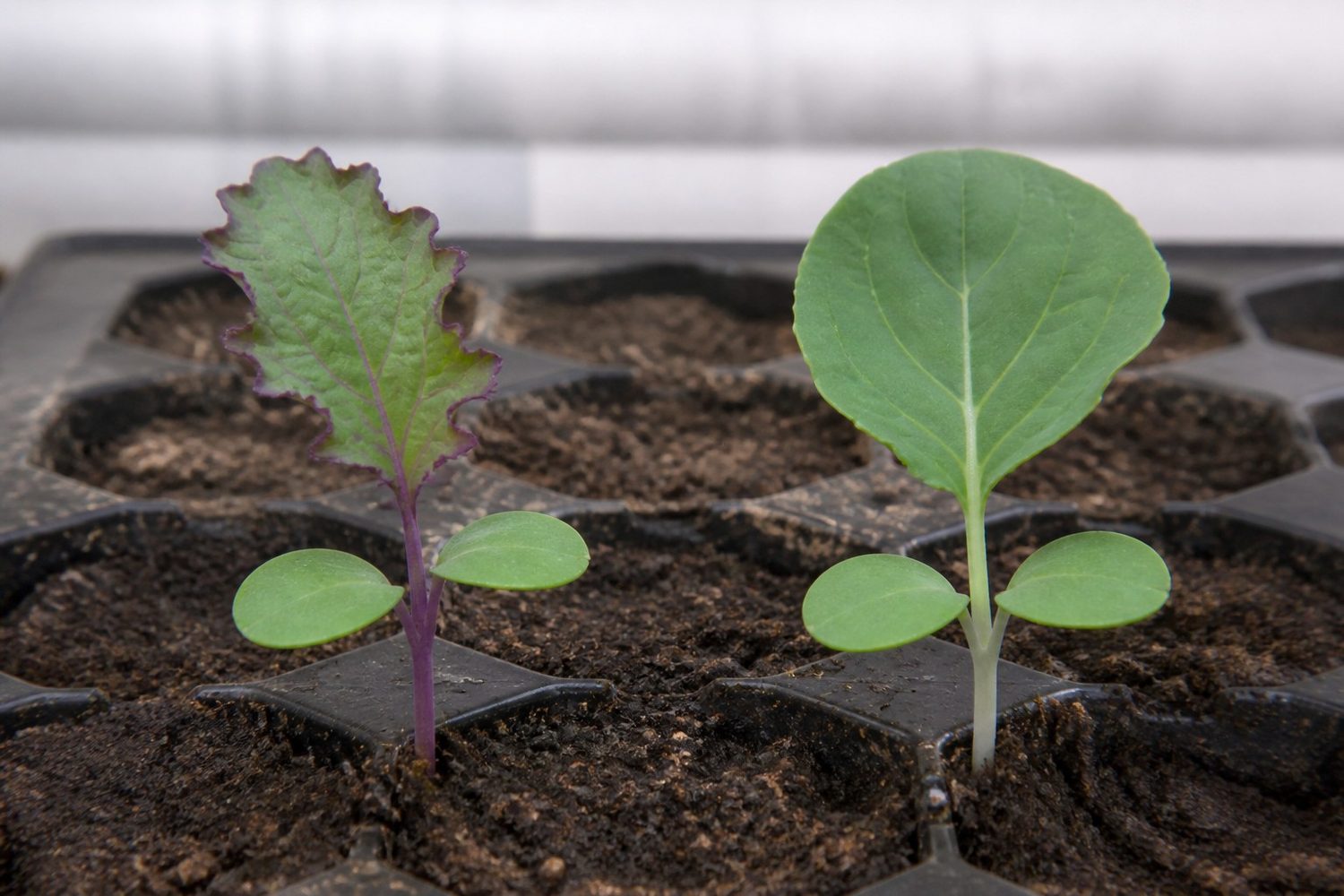
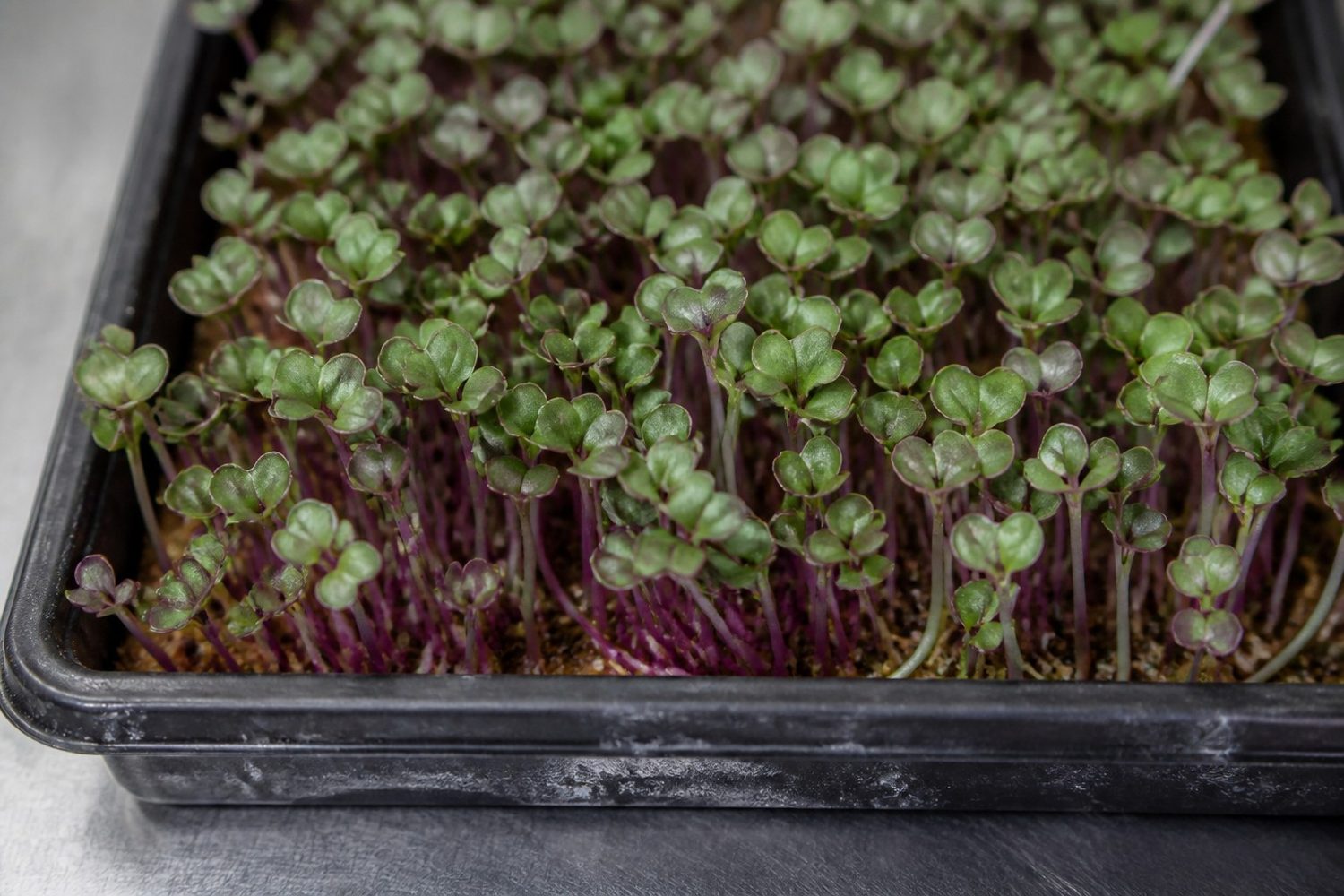
A correct tray is a short, even stand of two rounded mid-green cotyledons on fine light stems, roughly half an inch to two inches tall, cut clean above the medium. It should not look like miniature mature kale: no blue-green cast, no waxy coating, none of the crinkle. Cultivar changes the picture more here than on most crops. Red Russian carries bright purple on the stems and leaf margins and produces serrated first true leaves. Toscano is the exception in the other direction, the darkest green of the kales on light green stems.
It is confused with broccoli, and at cotyledon stage there is no honest way to tell them apart. The cotyledons and the fine light stems are near identical, and nothing opened for this page offers a reliable one-glance test. That is the truthful answer, and the practical consequences follow from it: either wait for the first true leaf, or keep the seed identity and label the tray. On Red Russian specifically the true leaf settles it, because it comes in serrated with bright purple margins and stem. That tell belongs to Red Russian, not to kale in general, so do not expect a green cultivar to announce itself the same way.
What it tastes like, and what to do with it
Mild and gently earthy, recognizably kale without the toughness or the bitterness the mature leaf can carry. Johnny's describes Red Russian as mild kale flavor and Toscano as mild and earthy. There is no heat in it at all.
That mildness is the whole use case. Kale microgreens are volume rather than accent: fold them through a salad, layer them into a sandwich, put them on an entree as a light garnish. They are tender enough to eat in quantity, which is the thing mature kale is not, and that contrast is worth more to a customer than any flavor note you could write.
It is the wrong choice when the plate wants heat, in which case radish or mustard does the job, and it is the wrong choice when someone wants the chew of mature kale, which no microgreen will give them.
The people who will not like it are the ones who do not like brassica flavor at all, even mild. That is a real group and there is nothing to be done about it. Nobody has run a consumer sensory study on kale microgreens, so how large that group is remains genuinely unknown.
Growing it: only what differs from the standard method
Everything general about trays, medium, light and watering is on the standard tray method for growing microgreens. Kale barely departs from it, so there is less to learn here than on most crops.
Ten grams per 1020, not twenty to thirty. Johnny's ran Red Russian in its 2017 trial at 10 g per tray, about three flats to the ounce of seed, and repeats the figure on the product page. Toscano's page lists 10.5 g. Kale seed runs about 146,600 seeds to the pound, so this is a fine-seeded crop and it should be sown by weight rather than by eye. Seed lower if you intend to grow past first true leaf, because a thinner stand has better airflow and depletes water and fertility more slowly. Do not raise the rate until a trial in your own system shows the stand stays healthy.
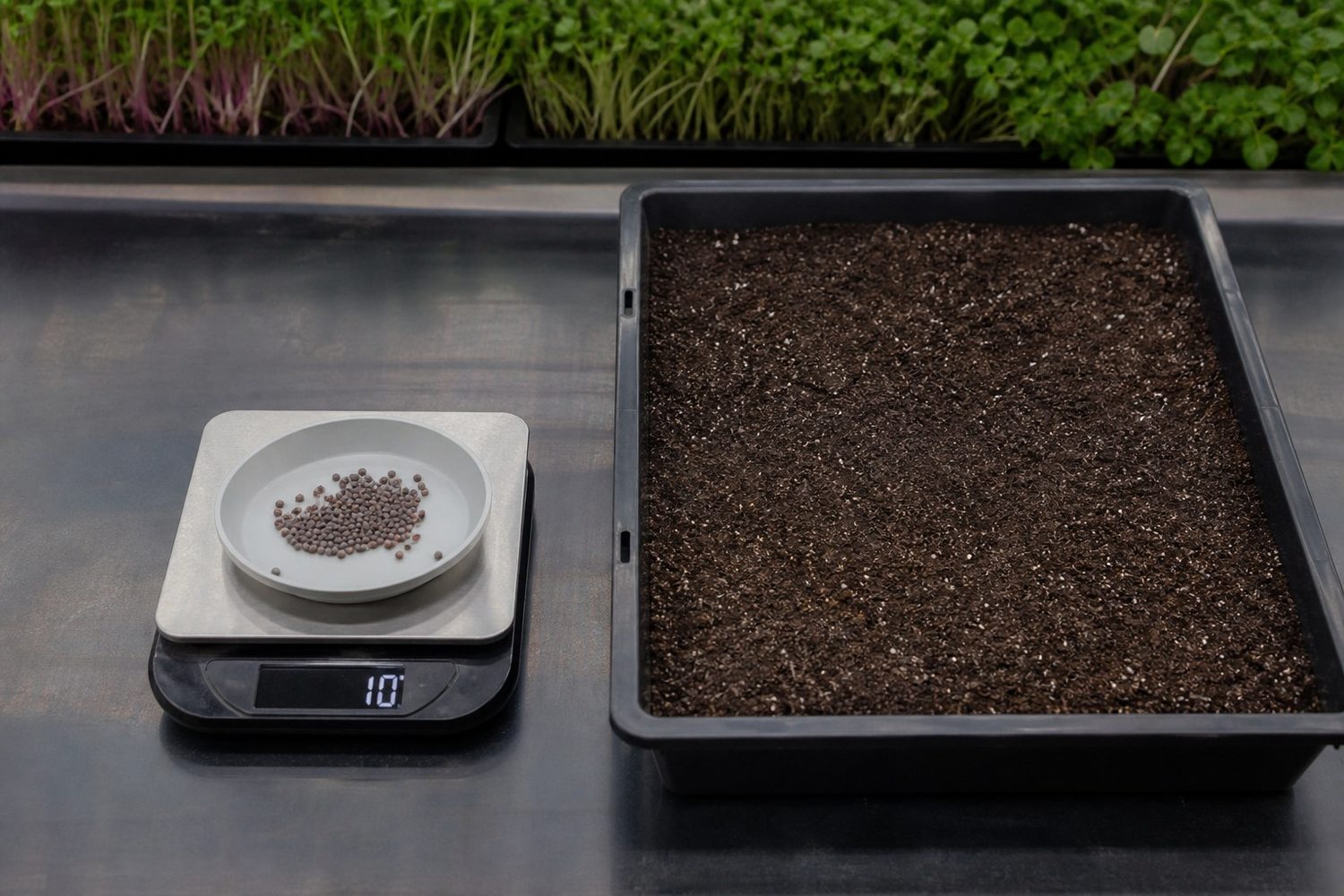
No soak, and no source says otherwise. The documented instruction is to broadcast dry, press firmly into the medium for contact, then cover lightly with mix or vermiculite, or use a humidity dome. Nothing opened for this page establishes a useful soak time or water temperature for kale seed. The federal seed-testing table does not prescribe one either.
Broadcast at an eighth to a quarter inch apart and press, do not bury. Bottom water or mist rather than watering overhead, because the crop is short and overhead flow splashes medium up into it.
Warm to germinate, then cool. Johnny's calls for 75°F at the medium until germination and 60°F after it, with 65 to 75°F ambient generally favorable, and warns that above 75°F germination can be inhibited and disease pressure rises. Virginia Tech's general microgreen target is 60 to 70°F.
The blackout is the real gap on this crop. Neither kale supplier page nor the yield trial gives a number of blackout days or a weight in pounds, which is a strange hole in the crop the category most often hands to beginners. What is documented is the signal rather than the number: uncover once the majority of seedlings have germinated, which across species generally falls between two and five days. So, a kale-specific blackout schedule from anywhere is somebody's preference rather than a published figure, and on this crop the growers on r/microgreens are ahead of the literature.
A kale tray, and where the published instructions stop
- 1
Day 0, sow dry
10 g broadcast on leveled, pre-moistened medium at an eighth to a quarter inch apart, pressed firmly for contact, covered only lightly or domed. No soak. Medium at about 75°F.
- 2
Covered phase, length not published
Held dark and humid. No kale source gives a number of days or a weight. Across species the general figure is two to five days, and the documented instruction is a signal rather than a schedule.
- 3
Uncover on the signal
When the majority of seedlings have germinated. That is the only removal instruction anyone publishes for this crop.
- 4
After uncovering, light and air
Drop the medium toward 60°F, bottom water or mist so the foliage stays dry and the medium does not splash. Growers add: fan on immediately, twelve hours of light, and little water often rather than a lot occasionally.
- 5
Days 8 to 15, cut
Watch the leaves, not the calendar. Cotyledons fully developed with the first true leaf beginning is the trial's harvest standard, and 13.5 days was its average.
What goes wrong with kale specifically
Kale has no signature failure of its own. What it has is the general seedling disease complex, made likelier by the one thing this crop does do differently, which is grow densely at 10 g in a tray.
Before emergence: seed rot and a stand that never arrives. Pythium can begin at the root tips, and those seeds are not recoverable. You find out by counting gaps.
Just after emergence: damping-off. A water-soaked or darkened, pinched stem at or below the medium line, then toppling. Individual seedlings do not recover, so remove them and fix the cause, which is nearly always drainage or airflow rather than anything to do with kale.
Then: spread through a wet, crowded tray. More gaps, more collapse. Shared water and shared medium carry the pathogen, so a broadly affected food tray is a discard rather than a treatment problem. Pythium favors cool and wet; Rhizoctonia will work warmer and drier. Neither is a kale disease.
Root hairs or mold, and the stem check that settles it
Hover or tap a card to highlight it.
Spray it
Root hairs are thin and fuzzy at the root zone and lose the fuzzy look when wetted. Mold is gray and spidery and goes MORE web-like when it gets wet.
Where it sits
Root hairs stay at the root and medium line. Growth crossing between seeds or climbing the stems is not root hair.
Then check the stem, which is the part people skip
Real damping-off shows rot and collapse AT the medium line. Harmless root fuzz never pinches or darkens a stem. If the stems are sound, the fuzz is not your problem.
Smell it
Nothing much is correct. Musty or sour is not.
What it means
Root hairs mean the tray is working. Collapse at the line on a food crop means discard and sanitize, and fix drainage and airflow before the next sowing.
And the one that is about timing rather than disease. Kale's measured figures belong to a first-true-leaf cut. Johnny's notes that each day past that can materially change plant size and yield, and advises sowing lower if you intend to grow larger. You can see it coming: true leaves progressing well beyond the first, and the stand starting to crowd and shade itself. What nobody has measured is what that costs you in texture, flavor or saleability.
A bad lot looks like technique. It presents as a low, patchy or delayed stand at a sowing weight you know is right, which is exactly what a watering mistake looks like. Test a retained sample before committing trays. Worth knowing that Johnny's trial excluded obvious poor-germination flats from its averages, which is precisely why a published average cannot certify a lot you just bought.
Nutrition, and what is actually established
There is no kale microgreen entry in USDA FoodData Central, checked 2026-08-08. The search returns a branded product, BRIGHTFRESH MICROGREENS MICRO KALE MIX, FDC ID 1549661, which is a mix and not a composition record for kale. It also returns mature raw kale entries, which are a different food at a different stage and are not a substitute.
The accessible kale-specific literature is one study, and it is more interesting than a marketing line would be. Zanzini and colleagues (2020) grew kale in trays and compared 15-day microgreens against 40-day baby leaves and 60-day adult plants, measuring carotenoids, minerals, phenolics and antioxidant capacity. The result runs in both directions: the microgreens and baby leaves carried higher micronutrient levels and higher phosphomolybdenum antioxidant capacity, while the adult kale carried higher phenolics and higher total carotenoids.
That is the useful finding, and it is the opposite of the claim in circulation. On the compounds this study measured, the mature leaf beat the microgreen on two of them. Anyone telling you kale microgreens are simply more nutritious than kale is not describing this study, and no other kale-specific composition source exists to describe instead. A fixed vitamin K or vitamin C figure, a multiple against mature kale, or the word superfood, are all unsupported here.
Which seed to buy
Two cultivars have real published detail behind them and the rest do not.
Red Russian is the default and the only one with trial numbers: medium-green serrated leaves, bright purple stems and margins, mild kale flavor, 10 g per tray, 13.5 days to first true leaf, and 11 oz average yield. Toscano is the visual opposite, the darkest green of the kales on light green stems, mild and earthy, listed at 10.5 g per tray and 13 days. Between them they cover the two looks a buyer might want.
Bright Green Curly, KX-1, Unicorn and the Kalefetti mix are all sold for microgreen use, and none of the opened listings gives a measured stem length, days to harvest or yield for any of them. Their mature-kale reputations do not transfer, so treat those four as untested rather than assuming the name tells you something.
Order seed sold explicitly for microgreens or food use, name the cultivar and the lot, and require untreated seed. SDSU Extension is direct about why: seed treatments may be present in the young shoots, and the shoots are what gets eaten. Organic is useful additional assurance and is not a substitute for a clean system. And specify the cultivar rather than accepting generic kale, because Red Russian's purple stem is the reason a buyer picks this crop over broccoli, and generic kale might arrive green.
Kale microgreen seed on Amazon is the convenient route for a home grower. If you are selling, buy where the cultivar and lot are named.
Is it worth growing?
Yes, and the reason is narrower than the category pretends.
By the numbers kale and broccoli are close to the same crop. Kale uses 10 g against broccoli's 13, returns 11 oz against 11.5, and takes 13.5 days against 12.5. Nothing there is a reason to choose one over the other. What is a reason: Red Russian's purple stems, which broccoli cannot produce at any seed rate, and a label that says kale, which some buyers want specifically. If neither of those matters to your customer, broccoli is the cheaper tray and the better choice.
It suits the beginner who wants a mild brassica on a short cycle, the market grower who now has a real 10 g and 11 oz benchmark to plan against rather than a guess, and the home grower who wants something to eat by the handful rather than a garnish. Choose something else if the buyer wants heat, if they want a crop that cuts twice, or if the pack needs a color no kale produces.
Its competition is broccoli first, on the mild green brassica slot, and then cabbage and kohlrabi in the same lane. Against radish and mustard it is not really competing on flavor at all, only for space on the rack.
A note on the numbers above
Hover or tap a row to highlight it.
| Figure | Value | Source | What kind of number it is |
|---|---|---|---|
| Seed per 1020, Red Russian | 10 g | Johnny's 2017 trial | Measured, at first true leaf |
| Seed per 1020, Toscano | 10.5 g | Johnny's product page | Published rate, no trial stated |
| Yield per 1020, Red Russian | 11 oz | Johnny's 2017 trial | Measured, at first true leaf, three-plus seedings |
| Days to harvest | 13.5 average | Johnny's 2017 trial | Measured, to first true leaf |
| Days to harvest | 10 to 15 | Johnny's product page | Published range |
| Days to harvest | 8 to 14 | Virginia Tech | Crop table, no stage stated |
| Days to harvest, Toscano | 13 | Johnny's product page | Published, first true leaf |
| Seeds per pound | 146,600 | Johnny's Red Russian lot | A lot specification, not a constant |
| Germination temperature | 75°F then 60°F | Johnny's | Crop guidance, not a trial |
| Germination test temperature | 68 to 86°F | 7 CFR 201.58 | A federal TEST protocol, not a grow target |
| Shelf life | 5 to 10 days | Johnny's | No temperature or package stated |
| Shelf life | About a week | SDSU and Purdue | Refrigerated, unwashed, wash before eating |
| Blackout | No published figure | Nobody | No kale source gives days or a weight |
| Harvest window | No published figure | Nobody | 13.5 days is a timing, not a window |
| Hull shedding | No published figure | Nobody | Not measured either way on this crop |
| Seed cost per 1020 | $1.07 | Calculated, Johnny's Red Russian | 10 g at $48.50/lb, listed 2026-08-08 |
Ten grams will look like too little on the tray, and it is the measured figure. Johnny's seeded Red Russian at 10 g and took 11 oz off it at first true leaf. If you have been sowing a fine-seeded brassica by eye rather than by scale, you are probably putting down two or three times that, and the extra seed buys density and disease pressure rather than weight. Broccoli sits in the same place at 13 g. Weigh it, accept that the sowing looks sparse, and let the canopy fill in.
Three fields are blank on purpose, and the blackout one is the surprise. Nobody publishes how long a kale tray holds a good cut, nobody has measured hull retention on it either way, and, more oddly, no supplier page and no trial gives a blackout period or a tray weight for kale at all. That last gap sits on the crop this category most often recommends to a beginner. Blank here means no published figure exists, which is different from not applicable and different again from nobody having looked.
Days to harvest spans 8 to 15 because three sources measured different things. Johnny's trial averaged 13.5 days to first true leaf, its product page says 10 to 15, and Virginia Tech's crop table says 8 to 14 without stating a stage. Toscano's page says 13. They are not in conflict; they are answering slightly different questions, and only the trial figure carries a stated harvest stage.
One number on this page is a test protocol, not a growing instruction. The 68 to 86°F range is what the federal seed-testing table specifies for a standardized kale germination test, with a first count at three days and a final count at ten. It describes a laboratory procedure. It is not a recommendation for your rack, and it circulates as though it were.
Hover or tap a row to highlight it.
| Crop | Seed per 1020 | Yield | Seed price | Cost per tray | Oz per $1 of seed |
|---|---|---|---|---|---|
| Broccoli | 13 g | 11.5 oz | $27.60/lb | $0.79 | 14.5 |
| Kale, Red Russian | 10 g | 11 oz | $48.50/lb | $1.07 | 10.3 |
| Radish, Hong Vit | 28.5 g | 11.5 oz | $31.95/lb | $2.01 | 5.7 |
| Radish, Daikon OG | 22.5 g | 8 oz | $31.95/lb | $1.58 | 5.0 |
That last table is the one nobody else can build, and it only became possible once four crops had been researched to the same standard with prices dated the same day. All four land within three and a half ounces of each other on yield, and they are nearly three times apart on what that yield costs in seed. Broccoli returns 14.5 oz per dollar of seed and Daikon radish returns 5.0. Radish earns its place on speed and on color, not on economics, and that is a conclusion no single-crop page could ever reach. Prices move, so the dollar figures are dated rather than permanent; the ranking is the durable part.
Terms on this page
Tap a term to see what it means.
Cotyledon. The seed leaf, and most of what you eat. Kale's are rounded and mid-green, and they are indistinguishable from broccoli's.
Sources
- Johnny's Selected Seeds, kale Red Russian organic microgreen seed - 10 g per 1020, 10 to 15 days, mild kale flavor, serrated leaves with purple stems and margins, 146,600 seeds per pound, dry sowing at an eighth to a quarter inch, 75°F then 60°F with 65 to 75°F ambient and the above-75°F warning, 5 to 10 days storage, the Brassica napus labeling, and the $48.50/lb price behind the cost calculation, listed 2026-08-08.
- Johnny's kale Toscano organic microgreen seed - 10.5 g per tray, 13 days to first true leaf, darkest green leaves on light green stems, mild and earthy.
- Johnny's microgreens yield trial results (PDF) - Red Russian at 10 g per 1020, 11 oz average, 13.5 days to first true leaf, about three flats per ounce of seed, and the rounding and variation caveats.
- Johnny's microgreens yield trial, method and discussion - the 2017 greenhouse method, at least three seedings per variety, exclusion of poor-germination flats, the advice to sow lower for larger plants, and the warning that one system's yields do not transfer.
- Johnny's microgreens, top picks for getting started - the kales listed among the explicit easy starting choices.
- Johnny's microgreen catalogue - Bright Green Curly, KX-1, Unicorn and Kalefetti sold for microgreen use with no measured figures published.
- Virginia Tech Extension SPES-756 (PDF) - kale as B. oleracea var. sabellica, the 8 to 14 day range, the 60 to 70°F general target, uncovering once most seedlings have germinated at typically two to five days, and damping-off as the leading disease concern.
- SDSU Extension, growing microgreens at home - salad, sandwich and garnish uses, about a week refrigerated in a bag or container, rinsing in cool water before eating, and why treated seed is unacceptable on a crop eaten as young shoots.
- Purdue Extension, grow microgreens at home - about a week unwashed in the refrigerator, washed just before eating.
- UC IPM, damping-off - Pythium and Rhizoctonia, Pythium often beginning at root tips, and the conditions each favors.
- UMN Extension, how to prevent seedling damping-off - the failure sequence and why a broadly affected tray is a discard.
- Oregon State Extension, high desert gardening newsletter, April 2025 (PDF) - the water test for root hairs against mold, and mold becoming more web-like when wetted.
- 7 CFR 201.58, federal seed-testing table - the standardized kale germination test at 20 to 30°C with a first count at three days and a final count at ten, and no presoak.
- Zanzini et al., 2020, kale at three growth stages - 15-day microgreens against 40-day baby leaves and 60-day adult plants, with microgreens higher in micronutrients and phosphomolybdenum antioxidant capacity while adult kale was higher in phenolics and total carotenoids.
- USDA FoodData Central - searched 2026-08-08, no single-ingredient kale microgreen record; FDC ID 1549661 is a branded micro kale mix, and mature raw kale entries are a different food.
Keep reading
The variety directory
Arugula microgreens
Arugula is a seasoning green rather than a salad base: 10 g of seed makes 10 oz in 14 days, it is genuinely peppery, and its 10-day shelf life comes from a controlled storage study rather than an estimate.
Read Arugula microgreensThe variety directory
Broccoli microgreens
Broccoli takes 13 g of seed per 1020 tray and gives 11.5 oz at first true leaf, both from Johnny's trial. No soak, fast even germination, and the root-hair-or-mold test you will need in the first week.
Read Broccoli microgreensThe variety directory
Cabbage, red microgreens
Red cabbage is measured at 10.5 g per 1020 tray returning 8.5 oz, the lowest of the four mild brassicas measured in one trial. What it sells on is the purple veining, which no broccoli tray can give you.
Read Cabbage, red microgreensThe variety directory
Collard microgreens
The crop where more light did not buy more weight: collard was the documented exception in a controlled DLI study. Its mold risk is left blank because nobody has measured it.
Read Collard microgreens