At a glance
Small dry brassica seed with no soak that germinates in one to two days and reaches a usable cut inside two weeks, with no handling quirk of its own.
- Botanical name
- Brassica oleracea var. viridis
- Also sold as
- Collard Microgreen Seeds, Vates, Georgia Southern, Champion, Morris Heading
- Family
- brassica
- Difficulty
- Beginner
- Days to harvest
- 7 to 15 days
- Harvest window
- No published figure
- Seed per 1020 tray
- 28.35 g
- Soak
- None
- Blackout
- 3 days
- Germination temperature
- No published figure
- Yield per 1020 tray
- No published figure
- Mold risk
- No published figure
- Hull shedding
- No published figure
- Shelf life
- 5 days
- Eaten as
- raw
- Seed cost per tray
- $0.90
1 oz (28.35 g) at $14.40/lb, Everwilde Vates collard seed, accessed 2026-08-08. Priced from a garden-seed listing rather than a documented microgreen lot. Seed only, excludes medium, tray, labor, light and loss.
Any field name above ranks every variety by it. No published figure means we researched it and nobody has established one, which is different from not yet researched. Every figure here is sourced at the bottom of the page. Compare every variety side by side.
Collard germinates in a day or two at around 75F and cuts as a mild, substantial brassica. If you already grow brassicas, nothing about the method will surprise you.
A controlled study grew Vates collard alongside other microgreens and raised the daily light integral from roughly 14.5 to 21.7 moles per square meter per day while keeping a 16-hour photoperiod. The other crops responded the way you would expect. Collard did not. The paper calls it the exception outright: the usual clear increase in fresh weight simply did not appear. More light bought dry matter and antioxidant measures, and it did not buy more collard.
So, on collard, more light is not the lever. If the stand is not performing, look at density, moisture and airflow first.
Mold risk is left unrated for this crop, because no source gives one and guessing at it from other brassicas would not help you.
What growers are saying right now
Sampled from public posts and videos, 10 July to 9 August 2026. Every line links what it is quoting. How often something is repeated is not evidence that it is true, so every line also says what the sources actually establish.
Collards tolerate frost and keep producing for months with regular harvesting
Circulating A gardener's beginner tips at 1,085 likes, alongside fall planting and companion planting with onions and garlic
True, and it is the best thing about the plant, and the tray throws it away. A collard microgreen does not regrow; the supplier's own instruction is to succession sow. This is the second crop on this site, after chives, whose garden form is cut-and-come-again for months and whose tray form is one cut and start again. Is it worth growing
Heirloom varieties like Nancy Malone Wheat Purple Collards let you save your own seed year after year
Circulating The same gardener, explaining letting the pods dry on the plant after bolting
Worth knowing before you buy, because collard seed is small and abundant at roughly 8,000 seeds an ounce, and one bolted plant makes a lot of it. It is also a reminder that this crop has many named varieties and nobody has compared any of them as microgreens. Which seed to buy
When to grow collards, so you can work out the ideal time where you live
Circulating A seasonality explainer at 1,065 likes, which is the shape of most collard content
Seasonality is the field crop's whole problem and the tray has none of it. Indoors at around 75F this germinates in one to two days in any month, which is the one clear advantage the microgreen has over the plant it comes from.
What it is, and how to tell you grew it right
Collard microgreens are seedlings of Brassica oleracea var. viridis, the same species as broccoli, kale, cabbage and cauliflower, and often sold under the older Acephala Group name.
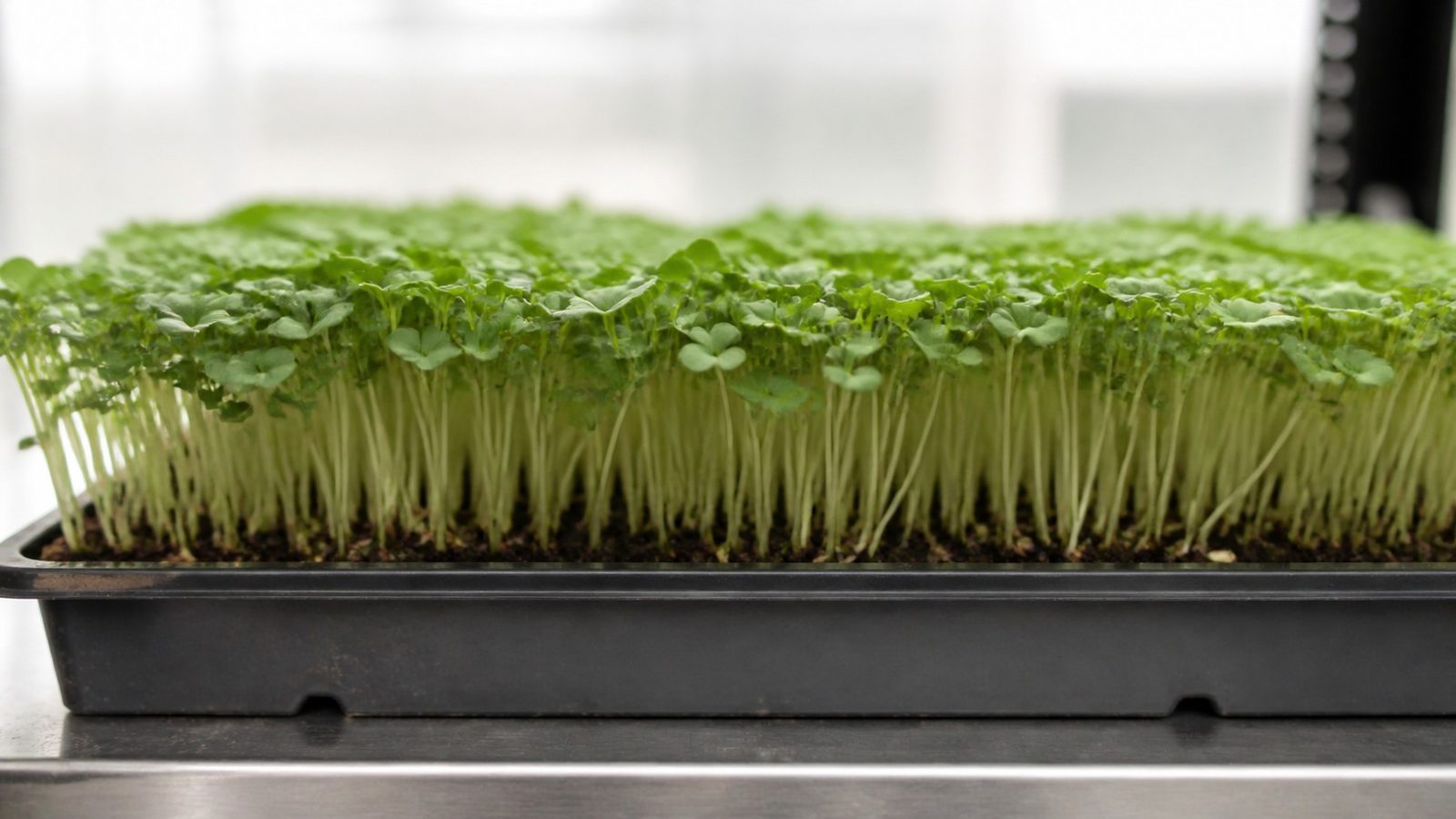
A correct tray is a dense stand of fine, pale cream to light green stems carrying small rounded to shallowly heart-shaped mid-green cotyledons. The stems come up thin and separate rather than as thick shoots. The supplier's harvest cue is 2 to 4 inches, when the first true leaves begin to appear.
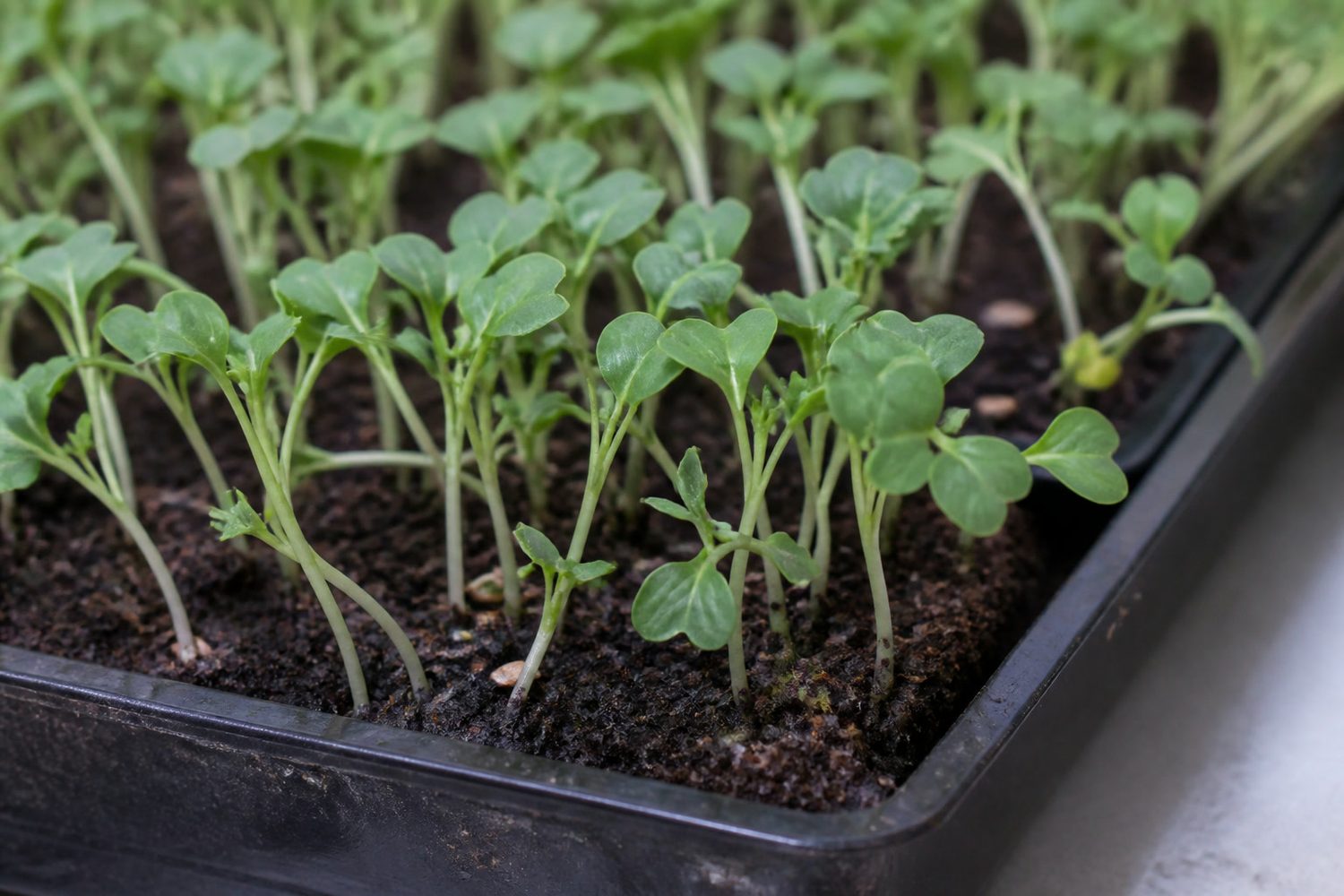
And here is the honest identification answer, which this page is going to state rather than dodge: there is no reliable way to tell collard from kale, cabbage, broccoli or kohlrabi at cotyledon stage. They are the same species complex and no validated one-photo diagnostic separates them. Pale stems and rounded green leaves are not unique to collard. If you did not sow it yourself, the seed label and later true-leaf development are the only dependable answers.
What it tastes like, and what to do with it
A crisp, mild cabbage bite with a slightly bitter edge and a little sweetness behind it. There is no pepper in it: this is not mustard or radish, and nobody should sell it as a spicy green.
Use it where mild brassica volume is wanted: folded through a mixed salad, layered in a sandwich, or scattered as a mild garnish on a plated dish. It behaves like a gentler cabbage, which is exactly what it is.
It is the wrong choice when the dish needs a sharp microgreen, and obviously the wrong choice when what is actually wanted is a large mature collard leaf for braising, which is a different food entirely. The people who will not like it are the ones who do not like even a mild cabbage flavor or a faint bitter edge. That is a brassica objection rather than a heat objection, and no consumer panel has measured how common it is.
Growing it: only what differs from the standard method
Everything general about trays, medium, light and watering is on the standard tray method for growing microgreens. Collard's deltas are genuinely few, and saying so is more useful than manufacturing some.
No soak. The crop card is explicit, and it germinates in one to two days without one.
Three days of blackout, at around 75F if you are reproducing the trial. The controlled protocol ran three days in complete darkness at 24C and 90 percent humidity, then grew on at 22C. No weight is reported anywhere for this crop, so do not invent a poundage. Uncover when the majority has germinated, which on a crop this fast will be close to that three-day mark.
Sow about 28 grams and treat it as a starting point. One ounce per 1020 is a supplier's recommendation, not a tested optimum, and no lower or upper bound has been published. The general principle from the trade's trial applies: for a larger plant use less seed and wait longer, for an earlier cotyledon cut sow thicker and cut sooner.
Do not reach for more light. This is where collard differs from the other brassicas. In the controlled study, going from about 14.5 to 21.7 mol per square meter per day did not produce the fresh-weight increase the other tested microgreens showed, and the authors name collard as the exception. Higher light did raise dry matter percentage and antioxidant-related measures, so it is not doing nothing, but if you are turning lights up to get weight out of a collard tray you are paying for electricity and getting dry matter. The supplier's practical target is 12 to 16 hours a day of bright, consistent light, and that is enough.
Then the ordinary small-seed routine. Scatter evenly on a level moist substrate and press it in. A light cover is permitted and is not required. Bottom water after emergence to keep the foliage dry, and keep gentle airflow moving.
A collard tray, day by day
- 1
Day 0, sow dry
About 28 g scattered evenly on level, moist medium and pressed in. No soak. A light cover is optional.
- 2
Days 1 to 3, blackout
Three days dark. At around 75F it germinates in one to two, so the third day is mostly evening up the stand.
- 3
Day 3, uncover
When the majority has germinated. On this crop that arrives quickly, which is most of why it is a beginner tray.
- 4
Days 3 onward, light
12 to 16 hours a day, bright and consistent. Resist turning it up: the measured response to more light here is dry matter, not weight.
- 5
Days 7 to 15, cut
At 2 to 4 inches as the first true leaves appear. The controlled trial cut on day 11.
What goes wrong with collard specifically
Very little that is specific to collard. It behaves like the brassica it is.
Before emergence, missing seedlings from rotted seed. Damping-off pathogens can infect seed before it ever comes up. The tell is unexplained bare patches rather than a uniformly slow tray. Dead seed does not come back; correct the wetness and drainage so it does not spread.
At emergence, collapse at or below the medium line. Water-soaked, thinning, toppling stems rather than upright pale hypocotyls. Pythium often starts at the root tips. Localized loss can be worked around; a spreading collapse is not a saleable crop.
After emergence, a wet crowded canopy. The supplier's advice is bottom watering and gentle airflow specifically to keep foliage dry. That is sensible and it is the general instruction rather than a collard finding.
And here is what this page will not tell you. There is no published collard-specific "most common mistake", no collard damping-off frequency, no collard pest, and no validated root-hair-versus-mold test for this crop. Those things exist for broccoli and they do not exist here. What is supported is the general rule: rot or collapse at the medium line is disease, and white fuzz on healthy upright roots is not evidence of it.
Why this crop's mold risk is left blank
Hover or tap a card to highlight it.
What we can say
Collard is exposed to the general dense-tray damping-off complex, Pythium and Rhizoctonia solani among others, which rot seedlings at or below the medium line.
What we cannot say
How it compares. No source ranks collard's risk against broccoli, cilantro, chia or anything else on this site.
The tempting shortcut
Write "Medium" because it is a small-seeded brassica and broccoli is Medium. That would be a guess formatted as a finding.
Why it matters
The mold risk column exists so a grower can compare crops. A value invented by analogy makes the whole column less trustworthy, not more complete.
What would fill it
A comparative incidence trial across crops at a stated density and moisture regime. Nobody has run one.
Nutrition, and what is actually established
There is no USDA record for collard microgreens. FoodData Central was searched on 2026-08-08 and returned mature collard entries, FDC 2709576 and FDC 170406, both "Collards, raw". Those are the mature leaf and they are not a substitute for a seedling cut on day 11.
One peer-reviewed study measured this crop directly: Vates collard, 200 seeds per experimental tray in potting soil, three days dark at 24C and 90 percent humidity, harvested 11 days after sowing. It measured fresh mass, height, dry matter percentage, chlorophylls, carotenoids, antioxidant activity by DPPH and FRAP, phenolics and anthocyanins across two light integrals and two photoperiods. Fresh mass was 20.40 to 24.70 g per experimental tray and dry matter 9.87 to 13.23 percent, with the higher light treatments raising dry matter and antioxidant-related measures.
That is real data on this exact crop, and it is not a nutrition panel. It reports composition responses to light, not amounts per serving.
So, the supplier claims that collard microgreens deliver particular vitamins A, C and K, calcium and iron, or are "concentrated nutrition", are not supported by anything opened here. No values, no sample basis, no cultivar, no method accompany them. And the broader claim that every microgreen beats its mature crop nutritionally is not established for collard either. If you want that comparison done properly on a crop where it has been, celery is the entry to read, and the answer there was not the one the category expects.
Which seed to buy
There is a real choice here and nobody has tested it, which is an unusual combination.
'Vates' is the only cultivar with any microgreen evidence behind it: it is sold as microgreen seed and it is the cultivar in the peer-reviewed trial, with no presoak, one to two day germination, about an ounce per 1020, a 10 to 12 day harvest and a dark green color. Beyond that, the market offers Georgia Southern, Champion and Morris Heading, all sold explicitly for microgreens, plus heirlooms like the purple-leaved varieties the seed savers grow.
No published comparison exists between any of them as microgreens. Not for stem length, color, days, tenderness or yield. So, buy Vates if you want the one with a paper behind it, buy a purple heirloom if color is the point, and understand that you are choosing on appearance and price rather than on evidence.
Collard microgreen seed on Amazon is a workable route and the results are unusually good on this crop. Checked 2026-08-08: 148 results with 36 collard listings, seven explicitly for microgreens, and several named cultivars sold in microgreen quantities from a 2 g packet up to 5 lb. That range of pack sizes matters less here than on barley grass, because at 28 g a tray a single pound is already about sixteen trays.
Specify a named cultivar or plainly generic collard, food or microgreen use, untreated status, a lot number, test date, germination percentage and purity. Refuse a lot whose treatment status is undisclosed, because a packet saying "collard" does not make field seed a food input for a crop eaten raw twelve days later.
A bad lot shows as poor or uneven emergence and a patchy canopy rather than the dense uniform stand this crop should give. Nobody publishes a collard germination benchmark or a defect threshold, so run a small germination test before committing trays, and note that neither the seller nor the study reports a germination percentage for its own lot.
Is it worth growing?
Yes for a beginner and a home grower, and with a caveat for anybody selling by weight.
It is genuinely easy: small dry seed, no soak, germination in a day or two, a cut inside two weeks, ninety cents of seed, and no crop-specific trap waiting for you. If somebody wants a mild brassica tray to put in salads and sandwiches and wants it to work the first time, this is a reasonable answer.
The caveat is that you cannot price it. Collard is absent from the trade's benchmark trial, and the only measured fresh mass comes from an experimental tray whose dimensions the paper never states, so it cannot honestly be converted to a 1020. Anyone quoting you ounces per tray for collard has borrowed broccoli's or kale's number. Grow a trial tray and weigh it before you build a price around it.
Its rivals are the other mild green brassicas, and they win on evidence rather than on merit. Red Russian kale is 10 g of seed, 11 oz and 13.5 days in the trade's trial; broccoli is 13 g, 11.5 oz and 12.5 days. Collard has no equivalent line. It wins when the flavor wanted is specifically mild collard, or when the grower has their own numbers, and it cannot win on looks because at cotyledon stage it is indistinguishable from its siblings.
A note on the numbers above
Hover or tap a row to highlight it.
| Figure | Value | Source | What kind of number it is |
|---|---|---|---|
| Days to harvest | 7 to 15 | A microgreen seed supplier | At 2 to 4 inches when first true leaves appear. No temperature |
| Days to harvest | 11 | Peer-reviewed Vates trial | MEASURED, after 3 days dark at 24C then 22C. No leaf stage stated |
| Seed per 1020 | About 28.35 g | A supplier's crop card | A starting rate for Vates, not a tested optimum |
| Seed per 1020 | No figure | Johnny's 2017 trial | Collard was not one of the 29 varieties |
| Yield per 1020 | No figure | Nobody | See the row below for why the measured figure cannot be converted |
| Fresh mass | 20.40 to 24.70 g per experimental tray | The same trial, from 200 seeds at day 11 | MEASURED, and the tray's DIMENSIONS ARE NOT REPORTED, so it is not a per-1020 yield |
| Dry matter | 9.87 to 13.23 percent | The same trial | Rose with higher light |
| Light response | NO clear fresh-weight gain from 14.5 to 21.7 mol | The same trial | Collard named as the exception among the crops tested |
| Soak | None | A supplier's crop card | Explicit. Germinates in 1 to 2 days |
| Blackout | 3 days at 24C, 90% RH | The trial protocol | No weight reported for this crop anywhere |
| Germination temperature | 24C demonstrated | The same trial | A working temperature, NOT an established range or limit |
| Shelf life | Up to 5 days | A supplier | Unwashed, airtight with paper towel. Temperature not stated |
| Harvest window | No figure | Nobody | Nobody has established it |
| Regrows | No | A supplier | Succession sow instead |
| Mold risk | No comparative rank | Nobody | See the infographic above. Left blank on purpose |
| Nutrition, USDA | No microgreen record | USDA FoodData Central | Mature "Collards, raw" is FDC 2709576 and 170406 |
The yield figure is real and still unusable, which is a distinction worth keeping. Twenty to twenty-five grams of fresh mass was genuinely weighed, from a stated 200 seeds, at a stated day. What the paper does not give is the tray's dimensions, and without an area there is no way to convert it to a 1020 without inventing the missing number. This site has area-converted measurements before, on carrot and chickpea, and in both cases the source stated the area. Here it does not, so the field stays blank.
And the blank mold risk is the more important blank. Every other crop on this site carries a Low, Medium or High in that column, and every one of those ratings is an operational judgment rather than a measured cross-crop ranking. Collard is the first entry where the research refused to make that judgment at all, on the grounds that calling it Medium purely because it is a brassica would be invented precision. That is the right call, and it makes the ratings on the other pages more honest rather than less, because it shows the column is not filled in automatically.
Where it lands, or rather does not.
Hover or tap a row to highlight it.
| Crop | Seed per 1020 | Yield | Days | Cost per tray | Oz per $1 | Oz per tray-day |
|---|---|---|---|---|---|---|
| Turnip, Purple Top White Globe | 10 g | No published figure | 7 to 12 | $0.31 | cannot be calculated | cannot be calculated |
| Komatsuna | 10 to 24 g | 10.6 oz at 1st true leaf, 13.4 at 2nd, area-converted | 8 to 12 | $0.47 to $1.12 | 10.0 | no day count for the measured stage |
| Collard | 28.35 g | No published figure | 7 to 15 | $0.90 | cannot be calculated | cannot be calculated |
| Cabbage, Green | No published figure | No published figure | 8 to 12 | no rate to price | cannot be calculated | cannot be calculated |
| Cauliflower | No published figure | No published figure | No published figure | cannot be calculated | cannot be calculated | cannot be calculated |
A blank means nobody has published that figure, so the cell is left empty rather than filled with an estimate. How the numbers work
All 62 crops, sortable, on the microgreen comparison.
Collard is the ninth crop that cannot complete this table, and it is the most frustrating of them. Everything else is in place: a rate, a day range, a real price, a controlled study with a stated protocol, even a weighed fresh mass. One unreported tray dimension is all that stands between this crop and a full row, and no amount of care on this end can supply it.
Terms on this page
Tap a term to see what it means.
Acephala Group. The older horticultural name collard is often sold under, covering the non-heading Brassica oleracea types. Collard and kale sit in it together, which is part of why they are hard to tell apart.
Sources
- Frontiers in Plant Science, controlled light study on Vates collard microgreens - Brassica oleracea var. viridis cv. Vates, 200 seeds per experimental tray, 3 days dark at 24C and 90 percent RH then growth at 22C, harvested day 11: fresh mass 20.40 to 24.70 g per tray with dimensions unreported, dry matter 9.87 to 13.23 percent, and collard named as the exception where raising DLI from about 14.5 to 21.7 mol did not produce the usual fresh-weight increase.
- St. Clare Seeds, collard microgreen seeds - 7 to 15 days at 2 to 4 inches as first true leaves appear, the crisp mild cabbage flavor with a bitter edge and sweetness, cover until sprouting, bottom watering with gentle airflow, no regrowth and succession sowing, and unwashed storage up to 5 days airtight with paper towel.
- Vates collard microgreen crop card - no presoak, 1 to 2 days to germinate, about 1 oz per 10x20 tray, 10 to 12 days to harvest, and dark green color with an intense collard flavor.
- Everwilde, Vates collard seeds - roughly 8,000 seeds per ounce, and the $14.40 per pound price behind the seed cost, accessed 2026-08-08.
- Johnny's microgreens yield trial results (PDF) - the 29-variety chart that contains no collard line, and the Red Russian kale and broccoli benchmarks used for comparison.
- Johnny's yield trial, method and discussion - harvest at first true leaf, the guidance that a larger plant needs less seed and more time, and the warning that figures vary with procedures, system, conditions, harvest stage and seed lot.
- Virginia Tech Extension SPES-756 (PDF) - the general 60 to 70F microgreen production range, and uncovering when the majority has germinated at typically 2 to 5 days.
- SDSU Extension, growing microgreens at home - small seed generally needing no cover, spacing guidance for large seed by contrast, and general refrigerated storage.
- UC IPM, damping-off - Pythium and Rhizoctonia solani rotting seedlings at or below the medium line, infection before emergence, and Pythium often beginning at root tips.
- USDA FoodData Central - searched for collard microgreens on 2026-08-08. Only mature records returned: FDC 2709576 and FDC 170406, both "Collards, raw".
Keep reading
The variety directory
Arugula microgreens
Arugula is a seasoning green rather than a salad base: 10 g of seed makes 10 oz in 14 days, it is genuinely peppery, and its 10-day shelf life comes from a controlled storage study rather than an estimate.
Read Arugula microgreensThe variety directory
Broccoli microgreens
Broccoli takes 13 g of seed per 1020 tray and gives 11.5 oz at first true leaf, both from Johnny's trial. No soak, fast even germination, and the root-hair-or-mold test you will need in the first week.
Read Broccoli microgreensThe variety directory
Cabbage, red microgreens
Red cabbage is measured at 10.5 g per 1020 tray returning 8.5 oz, the lowest of the four mild brassicas measured in one trial. What it sells on is the purple veining, which no broccoli tray can give you.
Read Cabbage, red microgreensThe variety directory
Garden cress microgreens
The crop where somebody finally measured what over-sowing costs: peak yield at 12 seeds per square centimeter, and roughly eight times the bacteria at 14. Plus 8 oz a tray at 13 days from the trade's own trial.
Read Garden cress microgreens