Chickpea shoots
Cal HewittPublished Checked
- legume
- moderate
- large seed
- shoot
- needs soaking
- cut and come again
- mold prone
At a glance
Not slow, just wet: a soaked bean carries a large water load and a detachable coat, so crowding it leaves humid voids that rot before a canopy ever closes.
- Botanical name
- Cicer arietinum
- Also sold as
- Chickpea, microgreen or sprouting, Garbanzo bean seed for sprouting, Black garbanzo, Chana
- Family
- legume
- Difficulty
- Moderate
- Days to harvest
- 9 to 14 days
- Harvest window
- No published figure
- Seed per 1020 tray
- 123 to 165 g
- Soak
- 6 to 12 hours
- Blackout
- 3 days
- Germination temperature
- 59 to 77 °F
- Yield per 1020 tray
- No published figure
- Mold risk
- High
- Hull shedding
- heavy
- Shelf life
- No published figure
- Eaten as
- raw
- Seed cost per tray
- $5.08
165 g at $13.98/lb, True Leaf Market organic black garbanzo microgreens seed, listed 2026-08-08. $3.79 at the 123 g end. The rate rather than the price is what makes this an expensive tray. Seed only, excludes medium, tray, labor, light and loss.
Any field name above ranks every variety by it. No published figure means we researched it and nobody has established one, which is different from not yet researched. Every figure here is sourced at the bottom of the page. Compare every variety side by side.
Chickpea shoots are one of the very few microgreens that genuinely come back after cutting, and the only one with a measured second-cut weight behind the claim.
That deserves the caveat immediately, because it is not the free lunch it sounds like. The measurement comes from a preliminary study that cut above a low node rather than at the medium line, which is a different harvest from the one every other crop on this site uses. Done that way, the second cut came in at 0.158 g per shoot against the first cut's 0.165 g: about 96 percent. The third was 0.146 g and the fourth 0.104 g. Nobody published how many days sat between the cuts, what the tray density was, or what any of it comes to per tray.
Everything else about the crop follows from a large soaked bean: 123 to 165 grams a tray, which is one of the heaviest rates going, and one of the most expensive trays to fill.
What growers are saying right now
Sampled from public posts and videos, 10 July to 9 August 2026. Every line links what it is quoting. How often something is repeated is not evidence that it is true, so every line also says what the sources actually establish.
I tried to grow chickpeas for homemade hummus and ended up with fewer chickpeas than I started with
Circulating A gardener's honest failure post, asking whether four chickpeas is enough for a teaspoon of hummus
The funniest argument for this crop anybody made this month, and a real one. Grown for the BEAN, chickpea is a months-long field crop with a famously poor home return. Grown for the SHOOT it is nine to fourteen days, and every seed you sow becomes part of the harvest instead of a lottery ticket on a pod. Is it worth growing
The magical life cycle of a chickpea
Circulating A short life-cycle clip, which along with the hummus post is close to the entire chickpea conversation of the month
Worth knowing that the plant most people picture is the field plant. This crop stops at day nine, before flowers, before pods, before anything anybody photographs. There is almost no chickpea SHOOT conversation to report, and the published record is nearly as thin: no trial entry, no yield, no shelf-life study. What is missing
What it is, and how to tell you grew it right
Chickpea shoots are seedlings of Cicer arietinum, in the pea and bean family, cut as a green shoot. Chickpea, garbanzo and chana are all the same species. There are two seed groups within it, desi (small, angular, rough-coated) and kabuli (larger, plump, smooth, cream), and black garbanzo is a genuinely dark-seeded type rather than a relabeled kabuli.
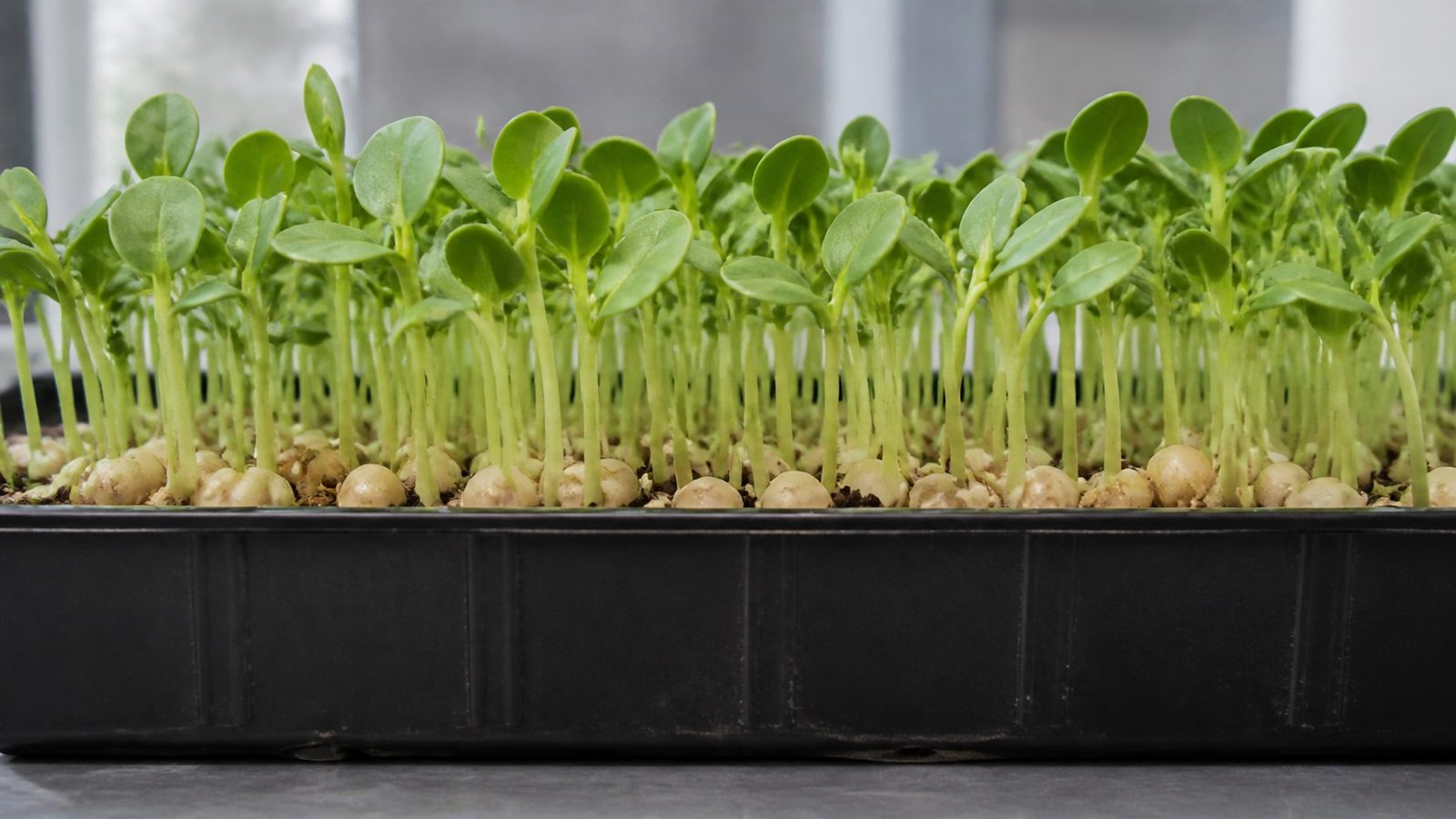
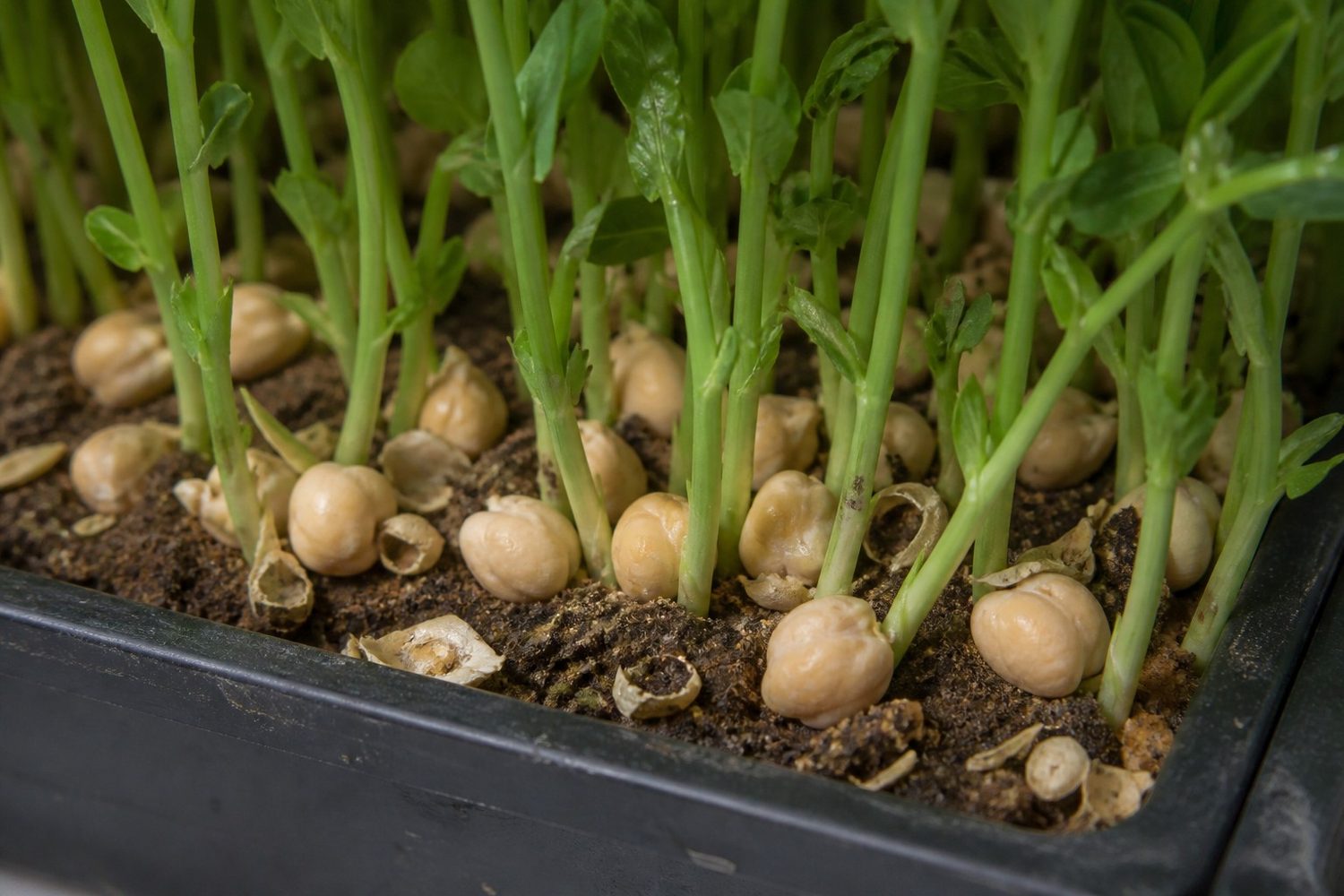
At the documented day-9 cut, expect green upright shoots with fully expanded cotyledons. The only measured height in any source is 8.34 cm, about 3.3 inches, at the first harvest in the multiple-cut report. At the medium you will see large pale swollen beans and loose seed coats, which is normal on a legume this size.
Beyond that, be careful what you believe about its appearance. No opened source gives a verified cotyledon shape, stem thickness, stand evenness, or how much seed should still be visible.
The confusion is with pea shoots, because both are tall green large-seeded legumes. At cotyledon stage there is no reliable tell and you should not claim one. Once true leaves arrive, chickpea gives itself away: five to seven pairs of small toothed leaflets on a compound leaf, which is nothing like a pea's tendrils.
What it tastes like, and what to do with it
Mildly sweet and nutty, clearly leguminous, with a small tart zest at the front. No pepper, no heat, nothing sharp. It tastes like what it is.
Use it where mild bulk is the point: folded through a grain bowl, in a sandwich or wrap, or as a leafy garnish on hummus or a warm lentil dish after plating. The chickpea-on-hummus pairing is obvious and it works. Its value is volume and soft legume flavor rather than a small dense hit of color or spice.
It is the wrong crop when the dish wants mustard or radish heat, and the wrong crop as a tiny concentrated garnish. Anyone who dislikes legume or nutty notes will not be won over, and there is no sensory study identifying who else might reject it, so that is a flavor-match judgment rather than a survey.
And one distinction that matters more than the flavor. This page is about the cut green SHOOT, and that is eaten raw. Whole sprouted chickpeas, where you eat the swollen bean and root together, are a different product: at least one supplier states plainly that its sprouted beans should be cooked before eating. If you are eating the bean, cook it. If you are cutting green shoots above the seed and eating those, you are eating a microgreen. Do not let a single word cover both, because the handling instruction is not the same.
Growing it: only what differs from the standard method
Everything general about trays, medium, light and watering is on the standard tray method for growing microgreens. Chickpea's deltas all come from the size of the seed.
Soak 6 to 12 hours. Extension guidance is that a soak speeds germination on a large hard seed like garbanzo, and a separate large-seed procedure gives 8 to 12 hours overnight with a rinse or two. Below about 6 hours a share of beans start unswollen and emerge unevenly. Beyond 12 nothing opened here establishes a benefit, and one seller's 12 to 24 hours is preference rather than a comparison. Nobody publishes a water temperature, so cool to room temperature potable water is the honest instruction.
Spread the swollen beans in ONE even layer. Never pile them. This is the crop's whole risk. A soaked chickpea is a large water reservoir with a coat that is starting to let go, and two beans stacked on each other make a humid void that does not dry. Broadcasting like a fine seed does not work here; you are placing a layer, not scattering.
Do not bury them. Covering is unnecessary on this crop and mostly makes the shoots dirty. Level a shallow pre-moistened medium and put the beans on it.
Three days of blackout, and no published weight. The crop-specific schedule is three days dark then six in light. Uncover when most have germinated. Nothing establishes a chickpea weight in pounds or a reason to weight it, so if you use a light cover its job is even contact and humidity. Do not import a pea shoot stack weight because the seeds look similar.
Then bottom water sparingly, with real airflow. After emergence keep free water off the surface and drain the excess, because a 1020 pair will hold more than this crop wants. Airflow matters more here than on a thin brassica canopy, since swollen beans and loose coats hold moisture at exactly the level where rot starts.
On light, do not overclaim. The one controlled study ran 12 hours at 200 micromoles per square meter per second at 25 to 30C. There is no chickpea-versus-brassica light comparison anywhere, so that is a setting that worked, not a demonstrated requirement.
A chickpea tray, day by day
- 1
Day minus 1, soak
6 to 12 hours in cool potable water. Discard anything that comes out soft, dark or smelling sour; do not sow it.
- 2
Day 0, place a single layer
123 to 165 g of swollen beans in ONE layer on leveled, pre-moistened medium. No piles, no burial.
- 3
Days 1 to 3, blackout
Three days covered. Uncover when most have germinated rather than on the clock.
- 4
Days 3 to 9, light
Bottom water only as needed, drain hard, keep air moving. Pull loose hulls while they are dry.
- 5
Day 9 to 14, cut
The controlled study cut on day 9 at fully expanded cotyledons. If you want a second harvest, cut ABOVE a low node instead of at the medium.
What goes wrong with chickpea shoots specifically
At the soak, before you even sow. Off odor, softened or darkened beans. Cause is too long a soak, poor drainage or a weak lot. This is the only crop here where a failure is visible before sowing, which is a genuine advantage: discard them and do not seed a bad batch.
Uneven emergence from piled or unevenly hydrated beans. A mix of swollen and still-hard seed, or no even radicle push. On a large-seed crop this rarely evens out, and re-sowing is usually more reliable than nursing it.
Damping-off at emergence. Water-soaked stem bases, rot starting at root tips, seedlings collapsing at or below the medium line. Pythium and Rhizoctonia in persistently damp crowded medium. Isolated plants can be removed and the drainage corrected; a spreading collapse is not food.
Loose hulls through the canopy. The coat detaches as cotyledons expand and ends up scattered through the crop. Entirely fixable, best done while dry, and nobody has measured what proportion comes off.
And held too long, it stops being a microgreen. True leaves develop, stems elongate, and the even cut is gone. The study's endpoint is fully expanded cotyledons on day 9, which is a thing you can see. Whether late chickpea shoots turn tough or bitter is not established.
Root hair or damping-off on a large-seed tray
Hover or tap a card to highlight it.
Root hair
Fine, even, short white fuzz confined to living roots. It stays root-local and the seedling above it is firm and upright.
Damping-off
Soft or rotting seed and stem, discoloration, collapse at or below the medium line. Pythium often begins at the root tips.
The test
Disturb the root zone gently and look at the SEEDLING, not the fuzz. Firm and upright with white fuzz on living roots is root hair. Soft, dark, pinched or toppling is disease.
Why this crop is harder to judge
A big soaked bean with a detaching coat looks alarming even when healthy, so the plant's condition decides it rather than the appearance of the seed.
On a food crop
Only a lab names an organism, and doubt resolves toward discarding.
Nutrition, and what is actually established
There is no USDA record for chickpea microgreens, so there is no identifier and no nutrient panel. Mature or canned chickpea entries are not a substitute.
There is one peer-reviewed study, published 2026, and it is worth reading precisely. Chickpea microgreens grown in cocopeat at 25 to 30C under 12 hours of light at 200 micromoles, harvested day 9 at fully expanded cotyledons, were compared against the raw seed:
- protein up 72.4 percent
- ash up 45.6 percent
- carbohydrate down 52.62 percent
- phytate down 71.4 percent
- saponins down 20.3 percent
Two things about how to read that. First, the article analyzes dried material, so none of these are per-100-g fresh serving values and none of them belong on a label. Second, the phytate result is the genuinely interesting one and it is not a "more nutritious" claim: phytate binds minerals and reduces how much of them you absorb, so a 71 percent reduction is about availability rather than content. The saponin drop is much smaller, at 20 percent.
What is not supported: that chickpea shoots are among the richest plant-protein microgreens, that they carry a complete amino acid set in significant concentration, or any specific vitamin and mineral panel. Retail pages say those things. USDA has no record and the study measured change against raw seed rather than issuing a nutrition label. The supportable sentence is the narrow one: under one study's conditions, day-9 chickpea shoots had more measured protein and ash and much less phytate than the raw bean.
Which seed to buy
The types actually sold for this use are black garbanzo, marketed specifically as organic microgreen seed, and generic chickpea, garbanzo or chana sold as microgreen and sprouting seed. Desi and kabuli are botanical seed groups rather than product lines: the difference matters for how the beans hydrate and pack into a layer, but no source compares their shoot yield.
Specify food-use seed explicitly labeled for sprouting or microgreens, with the botanical name or type, untreated status, and lot or test information where it exists. Refuse field seed with an undisclosed treatment, a dye, or a "not for food use" label. This is a nine-day crop that gets eaten, and a field-seed label does not establish food suitability.
Chickpea and garbanzo sprouting seed on Amazon is a clean route on this crop, which is not true of every microgreen. Checked 2026-08-08, that search returns genuine sprouting and microgreen product rather than grocery beans or garden packets, including one listing that publishes 96 percent germination and 99.98 percent purity on the page. That is exactly the lot information this crop's own suppliers say to ask for, and being able to read it before buying is worth more on a large expensive seed than on a cheap fine one.
A bad lot announces itself: damaged or discolored beans, a mix of hard and prematurely soft beans after the same soak, an off odor, or patchy emergence. Pick out visibly damaged beans before soaking. The cost is not just the seed, it is an unusable tray and a lost harvest slot, because a patchy large-seed canopy cannot be sold as an even shoot product.
Is it worth growing?
For the right use, yes, and the gardener who got four chickpeas out of a season made the case for it without meaning to.
Grown for the bean, chickpea is a months-long field crop that gives a home gardener almost nothing. Grown for the shoot it is nine to fourteen days and every seed becomes part of the harvest. If you like the flavor and want mild green bulk, that is a real proposition, and the possible second cut makes it more interesting still.
Grow it if you want a mild, green, legume-flavored, bulky cut crop and can manage soaked beans and a single-layer sowing. Trial a small tray first, because there is no yield benchmark for this crop at all and the seed is expensive enough that mistakes cost real money at $3.79 to $5.08 a tray.
Do not build a rack around it without weighing your own trays. Do not treat the regrowth as bankable until you have measured your own interval, because the study that recorded it did not publish one. And do not choose it over a fast brassica if what you actually need is a short predictable cycle with published numbers.
Its closest rival is pea shoots, and they are not interchangeable. Pea wins when your system is already set up for pea seed, when a customer expects that specific sweet-pea flavor, or when you need an established benchmark, and pea has one here at 150 g and 8 oz where chickpea has none. Chickpea wins on the sweet-nutty-with-zest flavor and on the regrowth. Radish and mustard win whenever the recipe wants heat.
A note on the numbers above
Hover or tap a row to highlight it.
| Figure | Value | Source | What kind of number it is |
|---|---|---|---|
| Days to harvest | 9 | 2026 controlled study | MEASURED, at fully expanded cotyledons, 25 to 30C, 200 micromoles for 12 h |
| Days to harvest | 10 to 14 | A seed company guide | No temperature, no harvest stage |
| Days to harvest | 9, as 3 dark plus 6 light | A crop supplier page | At 15 to 25C |
| Seed per 1020 | 123 to 165 g | Area-converted from a supplier | 150 to 200 g per 56x28 cm, scaled to a 1020's footprint. Not a trial |
| Seed per 1020 | No figure | Johnny's 2017 trial | Chickpea was not one of the 29 varieties |
| Yield per 1020 | No figure | Nobody | A supplier's "1:1 ratio" states no tray area, stage or method |
| Soak | 6 to 12 h | Maryland Extension | Speeds germination on garbanzo specifically |
| Soak | 8 to 12 h overnight | Penn State, large hard seed | With one or two rinses |
| Blackout | 3 days | A crop supplier page | Then 6 days in light. No weight published |
| Germination temperature | 59 to 77F | A crop supplier page | Described as common room temperature. Optimum not established |
| Regrows | 96% on the second cut | Preliminary multiple-harvest report | 0.165 g then 0.158, 0.146, 0.104 per shoot. Cut ABOVE A NODE |
| Shoot length | 8.34 cm at first cut | The same report | The only measured height for this crop anywhere |
| Shelf life | No figure | Nobody | No chickpea-specific refrigerated trial exists |
| Harvest window | No figure | Nobody | Nobody has established it |
| Seed price | $13.98/lb | True Leaf black garbanzo, listed 2026-08-08 | A real current price |
| Protein vs raw seed | up 72.4% | 2026 controlled study | Measured on DRIED material, not a fresh serving value |
| Phytate vs raw seed | down 71.4% | The same study | About mineral availability rather than nutrient content |
| Nutrition, USDA | No record | USDA FoodData Central | No chickpea microgreen entry located |
The regrowth figure is the most interesting number here and the least usable. Ninety-six percent on a second cut would change the economics of any microgreen, and chickpea is the only one with a measurement behind that claim at all. But the report is preliminary, it measured per shoot rather than per tray, it does not say how many days passed between cuts, and it required cutting above a low node rather than at the medium line, which is not how anybody harvests a microgreen. Everything you would need to turn it into a plan is missing, so treat it as a reason to run your own trial rather than as a number to budget against.
Chickpea cannot complete the comparison table below, because nobody has weighed a tray. It has a seed rate, a day range and a price, and no yield anywhere. On seed cost it is one of the four most expensive trays to fill, alongside barley grass, popcorn shoots and mung bean shoots, and all four for the same reason: not the price of the seed, which is ordinary at $13.98 a pound, but the 123 to 165 grams the tray swallows.
Hover or tap a row to highlight it.
| Crop | Seed per 1020 | Yield | Days | Cost per tray | Oz per $1 | Oz per tray-day |
|---|---|---|---|---|---|---|
| Fenugreek | 25 to 62 g | 3.9 to 4.3 oz | 6 to 12 | $0.55 to $1.35 | 7.5 | 0.53 |
| Clover, Red | 20 g | 3 to 5 oz | 10 | $0.96 | 4.2 | 0.40 |
| Alfalfa | not a tray crop | not a tray crop | 4 to 6 | not a tray crop | not applicable | not applicable |
| Chickpea shoots | 123 to 165 g | No published figure | 9 to 14 | $3.79 to $5.08 | cannot be calculated | cannot be calculated |
| Mung bean shoots | 200 to 215 g | No published figure | 7 to 12 | $5.48 to $5.89 at 1 lb | cannot be calculated | cannot be calculated |
A blank means nobody has published that figure, so the cell is left empty rather than filled with an estimate. How the numbers work
All 62 crops, sortable, on the microgreen comparison.
Note where the heavy seeders cluster at the bottom of what can be calculated: wheatgrass at 450 g, barley grass at 175 to 220, chickpea at 123 to 165, buckwheat at 91.4. Four of the five crops with no published yield are the four heaviest seeders on the site. That is unlikely to be coincidence: a crop that eats a fifth of a pound of seed per tray is expensive to run a trial on, and the trials that exist were run on crops that are cheap to repeat. The gap in the record is not random, and it sits exactly where a grower most needs a number.
Terms on this page
Tap a term to see what it means.
Chickpea, garbanzo, chana. Three names for Cicer arietinum. All the same species, and none of them indicates a cultivar.
Sources
- Discover Food, 2026, chickpea microgreen study - cocopeat trays at 25 to 30C, 12 h at 200 micromoles, watered twice daily, harvested day 9 at fully expanded cotyledons, and against raw seed: protein up 72.4 percent, ash up 45.6, carbohydrate down 52.62, saponins down 20.3, phytate down 71.4, all on dried material.
- Sreenivasan, preliminary report on multiple harvests of chickpea microgreens - successive regeneration after cuts above low nodes: 0.165 g per shoot at the first cut, 0.158 at the second, then 0.146 and 0.104, with shoot length falling from 8.34 cm to 7.90 cm, and no stated interval, density or per-tray figure.
- True Leaf Market, black garbanzo organic microgreens seed - the dark-seeded type sold specifically for microgreens, vibrant green shoots, sweet with a ping of zest, and the $13.98/lb price behind the seed cost, listed 2026-08-08.
- Pěstuj, chickpea crop page - 150 to 200 g per 56x28 cm tray, 3 days blackout then 6 in light, 15 to 25C as common room temperature, and a 12 to 24 hour soak.
- University of Maryland Extension, growing microgreens and baby greens indoors - garbanzo named among large seeds whose 6 to 12 hour soak speeds germination.
- Penn State Extension, growing microgreens at home - the 8 to 12 hour overnight soak with rinses for large hard seed, evenly distributing measured seed, that covering is unnecessary and can make sprouts dirty, and bottom watering with airflow after emergence.
- Premier Seeds Direct, sprouting chickpea - untreated and pathogen-tested microgreen and sprouting seed, and the subtly nutty slightly sweet flavor.
- Cool Beans and Sprouts, garbanzo bean seeds for sprouting - untreated seed, skins loosening and being picked out or left in, and the statement that sprouted beans require cooking before consuming.
- Sow Seeds, chickpea sprouting seeds - chickpea sold as microgreen and sprouting seed.
- W.H. Perron, sprouts and microgreens growing guide (PDF) - 10 to 14 days for chickpea microgreens, and the unusable "1:1 yield ratio" with no tray area or method.
- Kew, Plants of the World Online: Cicer arietinum - the accepted species, Fabaceae, the desi and kabuli seed groups, and the 5 to 7 pairs of toothed leaflets that identify it once true leaves appear.
- Johnny's microgreens yield trial results (PDF) - the 29-variety chart that contains no chickpea line.
- Johnny's yield trial, method and discussion - harvest at first true leaf, and the warning that yield varies with procedures, techniques, system, conditions, harvest stage and seed lot.
- Virginia Tech Extension SPES-756 (PDF) - tray-specific density testing, uncovering when the majority has germinated, and packaged storage at 41F.
- SDSU Extension, growing microgreens at home - home microgreens holding "a week or so" refrigerated, which is general rather than a chickpea result.
- UC IPM, damping-off - Pythium and Rhizoctonia favored by damp conditions, with Pythium often starting at root tips.
- USDA FoodData Central - searched for chickpea and garbanzo microgreens on 2026-08-08, no record located.
Keep reading
The variety directory
Lentil microgreens
The cheapest legume tray by a wide margin, because its seed is a grocery commodity: about 47 cents and 7 oz a tray, against pea shoots at $2.39 for eight.
Read Lentil microgreensThe variety directory
Sunflower microgreens
The heaviest tray you can grow, at about 18.8 oz, and the only one that needs a soak, a weight and daily hull-brushing. Published seed rates run from 48 g to 250 g a tray, more than five times apart.
Read Sunflower microgreensThe variety directory
Pea shoots
Pea shoots are the easiest microgreen to start and one of the easiest to lose. Sourced figures for seed rate, days, yield and cost, plus the wet-seed failure that actually kills trays.
Read Pea shootsThe variety directory
Buckwheat microgreens
Buckwheat keeps 21 days refrigerated, the longest shelf life measured for any microgreen, and has no measured tray yield at all. It is also the one crop where buying the wrong seed means nothing germinates.
Read Buckwheat microgreens