At a glance
Nothing about it is slow or fussy, but a tray holds 200 grams of soaked bean, and that much wet starch under a cover goes sour rather than merely slowing down if the airflow is not there.
- Botanical name
- Vigna radiata
- Also sold as
- Mung bean sprouting seed, Moong bean, Green gram, Jumbo Mung, Golden Mung
- Family
- legume
- Difficulty
- Moderate
- Days to harvest
- 7 to 12 days
- Harvest window
- No published figure
- Seed per 1020 tray
- 200 to 215 g
- Soak
- 8 to 12 hours
- Blackout
- 3 to 4 days
- Germination temperature
- No published figure
- Yield per 1020 tray
- No published figure
- Regrows after cutting
- No published figure
- Mold risk
- High
- Hull shedding
- some
- Shelf life
- 4 to 10 days
- Eaten as
- raw
- Seed cost per tray
- $5.89
215 g at $12.43/lb, True Leaf Market Handy Pantry organic mung bean sprouting seed at the 1 lb size, listed 2026-08-09. $5.48 at the 200 g end. One of the three most expensive trays to fill at the retail pound, after barley grass and popcorn. The ladder runs 4 oz $6.27, 8 oz $8.44, 1 lb $12.43, 2.5 lb $18.83, 5 lb $33.82, 35 lb $133.04, so the same tray falls to about $1.80 at the 35 lb bucket. Grocery mung beans sold for cooking run a third of that again, and the page explains why the label still matters on this crop. Seed only, excludes medium, tray, labor, light and loss.
Any field name above ranks every variety by it. No published figure means we researched it and nobody has established one, which is different from not yet researched. Every figure here is sourced at the bottom of the page. Compare every variety side by side.
On alfalfa and clover the line between a sprout and a microgreen is worth a paragraph. On mung bean it decides everything, including which federal rules you are under.
Mung bean is the bean sprout. The pale, crunchy, tailed thing in your pho is a germinated mung seed eaten whole, and it is what essentially the whole world means by the word. A mung bean shoot is a different product: sown in a medium, grown on for a week or more, and cut above the soil line as green-leafed stems, with the bean left behind. Those two products are not two names for one thing and they do not sit under the same food-safety law. Sprouts fall under Subpart M of the FDA Produce Safety Rule, 21 CFR 112.141, which is more stringent than the rest of the rule; a crop grown in a substrate and cut above it does not, and how the FDA separates the two is worth reading before you sell either.
That matters more on mung than on any other crop, because mung is what the sprout rules were largely written about.
What growers are saying right now
Sampled from public posts and videos, 10 July to 9 August 2026. Every line links what it is quoting. How often something is repeated is not evidence that it is true, so every line also says what the sources actually establish.
Day one, soaked about sixteen hours, and I probably could have harvested on day two or three
Circulating A three-part sprouting diary running day three and day four at 111, 98 and 174 views
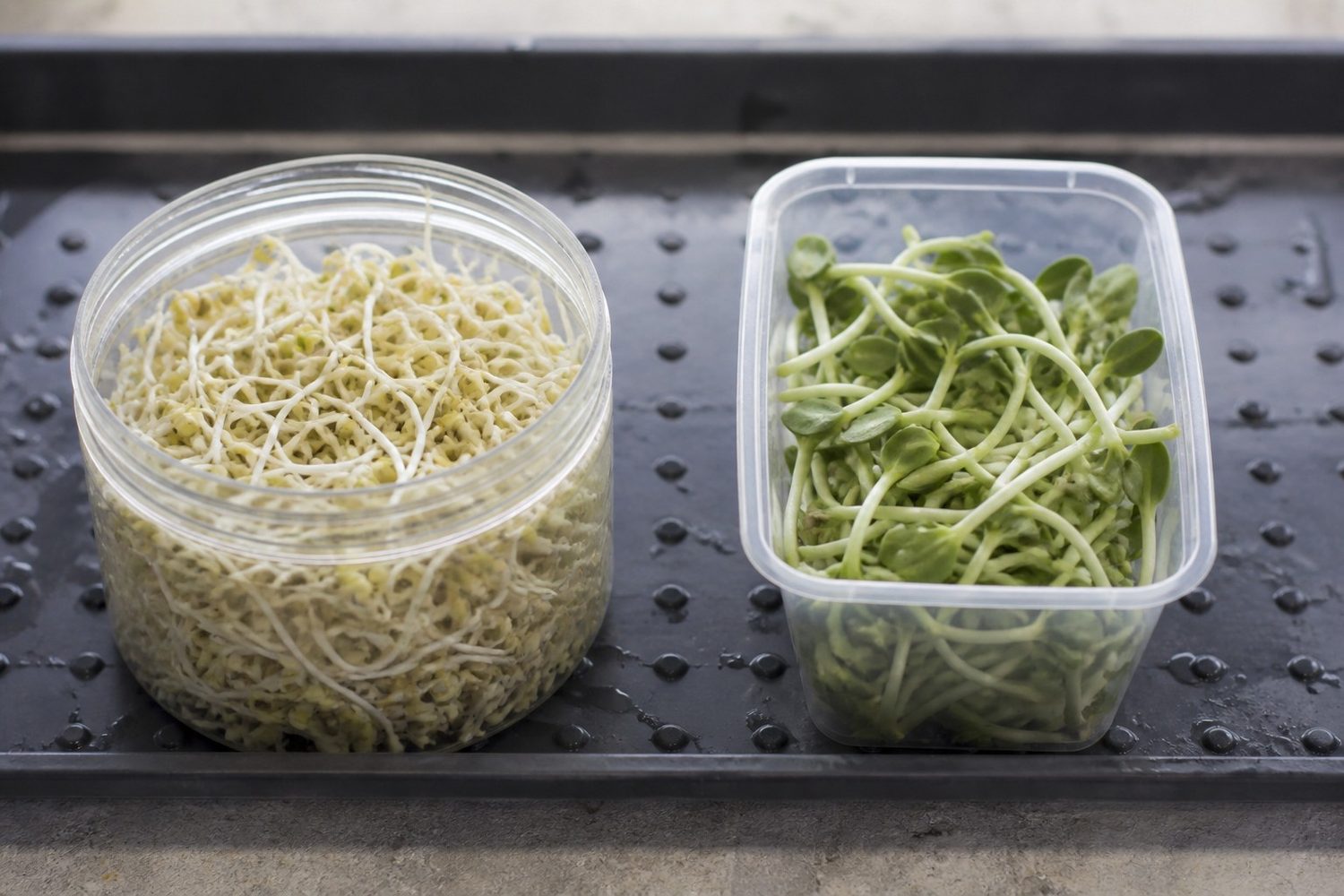
That is a sprout, and it is the clearest illustration of why this page separates the two. A two-to-four day jar of whole tailed beans and a seven-to-twelve day tray of cut green shoots are different foods with different rules and different economics. Neither is wrong. Confusing them is what makes the seed-buying advice on this crop go astray. What it is
Bought sprouts are expensive, and a lovely lady mentioned she buys mung beans and sprouts them herself, much cheaper
Circulating Said here at 272 views, with the whole method in the caption
True on the money and the reason this crop needs its label read. Grocery mung beans sold for cooking run roughly a third of what sprouting-labeled seed costs. What the cheaper bag does not carry is the pathogen testing and the documented handling that seed sold for sprouting does, and mung is the crop with the outbreak history behind those rules. Which seed to buy
A three-day hack, incredibly cheap, and ten times crunchier than the grocery store version
Circulating This one at 66 views, giving half a cup of beans and a twelve-hour soak
The soak time matches every source here. The crunch claim is plausible and unmeasured: nobody has run a texture comparison between home and commercial mung sprouts. Note again that three days is the sprout, not the shoot.
From GMO-free mung beans and nothing but clean water, harvested and dispatched the same day
Circulating A commercial sprouter's brand film at 749 views
Worth watching precisely because it shows the scale a home tray is competing with. Mung sprouts are a commodity produced in water in four days and sold cheaply everywhere. A tray of cut mung shoots has to sell on being a different product, not a fresher version of that one. Is it worth growing
Nobody is growing it as a tray crop
Circulating The whole mung conversation in this window is jar sprouting. Twenty-two threads came back from r/microgreens and the crops in them are kale, sunflower, pea shoots and mold. The sweep's YouTube results were 391,464 views of Chinese drama channels, a pure name collision and not evidence of anything
The published record matches the silence exactly: no trial entry, no measured 1020 yield, no germination range, no harvest window. Everything measured about mung as a food is measured about the sprout. Where the numbers stop
What it is, and how to tell you grew it right
Mung bean shoots are seedlings of Vigna radiata, a legume, also sold as moong bean and green gram. Like pea shoots, chickpea shoots, fenugreek and lentil, it has the legume problem: the seed is big, so the tray is heavy and the tray is expensive.
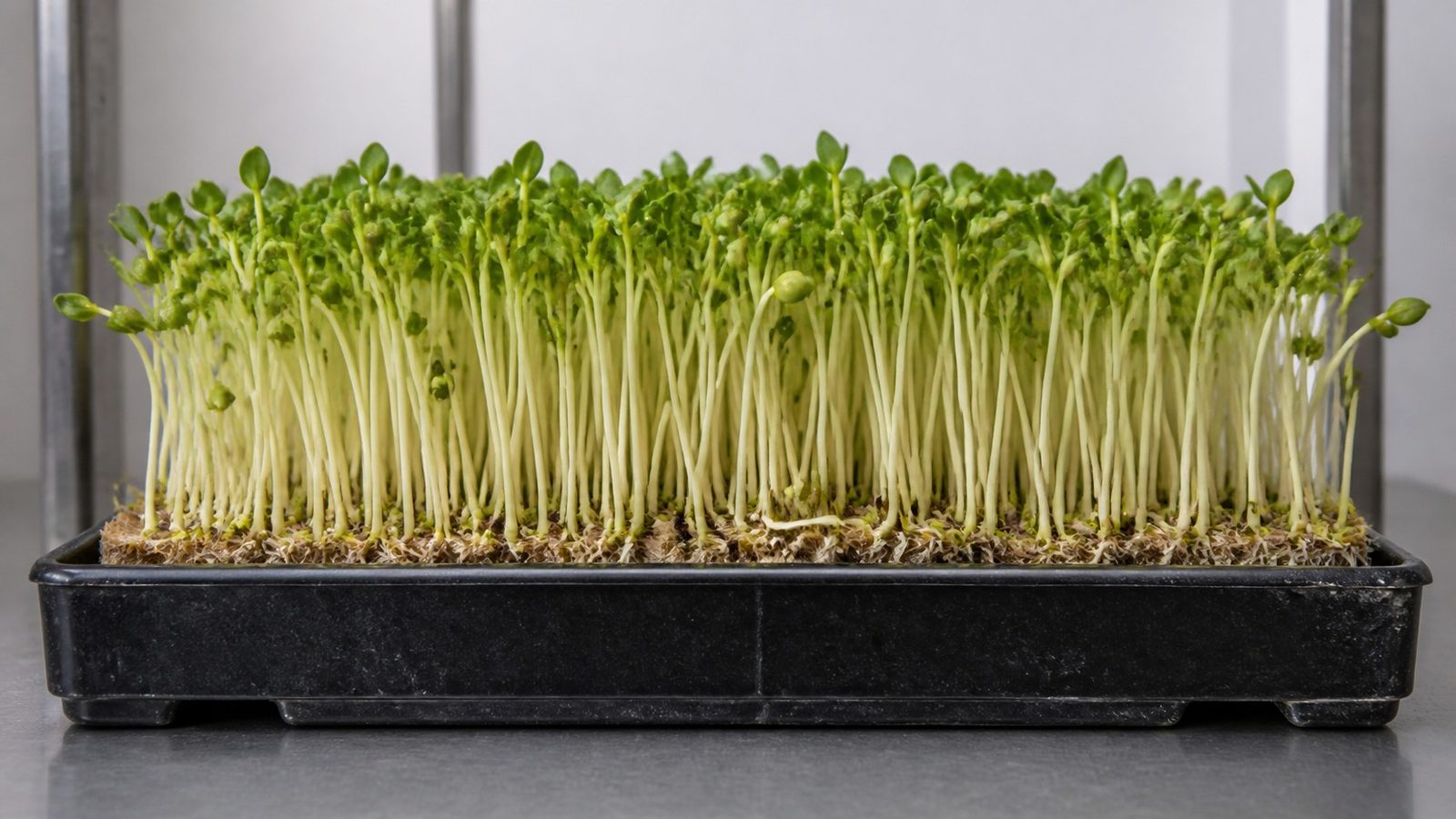
A correct tray at harvest is a dense even stand of substantial pale white to pink stems topped by paired green leaves, with a thick white root mat at the medium. The stems should be upright and tender rather than long, yellow or collapsed. Some green hulls will still be clinging to the leaf pairs, and that is normal rather than a fault. Precise harvest height is not published anywhere.
The thing it is confused with is not another crop, it is the other version of itself. A mung sprout is a pale whole bean with a long white tail, grown in water, eaten seed and root and all, ready in about four to five days. A mung shoot is green-leafed, grown in a medium, cut above it, and takes seven to twelve days. If what you have is pale and tailed and has no green leaves, you grew a sprout, and it falls under a different rule.
What it tastes like, and what to do with it
Mild, nutty, faintly earthy, and mostly about the crunch. There is no pepper here and no brassica edge; mung is a texture and volume crop, and the flavor gets out of the way on purpose.
That decides where it goes: pho and noodle bowls, quick stir-fries, soups added off the heat, omelets, wraps and salads that want bulk. It behaves like the bean sprout people already know, with green leaves attached and a softer stem.
It is the wrong choice when a plate needs a small dry garnish or an assertive note. Its stems take up real volume, which is the point when you want volume and a liability when you do not, and its flavor will not register beside anything strong.
The people who will not like it are the people who already do not like bean sprouts: the watery crunch and the faint legume note are the same ones. That is an inference from how the suppliers describe it and not a consumer panel, which nobody has run.
Growing it: only what differs from the standard method
Everything general about trays, medium, light and watering is on the standard tray method for growing microgreens. Mung's deltas are all consequences of one fact: a 1020 holds about 200 grams of bean, and after a soak that is a great deal of wet starch in one place.
Soak eight to twelve hours, in cold water, and drain it properly. One guide allows dry sowing and says the soak improves speed and evenness; another caps it at eight hours; a third specifies ten to twelve in cold water and reports that warm water, or a soak past twelve hours, sours the lot before it reaches the tray. This is one of very few crops where you can lose the batch before you even sow it.
Sow in one layer, and never two. Soaked beans are large, and a double layer suffocates the beans underneath. Level the medium first and spread the beans so they sit in a single course. This constrains your rate more than any recommendation does: if 215 grams will not fit in one layer on your tray, use less.
Three to four days of blackout, and this crop genuinely needs weight. Mung roots are vigorous enough to lift the whole seed layer off the medium, and the weight is what drives them down and keeps the canopy even. The only load published anywhere is 1 to 2 kilograms, and it is for an unspecified small box rather than a 1020, so do not convert it into a pounds-per-tray figure. Use enough weight to keep the layer down and judge it by the tray. Take the weight off when the shoots are pushing the cover up evenly.
Airflow from day one, not from day four. The crop-specific guide calls ventilation mandatory throughout, and on a dense wet seed mass that is not a general platitude, it is the difference between a tray and a fermentation. Bottom water once the canopy is up; top watering is tolerable only if the air is moving.
Do not leave it long in strong light. One supplier warns the stems go fibrous. That is the only stated cost of a late cut on this crop, and nobody has quantified it.
A mung bean tray, and where it can go wrong
- 1
Hours 0 to 12, the soak
Cold water, 8 to 12 hours, then drain thoroughly. A sour smell at the end of this step means the batch is already gone. Warm water and long soaks are how it happens.
- 2
Day 0, sow one layer
Level medium, soaked beans spread in a single course, never stacked. Cover on, with weight: the roots will lift the layer otherwise.
- 3
Days 1 to 3, weighted blackout
The highest-risk stretch on this crop. Dense, wet, warm and covered is exactly the fermentation condition, so the airflow has to be real.
- 4
Day 3 or 4, weight and cover off
The shoots should be pushing the cover up evenly. Beans or root mat rising as a sheet means there was not enough pressure, and that is a lesson for the next tray rather than a fix for this one.
- 5
Days 7 to 12, cut
Green paired leaves on thick pale stems, cut above the medium. Too long in light and the stems turn fibrous.
What goes wrong with mung bean specifically
During the soak, before the tray exists. Warm water or more than twelve hours ferments the batch. The early sign is a sour smell when you drain it. If it still smells fresh, rinse in cold water and sow promptly; if it does not, it is finished, and sowing it will not improve it.
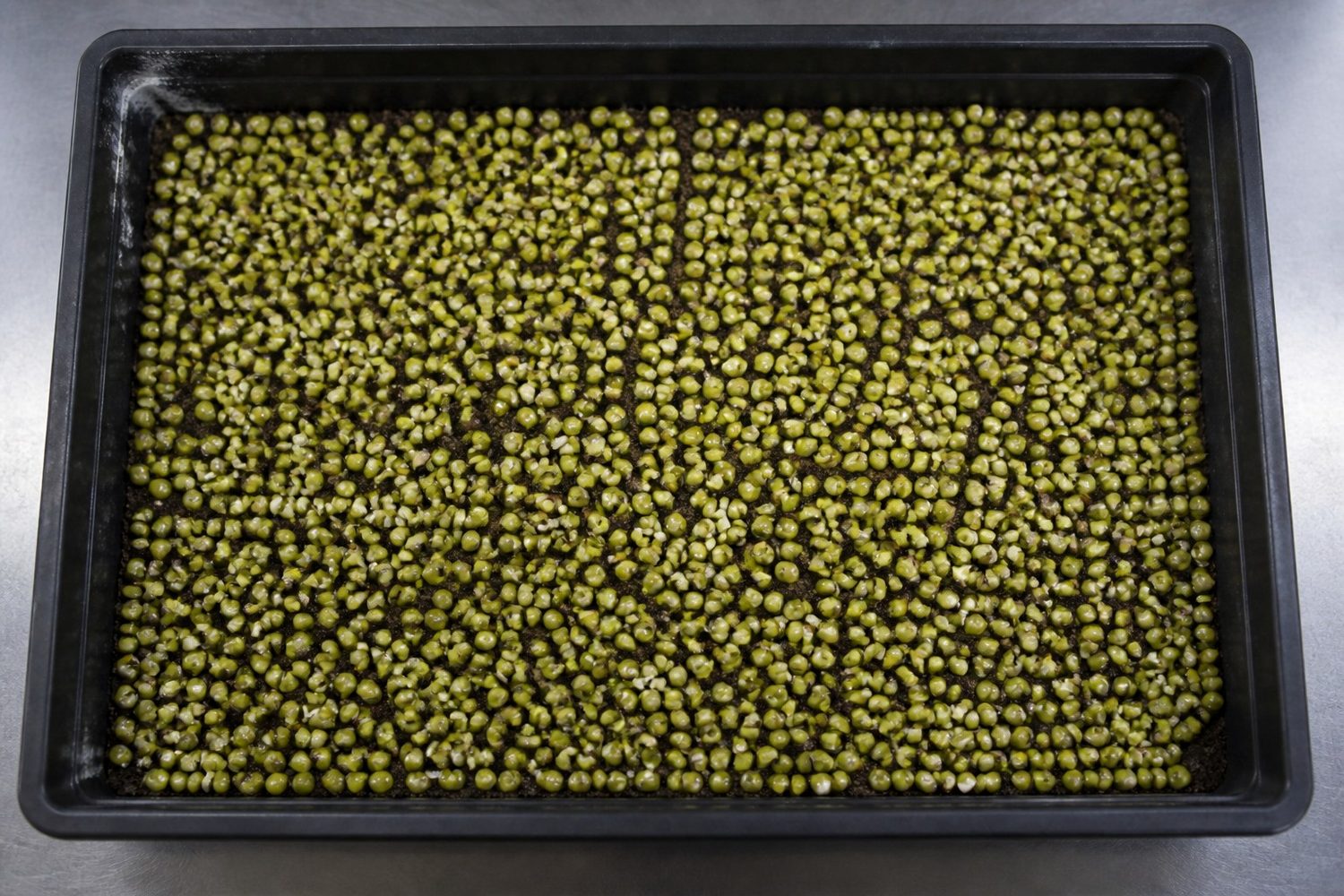
Under the blackout, the sour seed mass. Poor air plus too much water on 200 grams of soaked bean. Sour odor, a wet stagnant seed layer, patchy emergence. Caught early, more air and less water can save it. This is the failure this crop is known for and the reason its mold risk is rated high.
At emergence, damping-off. Seedlings rotting at or below the medium line, Pythium and Rhizoctonia among the usual organisms. Not mung-specific and not recoverable once it spreads.
Root hair or mold, and on mung the usual test is not supported. On most crops the rule is that growth staying at the medium line is root hair and growth climbing the stems is mold. No source opened for this crop validates that test on mung. What the documented disease signs actually are: rot at or below the medium line, collapse, and odor. Uniform close fuzz bound to the roots with no sour smell and no collapsing stems is the healthy picture. Anything with an odor attached is a discard.
After the cover comes off, a lifted seed layer. Insufficient pressure during blackout, showing as beans and root mat rising as a mat rather than the shoots rising out of it. Re-setting a tangled canopy does not work; fix the weight next time.
Nutrition, and what is actually measured
There is no USDA FoodData Central record for mung bean microgreens, searched 2026-08-09. The mature dry bean and the whole sprout both have entries and neither is a substitute, because they are different foods at different stages, and on this crop that is not a quibble.
There is one strong study and its finding is about variability. A peer-reviewed Frontiers paper grew 20 mung bean genotypes as microgreens, harvested at 7 days, cut about a centimeter above the medium, in two locations, and measured protein, phenolics, flavonoids, carotenoids, tocopherols, ascorbic acid, antioxidant activity and minerals. The Delhi-grown samples ranged 239 to 369 mg potassium per 100 g fresh weight, 47 to 87 mg calcium, 36 to 56 mg magnesium, 66 to 87 mg phosphorus and 30 to 60 mg sodium. Calcium nearly doubles across genotypes of the same species grown side by side.
That range is the finding, and it is what makes the marketing unsupportable. Claims that mung microgreens have many times the nutrients of the mature bean, or a defined vitamin C figure, have nothing behind them for this crop, and a calorie and protein panel rests on a single laboratory sample: 50.08 kcal and 4.55 g of protein per 100 g fresh weight (Kowitcharoen et al. 2021). The vendor page making those claims cites FoodData Central and does not name a record, because there is not one. The honest statement is that mung microgreens are a green vegetable whose mineral content depends heavily on which mung you grew and where.
That question goes both ways on the crops where somebody has measured it. Lettuce has measurements showing the seedling beating its adult, and celery has measurements going the other way. Mung has neither comparison, and twenty genotypes disagreeing with each other is the reason nobody should quote one number.
Which seed to buy
Three types are sold and only the size differs. Standard green mung, plus "Jumbo Mung" and "Golden Mung" on one crop guide, which claims the larger seed gives more tray weight at the same neutral, lightly sweet flavor. No supplier supports a cultivar claim for stem length, color, days or yield, and the named genetics in the research literature are Indian breeding lines rather than anything on a US shelf. Do not pay for a cultivar story here.
Buy seed sold for sprouting, and this is the one crop where that sentence carries real weight. Mung is sold three ways: as microgreen seed, as sprouting seed, and as a grocery bean for cooking. All three are Vigna radiata and the price difference is large. On Amazon, grocery mung runs roughly $3.75 to $4.50 a pound in four and five pound bags from the Indian and Middle Eastern food brands, against $12.43 a pound for sprouting-labeled seed. At a 200 gram tray that is about $1.75 of beans against $5.48.
What the cheaper bag does not carry is the testing. The FDA treats sprouts as a higher-risk category specifically because warm, moist, nutrient-rich germination favors dangerous microbes, and it expects sprout operations to control the seed, including treatment or documented prior treatment. Suppliers selling sprouting seed list untreated status and E. coli and Salmonella testing; a bag of cooking beans is sold on the assumption you will boil it. If you are growing shoots in a medium and cutting above it, you are not under the sprout rule, and the microbial argument for tested seed is weaker but it is not zero. If you are jar-sprouting the same beans, it is not weak at all. So: for a tray you cut above the medium, grocery beans are a defensible economy as long as you know what you are trading; for sprouts eaten whole, buy seed sold and tested for sprouting.
Refuse dyed or treated field seed outright. A fungicide coating is not selected or documented for a crop eaten raw a week later, and rinsing does not make a treatment safe.
A bad lot shows as uneven emergence, hard unswollen beans after a normal soak, a sour smell, or mixed sizes that will not stay in one layer. The last is specific to this crop and worth asking about, because a lot mixing jumbo and standard beans cannot be sown as a single course.
Mung bean sprouting seed on Amazon is a genuinely deep shelf, 625 results with most of the first page on-crop, and it carries the same Handy Pantry line the price above comes from. Compare the pound rate before you buy: at the time of writing Amazon was cheaper at the 2.5 lb size and the seed house was cheaper at 1 lb, 5 lb and 35 lb.
Is it worth growing?
As a tray crop, only for a specific person, and the competition is the reason.
Most microgreens compete with a garden plant. Mung competes with a four-day jar. Mung sprouts are a global commodity produced in water, with no medium, no light, no bench and no tray, ready in about four to five days, and sold cheaply in every supermarket. A mung shoot tray costs 200 grams of bean, a week and a half of shelf, and careful airflow, to produce something the buyer will probably mistake for the cheap thing.
So, the case has to be that the shoot is a different product: green leaves, softer stems, a week older, cut fresh. That is real, and it is narrow. It suits a home grower who wants that specific texture in noodle bowls and does not mind managing a soak, and a market grower only after a local yield test, because there is no measured yield to plan against.
Choose something else if you want low attention, if you have no ventilation, or if you are selling by weight into a market that already buys bean sprouts by the bag. Within the legumes, pea shoots have a measured 8 oz and a sweeter flavor, and lentil is the cheap one at 37 to 56 cents a tray. If what you actually want is bean sprouts, grow bean sprouts, read the sprout rule, and do not pay tray prices for them.
A note on the numbers above
Hover or tap a row to highlight it.
| Figure | Value | Source | What kind of number it is |
|---|---|---|---|
| Seed per 1020 | 215 g | Microgreen seed vendor, 10x20 product | Supplier figure, harvest stage unstated |
| Seed per 1020 | 200 g | Commercial seed-density calculator | Generated estimate, no method disclosed |
| Yield per 1020 | 350 g, 12.35 oz | Same density calculator | Generated estimate. Kept out of the table, see below |
| Yield, small box | 250 to 300 g from 11x19 cm | Crop guide | A box a fifteenth the area of a 1020. Not rescalable |
| Days to harvest | 7 | Frontiers 20-genotype study | Measured, at 82/79°F, no leaf stage stated |
| Days to harvest | 8 to 9 | Microgreen seed vendor | Supplier figure, with 3 to 4 blackout days |
| Days to harvest | 8 to 12 | Second supplier guide | Estimate, no temperature |
| Sprout timeline | 4 to 5 days | Johnny's sprout chart; Oregon State mung guide | A DIFFERENT PRODUCT, not a faster harvest |
| Soak | 8 to 12 hours, cold | Three supplier guides | Consistent across all three |
| Blackout weight | 1 to 2 kg | Crop guide | For an unspecified box, not a 1020 |
| Potassium | 239 to 369 mg/100 g FW | Frontiers, 20 genotypes | Measured, and the RANGE is the finding |
| Calcium | 47 to 87 mg/100 g FW | Frontiers, 20 genotypes | Measured, nearly doubling across genotypes |
| Shelf life | 8 to 10 days at 39 to 43°F | Crop guide | Sealed and dry, supplier guidance not a trial |
| Shelf life | About 4 days at 4°C | Storage trial, 2022 | MEASURED, zip-lock LLDPE bags, salability limit |
| Germination temperature | No published figure | Nobody | One study grew it at 82/79°F and tested no range |
| Harvest window | No published figure | Nobody | Nobody has established it |
The yield is blank, and the one number in circulation should not fill it. The single 1020 figure that exists anywhere, 350 g or 12.35 oz, comes from a commercial seed-density calculator with no disclosed method. That number would be the second heaviest yield of any microgreen, behind only sunflower's 18.77 oz and ahead of broccoli and radish at 11.5. It is not implausible: 350 g of shoot from 200 g of dry bean is 1.75 times the seed weight, and pea shoots return about 1.5 times theirs. But plausible is not measured, and after fenugreek a record-setting figure on this site has to survive a check it cannot pass here. A calculator output is thinner provenance than the single grower's tray behind celosia's 3.4 oz, and that one is labeled as one tray. So, it is reported here and kept out of the money columns.
The other figure available, 250 to 300 g, is from an 11 by 19 centimeter box. That is 209 square centimeters against a 1020's 1,290, about a sixth of the area, and scaling it up would be manufacturing a number rather than finding one.
Mung is among the three most expensive trays of seed to fill at the retail pound, $5.48 to $5.89, behind barley grass at $7.72 to $9.69 and popcorn shoots at $5.80 to $9.28, and ahead of chickpea shoots at $3.79 to $5.08. Either way it is an expensive tray to fill. And as with barley grass, the price of the bean is not what makes it expensive. Mung sprouting seed is $12.43 a pound, which is ordinary; the tray swallows 200 grams of it. Where you buy matters more than what you buy: the same supplier's ladder runs from $0.78 an ounce at 1 lb to $0.24 at the 35 lb bucket, so the identical tray is $5.48 or about $1.80 depending only on the bag you chose. That is the third crop in this directory where the pack size moves the tray cost by more than a factor of three.
Germination temperature is blank, which makes 13 of the 45 entries here with no figure for it. The one controlled study held its chamber at 82/79°F day and night and harvested at day 7. That is a condition the experiment ran at, not a range it tested, and there is no second source. A general 60 to 70°F microgreen figure exists and says nothing about mung. Filling the field from either would be putting a number where an experiment was never done.
The harvest window is blank as well, and as of 2026-08-09 that covers 41 of the 45 entries written. The only stated cost of a late cut is fibrous stems, with no day count attached.
Hover or tap a row to highlight it.
| Crop | Seed per 1020 | Yield | Days | Cost per tray | Oz per $1 | Oz per tray-day |
|---|---|---|---|---|---|---|
| Fenugreek | 25 to 62 g | 3.9 to 4.3 oz | 6 to 12 | $0.55 to $1.35 | 7.5 | 0.53 |
| Clover, Red | 20 g | 3 to 5 oz | 10 | $0.96 | 4.2 | 0.40 |
| Alfalfa | not a tray crop | not a tray crop | 4 to 6 | not a tray crop | not applicable | not applicable |
| Chickpea shoots | 123 to 165 g | No published figure | 9 to 14 | $3.79 to $5.08 | cannot be calculated | cannot be calculated |
| Mung bean shoots | 200 to 215 g | No published figure | 7 to 12 | $5.48 to $5.89 at 1 lb | cannot be calculated | cannot be calculated |
A blank means nobody has published that figure, so the cell is left empty rather than filled with an estimate. How the numbers work
All 62 crops, sortable, on the microgreen comparison.
Mung bean shoots cannot complete the comparison table below. It has a rate, a day range and a price, and the only weighed figure anywhere is a calculator output rather than a measurement. Somebody published a number; it is not one you can plan against.
Terms on this page
Tap a term to see what it means.
Sprout. Germinated seed eaten whole, seed and root included, grown in water and ready in days. Mung is the archetype, and that is what puts it under Subpart M.
Sources
- True Leaf Market, Handy Pantry organic mung bean sprouting seed - the price ladder verified 2026-08-09: 4 oz $6.27, 8 oz $8.44, 1 lb $12.43, 2.5 lb $18.83, 5 lb $33.82, 35 lb $133.04, at $1.57 down to $0.24 an ounce.
- UA Organic, mung bean microgreens - the crop-specific guide: 10 to 12 hour cold soak and the souring warning, single-layer sowing, 1 to 2 kg of pressure on an unspecified box, mandatory ventilation, hulls as edible helmets, 8 to 10 days at 39 to 43°F stored dry and unwashed, the 250 to 300 g from an 11x19 cm box, and the Jumbo and Golden types.
- Priti et al., 2022, mungbean, lentil and Indian mustard microgreens, PLoS One - mungbean microgreens held about 4 days at 4°C in 51 µm LLDPE zip-lock bags before falling below the salability score.
- MP Seeds, mung bean microgreen seed - 215 g per 10x20, 8 to 9 days, 3 to 4 days blackout, up to 8 hours soak, the fibrous-stem warning, and the product photograph showing green leaf pairs with residual hulls.
- Wagner Greens growing guide - 8 to 12 days to upright tender shoots, and the 8 to 12 hour soak improving speed and uniformity while dry sowing remains possible.
- Seed Density Calculator, mung - the 200 g rate and the 350 g yield estimate, with no method disclosed, which is why the yield is not in the comparison table.
- Kumar et al., 2021, nutritional characterisation of 20 mungbean genotypes as microgreens, Frontiers in Plant Science - harvest at 7 days, 82/79°F day and night, cut 1 cm above the medium, and the mineral ranges across genotypes including potassium 239 to 369 mg and calcium 47 to 87 mg per 100 g fresh weight.
- FDA, FSMA Produce Safety Rule - sprouts treated as a higher-risk category because warm, moist, nutrient-rich conditions favor dangerous microbes, and the seed controls expected of sprout operations.
- Johnny's microgreens yield trial, method and discussion - mung is absent from the 29-variety trial, and the warning that yields do not transfer between systems.
- Seedmart Australia, organic mung bean sprouting seed - untreated status and E. coli and Salmonella testing offered on sprouting seed.
- UC IPM, damping-off - Pythium and Rhizoctonia, and symptoms at or below the medium line.
- SDSU Extension, growing microgreens at home - the general refrigerated shelf-life figure, cited here only to mark that it is not mung-specific.
- USDA FoodData Central - searched 2026-08-09, no mung bean microgreen record.
- Johnny's Selected Seeds, sprout growing instructions (revised 2018) - mung bean sprouts at 4 to 5 days.
- Oregon State University, sprout production - mung bean sprouts at 4 to 5 days.
- Kowitcharoen et al. 2021, proximate composition of 14 microgreens, Applied Sciences - mung bean microgreens at 50.08 kcal, 4.55 g protein and 7.16 g carbohydrate per 100 g fresh weight.
Keep reading
The variety directory
Alfalfa
Alfalfa grows in a jar in four to six days, rinsed twice a day and eaten whole, root and all. The care goes into the food safety rather than the growing.
Read AlfalfaThe variety directory
Chickpea shoots
One of the very few crops with real regrowth data behind it: a measured second cut at 96 percent of the first, if you cut above a node instead of at the medium line.
Read Chickpea shootsThe variety directory
Pea shoots
Pea shoots are the easiest microgreen to start and one of the easiest to lose. Sourced figures for seed rate, days, yield and cost, plus the wet-seed failure that actually kills trays.
Read Pea shootsThe variety directory
Lentil microgreens
The cheapest legume tray by a wide margin, because its seed is a grocery commodity: about 47 cents and 7 oz a tray, against pea shoots at $2.39 for eight.
Read Lentil microgreens