At a glance
No soak, a simple stack-and-light routine, and a documented protocol that calls it easy, but the label flatters it: 20 g of small legume seed left wet in still air molds readily, and the quality window closes fast enough that a late tray is bitter rather than merely large.
- Botanical name
- Trifolium pratense
- Also sold as
- Red Clover, Clover, Red (Organic)
- Family
- legume
- Difficulty
- Beginner
- Days to harvest
- 9 to 13 days
- Harvest window
- No published figure
- Soak
- None
- Blackout
- 3 to 4 days
- Germination temperature
- No published figure
- Yield per 1020 tray
- 3 to 5 oz
- Mold risk
- Medium
- Hull shedding
- some
- Shelf life
- 7 to 10 days
- Eaten as
- raw
- Seed cost per tray
- $0.96
20 g at $21.84/lb, True Leaf Market organic red clover, listed 2026-08-08. Mid-pack: 18 of the 50 costed crops come in below it, the cheapest being turnip at $0.31. Seed only, excludes medium, tray, labor, light and loss.
Any field name above ranks every variety by it. No published figure means we researched it and nobody has established one, which is different from not yet researched. Every figure here is sourced at the bottom of the page. Compare every variety side by side.
Red clover costs 96 cents of seed a tray and returns 3 to 5 ounces, which is a light tray at a middling price. Eighteen of the 50 costed crops seed cheaper than it, the lowest being turnip at 31 cents, so do not reach for it expecting a budget crop. Broccoli costs 17 cents less and returns nearly three times as much.
It is also one of the few crops, alfalfa being the other, sold as a sprout as often as a microgreen. That is not a labeling quirk. A sprout is germinated seed eaten whole, seed and root included; a microgreen is grown in a medium, cut above the soil line, and the seed is not eaten. FDA's Subpart M sprout requirements apply to the first and not the second, so what you call it decides which federal rules you are under.
What growers are saying right now
Sampled from public posts and videos, 9 July to 8 August 2026. Every line links what it is quoting. How often something is repeated is not evidence that it is true, so every line also says what the sources actually establish.
Sprouts, microgreens, or both at once
Circulating Nearly every clover guide blurs the two in its own title. "Microgreens: how to sprout red clover", "Red clover microgreens or sprouts", "Red clover microgreens grown in sprouting tray", and "How to grow microgreens: red clover and alfalfa sprouting seed"
They are different products and on this crop the difference is regulatory. Germinated seed eaten whole is a sprout and falls under Subpart M of the FDA Produce Safety Rule. Seed grown in a medium and cut above the soil line is a microgreen and does not, though it may still be covered produce. Anyone growing clover to sell should settle which one they are making before they buy the seed. How the FDA separates them
Does one have more nutrients than the other?
Circulating The top question under the largest video in this sweep, 65,682 views comparing sprouts against microgreens, asked by @manjus3 at 15 likes, and left unanswered
For clover, nobody has published an answer. There is no USDA FoodData Central record for clover microgreens at all. What does exist is one peer-reviewed study that grew red clover among seven small-seeded forage legumes and found the clover group substantially higher in isoflavones than the others. That measures the microgreen, on freeze-dried material collected after first true leaves, and it says nothing whatever about the sprout. What is actually established
You don't need a specialist seed shop
Circulating A reel making that case at 8,223 views, about starting greens from ordinary seed
Reasonable for many crops and risky for this one, because clover is a major agricultural and lawn seed. Lawn, pasture, cover-crop and food-plot clover is routinely dyed, treated or inoculated, and SDSU Extension is explicit that seed treatments can be carried into shoots eaten this young. The good news from checking the shelf: searching specifically for red clover sprouting seed returns a clean, food-use category. Searching for "clover seed" does not. Which seed to buy
Microclover for your lawn
Circulating The only clover post on TikTok in the window is about replacing grass
A useful reminder that clover is an amenity and forage crop first, and that the word covers several species. The crop on this page is red clover, Trifolium pratense. Crimson clover is T. incarnatum and white clover is different again, and crimson clover sprouting seed ranks alongside red in the same search results. Buy the species, not the word.
Nobody in r/microgreens is growing it
Circulating Sixteen threads came back from the sub and not one is clover. What came back instead is sunflower at 28 comments, broccoli root hairs, monsoon mold, and a sprouting question in r/Sprouting
Consistent with everything else here. All the clover video content is years old, there is no trial data for the crop, and the one production protocol comes from a single grower. Clover lives on the sprouting shelf far more than in the tray rack, so expect to work from one grower's protocol rather than from a consensus.
What it is, and how to tell you grew it right
Clover microgreens are seedlings of red clover, Trifolium pratense, a legume, cut above the medium at cotyledon or early true-leaf stage.
Get the species right before anything else. "Clover" is sold as red, white and crimson, and those are different species. Crimson clover is T. incarnatum, and crimson clover sprouting seed appears in the same search results as red. The research and the growing protocol behind this page are for red clover, and nothing here should be applied to the others without checking.
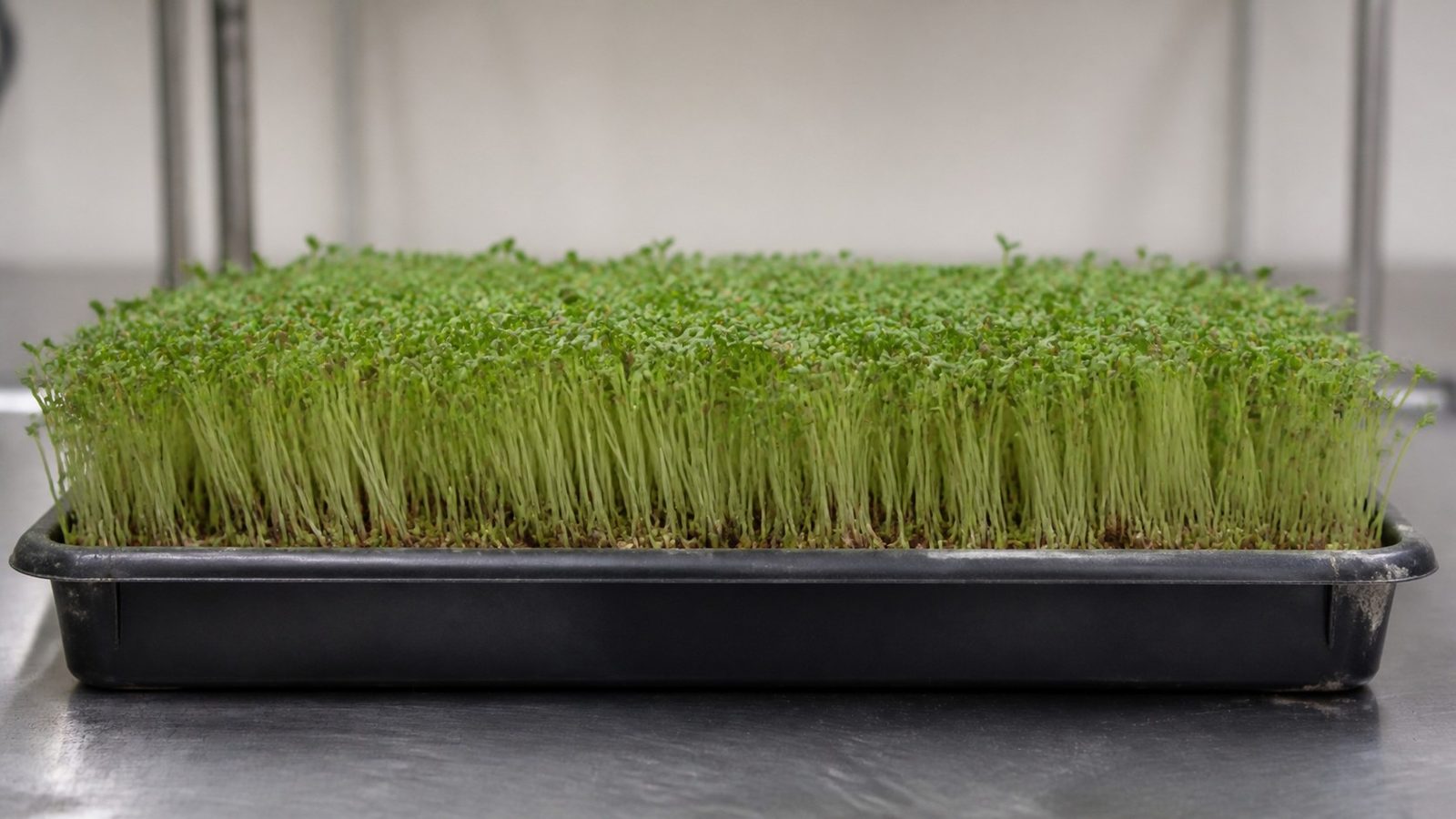
A correct tray is a dense, even carpet of very slender pale green to whitish stems topped by two tiny rounded cotyledons. The texture is the tell: fine and delicate, nothing like the thick stems of pea or sunflower. At the medium you will see a packed tangle of fine stems and some hulls sitting in the canopy. One thing to expect and not worry about: the canopy is green, not red. The "red" in red clover refers to the mature flowering plant.
It is confused with alfalfa and with other pale mild sprouts, and at cotyledon stage there is no reliable way to tell them apart by eye. So, keep the lot label on the tray rather than expecting to identify it later from a photograph. Red clover's trifoliate three-leaflet true leaf would settle it, but by then the crop is past its best cut.
What it tastes like, and what to do with it
Mild and light, with a gentle grassy sweetness. It contributes soft volume and fresh texture rather than flavor, which is the whole point of it.
And it turns bitter if you leave it. The supplier's instruction is to harvest before day ten specifically because flavor deteriorates with age, and bitterness cannot be washed out or refrigerated away. That single fact should shape how you plan the crop: sow small staggered batches rather than one big tray you intend to hold.
Use it as a salad base, in a sandwich or wrap, on a burger, or as a light finish on a grain bowl. It is the wrong choice when a dish needs one assertive flavor, because it will not deliver a peppery hit or a brassica bite at any density. Anyone who wants that should take radish or mustard instead.
The people who will not like it are those expecting flavor rather than texture, and anyone sensitive to bitterness who has been sold a late tray.
Growing it: only what differs from the standard method
Everything general about trays, medium, light and watering is on the standard tray method for growing microgreens. One thing to say plainly first: this crop's production figures come from a single grower protocol. Clover is absent from the one public per-variety trial, so unlike broccoli or radish there is no measured benchmark, and everything below is one documented system rather than a replicated result.
Twenty grams per 1020, sown level. Small legume seed, surface sown and pressed into pre-moistened medium, not buried. Leveling matters more than usual because the seed is fine and the hulls make even distribution harder.
No soak. The protocol says so directly. A research study did soak red clover before germination, but as part of a 3 to 12 hour species-dependent range across seven legumes, which is a laboratory method rather than a tray recommendation. Skipping the soak also avoids handling hydrated seed that clumps.
Three to four days stacked under about 16 pounds. The weight is for seed-to-medium contact and a level anchored mat. Unstack on schedule: this is a crop where the documented next step is light, air and bottom watering, and leaving weight on a wet emerged stand is how the trouble starts.
Then bottom water every two or three days, not daily. That is markedly less frequent than misting, and it is deliberate: the volume should be set by how fast your medium dries rather than by a schedule. Keep air moving and keep it out of direct sun. Hot and humid with still air is the named failure condition.
Then cut it early. About nine days in light after unstacking, and the quality deadline is before day ten. This is the crop where the harvest decision is made on the calendar rather than on the leaf, because the visual change lags the flavor change.
A clover tray, day by day
- 1
Day 0, sow dry
20 g surface sown on level, pre-moistened medium, pressed for contact, not buried. No soak.
- 2
Days 1 to 4, stacked
An empty tray on top with about 16 lb on it, for contact and a level mat. Unstack on schedule rather than by eye.
- 3
After unstacking
Light, moving air, no direct sun. Bottom water every 2 to 3 days as the medium dries, not daily.
- 4
Watch the room, not just the tray
Hot, humid and still is the documented condition that produces mold on this crop. Airflow is the control.
- 5
Day 9 or 10, cut
The protocol says 10 to 13 days; the seed supplier says cut BEFORE day 10 or it goes bitter. Sample around day 9, and believe your mouth rather than the calendar.
- 6
At harvest, deal with the hulls
Red clover needs extra rinsing to clear them. Rinse only if you can dry the crop fully before packing, or lift loose hulls out as you cut.
What goes wrong with clover specifically
Uneven emergence. Bare patches showing before you unstack, from uneven surface placement or poor seed-to-medium contact. You can accept a thinner tray or start again, but do not try to fix it by flooding it, which leads directly to the next two problems.
Mold in a hot, humid, still tray. Gray, webby growth above the medium rather than fuzz confined to the roots. Ventilate and dry the foliage. A genuinely localized patch can be removed; a spreading canopy is not saleable.
Damping-off from overwatering. A water-soaked or pinched stem, or collapse right at the medium line. Pythium and Rhizoctonia rot seedlings at or below that line, and affected plants do not recover.
Hulls in the canopy, and this crop handles them differently from every other one here. Red clover requires extra rinsing to clear hulls, and it is the rare crop where the fix is water rather than a brush or a cull. That creates an obvious tension with everything else on this page about keeping the crop dry, and the way to hold both is: rinse only if you can dry it completely before packing, otherwise lift the loose hulls out while cutting.
Bitterness, which is a failure you cannot see. A tray past day ten is bitter, and no amount of washing or chilling reverses it. Everything else on this list announces itself visually. This one does not, which is why the harvest deadline matters more on clover than on almost anything else you will grow.
Root hairs against mold, the mist test. Root hairs sit at the root and medium interface and lose their fuzzy look when misted. Mold is gray and web-like above the medium, becomes more web-like when sprayed, and may bridge between seedlings. On a stand this fine and dense the distinction is worth making carefully.
Nutrition, and what is actually established
There is no USDA FoodData Central record for clover microgreens, searched 2026-08-08. Neither the mature forage plant nor a branded label is a substitute.
One peer-reviewed study is directly relevant and it is worth reading precisely. It grew red clover, cultivar 'Sadūnai', among seven small-seeded forage legumes, without soil in sprouting boxes, misted two to three times daily, and collected microgreens after the first true leaves emerged. Samples were freeze-dried and analyzed for proximate composition, minerals, phenolics and isoflavones, and antioxidant-related measures. Its notable finding for this crop is that clover microgreens carried substantially higher isoflavone concentrations than the other legumes studied.
That is a real, specific measurement, and it is also the finding most likely to be misused. Isoflavones are the compounds red clover is known for in supplement marketing, and a measured concentration in freeze-dried laboratory material is not a serving, a dose, or a health effect. The study values are cultivar, system and dry-matter dependent and should not be converted into a fresh 100 g label.
The retail claims that clover microgreens are rich in vitamins A, C and K, or high in protein, or supply some percentage of a daily requirement, are not supported by anything opened for this page. No analytical method, no FDC record, no cultivar and harvest basis. The supportable statement is the narrower one above.
Which seed to buy
**Specify red clover, Trifolium pratense, sold for food, microgreen or sprouting use, untreated, with a current lot germination test.**
Every part of that sentence is doing work. The species, because crimson and white clover are sold under the same word and appear in the same search results. Food use, because clover is a major lawn, pasture, cover-crop and food-plot seed, and that is a far bigger market than the edible one. Untreated, because agricultural clover seed is routinely dyed, treated or inoculated, and SDSU Extension is explicit that those can be carried into shoots eaten this young. A lot germination test, because no supplier opened for this page publishes one and "high germination" on a listing is a sales claim rather than a document.
There are no named red clover microgreen cultivars to choose between. No supplier page opened here offers one with comparable stem length, color, days or yield. The 'Sadūnai' cultivar in the research is a literature accession, not a product you can buy.
A bad lot shows as patchy emergence at a known even sowing, with disproportionate unsprouted seed and hulls. It costs twice: the seed, and the full ten to thirteen day tray slot, and it tempts a grower into the overwatering that starts the disease.
Red clover microgreen and sprouting seed on Amazon is the convenient route for a home grower. Check the listing names the species rather than just the word clover.
Is it worth growing?
For a home grower who wants a mild, soft salad green and will cut it on time, yes. It is cheap to seed, needs no soak, and the routine is simple.
For anyone selling by weight, look at the numbers first. Three to five ounces is about the lightest tray going, and the figure comes from one grower's protocol rather than a trial. At 96 cents a tray the seed is not even cheap: broccoli costs 79 cents and returns 11.5 ounces. Nothing about the seed price rescues a light tray.
It also carries two costs that do not show up in a yield figure. The hull rinse is real handling labor that most crops here do not need. And the bitterness deadline removes the flexibility growers normally rely on, because you cannot hold a ready tray for a day or two to suit a delivery.
So, it earns a slot in two situations. When a buyer specifically wants a fine, mild, delicate green that broccoli and kale cannot imitate. And when you are already growing sprouts, where the same seed and the same shelf are in play, and the microgreen is an extension of something you do anyway.
Against alfalfa, the other sprout-adjacent legume here, the choice is largely about what your customers already ask for. Against a brassica tray it loses on every measurable axis and wins only on texture.
A note on the numbers above
Hover or tap a row to highlight it.
| Figure | Value | Source | What kind of number it is |
|---|---|---|---|
| Seed per 1020 | 20 g | Vitality Farms protocol | ONE grower's protocol, not a trial |
| Seed per 1020 | No trial figure | Johnny's | Clover is absent from the trial entirely |
| Yield per 1020 | 3 to 5 oz | Same protocol | Same single source. Lowest yield in this directory |
| Days to harvest | 10 to 13 | Same protocol | No temperature or harvest stage stated |
| Days to harvest | Before day 10 | True Leaf Market | A QUALITY deadline: it turns bitter after |
| Soak | None | Vitality Farms protocol | Stated as "Soak: No" |
| Soak | 3 to 12 hours | Red clover research study | A lab method across seven legumes, not a tray rate |
| Blackout | 3 to 4 days, 16 lb paver | Vitality Farms protocol | Then about 9 days in light |
| Watering | Bottom water every 2 to 3 days | Same protocol | Volume unstated; set it by medium dry-down |
| Germination temperature | No published figure | Nobody | 60 to 70°F and 70 to 75°F are general, not clover |
| Shelf life | 7 to 10 days | Same protocol | Bagged dry with an absorbent pad, temperature unstated |
| Harvest window | No published figure | Nobody | The instruction is a deadline, not a span |
| Hull shedding | Requires extra rinsing | True Leaf Market | Not quantified, and the only rinse-fix crop here |
| Seed cost per 1020 | $0.96 | Calculated, True Leaf price | 20 g at $21.84/lb, listed 2026-08-08 |
The two day-counts genuinely conflict, and the table shows both rather than splitting the difference. One source says a clover tray takes 10 to 13 days. The other says cut it before day 10 or it turns bitter. Those cannot both be routine advice, and the resolution is not arithmetic: sample around day nine and taste it. This page publishes 9 to 13 so the disagreement is visible, and says plainly that the deadline should win.
Almost every figure here comes from one grower. The seed rate, the yield, the blackout, the weight, the watering interval and the shelf life all trace to a single protocol document. That is a much thinner evidence base than broccoli or radish, where a trial and a commercial system can be checked against each other, and it is the direct consequence of clover being absent from the only public trial in the category. Treat these numbers as a starting point to test rather than a benchmark to plan against, and weigh your own trays.
Hover or tap a row to highlight it.
| Crop | Seed per 1020 | Yield | Days | Cost per tray | Oz per $1 | Oz per tray-day |
|---|---|---|---|---|---|---|
| Lentil | 19.1 to 28.7 g, area-converted | 6.1 to 8.4 oz, area-converted | 8 to 12 | $0.37 to $0.56 | 15.5 | 0.73 |
| Fenugreek | 25 to 62 g | 3.9 to 4.3 oz | 6 to 12 | $0.55 to $1.35 | 7.5 | 0.53 |
| Clover, Red | 20 g | 3 to 5 oz | 10 | $0.96 | 4.2 | 0.40 |
| Alfalfa | not a tray crop | not a tray crop | 4 to 6 | not a tray crop | not applicable | not applicable |
| Chickpea shoots | 123 to 165 g | No published figure | 9 to 14 | $3.79 to $5.08 | cannot be calculated | cannot be calculated |
A blank means nobody has published that figure, so the cell is left empty rather than filled with an estimate. How the numbers work
All 62 crops, sortable, on the microgreen comparison.
Clover is the clearest demonstration that cheap seed does not make a cheap crop. It has the lowest seed cost per tray of anything measured here, 96 cents, and it still returns only 4.2 ounces per dollar because the yield is so light. Broccoli, at 79 cents, returns 14.5. The seed line is the smallest cost in a microgreen operation and the one growers scrutinise most, and this row is the argument for looking at the other side of the equation instead.
Prices move, so the dollar columns are dated. The rankings are the durable part.
Terms on this page
Tap a term to see what it means.
Red clover. Trifolium pratense, the species this page is about. Crimson clover and white clover are different species sold under the same word.
Sources
- Vitality Farms, clover 1020 growing protocol (PDF) - 20 g per 1020, no soak, 3 to 4 days stacked under a 16 lb paver then about 9 days in light, bottom watering every 2 to 3 days, 10 to 13 days to harvest, a 3 to 5 oz yield, 7 to 10 days bagged dry with an absorbent pad, good airflow and no direct sun, and mold in hot humid low-airflow conditions with damping-off from overwatering.
- True Leaf Market, red clover organic sprouting seed - sold as Trifolium pratense for sprouts and microgreens, the instruction to harvest before day 10 because flavor turns bitter with age, the requirement for extra rinsing to remove hulls, and the $21.84 per pound price behind the cost calculation, listed 2026-08-08.
- Fresh Forage, red clover for chefs - the harvested product described as mild and fresh, and the photographs behind the appearance description: a dense even carpet of slender pale stems with tiny rounded cotyledons.
- Johnny's microgreens yield trial results (PDF) - 29 varieties at first true leaf, with no clover row. The absence is why every figure on this page traces to one grower.
- Johnny's microgreens yield trial, method and discussion - the trial method, and the warning that one system's yields do not translate to another's.
- FDA, guidance on sprouts and the Produce Safety Rule (PDF) - the Subpart M sprout requirements, and that microgreens cut above the growing medium are not subject to them though they may remain covered produce.
- University of Maryland Extension, growing microgreens and baby greens indoors - cutting seedlings above the medium and the statement that they will not regrow, the 70 to 75°F general figure, and the raw uses in salads, sandwiches, wraps, soups, omelets and garnishes.
- Virginia Tech Extension SPES-756 (PDF) - the general 60 to 70°F production range, and that environmental settings must be trialled by species and cultivar.
- UC IPM, damping-off - Pythium and Rhizoctonia, wet conditions favoring some Pythium species, and seedlings rotting at or below the medium line.
- Oregon State Extension, high desert gardening newsletter, April 2025 (PDF) - the mist test: root hairs losing their fuzzy appearance when wet, against mold looking more web-like when sprayed.
- SDSU Extension, growing microgreens at home - untreated seed, and why dyes, fungicides or insecticides applied to seed are not appropriate on shoots eaten this young.
- Red clover microgreen composition study - T. pratense cultivar 'Sadūnai' among seven small-seeded forage legumes, grown without soil in sprouting boxes, misted two to three times daily, collected after first true leaves, freeze-dried, and analyzed for proximate composition, minerals, phenolics and isoflavones, with clover microgreens substantially higher in isoflavones than the other legumes studied.
- USDA FoodData Central - searched 2026-08-08, no clover microgreen record.
Keep reading
The variety directory
Mung bean shoots
The crop where the sprout and microgreen line stops being a technicality: mung is the bean sprout of commerce, and the two products sit under different food-safety law. 200 to 215 g a tray, and no measured yield anywhere.
Read Mung bean shootsThe variety directory
Lentil microgreens
The cheapest legume tray by a wide margin, because its seed is a grocery commodity: about 47 cents and 7 oz a tray, against pea shoots at $2.39 for eight.
Read Lentil microgreensThe variety directory
Arugula microgreens
Arugula is a seasoning green rather than a salad base: 10 g of seed makes 10 oz in 14 days, it is genuinely peppery, and its 10-day shelf life comes from a controlled storage study rather than an estimate.
Read Arugula microgreensThe variety directory
Broccoli microgreens
Broccoli takes 13 g of seed per 1020 tray and gives 11.5 oz at first true leaf, both from Johnny's trial. No soak, fast even germination, and the root-hair-or-mold test you will need in the first week.
Read Broccoli microgreens