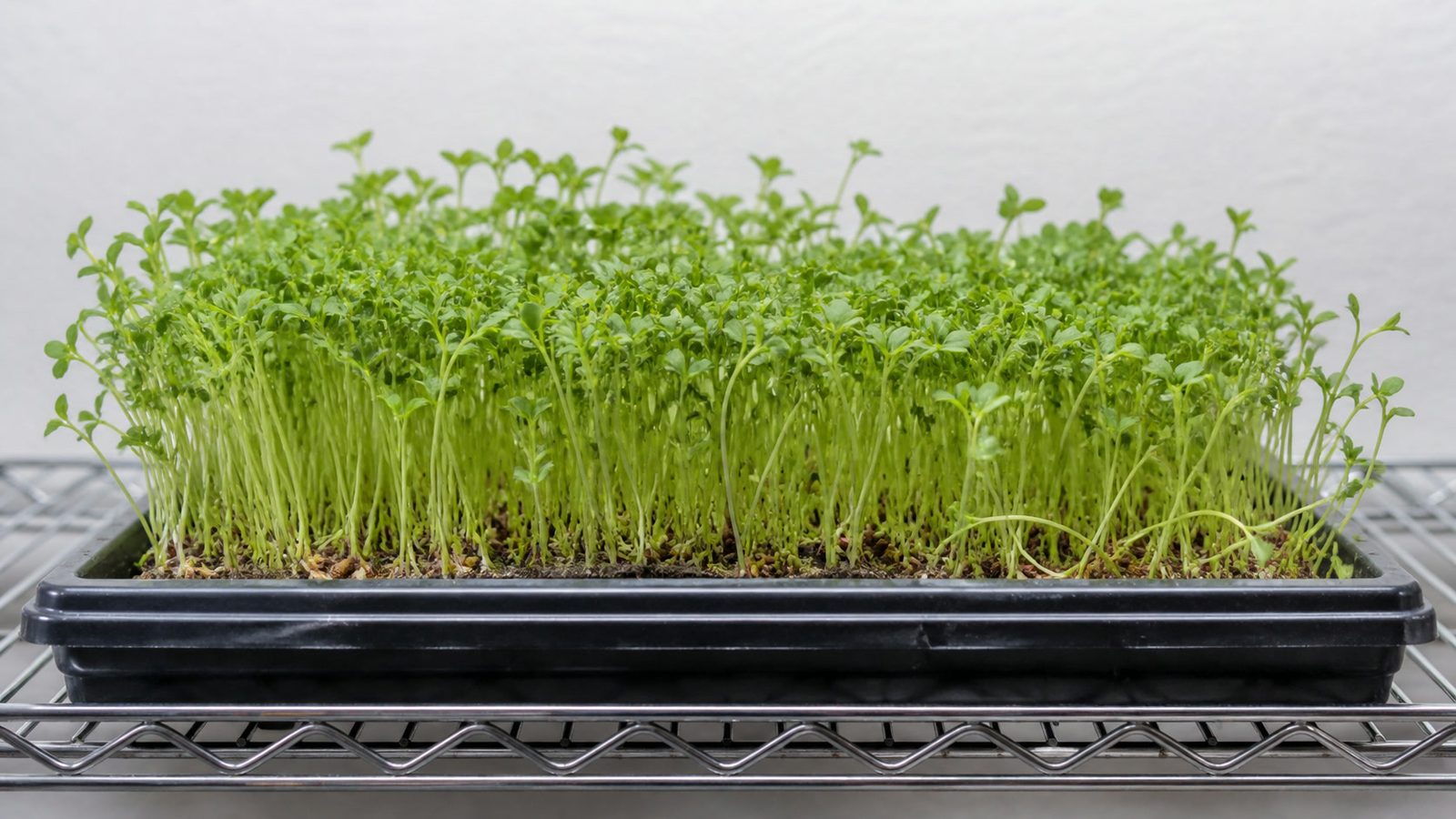
At a glance
Big obvious seed that germinates fast and visibly, with one condition attached: a soaked legume mass holds water, so drainage and airflow decide whether it comes up or sours.
- Botanical name
- Lens culinaris
- Also sold as
- Green lentil sprouting seed, Whole green lentil, Brown lentil, Beluga lentil
- Family
- legume
- Difficulty
- Beginner
- Days to harvest
- 8 to 12 days
- Harvest window
- No published figure
- Seed per 1020 tray
- 19.1 to 28.7 g
- Soak
- 6 to 12 hours
- Blackout
- 3 to 4 days
- Germination temperature
- No published figure
- Yield per 1020 tray
- 6.1 to 8.4 oz
- Regrows after cutting
- No published figure
- Mold risk
- High
- Hull shedding
- some
- Shelf life
- 7 days
- Eaten as
- raw
- Seed cost per tray
- $0.47
23.9 g at $8.86/lb, Handy Pantry organic green lentil sprouting seed, 5 lb at $44.30, listed 2026-08-09. THE POINT OF THIS CROP: lentil seed is a grocery commodity, so it is roughly a fifth the price per pound of pea and a twentieth of chives. At the ends of the rate range the same tray is $0.37 to $0.56. Seed only, excludes medium, tray, labor, light and loss.
Any field name above ranks every variety by it. No published figure means we researched it and nobody has established one, which is different from not yet researched. Every figure here is sourced at the bottom of the page. Compare every variety side by side.
Legume shoots share a problem: the seed is heavy, so the tray is expensive. Pea shoots take 150 g and cost $2.39. Chickpea shoots take 123 to 165 g and cost $3.79 to $5.08, one of the priciest trays you can fill, behind only barley grass and mung bean shoots. Fenugreek is lighter and cheaper but returns about four ounces.
Lentil breaks the pattern, and it does it for a reason that has nothing to do with the plant. Lentil seed is a grocery commodity. Organic sprouting lentil runs about $8.86 a pound in a five-pound bag, which is roughly a fifth of pea seed and a twentieth of chive seed, because the world grows millions of tonnes of it to eat.
At the published rate that is about 47 cents of seed for a tray returning six to eight ounces in ten days, which is about the third-best value per dollar of seed of any microgreen, behind mizuna at about 25 and arugula at 20.8. The catch is in where those numbers come from rather than in the crop, so read the numbers section before you plan against them.
What growers are saying right now
Sampled from public posts and videos, 10 July to 9 August 2026. Every line links what it is quoting. How often something is repeated is not evidence that it is true, so every line also says what the sources actually establish.
Sprouts have about 20 to 30 times more nutrients than adult greens, and a handful is the same as eating tons of produce
Circulating Said here at 2,433,119 views and 86,466 likes, by far the largest microgreen post of the month, in a video that uses lentils as one of its four sprouts
Not establishable as a number, and lentil is the crop that shows why. The one peer-reviewed study of lentil microgreens grew 20 genotypes in two locations and found results varied substantially by both. When the same crop's measured composition moves with which variety you sowed and where you grew it, a single multiplier against "adult greens" cannot be true of the category. Note also that the claim is about SPROUTS, which are germinated seed eaten whole, and this page is about a shoot cut above the medium. What is actually established
Lentil seeds are hard when dry, so soak them six to eight hours
Circulating Demonstrated here at 1,825,874 views, in a paper-towel-against-soil comparison that happens to be grown with lentil
Good advice, and lentil is one of the few microgreens where a soak is genuinely recommended rather than warned against. Most are better sown dry; lentil is a large legume that takes up water fast, and soaking is what makes the stand even. Drain it completely afterwards. The same video is cited on the [spinach](/microgreen-types/spinach/) page for the medium question, which is worth knowing: it is one of the most watched microgreen videos anywhere and its crop is lentil.
At day 15 the lentil microgreens are seven to nine inches tall and ready to harvest
Circulating Said in the same video, which reports two to three inches at day 10 and keeps growing
This directly contradicts the commercial grow card, which calls 10 to 12 days optimal, 13 to 14 acceptable and 15 plus overripe with woody stems and a faintly bitter taste. Both are describing real trays. Nobody has measured the difference, so there is no winner to pick and the harvest window stays unestablished. Cut across a few days and decide on your own trays. Where the numbers come from
What it is, and how to tell you grew it right
Lentil microgreens are seedlings of Lens culinaris, the food lentil, cut above the medium. Green, brown and beluga lentils are all whole viable seed and all usable; what is not usable is anything split or hulled, which is covered below and is the single most common way to waste a tray.
At harvest expect a stand of long, slender, juicy pale to bright green stems topped with small paired lacy leaflets. The stems should look elastic rather than stiff. Down at the medium there will be roots and a layer of split hulls and spent cotyledons, which is exactly why the cut is made above the cotyledons: the hard seed material stays in the tray instead of in the clamshell.
Height depends entirely on when you cut, and the two sources that give a number disagree by a factor of three: a grow card describes 10 to 12 cm at the recommended stage, and a filmed grower reports two to three inches at day 10 and seven to nine inches by day 15.
What it is confused with is pea shoots, the other pale mild legume shoot. The field cue is leaf size and tendrils: lentil keeps small paired lacy leaflets on slender stems, where pea develops larger leaflets and visible tendrils as it matures. No side-by-side authoritative photograph confirms that, so treat it as a cue rather than a key, and keep the seed labeled.
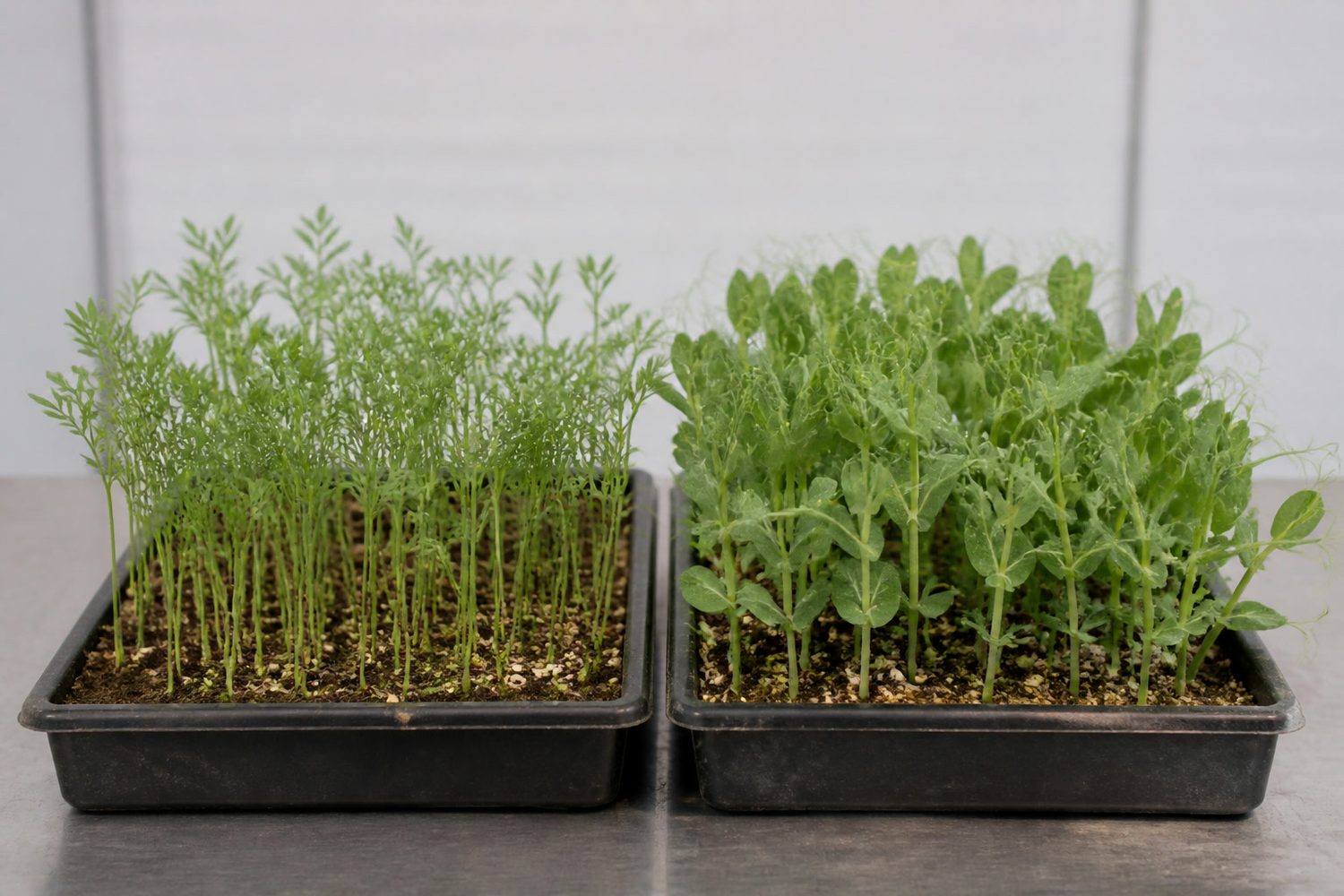
What it tastes like, and what to do with it
Mild, sweet and nutty, with a juicy snap. It reads much closer to fresh pea than to anything peppery, and it carries real volume rather than being a garnish note.
That makes it one of the few microgreens you can use as substance: through a grain bowl, on a hummus plate, alongside salmon or chicken, piled into a sandwich, or dropped onto a soup at the end. It is the wrong choice when the plate wants heat, when it wants a red or purple accent, or when it wants a delicate micro-herb that disappears into the dish.
Flavor moves with the cut. An early cut is delicate and slightly sweet; a 10 to 12 day cut is denser and more frankly leguminous; past 15 days a grow card reports woody stems and a taste that turns neutral to slightly bitter. That last stage is the one the filmed grower above disagrees about, so taste your own trays across a few days before you decide where your cut is.
Who will not like it: people who dislike pea and bean flavors, and anyone expecting brassica sharpness. Neither is fixable in the tray.
Growing it: only what differs from the standard method
Everything general about trays, medium, light and watering is on the standard tray method for growing microgreens. Lentil's deltas all follow from one fact: it is a big seed that drinks.
Soak it, which is the recommendation on this crop rather than the prohibition it is on most. Eight to twelve hours in clean room-temperature water, or six to eight in the filmed method. Water that is too hot or too cold can shock the seed and slow it down. Then drain completely and rinse, discard anything still floating, and sow damp rather than wet. Compare that with flax, chia and garden cress, where soaking is the documented way to ruin the tray. Seed size decides which camp a crop is in.
Sow one layer, and do not let seeds sit on each other. The general large-seed rule is roughly two seeds per square inch against up to twelve for a fine seed, although the one lentil density trial, a 2022 study in New Delhi, chose 3 seeds per square centimeter, about 19 per square inch, for the best marketable crop. Stacked seed cannot expand, and a supplier is explicit that restricted expansion means restricted airflow means mold. On this crop uneven sowing is not a cosmetic problem: swelling seeds heave each other up and you get uneven height plus trapped moisture.
Three to four days covered with gentle pressure, uncovered when most sprouts are 3 to 5 cm and lifting the cover. The pressure keeps seed in contact with the medium while the big seeds push; it is not there to make the crop taller.
Then bottom water, once or twice a day. Overhead water sitting on the stems is what starts stem rot on this crop. Light after uncovering, 16 to 18 hours if you are running LEDs.
And give it more drainage and airflow attention than a brassica, not more light. Nothing establishes a lentil-specific light requirement.
A lentil tray, day by day
- 1
The night before, soak
8 to 12 hours in clean room-temperature water. Drain completely, rinse, discard floaters. Damp, not submerged.
- 2
Day 0, sow
About 24 g in a SINGLE layer on leveled moist medium. No stacking. Big seeds need room to swell.
- 3
Days 0 to 3, covered
Gentle pressure for seed-to-medium contact. Watch for a sour smell, which is the first sign the mass is too wet.
- 4
Day 3 or 4, uncover
When most sprouts are 3 to 5 cm and pushing the cover up.
- 5
Days 4 to 10, light
16 to 18 hours. Bottom water once or twice daily. Do not wet the stems.
- 6
Days 8 to 12, cut
ABOVE the cotyledons, so the hard seed stays in the tray. This is where the 6 to 8 oz figure sits.
- 7
Day 15
A grow card says woody and past it. A filmed grower says seven to nine inches and ready. Nobody has measured which is right.
What goes wrong with lentil specifically
After the soak, a sour anaerobic seed mass. From soaking too long, soaking warm, or failing to drain. The signs are murky water and a sour smell. Recoverable only while the seed is still firm: rinse, drain, spread it out, get air on it.
At germination, a patchy compressed stand. From stacked seed or a weak lot. Bare areas next to clumps. You cannot fix this by adding seed afterwards; note the lot and start again.
Through emergence, decay and damping-off. Dark soft spots, pinched water-soaked tissue, collapse at the medium line. Pythium often begins at the root tips. Isolated decay can be picked out; widespread collapse means the tray is not food.
In light, rot at the root neck. A dense wet canopy with no air moving through it. Persistent fuzzy growth plus an off smell, as opposed to localized root hair.
And the root-hair test, which on this crop has an extra wrinkle. Root hairs are fine white fuzz on individual roots at the medium, they do not smell, and they look less obvious after watering. Mold webs across seed, stems and medium, persists after watering, and comes with a musty or sour smell and soft tissue. The wrinkle is that a lentil tray legitimately has a lot of spent seed debris at the medium line, so there is more for fuzz to grow on and more to mistake. Judge by whether tissue is soft and collapsing, not by whether you can see something pale among the hulls.
Late, woody stems. The grow card's account is that stems toughen and the flavor flattens toward slightly bitter past 15 days. It is a quality loss and nothing downstream repairs it.
Nutrition, and what is actually established
There is no USDA record for lentil microgreens, and mature or cooked lentil values are a different food at a different growth stage.
But this crop has better nutrition evidence than most, and the shape of it is the useful part. A peer-reviewed study grew 20 lentil genotypes in replicated trays at two locations, Delhi and Leh, harvesting on day 9, and measured phenolics, flavonoids, carotenoids, tocopherols, ascorbic acid, antioxidant assays, protein, antioxidant enzymes and macro and micronutrients. Among the minerals, potassium was most abundant, then calcium, then phosphorus. One genotype, L830, came out ahead on most parameters.
The headline finding is the variation itself. Results differed substantially by genotype and by location. That is not a footnote, it is the result: the same crop, grown two ways, measures differently, and twenty varieties of it do not agree with each other.
Read that against the claim at the top of this page, that sprouts carry 20 to 30 times the nutrients of adult greens. A study of this crop found it could not even give one answer for lentil. A fixed multiplier for an entire category cannot survive a result like that. Chia, celery and flax each show the same thing from a different angle: the claim is not true or false, it is incomplete.
What is not supported for lentil microgreens: a USDA nutrient panel, any specific multiple against mature lentils, and any disease-prevention claim. The study measured compounds under particular conditions and says so.
Which seed to buy
The rule that matters is whole, not color. Green, brown and beluga lentils all germinate. Split, decorticated or hulled lentils do not, because the embryo is damaged or the seed structure is gone, and the common orange or red split lentil in a supermarket is exactly that. It will sit in the tray as wet dead material. If you can see a flat cut face or the lentils are bright orange and lens-thin, they are food and not seed.
That distinction is the same one flax makes about milled seed and it catches people the same way, because both products sit on a shelf next to the viable version at a similar price.
And "black lentil" means two different plants. Beluga lentils are Lens culinaris and are lentils. Black gram, urad dal, is Vigna mungo, a different genus closer to mung bean, and it is routinely sold in English as black lentil. Cooking references warn about the confusion directly. Whether a black lentil seed is worth buying is not the issue; the issue is that nothing on this page applies to Vigna mungo, including the rate, the yield and the days. Check the binomial, not the color word.
Order whole, intact seed sold for sprouts or microgreens, and ask for species identity, untreated and uncoated status, lot number, germination percentage and the test date. Refuse dyed or chemically treated field seed: treatments can be present in a shoot eaten ten days later.
The shelf is genuinely good, and it is the reason this crop is cheap. Lentil sprouting seed on Amazon checked on 2026-08-09 returns 259 results with 16 lentil listings on the first page, most of them explicitly for sprouting or microgreens, in a proper size ladder: 4 oz, 8 oz, 1 lb and a 5 lb organic bag at $44.30, which is $8.86 a pound. That is the figure this page prices from, and it is cheap because lentil is a food crop grown at enormous scale rather than a specialty microgreen seed.
There is a rule of thumb in that worth carrying to other crops. Ask whether anyone sprouts the species, not whether it is popular. Lentil is both a staple food and a classic jar sprout, so its supply chain of seed sold for eating, often germination-tested, is deep, competitive and priced accordingly. Fennel, fenugreek, flax and garden cress sort the same way.
A bad lot shows as poor uneven emergence, an unusual number of floaters, soft or off-smelling seed after the soak, or a lot of splits and debris in the bag. The cost is the tray slot rather than the seed, and over-seeding to compensate makes the mold risk worse.
Is it worth growing?
Yes, and it is one of the better-value crops you can put on a rack.
The case is straightforward: about 47 cents of seed, six to eight ounces in roughly ten days, a mild sweet flavor that people actually eat in quantity rather than sprinkle, and seed you can buy at any scale from a grocery-adjacent supply chain. For a beginner it is forgiving in the way big seeds are, because you can see what is happening.
The case against is the evidence, not the crop. Both the seed rate and the yield are area conversions from a single grow card, with no harvest stage stated. Lentil is absent from the trade's 29-variety trial, so there is no independent 1020 benchmark to check them against, and the one peer-reviewed paper measured composition rather than weight. The numbers on this page are the best available and they are thinner than the arithmetic makes them look.
Grow something else if you want heat, color, or a delicate garnish. Its nearest competitor is pea shoots, which wins on familiarity, larger leaves and tendrils, and a supplier program behind it. Lentil wins on cost, and it wins by a distance: roughly a fifth the seed price per pound for a comparable tray. If you are growing legume shoots to sell by weight, that difference is the whole business.
A note on the numbers above
Hover or tap a row to highlight it.
| Figure | Value | Source | What kind of number it is |
|---|---|---|---|
| Seed per 11x19 in tray | 20 to 30 g | UAOrganic grow card | The only published rate for this crop |
| Seed per 1020 | 19.1 to 28.7 g | Area conversion of the above | 200 in2 against 209. A conversion, not a measurement |
| Yield per 11x19 in tray | 180 to 250 g | UAOrganic grow card | Harvest stage NOT stated |
| Yield per 1020 | 6.1 to 8.4 oz | Area conversion of the above | Same conversion. Not a weighed 1020 |
| Yield or rate | No trial figure | Johnny's | Lentil is absent from the 29-variety trial |
| Days to harvest | 8 to 12 | UAOrganic grow card | No temperature, no leaf stage |
| Day of harvest | 9 | Frontiers study, 20 genotypes | Measured, cut about 1 cm above the medium |
| Days to harvest | 15, "ready" | A 1.8 million-view grower video | 7 to 9 inches, and the grow card calls this overripe |
| Soak | 8 to 12 hours | Sow Seeds | Room temperature, drain fully, discard floaters |
| Soak | 6 to 8 hours | The same grower video | A filmed method on this crop |
| Blackout | 3 to 4 days, gentle pressure | UAOrganic grow card | Uncover at 3 to 5 cm. No weight figure exists |
| Germination temperature | No published figure | Nobody | Only qualitative guidance exists |
| Minerals | K, then Ca, then P | Frontiers study | Abundance order, across 20 genotypes |
| Genotype and location effect | Substantial for most parameters | Frontiers study | The most useful nutrition finding here |
| Seed price | $8.86/lb at 5 lb organic | Amazon, checked 2026-08-09 | About a fifth of pea, a twentieth of chives |
| Shelf life | Up to 7 days | UAOrganic grow card | No temperature, no package, no trial |
| Shelf life | Still salable on day 6 at 4°C | Storage trial, 2022 | MEASURED; the trial ended on day 6 |
| Harvest window | No published figure | Nobody | And two sources actively disagree about day 15 |
| USDA record | None for the microgreen | FoodData Central | Mature and cooked lentil are different foods |
Both headline numbers are conversions from one document, and that is worse than it sounds. The seed rate and the yield come from the same grow card, for an 11 by 19 inch tray, and this page scales both onto a 1020 by area. Scaling assumes the crop behaves the same at a slightly different size, which is probably close to true for a nine percent difference. What it cannot fix is that there is only one source, that the harvest stage is unstated, and that the two figures are internally consistent because they describe one grower's system rather than because anyone checked them. Leek has exactly the same weakness and says so too.
The value-per-dollar figure is the strongest claim on this page and the most robust one, because the piece that makes it remarkable is the price, and the price is a current listing on a five-pound bag rather than a conversion. Even if the yield is a third lower than the card says, lentil still beats every other legume here on seed cost per ounce by a wide margin.
The day-15 disagreement is left open on purpose. A commercial grow card says woody and slightly bitter; a video watched 1.8 million times says seven to nine inches and ready. They cannot both be describing the same product, and the likely explanation is that they are cutting for different things, bulk against tenderness. Nobody has run the trial that would settle it, so the harvest window field is blank and the entry says why rather than picking the source it prefers.
And the crop has no independent yield anywhere. Lentil is missing from the only per-tray trial the trade has, which is the same gap that leaves fennel, endive, flax and komatsuna resting on single sources. Weigh your own trays before you price anything.
Hover or tap a row to highlight it.
| Crop | Seed per 1020 | Yield | Days | Cost per tray | Oz per $1 | Oz per tray-day |
|---|---|---|---|---|---|---|
| Pea shoots | 150 g | 8 oz | 8 to 14 | $2.39 | 3.3 | 0.73 |
| Lentil | 19.1 to 28.7 g, area-converted | 6.1 to 8.4 oz, area-converted | 8 to 12 | $0.37 to $0.56 | 15.5 | 0.73 |
| Fenugreek | 25 to 62 g | 3.9 to 4.3 oz | 6 to 12 | $0.55 to $1.35 | 7.5 | 0.53 |
| Clover, Red | 20 g | 3 to 5 oz | 10 | $0.96 | 4.2 | 0.40 |
| Alfalfa | not a tray crop | not a tray crop | 4 to 6 | not a tray crop | not applicable | not applicable |
A blank means nobody has published that figure, so the cell is left empty rather than filled with an estimate. How the numbers work
All 62 crops, sortable, on the microgreen comparison.
The four legumes read as one argument about seed markets. Chickpea at $3.79 to $5.08 a tray, pea at $2.39, fenugreek at $0.55 to $1.35, lentil at $0.37 to $0.56. All four are heavy-seeded crops sown by the tens of grams, and the cost per tray varies by nearly ten times. That is not agronomy, it is which of them the world already grows to eat, and lentil is the one grown most.
Terms on this page
Tap a term to see what it means.
*Lens culinaris*. The food lentil, and the crop on this page. Green, brown and beluga are all this species.
Sources
- Frontiers in Plant Science, lentil microgreens across 20 genotypes and two locations - a peer-reviewed study of this crop (Kowitcharoen et al. 2021 also analyzed lentil microgreens): harvest on day 9 cut about 1 cm above the medium, coco peat vermiculite and sand trays in three replicates at Delhi and Leh, measurements of phenolics, flavonoids, carotenoids, tocopherols, ascorbic acid, protein, antioxidant enzymes and minerals, the K then Ca then P abundance order, genotype L830 leading most parameters, and the substantial genotype and location variation this page treats as the finding.
- UAOrganic, lentil microgreens grow card - the only published production figures: 20 to 30 g and 180 to 250 g per 11 by 19 inch tray, 8 to 12 days total, 3 to 4 days blackout, uncovering at 3 to 5 cm, bottom watering once or twice daily, 16 to 18 hours of light, the 10 to 12 optimal and 15 plus overripe account, cutting above the cotyledons, and up to 7 days refrigerated.
- Priti et al., 2022, mungbean, lentil and Indian mustard microgreens, PLoS One - a lentil density optimum of 3 seeds per square centimeter, chosen on marketable quality, and lentil microgreens still above the salability score on day 6 at 4°C, when the storage trial ended.
- Sow Seeds, lentil green sprouting seeds - the 8 to 12 hour room-temperature soak, draining and rinsing, discarding floaters, keeping seed damp rather than submerged, the warning that water too hot or too cold shocks the seed, and the warning that seed with no room to expand restricts airflow and molds.
- Splash of Goodness, how to grow sprouts at home - the 2,433,119-view video carrying the 20-to-30-times claim this page corrects, using lentils as one of four sprouts.
- Life in a pot, microgreens paper towel against soil - 1,825,874 views, grown with lentil: the 6 to 8 hour soak, two to three inches at day 10, and seven to nine inches at day 15 described as ready to harvest.
- Penn State Extension microgreens guide (PDF) - lentil listed among legume microgreens, and the large-seed density rule of about 2 seeds per square inch against up to 12 for fine seed.
- Johnny's microgreens yield trial, method and discussion - the absence of lentil from the 29 varieties tested, and the caveat that yield varies with procedure, system, conditions, harvest stage and seed lot.
- UC IPM, damping-off - Pythium and Rhizoctonia rotting seed, root or stem at or below the medium, and Pythium often beginning at root tips.
- Virginia Tech Extension SPES-756 (PDF) - uncovering when most seedlings have germinated at 2 to 5 days, storage at 41°F in the dark with the note that optimum varies by species, and the sprout against microgreen distinction.
- SDSU Extension, growing microgreens at home - untreated food-appropriate seed, and the warning that seed treatments may be present in the shoots that are eaten.
- Wikipedia, Vigna mungo - black gram, urad dal, sold in English as black lentil and botanically closer to mung bean than to Lens culinaris.
- USDA FoodData Central - no lentil microgreen record.
Keep reading
The variety directory
Chickpea shoots
One of the very few crops with real regrowth data behind it: a measured second cut at 96 percent of the first, if you cut above a node instead of at the medium line.
Read Chickpea shootsThe variety directory
Sunflower microgreens
The heaviest tray you can grow, at about 18.8 oz, and the only one that needs a soak, a weight and daily hull-brushing. Published seed rates run from 48 g to 250 g a tray, more than five times apart.
Read Sunflower microgreensThe variety directory
Buckwheat microgreens
Buckwheat keeps 21 days refrigerated, the longest shelf life measured for any microgreen, and has no measured tray yield at all. It is also the one crop where buying the wrong seed means nothing germinates.
Read Buckwheat microgreensThe variety directory
Alfalfa
Alfalfa grows in a jar in four to six days, rinsed twice a day and eaten whole, root and all. The care goes into the food safety rather than the growing.
Read Alfalfa