At a glance
Slow, slender, uneven-looking emergence that a supplier calls slower than scallion or onion, on a crop whose yield is modest enough that a patchy stand costs a meaningful share of it.
- Botanical name
- Allium ampeloprasum var. porrum
- Also sold as
- Leek, Organic Microgreen Seed, American Flag, Large American Flag, Giant Musselburgh
- Family
- allium
- Difficulty
- Moderate
- Days to harvest
- 10 to 25 days
- Harvest window
- No published figure
- Seed per 1020 tray
- 23 to 50 g
- Soak
- None
- Blackout
- 3 to 8 days
- Germination temperature
- 65 to 85 °F
- Yield per 1020 tray
- 5.64 oz
- Regrows after cutting
- No published figure
- Mold risk
- Medium
- Hull shedding
- some
- Shelf life
- No published figure
- Eaten as
- raw
- Seed cost per tray
- $2.21
23 g at $43.54/lb, Mountain Valley Large American Flag leek seed, 1 lb bulk, sold for microgreens, listed 2026-08-09. Deliberately the SAME CULTIVAR the 5.64 oz yield was measured on. Johnny's organic leek is $46.00/lb, which works out at $2.33, but its page does not name a cultivar. Seed only, excludes medium, tray, labor, light and loss.
Any field name above ranks every variety by it. No published figure means we researched it and nobody has established one, which is different from not yet researched. Every figure here is sourced at the bottom of the page. Compare every variety side by side.
On a lot of crops the garden version quietly beats the tray. Chives is a perennial clump you cut for years. Collard and cucumber are cut-and-come-again outdoors. Fennel self-seeds so freely that gardeners are told to cut the heads off. If you have ground, use it.
Leek is the crop that inverts that. A leek in the ground is most of a season: sown in spring, nursed through summer, lifted in autumn or winter. A leek in a 1020 is ten days. No other microgreen has a garden competitor that slow.
That changes what the tray is for. On chives the tray is the expensive way to get a flavor you could have for free. On leek it is the fast way to get a flavor that otherwise costs you a season, which is a much better reason to fill a rack.
What growers are saying right now
Sampled from public posts and videos, 10 July to 9 August 2026. Every line links what it is quoting. How often something is repeated is not evidence that it is true, so every line also says what the sources actually establish.
I often do not harvest my vegetables because they look so pretty, and my best leek last year is flowering because I could not bear to dig it up
Circulating Frances Tophill on Gardeners' World, at 61,659 views and 1,936 likes, on months of nurturing a perfect cabbage or leek
A charming confession, and unintentionally the best argument for this page. The reason that leek was worth being sentimental about is that it took most of a year. A tray gives you the same allium flavor in ten days and costs about two dollars of seed, which is the one place in this directory where the tray is the quick option rather than the indulgent one. Is it worth growing
Trying leeks in my Zone 9B garden, sharing the journey one seed at a time
Circulating A season-long grow diary, framed explicitly as a journey
Same point from the other direction, and it is the entire leek conversation online. Everything published this month is about growing leeks in soil for months. Nobody is discussing the tray crop at all, so expect to work from the production sheet rather than from a community.
Nothing about the microgreen, from anyone
Circulating The tray crop appears in nothing published this month. Every thread on r/microgreens is a different crop, and the biggest leek-adjacent result is a 487,541-view Epic Gardening video on fast vegetables that never mentions it
That matters for what the figures below rest on. A single commercial production sheet supplies the seed rate, the day count and the only yield figure that exists, and there is no crowd to catch an error in it. How much weight one document can carry
What it is, and how to tell you grew it right
Leek is Allium ampeloprasum var. porrum, in the Amaryllidaceae, and it is a monocot. That single botanical fact explains the whole tray: each seed produces one narrow thread-like blade rather than the paired cotyledons of a brassica, so there is no broad canopy to close and nothing that looks like a dense green carpet until quite late.
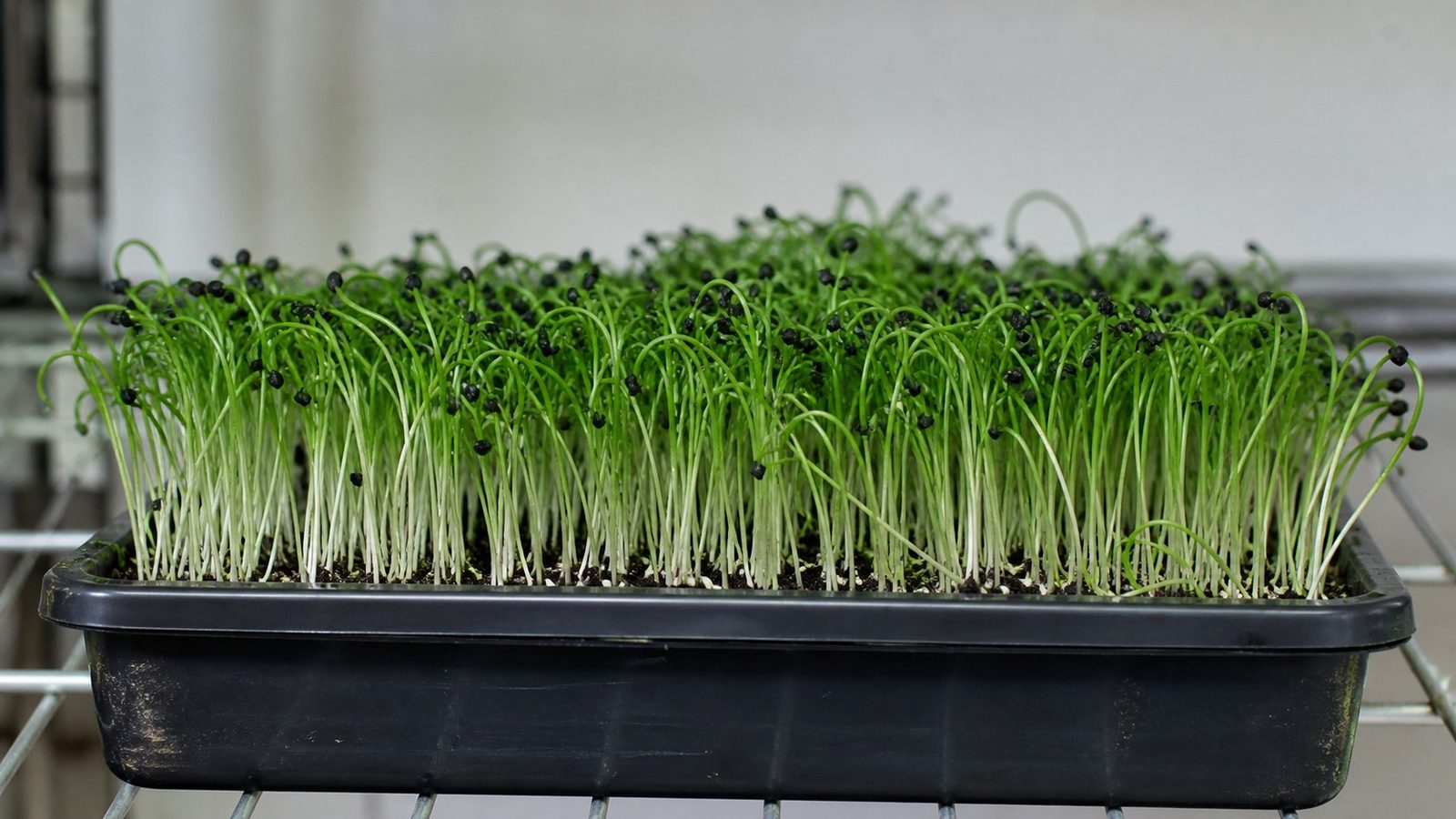
A correct tray at harvest is an even bed of upright, very fine grass-like green to blue-green blades, about 6 to 10 cm in the supplier description that gives a height, on pale ivory to light green lower stems. The blades emerge close together rather than fanning.
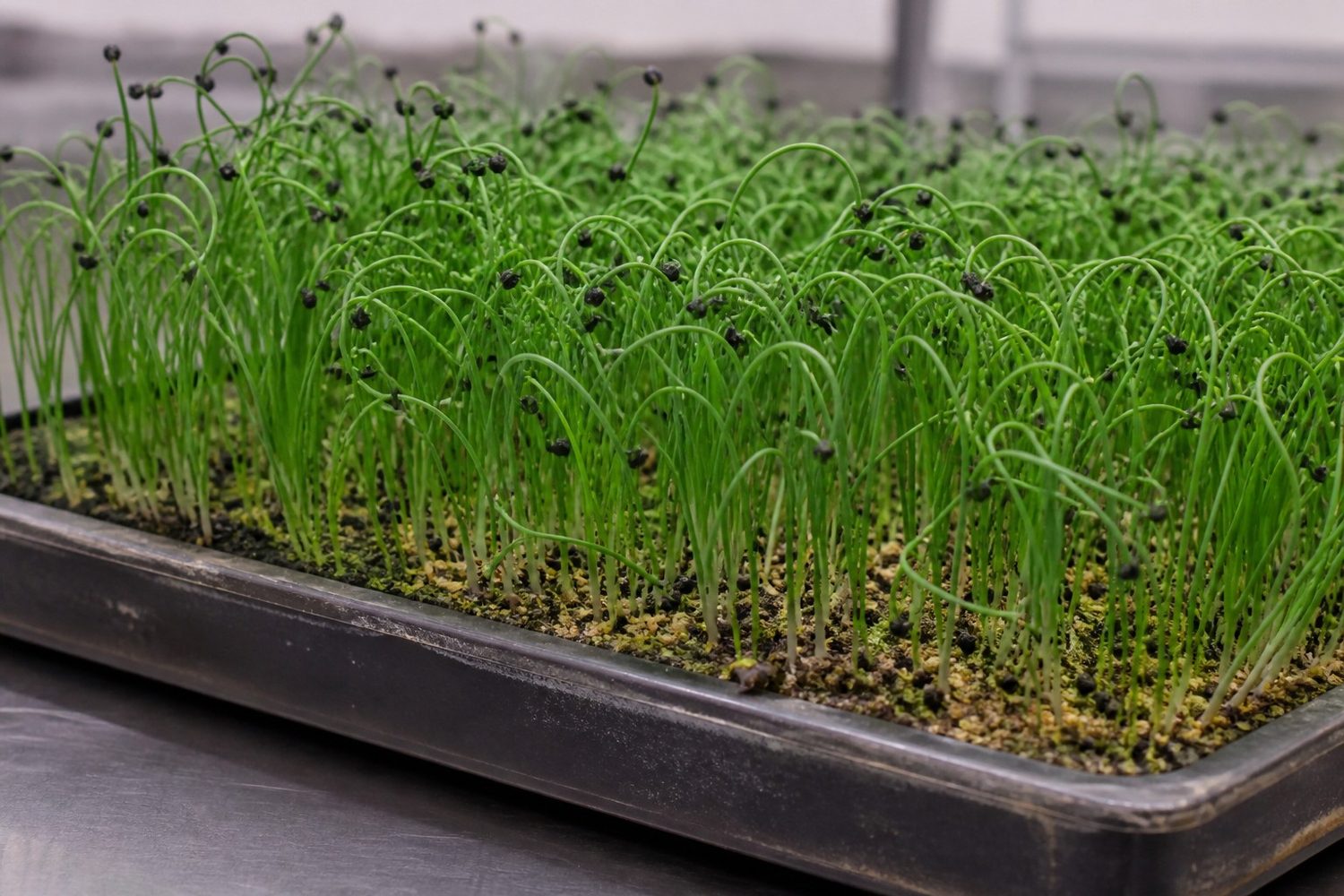
And nearly every one of them will be wearing a small flat black hull on its tip. That is not a fault and it is not avoidable. Leek's seed coat stays capped on the end of the blade, it shows in essentially every product photograph of this crop, and growers brush or rinse it off before packing. Budget the handling time; do not budget a hull-free tray.
What it is confused with is scallion and onion microgreens, and no reliable visual tell between them has been established. The forms are deliberately similar and the only difference anyone documents is behavioral: Johnny's says leek is slower to emerge than either. That is not something you can see in a photograph of a finished tray. Keep the seed lot labeled.
What it tastes like, and what to do with it
Mild, sweet onion. Gentler than a mature leek, and Johnny's simply calls it mild onion, but a producer warns that its flavor can overpower a dish when used heavily. That combination, delicate texture and a flavor with real reach, is the thing to design around.
Use it as a finish, in small volumes: scattered over potato soup, on smoked salmon, through eggs or an omelet, on a sandwich, over roasted vegetables or pasta. The fine threads look deliberate on a plate in a way a broad-leaf microgreen does not, which is most of why chefs buy it.
It is the wrong crop when a dish needs leaf volume or a cooked onion base. Thread-like blades collapse in heat and disappear into mass; this is a garnish note, not diced leek.
Who will not like it: anyone who dislikes allium flavor at any strength, and anyone expecting a substantial salad green. Neither objection is fixable in the tray.
Growing it: only what differs from the standard method
Everything general about trays, medium, light and watering is on the standard tray method for growing microgreens. Leek's deltas come from a small flat seed and a slow start.
Sow dry on a very level, fine, firmly pressed medium. The seed is small and flat and needs continuous contact; a coarse or uneven bed leaves some seeds dry and sinks others. Do not bury it, press it in.
And do not soak it for a tray. Both documented microgreen methods sow dry. You will find a 6 to 8 hour soak recommended for leek, and it belongs to jar sprouts, which are a different product eaten with the seed and root attached. Carrying that instruction across to a tray is a category error.
Germinate in a weighted stack for three to four days at about 70°F. The commercial system stacks trays and puts a 14 lb paver on top, which is heavier than most crops get, and the purpose is firm seed contact and upright strong blades rather than a long dark stretch for color. Unstack when the sprouts start lifting the stack, which that system reports at day three or four. A supplier instead runs 6 to 8 dark days under half a kilo to a kilo, so the two published methods are genuinely different and nobody has reconciled them. Pick one and stay with it rather than splitting the difference.
Then 16 hours of light and bottom watering. Water once each morning after unstacking, with a second evening watering only if the medium is drying. Bottom water specifically: the canopy is thin, close and carrying hulls on the tips, and repeatedly wetting it from above is what turns a slow crop into a moldy one.
Stop watering 24 to 48 hours before you cut, and cool open clamshells briefly rather than sealing warm product, so it does not sweat.
A leek tray, day by day
- 1
Day 0, sow dry
23 g of American Flag surface-sown on a level, fine, firmly pressed bed. No soak; the soak advice you will find is for jar sprouts.
- 2
Days 0 to 3, weighted stack
Stacked trays under about 14 lb at 70°F. Heavier than most crops want, and it is for contact and upright blades, not for stretch.
- 3
Day 3 or 4, unstack
The signal is the sprouts beginning to lift the stack. Waiting past it gives compressed, wet, weak growth.
- 4
Days 4 to 10, light
16 hours a day, bottom water each morning. The stand looks sparse and thread-like for most of this and that is what the crop is.
- 5
Day 10, cut
160 g in the one system that has published a figure. Stop watering a day or two before.
- 6
After cutting
Brush or rinse the black hulls off the tips. Every tray has them.
What goes wrong with leek specifically
Before emergence, missing plants. Weak seed, poor contact, or seed rot: damping-off organisms can kill seed before it ever comes up. On a crop with modest yield to begin with, a few gaps cost a real share of the tray, and a short crop cannot fill them in. If the stand is commercially unacceptable, reseed rather than nurse it.
In the stack, damping-off. Translucent, pinched, rotting stems at or below the medium and seedlings falling over. Pythium often begins at the root tips. A rotted seedling does not recover; a spreading tray gets discarded and the equipment sanitized.
After unstacking, the hulls. Black caps on the blade tips. Cosmetic, expected, and fixed with a gentle brush or rinse rather than by anything you do earlier.
Late, a matted wet canopy. From top watering, a dense sowing, poor drainage or still air. Correct it with airflow and by not saturating; a tray with spreading mold is not food.
And a diagnostic note that matters more on this crop than most. Root hairs stay on individual roots at the medium surface and a light mist temporarily collapses them. Mold webs across the medium, the hulls and the stems, and bridges between plants. On leek there is more debris in the canopy than usual, because those black hulls sit up at the tips, so judge by whether growth bridges rather than by whether you can see something pale. Persistent cobwebbing, an off smell, or soft pinched stems is damping-off, not a cosmetic event.
Nutrition, and what is actually established
Nothing has been measured on this crop, and the distinction that matters is unusually sharp.
There is no USDA record for leek microgreens. FoodData Central holds mature leek entries, including raw leeks at FDC 169246, and those are a different food at a different growth stage.
No peer-reviewed paper has measured leek microgreens. The study you will find in this space examined leek sprouts, and its microgreen samples were kale, radish, beetroot, green pea and amaranth, none of them leek. A sprout is germinated seed eaten whole; the microgreen on this page is a blade cut above the medium with the seed left behind. Reading a sprout result as a microgreen value is the same mistake that gets made on chia and flax, and here it is easier to make because the two products come from the same bag of seed.
What is being claimed anyway, on commercial pages, is that leek microgreens contain over 80 nutrients, supply omega-3 fatty acids, are particularly high in vitamin A, or fight cancer and protect heart health. There is no leek-microgreen FDC entry and no leek-microgreen nutrient study behind any of it. Mature leek data, a leek sprout result and generic microgreen evidence are three different things, and none of them is evidence for this crop.
There is one measured finding, and it is about the seed rather than the food. A Mississippi State thesis on leek seed sanitation found that hot-water treatment prevented mold over a five-day test and reduced aerobic plate count against an untreated control, with germination at 72.0 percent after hot water against 71.4 percent after hydrogen peroxide, and it examined Salmonella survival on the seed. That is a food-safety and seed-hygiene result, and it is genuinely useful: it shows that a leek tray full of mold may be a seed problem rather than a watering problem, which is not the first thing a grower suspects.
It is one of only two places anyone has counted what is living on a microgreen crop, the other being the garden cress density study, and both found the answer was worth knowing.
Which seed to buy
Two cultivars are actually documented for microgreen use: American Flag, which is the one the commercial production figures on this page were measured on, and Giant Musselburgh, sold as microgreen seed but described only by its mature plant traits, so its tray height, tenderness, days and yield are unverified. If you want the numbers on this page to mean anything for your tray, buy American Flag.
Specify untreated seed sold for microgreens or food production, with cultivar, lot, germination percentage and test date. Refuse dyed or chemically treated field seed: treatments can be present in a shoot eaten ten days later. Given the seed-sanitation finding above, ask about lot cleanliness rather than assuming it.
The shelf is thin but it has the right thing on it. Leek seed on Amazon checked on 2026-08-09 returns 232 results with 20 leek listings on the first page, and only three mention microgreens at all. One of those three is the one that matters: Mountain Valley Large American Flag, 1 lb bulk, sold for growing microgreens, at $43.54, which is the correct cultivar at a working quantity and slightly cheaper than Johnny's $46.00.
Everything else on that page is garden seed for growing actual leeks, in packets counted for a vegetable bed: 250 seeds, 350 seeds, 500 seeds, 1,000 seeds. That is the kohlrabi shelf problem rather than the fennel one. Nobody is selling you something inedible; they are selling you seed to grow a vegetable over a season, in quantities a tray would swallow at once.
And there is a species trap on this search, which is the same impostor the chives page found. One of the three microgreen-labeled listings is "Chinese Leek", and Chinese leek is Allium tuberosum, garlic chive, the same plant that makes up about half the shelf on a chives search. It is a legitimate crop with a garlicky flavor and it is not leek. Allium tuberosum turns up under two different English names on two different allium searches, so it is the one to watch for. Check the botanical name.
A bad lot shows as slow uneven emergence over the three to four day stack, persistent bare patches, or mold during the stack despite level moist medium and a stable temperature. It costs a ten to twenty-five day rack slot rather than the seed.
Is it worth growing?
Yes, for a chef and for the grower selling to one.
The case is the fine thread-like presentation and a sweet onion note that reads as deliberate on a plate. It is also, unusually, a crop where the tray genuinely beats the alternative: the garden version of this plant takes most of a season, so ten days and about two dollars of seed is a real shortcut rather than an expensive convenience.
The case against is the bench economics, and they are poor. On seed cost leek is among the worst microgreens going, at roughly 2.5 ounces per dollar of seed, because $43 to $46 a pound buys a modest 5.64 ounces. It is also slow to start, thread-like rather than voluminous, and has no benchmark in the trade's yield trial to check the one published figure against.
Against its nearest neighbor it does well, and that is the comparison that should decide it. Chives is the other allium measured in this directory, and the two are remarkably close on inputs: chive seed is $44.13 a pound against leek's $43.54, at similar rates. Leek returns slightly more weight and it does it in ten days against nineteen. On what a bench-day is worth that is 0.56 against 0.25, more than double. If you are choosing an allium for a rack, the published record favors leek clearly, and it favors it on time rather than on price or weight.
Choose something else if you are paid by weight, if you need a fast reliable beginner crop, or if the buyer would be equally happy with scallion, which the same supplier says comes up faster.
If you keep animals, this is the tray to keep away from them
Leek is Allium ampeloprasum, and the alliums carry a feeding caution that rests on veterinary sources rather than on garden advice. Merck describes the sulfur-containing compounds in onion, garlic, chives and leek causing oxidative red-cell damage and delayed hemolysis, and Colorado State Extension tells poultry keepers to avoid onions. No allium has been tested at microgreen stage in any animal, so there is no safe quantity published and the sensible response is distance rather than arithmetic.
Note what the claim does not cover. The veterinary sources name dogs, cats and horses; the same question is not established for reptiles in either direction. For a flock, the reasoning is on the feeding microgreens to chickens guide, along with the ten percent ceiling that governs any treat.
A note on the numbers above
Hover or tap a row to highlight it.
| Figure | Value | Source | What kind of number it is |
|---|---|---|---|
| Seed per 1020 | 23 g | Paperpot / Scintilla Farms | Named commercial rate, American Flag, standard 1020 |
| Seed per 1020 | 25 to 50 g | Deliseeds | Supplier assertion, no cultivar or yield attached |
| Seed per 1020 | No trial figure | Johnny's | Leek is absent from the 29-variety trial |
| Yield per 1020 | 160 g, 5.64 oz | Paperpot / Scintilla Farms | One commercial system, at 10 days, NO LEAF STAGE STATED |
| Days to harvest | 10 | Paperpot / Scintilla Farms | Attached to the seed rate and yield above |
| Days to harvest | 12 to 14 | Deliseeds | At 64 to 72°F, cut at 6 to 10 cm |
| Days to maturity | 16 to 25 | Johnny's | No stage, no temperature |
| Blackout | 3 to 4 days, 14 lb paver, 70°F | Paperpot / Scintilla Farms | A weighted stack, not a humidity cover |
| Blackout | 6 to 8 days, 0.5 to 1 kg | Deliseeds | A materially different method |
| Germination temperature | 65 to 85°F optimum, 32°F floor, 95°F ceiling | UC ANR germination table | Leek SEED figures, not a microgreen trial |
| Seed sanitation | Hot water prevented mold, cut aerobic plate count | Mississippi State thesis | Measured. Germination 72.0% after hot water |
| Seed price | $43.54/lb American Flag, $46.00/lb Johnny's organic | Amazon and Johnny's, 2026-08 | Current listings |
| Regrowth | 2 to 3 cuts claimed | Deliseeds | A claim with no weighed second cut behind it |
| Shelf life | No published figure | Nobody | No leek-specific refrigerated life exists |
| Harvest window | No published figure | Nobody | How long a READY tray holds is unmeasured |
| Nutrition | Nothing measured | Nobody | The study people cite examined leek SPROUTS |
| USDA record | None for the microgreen | FoodData Central | Mature leek is FDC 169246 and a different food |
Almost everything quantitative on this page comes from one document. The seed rate, the day count and the only yield figure are all from a single commercial production sheet, and they are internally consistent because they describe one system. That is not the same as corroborated. This site has already been caught once by a single grower sheet supplying matching figures for two crops, on chervil and dill, and the lesson was to say so on the page rather than let the consistency read as agreement. Weigh your own trays.
The day count is the number to be most careful with, because it swings the ranking. Ten days, 12 to 14, and 16 to 25 are three published answers, a two-and-a-half-fold spread. The table below uses 10, because that is the figure attached to the measured yield, and pairing a yield from one system with a day count from another would be arithmetic dressed up as a result. If leek actually runs 16 days in your room, its bench economics fall to about 0.35 ounces per tray-day and the comparison against chives narrows sharply. This is the single most load-bearing uncertainty on the page.
The yield has no leaf stage attached, so it is not strictly comparable to most of the table. The 29-variety trial that anchors broccoli, kale, radish, cabbage, kohlrabi and garden cress cut everything at first true leaf. Leek's 5.64 oz is simply what one grower's tray weighed on day 10. On a monocot there is no true leaf in the brassica sense anyway, which is a reason the stage is missing rather than an excuse for it.
And the cost figure is cultivar-matched on purpose. The 5.64 oz was measured on American Flag, so the price used is American Flag bulk seed at $43.54 a pound rather than Johnny's $46.00, whose page does not name a cultivar. It is a small difference in dollars and the right habit.
Hover or tap a row to highlight it.
| Crop | Seed per 1020 | Yield | Days | Cost per tray | Oz per $1 | Oz per tray-day |
|---|---|---|---|---|---|---|
| Leek, American Flag | 23 g | 5.64 oz | 10 to 25 | $2.21 | 2.6 | 0.56 at 10 days |
| Chives | 19.4 to 38.7 g | 3.8 to 5.6 oz | 19 | $1.89 to $3.77 | 1.7 | 0.25 |
| Onion, Crystal White Wax | 4.8 g, area-converted | 1.29 oz, area-converted | 10 to 21 | $1.20 | 1.08 | 0.12 at 11 days |
All 62 crops, sortable, on the microgreen comparison.
The two alliums in this table are worth reading together. Leek at 0.56 and chives at 0.25, on nearly identical seed prices and similar rates. The whole difference is days: ten against nineteen. It is the cleanest illustration in this table of why bench-days are the denominator and not an afterthought, and it is also a warning, because leek's ten is the least certain number on its own page.
Terms on this page
Tap a term to see what it means.
*Allium ampeloprasum* var. *porrum*. Leek. Kew also accepts Allium porrum for the same plant, so both names on a seed packet mean the same crop.
Sources
- Paperpot Co, how to grow leek microgreens in paperpot trays - the only complete production figures in existence for this crop: American Flag at 23 g dry seed per standard 1020, 160 g per tray, 10 days seed to harvest, a 3 to 4 day weighted stack at 70°F with a 14 lb paver, 16 hours of light, morning bottom watering, and stopping water 24 to 48 hours before harvest.
- Johnny's Selected Seeds, leek organic microgreen seed - 16 to 25 days to maturity with no stage or temperature stated, the mild onion flavor description, the observation that leek is slower to emerge than scallion or onion, and the $46.00 per lb listing, checked 2026-08-08.
- Johnny's microgreens yield trial, method and discussion - the absence of leek from the 29 varieties tested, and the warning that yields change with procedure, system, conditions, harvest stage and seed lot.
- Deliseeds, leek microgreens seeds - 12 to 14 days at 18 to 22°C cut at 6 to 10 cm, 25 to 50 g per tray, no soaking needed, 6 to 8 dark days at 0.5 to 1 kg, the two-to-three-cut regrowth claim, and the warning that top watering encourages mold.
- True Leaf Market, Giant Musselburgh leek microgreens seed - the second cultivar sold for microgreen use, described by mature plant traits only.
- Mississippi State University thesis on leek seed sanitation - hot-water treatment preventing mold across a five-day test and reducing aerobic plate count against control, germination at 72.0 percent after hot water and 71.4 percent after hydrogen peroxide, and the examination of Salmonella survival on leek seed.
- Kew Plants of the World Online, Allium porrum - the accepted name and the Allium ampeloprasum var. porrum synonymy.
- UC ANR, seed germination temperature and timing - leek at 65 to 85°F optimum with a 32°F minimum and 95°F maximum.
- UNL Extension (PDF) - leek at 70°F optimum and 7 days to germinate under optimum temperature and moisture.
- Virginia Tech Extension SPES-756 (PDF) - the general 60 to 70°F microgreen room range, 50 to 70 percent humidity, and the 9 to 16 daily light integral baseline.
- UC IPM, damping-off - Pythium beginning at root tips, seed killed before emergence, and symptoms at or below the medium line.
- SDSU Extension, growing microgreens at home - pressing small seed into saturated medium rather than burying it, about a week refrigerated in general, and the warning that seed treatments can be present in the shoots that are eaten.
- Molecules, sprouts and microgreens composition study (PDF) - cited here for what it is NOT: its leek sample was a SPROUT, and its five microgreens were kale, radish, beetroot, green pea and amaranth.
- USDA FoodData Central - no leek microgreen record; mature leeks are FDC 169246 and 2727584.
Keep reading
The variety directory
Chive microgreens
One of the few crops where somebody actually ran a density trial, and poor value per dollar of seed. It also competes with a perennial you buy once.
Read Chive microgreensThe variety directory
Celosia microgreens
A color crop whose entire measured record is a single YouTube video: 8 g of seed, 3.4 oz, 13 days. Bought for pink and orange stems, never for weight.
Read Celosia microgreensThe variety directory
Chervil microgreens
A chef's herb almost nobody grows: mild sweet anise, 3 to 5 oz a tray, and two independent seed rates that agree to within six percent, which is rare on a crop nobody has trialled.
Read Chervil microgreensThe variety directory
Dill microgreens
Two suppliers disagree by ten days on when to cut it, and an indoor grower with no stake in the argument settles it. Plus why dill's yield figure should be read alongside chervil's.
Read Dill microgreens