Fennel microgreens
Cal HewittPublished Checked
- herb
- difficult
- slow crop
- chef crop
- needs soaking
- mold prone
At a glance
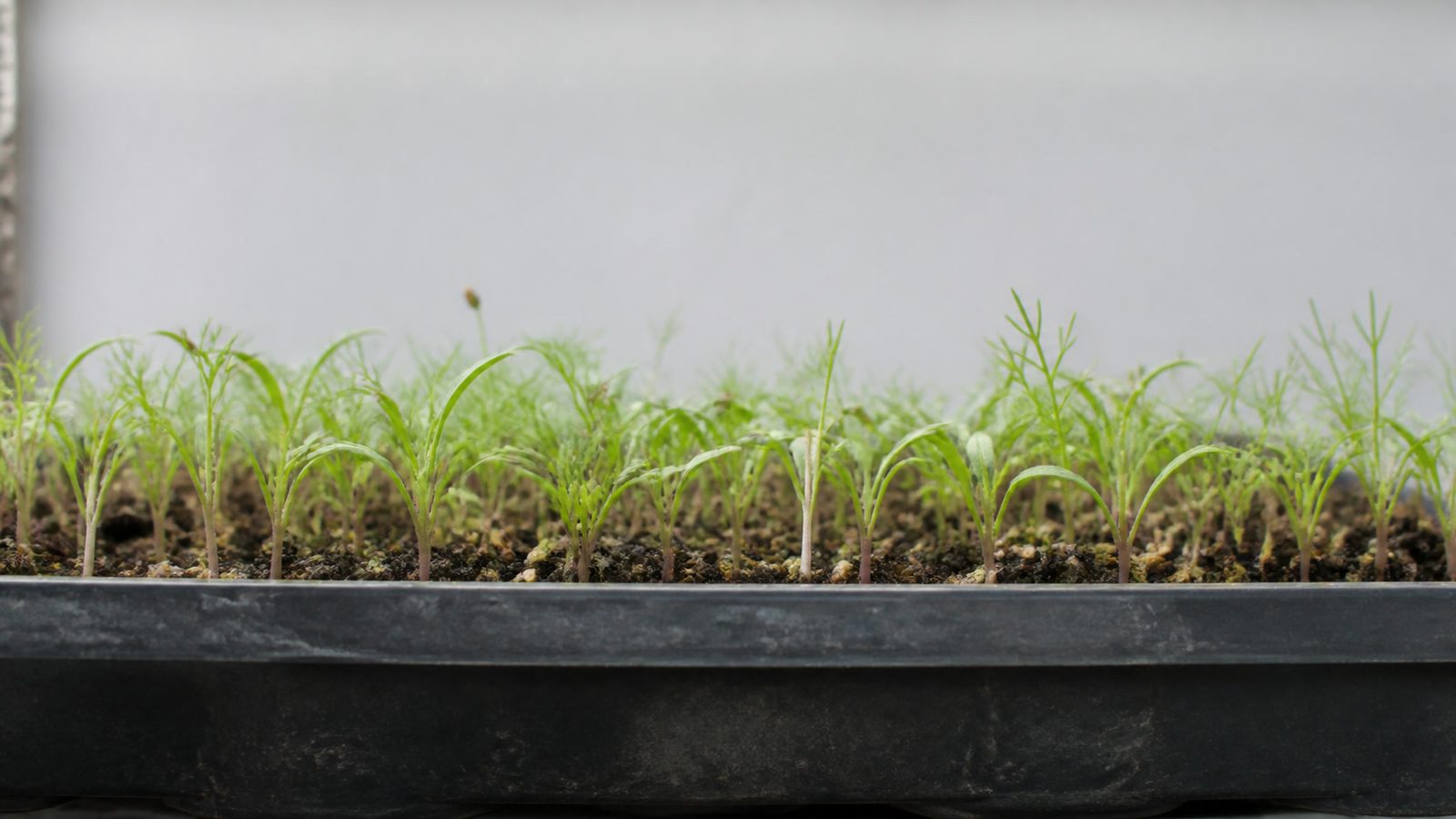
Slow uneven germination, first emergence around day 5 and a cut three weeks later, which keeps a sparse fine canopy wet and covered for far longer than a fast brassica and makes damping-off the defining failure.
- Botanical name
- Foeniculum vulgare
- Also sold as
- Fennel, Green Microgreen Seed, Florence Untreated Fennel/Microgreen Seeds, Grosfruchtiger, Sweet fennel
- Family
- herb
- Difficulty
- Difficult
- Days to harvest
- 16 to 25 days
- Harvest window
- No published figure
- Seed per 1020 tray
- 28.3 to 43 g
- Soak
- 0 to 6 hours
- Blackout
- 3 to 4 days
- Germination temperature
- 65 to 75 °F
- Mold risk
- High
- Hull shedding
- some
- Shelf life
- No published figure
- Eaten as
- raw
- Seed cost per tray
- $2.36
43.0 g at $24.90/lb, Johnny's Fennel Green microgreen seed, listed 2026-08-08. At the grower-reported 28.3 g it is $1.55. Paired with the measured 1.00 oz yield that is about 0.42 oz per dollar of seed, the worst return of any microgreen with a published yield. Seed only, excludes medium, tray, labor, light and loss.
Any field name above ranks every variety by it. No published figure means we researched it and nobody has established one, which is different from not yet researched. Every figure here is sourced at the bottom of the page. Compare every variety side by side.
A fennel tray returns about one ounce after 25 days, and that figure is a measurement rather than an estimate. Uher and colleagues weighed it at 0.22 kg per square meter, which scales to roughly an ounce on a 1020. At 0.04 ounces per tray-day that is less than half what carrot manages, and on seed at $24.90 a pound it works out at 0.42 ounces per dollar, a quarter of chives. On both money columns fennel comes last.
That is worth knowing because the rest of the umbellifers, carrot, dill, cilantro, chervil and celery, mostly rest on supplier estimates rather than trials. Fennel is the one somebody actually weighed, and weighing it made the economics look worse rather than better. Do not assume the unmeasured ones are doing any better.
None of which means do not grow it. It means know exactly what you are buying, because fennel is not sold by the ounce. It is sold by the smell.
What growers are saying right now
Sampled from public posts and videos, 10 July to 9 August 2026. Every line links what it is quoting. How often something is repeated is not evidence that it is true, so every line also says what the sources actually establish.
Fennel microgreens contain shikimic acid, the starting material for the antiviral drug Tamiflu
Circulating Said in this microgreens-blend video, which to its credit immediately adds that this does not mean eating fennel works like taking the drug
The creator's own caveat is the correct one, and it deserves to be louder than the claim. Shikimic acid is an intermediate in the shikimate pathway, which plants, fungi and bacteria all use to build aromatic amino acids and which mammals do not have at all. It is in broccoli and in grass clippings as surely as it is in fennel. Turning it into oseltamivir takes 10 to 17 industrial chemical steps, several of them through explosive azides, and the commercial source is Chinese star anise or bacterial fermentation, not fennel. Eating a precursor is not taking the drug, and nothing in a digestive system performs those steps. What is actually established
"Fennel seeds" for digestion, bloating and gas
Circulating Demonstrated here as a brewed tea, framed as an Ayurvedic practice, and it is by some distance the most common thing said about fennel seed online
That is the SPICE, the mature dried seed, and it is a different product from the crop on this page. It also explains the buying problem: search fennel seed and you land in the spice aisle, where the seed is sold to be eaten rather than sown. Which seed to buy
Fennel is expensive in the shops and easy to grow yourself
Circulating Made here at 5,668 views, and reinforced by this one on how prolifically it self-seeds
True, and it is the strongest argument against the tray. The garden plant is cheap, perennial in habit, self-seeds hard enough that gardeners are told to cut the heads off, and gives you fronds all season for nothing. A tray gives you about an ounce in 25 days. If you have any outdoor ground at all, grow it out there and use this page for the flavor notes.
Nobody is filming a fennel tray
Circulating The highest-ranked "fennel" results in the window are a garden plant, a spice tea, a homestead pollinator video, and a review of a fennel seed in a Roblox farming game
Not a finding about the crop, and that is the point. Fennel has real measured research behind it and essentially no grower community, which is the reverse of how most popular crops sit.
What it is, and how to tell you grew it right
Fennel microgreens are seedlings of Foeniculum vulgare, an Apiaceae herb, cut above the medium once the fine fronds have opened. Both microgreen products verified on sale are that one species: Johnny's sells it as Fennel, Green, and Osborne sells Florence fennel as untreated microgreen seed. Florence is a marketed type name, not a second species.
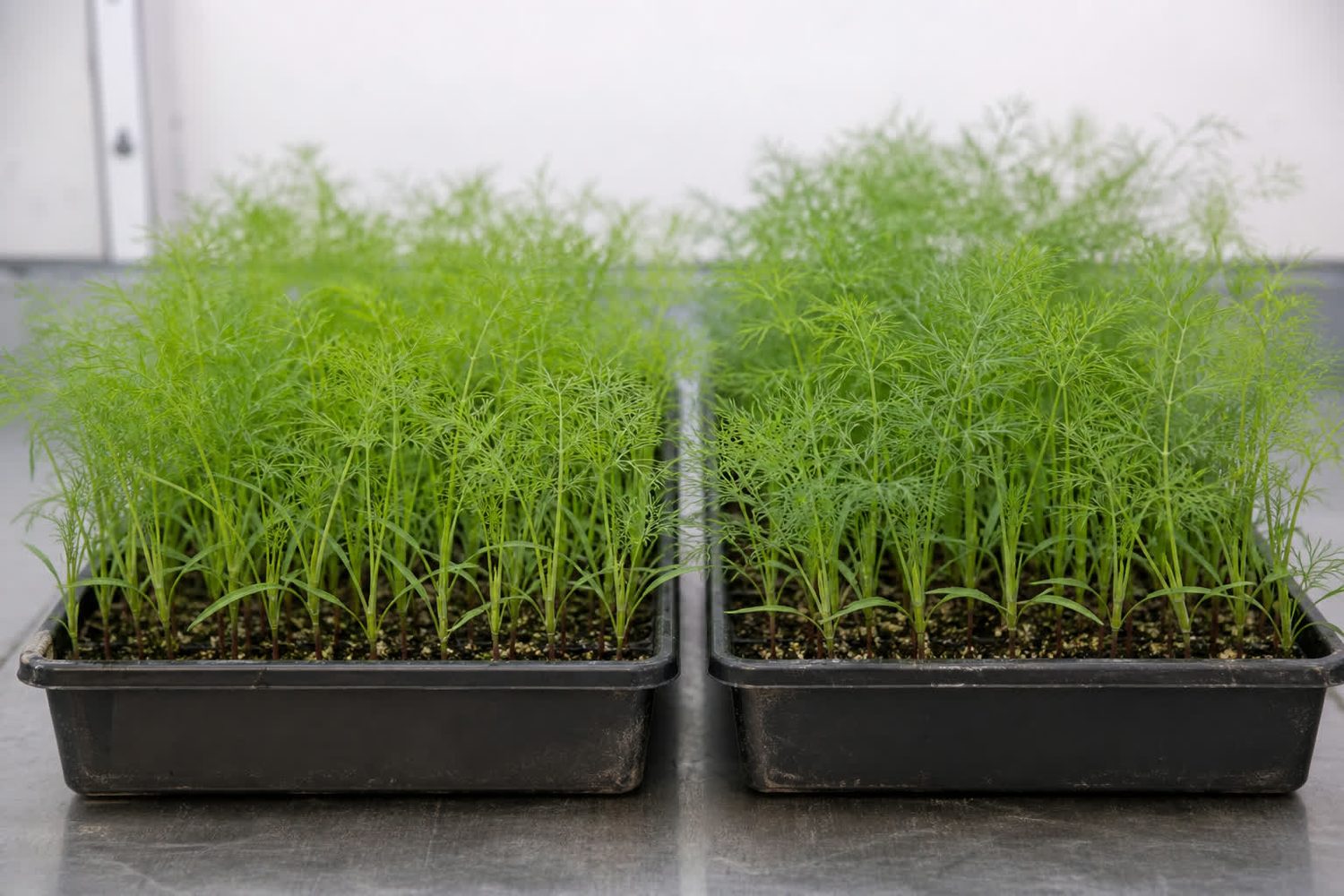
A correct tray reads as a relatively low, even carpet of slender pale white to pale green stems carrying bright green, finely divided feathery fronds. It is not a dense canopy and it is not supposed to be one. At the medium there is a light root mat rather than the heavy pad that pea or sunflower builds. One proprietary system reports 3 to 5 inches at maturity; stem thickness and a universal height are not established by any source that labels its photographs, so do not judge your tray against a number nobody published.
Expect some brown hulls still attached at the frond tips. That is normal on this crop rather than a fault, and it matters more here than on most because there is a second thing that looks like debris. See the failure section.
What it is most easily confused with is dill, and the reliable tell is not a visual one. Rub a frond and smell it: fennel is sweet anise and dill is not. No source opened for this page validates a side-by-side leaf-shape distinction at microgreen stage with photographs, so anyone offering you one is describing a mature plant.
What it tastes like, and what to do with it
Sweet, unmistakable anise. Mild at the microgreen stage and, as Johnny's says on its own product page, developing and intensifying after the first true leaf. The compound responsible is (E)-anethole, and it is not a subtle presence: in a Virginia Tech aroma analysis, phenylpropenes, dominated by anethole, made up between 36 and 83 percent of the aroma-active compounds identified in fennel microgreens.
So, this is a finishing herb, used by the pinch. It belongs on grilled salmon and seared scallops, in citrus salads, on ricotta flatbread, through sauces and dips, and on pasta and pizza after the heat is off. The delicate fronds do not hold up to cooking, so add them at the end or not at all.
It is the wrong choice in two situations that come up constantly. If you need volume or crunch, this crop cannot supply it at any density. And if the dish is already loud, garlic-heavy or chile-forward, the anise simply disappears and you have spent 25 days of bench time on a garnish nobody can taste.
People who dislike licorice will dislike this, and there is no growing technique that softens it. If anything, holding the tray longer makes it stronger. Sell it as what it is, and put a frond in front of a new customer before you sell them a case.
Growing it: only what differs from the standard method
Everything general about trays, medium, light and watering is on the standard tray method for growing microgreens. Fennel's deltas are all downstream of one fact: it is slow at the start and slow at the end, and everything difficult about it follows from the extra time it spends wet.
Expect nothing for five days. In the controlled trial, fennel first germinated on day 5, where cabbage and alfalfa in the same experiment were up on day 3. A bare tray on day 4 is not a failed tray. This matters more than it sounds, because the instinctive response to a tray that has not come up is to water it more and leave the cover on longer, and both of those are how fennel trays are actually lost.
Sow lighter than the number suggests, and sow dry. The measured density is 43 grams per 1020, converted from the trial's 333 grams per square meter. A grower working in soil uses 28 to 42 grams and says to go lower where crowding and humidity threaten airflow. On a crop this slow, err downward: you are asking the canopy to stay open for three weeks. A 4 to 6 hour soak is reported to advance germination by about a day, at the price of seed that clumps and distributes badly, and no controlled trial supports it. Dry is the lower-risk default.
Cover for three to four days, with light pressure, and check daily. The weight is for seed-to-medium contact and downward rooting, not for yield. Take it off when most seed has cracked and the stems are visibly reaching, before pale stretched shoots appear. Fennel etiolates readily under a cover held too long, and unlike a legginess problem on a fast brassica you cannot outgrow it in two days.
Then give it more light time, not more blackout. A grower protocol runs 12 to 16 hours a day after uncovering. Water less at a time and bottom water once germinated: the stems are thin enough to be knocked flat, and a wet canopy on a sparse slow crop is the damping-off invitation.
Hold it at 65 to 75°F. Above 80°F the same grower reports patchy, slow emergence, which on a crop that is already late is hard to distinguish from a bad lot.
A fennel tray, day by day
- 1
Day 0, sow
28 to 43 g broadcast dry on leveled medium, pressed for contact, seeds roughly an eighth to a quarter inch apart. Cover with light pressure. Hold 65 to 75°F.
- 2
Days 1 to 4, nothing visible
This is normal and it is the phase that kills fennel trays. Do not add water to hurry it and do not extend the cover past day 4 hoping for a fuller stand.
- 3
Day 5, first emergence
The trial's figure, at 68°F. Uncover when most seed has cracked and stems are reaching, not on a date.
- 4
Days 5 to 20, light
12 to 16 hours a day. Bottom water, less at a time, and keep air moving across a canopy that is sparse enough to hold humidity at the medium.
- 5
Days 16 to 25, cut
Feathery fronds open, at or just past first true leaf. The flavor intensifies from here, and so does the fiber. Cut above the medium.
What goes wrong with fennel specifically
The order matters, because on this crop the early failures are the ones that cause the later ones.
Days 3 to 6, delayed and patchy emergence. Some patches cracked, others not. Cool temperature, uneven water, uneven distribution, or a tired lot. Recoverable if the seedlings that are up look firm: normalize moisture and temperature and note the lot. The trap is the diagnosis. Because fennel legitimately emerges on day 5, a grower used to brassicas concludes on day 3 that the tray failed, and responds by watering more and covering longer, which produces the next two failures.
While covered, etiolation. Pale, stretched, weak shoots from a blackout held too long. Cosmetically it partly recovers under light. The crop will not get shorter and it will not regain its texture, so a tray sold on delicacy has already lost.
From emergence onward, damping-off, and on fennel this is the defining failure. Pythium can begin at the root tips and Rhizoctonia solani rots stems at or below the medium line. The mechanism here is time: a sparse fine canopy over a medium that has been kept moist for three weeks is a longer exposure than a brassica tray ever has. Early signs are dark pinched stems at the medium and a local collapse that spreads past the corner it started in. A slimy or collapsing tray is not a recoverable food crop.
At harvest, hulls on the fronds. Brown seed coats stay attached to the tips more often on fennel than on most crops. It is a presentation problem rather than a food-safety one, and a fine mist plus gentle handling loosens them. Do not fix it by washing and packing wet.
A note on the mist test, because fennel complicates it. The usual check for the category's most repeated question, root hairs or mold, is to mist: root hairs collapse and nearly vanish, mold stays as a web and does not care. That test still applies here, with one fennel-specific caveat. Because this crop genuinely carries brown debris in the canopy, inspect at the base and at the medium line rather than judging by what you see at the tips. Tip debris on fennel is usually just hulls.
Late, a coarser and sharper crop. Stems and fronds turn fibrous and can go slightly bitter while the anise gets stronger. Still edible, no longer the tender aromatic thing that was ordered. You can see it in a taller, coarser canopy before you cut.
Nutrition, and what is actually established
Fennel is unexpectedly well evidenced on composition, and badly evidenced on the thing people usually claim about it.
There is no USDA record. FoodData Central was searched directly on 2026-08-08 and returns zero results for fennel microgreens across every dataset: Foundation, SR Legacy, Survey, Experimental and Branded. The entry for mature fennel bulb is not a substitute and neither is the one for fennel seed, which is a spice.
What has been measured is condition-specific and worth knowing. Uher and colleagues grew F. vulgare cv. 'Aganarpo' on perlite in floating hydroponics and harvested at day 25, reporting 74.94 mg of ascorbic acid per 100 g fresh weight, 408.03 mg GAE of total phenols, 214.47 mg GAE of total flavonoids and 0.196 mg/g of total carotenoids. Those are numbers for that cultivar, in that system, at that harvest day. They are not a nutrition panel and they do not transfer to your tray.
And the aroma study is the one that actually matters for this crop. Liu and colleagues, using GC-MS-olfactometry on cv. 'Grosfruchtiger', identified 32 aroma-active compounds in fennel microgreens and found the microgreens carried between 81 and 98 percent more monoterpenes than mature fennel in their comparison. Read that alongside celery, where a 20-genotype study found several minerals HIGHER in the mature leaf than in the microgreen. The two results are not in conflict, and together they say something more useful than either alone: whether the microgreen beats the mature plant depends entirely on which compounds you measure. On fennel, the compounds that carry the aroma are more concentrated in the seedling, which is a measured reason to grow the tray rather than a slogan.
What is not supported is any claim that fennel microgreens have a verified nutrition profile, or some multiple of mature fennel's nutrients, or a health effect. That includes the shikimic acid claim at the top of this page.
Which seed to buy
Two microgreen products are verifiably sold: Johnny's Fennel, Green and Osborne's Florence, untreated. Neither supplier publishes a comparison of the two on stem length, tenderness, yield, color or days, so there is no cultivar performance table to choose from. Buy on lot quality and on which supplier will tell you about the lot.
Specify Foeniculum vulgare intended for edible microgreens or sprouting, untreated, with a lot number and germination information, and buy enough to run a small test tray first. That last point is not boilerplate on this crop. The reported lot problem for fennel is slow patchy germination, which is indistinguishable at day 4 from a lot that is simply behaving normally, so the only way to learn what your lot does is to have run one before you commit a rack.
A bad lot shows as persistent bare zones despite even moisture and temperature. The cost is not mainly the seed. It is 25 days of bench time on a crop that was only ever going to return an ounce, plus the extra damping-off risk if you respond to the laggards by keeping the tray wetter for longer.
Now the search, and on this crop it is genuinely bad. Fennel seed on Amazon is where a home grower will look, and the problem is not that the shelf is empty. Checked 2026-08-08, that search returns 884 results, 33 of the first 60 mention fennel, and not one of them is sold for microgreens. The same page carries 26 microgreen and sprouting listings for other crops, which is the control: the search knows what a microgreen product is, there just is not a fennel one.
Hover or tap a row to highlight it.
| What it is | Roughly how many of the 33 | Examples on the page | Can you sow it |
|---|---|---|---|
| Culinary spice seed, whole, for cooking and tea | About 20 | Jiva Organic 7 oz, Simply Organic 1.90 oz, Sadaf, The Spice Way, an Earthborn Elements 1 gallon bucket | Not reliably. Sold to be eaten, not germinated, with no germination test and often heat treated or irradiated |
| Garden planting seed, Florence and sweet types | About 11 | Sow Right Florence, Seed Needs Florence, SVI 1000 Florence, Banyan Botanicals 50 count | Yes. Right species, right purpose, but usually no lot germination figure and rarely stated untreated |
| Herb fennel, non-bulbing, named cultivar | 1 | Green Leaf Grosfruchtiger, $4.99 | Yes, and it is the cultivar in the published aroma study |
| Sold for microgreens or sprouting | 0 | none | n/a |
| Microgreen or sprouting seed for OTHER crops on the same page | 26 | the control that proves the search is not simply empty |
Three things follow, and they are the practical part of this page.
The spice listings are the same species, and that is exactly why they are dangerous to a beginner. Foeniculum vulgare in a spice jar and Foeniculum vulgare in a seed packet look identical in a thumbnail, and the spice is cheaper per ounce. But spice seed is sold to be eaten, carries no germination test and no planting lot traceability, and the trade routinely irradiates or heat treats. The tell is printed on the listings themselves: several of them advertise "non-irradiated" as a selling point, which tells you what the default is. Irradiated seed does not germinate, and you will not find out for five days, on a crop where five days of nothing is normal.
The one genuinely good find is the cultivar. Grosfruchtiger, a non-bulbing herb fennel, is on that shelf for $4.99, and it is the same cultivar Virginia Tech used for the aroma analysis above. It is sold as garden seed rather than microgreen seed, so it carries the usual garden-seed caveats, but if you want the fennel whose volatile profile somebody actually published, it is buyable.
And for anything you intend to sell, buy the microgreen lot. Osborne's Florence listing is explicitly untreated and sold for microgreens, which is the specification this crop needs and the garden shelf does not supply.
Is it worth growing?
By weight, no, and it is not close. One ounce in 25 days is about the worst bench return going, and the seed is not cheap enough to make up for it. A market grower selling by weight should grow something else, and a beginner wanting a dependable first tray should grow almost anything else.
By aroma, yes, for a narrow and real customer. If a chef wants sweet anise fronds for salmon, scallops, citrus or a ricotta flatbread, fennel is the only crop here that provides it, and the aroma study says the seedling carries the volatiles more strongly than the mature plant does. That is worth a tray, priced as a garnish, sold by the clamshell and not by the pound.
Its competition inside the tray is dill and cilantro for the feathery herb slot, and they win whenever the menu wants their flavors instead. Its competition outside the tray is more serious and is the reason most people should not grow it indoors: fennel is a vigorous garden plant that self-seeds so freely that gardeners are told to cut the heads off, and it will give you fronds all season for the price of one packet. The same trap catches chives, collard and cucumber, and fennel is the clearest case of it. If you have outdoor ground, the tray is the expensive way to get this flavor.
Grow fennel indoors when you need it in January, when you need it consistent, or when you are selling it. Otherwise plant it outside.
A note on the numbers above
Hover or tap a row to highlight it.
| Figure | Value | Source | What kind of number it is |
|---|---|---|---|
| Seed per m2 | 333 g | Uher et al. | Measured, floating hydroponics on perlite |
| Seed per 1020 | 43.0 g | Area conversion of the above | 333 g/m2 x 0.1290 m2. Not a measured tray |
| Seed per 1020 | 28.3 to 42.5 g | Wind River grower report | Unreplicated grower practice, in soil |
| Yield per m2 | 0.22 +/- 0.08 kg | Uher et al. | Measured at day 25, lowest of its four crops |
| Yield per 1020 | 1.00 oz | Area conversion of the above | About the lowest published for any microgreen |
| Days to harvest | 25 | Uher et al. | Measured, sown at 20°C, cut at developed cotyledons |
| Days to harvest | 16 to 25 | Johnny's product page | Published range, no stage or temperature |
| Days to harvest | 10 to 14 | Wind River grower report | At 65 to 75°F, to open first true leaves |
| Days to harvest | About 15, after 8 to 10 days covered | Hamama Seed Quilt | A proprietary mat system, not a 1020 |
| First emergence | Day 5 | Uher et al. | Measured, against day 3 for cabbage and alfalfa |
| Germination temperature | 65 to 75°F | Wind River grower report | Operating range, patchy above 80°F |
| Ascorbic acid | 74.94 mg/100 g FW | Uher et al. | Measured, cv. 'Aganarpo', day 25, one system |
| Total phenols | 408.03 mg GAE/100 g FW | Uher et al. | Same trial, same caveats |
| Monoterpenes vs mature fennel | 81 to 98 percent higher | Liu et al. | Measured, cv. 'Grosfruchtiger', aroma study |
| Harvest window | No published figure | Nobody | "A few extra days" is not a measured window |
| Shelf life | No published figure | Nobody | One system says about 10 days without a temperature |
| Seed price | $24.90/lb | Johnny's, listed 2026-08-08 | Current retail, microgreen lot |
| USDA record | Zero results | FoodData Central | Searched 2026-08-08, all five datasets |
The yield is a conversion, and that is its weak point. Uher et al. measured kilograms per square meter in floating hydroponics on perlite, scaled here by area onto a 1020's 0.1290 square meters, which assumes the density and the system transfer and they may not. Spinach and buckwheat carry the same kind of conversion. It is still the only measured fennel yield in existence, so use it as an order of magnitude and weigh your own trays before you price anything.
And here is what fennel tells you about the rest of its family. Carrot, dill, cilantro, chervil and celery all rest on supplier and grower figures rather than trials, so it is tempting to assume a measurement would rescue them. Fennel is the one umbellifer with a peer-reviewed yield, a peer-reviewed composition analysis and a peer-reviewed aroma analysis, and every one of those measurements made the economic case worse rather than better. Missing data was never what made these crops look poor on a bench. Do not expect a trial to improve the others.
Two records change hands on this page, and the pages that held them have been corrected. Carrot held the worst tray-day at 0.10 and now sits second to fennel's 0.04. Chives held the worst value per dollar at 1.7 and now sits second to fennel's 0.42. Neither page was wrong when it was written; both said "of any crop researched here", and the set has grown. Both now say so.
Hover or tap a row to highlight it.
| Crop | Seed per 1020 | Yield | Days | Cost per tray | Oz per $1 | Oz per tray-day |
|---|---|---|---|---|---|---|
| Parsley, Italian flat-leaf | 15 to 20 g | 6.25 oz, area-converted | 21 to 35 | $0.50 to $0.66 | 9.5 to 12.5 | 0.30 at 21 days |
| Dill | 10 g | 3 to 5 oz | 15 to 20 | $0.52 | 7.7 | 0.23 |
| Carrot | 6.2 to 9.4 g | 2.0 oz | 20.0 | $0.44 to $0.66 | 3.0 to 4.5 | 0.10 |
| Fennel | 28.3 to 43.0 g | 1.00 oz, area-converted | 16 to 25 | $1.55 to $2.36 | 0.42 | 0.04 |
| Celery | 1.1 to 4.4 g, calculated | No published figure | 21 to 30 | $0.14 to $0.58 | cannot be calculated | cannot be calculated |
A blank means nobody has published that figure, so the cell is left empty rather than filled with an estimate. How the numbers work
All 62 crops, sortable, on the microgreen comparison.
Terms on this page
Tap a term to see what it means.
*Foeniculum vulgare*. The one species sold as fennel microgreen seed. Florence, sweet fennel and Grosfruchtiger are all types within it, not different plants.
Sources
- Uher et al., microgreens of four species grown in floating hydroponics - the only measured fennel figures anywhere: 333 g/m2 sowing density, 0.22 +/- 0.08 kg/m2 fresh yield at day 25, first germination on day 5 against day 3 for cabbage and alfalfa, sowing at 20°C and 60 percent RH, and the ascorbic acid, phenol, flavonoid and carotenoid values for cv. 'Aganarpo'.
- Liu et al., aroma-active compounds in fennel microgreens (PDF) - GC-MS-olfactometry on cv. 'Grosfruchtiger': 32 aroma-active compounds, phenylpropenes at 36.3 to 83.4 percent of those identified, and 81.4 to 98.1 percent more monoterpenes than mature fennel.
- Johnny's Selected Seeds, Fennel Green microgreen seed - Foeniculum vulgare, 16 to 25 days, sweet anise flavor developing and intensifying after first true leaf, generic 1/8 to 1/4 inch spacing, and the $24.90 per lb price behind the seed-cost calculation, listed 2026-08-08.
- Johnny's microgreens yield trial, method and discussion - the harvest standard, the warning that one system's yields do not transfer, and the absence of fennel from the 29 varieties tested.
- Osborne Seed, Florence untreated fennel microgreen seed - the second verified microgreen product, and the untreated specification.
- Wind River Greens, how to grow fennel microgreens - the grower report behind the 10 to 14 day target, 65 to 75°F with patchy emergence above 80°F, the 1.0 to 1.5 oz per 10x20 range, the optional 4 to 6 hour soak, 3 to 4 covered days, 12 to 16 hours of light, hull retention, and damping-off as the main failure.
- Hamama, aromatic fennel growing diary - a proprietary Seed Quilt system: 65 to 80°F, cover to day 8, about 15 growing days, 3 to 5 inches at maturity, brown seeds remaining on top at harvest, about 10 days refrigerated with no temperature stated, and increasing bitterness and fiber if held.
- UC IPM, damping-off - Pythium and Rhizoctonia solani, root-tip and below-the-line symptoms, and the link to wet crowded conditions.
- Island Microgreens, root hair or mold - the mist test, which this page qualifies for a crop that legitimately carries hull debris in the canopy.
- Virginia Tech Extension SPES-756 (PDF) - the general microgreen DLI range of 9 to 16 mol per m2 per day, used as context rather than as a fennel figure.
- SDSU Extension, growing microgreens at home - the general week of refrigerated life after rinsing and thorough drying, and cutting just above the medium.
- Oseltamivir total synthesis and Chemistry World on Tamiflu manufacture - the 10-step azide route and 17-step azide-free route from shikimic acid, and star anise plus bacterial fermentation as the commercial sources.
- Interaction of glyphosate with EPSP synthase, PNAS - the shikimate pathway as the route to aromatic amino acids in plants, bacteria and fungi, and its absence in mammals.
- USDA FoodData Central - searched 2026-08-08, zero results across Foundation, SR Legacy, Survey, Experimental and Branded.
Keep reading
The variety directory
Celery microgreens
Three to four weeks of bench for a seasoning green, with an unusually complete measured nutrient panel behind it: 45.8 mg of vitamin C per 100 g, and four minerals that are higher in the mature leaf.
Read Celery microgreensThe variety directory
Carrot microgreens
Carrot is one of the cheapest trays of seed you can sow at 44 to 66 cents, and one of the poorest uses of a bench: about 2 oz after 20 days, a twelfth of radish's daily turnover.
Read Carrot microgreensThe variety directory
Spinach microgreens
A genuinely difficult crop with the thinnest numbers behind it: nobody has ever measured a 1020 tray of spinach. About $2.52 of seed for 7 to 9 oz over 16 to 20 days.
Read Spinach microgreensThe variety directory
Dill microgreens
Two suppliers disagree by ten days on when to cut it, and an indoor grower with no stake in the argument settles it. Plus why dill's yield figure should be read alongside chervil's.
Read Dill microgreens