At a glance
Not because it grows badly, but because almost nothing about it is published: no seed rate, no yield, no blackout, so a grower has to run their own density and irrigation trial instead of following a recipe.
- Botanical name
- Cucumis sativus
- Also sold as
- Cucumber, Cucumis sativus
- Family
- cucurbit
- Difficulty
- Moderate
- Days to harvest
- 7 to 12 days
- Harvest window
- No published figure
- Seed per 1020 tray
- No published figure
- Soak
- None
- Blackout
- No published figure
- Germination temperature
- No published figure
- Yield per 1020 tray
- No published figure
- Regrows after cutting
- No published figure
- Mold risk
- No published figure
- Hull shedding
- No published figure
- Shelf life
- No published figure
- Eaten as
- raw
- Seed cost per tray
- No published figure
Any field name above ranks every variety by it. No published figure means we researched it and nobody has established one, which is different from not yet researched. Every figure here is sourced at the bottom of the page. Compare every variety side by side.
Cucumber is one of the most thoroughly documented vegetables on the planet. There are millions of words on trellising it, pollinating it, spacing it, and diagnosing its powdery mildew. As a microgreen it is close to a blank page.
Ten of the figures a grower would want are simply unpublished, which is more than any other crop here. There is no seed rate per tray, no yield, no blackout standard, no shelf life, no germination range, and no cost per tray at all, because neither the rate nor a current microgreen seed price could be opened. Most crops with a blank yield at least have a price to work from. This one has neither number.
What does exist is one peer-reviewed measurement, one commercial listing, and a nutrition panel circulating on the internet that turns out to describe a different food.
What growers are saying right now
Sampled from public posts and videos, 10 July to 9 August 2026. Every line links what it is quoting. How often something is repeated is not evidence that it is true, so every line also says what the sources actually establish.
Cucumbers grow in 50 to 65 days from seed to harvest, and keep them on the trellis
Circulating The biggest cucumber item of the window at 167,512 views and 2,504 likes
The cleanest statement of what this page is not about. Fifty to sixty-five days and a trellis gets you fruit. Seven to twelve days and a flat tray gets you a cooling green garnish. Same seed, and effectively two different crops with almost no shared advice between them.
Why your cucumbers are not growing: find the female flower with the tiny cucumber behind it, then find a male flower
Circulating A grower hand-pollinating after a bad pollination year across strawberries, tomatoes, squash and cucumbers
Worth noticing because it is the garden crop's hardest recurring problem and the tray has none of it. A microgreen cut at day nine never flowers, so pollination, fruit set and the whole male-and-female business simply do not apply.
Yellowing leaves, powdery mildew and stunted growth do not show up overnight, they build slowly
Circulating A grower on why two cucumbers in the same bed end differently
Powdery mildew is the cucumber disease, and it is a disease of a plant that lives for months. A tray is finished in under two weeks. What this crop actually faces indoors is the ordinary seedling damping-off complex, and nobody has measured how badly. Why the mold risk is blank
Be sure to harvest them sooner so they can keep producing
Circulating The top reply under a first balcony cucumber at 70 upvotes
A reflex worth unlearning on a tray, as it is on chives and collard. Pick a cucumber and the vine makes more. Cut a cucumber microgreen and you sow again, and nobody has even tested whether a second cut is possible.
What it is, and how to tell you grew it right
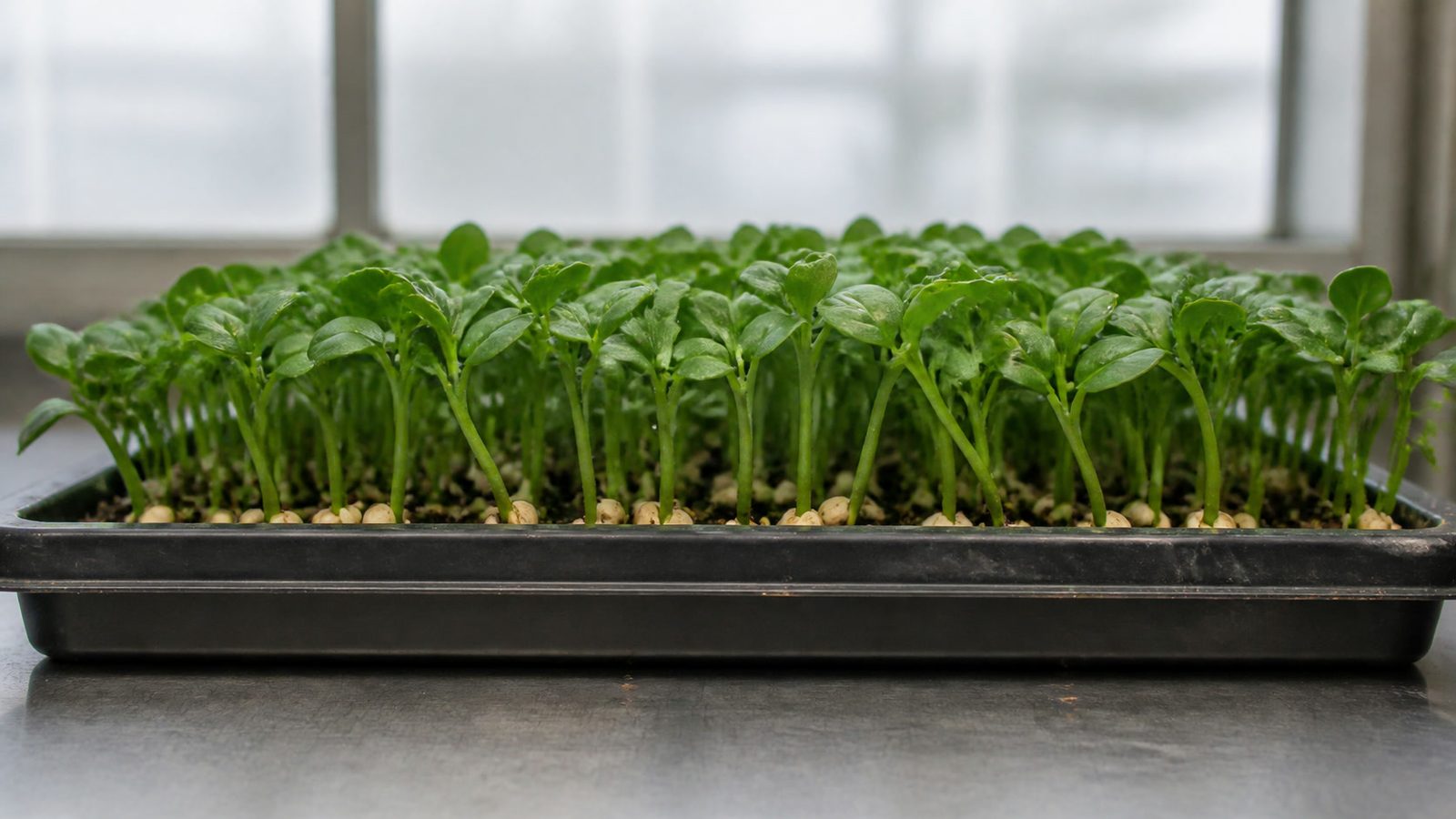
Cucumber microgreens are seedlings of Cucumis sativus, in the gourd family, cut in the first week or two.
At the supplier's stated crop point the tray should show thick, dark green stems and leaves, with harvest around 5 cm in one guide and a seven-day cycle at 20C in another. And that is genuinely all that can be said. Leaf shape, stem color at the base, stand evenness and what should be visible at the medium are not established, because no trustworthy identified crop photograph was available to check them against. A crop description is only as good as the identified photograph behind it, and for cucumber there is not one. Do not take a description of this tray from an image search, because the results are overwhelmingly the garden plant.
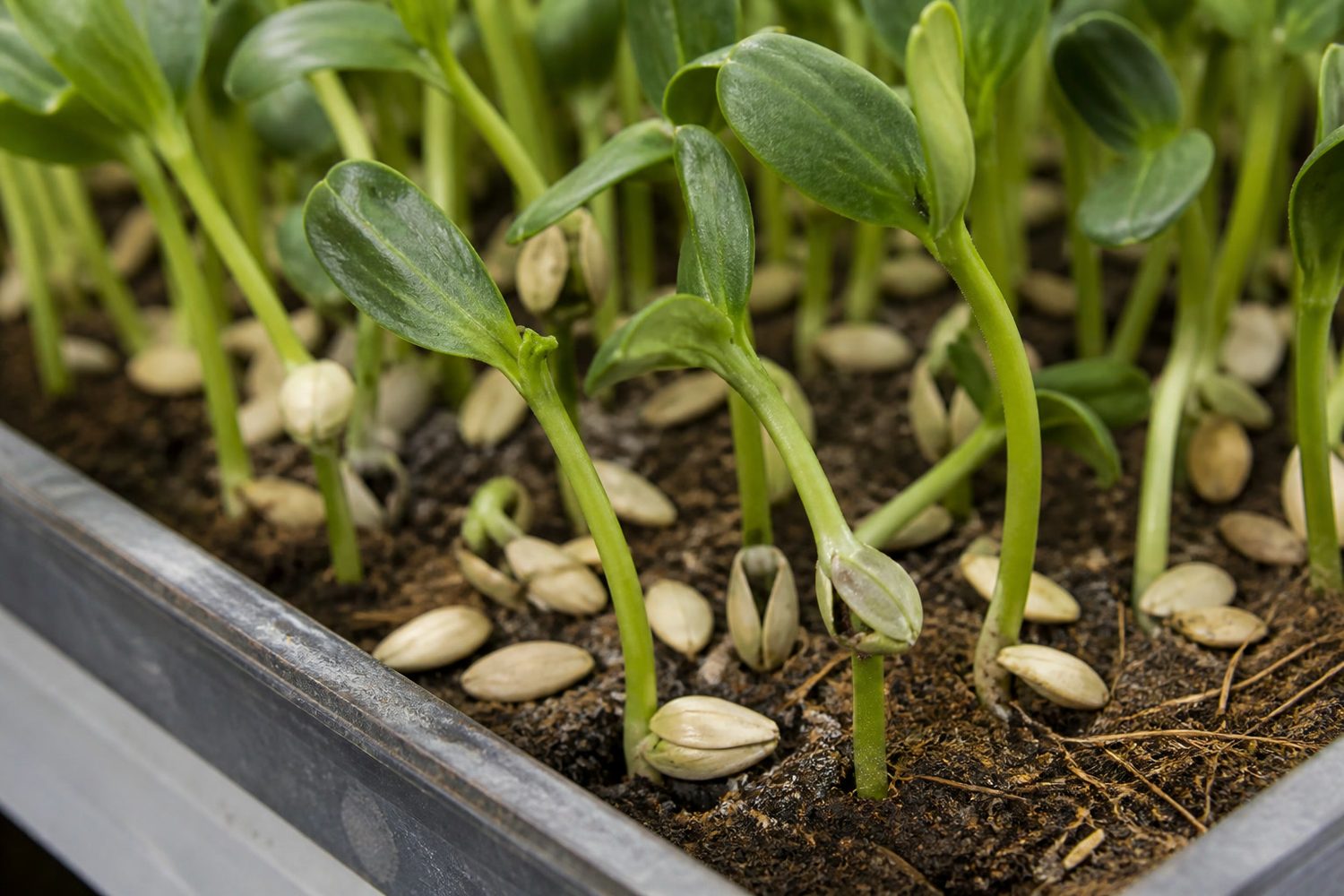
It is most plausibly confused with other cucurbit microgreens, especially melon and cantaloupe, and no source establishes a reliable single visual tell between them at this stage. Taste is not an identification method. Read the packet.
What it tastes like, and what to do with it
A refreshing cucumber note without bitterness. That is one commercial supplier's description and it is the only sensory claim that exists for this crop: there is no trained panel, and nobody has tracked how the flavor changes past the harvest window.
The sensible plate role follows from it: a raw, cooling, low-bitterness garnish or a small salad component. Over a chilled cucumber soup, through a tomato and cucumber salad, on an open sandwich. Its selling point is that it tastes like cucumber without the water content of a slice.
It is the wrong crop when a dish wants pepper, mustard heat or onion, and there is no support for using it as a cooked green. Anyone hoping a microgreen will be flavor-forward should look at radish or mustard; this one is mild by design and mild is the entire proposition.
Growing it: only what differs from the standard method
Everything general about trays, medium, light and watering is on the standard tray method for growing microgreens. This section is short because almost nothing cucumber-specific has been published.
Two real deltas exist. The seed is large, which is a handling fact rather than a technique, and one commercial guide states a seven-day cycle at 20C. That is the whole of what is published as specific to cucumber.
No soak. A crop guide says soaking is not necessary, so sow dry. No duration, temperature, benefit or harm has been tested in either direction.
Sow it as a large seed, spaced rather than scattered. General extension guidance separates large seed, spaced roughly half an inch to an inch apart, from fine seed that can go closer. Surface sow, press into thoroughly moist medium, and do not bury it deeply. Nobody has published a grams-per-1020 rate for cucumber, so the first thing to do with this crop is weigh what you use and record what comes off. On cucumber you are the trial, and that is the instruction rather than a caveat around one.
And here is what nobody has established. No blackout duration or weight: the one source that mentions covering gives no load and contradicts itself on timing. No light level, photoperiod, water volume or airflow target. No comparison at all between what cucumber wants and what a brassica tray wants. So, if you are told cucumber microgreens need a specific weight for a specific number of days, ask where that came from, because it is not in the record.
A cucumber tray, as far as anyone has published it
- 1
Day 0, sow dry and spaced
Large seed, surface sown, pressed into thoroughly moist medium. No soak. The rate is yours to establish and to write down.
- 2
Days 1 to 2, germination
One crop guide reports germination in one to two days. It gives no cover weight, so treat any cover as contact and humidity only.
- 3
Uncover on emergence
The general signal, since no cucumber-specific one exists: when the majority has germinated.
- 4
Day 7 at 20C
The commercial cycle, harvest stage unstated.
- 5
Day 9 at 27C
The peer-reviewed harvest, at two fully open cotyledons plus one emerged true leaf. Warmer, later, and a stated stage, which is why the two are not averaged.
What goes wrong with cucumber specifically
Nothing that anybody has documented, which is itself worth knowing before you start.
There is no published cucumber-specific failure sequence, no most-common mistake, no crop-specific pest or pathogen, and no validated root-hair-versus-mold test for this crop. Every one of those exists for broccoli. For cucumber the record is empty.
What applies is the general seedling disease complex, and it is worth knowing precisely: seed can decay before it emerges, seedlings can rot at or below the medium line, and Pythium often begins at the root tips. Damp conditions favor it, with Pythium associated with cool wet conditions while Rhizoctonia and some other Pythium species work in drier, warmer ones. The signs are missing emergence or a water-soaked, rotting base, and affected seedlings do not recover.
The mold risk field is blank on this crop, and it should be. No study compares cucumber's damping-off incidence against any other crop. A large seed and a short cycle are not a reason to call it "Medium", and a guess in that column is worse than a gap, because growers use it to choose between crops.
Do not diagnose mold from white material by color alone. Inspect the stem base and roots for the actual warning signs: rot at or below the medium line, root-tip involvement, collapse, or seedlings that never came up.
Nutrition, and what is actually established
Read this part, because there is a specific and checkable error circulating about this crop.
There is no USDA record for cucumber microgreens, searched 2026-08-08.
There is one peer-reviewed measurement. A study comparing nine summer leafy vegetables at microgreen and mature stages grew cucumber cv. 'Kumud' in coco pith, perlite and vermiculite at 27C, harvested in triplicate at nine days when two cotyledons were fully open and one true leaf had emerged, and measured 25.00 mg of ascorbic acid per 100 g, 38.66 mg of gallic acid equivalent phenolics per 100 g, and 17.15 mg of catechin equivalent flavonoids per 100 g.
Now the error. A cucumber microgreen page publishes a nutrition panel of roughly 15 kcal, 3.6 g carbohydrate, 2.8 mg vitamin C and 147 mg potassium per 100 g, with no study, no cultivar, no harvest stage and no provenance. Those figures closely resemble ordinary mature cucumber data.
Put the two side by side. The circulated "microgreen" panel gives 2.8 mg of vitamin C. The one actual measurement of a cucumber microgreen gives 25.00 mg, roughly nine times higher. The panel being copied around the internet as this crop's nutrition is not merely unsourced, it appears to describe the mature vegetable, and it understates the one thing anybody has actually measured about the seedling by nearly an order of magnitude.
And the counterweight, so this does not swing the other way. In that same study, cucumber microgreens came out higher in ascorbic acid but LOWER in phenolics and flavonoids than the mature comparator. So, no blanket "more nutritious than mature cucumber" claim survives either. That is the same split celery shows when somebody actually measures it, and it looks more like the normal result than the exception. A microgreen being better on one nutrient and worse on another is what the evidence usually says.
Which seed to buy
This entry carries no seed affiliate link, deliberately, and the reason is that there is nothing correct to link to.
Checked 2026-08-08, the Amazon results for cucumber microgreen seed returned over a thousand hits and not a single cucumber product sold for microgreens. All 35 cucumber listings on the first page were garden seed for planting outdoors: Marketmore, Persian, National Pickling, Spacemaster. Meanwhile the same page carried fifteen genuine microgreen listings for other crops, so the search works fine; there is simply nothing to find. Linking a reader to bush cucumber seed for a crop they intend to cut and eat at day nine would be sending them to the wrong product.
Buy it from a supplier that sells it in a microgreen range. Only one such offering could be opened anywhere for this research, listing the species and no cultivar, with a seven-day cycle at 20C, thick dark green shoots and a non-bitter cucumber flavor.
Specify Cucumis sativus sold for microgreen or food use, untreated, with a current germination test and lot record. This matters more than the usual boilerplate here, because almost all cucumber seed on the market is sold for gardens, and extension guidance is explicit that dyes, fungicides or insecticides applied to seed can be present in the young shoots you eat. A garden packet that does not disclose its treatment status is not a food input for a nine-day crop.
A bad lot has no published signature for this crop. It would show as low or uneven emergence, and nobody has quantified the cost. Ask for a germination result and run a small weighed test tray before committing 1020s, which on this crop is advice you would follow anyway, since you have to establish the rate yourself.
Is it worth growing?
Only if you are willing to be the person who measures it.
Grow it if you want an uncommon, mild, cooling garnish and you find the idea of running your own density and yield trial interesting rather than annoying. A home grower with one tray can test the seven-day cycle and decide whether the flavor earns a slot, and that is a genuinely reasonable thing to do.
Do not grow it as a production crop yet. There is no seed rate, no yield, no shelf life and no cost per tray, so there is nothing to price against and nothing to plan around. Any confident cucumber tray economics you find elsewhere have been borrowed from another crop.
Its competitors are the other mild specialty crops, and borage is the direct one whenever a buyer wants a cooling cucumber-like note, since borage tastes of cucumber and does have measured figures. That comparison is not close on evidence: borage has a seed rate, a yield, a cost per tray and a place in the table below. Cucumber has a flavor claim and a seven-day cycle.
A note on the numbers above
Hover or tap a row to highlight it.
| Figure | Value | Source | What kind of number it is |
|---|---|---|---|
| Days to harvest | 7 at 20C | A commercial microgreen guide | Indicative cycle, harvest stage unstated |
| Days to harvest | 9 at 27C | Peer-reviewed study, cv. 'Kumud' | MEASURED, at two open cotyledons plus one true leaf |
| Days to harvest | 7 to 12, about 5 cm | A lower-grade grower guide | Temperature for the range unstated |
| Seed per 1020 | No figure | Nobody | Cucumber is not in the 29-variety trial and no source states a rate |
| Yield per 1020 | No figure | Nobody | Nothing to borrow. A cucurbit or brassica yield is not a substitute |
| Soak | Not necessary | A grower guide | So sow dry. No duration or temperature established either way |
| Blackout | No figure | Nobody | One guide mentions covering and weighting, gives no load, contradicts its own timing |
| Germination temperature | 21C target, 27C used | Two separate sources | A target and an experimental setting. NOT an established range |
| Shelf life | No figure | Nobody | Storage temperature for microgreens generally is still being evaluated |
| Harvest window | No figure | Nobody | Nobody has established it |
| Regrows | No figure | Nobody | No paired first and second cut trial exists |
| Mold risk | No comparative rank | Nobody | Left blank on purpose, as on collard |
| Hull shedding | No figure | Nobody | Large pale seed coat, and no counted retention at harvest |
| Cost per tray | Cannot be calculated | Nobody | NEITHER a rate NOR an openable current microgreen seed price |
| Ascorbic acid | 25.00 mg/100 g | Peer-reviewed study, day 9 | Measured, one cultivar, one system |
| Phenolics | 38.66 mg GAE/100 g | The same study | Measured, and LOWER than its mature comparator |
| Flavonoids | 17.15 mg CE/100 g | The same study | Measured, and also lower than mature |
| The circulated panel | 15 kcal, 2.8 mg vitamin C | A microgreen page, no method or provenance | Resembles MATURE cucumber data. Roughly 9x below the measured microgreen figure |
| Nutrition, USDA | No record | USDA FoodData Central | Searched 2026-08-08 |
Ten blanks is a lot, and it is worth being precise about what it means. It does not mean cucumber grows badly, and it does not mean this research was thin: the sources that exist were opened and read. It means almost nobody has measured this crop. Compare chives, one entry ago, which has five densities on two substrates across two experiments. Same category, same year, and one crop has a density response curve while the other has no seed rate at all.
Cucumber is the tenth crop that cannot complete the comparison table, and the only one that cannot even state a cost per tray.
| Crop | Seed per 1020 | Yield | Days | Cost per tray | Oz per $1 | Oz per tray-day |
|---|---|---|---|---|---|---|
| Cucumber | No published figure | No published figure | 7 to 12 | cannot be calculated | cannot be calculated | cannot be calculated |
A blank means nobody has published that figure, so the cell is left empty rather than filled with an estimate. How the numbers work
All 62 crops, sortable, on the microgreen comparison.
Cucumber and cauliflower now sit together at the bottom as the two crops with essentially nothing to compare, and they got there from opposite directions. Cauliflower is a mainstream vegetable everybody grows and nobody has trialled as a microgreen. Cucumber is a mainstream vegetable with a whole industry of growing advice attached to the fruit and effectively none attached to the seedling. In both cases the familiarity of the name is doing work the evidence does not support, which is a reasonable thing to keep in mind whenever a crop feels like it must be well understood.
Terms on this page
Tap a term to see what it means.
Cucurbitaceae. The gourd family: cucumber, melon, cantaloupe, squash. Large seeds, thick shoots, and almost no microgreen research.
Sources
- VOLTZ microgreens range guide (PDF) - the one opened microgreen offering for Cucumis sativus, product 060052NS: a 7-day cycle at 20C, thick dark green stems and leaves, a refreshing non-bitter flavor, no cultivar named, and untreated seed with pathogen, purity and germination testing described for the range.
- Yadav et al., 2018, antioxidant potentiality and mineral content at mature and microgreen stages - cucumber cv. 'Kumud' in coco pith, perlite and vermiculite at 27 plus or minus 2C, harvested in triplicate at 9 days at two open cotyledons plus one true leaf: 25.00 mg ascorbic acid, 38.66 mg GAE phenolics and 17.15 mg CE flavonoids per 100 g, with the microgreen higher in ascorbic acid but lower in phenolics and flavonoids than the mature comparator.
- Borgmann Aquaponik, cucumber microgreens - 7 to 12 days at about 5 cm, a 21C germination target, soaking described as not necessary, germination in 1 to 2 days, and the unsourced 15 kcal and 2.8 mg vitamin C panel discussed above.
- Alo Farms, cucumber microgreen - the crop sold as a cut, ready-to-eat 0.75 oz product, supporting raw use.
- Johnny's microgreens yield trial results (PDF) - the 29-variety chart that contains no cucumber line.
- Johnny's yield trial, method and discussion - 1020 flats harvested at first true leaf, the instruction that a larger crop needs fewer seeds for airflow, and the warning that one system's yield data are unlikely to transfer to another's.
- Virginia Tech Extension SPES-756 (PDF) - density needing to be tested per facility, system, substrate, species and cultivar, uncovering when the majority has germinated, storage temperature still being evaluated, and the general 60 to 70F and 50 to 70 percent humidity ranges.
- SDSU Extension, growing microgreens at home - large seed spaced about half an inch to an inch apart against closer sowing for fine seed, surface sowing without deep cover, and the warning that dyes, fungicides or insecticides on seed may be present in the young shoots.
- UC IPM, damping-off - pre-emergence seed decay, rot at or below the medium line, Pythium beginning at root tips, and the different conditions favoring Pythium against Rhizoctonia.
- USDA FoodData Central - searched for cucumber microgreens on 2026-08-08, no record located.
Keep reading
The variety directory
Chia microgreens
A small bitter minty garnish in about a week. Chia seed is about 30 percent fat and the microgreen is not, so if you want the omega-3, eat the seed.
Read Chia microgreensThe variety directory
Amaranth microgreens
Red Garnet amaranth is the magenta garnish crop, and the trial numbers explain why it is a chef's crop rather than a grower's: 7.5 g of seed makes 6.5 oz in 17 days, against radish's 11 oz in nine.
Read Amaranth microgreensThe variety directory
Bull's Blood beet microgreens
Crimson stems under green cotyledons, 23 g of seed for 7.5 oz in 17 days, and one seed that is not one seed: beet is multigerm, which is why the tray behaves the way it does.
Read Bull's Blood beet microgreensThe variety directory
Celosia microgreens
A color crop whose entire measured record is a single YouTube video: 8 g of seed, 3.4 oz, 13 days. Bought for pink and orange stems, never for weight.
Read Celosia microgreens