Chive microgreens
Cal HewittPublished Checked
- allium
- moderate
- slow crop
- garnish
- chef crop
- no soak
- mold prone
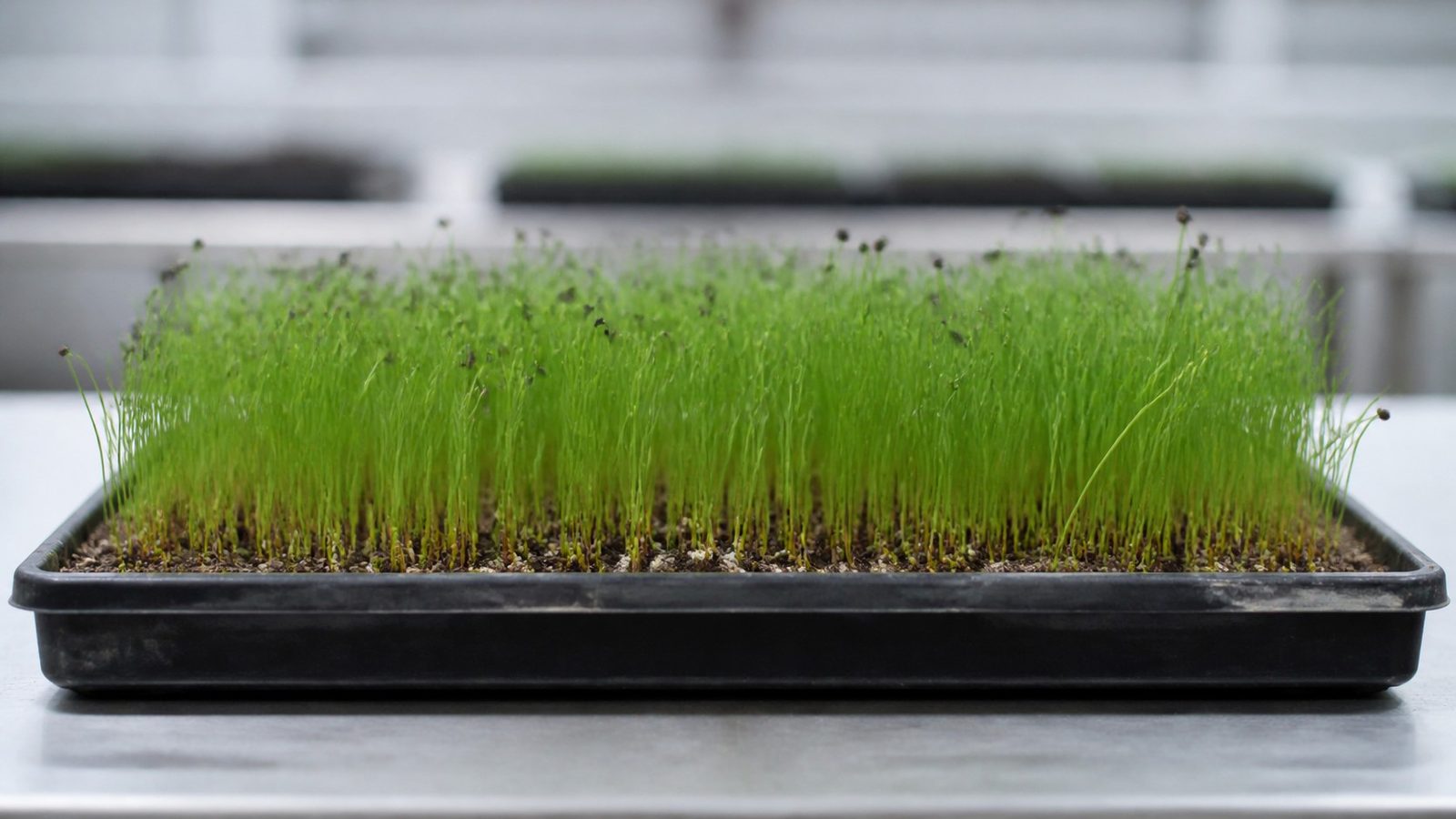
At a glance
Slow, uneven emergence over roughly 7 to 14 days leaves a thin stand sitting under cover far longer than a brassica, and the instinctive response to a patchy tray is the one that loses it.
- Botanical name
- Allium schoenoprasum
- Also sold as
- Chives Seeds, Common Chives Seeds
- Family
- allium
- Difficulty
- Moderate
- Days to harvest
- 14 to 30 days
- Harvest window
- No published figure
- Seed per 1020 tray
- 19.4 to 38.7 g
- Soak
- None
- Blackout
- 6 to 14 days
- Germination temperature
- 60 to 70 °F
- Yield per 1020 tray
- 3.8 to 5.6 oz
- Mold risk
- High
- Hull shedding
- some
- Shelf life
- 5 to 7 days
- Eaten as
- raw
- Seed cost per tray
- $3.77
38.7 g at $44.13/lb, True Leaf Market common chive seed, listed 2026-08-08. $1.89 at the 19.4 g end. Combined with a 3.8 to 5.6 oz yield this is the SECOND-WORST value per dollar of seed in this directory, behind fennel at 0.42 as of 2026-08-08. Seed only, excludes medium, tray, labor, light and loss.
Any field name above ranks every variety by it. No published figure means we researched it and nobody has established one, which is different from not yet researched. Every figure here is sourced at the bottom of the page. Compare every variety side by side.
Chives is one of the few crops with a real published density trial behind it, so you can set a sowing rate from measured data rather than from your own trial and error.
A replicated greenhouse study sowed common chive at five densities from 75 to 375 g per square meter, on two substrates, across two separate experiments, and weighed what came off. It concluded that chive should not exceed 300 g/m². That is a real density response curve for a real crop, and nothing else on this bench outside the trade's 29-variety trial has one.
What the measurement shows is not flattering. At the recommended rate a 1020 takes 19.4 to 38.7 grams of a seed costing $44.13 a pound, sits for around 19 days, and returns 3.8 to 5.6 ounces. That works out to roughly 1.7 ounces per dollar of seed, and until fennel was researched on 2026-08-08 it was the worst figure of any crop on this site. Fennel now sits below it at 0.42. We can say either of those things with confidence precisely because both are crops somebody bothered to measure.
And then there is the competition, which is not another tray.
What growers are saying right now
Sampled from public posts and videos, 10 July to 9 August 2026. Every line links what it is quoting. How often something is repeated is not evidence that it is true, so every line also says what the sources actually establish.
Snip your chives, straight into a freezer bag, twelve months, no blanching and no drying
Circulating The most engaged chive post of the window at 104 likes, aimed at people who let their chives die back each year
This is what a chive tray is actually competing against, and it is worth being honest about. A perennial clump you cut for years, plus a freezer bag that holds for twelve months, against a 19-day tray returning under five ounces. For most people that is not a close call. Is it worth growing
Top tips for keeping supermarket chives alive
Circulating A houseplant-style guide at 2,178 views, treating the supermarket pot as something to keep going rather than replace
The same point from the other side. Chives are the herb people already own, and the pot regrows. This crop is the only one in the directory whose main rival is a plant its customer bought once, years ago.
Tofu and chive pancakes, shrimp and chive dumplings
Circulating Recipes that are a large share of what the word "chives" returns at all
Read the characters and there is a buying trap in them. Those dishes use 韭菜, which is GARLIC chive, Allium tuberosum, a different species from the common chive on this page. Half the seed sold under "chive microgreens" is the other one. Which seed to buy
What it is, and how to tell you grew it right
Chive microgreens are seedlings of Allium schoenoprasum, common chive, in the onion family. That is a monocot, so it does not behave like anything else on this bench: one narrow grass-like blade per seedling instead of a pair of broad cotyledons, and no dramatic stem-to-leaf transition to watch for.
A correct tray is an even, fine green grass mat of very slender upright blades, cut at 2 to 5 cm in the commercial description. The research crop ran taller, 6.4 to 8.1 cm depending on substrate and experiment, which is a good illustration of how much the system moves this crop.
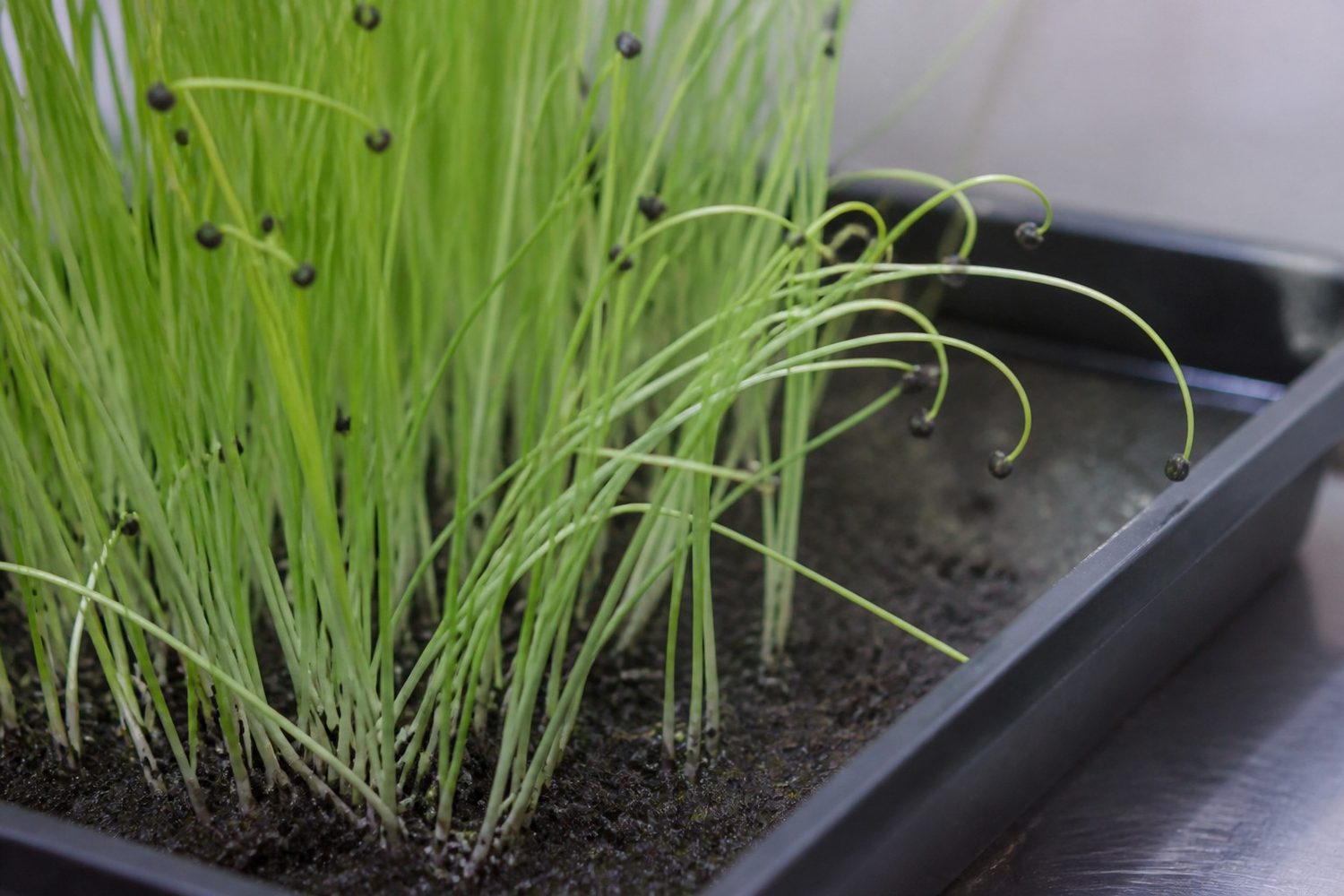
Those retained hulls are worth expecting rather than being alarmed by. Common chive seed is dark purple-black and a good share of it stays clamped on the tips, giving a visibly polka-dotted tray. It is a cosmetic and handling issue, not a reason to discard anything.
The confusion is with onion or scallion microgreens and with garlic chive. The tell is leaf form: common chive is extremely fine and needle-like, garlic chive is flatter and smells of garlic. At this stage that is a soft distinction, so read the Latin name on the packet before you claim an identification.
What it tastes like, and what to do with it
Delicate, mild onion-herb, and gentler than either onion microgreens or garlic chive. Unusually for a microgreen, the flavor gets less forceful as the blade grows past its tender cut rather than sharper.
Use it where a fine herb line and a mild allium finish are the point: scrambled eggs and omelets, baked or mashed potatoes, potato salad, leek and potato soup, sushi, fish, creamy sauces, quiche, avocado toast. It does the job a snipped chive does, at a finer scale and on a plate that is being composed rather than cooked.
It is the wrong crop as a salad base, in a smoothie, or anywhere needing crunch or a forceful onion hit. Onion or scallion microgreens give thicker shoots and a real bite; this gives a line of green and a whisper. And mild is not neutral: anyone who dislikes the onion family will dislike this, and anyone expecting garlic chive's flavor will find common chive disappointing.
Growing it: only what differs from the standard method
Everything general about trays, medium, light and watering is on the standard tray method for growing microgreens. Chive's deltas are mostly about waiting.
Emergence takes 7 to 14 days, and the covered phase runs 6 to 14. This is the longest blackout in the directory alongside celery, and the reason is simple: the seed is still germinating. The study uncovered at 6 to 7 days after planting; the commercial guide gives 7 to 14 and says take the cover off when most seedlings have emerged. Judge it on the stand, not on a date.
Do not soak. The seed is small and soft and the crop guide is explicit that it does not need it. No duration or water temperature has been validated in either direction, and pre-wetting only adds moisture to a crop that already sits wet for a fortnight.
Sow 19.4 to 38.7 g, and know that this number is real. It converts from the study's 150 to 300 g/m² recommendation. Use the low end for airy tender shoots that dry more easily; move toward 300 g/m² for weight per area. The study also tested 375 g/m² and concluded you should not go there. That is the only place on this site where a density ceiling comes from an experiment rather than from somebody's judgment.
Substrate matters more than usual, and jute beat peat. In one of the study's experiments jute produced higher chive fresh weight than peat, which is consistent with everything else about this crop: it is sensitive to sitting wet, and the substrate that drains better wins. This is the only crop on this bench with a measured substrate comparison behind it.
Then keep the foliage dry and the air moving for three weeks. Bottom water about ten minutes when the medium starts to dry, then drain. Give it even overhead light for around 12 hours, not side light, because thin blades lean toward it. There is no published chive light level, so that is a working setting rather than a target.
And the mistake to avoid is the obvious one. A tray that emerges slowly and patchily looks like it needs more water. It does not. Keeping it saturated or covered longer to "help" is how the stand is lost, and on a crop this slow you have two weeks in which to make that mistake.
A chive tray, week by week
- 1
Day 0, sow dry and even
19.4 to 38.7 g spread as a single layer on leveled, pre-moistened fine medium. Press for contact, cover lightly, do not bury. No soak.
- 2
Days 1 to 7, nothing much
Emergence starts around day 7 and runs to day 14. Patchy is normal. Even moisture, never saturated.
- 3
Days 6 to 14, uncover
Off when most seedlings are up and pushing. Held longer, the blades bend against the cover and yellow.
- 4
Days 14 onward, light and air
Even overhead light about 12 hours a day, bottom water for roughly 10 minutes as the medium dries, continuous gentle airflow.
- 5
Days 14 to 30, cut
At 2 to 5 cm around first true leaf. The study cut at 19 days at 25C. The window is described as small, so cut and use promptly.
What goes wrong with chives specifically
Before emergence, rot in the wet patches. Seed that never comes up in persistently soggy areas. Those patches are gone; manage the rest and re-sow if the coverage is unsaleable.
Then patchy late emergence, which is mostly not a fault. Mixed bare areas and just-emerged blades is what this crop does. It becomes a problem only when it is treated as one and answered with more water.
Surface mold and damping-off, which is the real risk. Fuzzy growth or a water-soaked pinched base, from poor airflow and wet foliage over a long covered period. Isolated early spots can be dried out; a spreading collapse in a food tray is not worth salvaging.
Bent, weak, yellow shoots, from the cover staying on too long or light coming in off-axis. Recoverable before harvest by uncovering and giving it even light from above.
And a hull-heavy bruised harvest, from thin blades handled wet. Brush the hulls while dry, cut dry, and do not crush it into a container, because wet crushed chive stores badly and this crop only has five to seven days to begin with.
Root hair or mold on a surface-sown allium tray
Hover or tap a card to highlight it.
Root hair
Fine white fibers coming only from roots at the moist medium, spread evenly around the root, and far less visible right after watering.
Mold
Irregular cottony webbing across seed, medium or blades, sometimes gray, expanding between plants, and unchanged by watering.
Why chives fools people
The seed is surface-sown, so white fibers sit in plain view below the green blades. On this crop that is usually root hair, not a problem.
The decider
Watering. Root hair collapses and nearly disappears; mold does not care and keeps spreading.
On a food crop
Only a lab names an organism, and unresolved doubt resolves toward discarding.
Nutrition, and what is actually established
There is no USDA record for chive microgreens. FoodData Central does hold mature "Chives, raw" as FDC ID 169994, and that is not a substitute: it is a different growth stage of the plant and using it here would be exactly the error this site exists to correct.
The study measured what it measured. Alongside fresh and dry shoot weight, visual quality and height, it recorded mineral concentrations for nitrogen, phosphorus, potassium, calcium, magnesium and sulfur across five densities on two substrates. Chive magnesium came out at 3.11 to 3.42 mg per gram of dry weight in the January experiment, and the study notes relatively high sulfur, which is what you would expect from an allium.
That is a composition measurement on dry weight, under one set of greenhouse conditions. It is not a serving, not a vitamin profile, and not a health claim.
What is not supported: that chive microgreens are rich in vitamins A, C and K, and that they are more nutritious than mature chives. The first is product copy usually traceable to mature chive data. The second would need a same-species, matched-stage analysis, and nobody has run one. Neither claim should be repeated on the strength of the USDA record for the mature herb.
Which seed to buy
The decision here is a species decision, and it is the one buyers get wrong.
**Common chive is Allium schoenoprasum. Mild onion, very fine needle-like blades, and it is what this page's numbers describe. Garlic chive, also sold as Chinese chive, is Allium tuberosum.** Different species, flatter blade, a clear garlic-onion flavor. They are not variants of one crop and substituting one for the other will be noticed immediately by anyone who ordered on flavor.
No supplier page establishes named common-chive cultivars with tested microgreen differences in stem length, color, days or yield, so beyond the species choice there is nothing to select for.
Chive microgreen seed on Amazon works, and the caveat goes before the click. Checked 2026-08-08, that search returned 156 results with 34 chive listings, of which 16 were garlic chive rather than common chive: roughly half the shelf is the other species, mixed in among the results with no visual difference on a thumbnail. Read the botanical name, not the picture. Sixteen listings were explicitly sold for microgreens or sprouts, so genuine product is there once you know which one you are looking at.
Specify common chive, Allium schoenoprasum, untreated, food or microgreen-intended seed, with a lot number, packed or test date and germination information. Refuse treated field seed and pelleted or coated seed: a coating is not a food-crop input to assume safe on a raw harvested tray, and it changes how the seed takes up water.
A bad lot is the crop's nastiest trap, because slow emergence and a weak lot look identical for the first fortnight and the grower usually blames their watering first. The study's seed tested at 90 percent germination, which is a fair benchmark for a fresh lot. Run a 100-seed paper-towel test before committing trays, because a failed chive tray costs you three weeks of a rack position rather than three days.
Is it worth growing?
For most people, honestly, no, and this is the clearest case of that in the directory so far.
The problem is not the plant, it is the alternative. Chives are a hardy perennial: buy one pot, cut it for years, and freeze the surplus for twelve months without blanching. That is the crop this tray is competing against, and a 19-day, sub-five-ounce tray of seed costing $44 a pound does not beat it for a home cook. Nothing else on this site has a rival that good, because you cannot keep a pot of radish microgreens on a windowsill for three years.
There are two real cases for it. A chef who wants a fine, uniform, cut-to-length chive line as a plated garnish gets something a snipped kitchen chive does not give: an even mat of identical blades, cut fresh, at a scale that looks deliberate. And a grower already selling a microgreen mix can use it as a distinctive allium component.
Beyond that, choose something else. A beginner wanting a fast forgiving first crop should grow radish or broccoli. A grower selling by weight should look at the numbers below and then at the three-week tray slot. If the requirement is allium flavor with actual volume and bite, onion or scallion microgreens do that better, and garlic chive does it with garlic.
If you keep animals, this is the tray to keep away from them
Chives are Allium schoenoprasum, and the alliums are the one group on this site with a real cross-species feeding caution behind them. Merck's toxicology chapter describes the sulfur-containing compounds in onion, garlic, chives and leek causing oxidative red-cell damage, Heinz bodies and delayed hemolysis, and Colorado State Extension tells poultry keepers to avoid onions outright. Nobody has tested allium material at microgreen stage in any animal, so there is no threshold to work to, which argues for keeping the tray out of reach rather than for calculating a safe amount.
Two things this does not mean. It is not a reason to avoid growing chives, which are perfectly ordinary food for people. And it does not transfer to every animal: the same claim is not established for reptiles in either direction, because the veterinary sources naming alliums name dogs, cats and horses and stop there. The feeding microgreens to chickens guide has the poultry side.
A note on the numbers above
Hover or tap a row to highlight it.
| Figure | Value | Source | What kind of number it is |
|---|---|---|---|
| Days to harvest | 19 DAP | Mississippi State study | MEASURED, at 25C day and night, no supplemental light |
| Days to harvest | 14 to 30 | A commercial grower guide | 7 to 14 dark plus 7 to 14 in light, at 18 to 24C |
| Seed per 1020 | 19.4 to 38.7 g | Converted from the study | 150 to 300 g/m2 over a 1020's 0.129 m2. A MEASURED recommendation |
| Seed density ceiling | Do not exceed 300 g/m2 | The same study | Five densities tested from 75 to 375. The only density trial on this site |
| Seed per 1020 | No figure | Johnny's 2017 trial | Chive was not one of the 29 varieties |
| Yield per 1020 | 3.8 to 5.6 oz | Converted from the study | 831 to 1,236 g/m2 in January, 1,083 to 1,227 in February |
| Substrate | Jute beat peat on fresh weight | The same study | In one of two experiments. The only substrate comparison here |
| Soak | Not required | A crop guide | Small soft seed. No validated duration either way |
| Blackout | 6 to 7 days | The study | Cover removed at 6 to 7 DAP |
| Blackout | 7 to 14 days | A commercial guide | Until most seedlings have emerged |
| Germination temperature | 60 to 70F | Virginia Tech, general | The study ran at 77F. No chive-specific experiment exists |
| Shelf life | 5 to 7 days refrigerated | A crop guide | Blotted dry, wrapped, sealed. Temperature not stated |
| Harvest window | No figure | Nobody | Described as a small window, with no day count |
| Regrows | No, as a tray | A crop guide | Replant after harvest. Mature perennial crowns are a different thing |
| Germination benchmark | 90 percent | The study's seed lot | A fair target for a fresh lot, not a guarantee |
| Magnesium | 3.11 to 3.42 mg/g dry weight | The same study | Composition on DRY weight, one greenhouse, one season |
| Nutrition, USDA | No microgreen record | USDA FoodData Central | Mature "Chives, raw" is FDC 169994 and is not a substitute |
This is the best-measured crop on the site outside the trade's own trial, and that is why the verdict can be this blunt. Most entries here have to hedge, because a supplier's estimate or a single filmed tray is all that exists. Chive has five densities, two substrates, two experiments, a stated harvest stage, a stated temperature and a stated seed germination percentage. When a crop is measured properly and the answer is unflattering, the answer is still the answer.
Hover or tap a row to highlight it.
| Crop | Seed per 1020 | Yield | Days | Cost per tray | Oz per $1 | Oz per tray-day |
|---|---|---|---|---|---|---|
| Leek, American Flag | 23 g | 5.64 oz | 10 to 25 | $2.21 | 2.6 | 0.56 at 10 days |
| Chives | 19.4 to 38.7 g | 3.8 to 5.6 oz | 19 | $1.89 to $3.77 | 1.7 | 0.25 |
| Onion, Crystal White Wax | 4.8 g, area-converted | 1.29 oz, area-converted | 10 to 21 | $1.20 | 1.08 | 0.12 at 11 days |
All 62 crops, sortable, on the microgreen comparison.
One figure here is a publisher's house number rather than a chive result. Added 2026-08-08, while researching endive. The five to seven refrigerated days, the roughly ten minute bottom watering and the no-regrowth verdict on this page come from a crop guide that also supplies endive's and spinach's. Comparing that publisher's guides across three unrelated species, the day counts change per crop and the storage life, the watering time, the light height and the regrowth verdict do not. Those are its standard method. It does not make them wrong, and this page still follows them, but they are not measurements of chive, and the density trial that makes the rest of this entry unusually well evidenced does not extend to them.
Superseded 2026-08-08. Fennel now sits below chives at 0.42 oz per dollar, on a measured yield of about one ounce. Corrected twice on 2026-08-09: nasturtium came in at 0.98 and onion at 1.08, so chives is now fourth-worst at 1.7. The reason it got there is still the interesting part, and it is a different reason from either of the crops below it.
Chives takes the second-lowest place in the oz-per-dollar column at 1.7, below borage and spinach, and it gets there by an unusual route. Most poor performers on this table are cheap seed that yields nothing, like carrot at 44 cents and 2 ounces. Chives is the opposite: a respectable 3.8 to 5.6 ounces, undone by seed at $44.13 a pound. It is the only crop here where the seed price, rather than the rate or the yield, is what sinks the number.
Which is worth holding next to the pattern the rest of this table shows. Across sixteen crops the lesson has been that the shelf price of seed almost never predicts the cost of a tray, because the RATE does the work. Chives is the exception that shows where that breaks: at $44 a pound, a mid-range rate is still expensive, and no amount of careful sowing fixes it.
Terms on this page
Tap a term to see what it means.
Common chive. Allium schoenoprasum. Mild onion flavor, very fine needle-like blades, and the crop this page's numbers describe.
Sources
- Mississippi State chive density and substrate study - Allium schoenoprasum at five densities from 75 to 375 g/m2 on peat and jute across two 25C greenhouse experiments, harvested at 19 DAP at expanding cotyledon or first true leaf: the recommendation not to exceed 300 g/m2, fresh shoot weights of 831 to 1,236 g/m2 in January and 1,083 to 1,227 in February, heights of 6.4 to 8.1 cm, jute outperforming peat in one experiment, magnesium at 3.11 to 3.42 mg/g dry weight, and the seed lot's 90 percent germination.
- True Leaf Market, common chive seed - A. schoenoprasum sold non-GMO and heirloom with microgreen use selectable, and the $44.13/lb price behind the seed cost, listed 2026-08-08.
- Epic Gardening, chive microgreens - 7 to 14 day emergence, no soak needed, removing the cover when most have emerged, about 12 hours of even overhead light, roughly 10 minute bottom watering, retained dark hulls being edible and brushable, 5 to 7 refrigerated days blotted dry and wrapped, replanting after harvest rather than expecting regrowth, and the small harvest window.
- LaNiTex, growing chive microgreens - 14 to 30 days total as 7 to 14 dark plus 7 to 14 in light at 18 to 24C, cutting at 2 to 5 cm around first true leaf, the fine needle-like blade, and the mild onion-herb flavor.
- Hoss, garlic chive microgreens - Allium tuberosum labeled as a distinct species with a garlic-onion flavor, sold untreated.
- Johnny's microgreens yield trial results (PDF) - the 29-variety chart that contains no chive line.
- Johnny's yield trial, method and discussion - harvest at first true leaf, the warning that yields do not transfer between systems, and the observation that high-80s and low-90s F periods accelerated crops while reducing uniformity and quality.
- Virginia Tech Extension SPES-756 (PDF) - the 60 to 70F general microgreen range, and both chive species listed among microgreen alliums.
- UC IPM, damping-off - Pythium and Rhizoctonia solani under damp conditions, and the symptom pattern that separates disease from root hair.
- USDA FoodData Central - no chive microgreen record located on 2026-08-08. Mature "Chives, raw" is FDC ID 169994 and is not a microgreen source.
Keep reading
The variety directory
Dill microgreens
Two suppliers disagree by ten days on when to cut it, and an indoor grower with no stake in the argument settles it. Plus why dill's yield figure should be read alongside chervil's.
Read Dill microgreensThe variety directory
Leek microgreens
A crop where the garden version is far slower than the tray: a leek takes most of a season in the ground and ten days in a 1020, and it turns a bench more than twice as fast as chives.
Read Leek microgreensThe variety directory
Celery microgreens
Three to four weeks of bench for a seasoning green, with an unusually complete measured nutrient panel behind it: 45.8 mg of vitamin C per 100 g, and four minerals that are higher in the mature leaf.
Read Celery microgreensThe variety directory
Flax microgreens
A mucilaginous seed like chia, and the crop where somebody measured both directions at once: flax microgreens beat flax sprouts on pigments and antioxidants and lose to them on dry matter.
Read Flax microgreens