Can Chickens Eat Microgreens?
Cal HewittPublished Updated Checked
- chickens
- poultry
- animal feeding
- safety
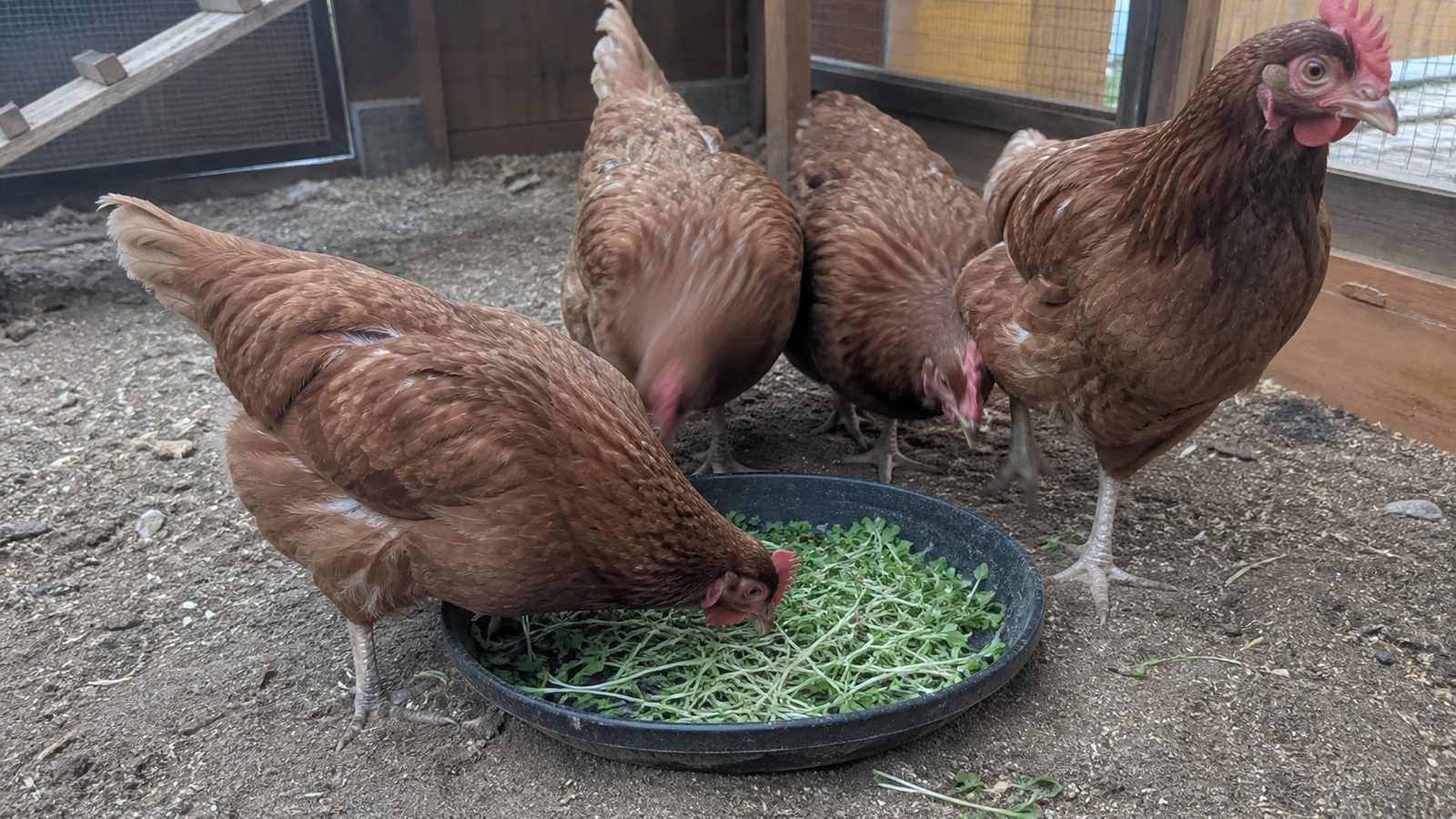
Yes, in small amounts, as one of the treats that fit inside the ten percent of daily feed Cornell Cooperative Extension says all scraps and treats together should not exceed. That is the whole of the defensible answer, and it is worth being clear that it is a rule about treats rather than a finding about microgreens.
No veterinary, extension, ASPCA or peer-reviewed source establishes a safety verdict or a dose for any named microgreen in chickens. Not sunflower, not pea, not broccoli, not radish. Every crop-by-crop recommendation you will read is an extrapolation from the mature vegetable, from sprouted grain fodder, or from somebody's flock enjoying a tray.
What to avoid, and this part is sourced
The named hazards for chickens are real and they are specific. Colorado State University Extension says to avoid avocado skins and pits, undercooked or dried beans, onions, rhubarb, and to be careful with potato peelings because of solanine. Merck's poultry chapter adds two seed contaminants with actual numbers: Crotalaria causes signs above 0.05 percent of the feed and killed birds in eighteen days at 0.3 percent, and sicklepod seed reduces intake and production at two percent or more.
The alliums are the group that matters to a microgreen grower, because three of them are grown as microgreens. Onion, garlic, chives, leek and onion microgreens all carry the same sulfur-containing oxidants, and Merck describes oxidative red-cell damage, Heinz bodies, methemoglobinemia and delayed hemolysis across food-producing animals. Two things follow. Merck's numerical onion doses are for cats and dogs and must not be carried across to a hen. And nobody has tested allium material at microgreen stage in any bird. So, the honest instruction is to keep allium trays away from the flock, on a real mechanism, without pretending a threshold exists.
Beyond that: nothing moldy, spoiled, manure-contaminated, or grown from treated seed.
Why a chicken is not a rabbit
A hen swallows without chewing. The crop stores what she eats and releases it to the gizzard to be ground, and she does very little microbial fermentation compared with a ruminant. Two consequences run through everything below.
Fresh greens are a supplement and never a substitute. They are mostly water and low in the protein and energy a laying hen needs, so the risk that actually shows up in the literature is not poisoning, it is dietary displacement. Cornell links treats above the ten percent ceiling to smaller and fewer eggs and to delayed onset of lay in younger birds, and reports that restricting feed by more than ten percent to push birds onto forage lowers both egg production and egg size.
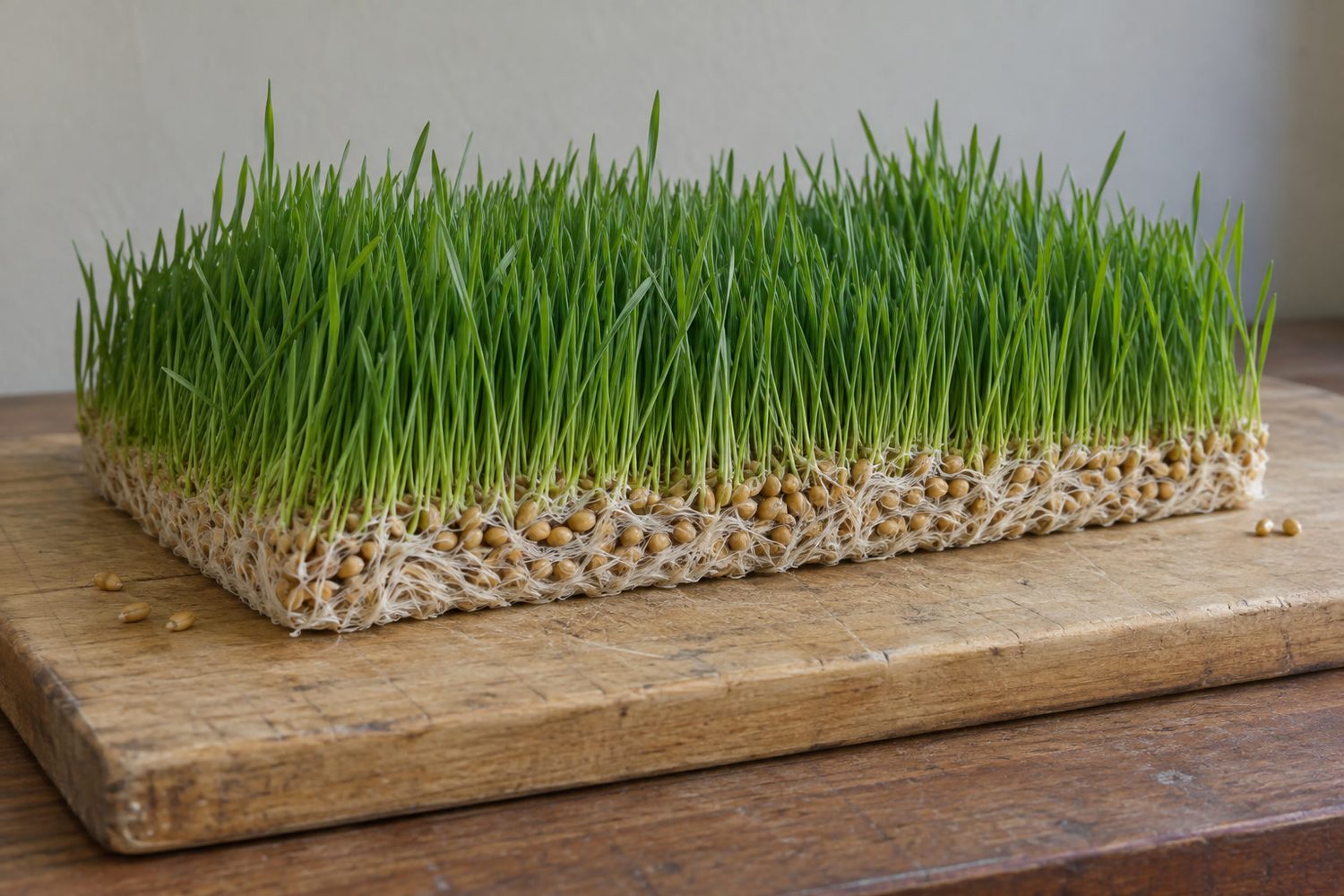
Form matters as much as species. University of Maryland Extension identifies large amounts of poorly digestible material as a cause of crop impaction, and specifically associates large amounts of fibrous material including grasses with pendulous crop. Nobody has measured how much long pea shoot or wheatgrass blade is too much. So, cut the shoots, offer the shoots, and keep roots, mats and growing medium out of the run. Sprouted grain fodder is a different case: the chicken trials fed the whole mat of seed, roots and shoot, as covered in growing microgreens for chickens.
Every crop keepers ask about
Hover or tap a row to highlight it.
| Crop | Verdict | What the evidence supports |
|---|---|---|
| Clover | Not established | No chicken microgreen study located |
| Broccoli | Not established | Studied by USDA ARS as a pathogen model, not as feed |
| Arugula | Not established | No chicken microgreen study located |
| Radish | Not established | No chicken microgreen study located |
| Sunflower | Not established | Sunflower SEED is a separate, recognized feed item. The shoot is not |
| Pea shoots | Not established | Long material carries a crop-form caution, which is not a toxicity finding |
| Wheatgrass | Not established | Wheat grain is ordinary poultry feed. The grass is a different thing |
| Barley grass | Not established | Sprouted barley fodder is not barley microgreens |
| Alfalfa | Not established | No chicken microgreen study located |
| Kale | Not established | No chicken microgreen study located |
| Mustard | Not established | No chicken microgreen study located |
| Buckwheat | Not established | No chicken microgreen study located |
| Popcorn shoots | Not established | Corn grain is ordinary feed. The shoot is not established |
Thirteen crops, thirteen identical verdicts. That is what the evidence base looks like once a mature-vegetable source, a fodder source or a blog post stops counting as a safety verdict. "Not established" is different from "unsafe", and it is also different from "safe". Nothing here says these crops harm chickens. It says nobody has checked, and you are entitled to know that before you decide.
Two crops sit on their own. Nightshades are not a blanket poison: an EFSA assessment records laying hens tolerating green potato sprouts and ground tubers at ten percent of the diet in an older study, while another chicken study found intestinal changes from potato protein concentrate at 154.2 mg glycoalkaloid per kg of body weight per day. That is evidence about potato products, not about tomato or pepper microgreens, and it supports neither the "all nightshades are lethal" line nor the "they are fine" one. And the yolk-color claim is real in principle: a thirty-day laying-hen trial moved YolkFan scores from 5.6 to 8.0 with 40 to 60 mg of lycopene per kg of feed, and to 14.8 with astaxanthin. No microgreen has ever been measured for that purpose, so treat a deeper yolk as an observation and never as proof the tray is doing the bird any good.
How much, and how to introduce it
The number to use is Cornell's, which AkoVet's veterinary treat guidance matches: all treats and scraps combined at no more than ten percent of the weight of feed offered that day, with complete, life-stage-appropriate feed freely available for the other ninety. There is no validated way to turn that into a gram figure for a two-kilo hen. Do not turn "a handful" into a dose.
Chicks and pullets are a separate question, and it is asked constantly. They need their starter or grower ration, Cornell reports that excess treats can delay young birds coming into lay, and keepers in the community consistently raise grit before they raise greens. There is no published microgreen dose for a chick.
On washing, the intuition is backwards. University of Nevada Extension reports that microgreen seed can carry pathogens and that post-harvest washing may be ineffective and can increase contamination by damaging tissue, and USDA ARS recovered Salmonella, E. coli O157:H7 and Listeria monocytogenes from edible shoots grown from contaminated seed. Those are human produce-safety findings, not chicken trials. The instruction that follows is about source hygiene rather than rinsing: if a tray is spoiled, moldy or grown from treated seed, washing does not rescue it.
Stop feeding and call a poultry vet for anorexia, lethargy or isolation, hunching with ruffled feathers, weakness, labored breathing, watery or bloody droppings, a crop still hard and full the next morning, a sudden drop in laying, or more than one sick bird.
Growing them for the flock
People do it. The Frugal Chicken grows sunflower microgreens for hens, and BackYardChickens keepers describe alfalfa, radish, broccoli and clover mixes on a five to seven day cycle. One calls it an expensive treat, which is the only cost assessment anybody has published for these mixes: no tray-to-bird ratio and no cost per bird per day exists in any credible source.
Keep the fodder distinction straight, because it is where most of the confusion enters. Fodder is whole sprouted grain including the roots and the remaining seed; a microgreen is a shoot cut above the medium. The sprouted-barley economics you will find are mostly from dairy cattle work. None of it transfers to a microgreen.
A tray of sprouted grain or greens works as a supplement for a laying flock, fed on top of a complete layer feed rather than in place of it. The only laying-hen trial located tested 15, 30, and 45 grams of fresh sprouted barley per hen per day and found no measurable change in egg production. For six hens at 30 grams a day, that is 1,260 grams of fresh sprouts a week, grown from roughly 218 to 885 grams of dry barley depending on how much water the sprouts hold. Seed runs up to about $0.0186 per hen per day. Any tray that is moldy, sour, or slimy goes in the trash, not the run.
Keep the complete feed full and add the tray on top
A complete layer feed is formulated to supply the energy, protein, minerals, and vitamins a producing hen needs. Alabama Cooperative Extension notes that extras are not complete feeds, and its practical warning is that birds can fill up on extras and then not eat enough of the ration that keeps them laying.
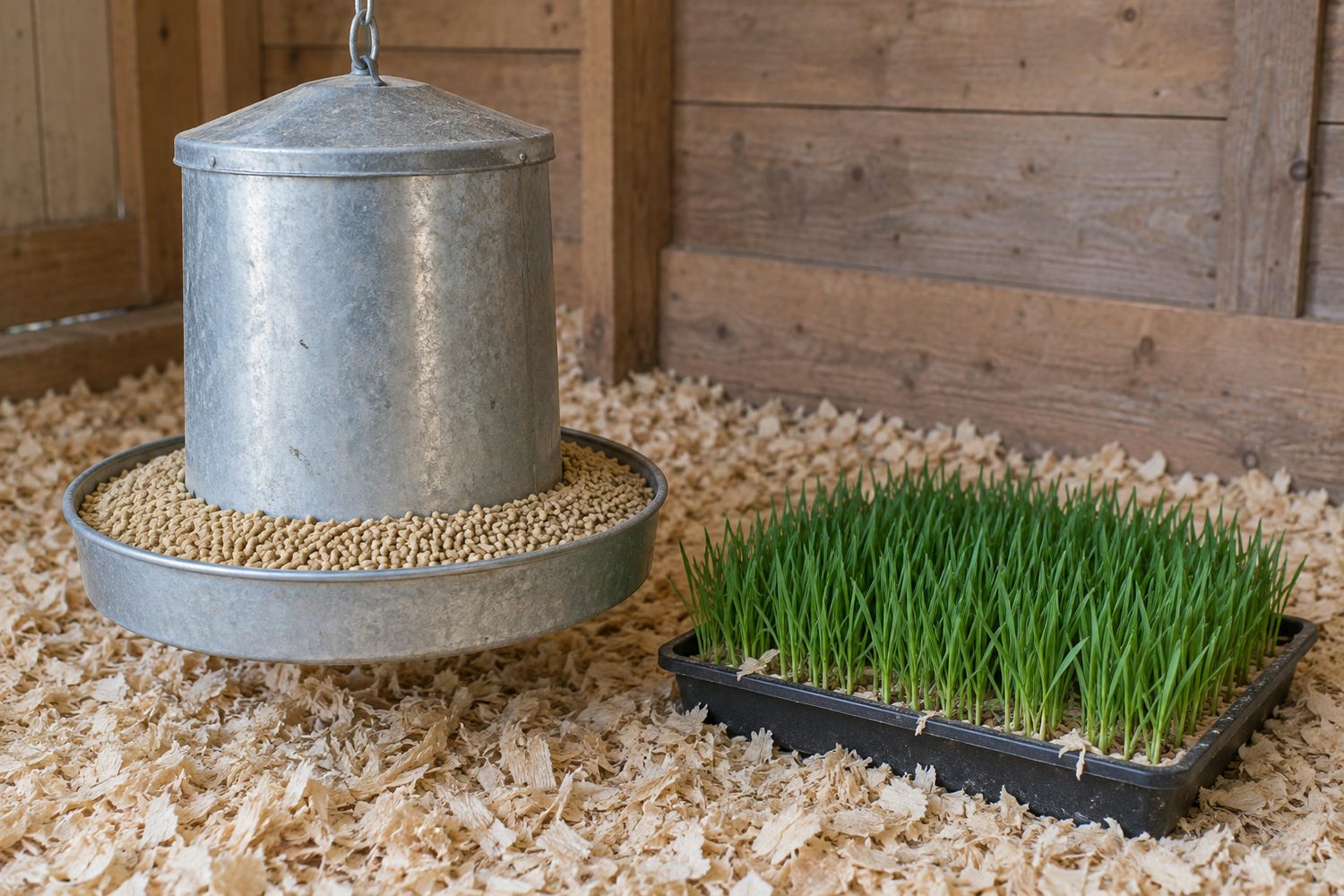
That is why the usual limits on extras are small. AkoVet, a veterinary education organization founded by veterinarians, researchers, and educators, puts all treats at no more than 10% of total daily intake, about two tablespoons per chicken per day at most, given after the main meal. Oregon State Extension gives 10 to 15% of total daily food for scratch, applies the same limiting idea to table scraps and greens, and calls pasture a supplement rather than a substitute. Neither is a measured fodder dose. They are ceilings on everything extra your hens get, and a tray counts toward them.
A SARE producer grant shows what happens when feed is cut instead. The farmer's own results, not peer reviewed, showed layer egg production dropping every time bagged feed was reduced and recovering once it was restored.
Hens eating whole grain or fibrous mats also need free-choice insoluble grit if they can't find small stones, because grit stays in the gizzard and does the grinding (UF/IFAS); oyster shell is too soft to stand in for it. Bring any new supplement in gradually, with the complete feed staying in the feeder.
Why dry matter matters more than tray weight
A sprouting tray gets heavier every day, mostly with water. Dry matter is what's left once water is removed, and it holds the calories, protein, and minerals.
The 2022 barley study measured dry barley grain at 89.12% dry matter and its day-7 hydroponic fodder at 12.64%. One kilogram of that wet fodder held 0.1264 kg of dry matter. On those measurements, it takes about 7.05 kg of wet fodder to carry the dry matter in 1 kg of the grain, before counting anything lost during sprouting.
Something is lost, too. Sprouting seeds burn starch to grow, and a Feedipedia review of hydroponic fodder reports dry matter losses of 7 to 47% after 6 to 7 days. A Meat & Livestock Australia review gives a barley example of 1,000 g of dry matter falling to 817 g by day 7, an 18% loss. Water makes the tray heavy, but it adds no calories and none of the minerals your layer feed supplies.
As a share of dry matter, protein does rise: in the 2022 table, crude protein went from 9.92% of the grain's dry matter to 19.17% of the fodder's, while nitrogen-free extract fell from 80.66% to 66.13%. That describes a less starchy, more fibrous product with less total dry matter, not protein made from nothing. No published trial has measured the vitamins in a daily tray portion for backyard layers, so treat vitamin gains as unmeasured.
Wet weight also varies from one tray to the next. The 2025 layer trial below measured its own sprouted barley at 51.30% dry matter, roughly four times the broiler study's figure, so you can't assume what your tray holds.
How much to grow for six hens
The layer trial's three amounts make a reasonable planning range, not a prescription. For six hens over seven days, the math works out like this:
Hover or tap a row to highlight it.
| Fresh barley per hen per day | Fresh weight per week, 6 hens | Dry matter at the layer trial's 51.30% | Dry barley seed needed | Dry matter at the broiler study's 12.64% | Dry barley seed needed |
|---|---|---|---|---|---|
| 15 g | 630 g | 323 g | 442 g | 80 g | 109 g |
| 30 g | 1,260 g | 646 g | 885 g | 159 g | 218 g |
| 45 g | 1,890 g | 970 g | 1,327 g | 239 g | 327 g |
The seed columns divide the dry matter by 0.8912 times 0.82, which assumes barley at 89.12% dry matter and the 18% day-7 loss from the Australian example. They are arithmetic estimates. Real trays vary in germination, yield, dry matter, and waste.
No source located gives a daily dry-matter fodder allowance for backyard layers, so measure your own. Weigh the dry seed going into a tray and the fresh mat coming out, write both down, scale the table to your hen count, and size trays from your own weights rather than a wet-weight multiplier.
What the layer trial found at those amounts
The 2025 trial gave 120 Lohmann Brown hens, 46 weeks old, in six pens of five per treatment, 0, 15, 30, or 45 g of fresh sprouted barley per hen per day for 42 days alongside a commercial layer mash.
The researchers found no significant difference between groups in body weight, mash intake, egg production, egg weight, egg mass, yolk color, or feather damage. The barley neither cost nor added anything measurable in laying.
Shell strength was the exception. By day 42, eggs from hens given sprouted barley at any of the three levels had weaker shells than eggs from the 0 g group. Every group still tested above the 3.5 to 4.5 kgf range the authors cite as acceptable for table eggs, so the shells stayed in normal territory, but the change ran downward. If thin shells are already a problem in your flock, watch them when you start a tray. And this was one breed over six weeks on full layer mash; it says nothing about replacing the mash.
Broiler results stay with broilers
In the 2022 Ross 308 study, 144 day-old chicks spent five weeks on pellets with 10% or 20% hydroponic barley fodder added, or with chopped fresh fodder offered free. Cumulative feed conversion, measured as grams of feed per gram of gain, was 1.446 at 10% and 1.470 with free fresh fodder, against 1.564 for the control and 1.620 at 20%.
In the 2024 Cobb 500 study, 144 birds ate diets with 0, 3.5, 7, or 10.5% hydroponic barley fodder from weeks 3 to 7. At 10.5%, final body weight was 2,091.9 g against 1,845.9 g for the control, and feed conversion was 1.99 against 2.24.
The SARE farm also reported, without peer review, that its broilers given all the fodder they would eat used 20% less bagged feed and weighed about the same at processing. Broilers are a different bird on a different ration over a short window, and none of these figures carries over to a laying hen or a mixed-age backyard flock.
What it costs in seed
On seed alone, a tray costs about the same as the layer feed it would match on dry matter.
Naylor Seed's 2026 retail list, dated March 24, 2026, lists spring barley at $0.40 per pound. That is planting seed, so treat it as a price example and check any bag's label for a feed restriction before you buy. Chewy listed a 50-lb bag of Purina Layena 16% pellets at $24.99, or $0.50 per pound, in a Wayback Machine capture from September 3, 2026.
At the trial's 30 g per hen, six hens eat 1.26 kg (2.778 lb) of fresh fodder a week. At the layer trial's 51.30% dry matter, that is 1.425 lb of dry matter, which takes 1.950 lb of dry barley, or $0.780 a week and $0.0186 per hen per day in seed. Buying the same dry matter as layer feed, using the 89.71% dry matter of the Cobb study's finisher diet as a stand-in because the bag's moisture isn't published, takes 1.588 lb, or $0.794 a week and $0.0189 per hen per day. At the broiler study's 12.64% dry matter every figure shrinks to about a quarter: 0.351 lb of dry matter, 0.480 lb of seed, and $0.192 a week in seed against $0.196 in feed. Either way, seed cost runs about 0.98 of the feed cost.
That is equal dry mass only, not equal energy, protein, calcium, vitamins, or minerals, and it leaves out trays, water, power, labor, and discarded trays. The Feedipedia review reports one analysis in which sprouted barley cost 3.4 times as much per kilogram of dry matter as the original grain. No universal cost per bird per day has been published, so run the math with your own prices and tray weights.
Equipment is where spending climbs. CropKing listed its Hobby Fodder & Microgreen System at $1,380 on September 12, 2026, with six 4-ft PVC channels, a pump, a timer, and a reservoir. Fodder Systems USA advertises a $3,950 HFS-100 that it says feeds 200+ poultry; those are seller figures, not established for backyard layers. The routine below uses plain draining trays.
Growing a clean tray
Use only seed that is explicitly untreated, lawful for food or feed, and from a traceable lot. The federal rule, 7 CFR 201.31a, requires "Do not use for food/feed" wording on treated seed where residues harm vertebrates, and University of Minnesota Extension and NPIC both say treated seed must never become feed. A "sprouting seed" label doesn't make a bag safer on its own; being untreated is what matters.
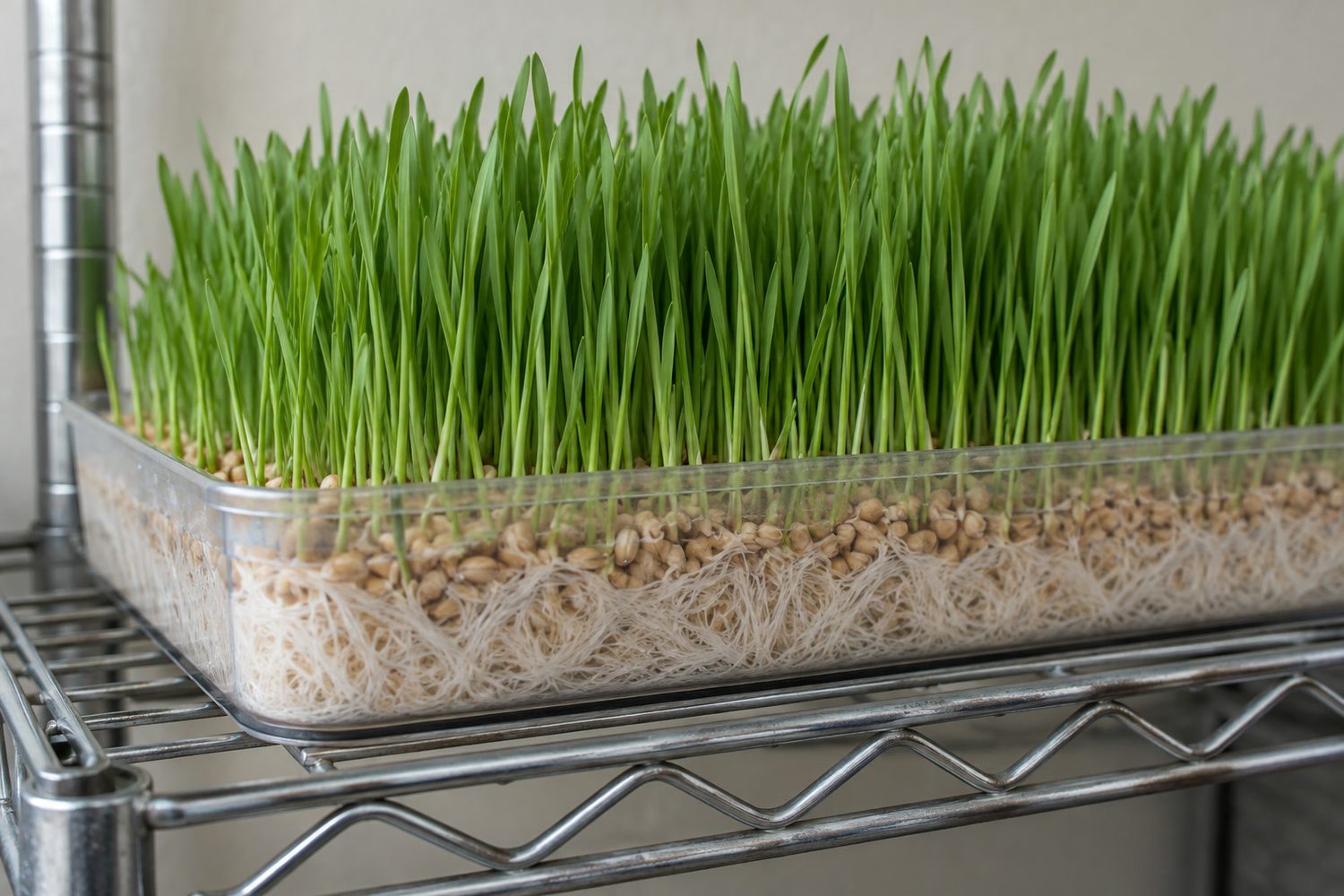
Growers also report using wheat, oats, rye, and black-oil sunflower seed; one Backyard Chickens build used rye and sunflower, and Fresh Eggs Daily grows alfalfa, broccoli, radish, and clover. Those are reports of what people grow, not feeding results.
The routine that follows the research is simple:
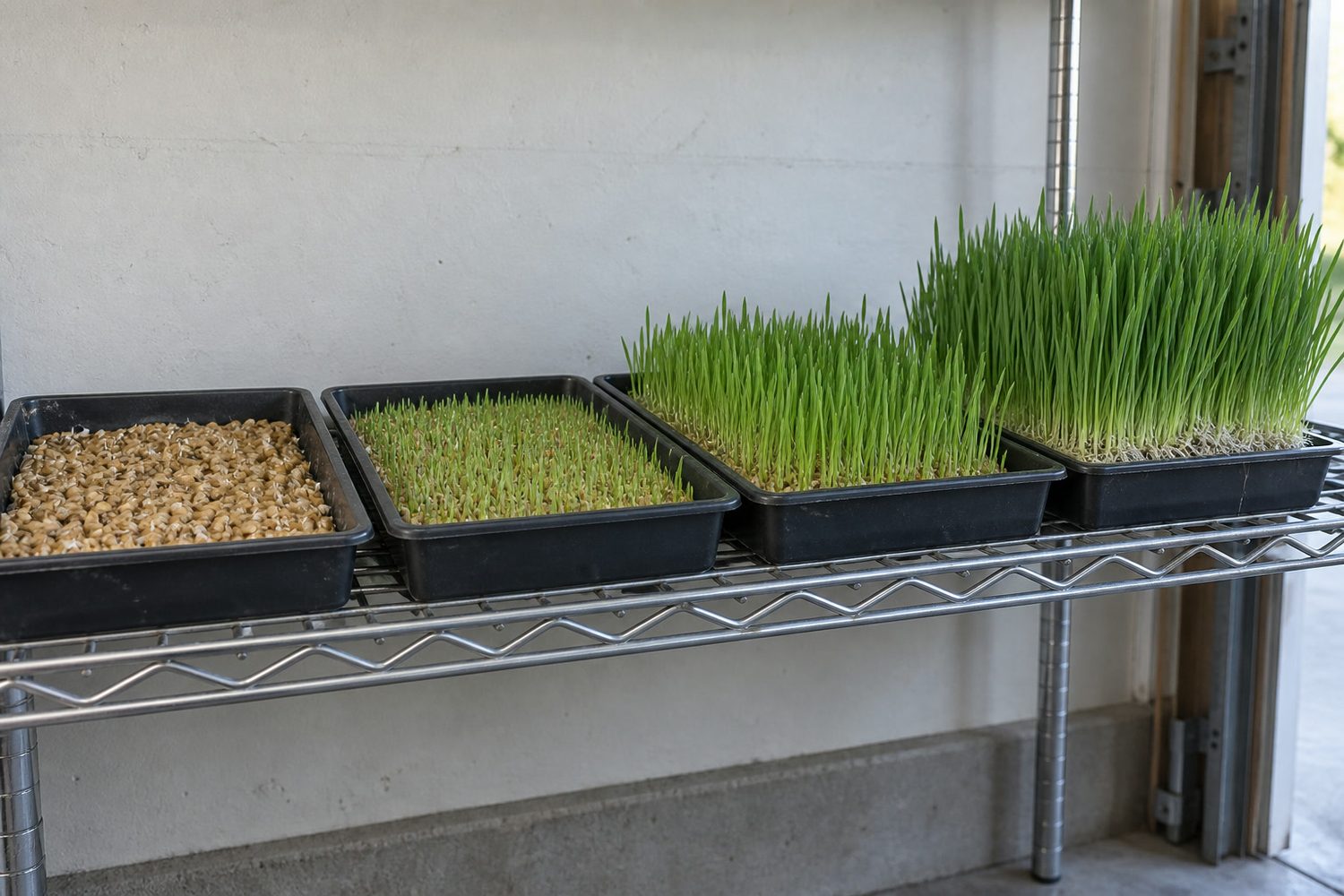
- Rinse the seed and look it over. The layer trial rinsed its 3 kg of barley, then soaked it about 8 hours.
- Drain thoroughly.
- Spread it in clean, food-safe plastic trays that drain, with no growing medium for grain fodder.
- Water or rinse enough to keep the seed moist, never sitting in water.
- Grow about 7 days. The experiments cited in the Australian review ran around 21°C for 5 to 7 days.
- Feed the clean whole mat in a removable pan, and clear away whatever the hens leave so it doesn't rot or draw rodents.
Vegetable microgreens grown in a medium are a different job: cut the shoots above the medium so no loose medium ends up in the run, and follow the per-crop seed rates and harvest timing in growing microgreens for animals.
When a tray molds
Molds can make mycotoxins, so a moldy tray is a safety problem. The FDA lists grain-associated aflatoxins, deoxynivalenol (DON), fumonisins, ochratoxin A, T-2 and HT-2 toxins, and zearalenone among the mycotoxins it monitors.
Veterinary literature on backyard poultry describes mycotoxins as interfering with protein synthesis and destroying rapidly dividing cells, and says there is no treatment beyond finding and removing the source. Aflatoxin signs it describes include reduced appetite and growth, poor pigmentation, lameness or unsteady walking, convulsions, death, and enlarged, pale livers and kidneys. Trichothecenes can cause feed refusal, dead tissue in the mouth and skin, digestive signs, depression, and lower egg production, and a poultry mycotoxin review links ochratoxin A to anemia, reduced egg production, and kidney injury. If your hens show signs like these, a veterinarian is the person to sort out the cause.
A tray with no visible mold isn't proof it's free of mycotoxins. Contamination can start in the grain before it ever sprouts, and only laboratory testing can say which toxins are present and how much.
When a tray is moldy, sour, slimy, or grown from seed whose treatment status you don't know, throw it out rather than rinsing it and serving it. Clean and sanitize the trays and anything the water touches, then start again with clean, untreated seed.
Prevention means starting clean and staying clean: potable water, equipment sanitized between batches, trays that drain with air moving around them, and no warm standing water. The same warm, wet conditions can multiply Salmonella, E. coli, and Listeria; UC ANR notes lightly contaminated seed can reach millions of Salmonella or E. coli O157:H7 cells per serving during sprouting, and Virginia Tech names contaminated seed and poor sanitation as primary risks. No temperature or airflow threshold has been published for poultry fodder trays, so note both whenever a tray goes bad and learn what your setup tolerates.
The fifteen percent figure you will see, and the sourced one
A figure of up to fifteen percent of intake circulates widely for feeding microgreens to chickens, usually alongside the claim that most edible microgreens are safe for them. No source is given for it.
The sourced ceilings in the poultry literature are Cornell's ten percent for all treats and scraps combined, AkoVet's ten percent for all treats, and Oregon State Extension's 10 to 15 percent for scratch grain. None is specific to microgreens, and the ten percent covers all treats combined rather than microgreens alone. So, the figure in circulation is both higher and narrower than the one with evidence behind it, in the direction of feeding more of a food nobody has studied in chickens. Use the ten percent, and count everything else you hand out against it.
What nobody has established
- Which crops, at microgreen stage, are actually safe for chickens, and at what inclusion rate by life stage. Settling it needs a replicated feeding trial with a complete-ration control.
- Whether glucosinolates, oxalates or nitrates occur at meaningful concentrations in these specific crops at this specific stage. Mature-plant values do not answer it.
- Whether feeding raw microgreens can move Salmonella or Listeria into a flock or into eggs, and whether washing changes that.
- Whether a home tray ever lowers feed cost once seed, labor and wastage are counted.
Nothing on this page is a substitute for a veterinarian who can see the bird.
Frequently asked questions
These cover the questions that come up once a tray routine is running.
Which seed should I start with?
Barley, if you want to match the research, since it's the only seed in the chicken trials located. For vegetable microgreens, check each crop in the chicken guide first, because "not established" is not the same as safe.
Can chicks, pullets, or meat birds have a tray?
No published tray dose exists for chicks, pullets, or meat birds, and their feed has jobs a tray can't do. Maine Extension lists broiler starter at 20 to 23% protein for the first four weeks, and UF/IFAS notes birds under 18 weeks need about 1% calcium, against roughly 3.5 to 4.0% in layer feed. Keep young birds on their life-stage ration, as set out by Maine Extension and UF/IFAS.
Are indoor greens worth growing in winter?
They can give hens variety when the run is bare, and Oregon State Extension says late fall and winter pasture has little feed value. No controlled winter trial has shown trays improve welfare, egg output, or feed costs for backyard layers, so judge it by your own records.
Should the hens eat the roots and seed, or just the greens?
For grain fodder, the studies fed the whole mat of seed, roots, and shoot, and one broiler trial chopped it. No poultry study has compared whole mats with cut greens, so don't count the roots as extra nutrition.
Starting your first tray
Keep the layer feed full, grit available, and the tray small. Start at the low end of the trial's range, weigh your seed and harvest, and write both down. Watch shells and laying as you go, and throw out any tray that looks, smells, or feels wrong before starting the next with clean untreated seed.
The four verdicts on this page, and what each one is telling you
Hover or tap a card to highlight it.
Safe
A veterinary, extension or ASPCA source says so for this species. No crop on this page reaches it.
Caution
Safe in a stated quantity, or except in a named circumstance, with the limit given.
Unsafe
Such a source says avoid, and the mechanism is known. For chickens that is the alliums, on Merck and Colorado State.
Not established
Nobody credible has looked. That covers all thirteen crops in the table above, and it is different from both safe and unsafe.
The terms on this page, in plain words
Tap a term to see what it means.
Crop (the organ, not the plant). The pouch at the base of a bird's neck where food is stored before it reaches the gizzard to be ground. It is why form matters as much as species.
Sources
- Cornell Cooperative Extension, feeding backyard poultry - the ten percent treat ceiling, and the effects of exceeding it on egg size, number and onset of lay.
- Colorado State University Extension, raising poultry the organic way - the named avoid list, including onions, and matching feed to age and purpose.
- Merck Veterinary Manual, Allium toxicosis - the oxidative mechanism, and the doses that belong to cats and dogs rather than birds.
- Merck Veterinary Manual, poisonings in poultry - Crotalaria and sicklepod thresholds as a share of feed.
- University of Maryland Extension, common crop issues - impaction and pendulous crop from bulky fibrous material.
- University of Maryland Extension, sickness behavior - the signs that mean stop and call someone.
- University of Nevada Extension, microgreen food safety - seed as a pathogen source, and why washing can make it worse.
- USDA ARS - pathogens recovered from edible shoots grown from contaminated seed.
- EFSA glycoalkaloid risk assessment - the poultry potato trials.
- Laying-hen carotenoid trial - the measured yolk-color shifts.
- Avian Diseases, California backyard flock pathology - Marek's disease as the leading mortality cause in that dataset.
- Microgreens World - the fifteen percent recommendation this page disputes.
- Alabama Cooperative Extension
- AkoVet
- Oregon State Extension
- SARE producer grant
- UF/IFAS
- 2022 barley study
- Feedipedia review of hydroponic fodder
- Meat & Livestock Australia review
- 2025 trial
- 2024 Cobb 500 study
- Naylor Seed's 2026 retail list
- Chewy listed
- Hobby Fodder & Microgreen System
- Fodder Systems USA
- 7 CFR 201.31a
- University of Minnesota Extension
- NPIC
- Backyard Chickens build
- Fresh Eggs Daily
- FDA
- Veterinary literature on backyard poultry
- poultry mycotoxin review
- UC ANR
- Virginia Tech
- Maine Extension
Prices, stock and specifications are as the linked pages showed them on 2026-09-12.
Keep reading
Animals and microgreens
Can Ducks and Quail Eat Microgreens?
Nothing is established. No source addresses any named crop as a microgreen fed to either bird, the 10 percent chicken scrap ceiling carries no duck or quail authority, and ducklings need nearly double the niacin a chick does.
Read Can Ducks and Quail Eat Microgreens?Animals and microgreens
Can Alpacas and Llamas Eat Microgreens?
It would take 50 to 90 trays to supply one alpaca's dry matter for a single day, and up to 250 for a llama. That settles the feed question, and leaves identity and suddenness as the only real risks.
Read Can Alpacas and Llamas Eat Microgreens?Animals and microgreens
Can Bearded Dragons Eat Microgreens?
Probably, as part of the salad. No study has fed a microgreen to a bearded dragon, the one vet-reviewed teaspoon dose has nothing behind it, and calcium to phosphorus is unmeasured for most crops.
Read Can Bearded Dragons Eat Microgreens?Animals and microgreens
Can Cats Eat Microgreens?
Some yes, four unsafe. Parsley is ASPCA-listed toxic to cats and the alliums have a published feline dose, while greens are enrichment for a cat rather than nutrition.
Read Can Cats Eat Microgreens?