Can Alpacas and Llamas Eat Microgreens?
Cal HewittPublished Checked
- alpacas
- llamas
- camelids
- animal feeding
- safety
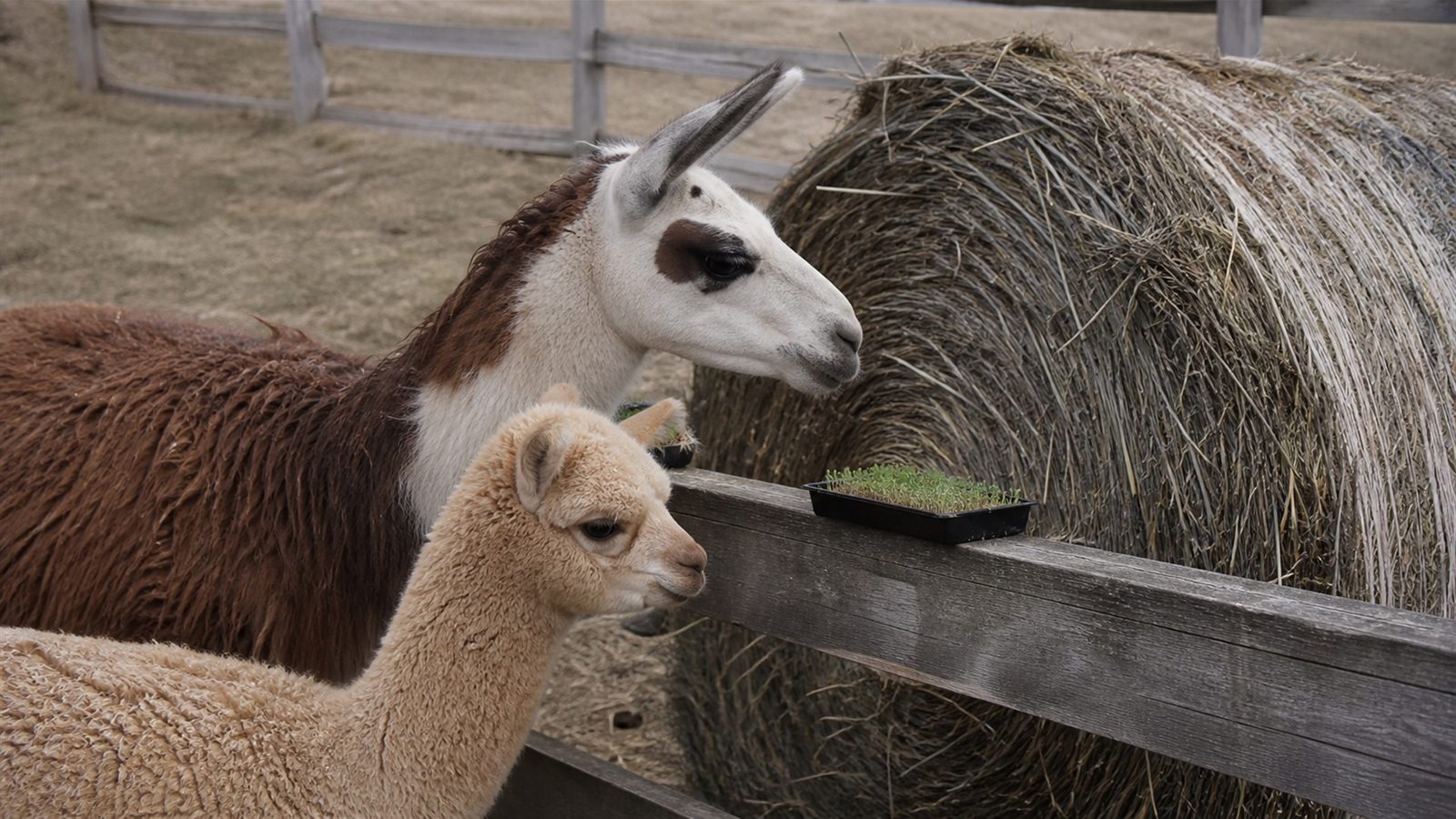
A small amount of a known, non-toxic crop is a reasonable caution rather than a hazard. Allium microgreens are the exception and are unsafe. And no feeding trial of any named microgreen exists for either animal.
Scale settles most of the worry before anything else does.
What to actually do
- Do not grow trays to feed alpacas or llamas. Fifty to two hundred and fifty trays supply a single day. The arithmetic ends the idea.
- Keep forage as the ration, and keep long fiber constant. These animals are built for poorly digestible fiber and do badly on rich substitutes.
- Never feed Allium microgreens. Onion, leek and chives are the one outright unsafe call.
- Feed one identified crop at a time, in a small amount, gradually. Never a mixed pack of unknown contents.
- Keep the seed, root mat and growing medium away from them entirely.
- Do not borrow a sheep or cattle mineral rule. Camelid copper toxicosis is diagnosed more often than deficiency, so stacking supplements is the documented risk.
- Palpate body condition rather than looking at the fleece, and aim for the middle of the 1 to 9 scale.
- Skip it for crias, pregnancy, lactation and any animal that is unwell.
One tray is a rounding error in the ration
Camelids eat 1.8 to 2.0% of their body weight a day as dry matter. Adult alpacas run 55 to 90 kg and llamas 113 to 250 kg, so the daily requirement is roughly 1.0 to 1.8 kg of dry matter for an alpaca and 2.0 to 5.0 kg for a llama.
A 1020 tray yields a median 7.055 ounces, almost exactly 200 grams, and that is mostly water. Taking fresh leafy material at around 90% moisture, the upper bound published for fresh forage, a whole tray is about 20 grams of dry matter.
Hover or tap a row to highlight it.
| Animal | Daily dry matter | One tray as a share of one day | Trays to supply one day |
|---|---|---|---|
| Alpaca, 55 kg | 0.99 kg | 2.0% | 50 trays |
| Alpaca, 90 kg | 1.80 kg | 1.1% | 90 trays |
| Llama, 113 kg | 2.03 kg | 1.0% | 102 trays |
| Llama, 250 kg | 5.00 kg | 0.4% | 250 trays |
Fifty to ninety trays to feed one alpaca for one day. Up to two hundred and fifty for a large llama. Microgreens are not a feed for these animals and cannot become one at any realistic scale.
That changes what is worth worrying about. The risk with a camelid and a tray is not quantity, because the quantity is negligible unless you are producing commercially and dumping many trays at once. The risks are identity, suddenness and displacement, and those are worth taking seriously.
They are not ruminants, and the shorthand causes real errors
"Pseudo-ruminant" is keeper shorthand, not permission to use a sheep ration. Alpacas and llamas have three stomach compartments rather than the ruminant four. The first is a fermentation chamber, but the compartments carry glandular saccules, the opening between the second and third is narrow, retention is longer, mixing is better, and the third compartment has an acid-secreting distal region that can ulcerate.
They also recycle urea efficiently and extract nutrients from poor forage unusually well, which is why they are easy keepers and why rich feed is a bigger problem for them than a thin pasture is.
So, do not carry across a cattle or sheep ration, or their dosage assumptions. Keep long-fiber forage constant and make any new wet or rich item gradual.
Copper is the sharpest example of why the transfer fails. Among goats and sheep copper is the number that divides the two species, and the sheep are the sensitive ones. That rule does not apply to a camelid at all. Camelids need copper, and veterinary guidance reports that chronic excess from formulation errors and stacked supplements has caused copper toxicosis, which is diagnosed more often than deficiency. The correct response is a camelid-specific total ration and veterinary assessment, not borrowing a sheep mineral because sheep are copper-sensitive.
The crop table
No microgreen crop has been trialed in a camelid. Not one.
Hover or tap a row to highlight it.
| Crops | Verdict | Why |
|---|---|---|
| Onion, leek, chives | UNSAFE | Allium sulfur compounds cause oxidative red-cell damage, Heinz bodies and hemolysis. The toxicology is cross-species and strong. Do not test it |
| Brassicas: broccoli, kale, cabbage, radish, mustard, arugula and relatives | CAUTION | Goitrogenic and other ruminant brassica concerns are biologically plausible here but not a camelid verdict. No camelid study exists |
| Higher-oxalate: beet, Swiss chard, spinach, amaranth, sorrel, buckwheat | CAUTION | Rumex species can carry high soluble oxalates, which extension guidance links to oxalate stones in camelids under the right conditions. No microgreen dose is published |
| Legumes and everything else | CAUTION | No identified intrinsic hazard at a small known amount, and no published camelid microgreen ration either |
| Seed, root mat and growing medium | Do not feed | Concentrated starch and an unknown load. A large grain exposure is a same-day emergency |
The Allium verdict rests on mechanism rather than on a camelid dose. The toxicology source documents cases in production animals rather than in camelids specifically, so it is strong cross-species mechanism. That is a reason not to run the experiment rather than a reason to discount it. The hazard is in the plant material generally, not only in the bulb.
The real risk is that it displaces hay
Over-conditioning is a documented management problem in these animals. Veterinary guidance scores body condition from 1 for emaciated to 9 for obese, with 5 as the ideal, and notes that legumes are usually unnecessary and can cause obesity.
Thick fleece hides all of it. You have to palpate rather than judge by eye, which is exactly how an easy keeper quietly becomes an overweight one.
Fresh greens are low in long fiber and palatable. At the scale discussed here they add almost no energy, but the habit they can build, of the animal waiting at the gate for the treat instead of eating forage, is the thing to avoid. Never use greens to give a healthy animal variety.
Introducing it, and when to call a veterinarian
No camelid source gives a numbered adaptation schedule for a new feed. What the evidence supports is simply "gradual": one veterinary teaching guide says diet changes should be gradual to minimize colic, a government education service says introduce new foods slowly and carefully, and a breed association describes short supervised exposure to rich new pasture with withdrawal if lethargy or loss of appetite appears.
So: one identified crop, a small amount, hay always available, and stop at the first sign of anything.
Call a veterinarian urgently for colic behavior such as pawing, repeatedly getting up and down, stretching or lying flat; refusing to join the herd to eat; severe diarrhea; feed material coming from the nose; or abnormal recumbency. Add decreased appetite, tooth grinding, depression and weight loss, and note that diarrhea in an adult is relatively uncommon and can signal serious disease.
A large grain exposure is a same-day camelid-veterinarian emergency even before any sign appears. That is the reason the seed tray and the growing medium stay out of reach.
Crias and growing animals are the worst subjects for a casual experiment. Vitamin D deficiency and rickets are documented as especially severe in heavily fleeced, fast-growing fall-born crias, and late-gestation and early-lactation animals have real energy and protein demands that a novelty cannot serve. Leave the diet of young, pregnant, lactating and unwell animals to the herd veterinarian.
What nobody has measured
- Any microgreen fed to an alpaca or a llama. No trial, no clinical case series, no crop.
- A safe percentage of daily intake for fresh greens in either species, on any basis. The published intake figure is total ration dry matter, not a supplement allowance.
- Whether brassica concerns transfer from ruminants to camelids, which would take a study measuring intake, thyroid indices and blood work against a grass-hay control.
- Microgreen oxalate at a camelid dose, and its relationship to urinary stones.
- A numbered adaptation schedule. The sources say gradual without saying how gradual, so start with one crop in a small amount and watch the animal.
- The dry matter of a microgreen itself, which is why the 90% moisture figure above is a stated assumption from fresh forage rather than a measured crop value.
Terms on this page
Tap a term to see what it means.
Camelid. The family that includes alpacas and llamas, along with camels, guanacos and vicunas. Not ruminants, despite fermenting forage.
Sources
Opened 2026-08-12. None of these sources fed a microgreen to a camelid; the arithmetic in the first table is computed from published intake figures, published body weights, a median tray yield of 7.055 ounces, and a stated 90% moisture assumption.
- Merck Veterinary Manual on the management of llamas and alpacas - the 1.8 to 2.0% of body weight daily dry-matter intake used throughout, the 1 to 9 body condition scale with 5 as ideal, the note that legumes are usually unnecessary and may cause obesity, the cria vitamin D figures, and the copper guidance.
- Merck on the diseases of llamas and alpacas - the gastrointestinal signs and their association with diet change, that adult diarrhea is relatively uncommon and can signal serious disease, and that chronic copper excess has caused toxicosis and is diagnosed more often than deficiency.
- GOV.UK guidance on South American camelids - the species names, the adult weights of 55 to 90 kg for alpacas and 113 to 250 kg for llamas used in the table, the three-compartment anatomy including the acid-secreting distal region of C3, efficient urea recycling, and that alpacas are grazers while llamas graze and browse.
- UC Davis veterinary large animal care and feeding guide (PDF) - the forage base, the grain caution, that diet changes should be gradual to minimize colic, and the list of signs that should trigger a veterinary call.
- Merck on garlic and onion toxicosis in animals - the Allium mechanism of oxidative red-cell damage, Heinz bodies, methemoglobinemia and hemolysis, and that the risk is in the plant material rather than only the bulb. It documents production-animal cases and does not name camelids, so it is used here as cross-species mechanism.
- NSW Department of Education on alpaca food and water - the high-fiber, low-protein diet and the instruction to introduce new foods slowly and carefully.
- Australian Alpaca Association care guidance - body condition, roughage, vitamin and selenium guidance, and the toxic ornamental plants keepers are warned about.
- Alpaca Association New Zealand on feed requirements - roughage and gradual change, including the supervised short exposure to rich new pasture. This is association guidance rather than a controlled trial.
- Alpaca Research Foundation summary of alpaca nutrition - a practitioner review whose nutrient requirements are explicitly labeled as estimated and partly extrapolated from small ruminants, which is itself the reason this page does not treat camelid mineral targets as settled.
- Penn State Extension on urinary blockage in llamas and alpacas - the soluble oxalate concern in Rumex species and oxalate uroliths. The page returned a 403 after opening, so it supports the caution and no numeric claim.
- A 1984 report of dry-season forage selection by alpacas in southern Peru - the field study of 280 adult and 200 young alpacas showing them to be primarily grazers, which is the basis for treating lush low-fiber material as a novelty rather than a substitute.
- Practice sources, recorded as such and not relied on for any verdict: a hydroponic fodder marketing post aimed at alpaca keepers, a farm listing microgreens with no animal feeding claim attached, two keeper threads on treat selectivity and feed mixes in r/alpaca and r/alpaca, a web ranking page used only to check the incorrect ruminant framing it repeats, and a ruminant hydroponic fodder review included to show that the fodder evidence base is ruminant and not camelid.
Keep reading
Animals and microgreens
Can Bearded Dragons Eat Microgreens?
Probably, as part of the salad. No study has fed a microgreen to a bearded dragon, the one vet-reviewed teaspoon dose has nothing behind it, and calcium to phosphorus is unmeasured for most crops.
Read Can Bearded Dragons Eat Microgreens?Animals and microgreens
Can Cats Eat Microgreens?
Some yes, four unsafe. Parsley is ASPCA-listed toxic to cats and the alliums have a published feline dose, while greens are enrichment for a cat rather than nutrition.
Read Can Cats Eat Microgreens?Animals and microgreens
Can Chickens Eat Microgreens?
Yes, as a treat inside the 10 percent ceiling Cornell sets for all scraps combined. Not one microgreen crop has a chicken-specific safety study behind it, and the 15 percent figure in circulation is unsourced.
Read Can Chickens Eat Microgreens?Animals and microgreens
Can Chinchillas and Rats Eat Microgreens?
One median tray is 83 to 145 days of everything a pet rat is allowed outside its pellet. A chinchilla's entire daily fresh allowance is about a teaspoon, and its own veterinary sources disagree about whether to give it at all.
Read Can Chinchillas and Rats Eat Microgreens?