Can Goats and Sheep Eat Microgreens?
Cal HewittPublished Checked
- goats
- sheep
- ruminants
- animal feeding
- safety
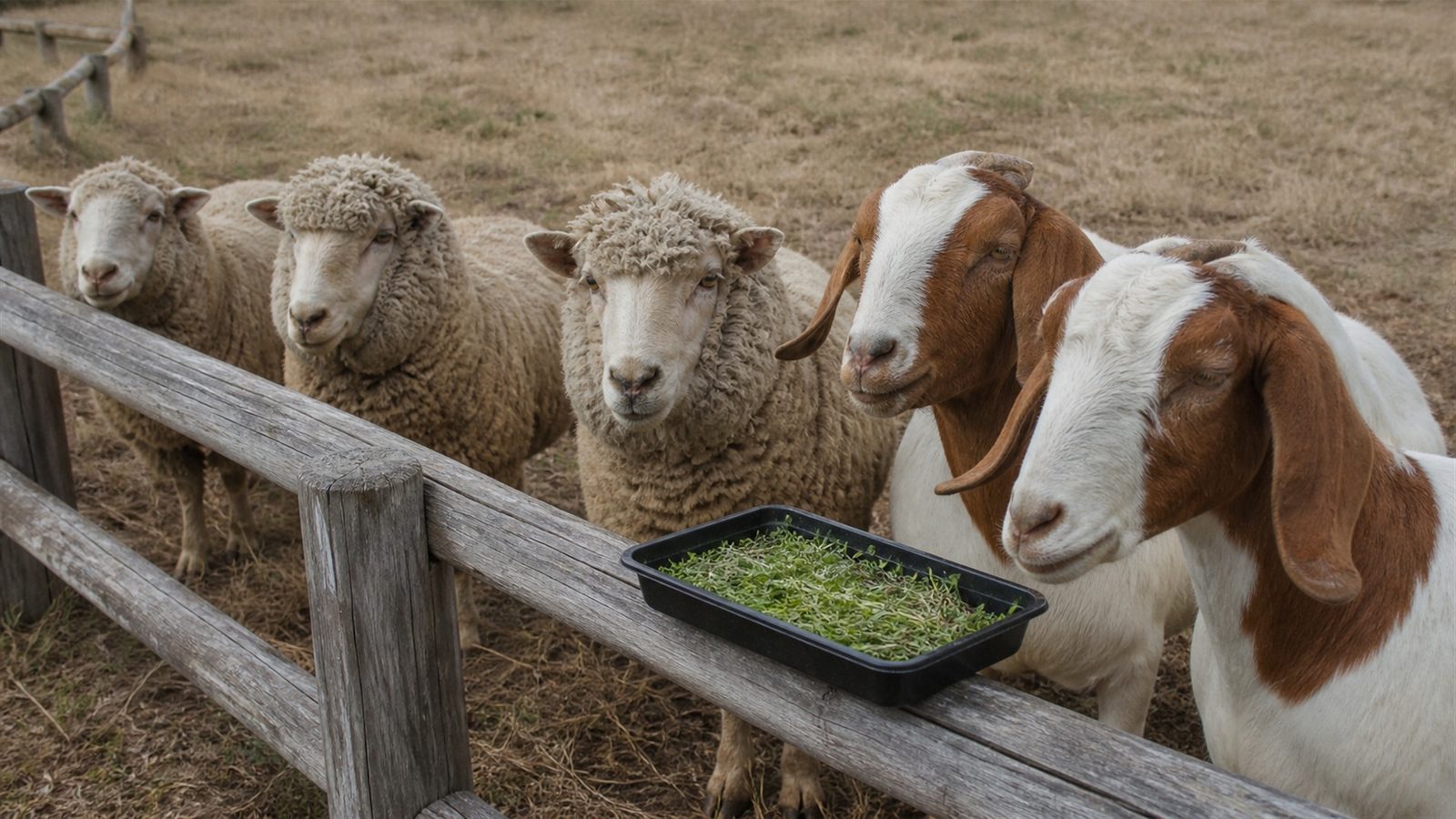
Probably, in small amounts, with a slow introduction, and nobody has established it. No published study feeds microgreens to either animal at a measured dose.
And the warning that matters more than the microgreens is this: goats and sheep are constantly treated as one animal, and on one number that is dangerous.
What to actually do
- Keep forage or browse as the diet. Goats and sheep need a primarily forage-based ration because it is the substrate their rumen microbes work on. Microgreens are a novelty, not a feed.
- Never feed Allium microgreens. Onion, leek and chives are the only outright unsafe call on this page.
- Never let goats and sheep share a mineral program, and never carry a copper decision from one to the other.
- Remove the seed and the growing medium from reach. Cereal seed is concentrated starch and abrupt intake is the established grain-overload emergency.
- Introduce over seven to ten days with hay always available, and stop at the first refusal or loose manure.
- Skip the trial entirely for pre-ruminants, late pregnancy, lactation and any unwell animal.
- Test the ration rather than the crop name if copper, nitrate or iodine status is a live question in your herd or flock.
The number that separates them
Goats require 15 to 25 milligrams of copper per kilogram of dietary dry matter. Sheep require 5 to 8. And lambs have been poisoned by dietary copper at 10 to 20 parts per million, which is the same unit.
Read those two ranges against each other. The bottom of what a goat needs, 15, sits inside the band that poisons a lamb. There is no single figure that feeds one correctly and leaves the other safe.
Hover or tap a row to highlight it.
| Animal | Published figure | What it means |
|---|---|---|
| Goat requirement | 15 to 25 mg/kg dry matter | Below this, goats can become deficient |
| Sheep requirement | 5 to 8 mg/kg dry matter | Roughly a third of the goat figure |
| Lamb toxicity | 10 to 20 ppm dietary copper | Especially where the copper to molybdenum ratio exceeds 10 to 1 |
| Sheep mineral ceiling | no more than 30 ppm | The published upper limit for a sheep mineral mix |
Sheep are the sensitive one and goats are the resistant one, so the mistake runs in a predictable direction: a goat mineral program offered to sheep is the hazard, and sheep minerals given to goats risk deficiency instead. Never let the two share a mineral supplement, and never reason from one species' feeding page to the other.
Microgreens do not obviously change this, and that is the honest position rather than a reassuring one: nobody has published whether any microgreen, grown in any particular tray, materially moves a whole ration's copper. Forage copper depends heavily on geography and on mineral interactions. Test the ration, the forage and the water. Do not infer copper safety from a crop name.
Crop by crop, for both animals
Nothing here is rated safe, because no source establishes safety for either animal at any dose.
Hover or tap a row to highlight it.
| Crops | Verdict | Why |
|---|---|---|
| Onion, leek, chives | UNSAFE | Allium crops carry organosulfur compounds capable of oxidative red-cell injury. Do not trial these at all |
| Brassicas: broccoli, kale, cabbage, radish, mustard, arugula, kohlrabi, cauliflower, collard, pak choi, tatsoi, mizuna, komatsuna, broccoli raab, turnip, watercress, garden cress | CAUTION | Extrapolated from grazed forage brassicas: glucosinolates, nitrate and low fiber |
| Legumes: pea shoots, alfalfa, clover, mung bean shoots, lentil, chickpea shoots, fenugreek | CAUTION | Legume and lush low-fiber feeds carry a documented bloat concern |
| Higher-oxalate: amaranth, beet, Swiss chard, spinach, sorrel | CAUTION | Oxalate and nitrate, plus genus-level lookalike concerns |
| Grasses and seed crops: sunflower, buckwheat, quinoa, flax, chia, sesame, wheatgrass, barley grass, popcorn shoots | NOT ESTABLISHED | No credible microgreen-stage evidence for either animal |
| Herbs and others: basil, cilantro, dill, fennel, parsley, chervil, celery, carrot, borage, nasturtium, purslane, endive, lettuce, shiso, mint | NOT ESTABLISHED | No published safety study at all |
Two identification warnings, because the names mislead. The curly dock that a university livestock sheet lists as hazardous to sheep and goats is Rumex crispus; garden sorrel is a different species, so the listing does not prove the culinary crop toxic. Likewise the hazardous redroot pigweed is Amaranthus retroflexus, not the amaranth grown as a microgreen. Those are reasons for caution and for positive identification, not direct unsafe calls.
Why a tray is not a grazed brassica field
Forage brassicas are field crops deliberately grazed as winter feed: forage rape, kale, turnip, swede and hybrids. That literature is where almost all of the caution above comes from, and it does not transfer cleanly.
The published hazards are real: goitrogenic effects that can aggravate iodine deficiency and produce goiter, poor growth and weak kids in goats; hemolytic anemia associated with kale; nitrate poisoning; bloat and low-fiber digestive upset; and other metabolic disorders. One extension service puts the threshold in terms of diet share, saying low fiber can cause disorders when brassicas exceed 75% of the diet, and that a pure brassica diet can cause anemia and goiter.
But that describes an animal eating a field for weeks. A tray of cut seedlings differs in cultivar, growth stage, light, fertilizer, dry matter, whether seed and root are included, and realistic intake. So, the transfer runs one way only. Forage-brassica hazards justify caution with related microgreens. They do not establish a dose, a hazard rate, or an equivalent threshold for them.
How to introduce it, if you are going to
The only sourced protocol is for putting stock onto a new lush forage crop, and two independent agricultural authorities give the same shape.
- Use only positively identified, clean, mold-free cut greens. Never Allium crops, and never the seed, root mat or growing medium.
- Fill the animals with hay first. Never offer a new feed to hungry animals.
- Day one, offer no more than a one to two hour exposure.
- Build up over seven to ten days, keeping normal hay, forage and water available throughout.
- Stop rather than push through any refusal, scouring, bloat or dullness.
- Do not use this protocol for grain or seed. A concentrate transition can need several weeks, and using a forage schedule for grain is how the classic overload happens.
Say plainly what that protocol is: an extrapolation. It is validated for lush pasture and grazed brassicas, not for a tray of microgreens, and no one has tested whether it is the right schedule here.
Do not start pre-ruminant kids or lambs, ill animals, or late-pregnant animals without veterinary direction. Milk-fed young do not yet have the fermenting system all of this assumes. Late gestation and lactation are the stages where goats and ewes are most exposed to energy and mineral disease, and a novelty feed has the least room there. Healthy maintenance adults are the only group for which a small gradual trial is a reasonable extrapolation.
When to stop and call a veterinarian
Immediately, for any of these: bloat or sudden left-flank distension, labored or open-mouth breathing, collapse or recumbency, marked depression, inability to eat, severe scouring, abdominal pain, tremors, staggering, convulsions, blindness or circling, or red or brown urine. Nitrate poisoning can cause scouring, salivation, abdominal pain, abortion, staggers and convulsions, and can kill within a day.
A single quiet animal that stops eating after a feed change also merits same-day advice. Do not try to diagnose plant toxicity from an online crop list.
Sprouted fodder is a different product, and its numbers are not encouraging
People do grow feed for small ruminants, and it is worth being precise: hydroponic barley fodder is a six or seven day whole sprouted seed and root mat. A microgreen is the cut shoot with seed, root and mat excluded. The seed is the difference, and the seed is starch.
The fodder trials that exist do not support the cost pitch.
Hover or tap a row to highlight it.
| Trial | Result |
|---|---|
| 100-day sheep trial, replacement ewes and rams | Sprouted-barley animals gained 0.54 lb a day against 0.64 for controls, no significant advantage |
| The same trial's ration cost | $0.54 a head a day for controls against $0.96 for the fodder ration |
| USDA work on 7-day sprouted barley | 17% dry-matter loss and 21% total-energy loss going from grain to sprouted mat |
| 2022 goat and ewe milk study | Milk yield unaffected; goat diet cost $0.82 against $1.06 a day, sheep $0.72 against $0.91 |
Put the first two rows together. The fodder ration cost 78% more and produced about 16% less daily gain. The USDA figures explain the mechanism: sprouting grain loses dry matter and energy rather than creating them. Water is not feed.
None of that is a verdict on microgreens, which are a different material again and have no trial at all. It is the answer to the specific pitch that growing trays will cut a livestock feed bill.
What nobody has measured
- Any microgreen fed to a goat or a sheep at a stated dose, with dry matter, diet fraction, adaptation schedule and clinical outcome recorded. Not one crop, for either species.
- A safe percentage of daily intake for fresh greens or any novel feed, for either animal. Published requirements are ration dry matter, not a fresh-greens allowance.
- Whether any microgreen changes whole-ration copper, which is the number that actually separates these two species.
- Microgreen-stage nitrate, glucosinolate or oxalate at a ruminant dose. Nitrate has been measured in microgreens, but those are plant analyses and not feeding studies.
- Any effect on milk yield, milk flavor, wool or meat. The nearest evidence is a barley-sprout trial, on a different material.
- Whether the seven to ten day protocol is even the right schedule for a tray, since it was written for pasture.
Terms on this page
Tap a term to see what it means.
Rumen. The fermenting first compartment of a ruminant stomach, where microbes break down fibrous forage before the animal digests the rest.
Sources
Opened 2026-08-12. Veterinary and extension guidance below concerns grazed forage crops and formulated rations; none of it is a microgreen feeding study, and this page does not present it as one.
- Merck Veterinary Manual on goat nutrient requirements - the 15 to 25 mg/kg dry matter goat copper requirement against 5 to 8 for sheep, the note that goats given sheep minerals may become copper deficient, the brassica and iodine context including goiter and weak kids, and the goat grain-overload rumen pH figures.
- Merck on sheep nutrient requirements - lamb copper toxicity at 10 to 20 ppm dietary copper and the role of a copper to molybdenum ratio above 10 to 1.
- Merck on the nutrition of sheep - the sheep copper warning, the 30 ppm ceiling for sheep mineral mixes, acidosis signs, and that nutritional plane affects wool output and fiber strength.
- MSD Veterinary Manual on the nutrition of goats - that goats need a diet primarily of forage or browse, and the crude protein and TDN demands of late gestation, lactation and growth against maintenance.
- MSD on subacute ruminal acidosis - the mechanism, the role of microbial adaptation, and why a concentrate transition needs far longer than a forage one. Also MSD on goat nutritional diseases.
- NSW Government on transitioning stock onto lush pastures - the one to two hour first exposure building to full access over seven to ten days, keeping roughage available, and the nitrate poisoning signs including sudden death. Corroborated independently by AHDB on management of grazed brassicas, which gives the same one to two hour start and seven to ten day build-up.
- Mississippi State Extension on forage brassicas for winter grazing - the 75% of diet guidance and the brassica disorders including anemia and goiter. The page returned an internal error when opened, so it is used only to identify that published guidance and no additional unquoted claim is drawn from it.
- UC Agriculture and Natural Resources on plants hazardous to 4-H animals (PDF) - the curly dock and redroot pigweed listings for cattle, sheep and goats, used here as the genus and lookalike caution rather than as a verdict on the culinary crops.
- ASPCA on chives - the Allium toxic principle. This is a non-ruminant reference and is used only as mechanism context for the unsafe call.
- USDA guide to the organic pasture rule (PDF) - daily dry-matter demand of 2.25% of body weight for weaned goats and 3.3% for weaned sheep, 4.0% and 3.65% for lactating and brood animals, and that fresh forage can be up to 90% moisture.
- NACAA journal report on hydroponic barley fodder - the two 100-day trials in 31 replacement ewes and rams, gains of 0.54 lb a day against 0.64 for controls, and ration costs of $0.96 a head a day against $0.54.
- USDA ARS on sprouted barley - the 17% dry-matter yield loss and 21% total-energy loss from grain to sprouted mat.
- Robinson and Baum 2022 on barley sprouts in goats and sheep (PDF) - milk yield unaffected, goat milk averaging 2,681 g a day and ewe milk 1,021 g a day across treatments, increased sheep milk solids, and total diet costs of $0.82 against $1.06 a day for goats and $0.72 against $0.91 for sheep. The linked SARE final report supplies the unit and feed-cost detail.
- Community discussion, recorded as practice and not as evidence: r/Permaculture on microgreens for sheep, and two r/microgreens threads on leftovers for pigs, goats and chickens and what to do after harvesting, the latter reporting goats that refused coir and root leftovers outright.
Keep reading
Animals and microgreens
Can Alpacas and Llamas Eat Microgreens?
It would take 50 to 90 trays to supply one alpaca's dry matter for a single day, and up to 250 for a llama. That settles the feed question, and leaves identity and suddenness as the only real risks.
Read Can Alpacas and Llamas Eat Microgreens?Animals and microgreens
Can Bearded Dragons Eat Microgreens?
Probably, as part of the salad. No study has fed a microgreen to a bearded dragon, the one vet-reviewed teaspoon dose has nothing behind it, and calcium to phosphorus is unmeasured for most crops.
Read Can Bearded Dragons Eat Microgreens?Animals and microgreens
Can Cats Eat Microgreens?
Some yes, four unsafe. Parsley is ASPCA-listed toxic to cats and the alliums have a published feline dose, while greens are enrichment for a cat rather than nutrition.
Read Can Cats Eat Microgreens?Animals and microgreens
Can Chickens Eat Microgreens?
Yes, as a treat inside the 10 percent ceiling Cornell sets for all scraps combined. Not one microgreen crop has a chicken-specific safety study behind it, and the 15 percent figure in circulation is unsourced.
Read Can Chickens Eat Microgreens?