Growing microgreens for animals: no species has a published dose, and one tray costs ten pounds of layer pellets
Cal HewittPublished Checked
- method
- yield
- cost
- food safety
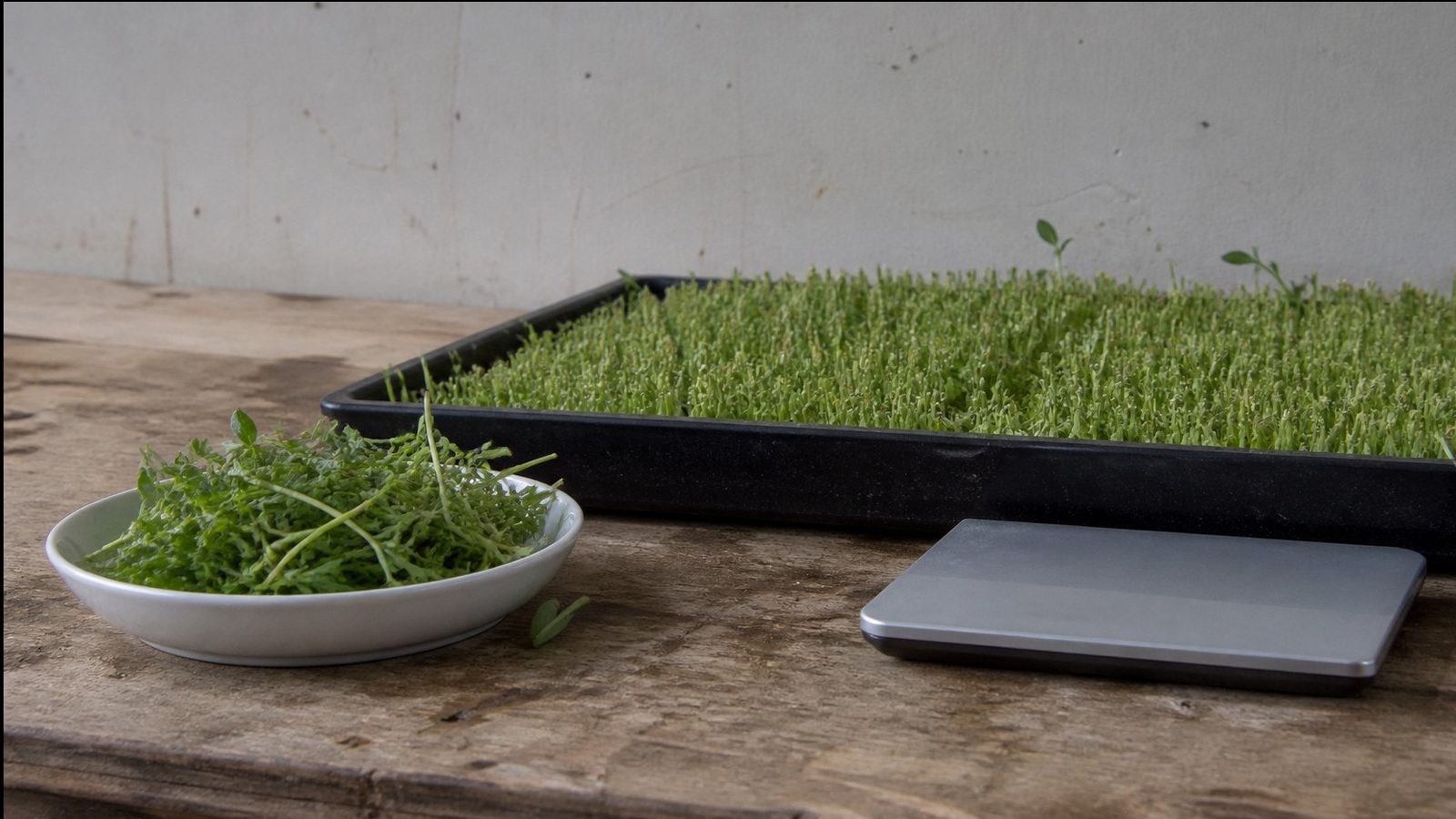
This page is about growing and costing a tray for an animal. Whether a given crop is safe for a given species is a separate question, answered species by species in the animal feeding guides. Read those first, because nothing here overrides them.
The growing question has a blunt answer. No veterinary or extension source sets a microgreen dose for any companion species. Not for rabbits, guinea pigs, hamsters, dogs, cats, chickens, parrots, bearded dragons, tortoises or horses.
What exists is guidance about greens and diet share, in four incompatible units.
Hover or tap a row to highlight it.
| Animal | Published guidance | The unit |
|---|---|---|
| Rabbit | 1 cup of fresh vegetables per 2 lb body weight per day, or a smaller universal 1/4 to 1/2 cup a day | Volume, scaled by weight |
| Guinea pig | 75 percent grass hay, 20 percent leafy greens, 5 percent pellets | Diet proportion |
| Parrots and small birds | 10 to 15 percent vegetables | Diet proportion |
| Bearded dragon | About 50 percent plant material, of which 80 to 90 percent leafy greens and flowers | Diet proportion |
| Horse | 1.5 to 2.5 percent of body weight per day in forage | Ration weight |
| Dogs and cats | Treats under 10 percent of daily calories | Calories |
| Chickens | Leafy greens as a treat, only what birds finish in 20 minutes | Time |
Volume, proportion, ration weight, calories and minutes. None of those is a gram of microgreens, and you cannot convert between them without weighing the animal's whole diet first.
Only the rabbit figure converts into something a grower can plan against, and even that leans on a kitchen estimate rather than a veterinary one: a 4 lb rabbit at 1 cup per 2 lb is 2 cups a day, which is about 60 g only if a loose cup of leafy greens weighs 30 g. That conversion is not published by any veterinary source. Weigh your own greens rather than trusting it.
What to actually do
- Check the species page first. The animal guides carry the safe and unsafe verdicts; this page does not repeat them.
- Ask your veterinarian for a portion in grams, for your animal, and treat every figure here as planning context around that number.
- Weigh a loose cup of your own greens before trusting the 30 g conversion. It is a kitchen estimate, not veterinary guidance.
- Weigh three harvests before committing shelf space. A tray's usable servings are net harvested grams divided by the approved daily grams, and both halves need measuring.
- Treat it as enrichment or a small supplement, which is what the evidence supports, rather than as a ration component.
- Do not plan to replace feed. The one project that tested it on laying hens found no cost saving and lower egg production.
- If cost matters, attack the medium. It is $3.00 of a $3.44 tray.
- Introduce slowly and watch the animal, which is the one piece of consistent veterinary advice across species: small quantities, and stop at soft feces, diarrhea or signs of gas pain.
- Keep the sanitation standard human-grade, and cut into a clean dish rather than handing over the tray, especially around reptiles.
What a tray actually weighs, and why you can plan on about 7 oz
Before any feeding arithmetic, you need a tray weight you can trust.
An on-farm study measured a 10 by 20 tray at 7.31 oz, or 207 g, averaged across microgreens, and 17.28 oz, or 490 g, for pea shoots.
That sits within about four percent of the 7.055 oz median you get from the published per-crop yields, which is reassuring because the two numbers were arrived at completely differently: one is a mean of real harvests in one operation, the other a median of figures published crop by crop.
Hover or tap a row to highlight it.
| Source | Figure |
|---|---|
| On-farm measured average, all microgreens | 7.31 oz |
| Median of published per-crop yields | 7.055 oz |
| Difference | 3.6 percent |
So, about 7 ounces is a defensible planning figure for a mixed bench. Two unrelated methods landing that close is about as much confidence as this subject offers.
One crop breaks the pattern badly. The same farm put pea shoots at 490 g, where the published figures work out near 227 g, so the farm's pea is more than double. Pea shoots carry the widest published spread of any crop in this subject. Do not plan a pea tray on anybody's average, including this one: weigh your own.
Within that one farm, pea shoots yielded 2.37 times the general average, which is the practical point for anyone feeding an animal by weight: crop choice changes the tray count more than anything else you control.
What a rabbit would actually take
Running the only convertible figure through the only measured tray weight:
- 60 g a day is 420 g a week.
- At 207 g a tray, that is 2.03 trays a week.
- At 490 g of pea shoots, 0.86 trays a week.
Then convert to space. A 10 by 20 occupies 1.39 sq ft. Two trays a week on a 10-day cycle means about 2.9 trays in production at any moment, which is roughly 4.0 sq ft of tray footprint before aisles, before blackout space, before the wash area the succession page says to plan for.
That is one rabbit, on an unproven one-for-one substitution. The rabbit guidance is for fresh vegetables generally, and nothing establishes that microgreens can stand in for all of them.
For every other species the tray count cannot be computed at all, because the serving weight does not exist. Do not fill that gap with a photograph of one tray and a hopeful caption.
The feed-replacement pitch was tested, and it failed
The most common commercial claim in this area is that a fresh tray offsets bought feed. One project actually tested it.
The same on-farm study set out to reduce feed costs for laying hens using hydroponic fodder. It did not work. Reducing bagged feed was not an effective cost reduction, and egg production dropped.
That is a direct, measured result against the pitch, from the same source as the tray weights above.
The costing explains why. Using dated retail inputs, one tray came to about $3.44: seed at $0.15, a coir mat at $3.00, and 16 hours a day of a 10 W lamp for 10 days at $0.29. That excludes water, tray depreciation, sanitation, heating, failures and every minute of labor.
Hover or tap a row to highlight it.
| Item | Price | What one tray costs instead |
|---|---|---|
| Orchard grass hay | $0.54/lb | 6.4 lb of hay |
| Layer pellets | $0.34/lb | 10.1 lb of pellets |
| Tray fresh weight at 207 g | $16.62 per kg fresh | |
| Tray fresh weight at 490 g pea | $7.02 per kg fresh |
One tray costs about ten pounds of layer pellets. No amount of nutrient density closes that gap when the thing being replaced is a commodity feed, and the hen trial says the substitution damaged production anyway.
The medium is most of the cost. At $3.00 of a $3.44 tray, a reusable medium changes this arithmetic more than anything else, which is why the medium page and the reuse question matter here.
For horses the answer is no, and the arithmetic is not close. A forage rule of 1.5 to 2.5 percent of body weight per day means tens of pounds daily for a 1,000 lb animal. A tray is not a forage operation, and replacing forage needs an equine nutritionist and a dry-matter-balanced ration, not a shelf.
There is real evidence for hydroponic fodder in livestock systems, and it is narrower than the pitch. A 2026 systematic review of 95 heterogeneous studies found possible positive or neutral production responses at moderate inclusion, and warned that high water content reduces dry matter and excessive inclusion can reduce performance. That supports a carefully formulated supplement in some production contexts. It is not a health claim for a pet.
Do not lower the standard because the eater is an animal
No source supports a reduced sanitation standard for an animal tray.
The Produce Safety Rule is written for human consumption and is not an animal feed rule. The contamination routes it identifies do not care who eats the crop: water, worker hygiene, manure and compost, animals, equipment and buildings.
Bacteria from soil or water contaminate fresh produce, and washing reduces rather than eliminates them. For reptile keepers there is an added household consideration: **CDC warns that reptile food, tank water, equipment and habitats can carry Salmonella**, which raises the stakes for anything moving between a grow tray and an enclosure.
Use the same baseline you would for a human tray. See cleaning and sanitation. Being an animal is not a reason to feed visible mold, contaminated medium or spoiled greens.
On the live grazing tray: it is a practice term, not a ration. Cat grass presented for chewing at 7 to 14 days is the familiar version, and it is genuine enrichment rather than established nutrition. For reptiles particularly, cut into a clean dish rather than putting a tray into the enclosure.
And nothing endorses feeding the whole tray, roots and medium. Human microgreens are cut above the substrate line by definition. Whole-mat fodder is a different product and has to be rationed as one.
What the feeding advice is actually based on
Six consumer and grower pages were audited on 2026-08-12.
- One of six publishes a quantity, and it is a calculator default rather than an animal serving.
- Two of six publish a tray count or yield.
- One of six publishes a cost, and it is seed cost per ounce rather than a ration.
- None publishes all three, which is what an owner would need to decide anything.
- Three of six have a direct commercial incentive: two sell seed or equipment, one carries affiliate links to seed and tray sellers.
They get real things right. Yields differ sharply by crop, a standard tray makes comparison possible, a small footprint genuinely does produce dense greens, and a living tray is engaging for an animal. What none of them can do is answer a veterinary dose or an economic replacement question, because neither has been established.
What nobody has measured
- A microgreen dose for any companion species. This is the gap everything else on the page runs into.
- A transition period for introducing microgreens, by species or crop.
- Tray counts per week for any animal but a rabbit, and that one rests on an unproven substitution.
- Any health or condition benefit in a controlled veterinary trial. The benefit claims are owner practice.
- Pathogen transfer rates from microgreens to any animal, or onward to the household.
- A safe live-tray protocol, comparing cut-and-bowl against tray access with medium ingestion monitored.
- Whether the whole tray including roots and medium is safe to feed, for any species.
- A companion-animal cost comparison in any peer-reviewed source.
Terms on this page
Tap a term to see what it means.
Hydroponic fodder. Sprouted cereal or legume mats grown for livestock, harvested whole including roots. A different product from a cut microgreen, with its own separate evidence.
Sources
Opened 2026-08-12. The 7.055 oz median is taken from the published per-crop yield figures across 62 crops, for comparison with the on-farm 7.31 oz mean. The rabbit tray arithmetic, the space calculation and the feed-equivalent costs are computed from the published figures and shown in full above so they can be checked. Species safety verdicts are covered in the animal guides linked above rather than restated here. All retail prices are single dated observations.
- SARE, microgreen cold-room report - the on-farm 10 by 20 yield figures of 7.31 oz or 207 g averaged across microgreens and 17.28 oz or 490 g for pea shoots.
- SARE, hydroponic fodder for pastured poultry - the on-farm result that reducing bagged layer feed in favor of hydroponic fodder was not an effective feed-cost reduction and that egg production dropped.
- Merck Veterinary Manual, diet for rabbits - fresh vegetables at about 1 cup per 2 lb body weight per day, and the instruction to check with a veterinarian before introducing new foods.
- Merck Veterinary Manual, management of pet birds - large and small birds at 10 to 15 percent vegetables, and a pellet conversion progressing in roughly two-week stages with veterinary contact if body weight falls more than 10 percent.
- VCA, feeding your rabbit - the smaller universal allowance of 1/4 to 1/2 cup a day, and the instruction to introduce new vegetables slowly in small quantities while watching for soft feces, diarrhea or signs of gas pain.
- VCA, owning guinea pigs - a diet of 75 percent grass hay, 20 percent leafy greens and vitamin C vegetables, and 5 percent pellets.
- VCA, feeding bearded dragons - adults at roughly 50 percent plant material and 50 percent insects, with 80 to 90 percent of the plant material as leafy greens and flowers.
- VCA, owning a tortoise - a mixed leafy-green diet described without a weight.
- WSAVA, feeding treats to your cat (PDF) - the veterinary ceiling of under 10 percent of daily calories for treats.
- University of Minnesota Extension, feeding the mature horse - 1.5 to 2.5 percent of body weight per day in forage, as pasture or hay.
- Poultry Extension, feeding chickens for egg production - leafy greens permitted as a treat only in the quantity birds finish within 20 minutes.
- Springer, systematic review of hydroponic fodder, 2026 - 95 heterogeneous studies with possible positive or neutral production responses at moderate inclusion, the warning that high water content reduces dry matter and that excessive inclusion can reduce performance, and that economic results depend on seed, labor, energy, system scale, local feed prices and inclusion rate.
- FDA, what the Produce Safety Rule means for consumers - the rule's human-consumption scope and its identified contamination routes of water, worker hygiene, manure and compost, animals, equipment and buildings.
- FDA, sprout production guidance (PDF) - the microgreens against sprouts distinction and the sanitation context, including that substrate-grown microgreens harvested above the medium remain covered produce.
- FDA, selecting and serving produce safely - that bacteria from soil or water can contaminate fresh produce, that raw sprouting conditions can amplify Salmonella, Listeria and E. coli, and that washing reduces but does not eliminate bacteria.
- CDC, reptiles and amphibians - that reptile food, tank water, equipment and habitats can carry Salmonella and other germs.
- EIA, electricity prices - the US residential average of 18.04 cents per kWh year to date through April 2026, used in the tray cost.
- Retail observations, 2026-08-12, used only for the dated cost illustration and not as price findings: Tractor Supply orchard grass bale at $26.99 for 50 lb, which is $0.54 per lb; Tractor Supply layer pellet at $0.34 per lb; Chewy timothy hay at $21.68 for 90 oz, which is $0.25 per oz; True Leaf Market speckled pea seed at $61.38 for 25 lb, which is $2.46 per lb; and Target 10 by 20 coir mats at $29.99 for ten, which is $3.00 a mat.
- Practice sample, audited 2026-08-12 for whether a quantity, a tray count and a cost are published: Biology Insights, giving yield bands of 14 to 27 oz for pea and sunflower, 6 to 12 oz for brassicas and radish, 3.5 to 4 oz for basil and about 3 oz for amaranth; Calcimator, a yield calculator whose 28 g seed default is the input used in the tray cost above; Homes and Gardens, which carries affiliate links to seed and tray sellers; a cat grass overview used only for the 7 to 14 day live-grass convention and not as veterinary evidence; and Paperpot's radish grower notes, which returned a bot check so its audit count reflects only the accessible state.
Keep reading
Growing guides
Do microgreens need fertilizer? It is worth 8 to 47 percent of the yield and up to 227 times the nitrate
In one peat trial, taking the feed away cost cabbage 7.9 percent of its yield and arugula 47.4 percent, while cutting nitrate in the cut crop by 98 to 227 fold. Feeding is the largest lever anyone has measured on either number.
Read Do microgreens need fertilizer? It is worth 8 to 47 percent of the yield and up to 227 times the nitrateGrowing guides
What to grow microgreens in: the medium barely moves yield and roughly doubles nitrate
Every medium comparison argues about yield, where the honest spread between reasonable media is 13 to 16 percent. The measurement nobody quotes is nitrate, which moved about twofold across three crops in two independent trials, and not always in the same direction.
Read What to grow microgreens in: the medium barely moves yield and roughly doubles nitrateGrowing guides
Can you reuse the medium? Reuse clean loose coir, replace the mat, never reuse a failed tray
Reuse loose coir or peat off a clean tray, screened and refreshed half with new mix, and throw fiber mats away. Reuse itself has never been tested, and the one pathogen study covers 4 of the 12 materials an extension service names.
Read Can you reuse the medium? Reuse clean loose coir, replace the mat, never reuse a failed trayGrowing guides
Do microgreens regrow after cutting?
A normal microgreen cut removes the growing point, so there is usually nothing left to regrow from. Roots do not make a new shoot; a surviving node does. The one documented path takes 3 to 4 weeks, about twice as long as sowing a fresh tray.
Read Do microgreens regrow after cutting?