What to grow microgreens in: the medium barely moves yield and roughly doubles nitrate
Cal HewittPublished Checked
- growing medium
- method
- food safety
- yield
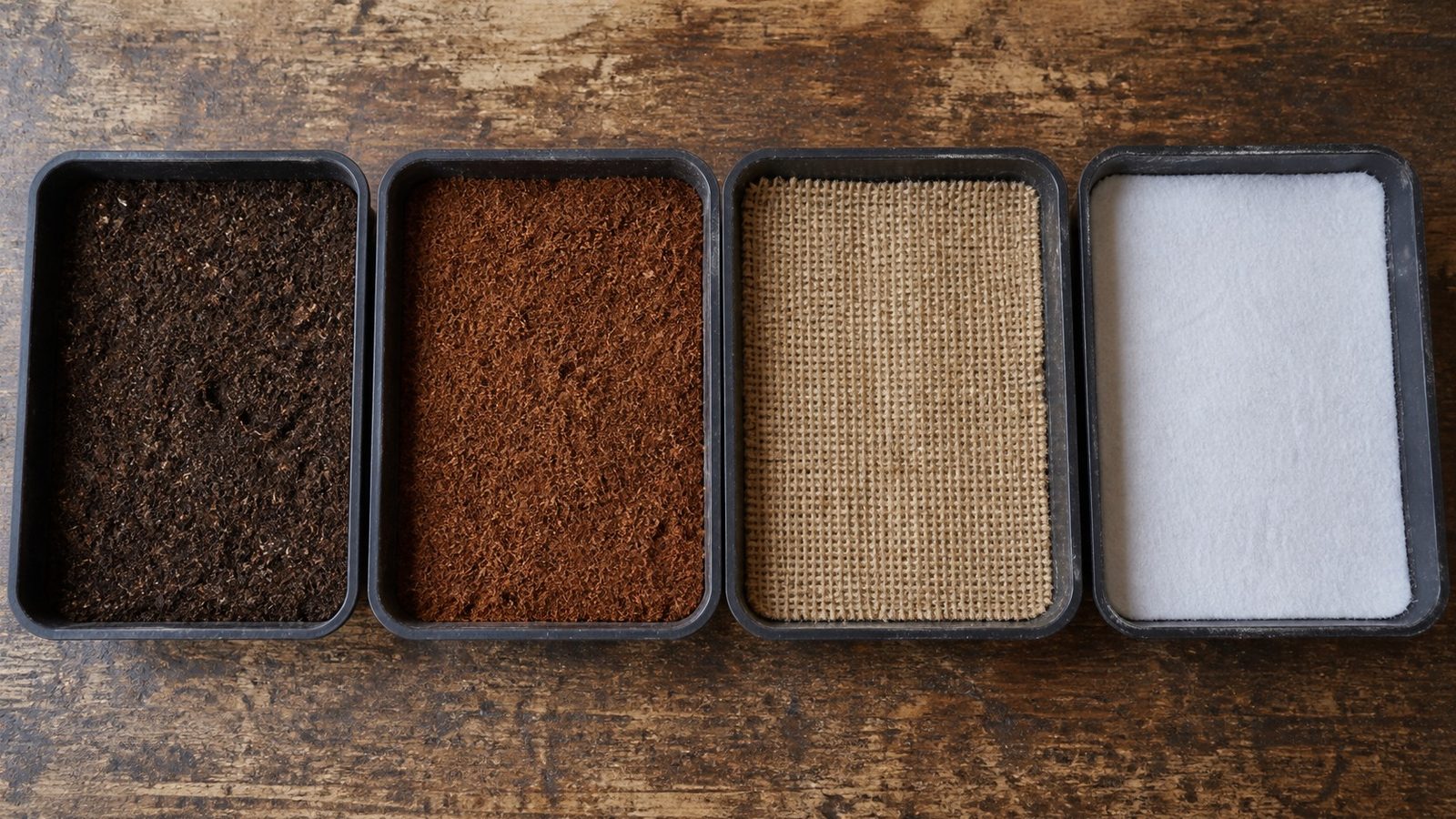
Every page ranking growing media argues about yield. That is the question with the smallest honest answer.
Two independent controlled trials weighed the harvest across a range of media. Between media that a reasonable person would actually use, the whole spread is 13 to 16 percent.
Hover or tap a row to highlight it.
| Trial | Crop | Media compared | The spread it found |
|---|---|---|---|
| 2017, peer reviewed | Rapini | Peat, recycled textile fiber, jute and kenaf, PET mat | Three tied at 1,502 g per m²; the PET mat came in 13.1 percent lower |
| 2023, university funded | Sunflower | Peat, coir dust, leaf compost, food waste compost, blends | Coir dust and leaf compost at 1:1 reached 10,114.81 g per m², up to 16 percent above the peat control |
| 2023, university funded | Water spinach | Coir, peat, coir and leaf compost, a three way blend | 9,800.00 to 10,966.67 g per m², reported as statistically similar |
Three of those four rows are a tie or close to one. A 13 percent difference on one crop with one named product, and a 16 percent difference on one other crop with one named blend, is the entire measured case for choosing a medium on yield. It is real, and it is nothing like the size that ranking pages imply.
The measurement that actually moved is one almost nobody mentions.
What to actually do
- Start with a clean fine seed starting mix or coir, or a clean mat intended for food contact. There is no evidence backed universal best, and the measured differences between reasonable options are around a tenth of the harvest. Coco coir bricks and hemp and jute grow mats are the two loose-and-mat options this page compares.
- Buy on cost and cleanliness, not on a yield claim. The only yield claims with weights behind them are crop specific and product specific.
- Wet it to a wrung out sponge, then bottom water and drain. Most problems blamed on a medium are water and airflow problems, and the two get changed together.
- Do not use raw manure mixes, untested homemade compost or field soil in a shallow tray for a crop eaten raw. The one medium that failed outright in either trial was a pure waste compost.
- Skip fertilizer on a first tray. Clear water grows the crop, and the fertilizer question has its own page.
- If nitrate matters to you, either way, the medium is a lever worth about two. A compost rich medium raises it and a clean fiber mat lowers it, and no published assay figure tells you what its crop was grown in.
- Match the depth to the crop's seed load rather than to a number off a page. A 450 g wheatgrass tray and a 3.5 g sorrel tray have nothing in common.
- Compare media only by holding everything else still and weighing the cut. Same seed lot, same rate, same light, same water, three trays each. That is the trial nobody has published, and it is small enough to run at home.
The medium roughly doubles the crop's nitrate, and not always upward
Both trials measured nitrate in the harvested shoots. Both found the medium moved it about twofold.
Hover or tap a row to highlight it.
| Crop | Lower medium | Higher medium | The ratio |
|---|---|---|---|
| Rapini | Three fiber mats, 940 mg/kg fresh weight | Peat, 1,959 mg/kg | 2.08x |
| Sunflower | Peat, 495.8 mg/kg | Leaf compost, 1,283.0 mg/kg | 2.59x |
| Water spinach | Peat, 527.3 mg/kg | Coir and leaf compost, 1,009.6 mg/kg | 1.91x |
Three crops, two independent studies, and every one of them lands near twofold. That consistency is the finding.
Now read the peat column. Peat is the HIGH nitrate medium in the rapini trial and the LOW one in both 2023 crops. So, the rule is not "peat is high." The rule is that the medium is worth roughly a doubling in either direction, and which direction depends on what is in the medium rather than on its category name. A compost carries nitrogen. A clean fiber mat does not.
That matters when you meet a published nitrate figure. The heart and blood pressure article shows that the nitrate figures published for microgreens span 31-fold, from mizuna at 4,602 mg/kg down to broccoli at 149.09 mg/kg, and that the whole spread comes from which paper you open rather than from the crop. The medium is a second lever on the same number, inside a single crop, and no assay result carries a note saying what its plants were grown in.
Nitrate reads two ways and both are legitimate. The heavy metals and nitrate article treats it as a contaminant question. The heart article treats it as the possible benefit. Neither one can be settled by a number that the growing medium moves by two.
The only medium that actually failed
One medium in either trial produced nothing sellable: 100 percent food waste compost. It produced no marketable sunflower at all, and it cut germination by 22.41 percent on sunflower and 44.82 percent on water spinach against the control. It also carried more Bacillus cereus than peat, coir or leaf compost wherever it made up 50 to 100 percent of the mix, and the researchers say plainly that waste media should be sterilized before any scaled use.
That is the shape of the whole subject. Choosing between sensible media is worth about a tenth of your harvest. Choosing an unsuitable one is worth all of it.
Nobody has published a depth, and the seed load varies 409-fold
There is no published optimal medium depth for a 1020 tray. Not for microgreens generally, and not for any single crop.
The nearest thing to an answer is a volume rather than a depth. Utah State Extension gives a working procedure of 2 quarts of pre-moistened coir per 1020 tray, with 2 cups of water in the tray beneath. Two US quarts is 1,893 mL, and a nominal 10 by 20 inch tray floor is 1,290 cm², so that fill works out at about 1.5 cm, a little under 0.6 of an inch.
Which is worth comparing against real prices. The growing medium review puts loose coir at $1.04 to $1.30 per tray at a 1 inch fill. The one extension procedure in existence implies a fill closer to 0.6 inch, so the same bag covers about 1.7 times as many trays and the real cost per tray is nearer 60 to 75 cents. The cost of filling a tray is uncertain by most of a factor of two before you have bought anything, purely because the depth has never been settled.
And a single depth could not serve every crop here even in principle. Read the seeding rate off all 62 variety entries and 51 publish a number, running from 1.1 g of celery to 450 g of wheatgrass on the same tray. That is a 409-fold range of seed load, with a median of 23 g. Split it by whether the crop gets soaked and the gap is starker still: crops with a documented soak seed at a median of 99.5 g against 11.8 g for crops with an explicit no-soak, 8.5 times heavier.
A tray carrying 450 g of soaked wheatgrass and a tray carrying 3.5 g of sorrel are not the same water and air problem. Treat any single recommended depth as a starting point for one crop, and see sowing and seed density for the load itself.
The categories, and what the labels on the bag actually mean
The practical categories are four, and extension services describe them consistently: loose peat based mixes, loose coir or compost or mineral blends, loose mineral soil, which is not generally advised for a shallow indoor tray, and bound mats made of plant fiber, recycled textile, wood or cellulose, or synthetic polymer.
Potting mix and seed starting mix are not the same product. Oklahoma State Extension puts the difference plainly. A potting mix is formulated for longer lived plants and usually carries nutrients. A seed starting mix is finer and has little or no added nutrient, because a young seedling is living on the seed. "Peat based" says only that peat is a principal component and tells you nothing about whether it is charged with fertilizer.
For a crop cut in one to three weeks, the finer, cleaner, less fertilized product is the sensible default. Read the ingredient panel rather than the category on the front.
Mats are a category, not a material. Natural cotton, kenaf, hemp, jute, recycled textile, wood fiber, rockwool and PET all get sold as grow mats, and the one trial that separated them found the PET mat below the plant fiber ones on a single crop. A claim about "mats" is not a claim about your mat.
What the medium does to microbes, measured rather than asserted
The 2017 rapini trial counted organisms at harvest and the medium moved some counts and not others. Aerobic bacteria were unchanged, at log 6.48 CFU per gram of fresh weight across every medium. Yeast and mold counts were higher on peat and on jute and kenaf than on the textile and PET mats, at log 2.64 against 1.80, and peat carried the highest E. coli count.
Read that carefully, because it points the opposite way to the yield result. The mats came out lower on yeast and mold here, while the reuse page covers a separate 2020 experiment in which hemp and BioStrate mats held deliberately inoculated Salmonella and Listeria near their starting levels for ten days while coir and peat let both fall. Those are different questions. One counted spoilage organisms on a normally grown crop. The other measured what a material does with a pathogen that has already arrived. A material can be fine on the first and poor on the second.
Do not use the medium to explain a mold problem before ruling out water and airflow. Warm, humid, still conditions favor damping off regardless of what the tray is filled with, which is why extension guidance pairs the medium advice with drainage and bottom watering every time. See mold or root hair and watering first.
On sourcing rather than sterilizing: a fresh commercial soilless mix from a reputable supplier is generally clean when new, which is the reason container growing uses soilless media at all. Field soil and untested homemade compost are not equivalent to it, and neither is a mix containing raw manure. Do not routinely heat treat an unopened commercial product, and do not assume that something you made is the same thing.
Peat, coir and the sustainability question that has no ranking
Peat's problem is established and specific. It accumulates over thousands of years, and moving it into warm aerobic horticultural use makes it decompose faster. A 2025 analysis puts the loss at roughly 5 percent of the carbon per year from containerized peat media, and reports an average of 0.6 Mt of carbon a year removed from Canadian peatlands for horticulture.
Coir is a coconut husk coproduct, and its behavior depends on particle size: fine coir holds more water, coarse fractions add air space.
What does not exist is a ranking. No published cradle to grave comparison covers peat against coir against each synthetic mat per marketable kilogram of crop. Freight, coproduct allocation, water and fertilizer use, yield, reuse and disposal can each reverse a conclusion drawn from the material alone. Peat has a documented carbon problem. That is not the same as coir being proven better, and anyone presenting it as settled is filling in a study nobody has run.
Coffee grounds, paper towel and the free medium question
Coffee grounds have been studied, and not in the form the question means. A 2025 peer reviewed study used industrial instant coffee residue, blended with sand and sawdust, for amaranth and chia, and measured pH, water holding, bulk density and growth. Its best result for stem diameter, root length and hypocotyl height was 100 percent sand.
That is a processing plant residue in a sand blend. It is not damp grounds out of your kitchen, and it does not establish household grounds as a medium. The mechanisms worth worrying about are real: dense fine particles and poor aeration, variable pH, salt and caffeine residues, high moisture, and whatever grew in the tub while the grounds were being saved.
Paper, wood fiber, textile, burlap, wool and biochar are not one class either. The Delaware work found a peat lite mix beat lower cost wood and paper fiber mulches for arugula, table beet and amaranth, while the rapini trial found jute and kenaf competitive with peat. "It worked for me" on a paper towel is practice, not a comparison, until somebody weighs two trays.
What nobody has measured
- An optimal depth, for any crop, in any medium.
- A multi crop, multi site comparison of a peat mix, coir, a cellulose mat, a plant fiber mat and a synthetic mat, with water standardized to each medium's own measured capacity.
- A yield and safety hierarchy across paper, burlap, wool, biochar and the other improvised materials.
- A full life cycle ranking of peat against coir against synthetic mats per marketable kilogram.
- A cost comparison that includes preparation, reuse and disposal, rather than the price on the bag.
- Whether household coffee grounds work at all, at any blend ratio, on any crop.
- Any medium practice that makes no difference across crops. The evidence points the other way, and the size and direction both depend on the crop.
Terms on this page
Tap a term to see what it means.
Growing medium. The material that supports the roots and manages water, air and sometimes nutrients. Substrate is the technical near synonym.
Sources
Opened 2026-08-11. The seed load range, the 23 g median and the soaked against unsoaked comparison were computed for this page from the published seeding rate and soak figures across all 62 crops, of which 51 publish a numeric seeding rate and 59 a numeric soak. The depth arithmetic on Utah State's 2 quart figure and the per-tray cost taken from the growing medium review are shown in full above so they can be checked. Two publisher pages returned a challenge and were excluded rather than quoted.
- Penn State research record, physicochemical, agronomical and microbiological evaluation of alternative growing media, 2017 - the rapini trial: peat, recycled textile fiber and jute and kenaf averaging 1,502 g fresh shoots per m² with the PET mat 13.1 percent lower, aerobic bacteria unchanged at log 6.48 CFU per gram, yeast and mold at log 2.64 on peat and jute and kenaf against 1.80 on the textile and PET mats, the highest E. coli count on peat, and shoot nitrate of 1,959 mg/kg fresh weight on peat against 940 on the three mats.
- Thammasat University funded study of waste derived growing media, 2023 (PDF) - sunflower at 10,114.81 g per m² on 1:1 coir dust and leaf compost, up to 16 percent above the peat control; water spinach statistically similar at 9,800.00 to 10,966.67 g per m²; germination of 90.67 percent on coir against 77.33 percent on peat for water spinach with no significant difference; 100 percent food waste compost producing no marketable sunflower and reducing germination by 22.41 percent on sunflower and 44.82 percent on water spinach; sunflower nitrate of 495.8 mg/kg on peat against 1,283.0 on leaf compost; water spinach nitrate of 527.3 on peat against 1,009.6 on coir and leaf compost; higher Bacillus cereus where food waste compost was 50 to 100 percent of the mix; and the authors' own instruction to sterilize waste media before scaled use.
- Utah State Extension, grow your own microgreens - the extension choices of seed starting mix, coir or a hydroponic mat, and the 2 quarts of pre-moistened coir per 1020 tray procedure with 2 cups of water beneath.
- Penn State Extension, a step by step guide for growing microgreens at home - the media categories including natural and synthetic fiber mats, the instruction to choose on availability, cost, sustainability, cleanliness and safety, bottom watering, and composting organic spent medium.
- Penn State Extension, growing microgreens - the drainage, bottom watering and airflow guidance and the damping off caution. This page returned a fetch error on the research date and its content was retained only where corroborated by the opened extract.
- University of Maryland Extension, starting vegetable seeds indoors - that a medium must supply roots with air, water and nutrients, that large pores drain excess water, that overwatering displaces oxygen, and why soilless media are preferred for containers.
- Oklahoma State Extension, which soilless media is best for your situation - the seed starting mix against potting mix distinction, and that "peat based" names a component rather than a formulation.
- University of Delaware thesis record - peat lite outperforming lower cost wood and paper fiber mulches for arugula, table beet and amaranth, and earlier and greater germination in a hydrophilic polymer than in grade 5 vermiculite, for which the abstract gives no percentage.
- Agrociencia, instant coffee residue as a substrate, 2025 - industrial instant coffee residue blended with sand and sawdust for amaranth and chia, the substrate measurements taken, and 100 percent sand giving the best stem diameter, root length and hypocotyl height.
- USDA NRCS urban agriculture handbook (PDF) - the coir definition and the relationship between particle size and air space.
- Frontiers in Horticulture, peat carbon, 2025 - approximately 5 percent carbon loss per year from containerized peat media, and an average of 0.6 Mt of carbon a year removed from Canadian peatlands for horticulture.
- Penn State Extension, ensuring food safety in microgreens production - medium sourcing guidance. This page returned a 403 on the research date and is named as identified guidance rather than used as the sole support for any figure here.
Keep reading
Growing guides
Hydroponic and soil-free microgreens: the same swap costs a third of the pea crop and gains on radish
In one replicated trial, moving from peat-perlite to coir cost pea 32.7 percent of its yield and gained radish 4.5 percent. Two extension services cannot even agree whether a mat counts as hydroponic, and the word is doing two jobs at once.
Read Hydroponic and soil-free microgreens: the same swap costs a third of the pea crop and gains on radishGrowing guides
Do microgreens need fertilizer? It is worth 8 to 47 percent of the yield and up to 227 times the nitrate
In one peat trial, taking the feed away cost cabbage 7.9 percent of its yield and arugula 47.4 percent, while cutting nitrate in the cut crop by 98 to 227 fold. Feeding is the largest lever anyone has measured on either number.
Read Do microgreens need fertilizer? It is worth 8 to 47 percent of the yield and up to 227 times the nitrateGrowing guides
Growing microgreens for animals: no species has a published dose, and one tray costs ten pounds of layer pellets
No veterinary source sets a microgreen dose for any companion species, and the published guidance comes in four units that will not convert. Plus an on-farm tray weight of 7.31 oz, and why fodder did not cut hen feed costs.
Read Growing microgreens for animals: no species has a published dose, and one tray costs ten pounds of layer pelletsGrowing guides
Can you reuse the medium? Reuse clean loose coir, replace the mat, never reuse a failed tray
Reuse loose coir or peat off a clean tray, screened and refreshed half with new mix, and throw fiber mats away. Reuse itself has never been tested, and the one pathogen study covers 4 of the 12 materials an extension service names.
Read Can you reuse the medium? Reuse clean loose coir, replace the mat, never reuse a failed tray