Wheatgrass
Cal HewittPublished Updated Checked
- grass
- juiced
- beginner
- needs soaking
- cut and come again
- mold prone
At a glance
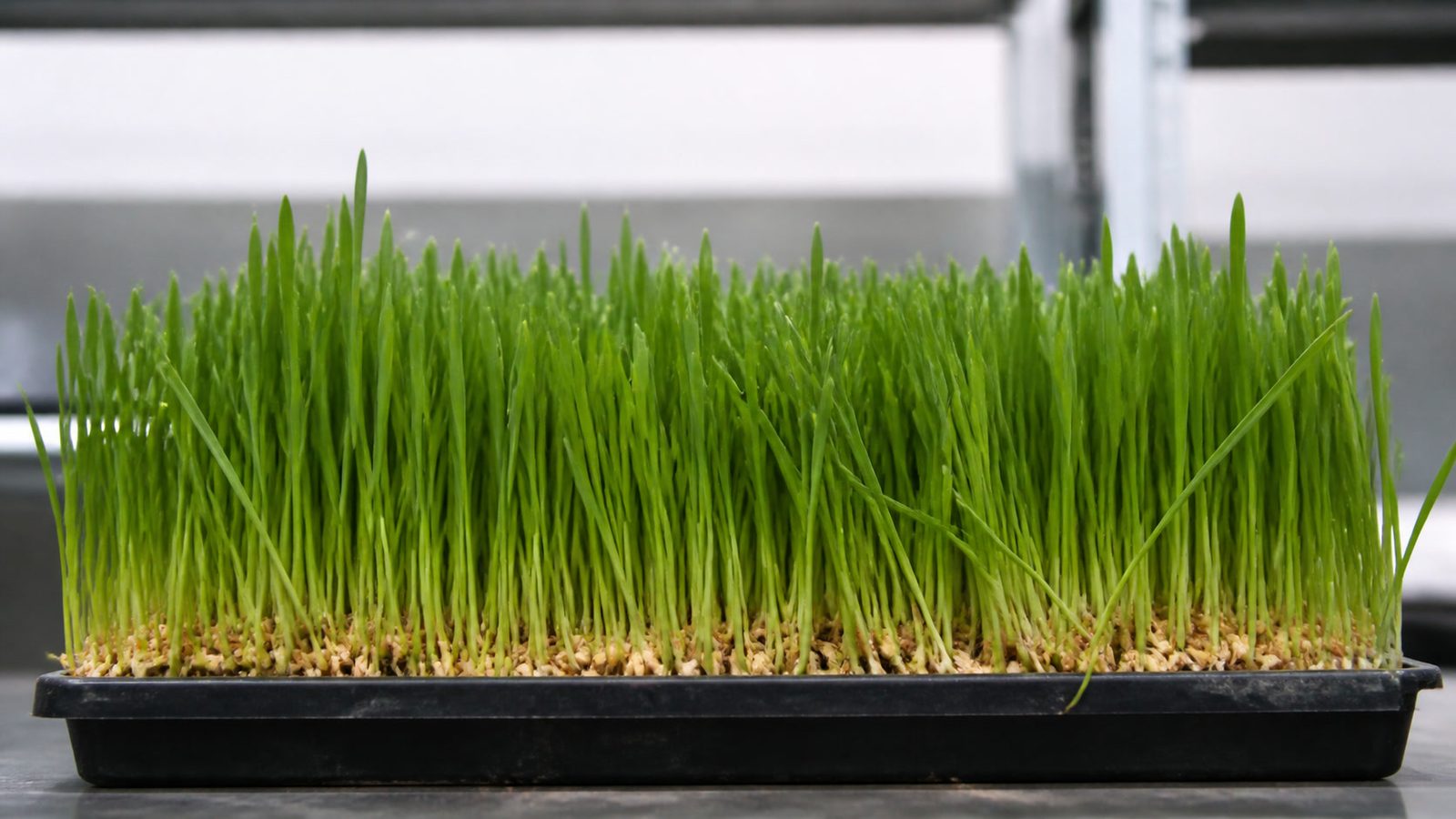
Large kernels germinate fast and the crop reaches cut height in about a week, but it is sown as the densest mat in this directory from soaked cereal seed, so it is easy to grow acceptably and unforgiving of overwatering or still air.
- Botanical name
- Triticum aestivum
- Also sold as
- Hard Red Winter, Hard Red Spring, Wheat shoot seed
- Family
- grass
- Difficulty
- Beginner
- Days to harvest
- 7 to 12 days
- Harvest window
- No published figure
- Seed per 1020 tray
- 450 g
- Soak
- 4 to 8 hours
- Blackout
- 2 to 3 days
- Germination temperature
- No published figure
- Yield per 1020 tray
- No published figure
- Regrows after cutting
- partial
- Mold risk
- High
- Hull shedding
- some
- Shelf life
- No published figure
- Eaten as
- juiced
- Seed cost per tray
- $3.10
450 g at $3.12/lb, Johnny's organic hard red winter wheat shoot seed at 25 lb, listed 2026-08-08. That is about the cheapest microgreen seed sold by the pound, and it still makes one of the dearer trays, because the rate is so heavy. Seed only, excludes medium, tray, labor, light and loss.
Any field name above ranks every variety by it. No published figure means we researched it and nobody has established one, which is different from not yet researched. Every figure here is sourced at the bottom of the page. Compare every variety side by side.
Wheatgrass is the crop you juice rather than eat. The blades are fibrous and not digestible whole, so a tray goes into a shot or a blended drink rather than onto a plate.
It is also the heaviest sowing you will ever weigh out: 450 grams of soaked wheat kernels to a 1020 tray, against 167 g for the heaviest sunflower protocol and 13 g for broccoli. That one fact drives everything else about growing it, because from day one what you are managing is a dense mat of wet cereal kernels. Bottom watering and moving air matter more here than on anything else.
Expect a dark green stand of 3 to 6 inch blades in 7 to 12 days. What nobody has published is what a tray actually returns, in weight or in juice volume. Wheatgrass is absent from the one public per-variety yield trial, no extension source measures a tray, and the seller figures that circulate are calculators rather than measurements. So, if you need to cost it, weigh your own first cut and work from that, and treat any yield figure you are quoted as a guess until somebody shows you the tray it came off.
What growers are saying right now
Sampled from public posts and videos, 9 July to 8 August 2026. Every line links what it is quoting. How often something is repeated is not evidence that it is true, so every line also says what the sources actually establish.
Green blood therapy
Circulating One creator's wheatgrass videos total roughly 1.95 million views on their own: what wheatgrass juice powder is at 851,349, twelve scientific health benefits at 560,919, and green blood therapy at 429,476, with a pinned comment under the first pointing viewers at the same channel's supplement line
None of it is supported by anything opened for this page. The one peer-reviewed study located measured proximate composition, chlorophyll, seven minerals, amino acids, phenolics and in-vitro radical scavenging, on 15-day dried shoot powder and freeze-dried juice powder. It measured constituents. It did not test detoxification, blood alkalinity, cancer, or vitamin B12, and neither did anything else. What is actually established
Don't waste your money on wheatgrass
Circulating The other side is loud too. A debunking video at 312,896 views and a dietitian answering the same question at 239,614
The evidence supports neither a miracle nor a scam. What the composition study actually found is narrower and duller than both: wheatgrass juice powder higher in potassium and magnesium than its comparator, and a real difference between two wheat varieties including more total chlorophyll in one. A measured constituent is not a health outcome, and its absence is not proof of uselessness either.
Mold on wheatgrass after switching to bottom watering
Circulating A wheatgrass-specific rescue thread in r/microgreens, and separately somebody posted a hydroponic wheatgrass tray to r/moldyinteresting
Both fit the crop exactly. At 450 g of soaked cereal kernel this is the densest, wettest seed mat in the directory by a distance, which is precisely the condition damping-off wants. Bottom watering is the documented fix rather than a cause, so mold appearing after the switch points at a mat that was already too wet rather than at the technique. What goes wrong
The biggest growing video in any of these sweeps
Circulating How to grow the best wheatgrass at 1,819,763 views, larger than any crop guide encountered across eight of these sweeps
Which tells you where wheatgrass sits: a wellness product first and a tray crop second. That matters practically, because growing advice attached to wellness content is rarely sourced, and this is the crop with the least published production data of any in this directory. The enthusiasm and the evidence are inversely proportional here.
Wheatgrass juice at home in eight days
Circulating A grow-along at 89,608 views
And this one checks out. Johnny's gives 7 to 12 days from seeding, so eight days sits comfortably inside the published range. Where each number comes from
What it is, and how to tell you grew it right
Wheatgrass is the young shoot of common bread wheat, Triticum aestivum, grown densely in a tray and cut as grass blades for juicing. One clarification first: in agronomy "wheatgrass" also names perennial forage species such as intermediate and tall wheatgrass, which are different plants entirely. The tray crop is wheat.
A correct tray is a dense, dark green stand of narrow, parallel-veined blades, 3 to 6 inches tall, each tapering to a point and rising from a cereal kernel. There are no cotyledons, no broad leaves and no pale stem band, because this is a grass rather than a seedling with seed leaves. The top of the stand is naturally uneven rather than flat. At the medium you will find the thick kernel and root mat, plus the occasional seed coat that has stayed on.
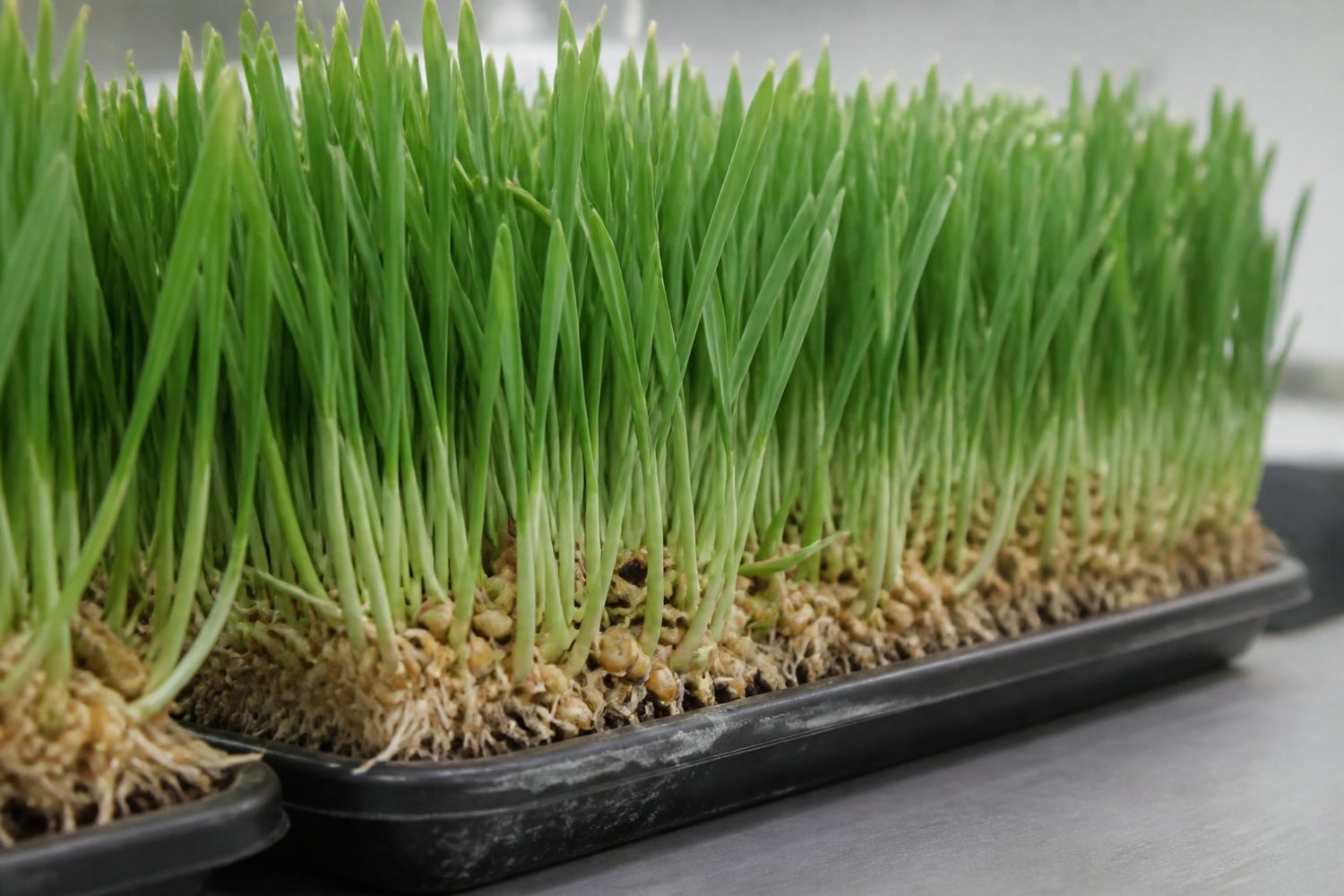
Almost nothing in this directory looks like it. The one thing it is confused with is cat grass, which is frequently the same plant sold for a different purpose.
What it tastes like, and what to do with it
Mildly sweet with a pleasant bitterness and an unmistakably grassy finish. Johnny's phrasing is fresh, pleasantly bitter and mildly sweet, which is fair. It is a juice flavor rather than a salad one.
It is juiced, and that is not a stylistic preference. The blades are fibrous and are not digestible whole, which is why this is the only crop in this directory whose "eaten as" field says juiced rather than raw. It goes into a shot or a blended drink where extraction handles the texture, and it takes well to apple, pear or grape when the grassiness needs softening.
It is the wrong choice for a salad, a sandwich, or any garnish meant to be chewed. And plenty of people simply do not like it. One growing guide says outright that many find it unappealing on its own, which is worth knowing before you commit a tray and 450 g of seed to finding out.
Growing it: only what differs from the standard method
Everything general about trays, medium, light and watering is on the standard tray method for growing microgreens. Wheatgrass departs from it in three ways, all of them consequences of sowing cereal kernels at density.
Soak 4 to 8 hours, and do not go past eight. Johnny's specifies 8 hours and says not to reuse the water. A second source gives 4 to 8 with an optional 12 to 24 hour pre-sprout in mesh, and warns explicitly against soaking beyond 8. No source states a water temperature, so use potable cool or room-temperature water rather than inventing one. Under-soaking gives less synchronous germination; over-soaking, on a crop already prone to a sour mat, is asking for trouble.
Sow 450 grams, which is the heaviest rate on this site by a wide margin. For scale, the heaviest sunflower protocol is 167 g and broccoli is 13. That figure is a supplier's starting point rather than a trial result, and it is for a dense juice-grass tray. Reduce it if shoots are staying wet or crowded, or if you are growing on longer, because a thinner stand has better airflow and depletes water more slowly.
Cover for 2 to 3 days, lightly. Johnny's says to remove the inverted tray when germinating kernels lift it about an inch. The cover is for darkness and moisture during germination. Notably, no source instructs you to add a heavy weight to wheatgrass, unlike sunflower or cilantro, and adding one increases the consequences of an over-wet mat rather than improving the crop.
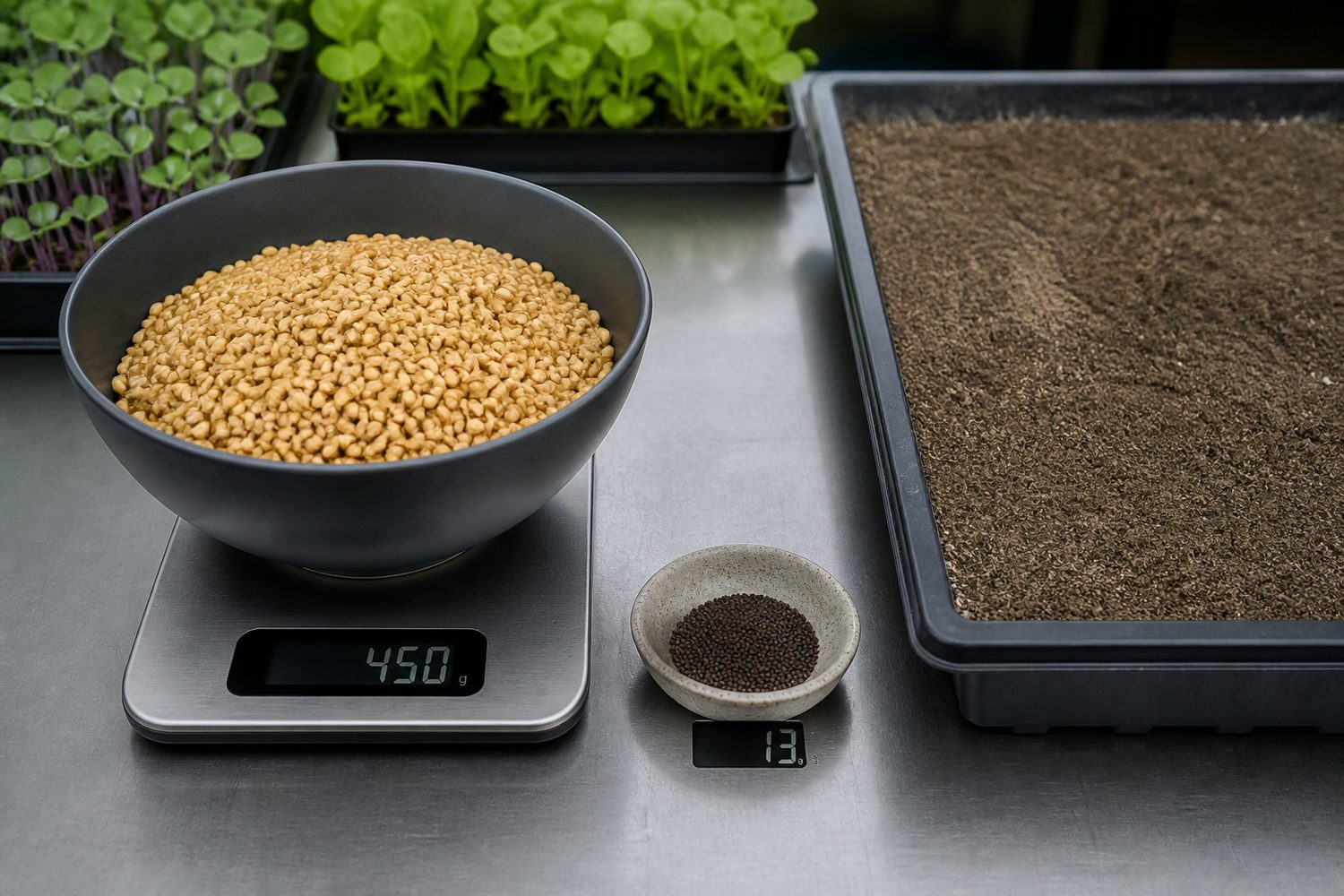
Then bottom water, and mean it. This is where the crop is won or lost. Broadcast onto an inch to an inch and a half of leveled medium, press lightly for contact, do not bury. After establishment, water from below so the kernels and foliage are not repeatedly wetted. Keep it under 75°F, with the general 60 to 70°F production range as the target, and keep air moving.
A wheatgrass tray, day by day
- 1
Day 0, soak
4 to 8 hours in potable cool water, and do not exceed eight. Do not reuse the water.
- 2
Day 0, sow
450 g broadcast densely on an inch and a half of leveled, moist medium, pressed lightly for contact, not buried.
- 3
Days 1 to 3, covered
An inverted tray for darkness and moisture. No weight: nothing published calls for one, and weight on this mat makes the wet worse.
- 4
Day 2 or 3, uncover
When germinating kernels lift the cover about an inch. From here the crop greens up fast.
- 5
Days 3 onward, light and air
Bottom water so kernels and blades are not repeatedly wetted. Under 75°F, air moving. Run a hand or stake over the stand to knock loose seed coats off.
- 6
Days 7 to 12, cut
At a dark green stand of 3 to 6 inches. One guide notes leaves may start yellowing past 3 to 4 inches, so watch the color rather than the calendar.
- 7
After cutting
Leave about an inch of stubble and a second cut is documented roughly a week later. It has never been measured against the first, so treat it as a bonus rather than yield.
What goes wrong with wheatgrass specifically
Everything on this crop comes back to a wet kernel mat. It is sown denser than anything else here from large soaked seed, and the failure modes follow from that single fact.
Poor or patchy emergence. Old or low-vigor seed, an incomplete soak, uneven contact, or uneven moisture. The sign is missing or uneven rows by day two or three. Test the lot rather than reseeding into a standing tray.
Waterlogged kernel rot and damping-off. Persistent wetness plus poor airflow. The sign is collapsed shoots or brown, soft tissue at or below the medium line, which is different from healthy white roots. Pythium often begins at the root tips and Rhizoctonia is also involved. Once seedlings are collapsing, discard rather than harvest.
Surface mold across the kernels. Warm, wet and dense. Fuzzy gray or white growth spreading across the kernels and medium. A genuinely isolated spot can be removed if the rest of the tray is sound, but widespread mold on a food crop is a discard.
Yellowing and overmaturity. Loss of dark green color, which one guide flags as starting past the 3 to 4 inch stage. Yellowed blades do not make premium juice, and the fix is cutting earlier next cycle rather than anything you can do to the tray now.
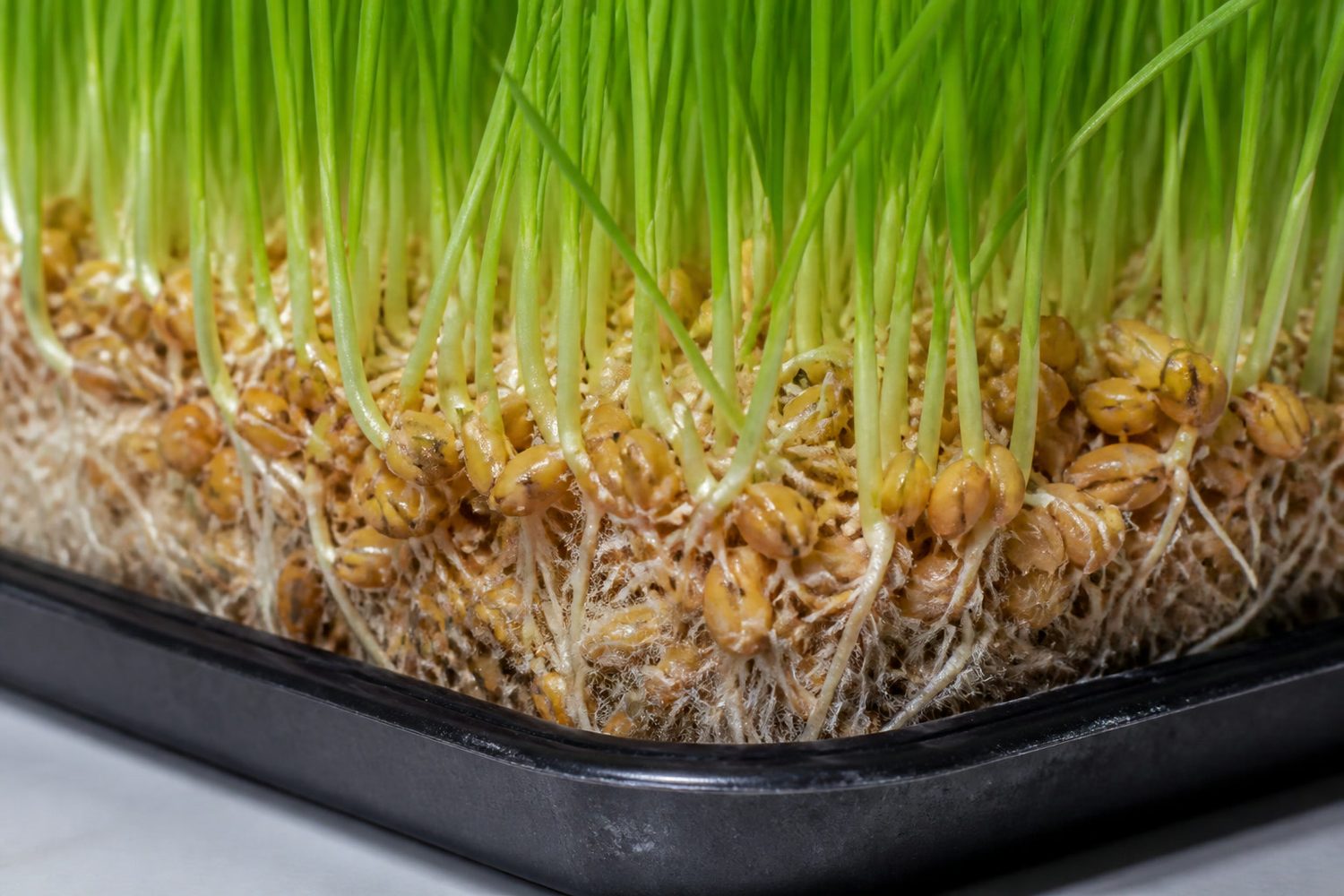
Seed coats that stay on. Johnny's tells growers to run a hand or a stake over the crop to knock coats off, and to remove plants whose coats will not release. It is a real handling job rather than a trivial one, though not the defining problem it is on sunflower.
Root hairs against mold, the wheatgrass version. Root hair is fine, uniform, white, and attached only to roots, most visible in the root zone and often visibly changed after watering. Mold is irregular, cobwebby or cottony, spreads across seed coats, medium and shoots, and moves away from the roots. On this crop the extra tell is the company it keeps: if the fuzz is on collapsing stems or spreading over the kernel mat, and especially if there is an odor, it is disease.
Nutrition, and what is actually established
There is no USDA FoodData Central record for wheatgrass as a shoot crop, searched 2026-08-08. Sprouted wheat, wheat grain, mature wheat and branded powders are all different foods and none of them is a substitute.
What exists is one small study, and its shape matters. Two wheat varieties were grown indoors, cut at 15 days at 2 cm above the soil, and then analyzed as dried shoot powder and freeze-dried juice powder. It measured proximate composition, chlorophyll, seven minerals, amino acids, phenolics and radical-scavenging activity. Wheatgrass juice powder came out higher in potassium and magnesium than the pulse comparator, and the two varieties differed, with more total chlorophyll in one of them.
Read the method again before using any of that. It is a 15-day crop, cut lower than a juice grower cuts, and processed into powder. A 7 to 12 day fresh tray is a different sample, so those figures describe that experiment rather than your shot.
The bigger claims, that wheatgrass detoxifies, alkalizes the blood, prevents or treats cancer, or supplies vitamin B12, are not supported by anything opened for this page. The study measured which compounds were present and how the samples behaved in a test tube. It made no clinical claim, and there is no basis here for making one either way.
Which seed to buy
Two market classes are sold and no trial separates them. Hard Red Winter is what Johnny's sells as wheat shoot seed, described as a fast producer of dark green leaves, 3 to 5 inch harvest, 7 to 12 days from seeding. Hard Red Spring is sold by others for the same use. Both are T. aestivum, both are genuine market classes rather than relabeled bags, and no controlled trial establishes that either produces more, tenderer, or faster grass under the same conditions. Seller claims either way are assertions.
Buy untreated, food-use seed, sold for shoots or sprouting, with a current germination test and the lot information. Refuse dyed, fungicide-treated or insecticide-treated field seed. This matters more on wheatgrass than on most crops here, because wheat is overwhelmingly grown as a field commodity and treated field seed is abundant and cheap. SDSU Extension is explicit that seed treatment chemicals may be present in the shoots.
A bad lot on this crop is expensive in a specific way. It shows as slow, uneven emergence with soft or rotting kernels and bare patches, and those bare wet patches are exactly where mold starts. Since the seed rate is 450 g, a failed tray also writes off far more seed than a failed brassica tray does.
Wheatgrass seed on Amazon is the convenient route for a home grower. At volume, buy where the lot test is published.
Is it worth growing?
It depends entirely on whether you actually want wheatgrass juice, and that is not a dodge.
If you do, it is a good crop. It is fast, it germinates readily, the seed is the cheapest per pound in this directory at $3.12, and there is a documented second cut about a week after the first if you leave an inch of stubble. For a home grower with a juicer, a tray a week is easy and fresh grass beats powder on every axis except convenience.
If you are growing it to sell by weight, proceed carefully, because you are flying blind on the one number that decides everything. There is no published yield per 1020 for this crop at all. You will spend $3.10 of seed per tray, the second highest here, on an outcome nobody has measured. Run your own weighed trial before you price anything, and record grams sown, tray area, temperature, light, cut height and harvested ounces, because that record will be better evidence than anything currently published.
Be careful comparing it against other crops on yield, including in the table below: the yield row is empty because nobody has measured it, not because it is low.
Its real competition is not the salad crops, which it does not compete with on eating quality at all. It competes for bench space against anything else you might put there, and it wins when the outlet is fresh juice and loses when the outlet is a bag of greens.
A note on the numbers above
Hover or tap a row to highlight it.
| Figure | Value | Source | What kind of number it is |
|---|---|---|---|
| Seed per 1020 | 450 g | Bootstrap Farmer | A SUPPLIER ASSERTION. The heaviest rate on this site |
| Seed per 1020 | No trial figure | Johnny's | Wheatgrass is absent from the trial entirely |
| Yield per 1020 | No published figure | Nobody | Not a trial, not an extension source, not anywhere |
| Days to harvest | 7 to 12 | Johnny's | From seeding, at a 3 to 6 inch harvest |
| Days to harvest | 7 to 21 | Johnny's | Marketable shoots, depending on conditions |
| Days to harvest | 8 to 10, ideally 10 | Bootstrap Farmer | No temperature or harvest height stated |
| Days to harvest | 7 to 10 after sprouting | KidsGardening | A different clock: not days from sowing |
| Soak | 8 hours | Johnny's | Do not reuse the water |
| Soak | 4 to 8 hours | Bootstrap Farmer | With an explicit warning not to exceed 8 |
| Blackout | 2 to 3 days | Johnny's | Remove when kernels lift the cover about 1 inch |
| Blackout weight | None published | Nobody | No source calls for weighting this crop |
| Germination temperature | No published figure | Nobody | 60 to 70°F is general; under 75°F is a crop note |
| Second cut | About one week later | KidsGardening | Cut about 1 inch above soil. Never quantified |
| Shelf life | No published figure | Nobody | Sealed and refrigerated, with no days or temperature |
| Harvest window | No published figure | Nobody | The cue is color and height, not a span |
| Seed cost per 1020 | $3.10 | Calculated, Johnny's price | 450 g at $3.12/lb, listed 2026-08-08 |
Nobody has published what a wheatgrass tray returns, and that is the gap that matters. It is absent from the one public trial, whose figures are all taken at first true leaf, a stage that does not apply to a grass at all. The forage yields and vendor calculators you will find are for a different crop at a different stage, so do not convert them across. Weigh your own tray, in grams of cut grass or in ounces of juice, and work from that number instead.
Wheatgrass takes far more seed than an ordinary tray, so general microgreen advice will underseed it. The documented rate is 450 g per 1020. A rule of thumb tuned to a typical microgreen tray lands nearer 250 to 350 g, which is too much for a fine-seeded brassica and nowhere near enough for a cereal. Weigh to the cereal figure, not to the category one.
The cheapest seed you can buy makes one of the most expensive trays. Wheatgrass seed is $3.12 a pound against mustard's $88.30, a 28-fold difference in shelf price, and yet a wheatgrass tray costs $3.10 of seed against mustard's $1.56, because one takes 450 g and the other takes 8. Those two crops make the point better than any table: shelf price tells you almost nothing about what a tray costs, and the rate does all the work, so multiply before you buy.
Hover or tap a row to highlight it.
| Crop | Seed per 1020 | Yield | Days | Cost per tray | Oz per $1 | Oz per tray-day |
|---|---|---|---|---|---|---|
| Barley grass | 175 to 220 g | No published figure | 6 to 12 | $7.72 to $9.69 at 1 lb retail | cannot be calculated | cannot be calculated |
| Popcorn shoots | 142 to 227 g | No published figure | 6 to 14 | $5.80 to $9.28 at 1 lb | cannot be calculated | cannot be calculated |
| Wheatgrass | 450 g | No published figure | 7 to 12 | $3.10 | cannot be calculated | cannot be calculated |
A blank means nobody has published that figure, so the cell is left empty rather than filled with an estimate. How the numbers work
All 62 crops, sortable, on the microgreen comparison.
Wheatgrass is the row that cannot be completed, and leaving it incomplete is the point. Every other crop here can be ranked on what it returns per dollar and per day of bench space. This one cannot, because the numerator does not exist. A table that filled it with a plausible guess would look more useful and be worth less, and a reader would have no way to tell which cells were measured and which were invented. That distinction is the whole product.
Prices move, so the dollar columns are dated. The rankings are the durable part, and wheatgrass has no ranking until somebody weighs a tray.
Terms on this page
Tap a term to see what it means.
Wheatgrass. The young shoot of common bread wheat, Triticum aestivum, grown densely and cut for juice. Not the same as the perennial forage species agronomists call wheatgrass.
Sources
- Johnny's Selected Seeds, wheat hard red winter organic shoot seed - Triticum aestivum, 7 to 12 days from seeding with marketable shoots at 7 to 21 depending on conditions, a 3 to 6 inch harvest, the 8 hour soak with no water reuse, a 2 to 3 day inverted tray removed at about an inch of lift, running a hand or stake over the crop to knock seed coats off and removing plants whose coats will not release, sealed refrigerated storage, fresh pleasantly bitter and mildly sweet flavor, and the 25 lb at $78.00 price behind the cost calculation, listed 2026-08-08.
- Johnny's microgreens yield trial results (PDF) - 29 varieties harvested at first true leaf, with no wheatgrass row. The absence is why no measured seed rate or yield exists for this crop.
- Johnny's microgreens yield trial, method and discussion - the 1020 method, seed weighed by packet difference, larger harvests needing fewer seeds for airflow, and the warning that one system's yields do not translate to another's.
- Bootstrap Farmer, the ultimate microgreen cheat sheet - the 450 g per 10 by 20 tray rate, 4 to 8 hour soak with an explicit warning not to exceed 8, an optional 12 to 24 hour mesh pre-sprout, 2 days blackout, 8 to 10 days ideally 10, keeping it under 75°F, the crop described as mold-prone with bottom watering recommended, and the blades not being digestible whole.
- KidsGardening, wheatgrass growing guide (PDF) - 7 to 10 days after sprouting to about 4 inches, leaves possibly yellowing past 3 to 4 inches, a second harvest about a week after cutting roughly an inch above the soil, blending with fruit to improve palatability, and the note that many people find it unappealing on its own.
- Virginia Cooperative Extension SPES-756 (PDF) - the general 60 to 70°F indoor microgreen range, 50 to 70 percent humidity, and airflow.
- UC IPM, damping-off - Pythium and Rhizoctonia solani, damp conditions favouring them, Pythium often beginning at root tips, and rot at or below the medium line.
- Frontiers in Plant Science, post-mowing regrowth in wheat - regrowth after mowing depending on retained stubble, which is why the documented second cut leaves about an inch.
- International Journal of Food Science and Technology, wheatgrass composition - two wheat varieties grown indoors, cut at 15 days at 2 cm above soil, analyzed as dried shoot powder and freeze-dried juice powder for proximate composition, chlorophyll, seven minerals, amino acids, phenolics and radical-scavenging activity, with juice powder higher in potassium and magnesium than the pulse comparator and higher total chlorophyll in one variety.
- True Leaf Market, hard red winter wheatgrass seeds - hard red winter sold as wheatgrass seed, with thick blades and even growth claimed and no lot test published.
- Home Microgreens, organic hard red spring wheat grass seed - hard red spring sold for the same use, with its day and rate statements being seller assertions rather than a comparative trial.
- SDSU Extension, growing microgreens at home - why seed-treatment chemicals may be present in the shoots and treated field seed is not appropriate to consume.
- USDA FoodData Central - searched 2026-08-08, no record for wheatgrass as a shoot crop.
Keep reading
The variety directory
Barley grass
One of the dearest trays of seed you can fill at a 1 lb retail pack, and about a seventh of that in bulk. A juice crop whose buyers are mostly buying powder.
Read Barley grassThe variety directory
Popcorn shoots
Grown in complete darkness from sowing to harvest, which is what makes it sweet and yellow, and also why the one study that measured it puts it at the bottom of 25 crops for carotenoids.
Read Popcorn shootsThe variety directory
Chickpea shoots
One of the very few crops with real regrowth data behind it: a measured second cut at 96 percent of the first, if you cut above a node instead of at the medium line.
Read Chickpea shootsThe variety directory
Nasturtium microgreens
A three-week tray that returns 5.64 oz and costs $5.74 of seed, so it earns its keep as a garnish and not by weight. Also the crop whose own name belongs to a different plant: search nasturtium in USDA's database and you get watercress.
Read Nasturtium microgreens