At a glance
Easy to germinate and hard to finish clean: a dense thirsty cereal mat sours or webs with mold if airflow drops, water stands, or the grain is sown more than one kernel deep.
- Botanical name
- Hordeum vulgare
- Also sold as
- Barley Grass seeds, Whole barley, hull intact, Hulless sprouting barley
- Family
- grass
- Difficulty
- Moderate
- Days to harvest
- 6 to 12 days
- Harvest window
- No published figure
- Seed per 1020 tray
- 175 to 220 g
- Soak
- 8 to 12 hours
- Blackout
- 3 to 5 days
- Germination temperature
- No published figure
- Yield per 1020 tray
- No published figure
- Mold risk
- High
- Hull shedding
- heavy
- Shelf life
- 7 days
- Eaten as
- juiced
- Seed cost per tray
- $9.69
220 g at $19.99/lb, SeedsNow 1 lb organic barley grass seed, listed 2026-08-08. THE MOST EXPENSIVE TRAY OF SEED IN THIS DIRECTORY at that pack size, $7.72 at the 175 g end. It falls to roughly $1.10 to $1.38 a tray at the $2.85/lb of a 30 lb sack, checked the same day. Seed only, excludes medium, tray, labor, light and loss.
Any field name above ranks every variety by it. No published figure means we researched it and nobody has established one, which is different from not yet researched. Every figure here is sourced at the bottom of the page. Compare every variety side by side.
Barley grass is wheatgrass's sibling: a cereal sown thick, grown to a turf, and cut for juice rather than for a salad. It is the second heaviest seeder in this directory after wheatgrass at 175 to 220 grams a tray, and that single fact drives everything interesting about it.
At the 1 lb retail bag most home growers reach for, that rate makes barley grass the most expensive tray of seed on this site, at $7.72 to $9.69. Buy the same commodity in a 30 lb sack and the same tray costs about $1.10 to $1.38. Nothing about the plant changed. On a crop that eats 200 grams a tray, where you buy the seed matters more than which seed you buy, and no other page in this category tells you that.
The other thing worth knowing before you start: most people who want barley grass buy the powder rather than grow a tray, so there is little grower-to-grower advice about it to find.
What growers are saying right now
Sampled from public posts and videos, 9 July to 8 August 2026. Every line links what it is quoting. How often something is repeated is not evidence that it is true, so every line also says what the sources actually establish.
Barley grass powder helps digestion, boosts energy and immunity, and is packed with vitamins and antioxidants
Circulating A creator answering a follower's question, which is the standard claim set across this month's barley content
None of that is established. There is no USDA record for barley grass at all, and the one peer-reviewed study on this crop grew it hydroponically for nine days and measured chlorophyll, minerals, polyphenols, flavonoids and luteolin. That is a composition result, not a health outcome, and it says nothing about digestion, energy or immunity. What has actually been measured
An easy way to add a green drink to your daily routine
Circulating A powder pitch framing it as the practical option for busy people
True, and it is the honest competitive position for anyone thinking of growing this. A fresh tray is not competing with other trays, it is competing with a tub of powder that needs no bench, no juicer and no eight-day wait.
Buy one take one, stock up on the barley grass juice drink
Circulating A direct-sales promotion for one of several supplement brands that dominate this month's barley grass content
Worth reading as a demand signal rather than a nutrition one. The people searching for barley grass are overwhelmingly looking to buy a supplement, not to grow a crop, and a grower planning to sell fresh grass is entering a conversation that is already about tubs.
Nobody is talking about growing it
Circulating Thirty days across Reddit, TikTok, YouTube and Instagram returns supplement brands and powder routines, like this morning-habit post, and essentially no tray content
The silence lines up with the record. Barley grass has no published yield per tray, no germination temperature, no measured harvest window, and it is absent from the trade's one yield trial. It is a crop with a large audience and almost no agronomy behind it. What is missing
What it is, and how to tell you grew it right
Barley grass is ordinary cultivated barley, Hordeum vulgare, grown as a young grass. There is no separate barley grass species. The one real distinction on a seed bag is hulled against hulless: hulless grain is reported to imbibe a little more evenly and to leave less chaff among the stems at cutting.
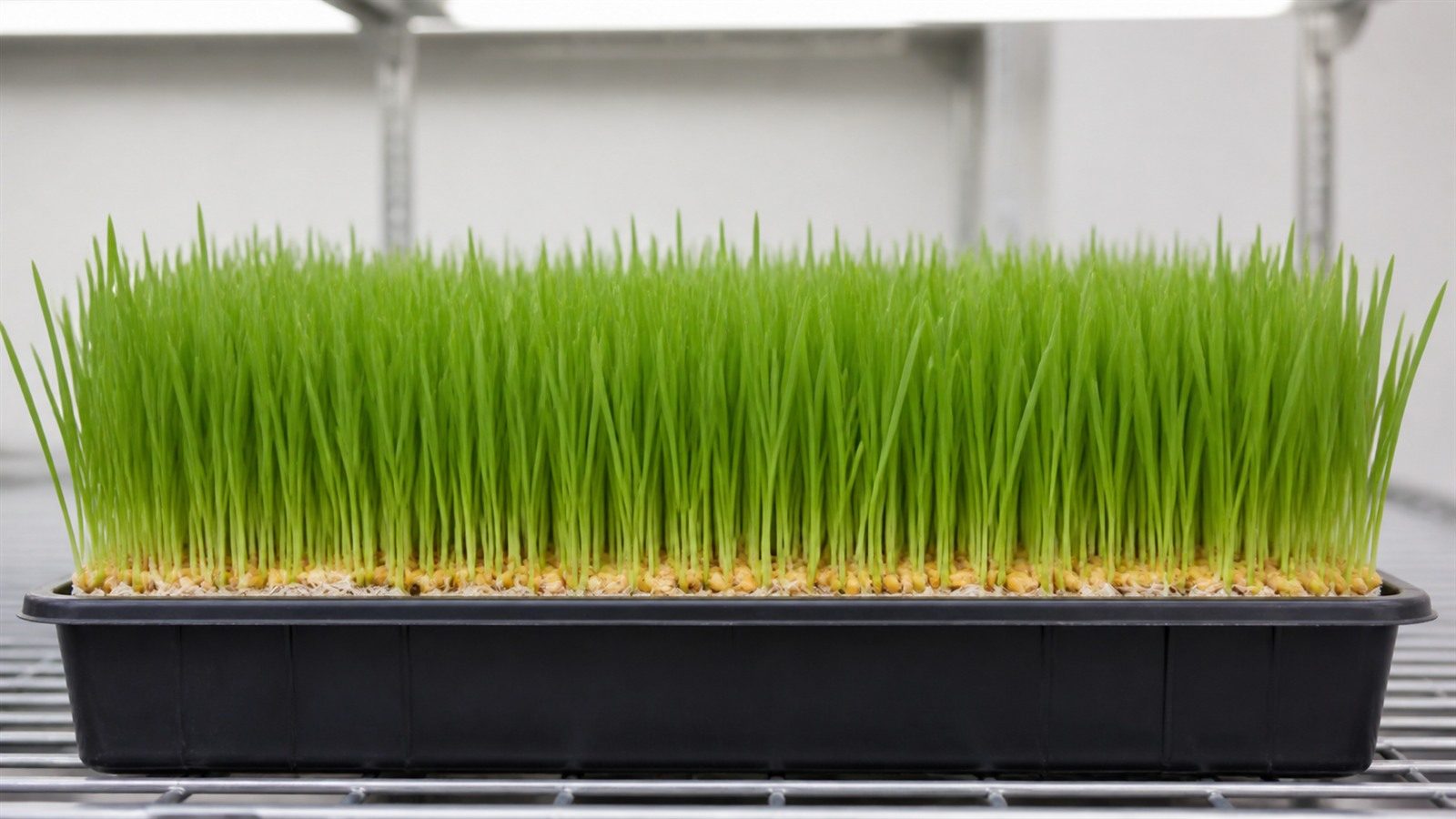
A correct tray is an even, bright green, turf-like carpet of upright narrow blades. Not cotyledons, not leaves: blades. The stand is dense and level, and at the medium line you will see pale kernels and hulls along with a white root mat, which is normal on a cereal. The crop guide's target is 12 to 15 cm tall with bright green, juicy, elastic stems, cut before or just as the second leaf starts.
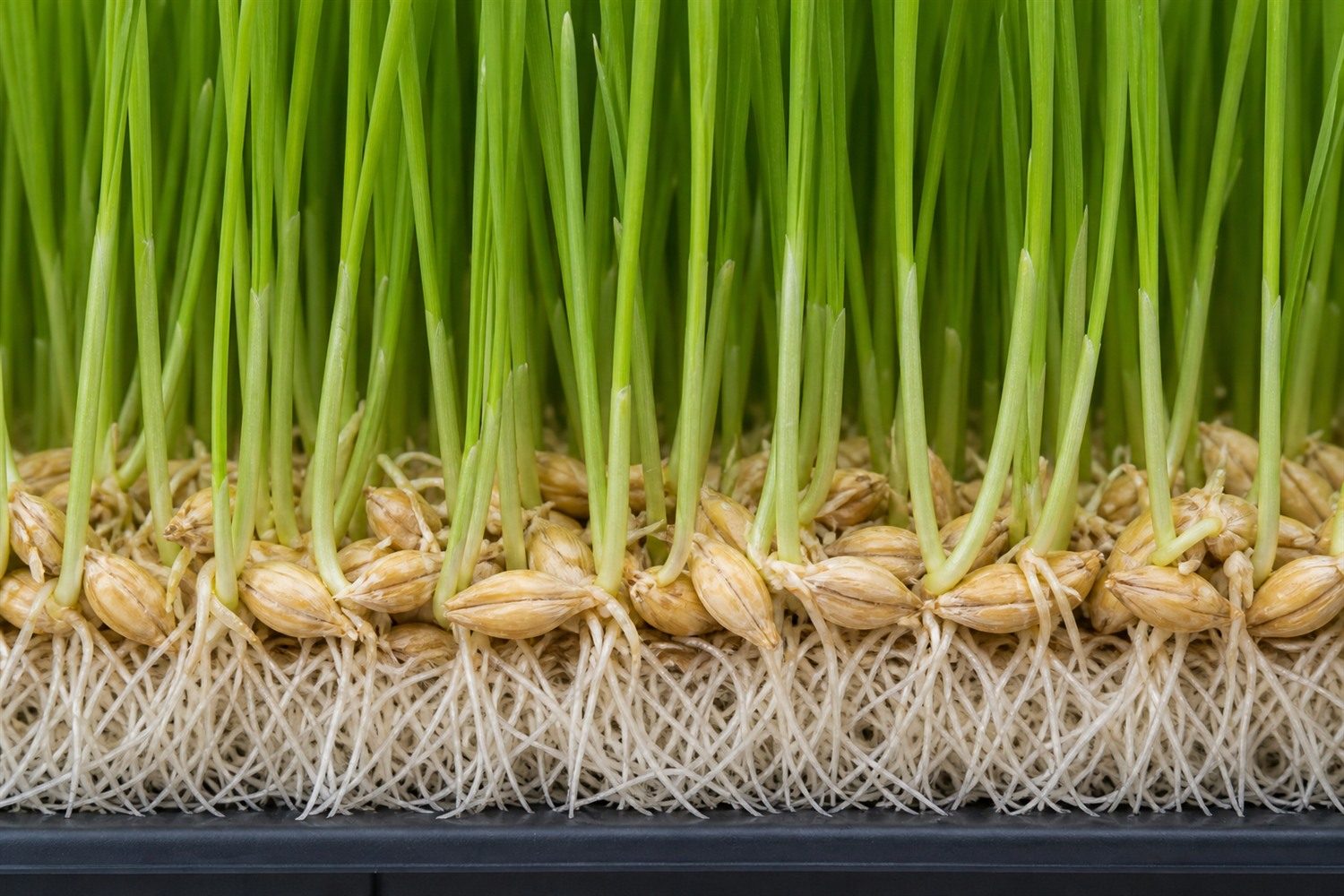
It is most easily confused with wheatgrass, and there is no honest one-glance test. Both are dense green cereal trays grown for juice at the same stage, and no botanical key in the sources opened here separates them by blade at a week old. Mature barley's awns are not a tell at this stage. The reliable answer is the seed lot: barley is Hordeum vulgare, wheat is Triticum. If you cannot trace the bag, you do not know which one you grew.
What it tastes like, and what to do with it
Mild, grassy and slightly earthy. It is a juice flavour rather than a salad one.
Its use is a juicer or a high-speed blender: a shot, a green juice, or a smoothie. The advantage of the crop is that it produces a great many narrow blades quickly, which is exactly what a juicer wants and exactly what a plate does not.
It is the wrong crop for a tossed salad, a garnish or a sandwich, and one crop guide is blunt about the consequence: customers will be dissatisfied if it is sold as a salad green. That is worth taking seriously as a commercial warning rather than a taste note. Anyone who dislikes grassy juice, fibrous texture or bitter green notes will dislike it, and cutting late makes all three worse.
Growing it: only what differs from the standard method
Everything general about trays, medium, light and watering is on the standard tray method for growing microgreens. Barley's deltas are the cereal deltas, and they are substantial.
Soak 8 to 12 hours in cold water. One guide specifies a 1 to 3 grain-to-water ratio, and suggests shortening toward 8 to 10 hours above 24C and lengthening to 12 to 14 below 16C. Too short and the kernels do not imbibe evenly; too long, especially warm, and the soak sours. Note that the specified temperature is only "cold water": nobody publishes a number.
Sow one dense layer, and never two. This is the single most consequential instruction on the page. A kernel sitting on another kernel has no air access and rots, and the crop guide is explicit that stacked grain is where trays are lost. Dense but flat, every kernel touching medium.
Weight it, properly. About 15 lb on a 10x20 for two to three days, then one to two days of blackout with the weight off. On a cereal the weight is doing a real mechanical job: it holds the emerging radicles into the medium so the grain roots down instead of lifting off as a carpet. One guide notes barley can lift 1 to 1.5 kg on its own, which is why a token weight is not enough. Take it off when the seedlings are visibly lifting the top tray.
Airflow is not optional here. The crop guide calls a fan mandatory in a dense cereal lawn. This is the crop's defining risk: a thick mat holds water between the stems, and webby mold in the stems is the failure that recurs across every barley source opened for this page. No source publishes an airflow target, so the requirement is established and the number is not.
Bottom water once or twice a day, and read the tips. A dense cereal mat drinks fast and evaporates hard. Yellow, dry tips mean it is short of water. Standing water between blades means the opposite and is more dangerous. One grower's system runs a cup twice daily per 10x20.
Do not feed it. The crop guide's position is that the seed reserves carry a crop this short, and adding fertilizer by default just adds another variable to a tray already prone to souring.
A barley grass tray, day by day
- 1
Day 0, soak
8 to 12 hours in cold water, roughly 1 part grain to 3 parts water. Shorter if the room is warm, longer if it is cold.
- 2
Day 0, sow one layer
175 to 220 g spread dense but FLAT on leveled moist medium. Two kernels deep is an anaerobic pocket, not a thicker crop.
- 3
Days 1 to 3, weighted
About 15 lb on the cover. The job is anchoring roots, not blanching stems. Off when the seedlings lift the tray.
- 4
Days 3 to 5, blackout without weight
One or two more days covered, then into light.
- 5
Days 6 to 12, grow and cut
Bottom water once or twice daily, fan running. Cut at 12 to 15 cm, before or just as the second leaf appears, and no later than about day 12.
What goes wrong with barley grass specifically
At the soak, a bad lot announces itself. Dirty, old, treated or feed grain brings poor germination, odor, insects or early mold. Debris in the water and a sour smell after soaking are the tells. A heavily suspect lot is not recoverable as food, and this is the one crop here where the seed's provenance is a genuine safety question rather than a quality one, because feed barley is a real and cheap thing to buy by accident.
Under weight, a lifted cap. Uneven root contact and the whole grain layer rises as a mat with roots on top instead of in the medium. Caught early it is fixable: level it, press it back, correct the weight. Left alone the tray never roots properly.
In blackout and light, webbing and sour smell. The signature barley failure. A web between the stems, a sour smell, soft brown kernel patches, or water standing in the mat. Expose it, drain it, get air moving. A localized patch can be isolated; a widely webbed, sour tray is not a food crop, and on a juice crop that is an easy thing to talk yourself out of.
At the end, fibrous and bitter. Past the window the second leaf advances, the stems toughen, and the juice darkens and turns bitter. There is no fixing it by cutting later. The crop guide puts the loss at beyond about 14 days.
The barley tray's two water failures, and they look nothing alike
Hover or tap a card to highlight it.
Too little
Yellow, drying blade tips on a mat that is otherwise green and upright. Fix it promptly with bottom water; this one is recoverable.
Too much
Water standing between the blades, a web forming in the stems, a sour smell, soft brown patches at the kernel layer.
Why it matters more here
A cereal mat is denser than any brassica canopy, so it both drinks faster and holds water longer. The same tray can be thirsty at the top and drowning at the base.
The lever
Airflow, not watering schedule. A fan below or beside the tray is described as mandatory on this crop, and it is the difference between the two failures above.
The limit
Rot at or below the medium line is damping-off and the tray is finished. Only a lab names an organism, and on a crop that goes into a juicer, doubt resolves toward discarding.
Nutrition, and what is actually established
Very little, against an enormous amount of marketing.
There is no USDA record for barley grass, searched 2026-08-08. Mature barley grain values and branded barley grass powder records are not substitutes for a fresh cut grass.
There is one peer-reviewed study, a 2021 hydroponic experiment on a named barley cultivar grown for nine days. It measured fresh weight, chlorophyll, minerals, total polyphenols, total flavonoids and luteolin, and found that nutrient solution increased growth and yield against a control and raised flavonoid and luteolin content in the extract. That is a real measurement of what is in the plant under one set of conditions. It is not a nutrition panel, not a serving size, and not a health outcome.
What is not supported by anything opened here: that barley grass is a proven superfood, that it detoxifies, that it treats or prevents disease, or that it delivers a standard amount of any vitamin or mineral per serving. Promotional "extremely healthy" language on a seed page is not a nutrient analysis, and the digestion, energy and immunity claims circulating this month have no source behind them in this research.
One distinction worth holding onto, because the marketing blurs it deliberately: powder is not this crop. Barley grass powder is dried and milled, often from field-grown grass, and whatever is or is not true of it does not transfer to a tray you cut and juice this afternoon. If you are growing barley grass, you are making a fresh juice about which almost nothing has been published.
Which seed to buy
This is the section that actually saves money on this crop, because the rate is so high that sourcing dominates everything else.
Buy it labeled for sprouting, microgreens or food use, with a traceable lot and untreated status. Refuse dyed pink or green seed and any field seed with undisclosed treatment, and specifically avoid anonymous feed grain, which crop guidance warns may carry mold, insects or chemical preservatives. On a crop you soak for twelve hours and then juice, that is not a fussy preference.
Hulled or hulless is the only real varietal choice. Hulless is reported to imbibe more evenly and leave less chaff in the cut grass. No source gives a validated stem length, harvest day or yield comparison between them, so buy hulless if the price is close and you dislike picking chaff out of a juicer.
And buy the biggest bag you will actually use. Barley grass seed on Amazon is a reasonable route, and checking it on 2026-08-08 makes the point better than any argument: 1 lb bags listed around $11.99 to $12.84, 2.5 lb at $16.85, 5 lb at $32.96, and 30 lb at $85.35. That is $11.99 a pound at the small end and $2.85 a pound at the large end, a 4.2x spread on the identical commodity. At 200 g a tray it is the difference between roughly $5.30 and roughly $1.26 per tray, every tray, forever.
A bad lot shows as no clear harvest or lot history, dust and debris, insect evidence, treatment coloration, a sour or moldy smell after soaking, and erratic emergence. The cost is dead spots, an uneven mat, disease spread through a dense stand and often the whole tray.
Is it worth growing?
Yes for a specific person, and that person owns a juicer.
Grow it if you juice or blend regularly and want fresh grass rather than powder, if you have an established juice-shot buyer, or for the pet grass niche. It is workable for a beginner who can soak, weigh, bottom water and run a fan, though the dense mat is genuinely less forgiving of overwatering than a brassica tray.
Do not grow it if you want something to eat as a green. Do not grow it in one-pound bags if you intend to keep growing it. And do not build a business plan on a yield figure, because there is not one: nobody has published ounces per tray for barley grass, so any revenue projection has to start with your own weighed trial at your own cut height.
Its direct rival is wheatgrass, which occupies the same juicing tray and has the same problem, no published yield. The two are close enough that no source opened for this page supports a numeric claim that either beats the other on yield, flavor or nutrition, and this site is not going to invent one. What can be said is that barley's seed rate is less than half wheatgrass's 450 g, which is a real and checkable advantage on a crop where seed is the dominant input.
A note on the numbers above
Hover or tap a row to highlight it.
| Figure | Value | Source | What kind of number it is |
|---|---|---|---|
| Days to harvest | 6 to 10 | Two independent suppliers | Both state it, neither states a temperature |
| Days to harvest | 7 to 9 in light after 3 days dark | A crop grow guide | A juice-grass schedule to 12 to 15 cm, cut by about day 12 |
| Seed per 1020 | 175 to 200 g | One grower guide, summary | Asserted practice |
| Seed per 1020 | 200 to 220 g | The same guide, step-by-step | Its own two figures differ, hence the range |
| Seed per 1020 | No figure | Johnny's 2017 trial | Barley was not one of the 29 varieties |
| Yield per 1020 | No figure | Nobody | The one study measured day-9 fresh weight with no tray area or seed mass |
| Soak | 8 to 12 h, or 10 to 12 h cold at 1:3 | Two crop sources | Practice guidance. "Cold" is the only temperature stated |
| Weight | About 15 lb on a 10x20 | One grower guide | For root anchorage. Barley can lift 1 to 1.5 kg unaided |
| Germination temperature | No figure | Nobody | A guide stacks at 18 to 24C; that is practice, not a germination test |
| Shelf life | Up to 7 days refrigerated | One grower guide | Sealed container, temperature unstated |
| Harvest window | No figure | Nobody | The signal is 12 to 15 cm and the second leaf, not a number of days |
| Regrows | No | A crop grow guide | Stated plainly at the 12 to 15 cm juice harvest |
| Seed price | $19.99/lb at 1 lb | SeedsNow, listed 2026-08-08 | Retail small-pack pricing |
| Seed price | $11.99 to $2.85/lb | Amazon, 1 lb to 30 lb, checked 2026-08-08 | A 4.2x spread on the same commodity by pack size |
| Nutrition | Chlorophyll, minerals, polyphenols, flavonoids, luteolin | 2021 hydroponic study, day 9 | Composition under one set of conditions. Not a panel, not an outcome |
| Nutrition, USDA | No record | USDA FoodData Central | Searched 2026-08-08 |
Barley grass cannot complete the comparison table, and it is the fifth crop that cannot.
Hover or tap a row to highlight it.
| Crop | Seed per 1020 | Yield | Days | Cost per tray | Oz per $1 | Oz per tray-day |
|---|---|---|---|---|---|---|
| Barley grass | 175 to 220 g | No published figure | 6 to 12 | $7.72 to $9.69 at 1 lb retail | cannot be calculated | cannot be calculated |
| Popcorn shoots | 142 to 227 g | No published figure | 6 to 14 | $5.80 to $9.28 at 1 lb | cannot be calculated | cannot be calculated |
| Wheatgrass | 450 g | No published figure | 7 to 12 | $3.10 | cannot be calculated | cannot be calculated |
A blank means nobody has published that figure, so the cell is left empty rather than filled with an estimate. How the numbers work
All 62 crops, sortable, on the microgreen comparison.
Where you buy matters more than what you buy on this crop. Across fourteen crops the pattern has been that seed price per pound predicts nothing about cost per tray, because the RATE does the work: mustard is $88 a pound and $1.56 a tray, chia is $12 a pound and $0.78.
Barley grass adds the other half. At 200 grams a tray, the rate is so high that pack size becomes the dominant term. The same barley moves from $2.85 to $11.99 a pound depending on nothing but how much you buy at once, which is a swing of about four dollars a tray. On broccoli at 13 g a tray the identical spread would move the cost by about eleven cents and nobody would notice.
So, the complete rule, on the evidence of this bench: for a light-seeding crop the rate decides your cost and the shelf price is noise; for a heavy-seeding crop the pack size decides it and everything else is noise. Barley grass, wheatgrass and spinach are where that second half applies, and they are precisely the crops where a home grower is most likely to be buying the small bag.
Terms on this page
Tap a term to see what it means.
Poaceae. The grass family. Barley, wheat, corn and rice. In a tray it means blades from a large kernel, sown thick and cut for juice.
Sources
- SeedsNow, sprouts and microgreens barley grass seeds - 6 to 10 days from sowing, raw natural untreated certified organic seed described as ideal for juicing, the tray photography behind the appearance description, and the $19.99/lb price behind the seed cost, listed 2026-08-08.
- Microgreen Silo, barley grass guide - 6 to 10 days, 175 to 200 g in summary and 200 to 220 g in the steps, an 8 to 12 hour soak, 2 to 3 days under about 15 lb then 1 to 2 days blackout, a cup of water twice daily per 10x20, up to 7 days refrigerated sealed, hulled against hulless, and the smoothie and juice uses.
- UA Organic, barley grow card - the 10 to 12 hour cold soak at 1 to 3, the 18 to 24C dark stack and slowdown below 14C, at least 2 kg of weight and barley lifting 1 to 1.5 kg unaided, mandatory ventilation, bottom watering once or twice daily with yellow dry tips as the shortage signal, single-layer sowing with stacked grain rotting from loss of air, webby mold as the recurring failure, the 12 to 15 cm harvest before the second leaf, no regrowth, fibrous bitter stems and darker juice past about day 14, the warning against selling it as a salad green, seed reserves carrying the crop without fertilizer, and the feed-grain sourcing warnings.
- Kew, Plants of the World Online: Hordeum vulgare - the accepted name and placement in Poaceae.
- Johnny's microgreens yield trial results (PDF) - the 29-variety chart that contains no barley line.
- Johnny's yield trial, method and discussion - 1020 flats with seed weighed by packet difference, harvest at first true leaf, and the warning that yields vary with procedure, technique, system, conditions, harvest stage and seed lot.
- Journal of Plant Biotechnology, 2021, hydroponic Hordeum vulgare cv. Hangmaeg - a 9-day crop measured for fresh weight, chlorophyll, minerals, total polyphenols, total flavonoids and luteolin, with a significant nutrient-solution effect on growth and yield.
- Virginia Tech Extension SPES-756 (PDF) - the general 60 to 70F microgreen operating range, packaged storage in the dark at 41F, and the foundations of weighed even seed distribution, drainage and sanitation.
- UC IPM, damping-off - Pythium and Rhizoctonia, seed killed before emergence, and rot at or below the medium line.
- USDA FoodData Central - searched for barley grass microgreens on 2026-08-08, no record located.
Keep reading
The variety directory
Wheatgrass
The crop you juice rather than eat. It takes 450 g of soaked kernels to a 1020 tray, the heaviest sowing of any microgreen, and cuts at 3 to 6 inches in 7 to 12 days.
Read WheatgrassThe variety directory
Popcorn shoots
Grown in complete darkness from sowing to harvest, which is what makes it sweet and yellow, and also why the one study that measured it puts it at the bottom of 25 crops for carotenoids.
Read Popcorn shootsThe variety directory
Chickpea shoots
One of the very few crops with real regrowth data behind it: a measured second cut at 96 percent of the first, if you cut above a node instead of at the medium line.
Read Chickpea shootsThe variety directory
Sunflower microgreens
The heaviest tray you can grow, at about 18.8 oz, and the only one that needs a soak, a weight and daily hull-brushing. Published seed rates run from 48 g to 250 g a tray, more than five times apart.
Read Sunflower microgreens