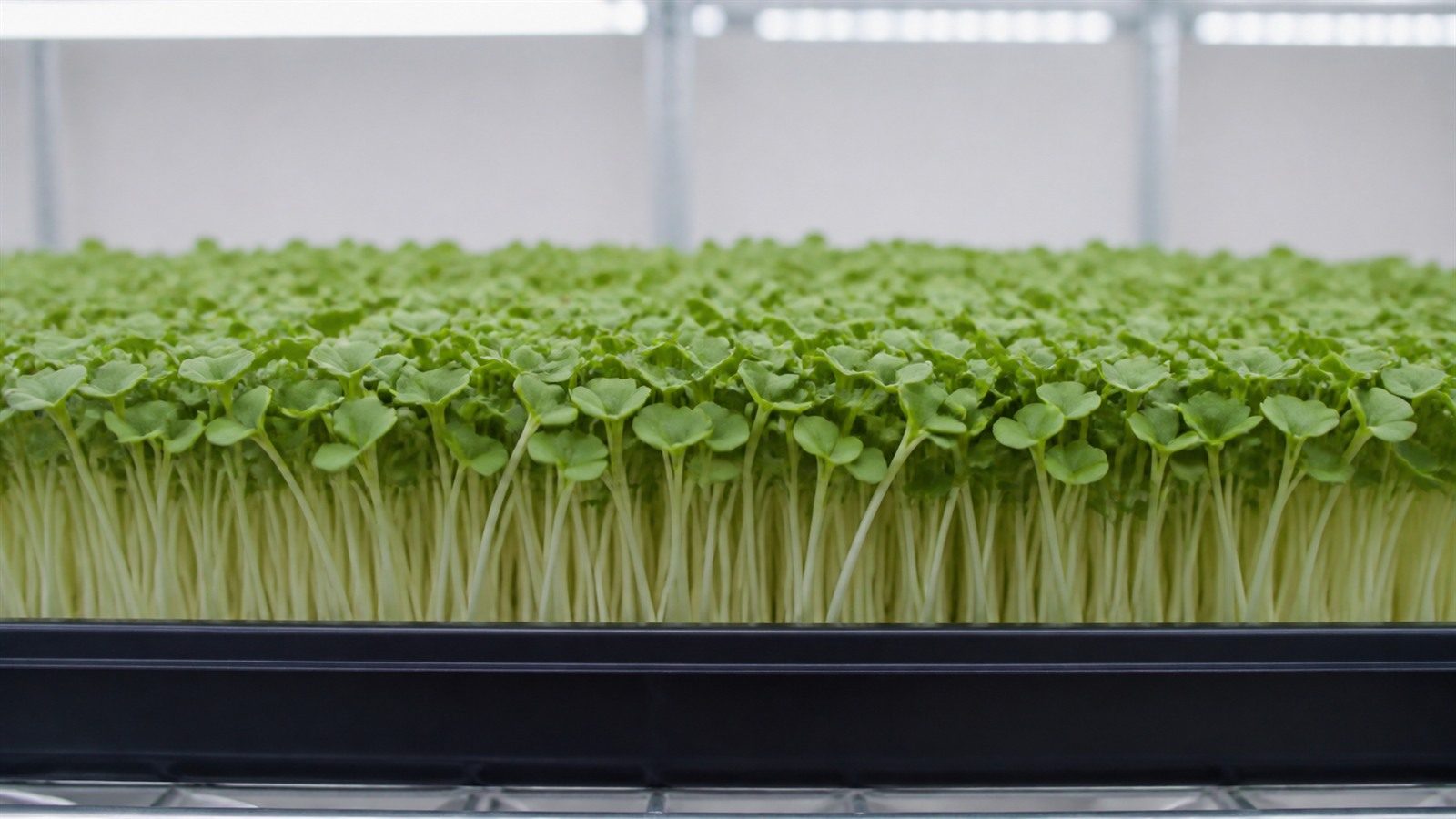
At a glance
Fast even germination from small dry seed with no soak, but sown dense enough that too much water or too little airflow turns the base of the canopy into a mold problem.
- Botanical name
- Brassica oleracea var. italica
- Also sold as
- Broccoli microgreen seed (conventional or organic), Waltham 29, Di Ciccio, Purple Sprouting Broccoli
- Family
- brassica
- Difficulty
- Beginner
- Days to harvest
- 7 to 15 days
- Harvest window
- No published figure
- Soak
- None
- Blackout
- 2 to 4 days
- Germination temperature
- 65 to 75 °F
- Yield per 1020 tray
- 11.5 oz
- Mold risk
- Medium
- Hull shedding
- some
- Shelf life
- 5 to 14 days
- Eaten as
- raw
- Seed cost per tray
- $0.79
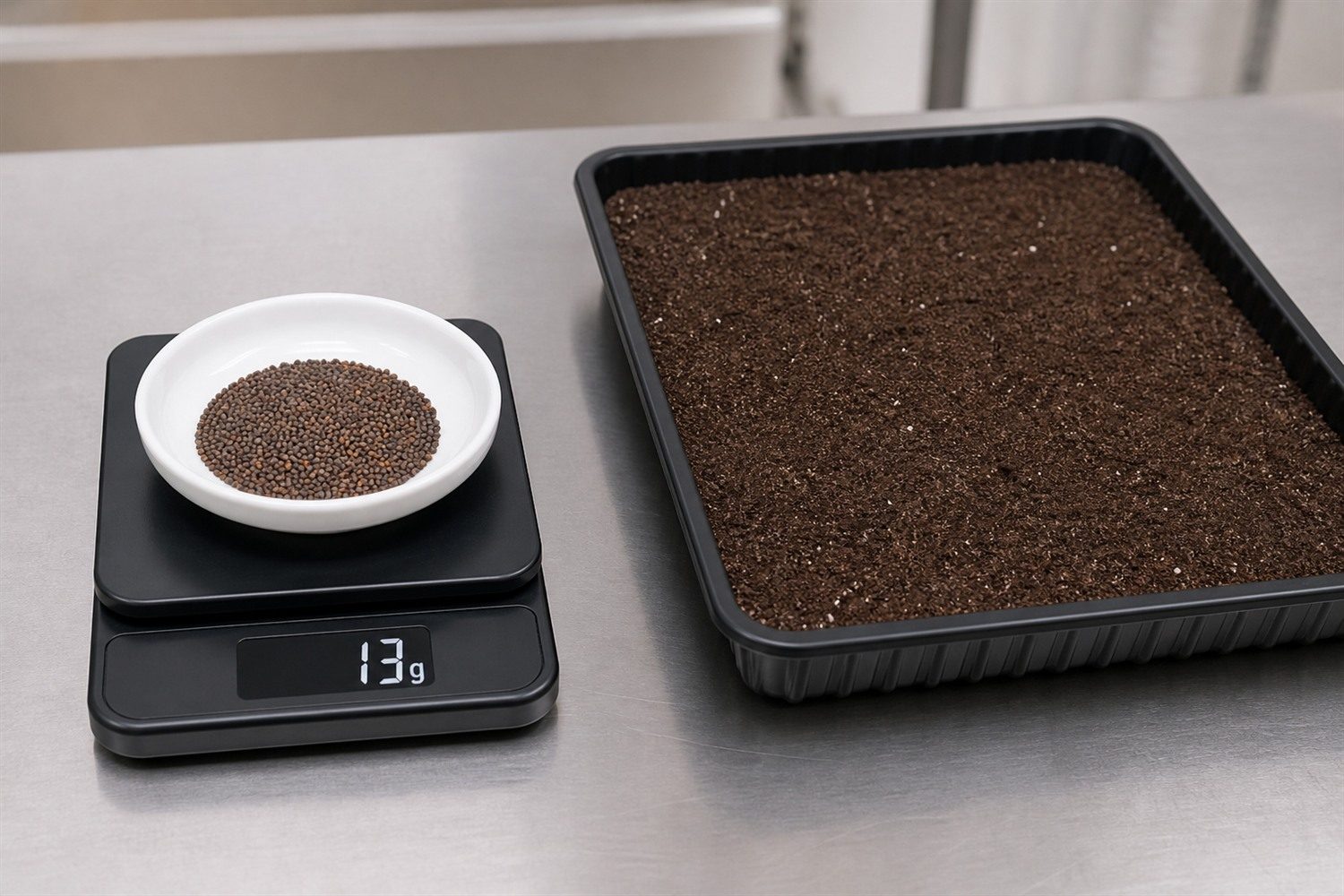
13 g at $27.60/lb, Johnny's organic broccoli microgreen seed, listed 2026-08-08. Seed only, excludes medium, tray, labor, light and loss.
Any field name above ranks every variety by it. No published figure means we researched it and nobody has established one, which is different from not yet researched. Every figure here is sourced at the bottom of the page. Compare every variety side by side.
Broccoli is the tray most people start with, and it earns that. The seed is small and dry so there is nothing to soak, it germinates in two or three days, and it comes up as an even upright stand that cuts cleanly in a single pass. It is mild enough to eat by the handful rather than the pinch, which is the other reason it stays in most rotations once it is in.
Thirteen grams of seed fills a 1020 tray. Johnny's grew it out in a greenhouse trial and cut 11.5 oz at first true leaf, averaging 12.5 days, which puts the seed cost around 79 cents a tray. Weigh the 13 g before you sow it. In the dish it looks like nowhere near enough to cover a tray, and the instinct is to double it, which buys you a denser canopy with worse airflow and a mold problem at the base.
What it is, and how to tell you grew it right
Broccoli microgreens are seedlings of Brassica oleracea var. italica, the same species as the mature head, grown in a medium and cut above the soil line at cotyledon or first-true-leaf stage.
They are not broccoli sprouts, and the two get used interchangeably often enough that it is worth pinning down. A sprout is germinated seed grown in water and eaten whole, seed and root included. A microgreen is grown in a medium, cut above the soil line, and the seed stays behind. That difference decides which food-safety rules apply to you: sprouts fall under Subpart M of the FDA Produce Safety Rule and cut microgreens do not, so anyone growing to sell should read how the FDA separates sprouts from microgreens before pricing anything. It also decides which research applies, because the well-known sulforaphane work was done on sprouts.
A correct tray reads as a very dense, very even canopy of small rounded mid-green cotyledons on fine white stems, roughly 1.5 to 3 inches tall in the grower system these figures come from. It is the tidiest stand of the common varieties, and that tidiness is what to judge it by. At the medium line there is a white mat of roots, and the medium should be moist rather than glossy wet or slimy. Johnny's harvest standard in its yield trial was first true leaf, so a tray held to that point is not overgrown, it is at the benchmark.
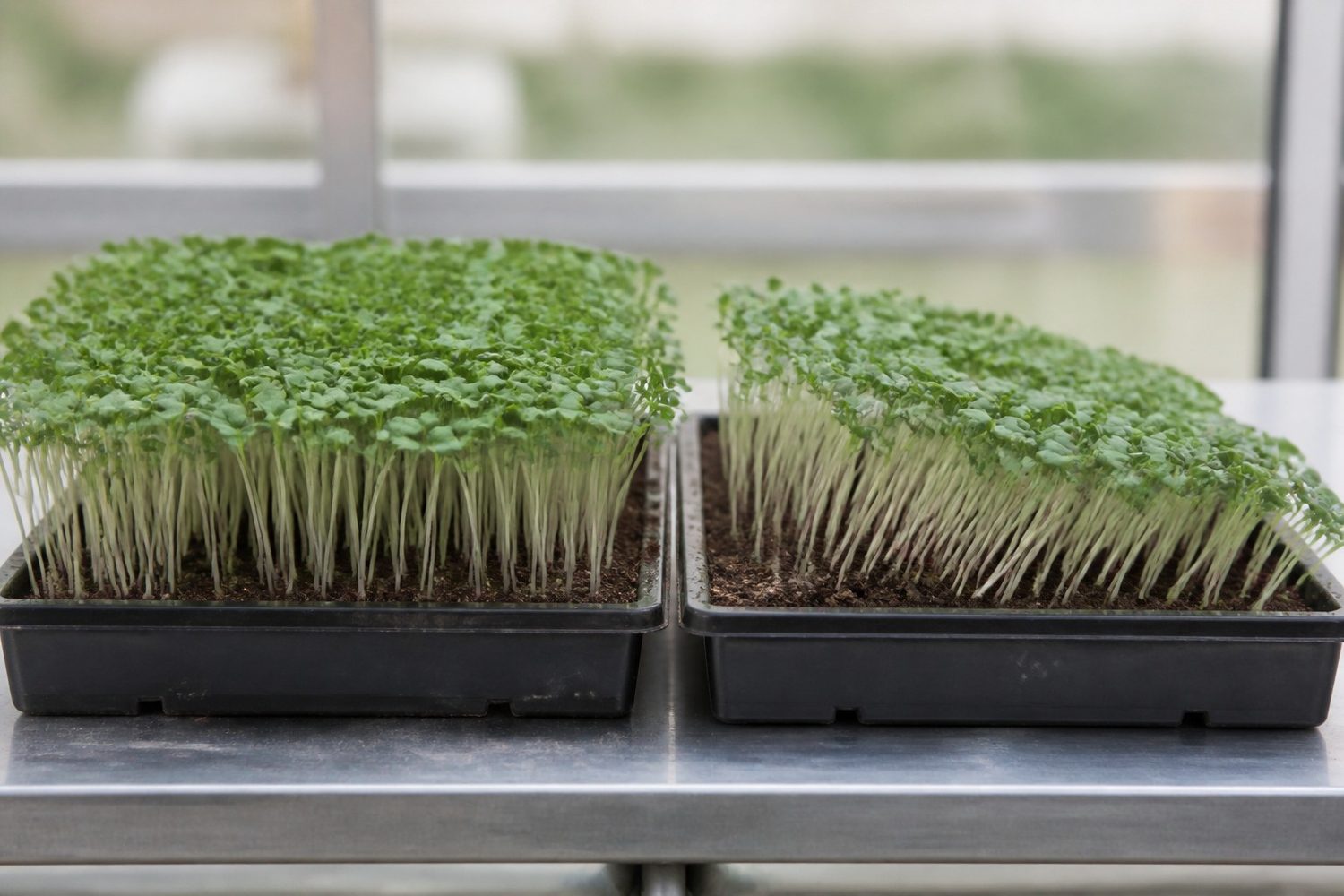
Broccoli and kale microgreens are near enough identical at cotyledon stage, and color is not the tell. The honest difference is how the stand carries itself: kale's fine stems start to lean under their own canopy while broccoli holds a more even upright stand. The reliable separator arrives later, at the first true leaf, which develops in the broccoli direction rather than the textured curl of a kale leaf. Anyone naming the two from seed leaves alone is guessing.
What growers are saying right now
Sampled from public posts and videos, 9 July to 8 August 2026. Every line links what it is quoting. How often something is repeated is not evidence that it is true, so every line also says what the sources actually establish.
Broccoli microgreens are about 40 times more nutritious than mature broccoli
Circulating Said in the opening fifteen seconds of Princeton Microgreens' broccoli how-to, the most-watched in the window at 83,458 views and 2,248 likes, and repeated in shorter clips like this one alongside the sulforaphane pitch
Not established, and not establishable as a single number. The ratio changes with the compound measured, the cultivar, the harvest stage, the light, and whether you compare fresh or dry weight. What the research does support is narrower and still worth knowing. What is actually established
Seed to harvest in nine days
Circulating Claimed here as one of the fastest foods you can grow, usually next to the nutrition claim
True at the early cut, and not in conflict with anything. Nine days is open cotyledons with true leaves barely starting. Johnny's 12.5-day trial average is to first true leaf. Same crop, different harvest stage, and the yield figures belong to the later one.
Twenty grams of seed per flat
Circulating Weighed out on camera and said aloud in the same how-to
Johnny's measured trial rate is 13 g per 1020. Twenty grams is one working system's practice and it is not wrong, but it is roughly 50 percent more seed for a benchmark that was set at 13. Where each number comes from
Will they regrow once I cut them, or do I start over?
Circulating Asked by a viewer under this 77,369-view growing reel, and it is a standing question under grow-alongs
You start over. Cutting a microgreen removes the growing point and broccoli does not put up a second useful crop. Corn is the microgreen usually named for a second cut, not broccoli.
Is this root hairs or is it mold?
Circulating The category's most repeated panic post, usually at day three or four. This one is a first-time grower asking at day four
There is a five-second test and it is worth knowing before you throw a tray out. Root hairs or mold
What it tastes like, and what to do with it
Mild, fresh, and recognizably brassica, with a faint bite rather than heat. Johnny's describes it simply as mild broccoli flavor. There is none of radish or arugula's pepper in it, and none of the sulfur note that cooked mature broccoli picks up. It reads as a fresh green, not as a condiment.
That decides what it is for. Broccoli is the microgreen you use in quantity when a dish needs a fresh green layer and nothing sharper: piled on avocado toast, laid over a burger or a taco once it is off the heat, through a grain bowl or a salad, or on eggs after the pan comes off. It carries a lot of visual volume for its weight, which is why it earns its place in mixed packs and on plates that need to look green without tasting louder.
It is the wrong choice in two cases. If you want a deliberate peppery hit, radish or mustard delivers it and broccoli will not at any density. If you want crunch and bulk, pea or sunflower does that job; broccoli is a tender layering green, not a salad base.
Some people will not like it. Anyone who cannot get past a mild cabbage note is not going to be persuaded, and anyone buying it expecting the crunch and substance of mature broccoli will find it grassy and insubstantial instead. Both objections are about fit rather than about how it was grown, and neither is fixable in the tray.
Using it in the kitchen, and the one instruction with a mechanism behind it
Broccoli is the mild all-rounder, so most published uses put it somewhere it will not be noticed: smoothies, pesto, a salad, a bowl. The amounts are unusually concrete for this category.
Hover or tap a row to highlight it.
| Amount | Dish | When it goes in |
|---|---|---|
| About 15 g, called a small handful | Morning smoothie with banana, mango, oat milk and chia | Blended cold, 60 seconds, drunk immediately |
| 1 oz | Super smoothie, "or to taste" | Cold |
| 1/2 cup | Cocoa smoothie | Cold |
| 1 cup, loosely packed | Pesto with basil, pine nuts, parmesan and lemon | Blended cold, then see the 90-second rule below |
| 1 cup | Salad with feta, cucumber, tomato and lemon vinaigrette | Raw |
| 1 cup | Stir-fry with florets, pepper, carrot and sesame | Tossed in just before serving |
| Not stated | Pork roast with rosemary and thyme | After the roast has rested 10 to 15 minutes |
Use the 15 g row if you want a figure you can repeat. It is the only weighed amount in the table; the rest are volumes or an unmeasured handful, and volume varies with how hard you pack it. Fifteen grams is also the closest thing here to a smoothie serving.
Recipes calling for "2 scoops" or "3 scoops" of broccoli microgreen powder are a different product and a different question. A scoop has no weight, and dried powder does not tell you what to do with a fresh tray.
What a tray gives you
A tray runs to 11.5 oz, or about 326 grams. That is:
- About 21 of the 15 g smoothies, or 11 or 12 of the 1 oz ones.
- About 130 servings at the 2.5 g garnish weight, at roughly six tenths of a cent of seed each.
At 79 cents of seed a tray, broccoli is cheap enough to keep one running permanently and mild enough that it will get used. If you only have space for one tray doing general work, this is the one.
The 90-second rule, and why it is not just fussiness
One grower's pesto recipe says something no other recipe in this whole wave says: after draining the pasta, take the pot off the heat and wait 90 seconds before tossing in the cold pesto.
The stated reason is myrosinase, the enzyme brassicas carry that converts their glucosinolates into the compounds the family is studied for. The claim is that it is destroyed above about 60°C, so dropping cold pesto into pasta straight off the boil undoes the thing you grew the crop for. Ninety seconds is enough for the pan to fall below that.
Three honest caveats, in order of importance.
- The claim comes from a grower, not a study. Myrosinase is a real enzyme and heat inactivation of it is ordinary food chemistry, but nobody has measured it on broccoli microgreens at a stated temperature and time. Take the instruction as sound reasoning rather than a tested result.
- It does not make the health claims true. The 40-times figure is still unsupported, and protecting an enzyme does not establish a benefit that was never established in the first place.
- The texture reason is enough on its own. These are small tender cotyledons. Heat wilts them. You do not need a biochemical argument to add them at the end.
What the rule does give you is a number. "Add microgreens last" is advice you cannot act on precisely; ninety seconds off the heat is.
Everything else about timing
Every reliable amount above is cold or added at the very end: tossed into the stir-fry just before serving, laid on the pork after it has rested 10 to 15 minutes, blended cold in a smoothie or a pesto. Nobody has measured a wilting time, a color change or a texture threshold for this crop, so there is no number to give you beyond the ones above. The wider cooking evidence sits here.
It has no signature dish
Unlike basil, where six of eight published recipes are pesto or Caprese, broccoli has no classic. The closest candidate is a broccoli microgreen pesto, and that recipe still calls for a full cup of basil alongside the cup of broccoli. The mild crop provides the volume and the aromatic one provides the flavor, which is broccoli's role generally, and why it turns up in smoothies more than anywhere else: it adds crop without adding taste.
Buying it and keeping it
Store it unwashed and cold, and wash only the portion you are about to eat. This entry publishes 5 to 14 days, which is toward the longer end of the directory, and every figure like it assumes the crop was never washed.
Broccoli microgreen seed on Amazon is the convenient route. At 13 g a tray and 79 cents it is one of the cheapest crops here to be wrong with, which is the other reason it is the usual first tray.
Growing it: only what differs from the standard method
Everything general about trays, medium, light and watering is on the standard tray method for growing microgreens. What broccoli does differently is short, and most of it is about restraint:
No soak. Sow it dry. The seed is small enough that soaking makes even seeding harder, not easier, and no source opened here establishes a broccoli-specific soak that improves anything. Large-seed practice does not transfer.
Broadcast on the surface, roughly an eighth to a quarter inch apart, and press for contact rather than burying it. Level the medium carefully first: in a carpet this dense, a high spot dries out and a low spot stays wet, and both show up later as patches you will blame on the seed.
Thirteen grams per 1020, not twenty-five to forty. This is the number that matters most on the page. Johnny's ran broccoli in its 29-variety trial at 13 g per 1020 tray, about 2.5 flats to the ounce of seed, and repeats it on the product page. Its own guidance is to seed lower than that if you are holding for a larger true-leaf crop, because a thinner stand has better airflow and depletes water and fertility more slowly. A commercial grower protocol runs 17 to 20 g, which is real practice rather than a controlled trial, and reads as a system-specific ceiling rather than a target.
Keep the dark period short and the weight light. A commercial protocol uses a gently weighted cover for two to three days, for root contact and an even canopy, then one more day under an unweighted dome. Take the weight off when seedlings lift the cover and you can see pale stems and yellow cotyledons underneath. No source establishes a weight in pounds for a 1020 broccoli tray, so anyone quoting you one is quoting a preference.
Warm to germinate, then cool. Johnny's brassica guidance is 75°F at the medium until germination and 60°F after it, with 65 to 75°F ambient generally favorable, and it warns that above 75°F disease pressure rises and germination can be inhibited. Virginia Tech's general range is 60 to 70°F. Beyond temperature there is no broccoli-specific case for more light, water, airflow or blackout than a default brassica program gets.
A broccoli tray, day by day
- 1
Day 0, sow dry
13 g broadcast on leveled, pre-moistened medium, pressed for contact, not buried. Medium at about 75°F until it germinates.
- 2
Days 1 to 3, weighted cover
A gently weighted cover holds the roots into the medium and brings the canopy up level. This is the phase that punishes a heavy hand with water.
- 3
Day 3 or 4, dome only
Weight off once seedlings lift the cover and you can see pale stems and yellow cotyledons. One more day under an unweighted dome.
- 4
Day 4 onward, light
Cover off, drop to around 60°F, bottom water so the foliage stays dry. The cotyledons green up and the stand should stay upright.
- 5
Days 7 to 15, cut
Watch the true leaves, not the calendar. Open cotyledons with true leaves just beginning is the early cut; first true leaf is where the 11.5 oz trial figure was measured.
What goes wrong with broccoli specifically
Failures arrive in a rough order, and knowing which stage you are in tells you whether the tray is worth saving.
Before emergence: bare patches from uneven sowing, dry spots, or seed pressed too deep. You can fix the next sowing. You cannot fix this one by adding seed to a tray that is already running.
During the dark period: waterlogged seed rot and surface mold. Pooling, a sour smell, or gray to green webbing. On a food crop this is a discard and a sanitize, not a rescue.
Just after: damping-off. Thin, water-soaked stem bases and seedlings that wilt and collapse. Pythium and Rhizoctonia are the usual organisms, and none of them are broccoli-specific: this is the general seedling disease complex, which is why clean seed, clean water, clean medium and airflow matter more than any crop-specific pest list. Once it is widespread the tray is finished.
In light: legginess and falling stems from too long in the dark, weak or distant light, or heat. Still edible if it is clean, but the tidy uniform canopy that made it worth growing is gone.
The one test worth committing to memory: root hair or mold? This is the question new growers actually ask, over and over, and on broccoli it comes up constantly because a healthy tray shows a visible white fuzz at the medium line. LSU's practical rule is the useful one: growth migrating up the stems is mold. This is a grower's diagnostic, not an identification. Only a lab names an organism.
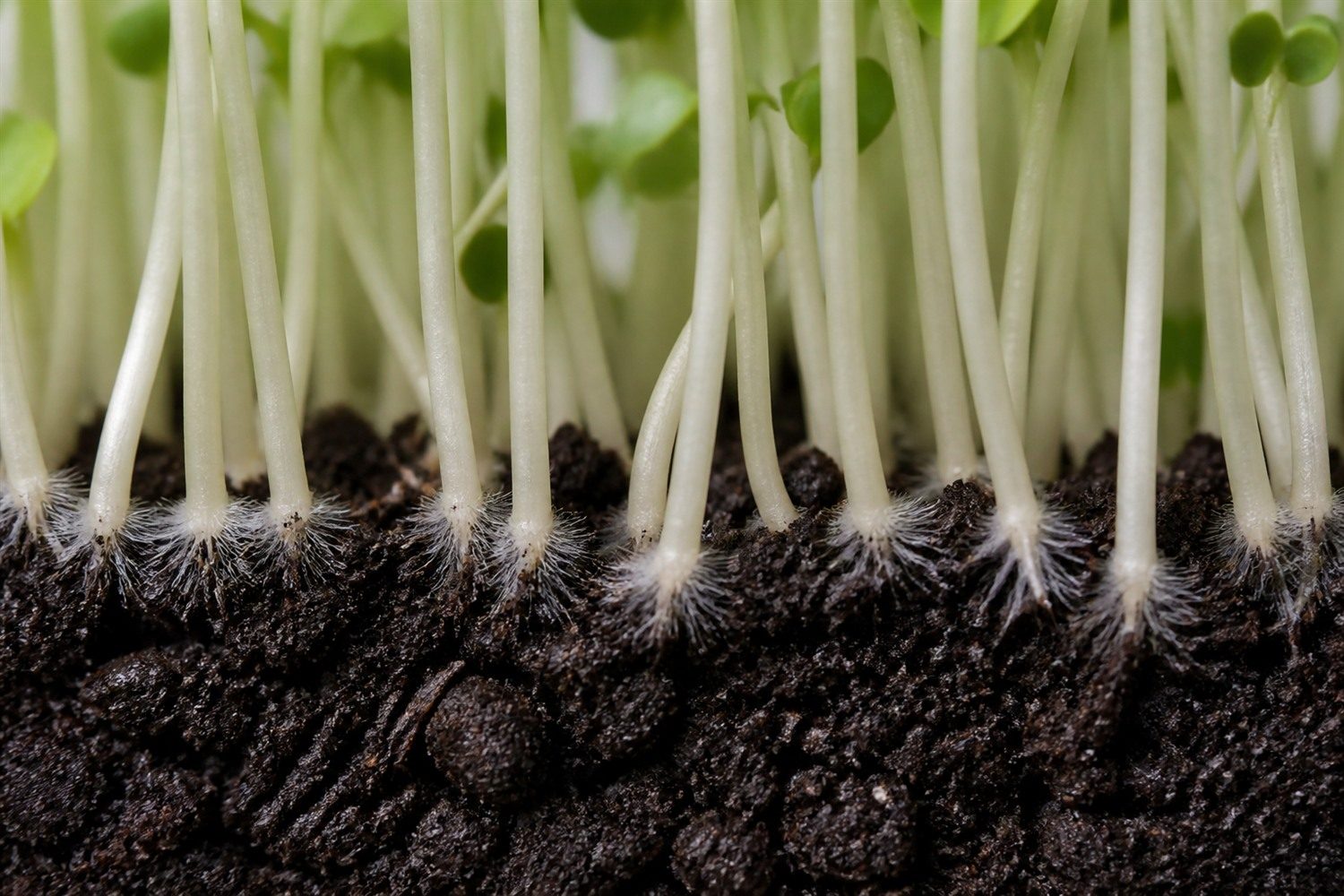
Root hairs or mold? The five-second check
Hover or tap a card to highlight it.
Where it sits
Root hairs stay at the root and medium line. Anything climbing the stems is mold.
What it looks like
Root hairs are fine, white and uniform. Mold spreads irregularly, runs gray, green or black, and can be web-like.
The mist test
Mist it. Root hairs collapse and nearly vanish, then reappear as the area dries. Mold does not care.
The smell
Healthy trays smell of nothing much. Musty or sour is mold, and smell is the tell people ignore longest.
What it means
Root hairs mean the tray is working. Mold on a food crop means discard and sanitize, not rinse and hope.
Broccoli also holds onto some seed coats, though as a small-seeded crop it is a minor handling job rather than the defining problem it is on sunflower or pea. A weighted cover helps the stand push free of them. Nobody publishes a retention percentage for broccoli, so budget for a little cleanup and do not expect a number.
Harvested late, it stops being the crop you sold. True leaves expand rather than merely beginning, stems lengthen and coarsen, and the even canopy turns leafy. You can see it before you cut. What no controlled study gives is the penalty per day past the mark, in flavor, tenderness or yield, so the honest instruction is to watch the true leaves rather than the calendar.
Nutrition, and what is actually established
The figure attached to broccoli microgreens is usually 40 times the nutrition of mature broccoli, sometimes 100. There is no such number.
A ratio like that has to say what is being compared, and this one never does. It moves with the compound measured, the cultivar, the harvest stage, the light, the substrate, and whether you weigh fresh or dried. Change any one and the multiple changes, so there is no single figure to quote. Sulforaphane is the compound behind most of the health claims, and most of that research used broccoli sprouts, which are grown in water and eaten seed, root and all. Different food, different numbers.
What has been measured is narrower and more useful. Marchioni and colleagues (2021) analyzed broccoli microgreens alongside daikon, mustard, rocket and watercress for chlorophylls, polyphenols, carotenoids, anthocyanins, ascorbic acid, sugars, antioxidant activity and isothiocyanate composition. Broccoli came out highest for polyphenols, carotenoids and chlorophyll, with good antioxidant activity, and its dominant essential-oil isothiocyanate was 4-pentenyl isothiocyanate. That is a comparison among microgreens, not a serving-size table and not a health outcome.
USDA FoodData Central holds broccoli microgreens only as a branded label record (FDC ID 2480548, a 14 g serving that declares 0 kcal by permitted rounding), not as an analyzed generic food. Mature broccoli values are not a substitute, and neither is a broccoli sprout record.
Which seed to buy
Four types are sold, and they differ less than the marketing suggests. Regular broccoli gives a reliable even canopy and is the sensible default. Waltham 29 is reported as dense deep-green trays with uniform cotyledons, Di Ciccio as leggier with smaller cotyledons, and purple sprouting broccoli gives purple-tinged stems for presentation. All four descriptions come from one commercial grower's observation rather than replicated trials, so treat them as leads rather than specifications. Note too that neither of Johnny's broccoli offerings names a cultivar at all: conventional and organic are production status, not variety.
Specify seed sold for microgreen or sprouting food use, ask for the lot germination information if the supplier publishes it, and insist on untreated seed. Seed coated with fungicide or insecticide is not appropriate for a crop whose young tissue is eaten whole a week later, and rinsing does not make a treatment safe. Organic is a production and positioning choice; untreated food-use is the actual safety requirement.
A bad lot looks like poor or uneven emergence on a tray that is level and evenly moist: bare patches, late seedlings, a thin canopy. The cost is not just the seed, it is the saleable ounces, the tray time and a missed harvest date. Johnny's lists seed lot among the causes of yield variation, and no broccoli-specific loss figure exists to put a number on it.
Broccoli microgreen seed on Amazon is the convenient route for a home grower. If you intend to sell what you grow, buy from a supplier who will name the lot.
Is it worth growing?
Yes, and it is the right first tray for most people. It suits a beginner who wants something fast, mild and tidy; a home grower who does not want to manage a soak; and a market grower who now has a real published starting point rather than a guess. Choose something else if your buyer wants a spicy garnish, if they want crunch and bulk, or if you were hoping for a crop that cuts twice. Broccoli does not regrow meaningfully: cutting a microgreen removes the growing point, and there is no second harvest to plan around.
Its real competition is the other mild green brassicas, kale, cabbage, pac choi and kohlrabi, all chasing the same dense-tender-mild slot in a rotation. They win when a customer wants something broccoli cannot give: purple or red stem color, a sharper bite, or a named cultivar look. Broccoli wins on the even all-green stand, the mild flavor that lets people eat a lot of it, and being the one crop in the group with a published 13 g and 11.5 oz benchmark to plan against.
A note on the numbers above
Hover or tap a row to highlight it.
| Figure | Value | Source | What kind of number it is |
|---|---|---|---|
| Seed per 1020 | 13 g | Johnny's 2017 trial | Measured, at first true leaf |
| Seed per 1020 | 17 to 20 g | On The Grow protocol | One commercial system's practice |
| Yield per 1020 | 11.5 oz | Johnny's 2017 trial | Measured, at first true leaf, single trial |
| Days to harvest | 12.5 average | Johnny's 2017 trial | Measured, to first true leaf |
| Days to harvest | 10 to 15 | Johnny's product page | Published range, no stage stated |
| Days to harvest | 7 to 10 | On The Grow protocol | Earlier harvest target, cotyledon stage |
| Shelf life | 5 to 10 days | Johnny's | Refrigerated, no temperature or package stated |
| Shelf life | Up to 14 days | LSU AgCenter | Airtight container, refrigerated |
| Germination temperature | 75°F then 60°F | Johnny's brassica guidance | Crop guidance, not a trial |
| Harvest window | Not published | No source | Watch the true leaves instead |
The yield figure is one measurement, and one measurement is not a fact yet. Johnny's 11.5 oz per 1020 comes from at least three seedings in its 2017 greenhouse trial, at 13 g of seed, harvested at first true leaf. The sheet rounds to the nearest half unit and says plainly that figures vary with procedure, system, conditions, harvest stage and seed lot, and warns that one grower's yields are unlikely to transfer to another's. No second independently measured broccoli 1020 yield turned up. Weigh your own trays before you price anything.
Days to harvest spans 7 to 15 because the sources measure different harvest targets, not because they disagree. Johnny's trial averaged 12.5 days to first true leaf and its product page says 10 to 15. A grower harvesting earlier, at open cotyledons with true leaves only beginning, reports 7 to 10, stretching to 12 to 14 when cooler or dimmer.
Shelf life is 5 to 14 days because the two published figures are that far apart. Johnny's gives 5 to 10 refrigerated days with no temperature or package stated; LSU gives up to two weeks in an airtight container, washed only immediately before use. Keep it dry, unwashed, cold and barely handled, and let your own product tell you where in that range you sit.
The harvest window has no number, so use the plant instead. No controlled source defines how many days broccoli holds a good cut once it is ready, and the trigger the sources do publish is a shape rather than a date: cotyledons fully open with true leaves only beginning. Watch for that and cut, rather than counting days from sowing. The spec field is left empty rather than filled with a guess, which is not the same as the question being irrelevant.
Terms on this page
Tap a term to see what it means.
Cotyledon. The seed leaf, the first thing up and the thing you eat. Broccoli's are small, round and mid-green, and they are not a true broccoli leaf.
Sources
- Johnny's Selected Seeds, microgreens yield trial results (PDF) - 13 g per 1020 tray, 11.5 oz yield, 12.5 days to first true leaf, and the rounding and variation caveats.
- Johnny's microgreens yield trial, method and discussion - trial method, the harvest standard, and the warning that one system's yields do not transfer.
- Johnny's broccoli microgreen seed, conventional - seeds per pound, sowing spacing, 75°F then 60°F, the above-75°F warning, and 5 to 10 refrigerated days.
- Johnny's broccoli microgreen seed, organic - 10 to 15 days, mild broccoli flavor, and the $27.60/lb price behind the seed-cost calculation, listed 2026-08-08.
- On The Grow, how to grow broccoli microgreens - the commercial protocol: dry sowing, 17 to 20 g, the weighted cover then dome, 7 to 10 days, canopy height, cultivar observations, and no meaningful regrowth.
- Virginia Tech Extension SPES-756 (PDF) - Brassica oleracea var. italica identification and the general 60 to 70°F production environment.
- LSU AgCenter, growing microgreens - up to two weeks refrigerated in an airtight container, wash only before use, and the growth-up-the-stems rule for mold.
- UC IPM, damping-off - Pythium and Rhizoctonia, and symptoms at or below the medium line.
- Marchioni et al., 2021, Brassicaceae microgreens comparative composition - broccoli highest in polyphenols, carotenoids and chlorophyll among five brassica microgreens, and its dominant isothiocyanate.
- USDA FoodData Central - searched 2026-08-08; a branded label record only (FDC ID 2480548), no generic broccoli microgreen record.
Keep reading
The variety directory
Arugula microgreens
Arugula is a seasoning green rather than a salad base: 10 g of seed makes 10 oz in 14 days, it is genuinely peppery, and its 10-day shelf life comes from a controlled storage study rather than an estimate.
Read Arugula microgreensThe variety directory
Cabbage, red microgreens
Red cabbage is measured at 10.5 g per 1020 tray returning 8.5 oz, the lowest of the four mild brassicas measured in one trial. What it sells on is the purple veining, which no broccoli tray can give you.
Read Cabbage, red microgreensThe variety directory
Collard microgreens
The crop where more light did not buy more weight: collard was the documented exception in a controlled DLI study. Its mold risk is left blank because nobody has measured it.
Read Collard microgreensThe variety directory
Garden cress microgreens
The crop where somebody finally measured what over-sowing costs: peak yield at 12 seeds per square centimeter, and roughly eight times the bacteria at 14. Plus 8 oz a tray at 13 days from the trade's own trial.
Read Garden cress microgreens