How Much Microgreens Per Serving, and What It Actually Costs
Cal HewittPublished Checked
- eating
- cost
- evidence
- serving size
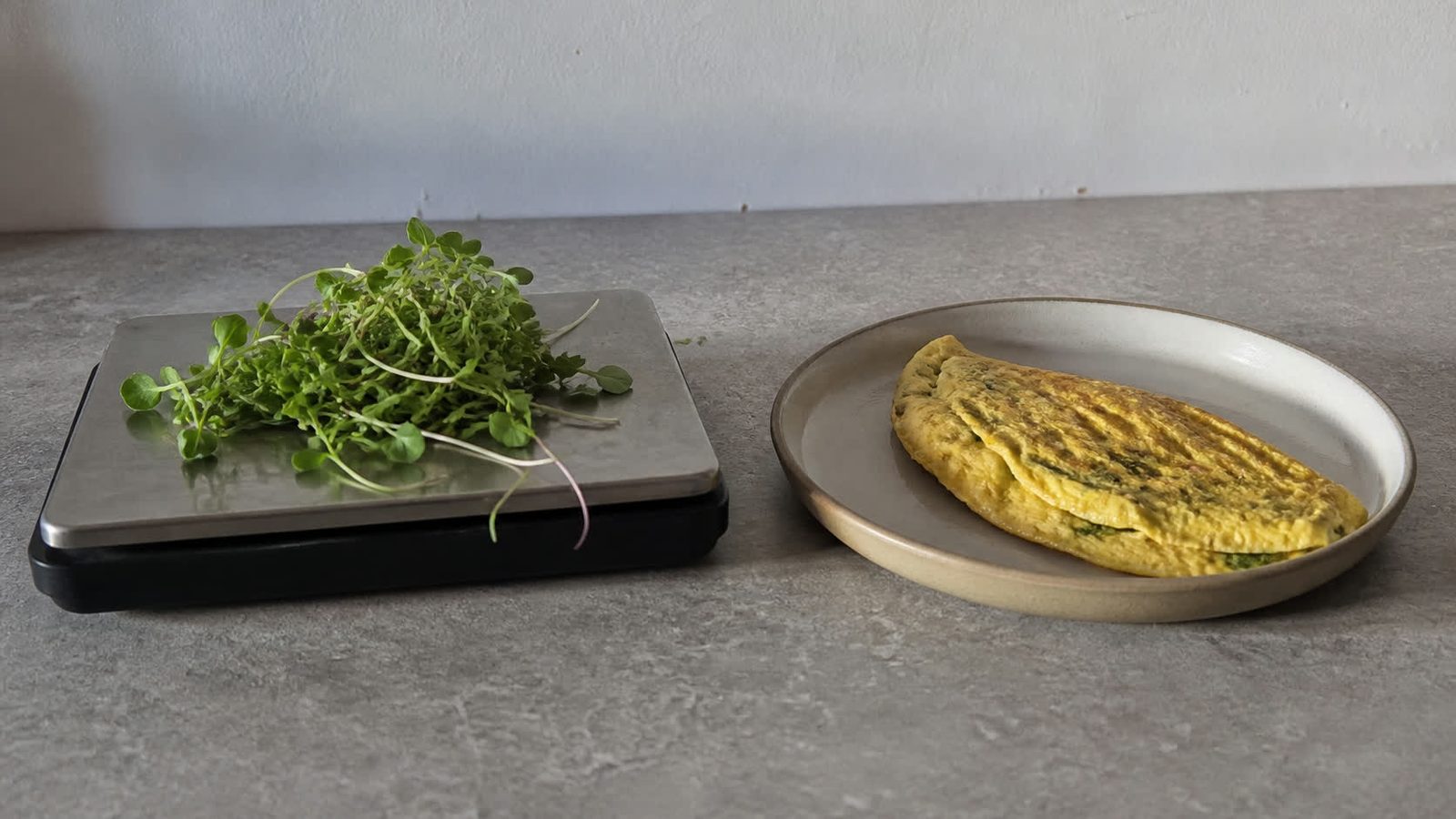
A garnish serving is about 2.5 grams a person. That is the only weighed per-person figure in any published recipe located, and almost every other source gives you a volume or a handful. A restaurant supplier's usage guide weighs a plated garnish smaller, at 1 to 2 grams a cover (London Microgreens).
That serving costs roughly 1.5 cents of seed to grow. Retail sells the same weight at 16 to 21 times the seed cost per ounce. Both figures are computed below, from the costed seed and measured yield in 38 crop entries set against published retail prices.
And one rule matters more than any quantity: do not eat nightshade microgreens at all. Tomato, potato, pepper, eggplant, tomatillo and ground cherry seedlings contain toxic alkaloids. Raw or cooked, they are not food.
Why no recipe tells you how much to use
Recipes mostly do not weigh it.
Across a defined audit of ten published recipe pages, eight gave some quantity and only three gave a weighable one. Five used cups. Two gave nothing usable at all.
Hover or tap a row to highlight it.
| Amount | Dish | Crop named? | What it tells you |
|---|---|---|---|
| 2.5 g per person | Omelette garnish, 10 g reserved across four | No | The only per-person weight in a recipe. Reproducible by scale |
| 50 g total | Omelette for four, 40 g cooked in | No | 12.5 g a head, most of it cooked into the dish rather than on it |
| 2 oz (57 g) | Breakfast porridge | Pea shoots, young | A cooked component, not a garnish |
| 3/4 lb (340 g) | Stir-fry for four | Pea shoots, mature | 85 g a head. This is a vegetable, not a finish |
| 1/4 cup | Herb salad, whole recipe | Basil, arugula or beet | A volume, and not convertible |
| 4 and 6 cups | Two pea shoot salads | Pea shoots | Volumes. The crop is a salad base here |
Do not convert cups to grams. Stem length, leaf size and how tightly the crop packs vary so much between pea shoots, radish and a fine basil that a cup measure is not a weight in disguise. It is a different unit answering a different question.
So, the honest scale of use runs across three roles, and the weight changes by more than thirtyfold between them:
- Garnish: about 2.5 g a person. A scattering on a finished plate.
- Component: a quarter cup across a whole dish. Part of a salad among other leaves.
- Base: 85 g a person. The crop is the vegetable, and in practice this only appears with pea shoots.
Nobody has published a recommended intake for any microgreen, for any population. A recipe amount is culinary usage, not a dietary requirement, and any page telling you to eat a specific quantity per day for health reasons is inventing it.
What a serving costs to grow
Published sources give seed cost per tray or a recipe portion, never both for the same crop, so cost per serving is normally uncomputable.
38 of the 62 crop entries here carry both a costed tray of seed and a measured yield as of 2026-08-11, which is exactly the two inputs the arithmetic needs:
seed cost per ounce = seed cost per tray ÷ ounces harvested per tray
Hover or tap a row to highlight it.
The spread between crops is sixtyfold, and it is driven by yield far more than by seed price. Fennel's seed is cheaper per tray than chives', and it costs three times as much per ounce, because it returns one ounce where mizuna returns ten.
Now the caveat, which is not small. Every figure above is seed only. It excludes medium, water, electricity, labor, packaging and loss. A single-use growing mat costs $1.18 to $2.90 a tray against a median $1.08 of seed, so adding the medium alone roughly doubles or triples the input cost. Treat 1.5 cents as a floor, not as what a serving costs you.
What a serving costs to buy
Hover or tap a row to highlight it.
| Where | Product | Price | Per ounce |
|---|---|---|---|
| Instacart, H-E-B | 80 Acres Micro-topia, 2 oz | $5.29 | $2.64 |
| Publix delivery | Broccoli microgreens, 2 oz | $5.69 | $2.85 |
| Farmoponics | Popcorn shoots, about 2 oz | $6.99 | about $3.50 |
| Food service, base tier | Sunflower, pea, broccoli, radish, mixes, kale, cabbage, kohlrabi, mustard, 4 oz | $15.00 | $3.75 |
| Food service, mid tier | Afila tendril, cilantro, 4 oz | $20.00 | $5.00 |
| Food service, premium | Basil, shiso, amaranth, beet, beet and chard, 4 oz | $25.00 | $6.25 |
Retail runs 16 to 21 times the median seed cost per ounce, and the food-service base tier is 22 times it. That multiple is not a scandal: it is paying for the medium, the light, the labor, the packaging, the losses and the delivery, all of which the seed figure excludes.
What it does tell you is where the money goes, and the answer is that essentially none of it is seed. If you are selling, the seed is the cheapest input you have. If you are deciding whether to grow, the honest comparison needs your own medium, power and time, not the seed line.
Note the premium tiers. The food-service list asks 67 percent more for basil, shiso, amaranth and beet than for sunflower and pea. Those are the aromatics and the colors, bought for plating rather than volume.
Which crop, on published flavor evidence
Most flavor charts treat crops as interchangeable. Two sources actually did the work.
USDA sensory panel work on 25 varieties sorted them into groups: Dijon mustard as mustard, Opal basil as herbal, Bull's Blood beet as vegetable and earthy, red amaranth as mild, and peppercress and China Rose radish as peppery.
Utah State's production table independently calls arugula peppery, basil intense, broccoli mild, kale strong and nutty, mesclun mild to slightly sweet, pea sweet, and Champion radish nutty and spicy.
Picking by role rather than by picture
Hover or tap a card to highlight it.
Use as a finish, sparingly
Arugula, peppercress, radish, Dijon mustard, Opal basil. Sources call these peppery, spicy or intense. Weigh a small amount and taste before adding more.
Use as a component
Broccoli, red amaranth, mesclun. The mild group. Mild does not mean flavorless, it means no source describes them as pungent.
Use as a base
Pea shoots. The only crop with published recipes treating it as the vegetable rather than the garnish, at up to 85 g a head.
Use for texture or sweetness
Sunflower for substance, pea and popcorn shoots for sweetness. Better described as mild-but-present than neutral.
One negative finding is worth carrying. The USDA work reports that high sourness, astringency and bitterness lower overall acceptability and can limit a crop to strongly flavored dishes. That is an argument against using an intense crop as a universal garnish, which is exactly what a generic "microgreens" line in a recipe encourages.
And nobody has mapped sour or bitter to a named crop. Both are dimensions in the sensory work and neither is assigned a dominant crop, so any chart telling you which microgreen is the bitter one is going beyond the evidence.
Can you cook them? It depends on the crop and the method
The evidence splits by crop and by method, which is why the blanket "never heat microgreens, it destroys the nutrients" does not survive contact with it.
Pea shoots are deliberately cooked in published recipes, with real stop cues: about one minute in a hot pan until the stems are crisp-tender and the leaves just wilted, or about two minutes cooked into a porridge. Those are culinary instructions rather than nutrient measurements, but they establish that cooking this crop is normal practice rather than a mistake.
The one real retention measurement is about drying, not sautéing. Penn State measured hot-air drying of radish microgreens:
Hover or tap a row to highlight it.
| Compound | Retention | At |
|---|---|---|
| Total phenolics | 91% | 113°F |
| Total phenolics | 79% | 149°F |
| Total phenolics | 100% | 203°F |
| Glucoraphenin | 78% | 203°F |
| Vitamin B2 | up to 65% | across the range |
| Vitamin B3 | up to 64% | across the range |
| Vitamin C | up to 37% | across the range |
Read the phenolics column twice, because it does not fall neatly with temperature. Retention was higher at the hottest setting than at the middle one. Whatever is happening there, it is not the simple story that hotter destroys more.
Vitamin C is the one that clearly suffers, at up to 37 percent retained. That is the compound to think about if heat retention matters to you.
This is drying evidence, not pan evidence. No replicated study compares a named microgreen raw against a stated cooking method, time and temperature. The honest instruction is to specify the crop, the method and the timing rather than to ban heat, and to add tender crops after the heat when what you want is fresh texture.
Nightshade microgreens are not food at any quantity
Do not eat nightshade microgreens. Eggplant, ground cherry, pepper, potato, tomatillo and tomato seedlings contain toxic alkaloids in their leaves, and published gardening guidance says they should not be consumed. This is a species exclusion, not a cooking problem. Cooking does not fix it.
This matters here because the seed for several of those is easy to buy and a tray of tomato seedlings looks like any other tray. It is the one place where "microgreens are healthy" fails completely.
Washing, in one paragraph
Extension guidance is consistent and it is the opposite of most produce instinct: wash immediately before eating, not before storing. Washing damages delicate tissue and leaves moisture behind, which shortens keeping quality. Rinse gently under cool running water, use no soap, detergent or produce wash, drain without crushing, and dry with a clean towel or a light spin.
Washing reduces bacteria, and it is not a kill step. A two-minute sterile-water wash in one study took Chinese cabbage from 7.8 to 7.2 log CFU per gram, about 0.6 of a log, with effects varying by organism and crop. Anything inside the tissue is not reachable by rinsing, and what that means for eating them raw is worked through separately.
Practical version: wash only what is going on the plate now.
What is not known
- No recommended intake for any microgreen, for any group. Recipe amounts are usage, not doses.
- No validated sour or bitter crop map. Both are sensory dimensions with no crop assigned.
- No wilting point, collapse temperature or exposure time for microgreens generally. The pan timings above are recipe observation, not measurement.
- No raw-versus-cooked nutrient comparison for any named microgreen by any stated pan method.
- No published crop-by-crop flavor change past ideal harvest, beyond the handful of crops where one has been recorded.
- No restaurant cost card allocating a garnish to a menu item, so the plate-level economics are guesswork.
- No test of whether a kitchen salad spinner is too aggressive. The nearest evidence is a USDA experiment comparing centrifugal against forced-air dewatering on ready-to-eat microgreens, where centrifugal drying caused severe damage, failed to remove water effectively, or both, shortening shelf life. That was a commercial centrifuge rather than a hand spinner, so it does not settle the kitchen question. A spinner remains an extension-permitted method for a meal portion: small clean load, stop if the crop bruises. For crop you intend to store, the better answer is not to have washed it, which is the whole washing question in one sentence.
Terms on this page
Tap a term to see what it means.
Garnish, component, base. The three roles a microgreen plays, and they differ by more than thirtyfold in weight. Most confusion about how much to use is really confusion about which one you are doing.
Sources
Prices were seen on 2026-08-11 and are rechecked at least every two months.
- USDA ARS sensory study of 25 microgreen varieties - the flavor groupings for Dijon mustard, Opal basil, Bull's Blood beet, red amaranth, peppercress and China Rose radish, and the finding that high sourness, astringency and bitterness lower overall acceptability.
- Utah State University Extension, grow your own microgreens - the independent flavor descriptions per crop, and seed cost per 1020 tray including arugula at $0.17 and basil at $1.84.
- Penn State, hot-air drying of radish microgreens - total phenolics at 91, 79 and 100 percent across 113, 149 and 203°F, glucoraphenin at 78 percent, and vitamins B2, B3 and C at up to 65, 64 and 37 percent.
- Bon Appétit, stir-fried pea shoots - 3/4 lb of mature shoots for four, cooked about one minute to crisp-tender stems and just-wilted leaves.
- Bon Appétit, breakfast porridge with pea shoots - 2 oz of young shoots cooked about two minutes.
- Bon Appétit, smoked trout with pea shoots and fava and pea salad - pea shoots as a salad base at six cups for four and four cups for eight.
- Bon Appétit, smoky and crunchy peas - pea tendrils scattered after cooking rather than during.
- Epicurious, herb garden salad - basil, arugula or beet microgreens at a quarter cup for the whole recipe.
- Dobbies microgreens omelette - 50 g for four eggs, 40 g cooked in and 10 g reserved for plating, which is the only per-person weight located in a recipe, at 2.5 g. The crop is not named.
- Associated Press, growing microgreens indoors - the nightshade exclusion: eggplant, ground cherry, pepper, potato, tomatillo and tomato leaves contain toxic alkaloids and should not be consumed.
- New Mexico State University, microgreens for consumers - wash immediately before eating, because washing damages delicate plants and creates conditions for spoilage.
- Purdue Extension microgreens (PDF) - gentle cool-water rinse right before use, paper towel or salad spinner, stored unwashed for 5 to 7 days.
- PLOS ONE, washing and microbial load on microgreens - a two-minute sterile-water wash taking Chinese cabbage from 7.8 to 7.2 log CFU/g, with effects varying by organism and crop, and faster shelf-life loss in washed product.
- FDA, selecting and serving produce safely - wash under running water, no soap or detergent, dry with a clean towel, and that washing reduces but does not eliminate bacteria.
- Instacart H-E-B listing, Publix delivery listing and Farmoponics popcorn shoots - the retail snapshot at $5.29, $5.69 and $6.99 per roughly 2 oz.
- MicroFreshly wholesale pricing - the food-service tiers at $15, $20 and $25 per 4 oz, and which crops sit in each.
- ChefPax, which microgreens chefs use - supplier-reported chef preference for radish, sunflower, pea shoots and specialty crops, and the live-tray practice. A supplier's observation of its own customers.
Keep reading
The journal
The Downsides of Microgreens: What Is Real, What Is Overstated, and What Is Invented
No published case report attributes an illness to eating a named edible microgreen, and at least eight recalls have produced zero illnesses. The real downsides are not health risks. They are cost, bench time and a nutrition claim that does not hold.
Read The Downsides of Microgreens: What Is Real, What Is Overstated, and What Is InventedThe journal
Are Microgreens Low FODMAP? What Monash Research Shows
Are microgreens low FODMAP? Learn what Monash sprouting research shows, which crop families deserve extra caution, and how reintroduction testing works.
Read Are Microgreens Low FODMAP? What Monash Research ShowsThe journal
Best Microgreens for Kidney Health: Potassium by the Serving
See measured potassium and phosphorus for the best microgreens for kidney health, from lowest to highest, plus what your renal dietitian needs to know.
Read Best Microgreens for Kidney Health: Potassium by the ServingThe journal
Can You Cook Microgreens? Yes, and Pea Shoots Are the One With Real Evidence
Yes, and the technique is the whole answer: add them late. Every documented method adds them at or near the end, and pea shoots are the one crop with a real cooked recipe behind it.
Read Can You Cook Microgreens? Yes, and Pea Shoots Are the One With Real Evidence