Can You Cook Microgreens? Yes, and Pea Shoots Are the One With Real Evidence
Cal HewittPublished Updated Checked
- eating
- cooking
- evidence
- pea shoots
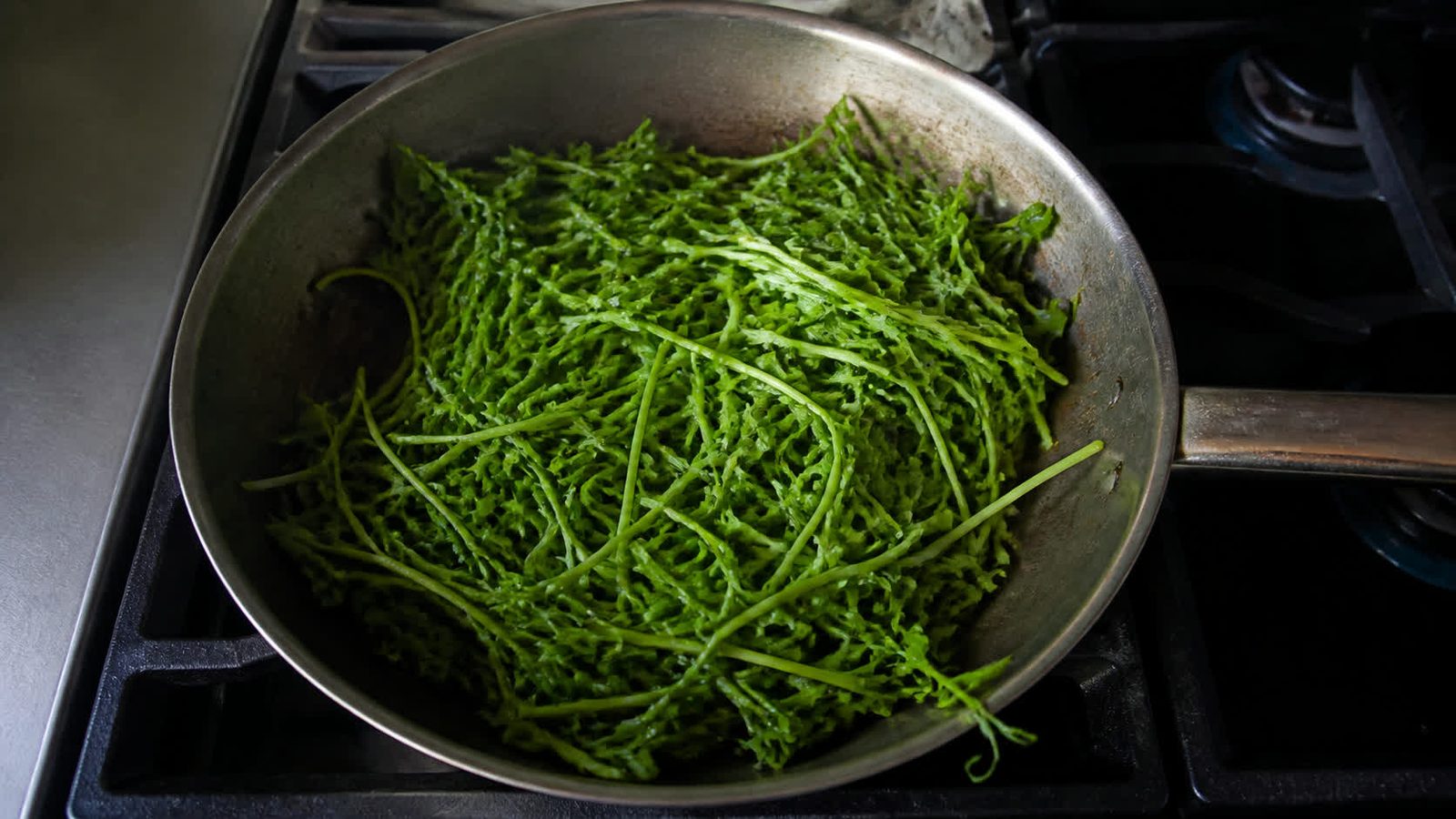
Yes, and pea shoots are the crop to cook. They are the one with an actual cooking study and a published recipe behind them, and the portion is the number worth taking away. For everything else the question has mostly never been tested. Across the 62 crops in the variety directory, three are recorded as eaten raw or cooked, two are juiced rather than eaten, and the other 57 are recorded raw. Only one of the three, pea shoots, has both a published cooking study and weighed recipes behind it.
The one number worth taking away is a portion. The best-specified cooked microgreen recipe published anywhere uses 1 lb of pea shoots to serve four, and it is the only one that gives a weight and a serving count together. A 1020 tray of pea shoots yields 8 oz. That recipe is two entire trays for one side dish, and it costs about $4.78 in seed. The same two trays would make roughly 180 garnish servings.
And one rule overrides everything below: never cook a nightshade microgreen as a way of making it safe. Tomato, potato, pepper, eggplant, tomatillo and ground cherry seedlings carry toxic alkaloids. Cooking is not a workaround. They are not food in any state.
When to add them, which is the whole technique
Every documented method adds them late. Not one adds them at the start. Three independent sources, three different crops, three different dishes, and they agree:
Hover or tap a row to highlight it.
| Crop | When to add | The endpoint |
|---|---|---|
| Pea shoots | during cooking, high heat | Cornell: turn the heat off when they begin to wilt, usually within a minute |
| Sunflower, pea | at the last minute of a stir-fry | West Coast Seeds: just before serving |
| Radish, 25 g | at the end, into already-cooked dal | Chauhan: stir through, then serve hot |
| Unnamed | on top of soup | UMass, which names no crop, amount or moment |
No opened source simmers a microgreen in anything. So the working rule, where a crop has no recipe of its own, is to add it off the heat or at the table rather than into the pot.
The practical version, for a cook holding a punnet tonight:
- Treat it like a soft herb, not like spinach. It goes in where you would add basil or coriander, at the end.
- If you want it to behave like a cooked vegetable, use pea shoots, which is the one crop with a full recipe and a weighed portion behind it.
- Sunflower and pea are the two called "thicker greens" by a supplier and are the next-best candidates for brief heat.
- Everything else, add off heat. That is not a rule anybody tested; it is what you do when no crop-specific method exists.
How each crop is actually eaten
Every crop entry records how that crop's own sources describe it being eaten.
Hover or tap a row to highlight it.
| Recorded as | Crops | Count |
|---|---|---|
| Raw | the other 57 | 57 |
| Raw or cooked | buckwheat, pea shoots, sesame | 3 |
| Juiced | barley grass, wheatgrass | 2 |
Read that carefully, because it is easy to over-read. "Raw" here means the sources that describe the crop describe it eaten raw. It does not mean cooking has been tested and failed, and it does not mean cooking is prohibited. For all but a handful of these crops, nobody has cooked them in a way anyone wrote down. That is an absence of evidence rather than a verdict.
The three raw-or-cooked entries got there by different routes, which is worth knowing:
- Pea shoots are cooked deliberately and repeatedly in published recipes, and are the subject of the one cooking study.
- Sesame is the odd one: the single guide that compares eating quality actively prefers it cooked, and its raw flavor descriptions contradict each other. It is the only one of the three where cooking is presented as an improvement rather than an option.
- Buckwheat is recorded raw or cooked without a weighed cooked recipe attached.
Pea shoots: the crop with actual evidence
The study
A 2025 paper in Plant Foods Human Nutrition compared home cooking methods on pea shoots, and it is the only study of its kind: nothing else in the journals, the extension services or the seed-company material cooks a microgreen and measures the result.
Tsuruoka, Koriyama and Hosoya, 2025, on cooked pea shoots
Hover or tap a card to highlight it.
Steaming preserves it
Antioxidant activity was preserved by steaming, with minimal losses in the four flavonoid glycosides measured.
Boiling and microwaving do not
Both significantly reduced antioxidant activity, and both also caused weight loss during cooking, so you lose material as well as compounds.
There is a mechanism, not just a result
Model experiments with purified antioxidants found that the compounds conjugated with p-coumaric acid are the ones that survive heat and pressure. The paper's conclusion is that steaming is the most effective method for preserving pea shoots' antioxidant properties.
Two honest limits. The paper reports directions rather than percentages in its public abstract, so no retention figure is quoted here. And it is one study on one crop; it says nothing about radish, sunflower or basil.
The recipes, and what they actually cost you in trays
Published cooked pea shoot recipes disagree with each other by a factor of eight on quantity and a factor of five on time. That spread is the finding, not a nuisance.
Hover or tap a row to highlight it.
| Amount | Method | Time at heat | Trays of pea shoots |
|---|---|---|---|
| 1 lb, serves 4 | High-heat stir-fry with garlic, ginger, soy and sugar | Until first wilt, about 1 minute | 2 whole trays |
| 2 oz | Folded into breakfast porridge | About 2 minutes | About 1/4 tray |
| 2 packed cups | Cooked into a garlic and ginger sauce | 3 minutes, until reduced | Not weighable |
| 2 cups, serves 4 | Cooked into broth with radish and cress, then blended | 3 to 5 minutes | Not weighable |
| 2 cups, serves 4 | Cold soba, tossed in raw after the noodles are rinsed | None, cold dish | Not weighable |
| 1 cup, serves 4 | Rice bowl, added at assembly after the eggs are fried | None, added off heat | Not weighable |
That table is not the full set. Four more published cooked pea shoot recipes exist, three of them with weights, running from 2 oz up to 1 and 1/4 lb. They also show why a cup measurement cannot be trusted on this crop: three publishers convert a cup to anywhere between 14 and 28 grams. The pea shoots entry carries all of it.
The tray column is the part no recipe site can give you, because it needs a measured tray yield alongside the recipe. Pea shoots run 150 g of seed in and 8 oz out per 1020 tray, at $2.39 of seed. So:
- The 1 lb stir-fry is two full trays, about $4.78 of seed, or $1.20 a head before anything else in the pan.
- The 2 oz porridge is about a quarter of a tray, roughly 60 cents of seed.
- The same tray cut up as a 2.5 g garnish yields about 90 servings.
One tray of pea shoots therefore feeds either about 90 people or two people, and the only variable is whether you cook it. That is a fortyfive-fold difference, and it is the thing to plan around.
It also explains why cooked microgreen recipes are rare. Pea shoots have the third lowest seed-to-leaf return of the 39 crops with both numbers measured, at about 1.5 times the seed weight, behind only fennel and nasturtium as of 2026-08-11. That is normal for a big-seeded legume and not a fault. But it means cooking pea shoots is genuinely expensive in bench time, and it is why the crop is treated as a vegetable rather than a garnish in every recipe that cooks it.
The variable the recipes leave out
Growers report the same problem repeatedly: stir-fried pea shoots come out tough and fibrous. Other growers report the opposite from the same technique. The variable neither side states is harvest age. One grower's practice is to eat the first harvest raw and stir-fry a later, taller cut.
None of the published recipes states a harvest stage, and pea shoots are published at 8 to 14 days, which is a wide window for a crop whose stems get woodier as it runs. If a cooked pea shoot came out stringy, the likeliest cause is the age of the crop, not the pan. Nobody has tested it, so that is a hypothesis with a mechanism, not a finding.
What heat does to the nutrients, and why nobody can tell you
Here is the honest state of it: there is no published measurement of nutrient loss from ordinary cooking of any named microgreen. Not sautéing, not soup, not a pizza oven.
What exists instead is a drying study. Radish microgreens dried with hot air at three temperatures, measured against freeze-drying:
Hover or tap a row to highlight it.
| Compound | Drying temperature | Retained |
|---|---|---|
| Total phenolics | 113°F | 91% |
| Total phenolics | 149°F | 79% |
| Total phenolics | 203°F | 100% |
| Glucoraphenin | 203°F | 78% |
| Vitamin B2 | across the treatments | up to 65% |
| Vitamin B3 | across the treatments | up to 64% |
| Vitamin C | across the treatments | up to 37% |
The three vitamin rows are reported as a single "up to" figure across the treatments, not per temperature, so they are shown that way rather than split into columns that would imply a precision the source does not give.
Two warnings about that table. First, drying is not cooking: it is hours of dehydration to make a shelf-stable powder, not thirty seconds in a hot pan, and you cannot convert one into the other. Second, look at the phenolics row: retention is 91 percent at the lowest temperature, drops to 79 in the middle, and returns to 100 at the highest. That is not a simple degradation curve, and it is a good reason to be suspicious of anyone who tells you confidently that heat destroys the goodness in a microgreen.
The reasonable summary is the one both the radish drying work and the pea shoot study point at: heat effects are compound-specific, not general. Vitamin C is fragile in both. Phenolics are tougher than expected. Whether a given crop keeps a given compound through a given cooking method is, for 61 of the 62 crops, simply unknown.
That is one study, not two studies agreeing, so read the table as a single measurement.
The two crops where heat is not the question
Barley grass and wheatgrass are recorded as juiced rather than eaten, and cooking them is not a live question. The limit is fiber, not heat: both are grasses whose stems are too tough to chew at the stage they are harvested. Wheatgrass takes 450 g of seed a tray, the heaviest rate of any crop, and returns a juice rather than a leaf. There is nothing to sauté.
The advice that is everywhere, and is not supported
The most repeated instruction on this subject, and the one that survives least contact with the evidence, is "stir microgreens into any hot dish", or its sibling, "top any hot dish with microgreens".
It is unsupported as written, and the published recipes show exactly why: the only crop with real cooked instructions has four different published timings for four different dishes, running from off-the-heat entirely, through one minute, to five minutes in broth. A rule that resolves to "sometimes cook it and sometimes do not" is not a rule.
The usable version, and the most this evidence will carry:
- If you are cooking a microgreen deliberately, use pea shoots, and steam them if you care about the antioxidants.
- Sow for the volume you need, not for a garnish. A cooked pea shoot dish for four is two trays, so start them a week apart rather than trying to stretch one. Pea shoot seed on Amazon is the convenient route for a home grower, and the pea shoots entry has the rate, the soak and what goes wrong.
- Cut earlier than you think if the destination is a pan, because the fibrous complaints all come from taller cuts.
- Stop at first wilt. Every published stir-fry endpoint is visual, not timed, and the timings behind it run about one minute.
- For everything else, add it off the heat, at plating or assembly, which is what the recipes that do not cook the crop actually do. A radish or mustard tray scattered on a finished dish is doing the job those crops are for.
- Never cook a nightshade seedling. It is not a heat problem.
The second-best-documented cooked crop is sunflower. Four published heat applications give an amount: a quarter cup baked on a pizza for 15 to 20 minutes at 375°F, a cup baked into muffins, two cups simmered in soup for five minutes, and a stir-fry finished in about a minute. Most of them come from one farm, so this is one kitchen's practice rather than a consensus, and nobody has measured what any of it does to texture or nutrients. But sunflower is structurally the crop most likely to survive a pan, because it is a thick crunchy shoot rather than a fine leaf, and it produces more per tray than any other crop. If you want to test cooking a microgreen, sunflower seed is the cheap way to do it.
What nobody has measured
- Cooking studies for 61 of the 62 crops. Pea shoots is the only one, and it is a 2025 paper.
- Any nutrient measurement for a real cooking method. Drying and freeze-drying only.
- A wilting point. No published time-at-temperature or structural-collapse measurement for any microgreen. "They wilt" is a kitchen observation.
- Harvest age against cooked texture, which is the variable the fibrous-pea-shoot complaints keep circling and nobody controls.
- Whether sesame's cooked preference generalizes, given it rests on a single guide.
A single controlled test, one crop, one pan, three harvest ages, would settle more than the entire published literature currently does.
Terms on this page
Tap a term to see what it means.
Eaten as. The field on each variety entry recording how that crop's own sources describe it being consumed. Raw means the sources describe it raw, not that cooking has been tested.
Sources
Opened on 2026-08-11 unless stated. Tray yields and seed costs come from this site's own variety directory, where each figure is sourced on the crop's own page.
- Tsuruoka Y, Koriyama T, Hosoya T, "Influence of Cooking Methods on Phenolic Compounds and their Activities in Pea Shoots", Plant Foods for Human Nutrition 2025;80(3):157 - steaming preserves antioxidant activity, microwaving and boiling significantly reduce it and cause weight loss, and p-coumaric acid conjugation is what confers thermal and pressure stability. The only microgreen cooking study located.
- Penn State, hot-air drying of radish microgreens - the retention figures at 113, 149 and 203°F. A drying study, not a cooking study.
- Cornell Cooperative Extension, stir fried pea shoots - 1 lb of pea shoots for four, high heat, off at first wilt within about a minute, with garlic, ginger, soy and sugar quantities. Three other weighed cooked pea shoot recipes exist (2 oz, 6 to 8 oz and 1 and 1/4 lb), so Cornell's distinction is narrow: it is the only one stating a weight AND a serving count.
- Bon Appétit, breakfast porridge with soft egg and pea shoots - Alison Roman's 2 oz of young pea shoots cooked about two minutes.
- Bon Appétit, soba with tofu and miso-mustard dressing - Claire Saffitz's 2 cups of pea shoots tossed into a cold dish after the noodles are rinsed.
- Bon Appétit, crispy rice bowl with spring vegetables - 1 cup of pea shoots across four bowls, added at assembly rather than cooked.
- Microganics recipes - 2 packed cups of pea shoots cooked three minutes in a garlic and ginger sauce, and 2 cups with radish and cress simmered 3 to 5 minutes then blended.
- UMN Extension, growing peas in home gardens - pea shoots harvested for stir-fries or steaming.
- West Coast Seeds, going green winter salads - sunflower microgreens and pea sprouts as thicker greens added at the last minute of a stir-fry.
- N.C. State, microgreens card (PDF) - the instruction not to eat shoots from tomato, eggplant, pepper or potato.
- Associated Press, growing microgreens indoors - the fuller nightshade exclusion including ground cherry and tomatillo.
- UMass Extension produce spotlight, microgreens - the generic instruction to sprinkle microgreens on soups, with no crop, amount or timing.
- UConn Extension, the amazing power of microgreens - pizza, soup and omelette listed as garnish applications without crop or timing.
- Cotyledon, radish microgreen recipes - 25 g of radish microgreens stirred into dal at the end of cooking. Culinary practice, and its nutrient-retention claim is not supported by a study.
- r/microgreens, tough stir-fried pea shoots and pea shoots progress - grower reports of fibrous results and of raw-then-stir-fried practice across harvests. Anecdotal, and neither states a weight or a harvest age.
Keep reading
The journal
Are Microgreens Low FODMAP? What Monash Research Shows
Are microgreens low FODMAP? Learn what Monash sprouting research shows, which crop families deserve extra caution, and how reintroduction testing works.
Read Are Microgreens Low FODMAP? What Monash Research ShowsThe journal
Best Microgreens for Kidney Health: Potassium by the Serving
See measured potassium and phosphorus for the best microgreens for kidney health, from lowest to highest, plus what your renal dietitian needs to know.
Read Best Microgreens for Kidney Health: Potassium by the ServingThe journal
Can You Freeze Microgreens? What Survives Drying and Freezing, and What Does Not
A microgreen is 87 to 94 percent water, so a whole tray dries down to a couple of spoonfuls. Drying is not a kill step, freezing does not make greens keep their crunch, and only one crop has ever been measured.
Read Can You Freeze Microgreens? What Survives Drying and Freezing, and What Does NotThe journal
How Long Do Microgreens Last by Crop and Temperature
How long do microgreens last in the fridge depends on the crop and the temperature. See measured storage life by crop and what to do when no figure exists.
Read How Long Do Microgreens Last by Crop and Temperature