Are Microgreens Low FODMAP? What Monash Research Shows
Cal HewittPublished Checked
- health
- eating
- evidence
- nutrition
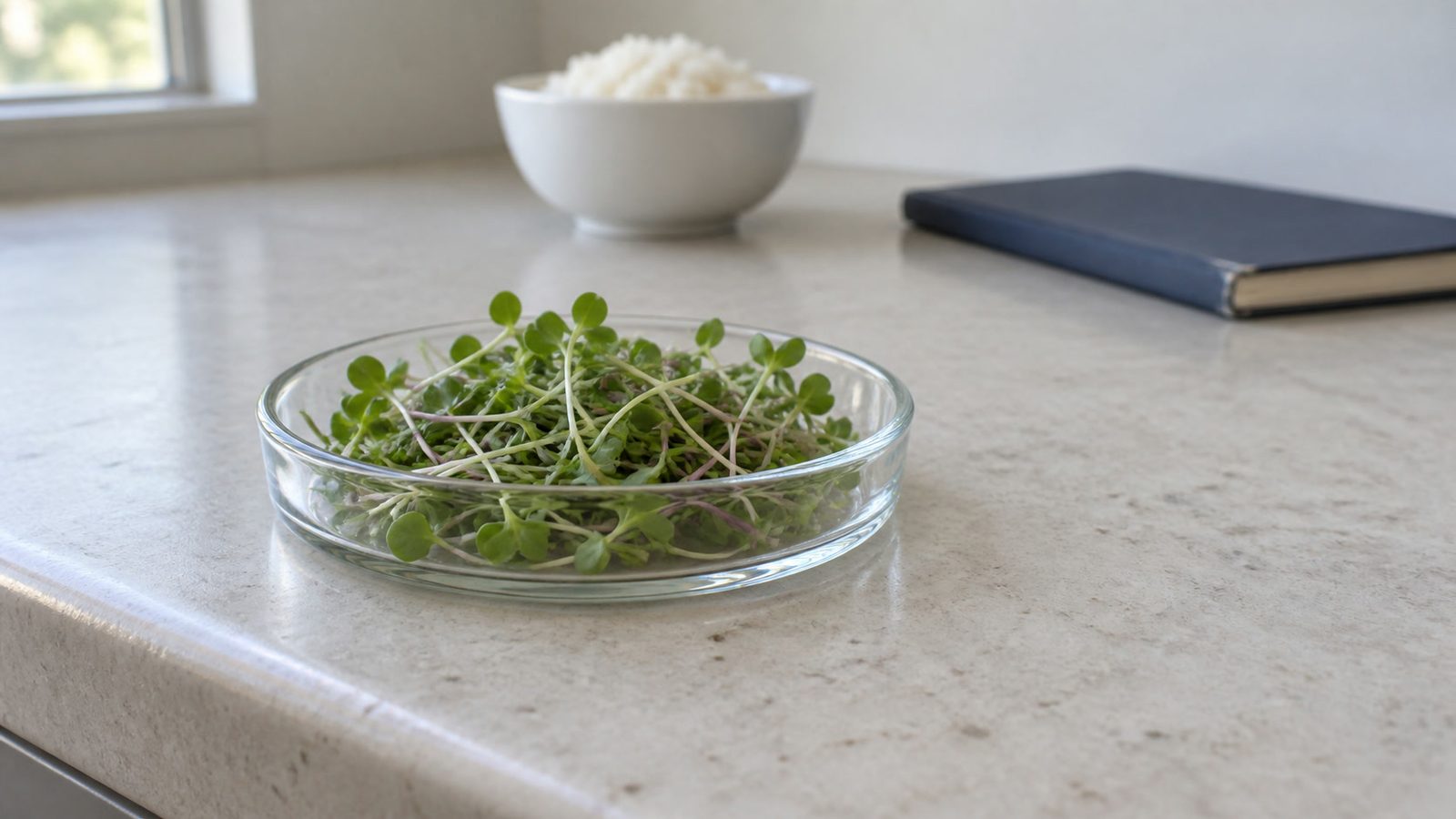
Microgreens do not have a FODMAP rating yet. Neither the Monash University FODMAP app nor FODMAP Friendly has a published microgreen entry, and Monash says a food missing from its guide is one it is "yet to test," which is different from low (Monash app help).
What you can work from is a Monash experiment on sprouted grains and legumes, one study of sugars in microgreens, and ratings for the mature vegetables. Those point to legume and onion family microgreens as the ones to test most carefully. This page is information, not medical advice; your dietitian or gastroenterologist sets your plan.
How a food gets a FODMAP rating
A rating starts in a lab. For a fruit or vegetable, Monash buys samples from 10 stores, five supermarkets and five greengrocers. The samples are freeze-dried, milled and extracted, and the short-chain carbohydrates are measured by liquid chromatography. One food takes 2 to 4 weeks to analyze, and a dietitian then sets the green, amber and red serving sizes (Monash laboratory method). Monash describes its cut-offs as conservative and does not publish the grams of each FODMAP in a food (Monash app help).
FODMAP Friendly uses independent testing in a NATA-accredited laboratory, with assay kits and chromatography "to test for the six FODMAPs" (FODMAP Friendly testing FAQ). Those six are fructans, GOS, lactose, excess fructose, sorbitol and mannitol, and results are judged "against our evidence-based FODMAP threshold values" (FODMAP Friendly ingredient testing). Both programs measure the food itself, but their samples, countries and thresholds can differ, so a result from one is not automatically a result from the other.
An app rating drawn from an ingredient label is a different kind of information. Spoonful's listing for a packaged sunflower microgreen product says, "We believe this product is Low FODMAP at 1 serving as there are no moderate or high FODMAP ingredients listed on the label" (Spoonful). The only ingredient on that label is organic sunflower microgreens. That is an ingredient screen, not a lab result: it names no laboratory, no gram serving and no measurement of the greens.
What Monash found when it sprouted grains and legumes
The closest lab work to a microgreen tray is Monash's sprouting experiment, published 28 March 2017. The team soaked wheat, barley, rye, chickpeas, red kidney beans and mung beans for at least 12 hours, then sprouted them with daily rinsing for 3 to 6 days, until the sprouts were at least 1 cm long. Three brands of each were pooled, and the whole sprout was freeze-dried and tested (Monash sprouting study).
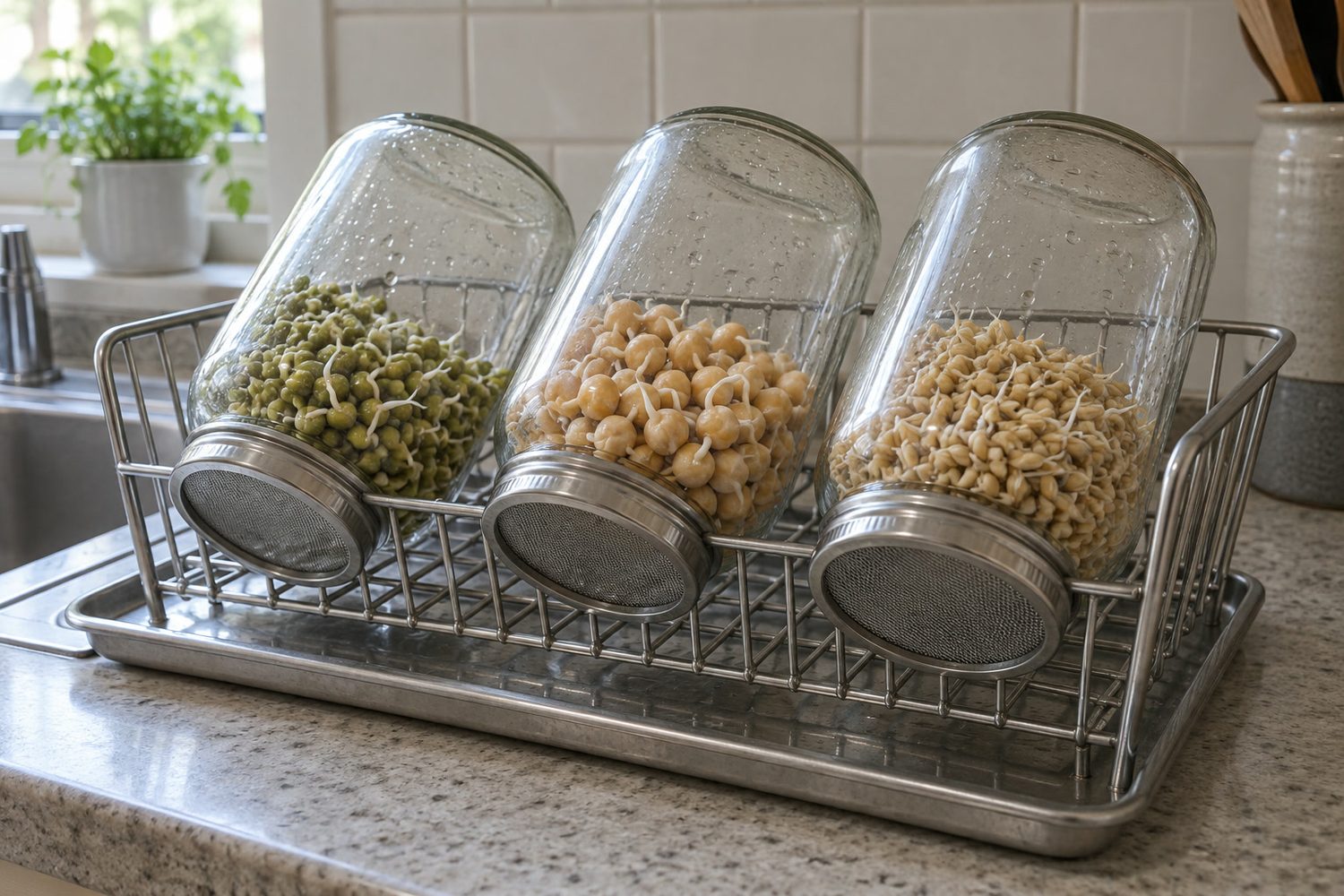
The results for each of the six seeds are set out below.
Hover or tap a row to highlight it.
| Sprouted whole seed | What happened to FODMAPs |
|---|---|
| Wheat | Fell |
| Barley | Fell; moved from red to green in the app |
| Rye | Fell |
| Red kidney beans | Fell |
| Mung beans | Fell; moved from red to green in the app |
| Chickpeas | Rose slightly |
Monash suggested the drop likely comes from enzymes released during germination breaking down carbohydrate chains, and it called for more testing. The chickpea result matters as much as the others: sprouting lowered FODMAPs in five of these seeds and raised them in one, so it is not a rule that holds for every seed.
These were sprouts, not microgreens. A sprout is eaten as the whole germinated seed after a few days. A microgreen grows on for days or weeks longer, until the seed leaves open and often the first true leaves form, and you harvest the stem and leaves. The difference between microgreens and sprouts is a difference in plant tissue and age, and a FODMAP result for one cannot be assumed to carry over to the other.
What the microgreen and seed studies measured
At least four studies have measured sugars in microgreens. Wojdyło and colleagues tested kale, radish, beetroot, pea and amaranth microgreens bought from a commercial shop and reported fructose, glucose, sucrose and sorbitol at 0.0 g per 100 g of fresh weight in all five (Wojdyło et al., 2020; full text, Table 1).
The others found small amounts. Xiao and colleagues measured 1.7 to 10.3 g of fructose, glucose and sucrose combined per kilogram of fresh weight in six microgreens, which is 0.17 to 1.03 g per 100 g (Xiao et al., 2015). Paglialunga and colleagues measured 483.5 mg of soluble sugars per 100 g in radish microgreens and 1,247.3 mg in savoy cabbage (Paglialunga et al., 2023), and Balik et al., 2025 reported sugars in six more crops.
Together they cover fructose, glucose and sucrose, and Wojdyło also covered one polyol. They do not cover fructans or GOS, which were not measured, and those are the FODMAPs that matter most for onion family and legume crops. A zero for simple sugars tells you nothing about either one.
Seed studies show how much GOS can change as a legume germinates. In lentil and common bean malts, four days' germination cut lentil stachyose and raffinose by 87.5% and 87.3%, and five days cut bean raffinose by 54.0% and stachyose by 52.4% (Gasiński et al., 2022). Those losses were measured in kilned malts, not in microgreens, so they show the direction of change, not the GOS left in a pea shoot or lentil microgreen at harvest.
Which microgreens to test with extra care
Without a microgreen test, the mature crop and the seed are the only guide to where the carbohydrates sit. The table below sets out what that evidence covers and what it leaves open.
Hover or tap a row to highlight it.
| Crop family | Mature or seed evidence | Microgreen tested? |
|---|---|---|
| Legumes (pea, lentil, chickpea) | Seeds carry GOS; germination lowers it in some seeds, and Monash's chickpea sprouts rose | No |
| Onion family (onion, garlic, leek, chives) | Mature onion and garlic contain fructans; green spring onion tops and chives are lower FODMAP choices | No |
| Broccoli | Mature broccoli listed as low FODMAP, with serving size mattering | No |
| Sunflower | Mature sunflower seeds listed lower | No |
Legumes. Pea, lentil and chickpea seeds are where GOS is stored, and the germination studies show those levels can fall a long way or, in chickpeas, rise. Dietitians Australia lists green peas among high FODMAP foods and lists lentils and chickpeas as lower only as a canned half-serve (Dietitians Australia fact sheet, September 2020). None of that is a measurement of pea shoots or lentil microgreens, and it is the reason to give those crops more care when you test them.
The onion family. The Monash team wrote on 1 June 2015 that onion and garlic contain fructans, and that the green parts of spring onion and chives can give onion flavor as lower FODMAP choices (Monash on onion and garlic). That describes mature plants, where the green top and the bulb are different parts you can eat separately. An onion microgreen is a whole young seedling, so it does not split into tops and bulb the same way, and fructans in onion family plants at the microgreen stage have not been rated. The green-top result cannot simply be passed down to it.
Broccoli and sunflower. Dietitians Australia's September 2020 fact sheet lists broccoli and chives as low FODMAP foods and notes that serving size matters, and it lists sunflower seeds as lower (Dietitians Australia fact sheet). Those are ratings for broccoli florets and sunflower seeds. They give less reason for concern than the legume and onion evidence, but they are not a rating for broccoli microgreens or sunflower microgreens, which are still unrated.
How much to eat when you test one
Weigh a small portion for your first test. The weights you see in studies were chosen for lab work or tasting: broccoli microgreens sealed in 10 g bags for storage testing (broccoli microgreen study), mustard microgreens served in samples of roughly 3 to 5 g to a tasting panel (mustard storage study), and two cups of red cabbage microgreens weighed at about 30 g in a 2025 feeding study by Lee and colleagues (Lee et al., 2025). The small human study covered in microgreens and your gut used a 16 g serving. None of these amounts was set to test FODMAP tolerance.
Smaller does not automatically mean a smaller FODMAP dose. Monash's low serve for mature red cabbage is 75 g (Monash on FODMAP stacking), so a 10 g handful of microgreens is about 13% of that by weight, but the concentration in a seedling can be very different from the concentration in a head of cabbage. The weight comparison cannot tell you which way it goes.
What the sources describe is a method rather than a number. For a food Monash has not tested, it says, "Until this food is tested, we would suggest testing your own tolerance" (Monash app help), and its sprouting article suggests trying a small amount of a sprouted grain or legume and watching for symptoms (Monash sprouting study). Ask your dietitian what small amount to start with, weigh it on a scale that reads small amounts, and write the number down so the next test can be compared with this one. For how microgreen portions are usually described outside a FODMAP plan, see how much microgreens per day.
Testing a microgreen during reintroduction
The American College of Gastroenterology describes the diet in three stages: swapping high FODMAP foods for low FODMAP ones, reintroducing foods while you track symptoms, and then personalizing the diet so you avoid only the foods that cause symptoms. Its patient page describes elimination for 2 to 4 weeks only and reintroduction one FODMAP group at a time (ACG). Its clinical guideline says gradual reintroduction of foods containing individual FODMAPs is how sensitivities are identified, and that the diet's complexity calls for a properly trained GI dietitian (ACG clinical guideline, 2021).
Applied to a microgreen, that method looks like this:
- Test one crop at a time. A mixed salad blend puts several crop families on the plate at once, so you cannot tell which one caused a reaction.
- Keep the rest of your plan steady while you test, so the microgreen is the only change.
- Use the small amount your dietitian suggests and weigh it.
- Write down the crop, the grams, whether it was raw or cooked, where it came from, and any symptoms over the following hours and days.
- Let your dietitian choose the order and the pace.
Two questions are worth taking to that appointment. Should a pea or lentil microgreen wait until your GOS challenge, and an onion microgreen until your fructan challenge, since those are the carbohydrates the mature crops carry? And which crop does your dietitian want you to try first? Let the person who knows your results so far choose which microgreen you start with.
The ACG notes that the low FODMAP diet has been studied most in IBS, and that it may not be a good plan for people with a history of eating disorders, people at risk of malnutrition, or people with complex medical histories (ACG). If any of that applies to you, raise it before you start testing new foods.
Raw microgreens and food safety
A FODMAP rating says nothing about bacteria. The FDA treats raw and lightly cooked sprouts as a special food safety concern because even a few bacteria carried on the seed can multiply under sprouting conditions, and it advises people with weakened immune systems to avoid them (FDA produce safety). That warning names sprouts, not microgreens, but microgreens are usually eaten raw too. If raw eating is part of your question, read are microgreens safe to eat raw alongside this.
Frequently asked questions
Does cooking microgreens change their FODMAP content?
Monash's app lists vegetables as raw unless it says otherwise, and its help page says, "Cooking should not increase the FODMAP content" (Monash app help). A cooked food is still a different form from the one tested, so a raw rating does not carry over to a cooked one without its own entry. For cooking methods themselves, see can you cook microgreens.
Why does one vegetable have green, amber and red serving sizes?
The rating depends on how much you eat as well as what the food contains. Monash's example is red cabbage, which is low FODMAP at 75 g, moderate above 150 g and high above 180 g because of its fructans (Monash on FODMAP stacking). That is why a microgreen test needs a weighed amount written down, not just the name of the crop.
Should I eat more or less fiber from microgreens with IBS?
The ACG guideline says, "We suggest that soluble, but not insoluble, fiber be used to treat global IBS symptoms," and reports that bran, an insoluble fiber, gave no significant benefit for IBS symptoms (ACG clinical guideline, 2021). It does not say that leafy greens make IBS worse. Your dietitian can tell you how fiber fits your own plan, and the downsides of microgreens page covers other reasons they may not suit everyone.
Is the low FODMAP diet only for IBS?
The ACG says the diet has been studied most in IBS. It adds that it may help people with IBD, celiac disease or SIBO who still have symptoms, with a GI provider and dietitian involved (ACG).
Is a FODMAP Friendly result the same as a Monash result?
Not necessarily. FODMAP Friendly sends foods to an external Eurofins laboratory and judges results against its own thresholds, while Monash samples retail foods from 10 stores and sets its own traffic-light serves (FODMAP Friendly ingredient testing; Monash laboratory method). If you use a rating from either program, check the exact food, form and serving it applies to.
Where that leaves your next test
Microgreens have no FODMAP rating from any laboratory, so treat every crop you try as a new food. Sprouting lowered FODMAPs in five of the six seeds Monash tested and raised them in chickpeas, and the microgreen sugar studies left fructans and GOS unmeasured. That puts pea, lentil and onion family microgreens at the top of the list for careful testing, with broccoli and sunflower giving less reason for concern but still unrated. Test one crop at a time, weigh a small amount, write it down, and let your dietitian set the order and the pace. For how microgreens sit with digestion more broadly, including the human study, read microgreens and your gut.
Sources
Prices, stock and specifications are as the linked pages showed them on 2026-09-13.
- Monash app help
- Monash laboratory method
- FODMAP Friendly testing FAQ
- FODMAP Friendly ingredient testing
- Spoonful
- Monash sprouting study
- Wojdyło et al., 2020
- full text, Table 1
- Xiao et al., 2015
- Paglialunga et al., 2023
- Balik et al., 2025
- Gasiński et al., 2022
- Dietitians Australia fact sheet, September 2020
- Monash on onion and garlic
- broccoli microgreen study
- mustard storage study
- Lee et al., 2025
- Monash on FODMAP stacking
- ACG
- ACG clinical guideline, 2021
- FDA produce safety
Keep reading
The journal
Best Microgreens for Kidney Health: Potassium by the Serving
See measured potassium and phosphorus for the best microgreens for kidney health, from lowest to highest, plus what your renal dietitian needs to know.
Read Best Microgreens for Kidney Health: Potassium by the ServingThe journal
Are Microgreens Keto? How to Count Net Carbs
Are microgreens keto? Find total carbohydrate, fiber, and sugar per crop, plus per serving net carb ceilings measured against daily keto limits.
Read Are Microgreens Keto? How to Count Net CarbsThe journal
High Protein Microgreens: Calories and Protein per Serving
Compare high protein microgreens by crop, with protein and calories per 100 grams and per serving, so you know exactly what ends up on your plate.
Read High Protein Microgreens: Calories and Protein per ServingThe journal
Are Microgreens Anti-Inflammatory? What the Research Really Says
Inflammation has not been measured in people eating microgreens. And when researchers pooled ten broccoli sprout trials, the combined result came out at something that could be zero.
Read Are Microgreens Anti-Inflammatory? What the Research Really Says