High Protein Microgreens: Calories and Protein per Serving
Cal HewittPublished Checked
- nutrition
- eating
- health
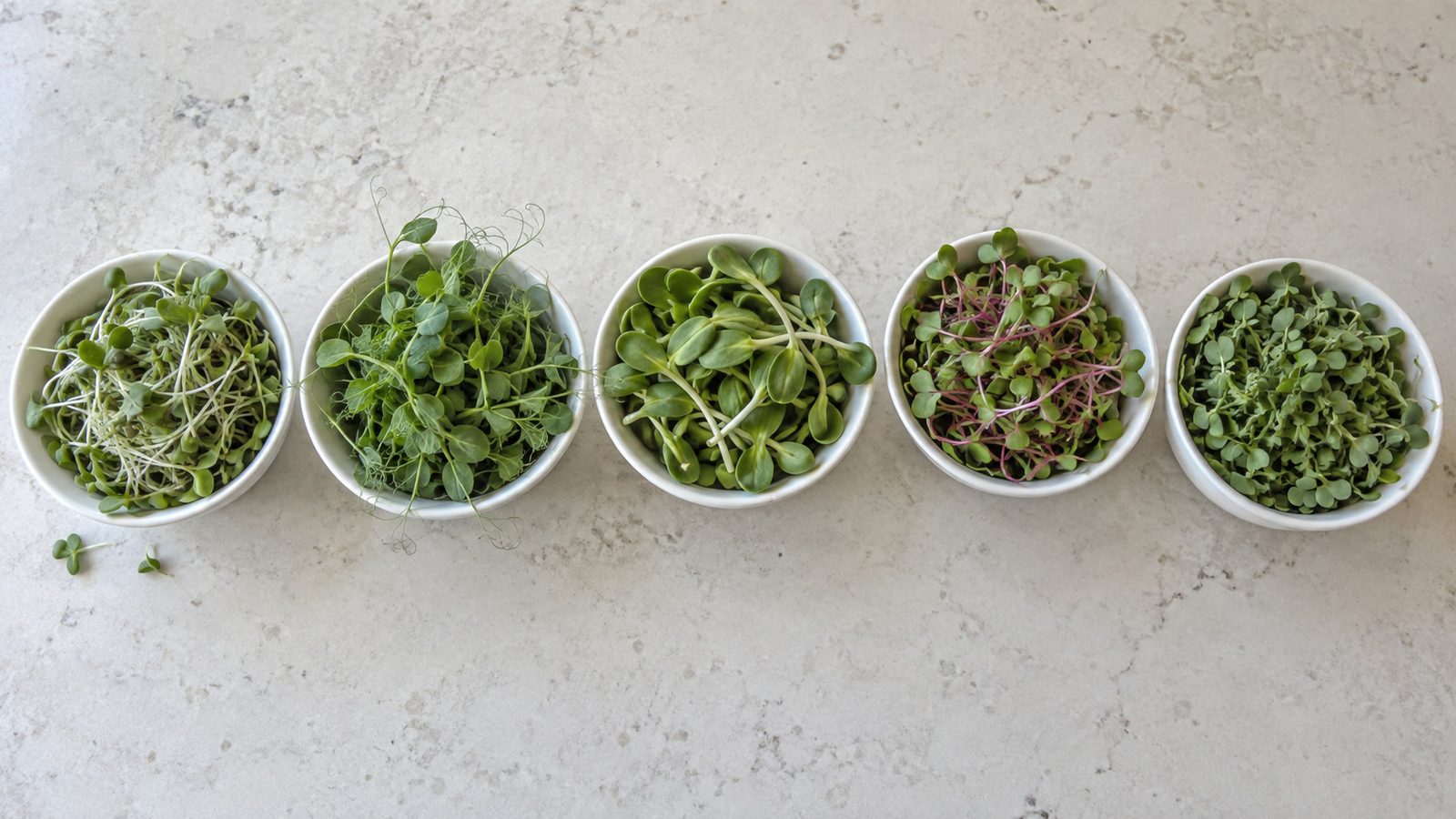
Lentil microgreens carry the most protein among crops with comparable fresh-weight lab figures: 6.47 g per 100 g, measured by Kowitcharoen et al. (2021). Fenugreek follows at 4.03 g, then pea at 3.73 g, sunflower at 3.6 g (Scientific Reports, 2025), radish at 2.58 g, broccoli at 2.23 g and buckwheat at 1.75 g.
Calories stay low, from about 24 to 30 kcal per 100 g for broccoli, radish and pea up to 55.5 kcal for sunflower. What lands on your plate depends on portion: 85 g of lentil microgreens gives about 5.5 g of protein, while a 2.5 g garnish of any of these gives well under 1 g.
Protein per 100 grams of fresh microgreens
Every figure in the table below is fresh weight, which means the greens as you cut them, water and all. That basis matters because most of a microgreen is water. The 2021 study measured 86.57 g of water per 100 g in lentil and 94.07 g in broccoli (Kowitcharoen et al.), and the protein sits in what is left.
Hover or tap a row to highlight it.
| Crop | Protein, g per 100 g fresh weight | Source |
|---|---|---|
| Lentil | 6.47 | Kowitcharoen et al. 2021 |
| Fenugreek | 4.03 | Kowitcharoen et al. 2021 |
| Pea | 3.73 | Kowitcharoen et al. 2021 |
| Sunflower | 3.6 | Scientific Reports 2025 |
| Radish | 2.58 | Kowitcharoen et al. 2021 |
| Broccoli | 2.23 | Kowitcharoen et al. 2021 |
| Buckwheat | 1.75 | Kowitcharoen et al. 2021 |
Read the order as a ranking of these samples, not a fixed property of each crop. A separate 2025 analysis measured pea microgreens at 6.4 g per 100 g fresh weight, close to lentil (Scientific Reports), and a 2020 study put radish at 1.81 g where the 2021 study found 2.58 g (Ghoora, Babu and Srividya). The 2021 table doesn't name cultivars, so two trays of "pea" grown from different seed can land in different places.
One entry in the 2021 study trips people up. It measured Chinese kale at 2.23 g of protein per 100 g, and Chinese kale is a different plant from the curly or lacinato kale most US growers sow. Don't carry that number over to kale. The same goes for arugula, beet, amaranth, basil and cilantro, which aren't in this comparison.
If you grow one of them and want a working number, find a packaged version of that crop with a Nutrition Facts panel, note the serving weight on it, and convert it to 100 g yourself: divide the protein figure by the serving grams and multiply by 100. Keep in mind that the result describes a label, not a lab analysis of your tray.
What a serving of microgreens gives you
A per-100 g number only helps once you apply it to what you eat. The math takes one line: protein per 100 g, times the grams you eat, divided by 100. Cup and handful measures don't convert reliably across crops, because a loose cup of sunflower shoots and a loose cup of broccoli greens hold different amounts, so a kitchen scale is the tool that makes this work. The site's serving size and cost audit found recipes using about 2.5 g per person as a garnish, 57 g of young pea shoots in one porridge recipe, and 85 g per person of mature pea shoots in a stir-fry.
Hover or tap a row to highlight it.
| Crop | Protein in a 2.5 g garnish | Protein in a larger portion |
|---|---|---|
| Lentil | 0.162 g | 3.69 g in 57 g; about 5.5 g in 85 g |
| Pea | 0.093 g | 2.13 g in 57 g |
| Sunflower | 0.090 g | Use the formula with your portion |
| Radish | 0.065 g | Use the formula with your portion |
| Broccoli | 0.056 g | Use the formula with your portion |
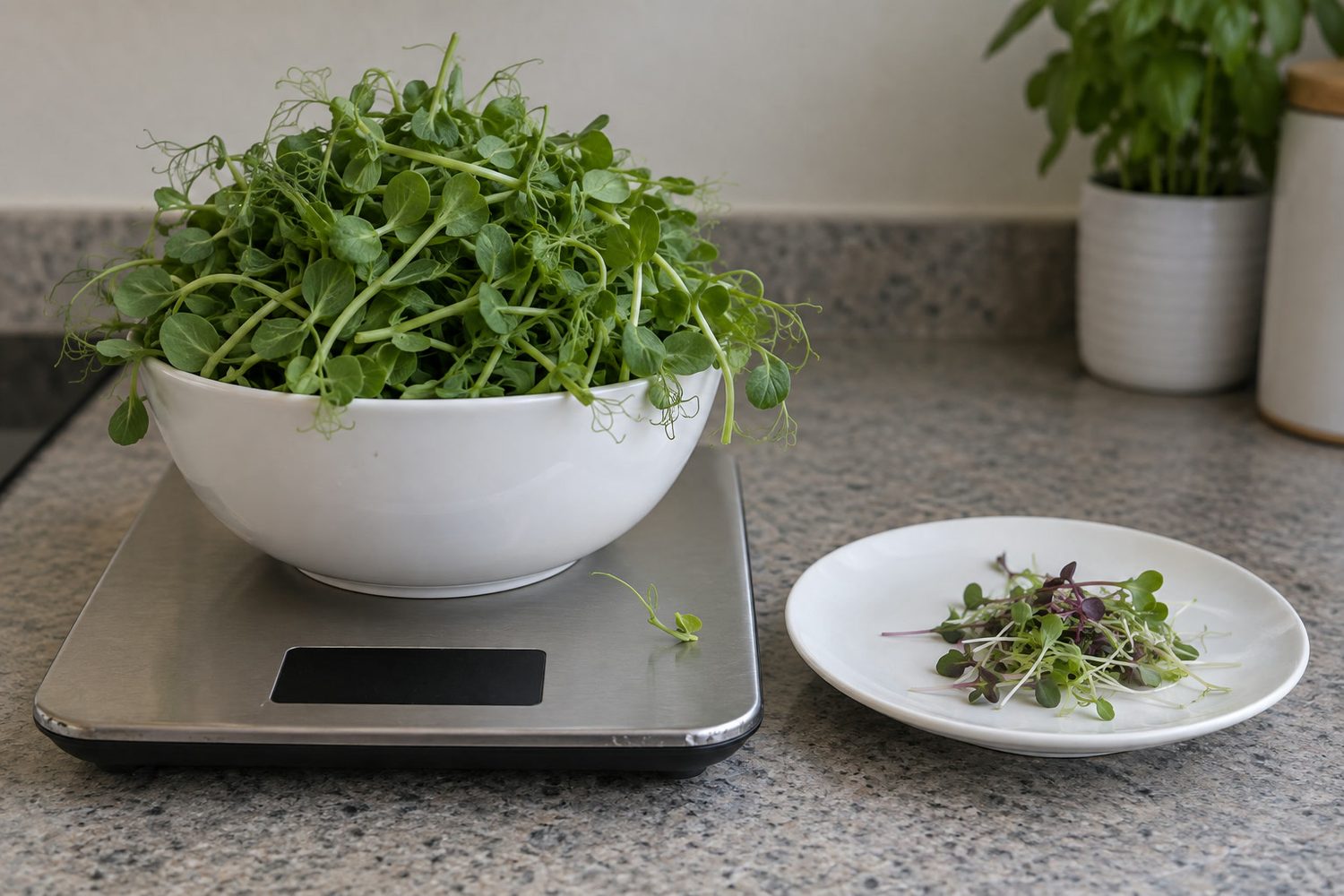
The garnish figures come from the fresh-weight values above (Kowitcharoen et al.; Scientific Reports). Put your usual portion on a scale once, write the grams down, and run that number through the formula for each crop you grow. After that you won't need to guess again.
The 85 g portion isn't a random choice. It's the FDA reference amount customarily consumed for "all other vegetables without sauce," while vegetables used mainly as garnish or for flavor have a reference amount of 4 g (21 CFR 101.12). Microgreens aren't named separately, so which one fits depends on how a product is presented and used. At the 4 g garnish amount, lentil microgreens supply 0.259 g of protein. FDA sets the protein Daily Value at 50 g (FDA Daily Values), so a 2.5 g lentil garnish covers 0.32% of it and a 57 g portion covers 7.4%.
None of these crops meets FDA's definition of high protein, which under 21 CFR 101.54 requires at least 20% of the Daily Value, or 10 g of protein, per reference amount. A "good source" needs 10% to 19%, or 5 g. Lentil at 85 g supplies 5.50 g, which could clear that lower bar only if 85 g is the reference amount that applies to the product and FDA's protein quality requirements are also met (FDA claims guide).
Calories in microgreens
Calories run low in every crop with fresh-weight lab data, and the spread between crops is small except for sunflower.
Hover or tap a row to highlight it.
| Crop | kcal per 100 g fresh weight | Source |
|---|---|---|
| Broccoli | 24.13 | Kowitcharoen et al. 2021 |
| Chinese kale | 24.68 | Kowitcharoen et al. 2021 |
| Radish | 27.98 | Kowitcharoen et al. 2021 |
| Pea | 29.83 | Kowitcharoen et al. 2021 |
| Purple radish | 32.85 | Kowitcharoen et al. 2021 |
| Sunflower | 55.5 | Scientific Reports 2025 |
The 2025 analysis measured its own broccoli at 21.1 kcal and radish at 23.8 kcal per 100 g, a little under the 2021 values, and it found 3.9 g of fat per 100 g in sunflower against 1.1 g in broccoli (Scientific Reports). At garnish scale the calorie count barely registers: 2.5 g gives 0.75 kcal from pea, 1.39 kcal from sunflower, 0.60 kcal from broccoli and 0.70 kcal from radish. A 57 g pea shoot portion comes to 17.0 kcal.
Carbohydrate is low too. The 2021 study reported total carbohydrate by difference, meaning what is left after water, protein, fat and ash are subtracted, so any fiber is counted in it. Per 100 g fresh weight that came to 2.70 g for broccoli, 3.29 g for radish, 3.39 g for pea, 4.90 g for buckwheat, 5.12 g for fenugreek and 5.92 g for lentil (Kowitcharoen et al.).
Those are total carbohydrate figures, not net carbs, so don't subtract fiber from them unless you have a fiber number measured on the same sample. A 57 g portion of pea microgreens holds 1.93 g. If you're tracking calories for weight reasons, the site's post on microgreens and weight covers that side.
Is sunflower a complete protein?
Sunflower microgreens haven't been shown to be a complete protein. The 2025 analysis measured 17 amino acids in fresh sunflower microgreens, including leucine at 240 mg, lysine at 150 mg and methionine at 62 mg per 100 g, but it didn't report tryptophan and didn't calculate a digestibility or amino acid score (Scientific Reports). Calling a protein complete takes more than finding the essential amino acids in it. It takes their quantities compared against a reference pattern, plus a digestibility score, and neither exists for sunflower microgreens.
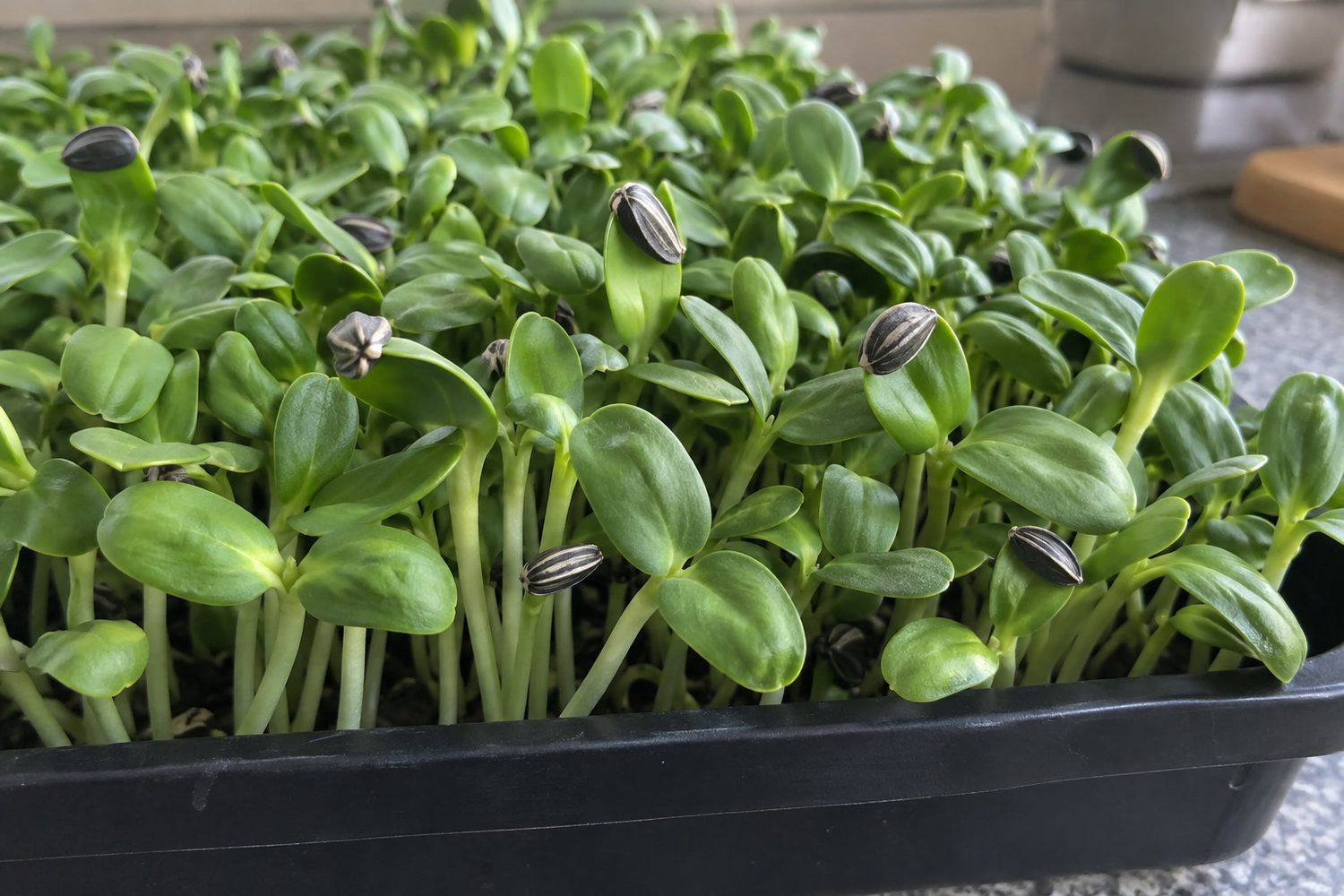
What you can say with confidence is the amount: 3.6 g of protein per 100 g fresh weight. The same analysis measured pea microgreens at 280 mg of leucine and 240 mg of lysine per 100 g, so pea is no weaker than sunflower on those two, and it carries the same missing tryptophan and score.
Keep fresh greens, dry weight, sprouts, powders and mature vegetables apart
A protein number means little until you know which food it describes and whether water is included. Several figures you'll come across describe something other than fresh microgreens, and mixing them into one comparison will send you to the wrong crop.
Dry weight figures
Dry weight numbers look far higher because the water has been removed. Ayeni (2021) dried tropical spinach micro and baby greens and reported 33.5 g of protein per 100 g dry weight. The paper lists 134 calories per 100 g dry weight next to that protein, and that 134 is energy from protein only; add carbohydrate and fat and the total is 220 kcal per 100 g dry weight.
The fresh tissue was 85% to 90% water, so 100 g fresh held 10 to 15 g of dry matter. That works out to about 3.35 to 5.03 g of protein and about 22 to 33 kcal per 100 g fresh. You can convert any dry weight figure the same way: multiply it by the dry share of the fresh greens, which is 100 minus the moisture percentage, divided by 100.
Powders
Powders concentrate everything. Wheatgrass powder dried in shade, in an oven or by freeze drying measured 31.37, 27.83 and 30.04 g of protein per 100 g of powder (drying study, 2018). Black gram, mung bean and chickpea microgreen extract powders measured 51.07% to 60.41% protein (Kaur et al., 2022). Those numbers describe a dried, concentrated product, so they can't tell you anything about a tray of fresh greens.
Sprouts
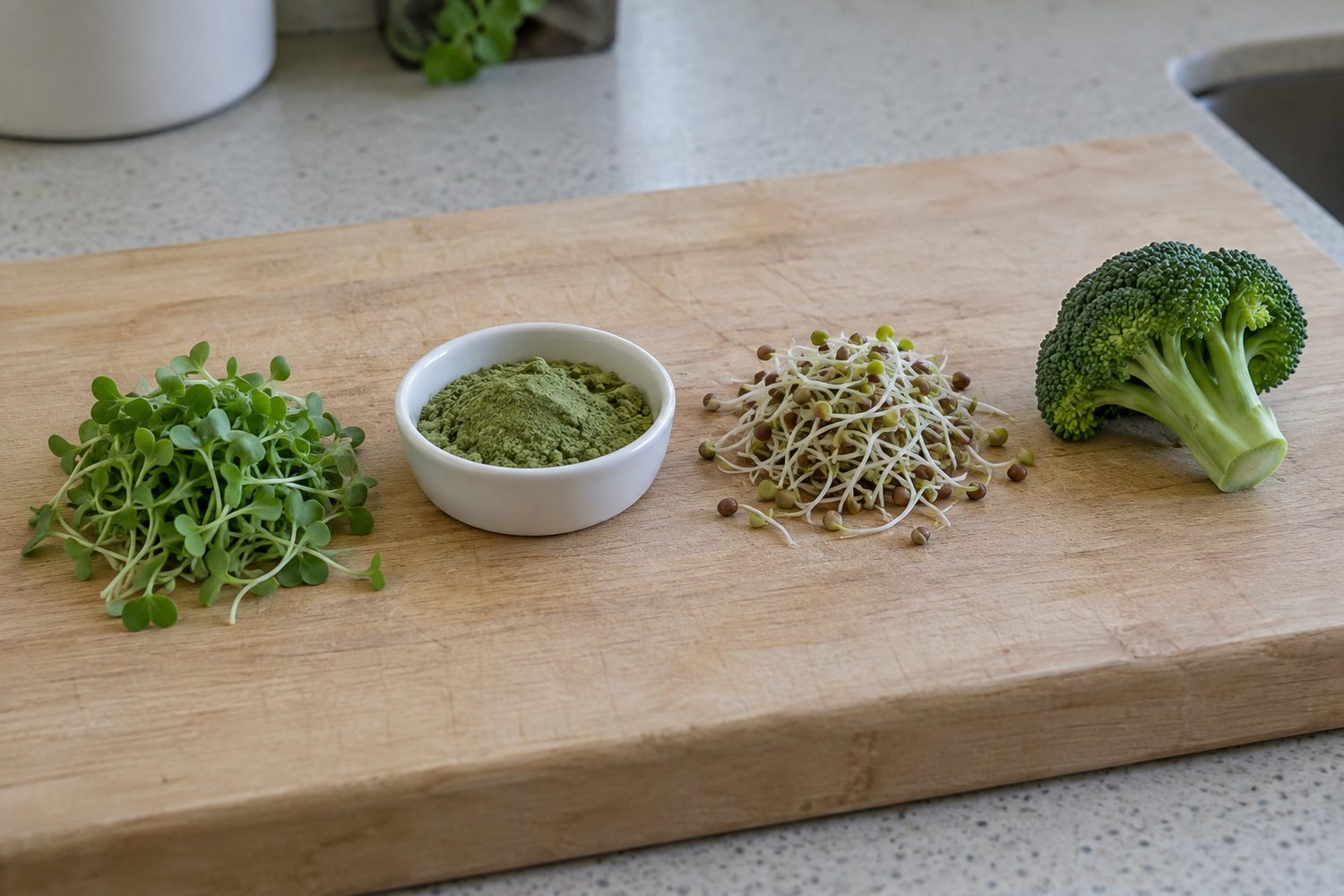
Sprouts are a different food with different numbers. Raw radish seed sprouts in FoodData Central's SR Legacy data list 43 kcal and 3.81 g of protein per 100 g, against 27.98 kcal and 2.58 g for radish microgreens (FoodData Central; Kowitcharoen et al.). USDA's sprouted pea seed record describes the sprouted seed, not pea shoots or pea microgreens, so use 3.73 g per 100 g for the greens.
A packaged product of sprouted sunflower seeds labels a 28 g quarter cup at 160 kcal, 6 g of protein and 14 g of fat (Carb Manager entry); that is a seed, not the green. The differences between the two foods go beyond nutrition, and the site's post on microgreens vs sprouts walks through them.
Mature vegetables
Mature vegetables sit on either side of their microgreens. USDA Foundation raw broccoli (FDC 747447) lists 32 kcal and 2.57 g of protein per 100 g, calculated with Atwater specific factors, so broccoli microgreens at 24.13 kcal and 2.23 g run slightly below the grown plant. Mature raw radish lists 16 kcal and 0.68 g of protein, well under radish microgreens at 27.98 kcal and 2.58 g (FoodData Central). The site's post on whether microgreens have 40 times the nutrients covers the vitamin side of that comparison.
Package labels
USDA FoodData Central branded records store label values per 100 g, calculated from the label's own serving. The 28 kcal and 2.2 g of protein per 100 g often given for sunflower microgreens traces to a New Day Farms sunflower-and-basil label: its 90.5 g serving declares 25.3 kcal and 2 g of protein, which FoodData Central stores as 28 kcal and 2.21 g per 100 g (FoodData Central). That is a manufacturer's label for a packaged mix, so when you want a crop figure for sunflower, use the 3.6 g and 55.5 kcal from the fresh lab analysis instead.
Which microgreen to grow or eat for protein
If protein is the reason you're choosing a crop, lentil leads the fresh-weight comparison at 6.47 g per 100 g, with fenugreek at 4.03 g and pea at 3.73 g behind it. The catch is portion size. Those crops only add up to a few grams when you eat them as a vegetable, in the 57 to 85 g range of a stir-fry or salad base, and lentil at 85 g gives about 5.5 g.
At garnish scale the crop you pick changes your protein intake by a few hundredths of a gram, so choose garnish crops for flavor, color and the nutrients they carry beyond protein. The site's post on which microgreen is most nutritious compares crops on those other nutrients, and how much microgreens to eat per day covers daily amounts.
Keep in mind that the figures here came from laboratory samples, and your own trays may differ. Growing medium and harvest age both moved the numbers in published work, as the questions below cover, so treat the table as a starting comparison rather than a promise about your crop.
Frequently asked questions
These answers cover points that come up once you start working with the numbers above.
How much protein is in an ounce of sunflower microgreens?
About 1.0 g of protein and about 15.5 kcal in 28 g of fresh sunflower microgreens, working from 3.6 g of protein and 55.5 kcal per 100 g fresh weight (Scientific Reports). One ounce is 28.35 g by definition. An ounce is a unit of mass, though, not a typical serving, so check what you eat on a scale.
Why do some microgreen labels show 0 calories and 0 protein?
Some small-serving labels round down. FoodData Central lists Triple B broccoli and arugula records with a 14 g serving that declare 0 kcal and 0 g of protein, which are permitted rounded label declarations (FoodData Central). Lab analysis of broccoli microgreens found 24.13 kcal and 2.23 g of protein per 100 g, so the greens do contain both.
Does the growing medium change protein content?
It did in one institutional report. The National Institute of Nutrition, Hyderabad, found broccoli microgreen protein ranging from 2.09 to 3.90 g per 100 g across tissue paper, coco peat, vermicompost and hydroponic growing (MANAGE report, 2023). The report isn't peer reviewed and doesn't state its analytical methods, so use it as a sign that medium matters rather than as a recipe for more protein.
Does harvest age change protein?
In tropical spinach it did. Between day 10 and day 20 after sowing, protein fell from 35% to 27% of dry weight while carbohydrate rose from 12.5% to 25% (Ayeni, 2021). That result applies to tropical spinach, so if you want to know how it plays out in your crop, you would need lab analysis at each harvest age.
Where to go from here
Start with your own portion. Put it on a scale, multiply the grams by the crop's protein per 100 g, divide by 100, and you have the number for your plate. If lentil or pea fits the way you eat, grow them for meal-sized portions; if your microgreens mostly go on top of things, pick them for taste and the nutrients beyond protein. For the next step, the site's posts on serving size and cost, daily amounts, nutrient density, weight management and how microgreens differ from sprouts pick up where this one stops.
Sources
Prices, stock and specifications are as the linked pages showed them on 2026-09-12.
Keep reading
The journal
Are Microgreens Keto? How to Count Net Carbs
Are microgreens keto? Find total carbohydrate, fiber, and sugar per crop, plus per serving net carb ceilings measured against daily keto limits.
Read Are Microgreens Keto? How to Count Net CarbsThe journal
Best Microgreens for Kidney Health: Potassium by the Serving
See measured potassium and phosphorus for the best microgreens for kidney health, from lowest to highest, plus what your renal dietitian needs to know.
Read Best Microgreens for Kidney Health: Potassium by the ServingThe journal
Are Microgreens Low FODMAP? What Monash Research Shows
Are microgreens low FODMAP? Learn what Monash sprouting research shows, which crop families deserve extra caution, and how reintroduction testing works.
Read Are Microgreens Low FODMAP? What Monash Research ShowsThe journal
Are Microgreens Anti-Inflammatory? What the Research Really Says
Inflammation has not been measured in people eating microgreens. And when researchers pooled ten broccoli sprout trials, the combined result came out at something that could be zero.
Read Are Microgreens Anti-Inflammatory? What the Research Really Says