Microgreens vs Sprouts: The Difference Is a Cut, Not a Nutrient, and It Decides Which Federal Rule Applies
Cal HewittPublished Checked
- comparison
- food safety
- beginner
- buying
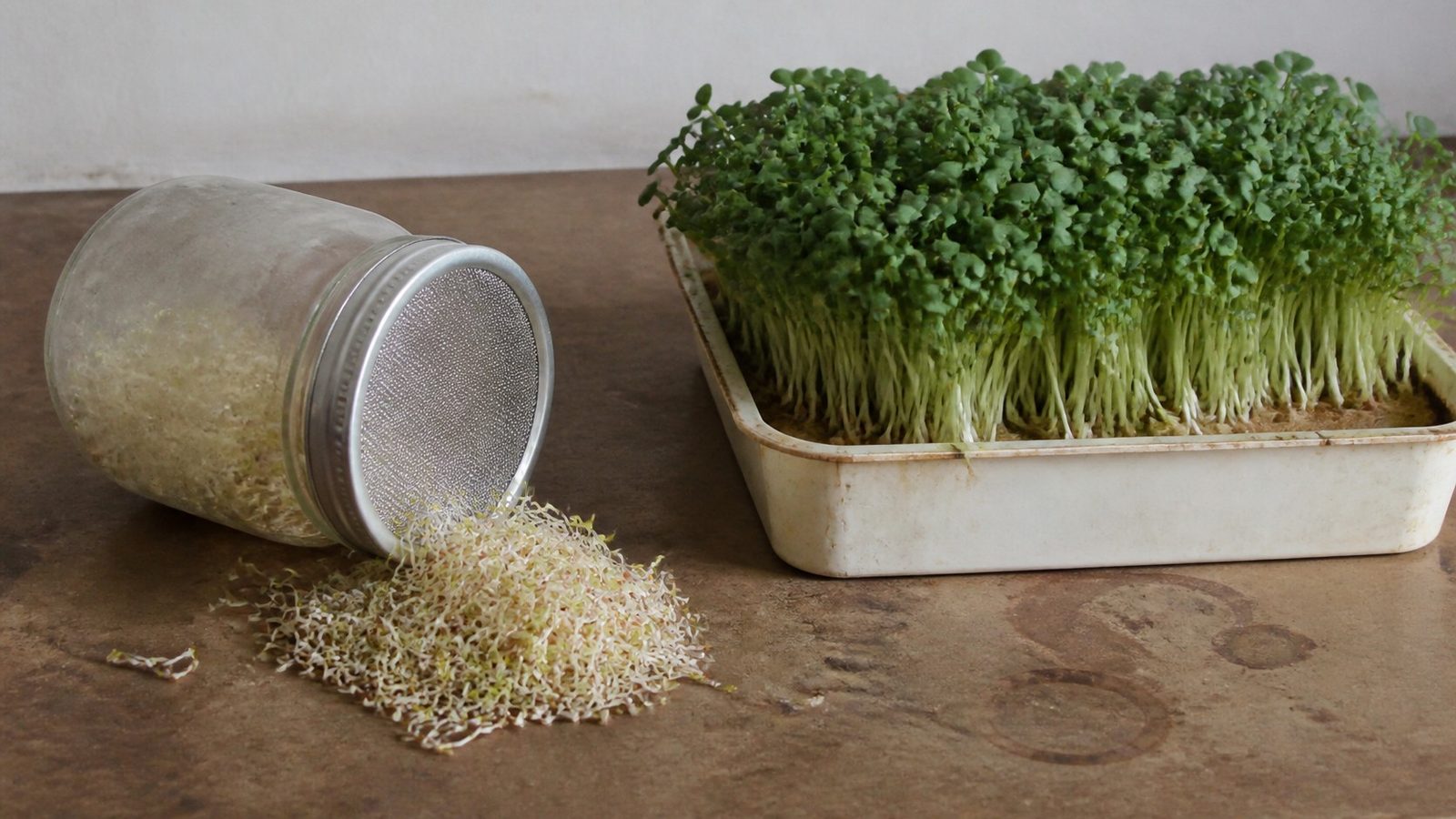
Almost every page that compares these two foods compares their nutrition, and the number it reaches for was never measured on a sprout.
The familiar figure, that microgreens carry four to forty times more of certain nutrients, comes from a study of microgreens against mature vegetables. It says nothing about sprouts. Borrowing it to settle a sprout contest is the single most repeated error in this subject, and where that number actually came from is worth knowing before you use it for anything.
The difference that actually holds is physical, and you can see it in the bowl. A sprout is a just-germinated seed eaten whole, root and seed coat included. A microgreen is a later seedling cut above its growing medium, so the root and the spent seed stay behind. That one cut is also the line United States law draws, and it changes which federal requirements a commercial grower has to meet.
What to actually do
- Name the product before you judge it. Whole with roots and seed is a sprout. Cut above the medium is a microgreen. Everything else in this comparison follows from that.
- Ignore any nutrition claim that cites a mature-vegetable multiple. The four to forty times figure is microgreens against grown-up plants and has nothing to say about sprouts.
- Do not expect a form to decide your yield. Per gram of seed, the crop moves this number 66-fold within microgreens alone, and the sprout figure counts the seed and root that a microgreen cut throws away.
- If you want sprouts, choose them deliberately. Use seed intended for edible sprouting rather than seed sold for planting, which may carry a pesticide treatment and should not be assumed edible.
- If you are in a higher-risk group, follow the advisory that exists. CDC says avoid raw sprouts and cook them thoroughly; that advice is specific to sprouts and it is not hedged.
- Treat seed as the shared hazard. It is the route into both foods, so buy seed sold for food use, keep it dry and sealed, and do not solve a seed problem with a rinse.
- Compare prices per ounce, from your own two labels. Pack size moves the per-ounce figure more than the category does.
- If you run both, keep them apart. Separate water, separate tools, traceable seed lots, and no untreated reuse of sprout rinse water.
The definitions, and the one that does the work
USDA's Agricultural Marketing Service defines a sprout as a germinated seed whose cotyledons are undeveloped or under-developed and whose true leaves have not begun to emerge, with the final product intended to be eaten whole, including the seed.
Penn State Extension describes a microgreen as a young edible seedling harvested once cotyledons are developed and the first true leaves have emerged, cut just above the growing medium. USDA's Agricultural Research Service is blunter and calls it a marketing term for tiny edible greens grown in soil or a substitute.
So, it is stage and harvest method together. Early and whole points to a sprout. Later, leaf-bearing and cut above the medium points to a microgreen.
Two things this is not. It is not a growing-method label: a sprout grown in substrate and pulled up whole is still a sprout, and calling a jar "semi-hydroponic" does not change what comes out of it. And "water only" is too absolute as a description of sprouting, because what matters is whether the roots come with the product.
"Shoots" is not a reliable third stage. In the AMS audit scope, shoots and microgreens are defined jointly as germinated seeds with true leaves emerged, whose shoots and leaves rather than roots or seed coats are harvested. In shops, "pea shoots" is a crop name applied at a range of ages. Identify the crop, the leaf stage, the harvest point and whether roots are sold, rather than trusting the word.
This matters at home more than it sounds. A rinsed jar makes a sprout, and three of three pages promoting the technique call it a microgreen. A reader following those pages is producing the higher-risk product while reading guidance written for the other one.
What the cut changes is which federal rule applies
FDA's Produce Safety Rule contains a sprout-specific section, Subpart M, and it is genuinely demanding.
Hover or tap a row to highlight it.
| Requirement | What it means in practice |
|---|---|
| Seed treatment | Treat the seed, or hold documentation that a prior treatment was applied |
| Hazard prevention | Take measures against known and reasonably foreseeable hazards on and in the seed |
| Surfaces | Clean and sanitize food-contact surfaces |
| Environmental monitoring | A written plan for Listeria species and L. monocytogenes in the growing environment |
| Batch pathogen testing | Test spent irrigation water or in-process sprouts from every production batch for Salmonella species and E. coli O157:H7 |
| Release | Product cannot enter commerce until the required results are negative |
| Records | Written sampling and corrective-action plans, plus records of tests, methods, corrective actions, seed lot, locations, dates and signatures |
| Water | Safe and sanitary water, testing requirements for untreated groundwater, and no untreated reuse of spent irrigation water |
None of that applies to a microgreen cut above the soil or substrate without roots. FDA states the distinction explicitly, and it runs the same way in reverse: a sprout grown in soil or substrate and harvested with its roots stays inside Subpart M. The growing medium is not what decides it. The knife is.
Of five popular comparison articles checked on 2026-08-11, none mentioned Subpart M. That is a bounded look at five visible results rather than a share of the web, but it is the actual regulatory difference between the two foods and none of the five had it.
Two cautions on reading that as good news for microgreens. Falling outside Subpart M is not an exemption from all law; a covered microgreen farm can still sit under other parts of the Produce Safety Rule. And a rule written for commercial operations is not a household one, which is why the mechanism below matters more to a home grower than the paperwork does.
The nutrition comparison, and what one same-species study actually found
There is no universal winner, and the honest answer is that almost nobody has run the comparison.
The one clean same-species measurement is a 2026 peer-reviewed study of mung bean, Vigna radiata, growing sprouts and microgreens from the same locally obtained seed.
Hover or tap a row to highlight it.
| Measure | Which form was higher |
|---|---|
| Vitamin C, fresh weight | Microgreen, 110.955 mg/100 g against the sprout's 88.888, about 25 percent more |
| Dietary fiber | Microgreen, roughly twice the sprout |
| Calcium, magnesium, iron, zinc | Microgreen |
| Protein | Sprout |
| Fat | Sprout |
| Potassium | Sprout, slightly |
That is a split result, not a verdict, and it is one species under one protocol. The study also carries an internal timing ambiguity: its method describes sprouts held on tissue paper in plastic trays while microgreens continued a further seven days to true leaves. The fresh-weight vitamin C figure is usable as a stage comparison. It is not a clean answer to "commercial water-grown sprouts against tray-grown microgreens."
A second study measured radish and beet on both sides. Across its selected sets, sprouts carried higher total polyphenols and generally more free amino acids, while microgreens carried more carotenoids and chlorophyll. Its columns are not directly comparable to each other, because amino acids and polyphenols are reported on fresh weight and carotenoids and chlorophyll on dry weight, and its sprout and microgreen species panels differ. Only the radish and beet contrasts inside it answer a same-species question at all.
So, both popular slogans fail. "Microgreens are more nutritious" traces to the microgreen-against-mature-plant work, and "sprouts have more protein and enzymes" is usually asserted with no stated assay, cultivar or units. The one same-species dataset splits between them.
The yield comparison looks like a tie, and the tie is an artifact
This is the comparison where the unit does the most damage.
The sprout literature quotes an industry target of roughly 9 to 10 grams of fresh sprouts per gram of seed. Set that against the microgreen side, computed from the 39 crops that publish both a seed rate and a yield, and the two appear to land in the same place.
Hover or tap a row to highlight it.
| Basis | Figure |
|---|---|
| Sprout industry target, quoted as background | 9 to 10 g per g |
| Microgreen median, across the 39 crops publishing both a seed rate and a yield | 9.24 g per g |
| Lowest crop here | 0.80 (fennel) |
| Highest crop here | 52.65 (sorrel) |
| Spread across the 39 | 66-fold |
| Crops actually falling inside 9 to 10 | 1 of 39 |
The median matching is a coincidence with nothing behind it. Exactly one crop of thirty-nine, bull's blood beet, sits inside the 9 to 10 band. Nineteen are below it and nineteen above. A median that lands inside a range is not a match; it is the middle of a spread that happens to contain it, and a 66-fold spread means the crop decides this number, not the form.
Then the deeper problem: the two ratios are not counting the same product. The sprout figure puts the seed and the root in the numerator, because a sprout is eaten whole. The microgreen figure leaves both out, because the crop is cut above the medium and the root mass and spent seed are discarded.
That gap is largest for exactly the crops sprouting uses. Mung bean is sown here at 200 to 215 grams a tray and pea at 150, against a directory median seed rate of 23 grams. So, a mung tray discards about nine times the median crop's entire seed weight at the cut, and a pea tray about six and a half times, while the sprout form of the same seed keeps that mass in the bowl. The full 409-fold seed-rate range and what a median tray actually returns are each worked through separately.
Restricting the comparison to the species grown both ways does not rescue it. The research names broccoli, radish, beet, mung bean, sunflower and pea as the common overlaps. Two of those six publish no microgreen yield here at all, and the four that do span 1.51 to 25.08 grams per gram, a 16.6-fold range, which is still far too wide to set a single number against the sprout target.
The clearest case refuses the comparison outright. Alfalfa, the most sprouted seed there is, has no seed rate per tray and no yield per tray to publish. There is no tray and there is no cut, so the fields that describe a microgreen crop have nothing to hold.
And no controlled head-to-head exists. Nobody has published a same-cultivar, same-seed-lot trial reporting edible fresh yield per gram of seed and per day for both forms. Microgreen yield trials exist by crop and area, but differing seed density, medium, lighting, tray area and cut stage make them non-comparable to a sprout figure. The 9 to 10 number is a background statement in a paper, not a trial result, and treating it as one is how the tie gets manufactured.
The safety record is real, asymmetric, and not zero on either side
The sprout rule exists because of a documented outbreak history, not a precaution chosen on taste.
Hover or tap a row to highlight it.
| Record | Figure |
|---|---|
| United States sprout-associated outbreaks, 1996 to 2014 | 43 |
| Illnesses | 2,405 |
| Hospitalizations | 171 |
| Deaths | 3 |
| Organisms implicated | Salmonella, Shiga toxin-producing E. coli O157:H7, L. monocytogenes |
| One later case | A 2022 Salmonella outbreak linked to alfalfa sprouts, prompting a four-lot recall on 29 December 2022. An example of a later case, not established here as the most recent one |
| Microgreens | A Greenbelt Greenhouse recall announced 25 April 2018 after Washington State detected L. monocytogenes in broccoli microgreens. No illnesses reported |
Do not say microgreens have never had a problem. That 2018 recall covered arugula, broccoli, mixes, pea shoots and sunflower. What has not been located is a microgreens-attributed illness outbreak on anything like the scale of the sprout series. That is a limited search result and not proof that none has occurred.
The mechanism is two-part, and only the second part is sprout-specific. Contamination can arrive on or in the seed, including in cracks and crevices where it is protected. Then warm, wet, nutrient-rich germination conditions can multiply it. FDA's own sampling found Salmonella in 2.35 percent of sampled sprouting seed, against 0.21 percent of finished sprouts and 0.54 percent of spent irrigation water, in its 2014 to 2016 program. Those are that program's figures, not a current prevalence estimate, and the seed being the highest of the three is consistent with a seed-borne route.
Microgreens are not outside that mechanism. A controlled experiment found that contaminated seed produced Salmonella growth in both alfalfa sprouts and Swiss chard microgreens. The seed risk is shared. What differs is how much amplification the growing conditions allow and whether the root and seed coat end up on the plate.
CDC's advice is specific and worth repeating exactly. People at higher risk, meaning adults 65 and over, children under five, pregnant people and people with weakened immune systems, are advised to avoid raw sprouts and to cook sprouts thoroughly. Its pregnancy guidance lists raw and undercooked alfalfa and bean sprouts as a riskier choice. CDC does not issue the same categorical avoid-raw advice for microgreens in these sources, treating washed produce generally as safer instead. The absence of a parallel advisory is not evidence that raw microgreens are sterile, and what the raw evidence does and does not show is worked through in full separately.
Price, cost, shelf life and difficulty are all unsettled
Retail price. Two listings checked on 2026-08-11: Sprouts Farmers Market listed a 4 oz pack of alfalfa sprouts at $2.99, or $0.75 an ounce, and Heinen's listed a 2 oz red-blend microgreen pack at $6.49, or $3.25 an ounce.
Do not turn that into a multiple. The two differ in seller, brand, crop, blend, package size, location and date, and one pair of listings is not a national average. There is a live cross-check for that: at $3.25 an ounce the Heinen's pack works out at $52 a pound, which sits above the entire $27.22 to $45.36 per pound band one grower's three pack sizes produce. An observed listing is an observation.
Startup cost. A grower guide's figures of $3 to $8 for sprouting against $15 to $40 for microgreens are practice, not a validated cost study. The equipment genuinely differs: sprouting needs a food-safe vessel and a way to drain and rinse, while microgreens need a shallow drained tray, medium or hydroponic support, water and light after emergence. Cost your own batch as seed plus consumable medium plus water and electricity plus annualized equipment, divided by edible grams, and record the crop and the losses.
Shelf life has no winner either. Daikon radish microgreens held acceptable quality to day 28 at 1 °C in one specified package, and that is one crop, one package and one temperature rather than a promise about microgreens. The mung study asserts microgreens last about a week and that sprout roots prolong shelf life, but it ran no controlled postharvest comparison. "Seven to ten days against two to three" is a grower claim. What actually moves a shelf life is temperature, packaging and whether the crop was washed.
Beginner difficulty is not established in either direction. No controlled trial of novices exists. The failure modes simply differ: sprouts fail through unsafe seed and conditions that let bacteria multiply, and demand repeated sanitary rinsing and draining; microgreen trays fail through poor sanitation, contaminated seed or water, excessive density, weak airflow and overwatering or damping off. "Easier" depends on whether your bottleneck is daily rinsing, light, space, sanitation or diagnosis.
Can one setup do both
Physically yes, as one area but not one unchanged system.
Sprouting needs a batch-segregated soak, rinse and drain workflow, with the water and containers managed as sprout equipment. Microgreens need the tray, medium or hydroponic support, light after emergence, airflow, irrigation and a cut above the medium.
Do not reuse spent sprout irrigation water to irrigate another batch without treatment, which FDA warns against for cross-contamination. Keep seed lots and tools traceable and segregated if you run both.
What nobody has measured
- A controlled head-to-head yield trial: one cultivar, one seed lot, replicated, reporting dry seed in, marketable fresh product out, rejects, and both grams per gram and grams per square meter per day.
- A blinded sensory comparison. Growers agree microgreens are more intense and sprouts milder and crunchier, and not one of those pages reports a cultivar, a harvest age, a preparation or a panel method.
- A transparent home cost study separating durable equipment from seed, medium, water, electricity, labor and crop loss across multiple households.
- A matched shelf-life trial under stated wash, package, humidity and refrigeration, with daily sensory, mass-loss and microbiological endpoints.
- A beginner-success study with predefined successful-harvest, food-safety and crop-loss outcomes and a log of the errors made.
- A microgreen outbreak denominator. The sprout record has one and the microgreen record does not, so "fewer outbreaks" cannot yet be separated from fewer people looking.
Terms on this page
Tap a term to see what it means.
Sprout. A just-germinated seed sold and eaten whole, before true leaves emerge, with the root and seed coat included.
Sources
Opened 2026-08-11 unless stated. The seed-to-fresh arithmetic was computed for this page from the seedGramsPer1020 and yieldOuncesPer1020 fields across the 39 of 62 variety entries that publish both, on a range-midpoint basis, converted at 28.3495 grams per ounce. It reproduces the ounces-per-gram figures already published on the tatsoi, mizuna and pak choi entries, which is the check that it is reading the fields correctly. The 39-entry subset is stated everywhere it is used, because 23 entries publish no yield and 11 publish neither field.
- FDA, guidance for industry on sprouts (PDF) - the explicit statement that soil and substrate grown sprouts cut above the line without roots are excluded from Subpart M while those harvested with roots remain covered, the sprout-specific standards themselves, and the warning against reusing spent irrigation water.
- FDA, FSMA final rule on produce safety - the Subpart M requirements listed in the table above, and the documented basis for them: 43 United States sprout-associated outbreaks from 1996 to 2014 causing 2,405 illnesses, 171 hospitalizations and three deaths, with Salmonella, E. coli O157:H7 and L. monocytogenes implicated.
- USDA Agricultural Marketing Service, GAP program audit scope (PDF) - the sprout definition as a germinated seed with undeveloped or under-developed cotyledons and no emerged true leaves, intended to be eaten whole including the seed, and the joint definition of shoots and microgreens as germinated seeds with true leaves emerged whose shoots and leaves rather than roots or seed coats are harvested.
- Penn State Extension, the ABCs of microgreens - microgreens as young edible seedlings harvested at developed cotyledons and emerged first true leaves, cut just above the growing medium, and a 7 to 21 day range depending on species and conditions.
- USDA Agricultural Research Service, greens - microgreens described as a marketing term for tiny edible greens grown in soil or a substitute, a 7 to 14 day harvest window, and the about-fivefold vitamin and carotenoid result from 25 microgreen against mature plant pairs, which is the study the four to forty times claim traces to.
- Marottickal et al., 2026, mung bean sprouts and microgreens - the same-seed-source Vigna radiata comparison, microgreen vitamin C at 110.955 mg/100 g against sprout 88.888 on a fresh-weight basis, lower protein and fat, about twice the dietary fiber, more calcium, magnesium, iron and zinc and slightly less potassium; the 26 to 28 °C and 80 percent humidity method with its internal timing ambiguity; the literature statement that industry seeks roughly 9 to 10 g fresh sprouts per gram of seed, which is background rather than a trial; and the unsupported shelf-life assertion.
- Wojdyło et al., 2020 - radish and beet measured on both sides, sprouts higher in total polyphenols and generally free amino acids, microgreens higher in carotenoids and chlorophyll, with amino acids and polyphenols reported on fresh weight and carotenoids and chlorophyll on dry weight, and non-matching species panels overall.
- CDC, Salmonella Typhimurium outbreak linked to alfalfa sprouts, December 2022 - the 2022 outbreak and the four-lot recall of 29 December 2022, and the advice that adults 65 and over, children under five, pregnant people and people with weakened immune systems avoid raw sprouts and cook sprouts thoroughly.
- CDC, food safety for pregnant people - raw and undercooked alfalfa and bean sprouts listed as a riskier choice.
- FDA, Greenbelt Greenhouse microgreens recall - the recall announced 25 April 2018 for possible L. monocytogenes after Washington State Department of Agriculture sampling detected the organism in broccoli microgreens, covering arugula, broccoli, mixes, pea shoots and sunflower, with no illnesses reported.
- FDA, microbiological surveillance sampling of sprouts, FY14 to 16 - Salmonella in 2.35 percent of sampled sprouting seed, 0.21 percent of finished sprouts and 0.54 percent of spent irrigation water, from that program rather than as a current prevalence estimate.
- Applied and Environmental Microbiology, seed-borne contamination study - contaminated seed producing Salmonella growth in both alfalfa sprouts and Swiss chard microgreens, which is why the seed risk is described here as shared rather than sprout-specific.
- Radish microgreen storage study - daikon radish microgreens holding acceptable quality to day 28 at 1 °C in a specified package, the single controlled figure behind the shelf-life discussion.
- Penn State Extension, growing microgreens - the caution that seed marketed for planting may carry a pesticide treatment and should not be assumed edible.
- Penn State Extension, ensuring food safety in microgreens production - the microgreen-side failure modes: sanitation, contaminated seed and water, excessive density, poor airflow, overwatering and damping off.
- Frontiers in Plant Science, microgreen yield study (PDF) - an example of the crop-and-area microgreen yield literature whose differing seed density, medium, lighting, tray area and cut stage make it non-comparable to a sprout figure.
- Retail listings observed 2026-08-11 and used only as observations: Sprouts Farmers Market, Fullei Fresh alfalfa sprouts 4 oz at $2.99 and Heinen's, red blend microgreens 2 oz at $6.49.
- Practice sample, audited 2026-08-11 as a record of what is currently published rather than as evidence, and the source of the zero-of-five Subpart M count: Blooming Expert, the source of the $3 to $8 against $15 to $40 startup figures; On The Grow; BageechaBox, which asserts microgreens higher in vitamins and phytonutrients and sprouts higher in enzymes and protein with no matched data; IndoorGarden; and Wind River Greens, which gives microgreens "the edge" by citing four to forty times comparisons against mature plants and is the source of the seven to ten against two to three day shelf-life claim.
Keep reading
The journal
Best Tasting Microgreens: 233 Consumers Ranked Them, and Bull's Blood Beet Won
Preference has been measured on 233 consumers across three panels. Bull's Blood beet topped the only 0-to-100 ranking, pea shoots and Swiss chard led the other two, and milder crops won throughout.
Read Best Tasting Microgreens: 233 Consumers Ranked Them, and Bull's Blood Beet WonThe journal
The Healthiest Microgreens: Which Are Most Nutritious, and Why the Ranking Collapses
Red cabbage leads vitamin C, red sorrel beta-carotene, cilantro the other carotenoids and green daikon radish vitamin E, all in one study. Converted to a real serving, first and third are 15 micrograms apart.
Read The Healthiest Microgreens: Which Are Most Nutritious, and Why the Ranking CollapsesThe journal
Microgreens Equipment List: What to Buy at Every Scale
See a microgreens equipment list priced at three scales, from one windowsill tray to a full rack, with what to buy, skip, or borrow from the kitchen.
Read Microgreens Equipment List: What to Buy at Every ScaleThe journal
Four Bags Labeled Kale, Two Species and a 227 Percent Price Gap: How Microgreen Seed Actually Gets Named
Federal law makes a seed packet state its kind and variety, not its species. One catalog's four kale microgreen listings span two different species and $25.73 to $84.25 a pound.
Read Four Bags Labeled Kale, Two Species and a 227 Percent Price Gap: How Microgreen Seed Actually Gets Named