Microgreens During Pregnancy: Safety And Nutrition
Cal HewittPublished Checked
- health
- food safety
- evidence
Disclosure: Microgreens Guru earns from some links on this site, including affiliate links. That never changes what the sources below say.
The pregnancy warning you have heard is about raw sprouts. FDA tells pregnant people to "avoid eating raw sprouts of any kind," and it also says, in its own sprout guidance, that "microgreens and sprouts are different products." No food safety agency has published a pregnancy rule for microgreens, raw or cooked. That leaves you in the same place as any other raw produce: buy or grow them carefully, keep them cold, rinse them, eat them within about a week, and cook them when you would rather not eat them raw. A typical serving adds a small amount of folate and iron, not a meaningful share of what pregnancy calls for, and it does not replace a prenatal folic acid supplement. Anything specific to your own diet belongs with your prenatal care provider.
What the agencies say about raw sprouts
The sprout warning is consistent across the US sources, and it is worth reading in the agencies' own words, because the wording is what tells you where microgreens stand.
FDA's pregnancy produce page (content current as of March 5, 2024) says pregnant people should "avoid eating raw sprouts of any kind," naming alfalfa, clover, radish and mung bean sprouts. The reason it gives is specific to how sprouts are grown: bacteria can get into sprout seeds through cracks in the shell, are "nearly impossible to wash out," and can grow to high levels during sprouting "even under clean conditions." FDA's 2022 sprout-seed guidance counted 52 US foodborne illness outbreaks linked to contaminated sprouts from 1996 through 2020, with more than 2,700 illnesses.
CDC's safer food choices page for pregnant people lists "any raw or undercooked sprouts, such as alfalfa and bean" as the riskier choice, and cooked sprouts, cooked until steaming hot, as the safer one. FDA's booklet Food Safety for Pregnant Women, Their Unborn Babies, and Children Under Five (January 2022) carries the same pairing in its food table: "Raw sprouts (alfalfa, bean, or any other sprout)" on the riskier side and "Cooked sprouts" on the safer side. FoodSafety.gov, the federal food safety site, repeats it.
ACOG's patient article by ob-gyn Dr. Anne Srisuro (published April 2022, last reviewed February 2026) says, "Avoid raw sprouts, including bean and alfalfa," and points to the moist conditions sprouts grow in. That is an expert patient article, not a formal ACOG clinical guideline.
Where microgreens fit
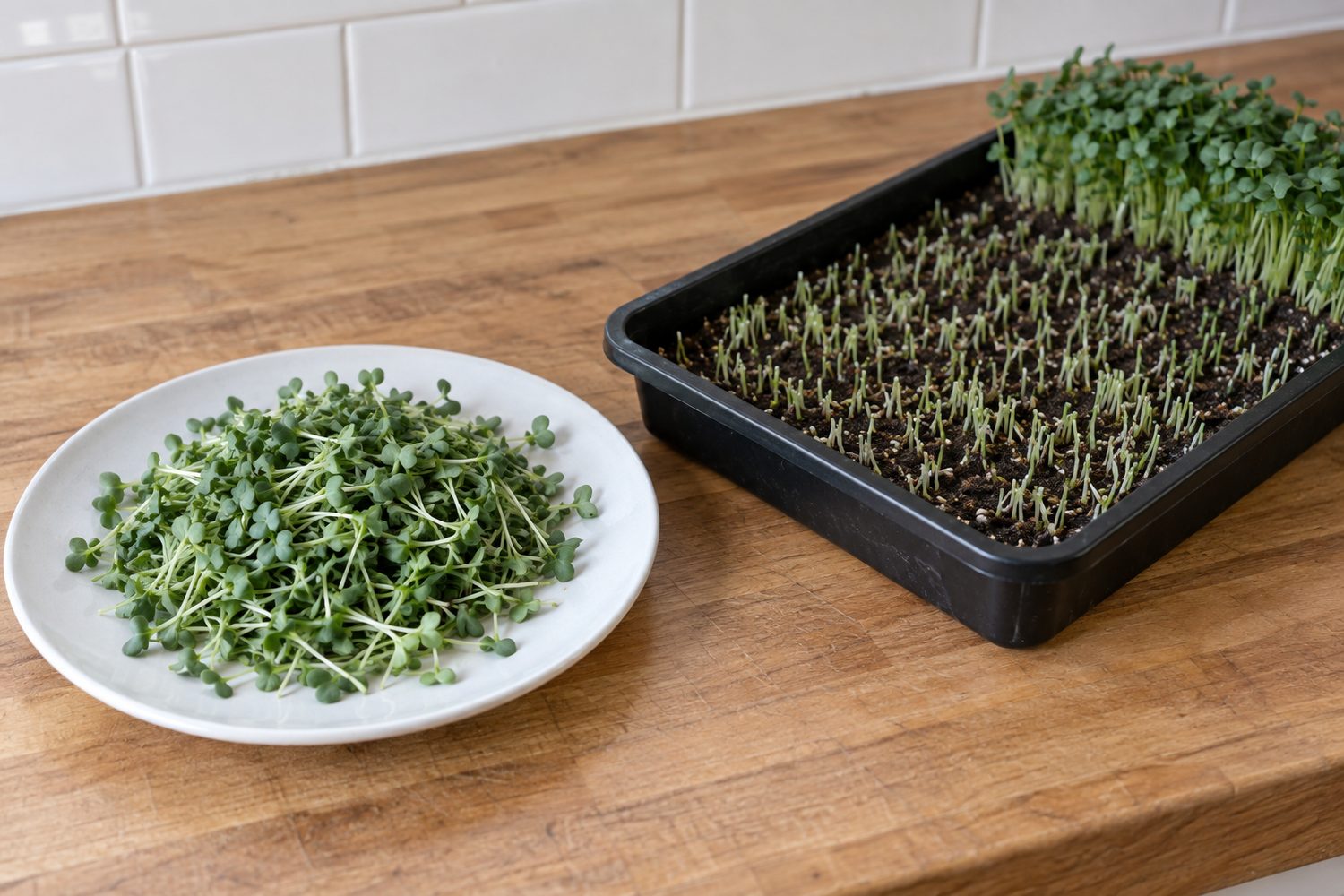
Every one of those warnings names sprouts. FDA draws the line between the two foods in its September 2023 sprout guidance: "We note that microgreens and sprouts are different products." Sprouts are harvested while the seed leaves are still undeveloped. Microgreens "reach a later stage of growth, typically associated with the emergence of 'true' leaves," and are "typically grown in soil or substrate and harvested above the soil or substrate line." FDA concludes that "because microgreens are not sprouts, they are not subject to the requirements in Subpart M," the sprout-specific part of the Produce Safety Rule. Microgreens are still covered produce under that rule, the same as lettuce. If you want the growing difference in more detail, microgreens vs sprouts covers it.
The one government page that names both foods near pregnancy advice is Quebec's Sprout and microgreen food safety (last updated July 6, 2026). It lists pregnant women among the groups that "should not consume raw or undercooked sprouts," and that sentence names sprouts only. Its handling advice covers both: "always keep sprouts and microgreens in the refrigerator," eat them "within one week after they have been harvested or purchased, or before the 'best before' date," and "Rinse in cold running water before eating."
So, the practical reading is this. Your microgreens habit sits outside the raw-sprout warning as it is written. It sits inside the agencies' ordinary raw produce advice, which applies to leafy greens generally. CDC lists unwashed fresh fruits and vegetables, including lettuce and other leafy greens, as riskier choices in pregnancy, and it lists washed produce as safer, adding that produce "washed and then cooked" is safest. One caution on the line between the two foods: FDA's guidance says Subpart M does apply to soil- or substrate-grown sprouts harvested with their roots. If what you are eating was pulled up whole, roots and seed attached, it is closer to a sprout than to a microgreen cut above the soil.
Listeria recalls involving microgreens
Listeria is the organism the pregnancy advice is most concerned with. FDA's Listeria prevention page (content current as of January 16, 2025) says pregnant women are "about 10 times more likely than the general population to become infected," and that Listeria can grow at refrigerator temperatures. FDA's Get the Facts about Listeria lists raw vegetables and prepared or stored salads among the foods it can contaminate, and says "pasteurization, cooking, and most disinfecting agents kill L. monocytogenes."
Microgreens have been recalled for Listeria several times in the US and Canada. The recall record looks like this:
- Greenbelt Microgreens, 2018. Greenbelt Greenhouse Ltd. of British Columbia recalled all Greenbelt Microgreens products with best-before dates of April 24 and April 30, 2018, after Washington State Department of Agriculture sampling found Listeria in broccoli microgreens. The recall covered seven 75 g and 100 g packs (arugula, broccoli, pea shoot and sunflower microgreens and three mixes) sold at Whole Foods stores in Washington between April 11 and April 24, 2018. The company announced it on April 25, 2018, and the FDA notice says "No illnesses have been reported to date." FDA lists the recall as completed and terminated.
- Canadian recall warnings, 2018 and 2019. A peer-reviewed article by Misra and Gibson in Food Protection Trends (2021) lists eight Canadian Food Inspection Agency recall warnings for microgreens and pea shoots in those two years. Seven name Listeria monocytogenes: Greenbelt Microgreens (an original and a correction warning, 2018), GPM pea shoots (2018 and 2019), Evergreen Herbs pea shoots (2018), Goodleaf daikon radish microgreens (2018) and Pousses et Cie Mix Spicy microgreens (2019). The eighth, Lufa Farms arugula microgreens (2018), names Salmonella.
The same article reports multiple microgreen recalls for Salmonella and Listeria in the US and Canada since 2016, and no known outbreaks associated with microgreens. None of the recalls above reported an illness. A recall means contamination was found in a product; it does not mean anyone got sick from it. What the record tells you is that commercial microgreens can carry Listeria, which is why the handling steps below matter whether you buy or grow.
Steps that lower the risk
None of these steps is special to pregnancy. They are the agencies' raw produce advice, applied to a tray of greens.
Keep them cold from the moment you have them. FDA's Food Safety at Home advice is to refrigerate perishable food promptly and not leave it at room temperature for more than two hours, or more than one hour above 90°F. FDA's Listeria page puts the refrigerator at or below 40°F. If yours has no thermometer, a fridge thermometer tells you where it actually sits.
Eat them within about a week. Quebec's page gives one week after harvest or purchase, or the best-before date if that comes first. For a store pack, follow the date on the label. For your own tray, write the cut date on the container so you are not guessing later.
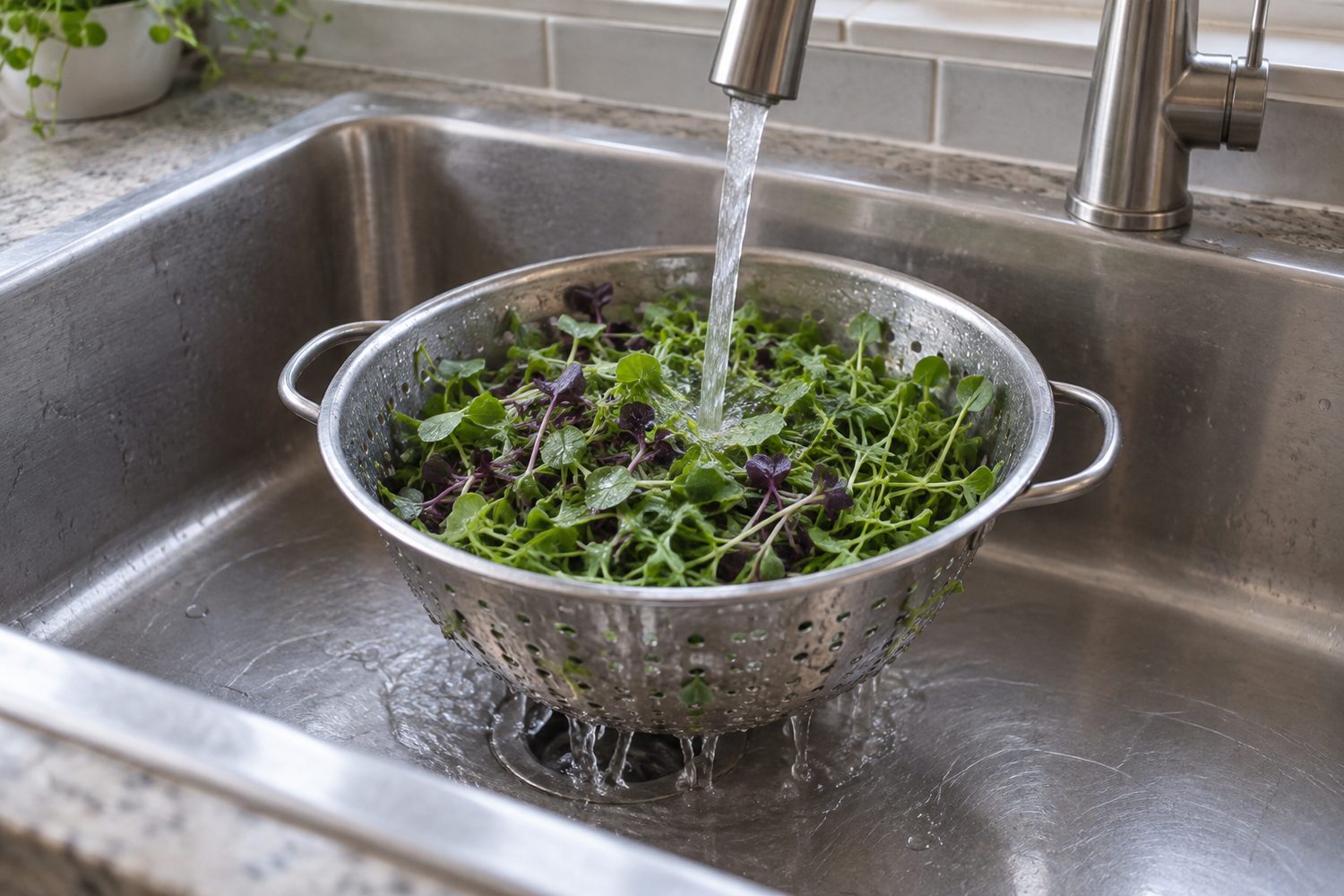
Rinse before eating. FDA says to rinse raw produce thoroughly under running water and not to use soap, detergent or bleach solutions. Quebec says to rinse microgreens in cold running water. Rinsing lowers what is on the surface; FDA is clear that it cannot reliably remove bacteria that have entered sprout seeds, which is the reason sprouts get their own warning. Should you wash microgreens covers how to rinse something this delicate without turning it to mush.
Keep them apart from raw meat. Wash hands, knives, cutting boards and counters, and keep produce separate from raw meat, poultry, seafood and eggs.
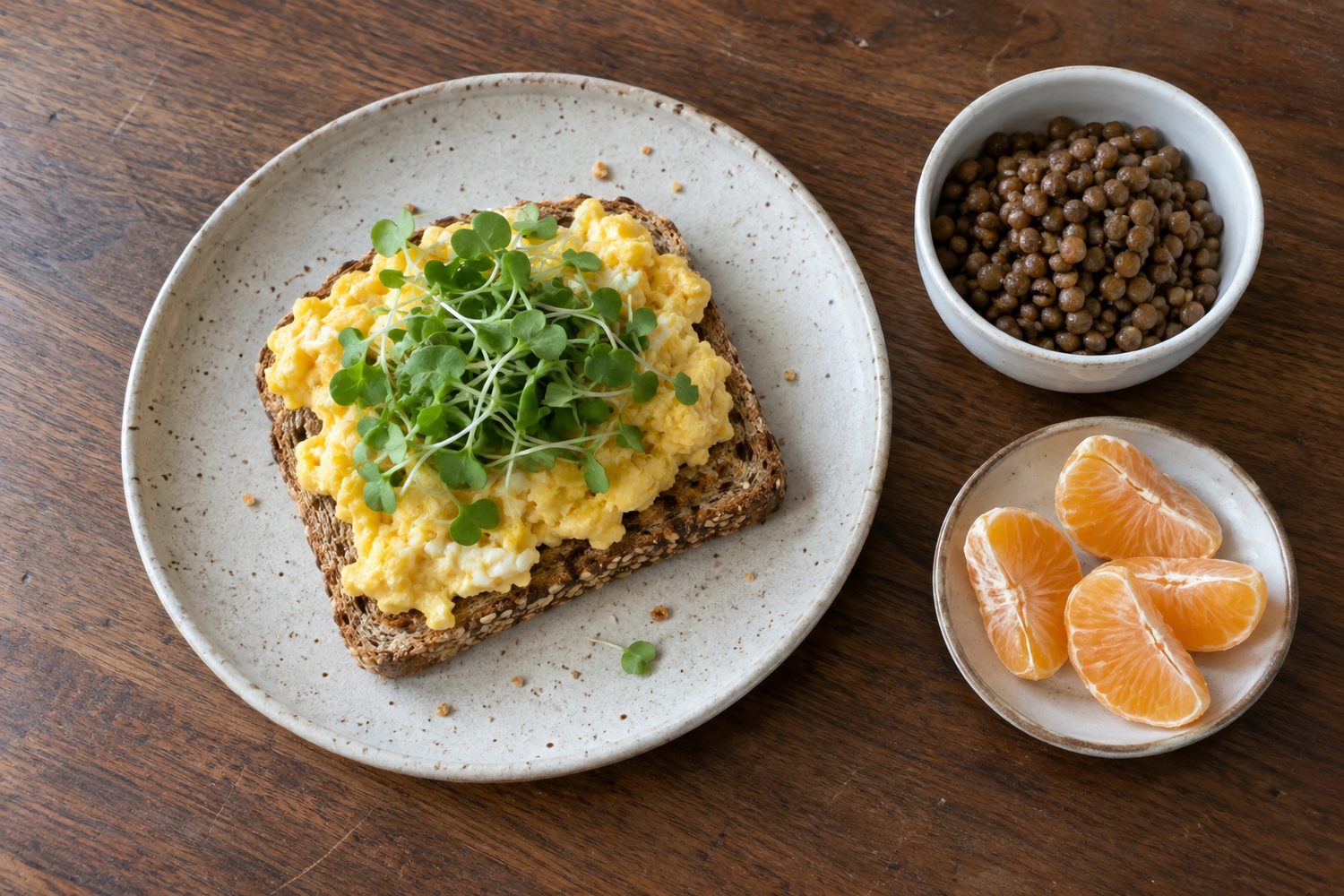
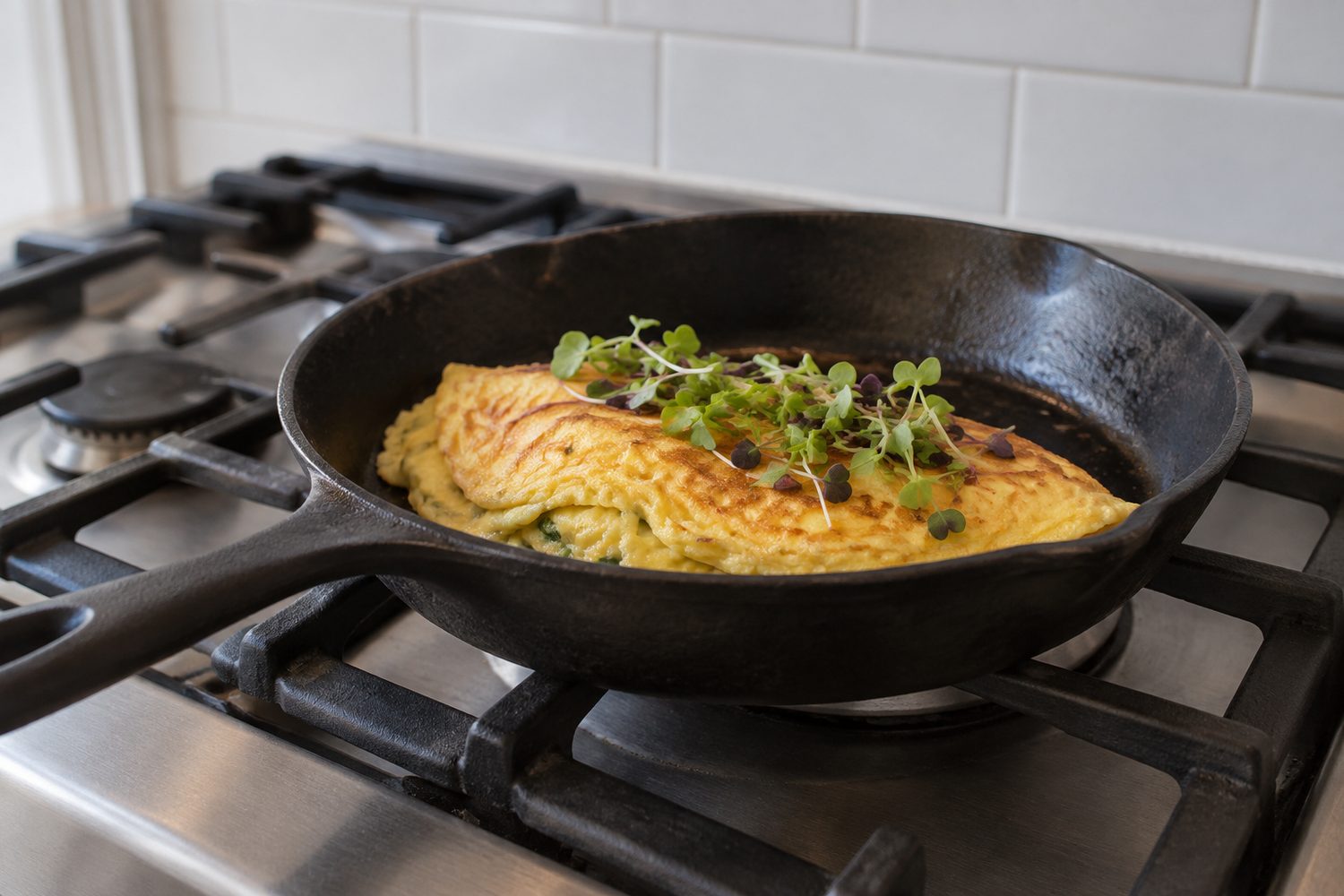
Cook them when you want the extra margin. Cooking kills Listeria, per FDA, and CDC's "washed and then cooked are safest" applies to leafy greens. No agency publishes a cooking temperature for vegetables against Salmonella or E. coli, and none publishes one for microgreens. The only heat instruction the agencies give for this kind of food is CDC's for sprouts: cook them "until steaming hot." That is a sensible standard for microgreens too. Stir them into soup, eggs or a stir-fry until everything in the pan is steaming, rather than scattering them on at the end. In a microwave, FDA advises covering, stirring and rotating to avoid cold spots. Can you cook microgreens has ideas for which crops hold up to heat, and are microgreens safe to eat raw covers the raw question for everyone else in the house.
Home-grown is not automatically safer. FDA says home-grown sprouts are risky raw "even if you are growing your own sprouts under sanitary conditions at home." No source has compared the safety of home-grown and store-bought microgreens. Growing your own gives you control over seed, water, cleanliness and harvest timing, and none of that has been shown to lower illness risk, so handle your own trays with the same care as a store pack.
What a serving gives you in folate and iron
Pregnancy targets from the NIH Office of Dietary Supplements are 600 micrograms of dietary folate equivalents (DFE) a day and 27 mg of iron a day. Against those, a serving of microgreens is a small contribution. The serving used below is 22.5 g, a figure from the research literature based on average lettuce eating in Europe, not a recommended portion; weigh what you actually put on your plate and scale from there.
Hover or tap a row to highlight it.
| Nutrient | Crop and source | Per 100 g fresh weight | Per 22.5 g serving | Share of pregnancy RDA |
|---|---|---|---|---|
| Folate | Choy sum microgreens, 7 days after sowing (Zou et al. 2021) | 106.6 mcg (sum of four folate forms) | about 24 mcg | 4.0% of 600 mcg DFE |
| Iron | Highest of 30 Brassicaceae varieties (USDA, Xiao et al. 2016) | 0.84 mg | 0.189 mg | 0.70% of 27 mg |
| Iron | Purple kohlrabi microgreens (USDA ARS, 2017) | 0.75 mg | 0.169 mg | 0.63% of 27 mg |
| Iron | Choy sum microgreens (Zou et al. 2021) | 0.504 mg | 0.113 mg | 0.42% of 27 mg |
The folate figure comes from choy sum microgreens measured by Zou et al. (2021, Food Chemistry), as tabulated in a 2023 review by Gupta et al. in Frontiers in Genetics. The study reported four folate forms at the microgreen stage: CHO-folate 46, folic acid 1.6, tetrahydrofolate 36 and 5-methyltetrahydrofolate 23 micrograms per 100 g fresh weight. Added together they come to 106.6 micrograms. That total is the four reported forms summed, not a total printed in the paper, and it is the only measured microgreen folate figure available; other crops will differ, and nobody has published a crop-by-crop folate table.
NIH ODS is plain that food folate does not stand in for folic acid. It says folic acid "specifically before and during the first 28 days after conception, reduces the risk of neural tube defects," recommends 400 to 800 mcg a day of folic acid from supplements or fortified foods for anyone who can become pregnant, and notes that about 50% of the folate naturally in food is absorbed, against at least 85% of folic acid taken with food. Microgreens are a food that contains some folate. They are not a substitute for the supplement your provider recommends.
The iron range comes from a USDA Agricultural Research Service study of 30 Brassicaceae microgreen varieties (Xiao et al. 2016), which measured 0.47 to 0.84 mg of iron per 100 g fresh weight; none of the 30 went above 0.84. The USDA ARS summary names purple kohlrabi at 0.75 mg as a choice "if getting enough iron is important for a particular person." Plant iron is nonheme iron, which NIH ODS says is generally less well absorbed than the heme iron in meat, and vitamin C eaten with it can help. Microgreens and iron goes further into that.
The arithmetic assumes the measured concentration holds for your serving. Real values shift with crop, variety, harvest stage, growing conditions and storage.
Frequently asked questions
Do pea shoots count as sprouts or microgreens? FDA's line is the growth stage and how the crop is harvested: microgreens are cut above the soil or substrate once true leaves are emerging. Pea shoots grown in a tray and cut above the medium fit the microgreen description. Several of the Canadian Listeria warnings in 2018 and 2019 were for pea shoots, so they get the same cold, rinse and cook-when-you-like care.
Are microgreens from a farmers market different from store-bought? No agency or study has compared them for safety. Microgreens sold by a farm are covered produce under FDA's Produce Safety Rule, but the rule does not make a pack risk-free, as the recall history shows. Ask the grower when they were cut and keep them cold on the way home.
Is the vitamin K in microgreens something to mention to my provider? Choy sum microgreens measured 377 micrograms of vitamin K1 per 100 g fresh weight (Zou et al. 2021), so a 22.5 g serving works out to about 85 micrograms, close to the NIH ODS pregnancy adequate intake of 90 micrograms a day for ages 19 to 50. That comparison says nothing about absorption, so if vitamin K matters for you in particular, bring the number to your prenatal care provider.
Can I serve microgreens to my kids while I am avoiding sprouts? The same FDA booklet that carries the sprout table covers children under five as well as pregnancy. Microgreens for babies and children covers what applies to younger eaters.
The short version
Raw sprouts carry a specific warning in pregnancy from FDA, CDC and ACOG. Microgreens are a different product in FDA's own words, and no agency gives a pregnancy rule for them. They fall under ordinary raw produce advice: keep them at or below 40°F, eat them within about a week, rinse them under running water, and cook them until steaming hot if you would rather not eat them raw. A 22.5 g serving gives roughly 4% of the pregnancy folate target and under 1% of the iron target, and it does not replace folic acid. For anything about your own pregnancy, your prenatal care provider is the person to ask.
Terms on this page
Tap a term to see what it means.
Microgreen. A young edible plant cut above the soil or substrate at a stage FDA associates with the emergence of true leaves, later than a sprout and long before maturity.
Sources
Prices, stock and specifications are as the linked pages showed them on 2026-09-26.
- FDA's pregnancy produce page
- 2022 sprout-seed guidance
- CDC's safer food choices page for pregnant people
- Food Safety for Pregnant Women, Their Unborn Babies, and Children Under Five
- FoodSafety.gov
- published April 2022, last reviewed February 2026
- September 2023 sprout guidance
- Sprout and microgreen food safety
- Listeria prevention page
- Get the Facts about Listeria
- FDA notice
- Misra and Gibson in Food Protection Trends (2021)
- Food Safety at Home
- NIH Office of Dietary Supplements
- Zou et al. (2021, Food Chemistry)
- 2023 review by Gupta et al. in Frontiers in Genetics
- Xiao et al. 2016
- USDA ARS summary
Keep reading
The journal
Microgreens and Allergies: Four Crops Are Regulated Allergens
Sesame, mustard, buckwheat and celery are all grown as microgreens and all carry allergen labeling law somewhere. And not one published case report names a cut microgreen as the food eaten.
Read Microgreens and Allergies: Four Crops Are Regulated AllergensThe journal
Microgreens for Seniors: Nutrition, Safety, and Serving Size
Microgreens for seniors: what a 2025 feeding trial measured, how much vitamin C a serving gives after 50, and what CDC food safety guidance says.
Read Microgreens for Seniors: Nutrition, Safety, and Serving SizeThe journal
Are Microgreens Anti-Inflammatory? What the Research Really Says
Nobody has fed a person microgreens and measured their inflammation. And when researchers pooled ten broccoli sprout trials, the combined result came out at something that could be zero.
Read Are Microgreens Anti-Inflammatory? What the Research Really SaysThe journal
Are Microgreens Low FODMAP? What Monash Research Shows
Are microgreens low FODMAP? Learn what Monash sprouting research shows, which crop families deserve extra caution, and how reintroduction testing works.
Read Are Microgreens Low FODMAP? What Monash Research Shows