Should You Wash Microgreens? Yes, But Not When You Think
Cal HewittPublished Checked
- eating
- food safety
- evidence
- storage
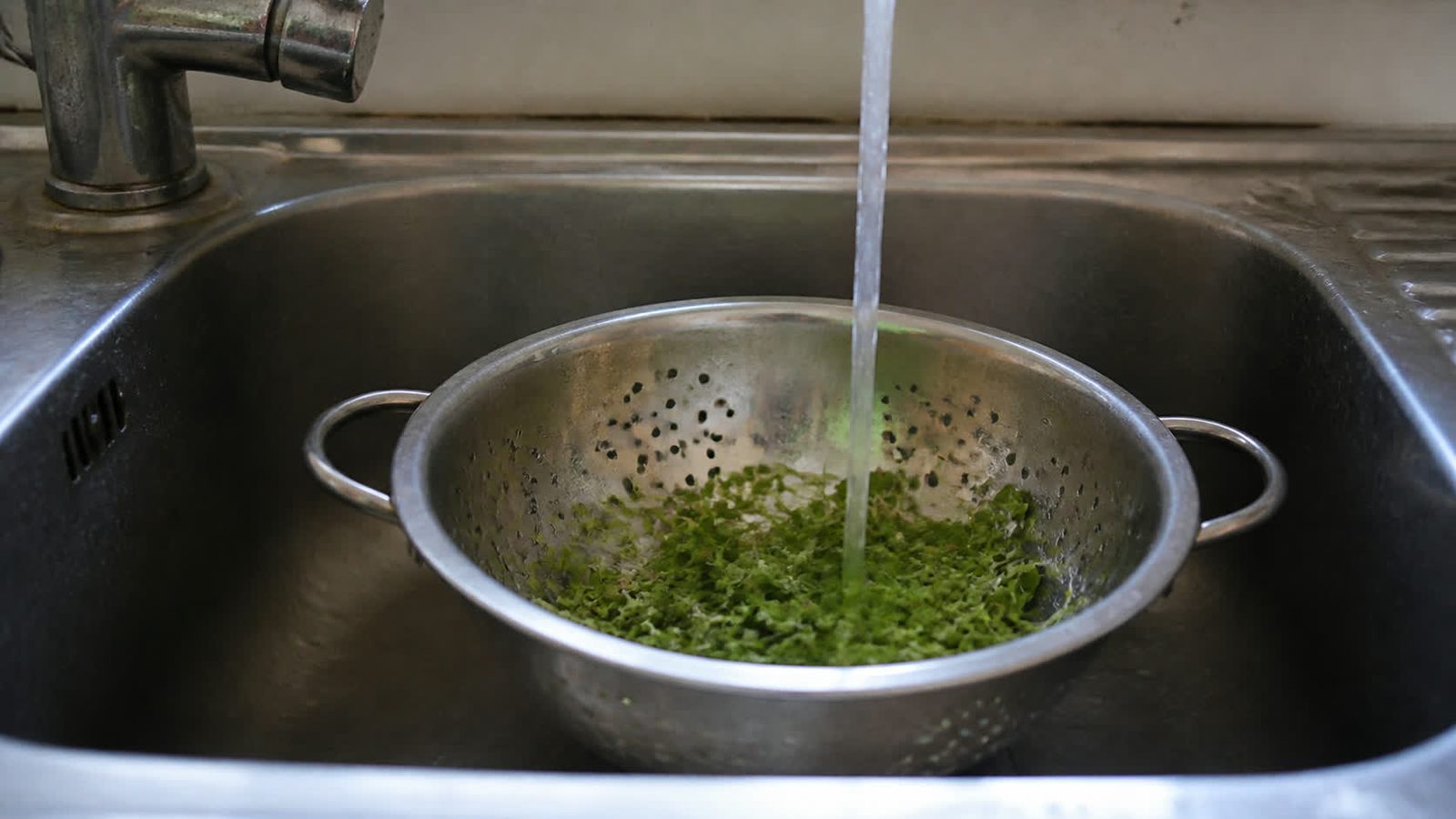
Wash them immediately before you eat them, and never before you put them away. Every food-safety authority and every extension service says some version of this, and it is the one thing they all agree on. Washing wet, fragile leaves and then refrigerating them is the single most common handling mistake with this crop.
Washing reduces bacteria. It does not remove them. In the published studies, a plain-water rinse takes out somewhere between half and three quarters of the bacterial load, and the FDA is explicit that washing cannot eliminate bacteria on produce. If you were washing microgreens to make them safe, that is not what you are buying.
And here is the part nobody tells you: every shelf-life figure you have read for microgreens assumes the crop was never washed. All 47 source notes behind the figures here were checked, and not one states a wash status. The one study that looked found washed crop degrading faster.
What to do, in order
- Buy or harvest, then keep it dry and cold. Refrigerate at or below 40°F, in something that does not crush it. Deli containers or a vented produce keeper both work; the point is airflow without compression.
- Do not wash it until the moment it goes on the plate.
- Wash your hands for twenty seconds first, and keep the colander away from anything that has touched raw meat.
- Rinse gently under plain cool running water. No soap, no vinegar, no bleach, no produce wash. Do not soak in a filled bowl, which can move contamination around rather than remove it.
- Pat dry, or spin a small load briefly if you must.
- Eat it. Do not wash now and serve in an hour.
- Skip all of it for anything labeled ready to eat or triple washed.
The timing rule, and why it is the whole answer
The instruction is consistent across four extension services and the FDA, and the reasoning is the same every time: microgreens are physically fragile, water damages them, and damaged wet tissue in a cold box is an invitation.
What the authorities actually say
Hover or tap a card to highlight it.
Purdue Extension
Store them unwashed. Give a gentle cool-water rinse right before use, then dry with paper towel.
New Mexico State
Wash when you are preparing the meal, not before. Early washing damages tissue, adds moisture and can increase spoilage.
UMass Extension
Keep them dry, and wash only when you are ready to eat.
Penn State
Post-harvest washing is not recommended unless necessary, because it can spread contamination rather than remove it.
FDA
Wash under plain running water before eating. No soap, no detergent, no commercial produce wash. Dry with a clean cloth or paper towel. Do not rewash anything labeled ready to eat or triple washed.
That last FDA point catches people out. A clamshell marked ready to eat has already been washed under conditions your sink cannot match, and rewashing it at home adds handling and moisture without adding safety. Leave it alone.
If you are growing rather than buying, the same logic runs backwards through the whole harvest. On what harvest and washing equipment is actually worth owning, the cheapest correct answer is frequently to buy nothing.
What washing actually does to the bacteria
This is where the numbers matter, and where they are smaller than most people expect.
Hover or tap a row to highlight it.
| Crop | Wash | Reduction | What it means in plain terms |
|---|---|---|---|
| Chinese cabbage | 2 minutes, plain water | 0.6 log, 7.8 down to 7.2 | About a fourfold cut |
| Chinese cabbage | Plain water, separate report | 0.3 log | About a twofold cut |
| Chinese cabbage | 50 mg/L chlorine | 0.9 log | About an eightfold cut |
| Chinese cabbage | 100 mg/L chlorine | 1.3 log | About a twentyfold cut |
| Daikon radish | 100 mg/L chlorine | 0.5 log, and it rebounded after day 7 | About a threefold cut, temporarily |
| Sunflower | 1 g/L ozonated water, 5 minutes | 1.3 log, 5.51 down to 4.21 | About a twentyfold cut |
| Mung bean | 2 minutes, distilled water | Shigella down, total bacteria not significantly | Works on one organism, not the others |
| Lentil | 2 minutes, distilled water | Shigella and E. coli down, total bacteria little change | Same pattern |
| Mustard | 2 minutes, distilled water | Not very significant | Barely moved |
A log is a factor of ten, and this is worth being careful about, because it is easy to read these numbers as far larger than they are. A 0.5 log reduction is not a fifty percent cut and it is certainly not a fiftyfold one. It is ten to the power of 0.5, which is a little over threefold. The best plain-water result in that table, 0.6 log, is a fourfold cut, and the load it starts from is in the millions per gram.
Three things follow, and all three are more useful than the headline.
Washing is a rinse, not a sanitizing step. The chlorine and ozone results are two to twenty times better than plain water, and neither is a home method. Do not attempt either in a kitchen sink.
It works differently on different crops and different organisms. In the one study that tested three crops side by side, plain water knocked Shigella down on mung bean and lentil while barely touching the total bacterial count, and did very little of anything on mustard. There is no general microgreen washing result.
It does not hold. The daikon result rebounded after day seven, which is the strongest single argument for washing at the moment of eating rather than in advance. Whatever you achieve at the sink is temporary.
Every published shelf life assumes the crop was never washed
A shelf life is published for 39 of the 62 crops here, running from 1 day on amaranth and basil to 21 on buckwheat and radish, and every one of those figures is sourced.
Not one of the 47 shelf-life source notes carries a wash status. All 47 were checked on 2026-08-11, and the answer is zero, because the underlying sources do not state it either. Nobody publishes it.
That matters, because washing changes the answer. The one study that examined it found washed radish and washed buckwheat deteriorating faster than unwashed material, and attributed it to wash damage and residual moisture. Buckwheat carries the longest published shelf life of any crop here, 21 days, so the crop with the best number is one of the two the study names as degrading faster once wet.
So, every shelf-life figure here, and every one you will find anywhere else, should be read as: this is how long it keeps if you never wash it. There is no published figure for how long a washed microgreen keeps, which is the number a person standing at the fridge actually wants.
The published estimates do not even agree on the unwashed case:
Hover or tap a row to highlight it.
| Source | Figure | Conditions stated |
|---|---|---|
| New Mexico State | 1 to 2 days | Room temperature, plus a day or two if kept cool |
| New Mexico State | 3 to 5 days | The outer limit it gives for eating after harvest |
| UMass Extension | 5 to 7 days | Refrigerated, unwashed, varying by type |
| Purdue Extension | 5 to 7 days | Stored unwashed |
| Maryland Extension | Up to 10 days | Rinsed, patted dry, refrigerated |
| Penn State | 10 to 14 days | 41°F, dark storage, unwashed |
That is a sevenfold spread between authorities on the same question, and Maryland is the outlier in method as well as number: it is the only one of the six that assumes you rinsed first. Nobody has run the comparison that would settle it.
Drying, and the salad spinner question
Every consumer source says the same thing: pat dry with a clean cloth or paper towel. Purdue permits a salad spinner for a meal portion, and its own recipe instead suggests a few moments air-drying in a colander.
There is one piece of directly relevant evidence, and it is about commercial machines. A USDA experiment compared centrifugal and forced-air dewatering on ready-to-eat microgreens and found centrifugal drying caused severe damage, failed to remove water effectively, or both, shortening shelf life, while gentle forced-air drying caused less damage and supported less microbial growth.
What that evidence does and does not cover matters. It tested a commercial centrifuge, not a hand-cranked kitchen spinner, and the forces are not necessarily comparable. So, the honest position is narrower than either "spinners are fine" or "spinners are too aggressive":
- For a meal portion you are about to eat, a spinner is a permitted method. Use a small load, spin briefly, and stop if the crop looks bruised. An OXO-style spinner is the common household one, and what it costs and when it is worth owning is set out with the rest of the harvest kit.
- For crop you are storing or selling, the centrifugal result is a genuine warning, and the better answer is not to have washed it.
- Patting dry is never wrong, and it is what every regulator actually recommends.
What nobody has measured
- How long a washed microgreen keeps. The single most obviously useful number in this whole subject, and it does not exist for any crop.
- Whether a kitchen salad spinner damages microgreens, as opposed to a commercial centrifuge. One named crop, one spinner, one load size would answer it.
- Plain-water reduction on most crops. The measurements cover Chinese cabbage, daikon, sunflower, mung bean, lentil and mustard. That is six of the 62 crops here.
- Whether any of this changes the risk in practice. No published microgreen illness has been traced to a consumer's decision to wash or not, and there have been at least eight microgreen recalls on record, with zero illnesses across all of them.
- A wash status attached to a shelf-life claim, anywhere, by anyone.
Terms on this page
Tap a term to see what it means.
Log CFU/g. Colony-forming units per gram on a base-ten log scale. A 1 log reduction is tenfold, 0.5 log is a little over threefold, and 0.3 log is roughly twofold. Small-looking numbers, large-looking factors, and neither is sterilization.
Sources
Opened on 2026-08-11. Shelf-life figures for individual crops are sourced on each crop's own page in the variety directory.
- FDA, selecting and serving produce safely and 7 tips for cleaning fruits and vegetables - plain running water, no soap or produce wash, dry with a clean towel, do not rewash ready-to-eat packages, and washing reduces but does not eliminate bacteria.
- New Mexico State University, microgreens for consumers - wash at meal preparation rather than before storage, the fragility and moisture reasoning, 1 to 2 days at room temperature and a 3 to 5 day outer limit.
- Purdue Extension, microgreens - store unwashed for 5 to 7 days, gentle cool-water rinse right before use, paper towel or salad spinner.
- Purdue Extension, homegrown microgreens salad - wash gently and air-dry briefly in a colander because the greens are fragile.
- UMass Extension produce spotlight, microgreens - keep dry, wash only when ready to eat, 5 to 7 days refrigerated and unwashed depending on type.
- Penn State Extension, ensuring food safety in microgreens production and growing microgreens - post-harvest washing not recommended unless necessary, wash water must be free of E. coli, and 10 to 14 days at 41°F in dark storage against 2 to 4 days at ambient.
- Maryland Extension, growing microgreens and baby greens indoors - rinse, pat dry, use immediately or refrigerate up to 10 days. The one source of the six that assumes a rinse before storage.
- PLOS ONE, washing and microbial load on microgreens - the two-minute wash results by crop and organism for mung bean, lentil and mustard, the 7.8 to 7.2 log CFU/g Chinese cabbage figure, refrigerated shelf life at 4°C, and the finding that washed radish and buckwheat deteriorated faster than unwashed material.
- University of Maryland dissertation reproducing Xiao et al. on daikon radish microgreens - a 100 mg/L free-chlorine wash giving a 0.5 log reduction at 1°C, with populations rebounding after day 7.
- Frontiers review on LED lighting, nutrition and microbial safety of microgreens - the comparative wash table giving 0.3 log for water and 0.9 and 1.3 log for 50 and 100 mg/L chlorine on Chinese cabbage microgreens.
- Asia-Pacific journal, ozonated-water washing of sunflower microgreens (PDF) - 1 g/L ozonated water for five minutes taking total bacteria from 5.51 to 4.21 log CFU/mL.
- USDA ARS, extending shelf life of ready-to-eat microgreens by optimizing dewatering procedure - centrifugal dewatering causing severe damage or failing to remove water effectively against gentler forced-air drying, stored at 5°C for 14 days.
- University of Nevada Reno, microgreens and produce safety (PDF) - the producer-side position against washing on farm for storage or packing.
- CDC, Listeria outbreak guidance - no wash removes every germ, plus the leafy-green washing and refrigeration guidance.
Keep reading
The journal
Can You Freeze Microgreens? What Survives Drying and Freezing, and What Does Not
A microgreen is 87 to 94 percent water, so a whole tray dries down to a couple of spoonfuls. Drying is not a kill step, freezing does not make greens keep their crunch, and only one crop has ever been measured.
Read Can You Freeze Microgreens? What Survives Drying and Freezing, and What Does NotThe journal
How Long Do Microgreens Last by Crop and Temperature
How long do microgreens last in the fridge depends on the crop and the temperature. See measured storage life by crop and what to do when no figure exists.
Read How Long Do Microgreens Last by Crop and TemperatureThe journal
How to Store Microgreens, and How Long Do They Last?
Cold, dry, unwashed and vented, and basil is the exception. Controlled studies cover about a dozen crops out of sixty-two, and they disagree on the best temperature.
Read How to Store Microgreens, and How Long Do They Last?The journal
Have These Gone Bad? Judging a Box of Microgreens in the Fridge
A warm fridge costs days: arugula, radish and red cabbage lost a week of quality at 10C against 4C, and one mustard study lost ten. And no visible sign has ever been validated as a safety test.
Read Have These Gone Bad? Judging a Box of Microgreens in the Fridge