The Best Salad Spinner for Microgreens, and the Question to Answer First
Cal HewittPublished Checked
- harvesting
- washing
- equipment
- buying
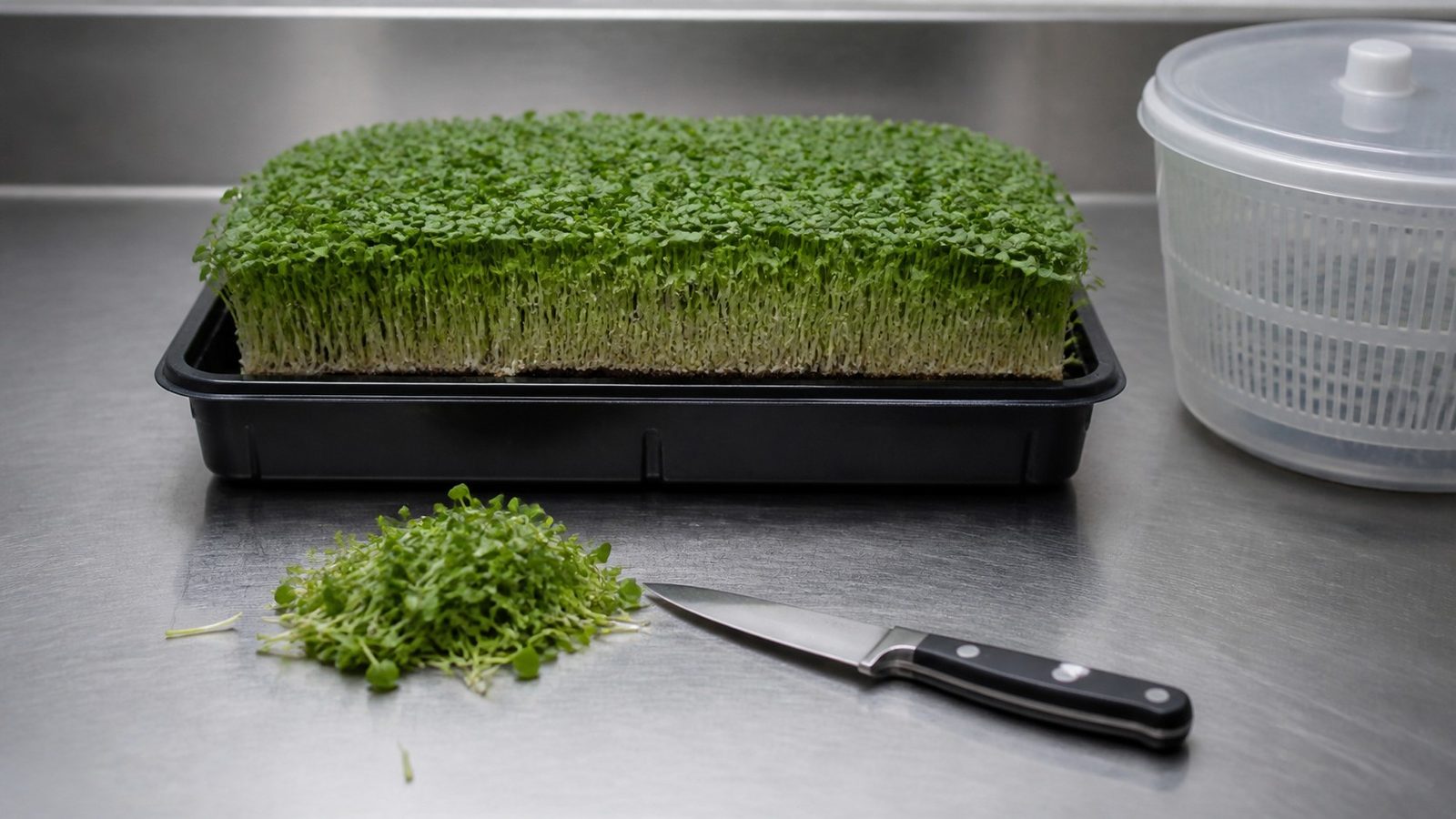
Buy a clean sharp cutter. Then answer the question that decides everything else on this shelf: does this crop need washing at all?
For microgreens you are going to store or sell, the answer from the extension services is usually no. New Mexico State says washing fragile microgreens too early damages tissue, adds moisture and can shorten shelf life. Purdue advises storing them unwashed and rinsing under cool running water before use. Penn State says post-harvest washing is not recommended unless necessary, because it can spread contamination rather than remove it.
That changes what the equipment is for. A salad spinner is not a shelf-life upgrade. It is a tool for drying crop you have already decided to wash, and for stored microgreens that decision is often the wrong one. The honest sequence is: cut cleanly, keep it dry, keep it cold, and wash immediately before eating if you wash at all.
Plenty of growers do have a genuine washing need, and the gear ladder runs from $18 to $30,000 with very little published measurement anywhere on it. Often the cheapest right answer on that ladder is to buy nothing.
The order to buy in
What to buy, and when, if ever
Hover or tap a card to highlight it.
A clean sharp cutter
The only priority-one purchase in this category. Knife or scissors, kept sharp. Everything else is conditional.
Answer the wash question
For crop you will store or sell, extension guidance says keep it unwashed and dry. If your crop is clean-grown and dry at harvest, you can stop here and buy nothing else.
A small spinner, only for immediate-use rinsing
If you wash small batches right before eating or serving, a home spinner beats towel drying on labor and loose water. It is a convenience, not a shelf-life tool.
A manual commercial spinner, only after you have records
Weighed batch and time records showing manual drying is the bottleneck. Not a hunch that it feels slow.
A bubbler, only with a real debris problem
Enough volume, water handling, cleaning discipline, and soil or hull contamination that a rinse actually removes. It is not the default microgreens purchase.
Mechanical cutting, last
Only when cutting labor repeatedly constrains dozens of trays and the crop height and tray size are compatible.
The purchase that gets made too early is almost always the wash station, because it solves a problem that extension guidance says most stored microgreens should not have in the first place.
Against a fixed setup budget, this whole category ranks below seed quality, clean trays and tools, reliable irrigation, airflow, lighting, refrigeration and packaging. The cutter is the exception. Everything else waits until the farm can show that cutting or drying labor, rather than crop quality or the cold chain, is the binding constraint.
You will find the opposite advice, so here is who says what
Two of the pages that rank for storing microgreens tell you to rinse before storage. That is directly at odds with NMSU, Purdue and Penn State. A third, ChefPax, gives the right storage direction and is a produce seller that also offers a spinner. Farmers Friend publishes useful detail and sells the equipment.
The version that holds up: wash with clean potable water immediately before eating, then dry gently. Do not make washing before storage the default, and do not treat a spinner as the thing that makes microgreens safe.
One real distinction sits underneath the disagreement. Soil-grown trays put growing medium and seed hulls at the cutting plane, which is a genuine debris problem a rinse can address. Cleanly grown hydroponic crop may need no post-harvest wash at all. The crop and the method decide, not the category.
What is claimed, against what has been measured
Hover or tap a row to highlight it.
| The claim | Who says it | What is actually measured |
|---|---|---|
| 2.5 gal, 500 RPM, 200 W | Retailer, reproducing the maker's spec for a Dynamic electric spinner | Nothing about microgreens. Bowl size and motor power are the batch envelope, not the result |
| "Up to 9x faster" | Seller | No crop, no load mass, no comparator, no damage definition |
| 3 seconds per tray | Farmers Friend, for the Quick Stand and harvester together | A seller claim, not an independent measurement |
| "Gentle", "bruise-free" | Sellers, across the category | Design intent. Neither seller copy nor a star average establishes shelf life |
| 32 lb washed in 1.5 to 2.5 minutes, 100 lb/hour with one worker | UVM Extension, documenting Tamarack Hollow Farm's 195 gallon bubbler | The only real throughput figure found, and it is one named farm system, not a product test |
| NSF/ANSI 2-2009, ETL listed | Retailer and Johnny's, on named Dynamic models | Real, and about material cleanability and electrical safety. Not drying performance |
| "HACCP compliant" | Seller language | Not a product certification. HACCP is a food-safety management system, not a spinner test |
No independent, product-to-product test of these tools on microgreens was found. Not for throughput, not for damage, not for shelf life. The UVM row is the closest anything comes, and it measures a farm's whole wash line rather than a machine you can buy, on mixed greens rather than on a named microgreen cultivar.
The specs do not even compare with each other. "Heads of lettuce", gallons, RPM, watts, "9x faster" and seconds per tray take different inputs and exclude different loading, transfer and cleanup time. One retailer manages to give inconsistent loading guidance for the same Dynamic manual spinner in the same listing, at 2 to 3 heads in one place and 6 to 8 in another.
The specification that would actually decide it is saleable trays or pounds per hour from cut to packed, with damage and remaining surface moisture recorded alongside. A large fast spinner can still be slower per saleable pound if the crop needs small gentle loads.
What actually fails
The published failure modes here are mostly qualitative, and the most important one is not a machine breaking.
The process fails before the equipment does. NMSU is explicit that washing fragile microgreens too early damages tissue and adds moisture, and that rough handling creates spoilage openings. On a crop that is tiny, tender, freshly wounded at the stem and packed at high surface area into a small clamshell, that matters more than it does for lettuce. Condensation and spoilage can appear in the pack even when the spinner worked perfectly.
Too much bubbling bruises greens. That is UVM's documented farm report, not a manufacturer caveat, and it comes from the same system that produced the only good throughput number on this page. The same report notes a tank that can bulge and an apparatus that is hard to keep in place.
The hardware failures on record are small and specific. Food Network's independent review flags thinner plastic parts on the OXO spinner as potentially crack-prone. A Farmers Friend Quick Stand owner reports the stand dropping in height when its J-bolt is mispositioned.
What nobody has published is a controlled time-to-failure curve for any named spinner, or a comparative reliability study across brands. The owner reports that exist are too few and too self-selected to turn into rates, and the largest visible set sits on the seller's own product pages.
On warranty, the Dynamic electric listing states one year against manufacturing defects. A seller-hosted review reports Farmers Friend replacing a failed blower. That is one favorable reported outcome, not a claim-rate study, and the written warranty for everything else in this category has to be obtained per SKU before it means anything.
The tools, and what they cost
Prices move. Every figure here is what that listing showed on the check date at the top of this page, and this page is rechecked at least every two months.
Hover or tap a row to highlight it.
| Tool | Price seen | Seen at | What the money buys |
|---|---|---|---|
| Produce or harvest knife | about $18 | Reported by Microgreen Manager | The one priority-one item in this category |
| OXO Good Grips Large spinner, 6.22 qt | $32.99 | Amazon | Small-batch drying for crop washed immediately before use |
| OXO stainless, 6.34 qt | $65 | Reported by Food Network | The marketplace did not match this figure. See below |
| Farmers Friend 5 gal spinner | $175 | Farmers Friend, direct only | Farm batch capacity and serviceability |
| Dynamic USA E002 manual, 5 gal | $199 | Cresco Resco | NSF/ANSI 2-2009. A 2.5 gal Dynamic manual is $176.63 on the marketplace |
| Farmers Friend Quick Stand | $230 | Farmers Friend, direct only | A stand for tray harvesting, harvester not included |
| Farmers Friend Quick-Clean Bubbler kit | $375 | Farmers Friend, direct only | Air wash, tank and stand excluded |
| Dynamic EM25 electric, 2.5 gal | $476.89 | KaTom | Labor, if repeat batches justify it. One year warranty |
| Dynamic electric, 5.2 gal | $959 | Johnny's Selected Seeds | ETL listed. A 5 gal Dynamic electric is $692.73 on the marketplace |
| Rooted Robotics channel washer | $30,000 | Rooted Robotics, direct only | Washes trays and channels, not edible crop. Not this workflow |
Farmers Friend and Rooted Robotics sell direct only, so those four rows carry no marketplace link and no second price to compare against. Worth knowing before you plan a purchase around a price you saw here.
The $30,000 machine is not a competitor to the $33 one. It is equipment sanitation, not crop washing. They sit in the same search results and solve unrelated problems, and confusing them is an expensive mistake in one direction and a food-safety mistake in the other.
Do not count on the $65 for the stainless spinner. That figure comes from an independent editorial review. Checking the marketplace on the same day found the large plastic model at $32.99, matching its reported $33, but the stainless variant did not appear at that price: what was listed was a glass 6.22 qt at $74.95 and a steel model showing no price at all. The $65 stays attributed to its source rather than presented as current.
The restaurant spinners are cheaper on the marketplace than through the seed and restaurant suppliers, and the gap is large. Johnny's lists a 5.2 gallon Dynamic electric at $959; a 5 gallon Dynamic electric sits at $692.73 on the marketplace, about 28 percent less. A 2.5 gallon Dynamic manual is $176.63 there against $199 for the 5 gallon manual at a restaurant supplier. Model numbers differ between the two channels, so those are comparisons by size class rather than the same SKU, and a generic commercial 5 gallon at $145.99 undercuts every named unit. Buy direct from the specialist supplier is a habit here rather than a rule, so price both channels by size class before you order.
The $18 knife price is the source's rather than one checked on the day. Microgreen Manager names the Mercer Culinary Millennia produce knife at about $18. Mercer is well stocked on the marketplace, 106 results, but that specific produce knife was not on the first page and the Mercer knives that were ran $25 to $75. The link goes to the search rather than to a price this page can stand behind, and the recommendation was never brand-specific anyway: what matters is that it is clean and sharp.
Both links above pay this site a commission. What they point at is a knife and probably no spinner, which is the smallest purchase in a category that also holds a $959 machine and a $30,000 one, neither of them linked.
What it costs to be wrong
The small mistake is money sitting idle. A $33 to $199 spinner bought by a grower who correctly keeps the crop dry is a tool that never gets used.
The expensive mistake is buying the workflow before validating it. A $375 bubbler or a $959 electric spinner, or a mechanical harvester plus its stand, purchased before batch and time records show that cutting or drying is the actual bottleneck.
The biological cost is the one that recurs. Added moisture and tissue damage produce a batch with reduced shelf life, condensation in the pack, and discard. It can also put water weight into a pack sold by weight, which is a different kind of problem. No published figure exists for how often that happens or what it costs.
A DIY route is real at both ends. At the small end: clean sharp scissors, a food-safe bin, potable water only when washing is genuinely needed, and paper towels or a sanitized screen with gentle airflow. At farm scale, UVM documents built bubblers at around $1,000 including tank, blower, PVC and frame, handling 25 to 40 lb batches. DIY stops being adequate when it cannot be thoroughly cleaned and sanitized, when electrical placement near water is unsafe, or when agitation is uneven enough to bruise.
Who should skip this entirely
Skip the washing and spinning category outright if your greens are clean-grown, dry at harvest, and will be stored or sold for the buyer to wash later. NMSU, Purdue, Penn State and Hamama all point the same way. A home grower cutting from a clean tray into a bowl needs clean scissors and nothing else on this page.
Skip the bubblers and the commercial and electric spinners unless waterborne washing is an established need in your operation, with potable water, written cleaning procedures, and enough batch volume to repay the extra handling step.
Skip the $30,000 channel washer unless you are automating tray and NFT channel sanitation, which is a different job from anything else described here.
What is still genuinely unknown
- The crop-specific load and spin duration at which each named spinner leaves the crop dry enough to pack without bruising or tearing.
- Whether washing is necessary at all in a given grower's real production and sales workflow, cultivar by cultivar.
- How many complete trays per labor-hour a real team can cut, dry, weigh and pack, including loading, transfer, cleanup and sanitizing.
- What package condensation, weight loss and spoilage look like on days 1, 3, 5 and 7 in real packaging and a real cold chain.
- Replacement-part pricing and service intervals for the mechanical harvesters.
Every one of those would be settled by a protocol naming the crop, the load mass, the wash conditions and the cycle, run with replicates and a manual knife-and-towel control, and scored blind for shelf life. Nobody has published one.
The terms on this page, in plain words
Tap a term to see what it means.
Bubbler. A wash basin that moves water with low pressure air to loosen debris from greens.
Sources
Every price below was seen on the check date at the top of this page, and the prices on this page are rechecked at least every two months.
- New Mexico State University, microgreens for consumers - washing fragile microgreens too early damages tissue, adds moisture and can shorten shelf life, and rough handling creates spoilage openings.
- Purdue Extension FoodLink, microgreens - store unwashed, rinse under cool running water before use.
- UVM Extension, building a better greens bubbler - Tamarack Hollow Farm's 195 gallon system, 32 lb washed in 1.5 to 2.5 minutes and 100 lb per hour with one worker, the spinner named as the bottleneck, the bruising warning, and DIY builds around $1,000 at 25 to 40 lb batches.
- Food Network, OXO salad spinner review - the independent editorial review behind the $33 plastic and $65 stainless figures, the 6.22 qt capacity, and the thin-plastic durability note.
- Cresco Resco, Dynamic USA E002 manual spinner - $199, NSF/ANSI 2-2009, and the inconsistent loading guidance of 2 to 3 against 6 to 8 heads.
- KaTom, Dynamic EM25 electric spinner - $476.89, 2.5 gal, 500 RPM, 200 W, and the one year warranty against manufacturing defects.
- Johnny's Selected Seeds, Dynamic electric salad spinner - $959 for the 5.2 gal unit, ETL listed to applicable NSF/ANSI sanitation standards.
- Farmers Friend, Quick-Clean greens bubbler - the $375 kit excluding tank and stand, and the seller's gentle and faster language.
- Farmers Friend, Quick Stand - $230, marketed for microgreen tray harvesting, the 3 seconds per tray claim, and the owner report of the height lock dropping.
- Farmers Friend, do it yourself greens blower kit - the $183 blower and switch kit, and the seller-hosted review reporting a replaced blower.
- Farmers Friend, post-harvest tools - the catalog, including the $175 five gallon spinner.
- Rooted Robotics, microgreens channel washer - $30,000 with a $1,500 mobility kit, and the fact that it washes channels and trays rather than edible crop.
- Microgreen Manager, farmer starter kit - names the Mercer Culinary Millennia produce knife at about $18.
- On The Grow, what works best for harvesting microgreens - knife or mechanical harvesting recommended only at substantially larger volume.
- ChefPax, how to store microgreens - wash immediately before serving and lightly spin or pat dry. A produce seller.
- Indoor Vegetable Grower, how to store microgreens - recommends rinsing before storage, which is at odds with the extension guidance above.
- Grow Microgreens at Home - recommends a wash before sale or consumption.
- Hamama, diary of a super salad mix - do not wash before storage.
- A large-scale harvesting discussion - hand cutting described as the largest labor input, and disagreement about mechanical harvesting for microgreens.
- A wet-harvest discussion - a three bin wash with fans, the report that wet crop changes packed weight, and growers using reduced last-day water or no wash at all.
Keep reading
The test bench
AeroGarden and Countertop Pod Gardens for Microgreens: Is It Worth It?
Pod count is holes for separated mature plants, not dense tray area. A $30 tray kit gives you more sowing surface for microgreens than a $250 pod garden.
Read AeroGarden and Countertop Pod Gardens for Microgreens: Is It Worth It?The journal
AeroGarden Bounty Review: Basic, Bounty and Elite Specs
This AeroGarden Bounty review compares the Basic, Bounty and Elite by watts, features, price, stock, running cost estimates, and warranty terms.
Read AeroGarden Bounty Review: Basic, Bounty and Elite SpecsThe journal
AeroGarden Farm Review: Specs, Price and What It Grows
This AeroGarden Farm review breaks down the Plus and Basic models, last known list prices, running costs, warranty terms, and owner-reported problems.
Read AeroGarden Farm Review: Specs, Price and What It GrowsThe journal
Best Potting Soil for Microgreens: Cost per Tray
Compare the best potting soil for microgreens by ingredients, bag size, trays filled per bag, and cost per tray, plus problems to expect from each mix.
Read Best Potting Soil for Microgreens: Cost per Tray