AeroGarden and Countertop Pod Gardens for Microgreens: Is It Worth It?
Cal HewittPublished Checked
- countertop
- hydroponics
- equipment
- buying
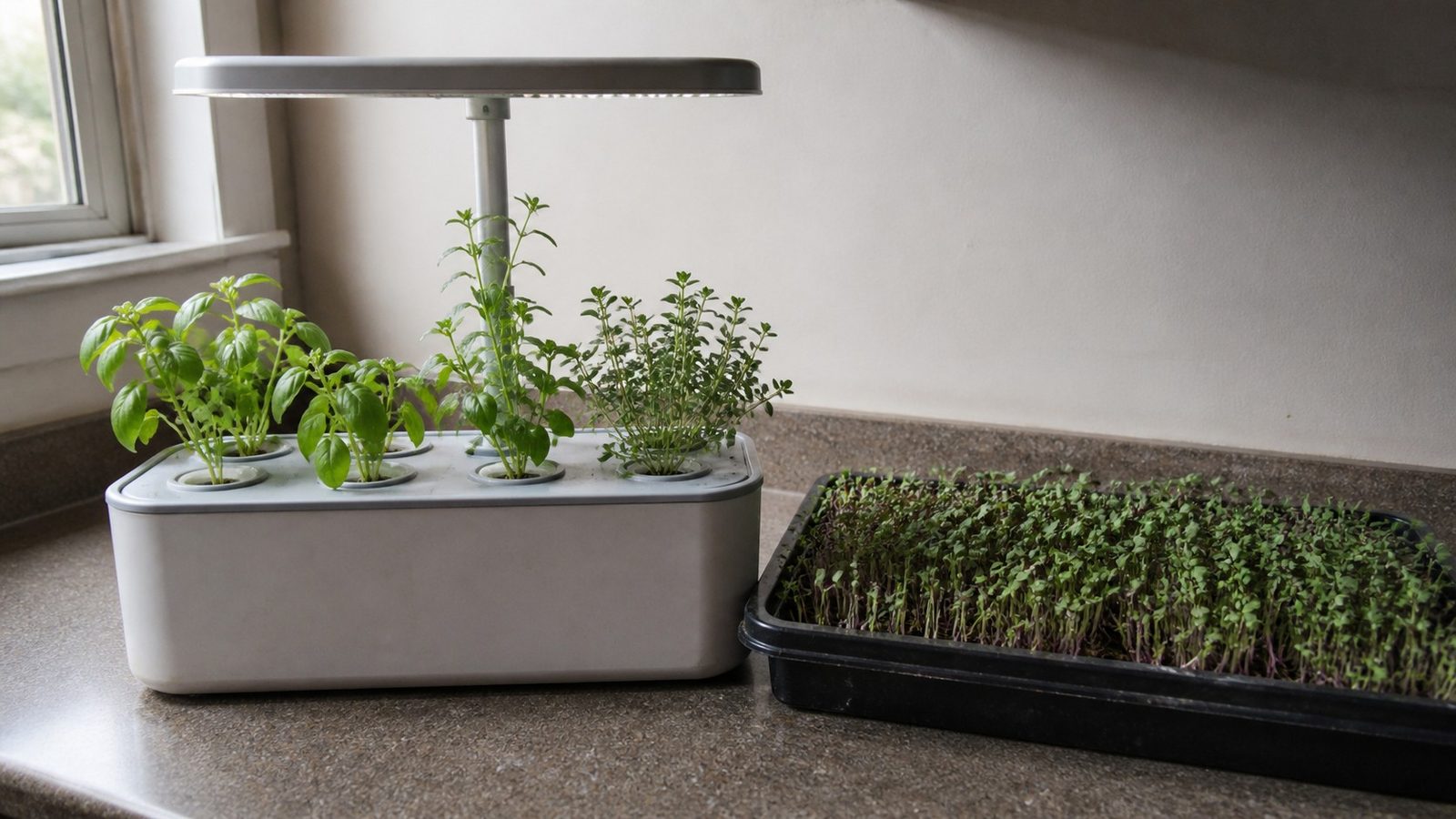
A countertop pod garden can grow microgreens. It is not the sensible way to produce them.
The specification everyone shops on is pod count, and a pod is a hole for one separated mature plant. Six or nine holes is not a 10 by 20 flat. Microgreens are sown dense across a continuous surface and cut as one crop, so a deck designed to keep individual basil plants apart is solving a different problem from the one you have.
The cheapest credible microgreen-specific kit in this market is $29.99, and it comes with no light. A passive 10 by 20 tray kit is $39.97. A nine-pod countertop garden runs $107.97 to $249.99 on the snapshots below, and a Click and Grow Smart Garden 9 is $249.95. The money does not buy tray area.
Buy one of these for herbs and lettuce as a kitchen appliance. That is a real thing it is good at. Buy it for microgreens only if you value the automation more than the output, and know going in that nobody has published what the output actually is.
The order to buy in
What to buy, and where a countertop unit fits
Hover or tap a card to highlight it.
One simple tray in a drainable container
Start here. A shallow food-safe container or a 1020 with a catch tray, soilless medium or a mat, seed, and a lid for germination.
A dedicated light, if the window is not enough
This is the purchase that changes the crop, because light at the canopy is an actual measured variable in microgreen research. Pod count is not.
A second tray and gentle airflow
Airflow is what keeps a dense sowing out of trouble, and it is cheap.
A passive 10 by 20 kit, if bottom watering convenience matters
$39.97, no pump, no controller, nothing to fail mid-crop.
Shelving, only once a repeatable schedule exists
The point at which you are running crops in succession rather than trying one.
A countertop pod garden, only for herbs
Buy it because you want basil and lettuce on the counter with no fuss. That is a real and reasonable want. It is not a microgreens decision.
The premature purchase is a $100 to $250 pod garden bought before proving you want repeated microgreen harvests. Its automation solves individual-plant care. It does not solve crop area, seed density, sanitation, harvest labor or crop succession, which are the actual problems of growing microgreens.
Against a fixed microgreen budget this category ranks below seed, trays and catch trays, adequate evenly placed lighting, clean water and sanitation supplies, and airflow.
What is claimed, against what has been measured
Hover or tap a row to highlight it.
| The claim | Who says it | What it actually establishes |
|---|---|---|
| Nine pods, 30 W LED | AeroGarden Bounty Basic, via Walmart | Nine separated plant positions and electrical input. Not lit area, not canopy light level, not crop mass |
| Six pods, 15 W, up to 12 inches of plant height | AeroGarden Harvest Lite | The same. Height suits a mature herb; microgreens need a broad even LOW canopy |
| Nine pods, 13 W, 4 L tank, 6.2 kWh per month | Click and Grow Smart Garden 9 | A seller-published energy figure, not a cost per harvest |
| 21 pods, 7.5 L tank, auto refill, auto fertilizing, app | LetPot LPH-Max | More automation for separated plants. Not evidence of better microgreen economics |
| "Grows 5x faster than soil" | Product claim on the Bounty Basic listing | Nothing checkable: no species, no soil control, no light, no endpoint, no replication |
| "Up to N plants", "no green thumb required", "set it and forget it" | Across the category | Capacity ceilings and convenience slogans |
| CE mark | Some units | UL notes CE is generally a European conformity marking and may be the maker's own self-declaration, not US third-party safety certification |
| EnergyGuide | Not applicable | The FTC's covered-appliance list does not include countertop hydroponic gardens |
No independent source reports a named countertop garden's cost per microgreen harvest against the same crop in a flat tray under a shelf light. The independent research that does exist studies lighting and microgreen yield directly, and it measures light at crop level as PPFD, not wattage. One arugula experiment tested 100 to 600 micromoles per square meter per second across six replicates. Pod count is not a variable in any of that work, because it is not a plant-relevant quantity.
Watts are electrical draw, not light at the canopy. Pod count is the number of holes, not the area available for a dense sowing. Neither answers the question a microgreen buyer is asking, which is grams of edible crop per dollar against one ordinary tray.
What actually fails
Electronics and the single point of failure. Reported failures are pumps, lights and power supplies, control panels, and water-level sensing. One owner discussion describes the whole system as a light, a pump, a water-level meter and a schedule, and notes that roots can produce false water-level readings. A BBB complaint records both pump and lights stopping. These are owner reports, not failure rates, and no independent time-to-failure figure exists for any model.
The passive tray has none of that, by design. A Kratky kit has no pump, no timer and no controller, so there is nothing electronic to fail mid-crop.
Supply continuity is a live risk here and it is documented. A 2025 BBB response from AeroGarden says it closed its storefront in November, then reopened due to demand and initially offered gardens only with Grow Anything kits. Product pages now redirect to ScottsMiracle-Gro listings and the Bounty Basic has appeared as clearance and out of stock, and by September 13, 2026 it was no longer in AeroGarden's gardens collection. Accessory and service continuity is part of what you are buying, and owners report the official microgreen tray is often unavailable and branded felt or media hard to replace, with some substituting cheesecloth.
The microgreen-specific failure is dense seed on a small wet surface with poor airflow. The University of Saskatchewan identifies excess moisture, a container sitting in water, insufficient air circulation and overly thick sowing as causes of fungal disease, and advises discarding an affected crop. A pod deck also fragments a crop that normally grows as one dense flat, which is a structural mismatch rather than a fault.
On warranty, Click and Grow offers a one year hassle-free warranty on the Smart Garden 9. AeroGarden's limited warranty covers the garden for one year from the date of purchase when it was bought from an authorized seller, and it excludes seed kits and accessories. For gardens bought on or after November 1, 2024, AeroGarden's closing email, in an archived owner copy, announced a 90-day limited warranty in place of the one-year term.
What they cost
Prices move. Every figure here is what that listing showed on the check date at the top of this page, and this page is rechecked at least every two months.
Hover or tap a row to highlight it.
| Option | Price seen | Seen at | What it actually is |
|---|---|---|---|
| Aquager two-tray microgreen kit | $29.99 | Aquager, direct | Microgreen-specific and has no light. A window or a separate light is still required |
| On The Grow 10 by 20 Kratky kit | $39.97 | On The Grow, direct | A passive tray kit at the standard flat size. Trays and reusable media, no seed, nutrient or light |
| AeroGarden Bounty Basic, nine pod | $107.97 clearance, listed out of stock | ScottsMiracle-Gro, direct | Nine separated pod positions, 30 W. By September 13, 2026 it was gone from the gardens collection, where the 40 W Bounty was $114.98 |
| AeroGarden Bounty Basic, same unit | $249.99 on September 26, 2026 | Walmart, sold by marketplace seller Quik-Mart | The same garden through a third-party seller |
| Click and Grow Smart Garden 9 | $249.95 | Click and Grow, direct | Nine pods with nine pre-seeded plant pods, and a one year warranty |
| LetPot LPH-Max, 21 pod | $251.99 | LetPot, direct | 21 separated pod positions. On September 13, 2026 the US store listed it at $251.99 in US dollars |
The Aquager price does not include a light. At $29.99 it is the cheapest microgreen-specific entry found, so the real comparison is $29.99 plus whatever lighting you already own or must buy. The grow lights review covers that side, and its conclusion is that an ordinary white strip is enough.
Consumables are not optional on the pod side. Every system uses seed and usually medium. Hydroponic pod gardens add nutrient solution and, depending on brand, replacement sponges, baskets or pre-seeded pods. The current Harvest Lite is sold without a seed kit or plant food, so those are purchases before first use. On The Grow's silicone media are reusable but it says to replace them when torn, cut or worn.
The one marketplace link here pays this site a commission, and it points at the pod garden rather than at the tray. If a herb appliance is what you want, that is a fair purchase and the link saves you hunting for it. The two options recommended above for microgreens, Aquager and On The Grow, are direct-only and pay nothing.
What it costs to be wrong
The direct cost is the premium, roughly $108 to $144 for a nine-pod garden against $29.99 or $39.97 for a tray kit, before lights and seed either way.
The opportunity cost is worse and less obvious. A pod garden's small fragmented growing area can leave a household with a garnish-sized harvest and no scalable tray system, which means the next purchase starts from zero. The 10 by 20 tray is the scale break, because it supports a whole dense sowing rather than separated positions, and everything above it, shelving, racks, lights, is built around that footprint.
No dollar figure exists for a failed tray, because it varies by crop, seed price, medium and system. Calculate it from your own invoices rather than trusting a number from anyone selling something.
Who should skip this entirely
Skip the category outright if you want the cheapest indoor microgreens, a meaningful weekly volume, several crops on a schedule, anything commercial, or if you already know you need a 10 by 20 tray. Buy a tray, a catch tray, medium, seed, a basic light and a small fan instead.
Skip it too if recurring branded consumables, electronics repair risk, or a bright glowing appliance on the kitchen counter all evening are things you would rather not sign up for.
Buy it if you have no usable window, want a clean automated way to keep a few herbs or lettuce plants alive, and accept the ongoing pod and solution cost. It is a good appliance and a bad microgreens machine at the same time.
What is still genuinely unknown
- What fresh and dry weight each named microgreen actually produces in a given adapter, against a matched tray.
- Whether the light covers an adapter evenly at harvest height, measured with a meter rather than inferred from wattage.
- Whether a particular adapter floods the seed surface on each pump cycle, and whether the timing can be changed.
- How many crops the mat, deck, pump, light and controller complete before failure or an unacceptable cleaning burden.
- Whether the reservoir develops odor, algae, root blockage or false water-level alerts under a dense microgreen crop.
- Whether a replacement part can still be bought and fitted when a specific garden fails.
Treat that last one as a live question rather than a theoretical one. The AeroGarden storefront has already closed once and reopened, and owners report the official microgreen tray is often unavailable.
The terms on this page, in plain words
Tap a term to see what it means.
Canopy. The upper surface of the crop that actually receives the light.
Sources
Every price below was seen on the check date at the top of this page, and the prices on this page are rechecked at least every two months.
- An arugula microgreen lighting study - PPFD tested from 100 to 600 micromoles per square meter per second with six replicates, which is what a plant-relevant light variable looks like.
- University of Saskatchewan, microgreens guide - excess moisture, a container sitting in water, poor air circulation and overly thick sowing as causes of fungal disease, and the advice to discard an affected crop.
- Associated Press, growing microgreens indoors - the basic home method: a shallow covered container or seed-starting tray, with a grow light and small fan optional.
- UL, code authority FAQs - a CE mark is generally a European conformity marking and may be the maker's self-declaration rather than US third-party certification.
- FTC, EnergyGuide labeling FAQs - the covered-appliance list, which does not include countertop hydroponic gardens.
- AeroGarden Harvest Lite, via ScottsMiracle-Gro - six pods, 15 W, up to 12 inches of plant height, and sold without a seed kit or plant food. No purchase price was exposed when the page was opened.
- AeroGarden Bounty Basic, via ScottsMiracle-Gro - nine pods, $107.97 clearance, listed out of stock, in the store's product data; the product page itself no longer opens.
- AeroGarden Bounty Basic at Walmart - $249.99 from marketplace seller Quik-Mart on September 26, 2026, the 30 W LED, and the "up to 5x faster than soil" claim.
- AeroGarden BBB complaint record - the November storefront closure and reopening, the initial Grow Anything-only offer, and complaints including pump and light failure.
- AeroGarden closing email, archived owner copy - gardens bought on or after November 1, 2024 announced at a 90-day limited warranty.
- Click and Grow Smart Garden 9 - $249.95, nine pods, 13 W, 4 L tank, the 6.2 kWh per month figure, and the one year warranty.
- LetPot LPH-Max - 21 pods, 7.5 L tank, auto refill and app control, $251.99 in US dollars on the US store on September 13, 2026; the en-ca address now redirects there.
- Aquager microgreens starter kit - $29.99 for the two tray, seed and mat configuration, with no light.
- On The Grow, 10 by 20 Kratky tray kit - $39.97 for trays and reusable media, no seed, fertilizer or light, and the instruction to replace silicone media when torn or worn.
- Gardener's Supply tabletop microgreen kit instructions - two growing pods, seed packets, a basin, timer and water-level sensor.
- Gardenuity microgreens kit at Home Depot - a divided steel-tray desktop kit sold specifically for microgreens.
- Reviewed, AeroGarden Harvest review - an independent review, documenting a bright light and herb and lettuce observations rather than a microgreen flat comparison.
- Vegbed, growing microgreens in an AeroGarden - says it can be done, published by a company that sells growing products, and reports no weighed yield or tray comparison.
- Can I grow microgreens in an AeroGarden - owners saying it works with an adapter or alternative medium, several saying the garden is unnecessary, and reports that the official tray is often unavailable.
- An owner discussion on hackability - the system described as a light, pump, water-level meter and schedule, roots causing false level readings, and owners substituting generic parts.
Keep reading
The journal
AeroGarden Bounty Review: Basic, Bounty and Elite Specs
This AeroGarden Bounty review compares the Basic, Bounty and Elite by watts, features, price, stock, running cost estimates, and warranty terms.
Read AeroGarden Bounty Review: Basic, Bounty and Elite SpecsThe journal
AeroGarden Farm Review: Specs, Price and What It Grows
This AeroGarden Farm review breaks down the Plus and Basic models, last known list prices, running costs, warranty terms, and owner-reported problems.
Read AeroGarden Farm Review: Specs, Price and What It GrowsThe journal
Best Potting Soil for Microgreens: Cost per Tray
Compare the best potting soil for microgreens by ingredients, bag size, trays filled per bag, and cost per tray, plus problems to expect from each mix.
Read Best Potting Soil for Microgreens: Cost per TrayThe journal
Best Sprouting Trays and Jars for Home Sprouting
Compare the best sprouting trays, jars, sacks and automatic sprouters by format, price and cleaning needs, plus which seeds and buyers each one suits.
Read Best Sprouting Trays and Jars for Home Sprouting