Can You Grow Microgreens in an AeroGarden? What Owners Do
Cal HewittPublished Checked
- growing
- equipment
- aerogarden
- pod gardens
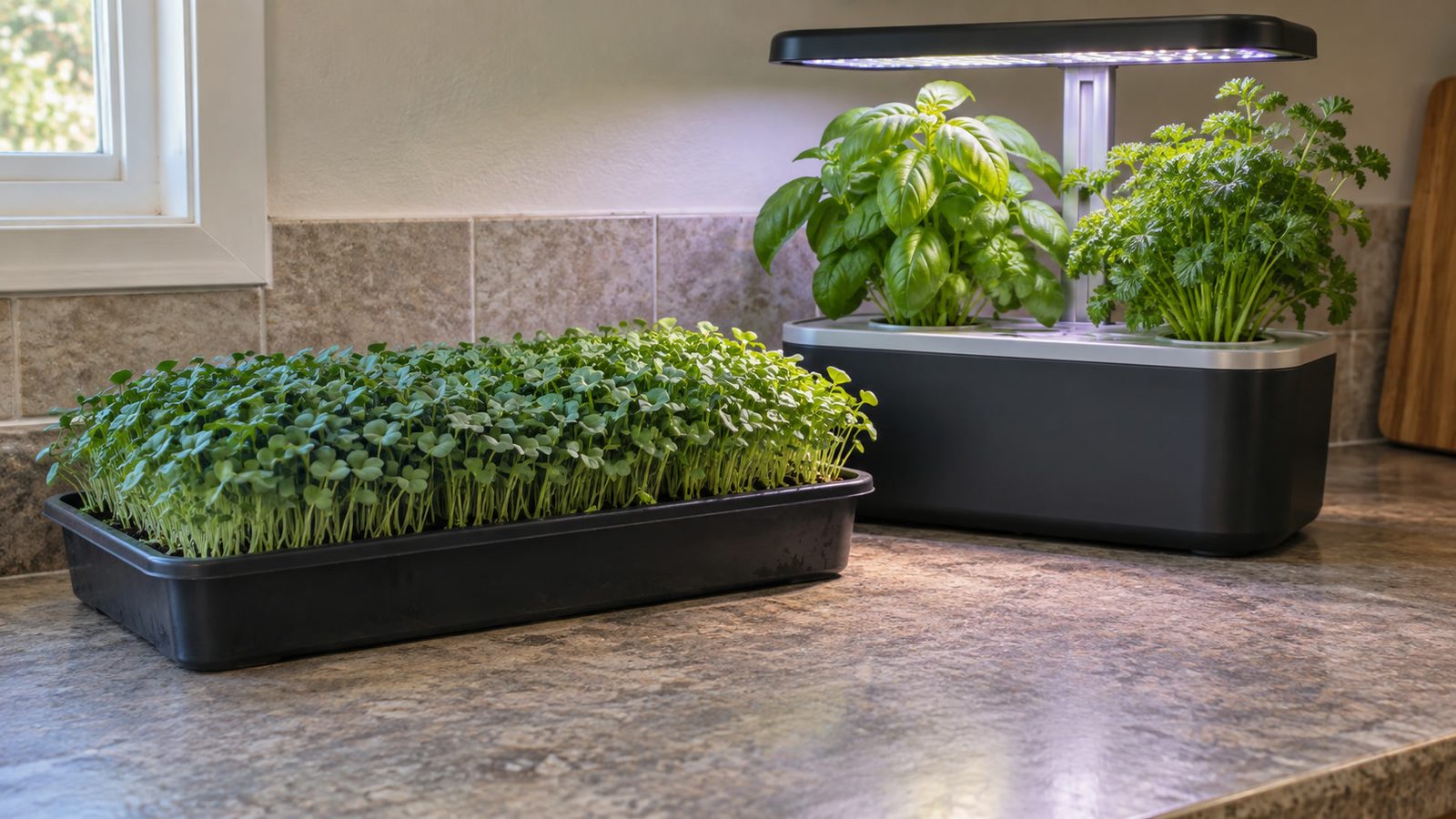
Yes, you can grow microgreens with an AeroGarden, but probably not the way the old instructions describe. The official AeroGarden MicroGreens Kit was not listed on the official Scotts AeroGarden store or garden pages when we checked on September 12, 2026, so don't count on buying one new.
The method owners use today is a small freestanding tray set beside the garden's light, with the garden's own pump kept out of it. Sowing seed thickly into the regular pods is the approach to skip. The rest of this page covers how to set up that tray, what to watch with water, and what a tray can realistically give you.
If you haven't bought a pod garden yet and are still deciding whether one is worth it for microgreens, start with our review, AeroGarden and Countertop Pod Gardens for Microgreens: Is It Worth It?. This page assumes the garden is already on your counter.
Is the AeroGarden MicroGreens Kit still sold?
Not through the official store, as far as anyone can currently see. The current AeroGarden setup and shop page shows gardens, ordinary seed pods starting at $13.95, and Grow Anything pods. There is no MicroGreens Kit and no replacement felt listed. Scotts has not published a discontinuation date or named a successor accessory, though, so this tells you what's on the shelf now, not that the product is officially finished. If a dated statement from the company or a live listing turns up, that would settle it.
Owners have been running into this for a while. One reported the Bounty version out of stock back in 2021. In August 2026, another owner described every Bounty accessory kit, microgreens included, as long gone, and pointed people toward eBay, other used marketplaces, or a 3D-printed substitute. A Canadian retailer's listing for the Harvest kit also shows it out of stock. A used kit is a reasonable thing to look for, but expect the price and availability to vary, and check that it matches your model before you pay.
What the kit was, and which gardens it fit
It helps to know what you'd be hunting for. AeroGarden launched the MicroGreens Kit on May 26, 2021. The launch email from August 2021 listed the Harvest version at $29.95 and the Bounty version at $39.95. Inside the box was an irrigation deck that replaced the normal grow deck, two perforated trays, two domes, four pieces of compostable AeroFelt growing medium, and a 4 oz Superfood seed mix.
The Harvest kit guide lists the Harvest and Harvest Elite as the fit, and the kit was also made for the Bounty family. It was never a standalone garden. Owners separate the original Harvest from the Harvest 360, Slim, and later 2.0 versions, and one owner posted a warning about fit and overflow with an older Harvest. If you own a Sprout, there's no known kit for it at all; owners in a Sprout thread recommend a tray beside the unit instead.
No third-party insert that a maker actually specifies as fitting a Harvest or Bounty, with measurements, turned up either. If a listing claims it fits, measure your deck and compare before trusting it.
Why seeding the pods doesn't make a good crop
Your first thought might be to skip the kit and pack seed into the regular pods, or into the reusable baskets from a Grow Anything set. The trouble is the shape of the space. Microgreens grow as a dense mat, with thousands of seedlings sharing one continuous bed of roots. Each pod is a small, separated root volume, so you end up with six little tufts instead of a tray of greens. AeroGarden's own Grow Anything material describes baskets for your own seeds, but it doesn't give instructions for dense microgreen sowing.
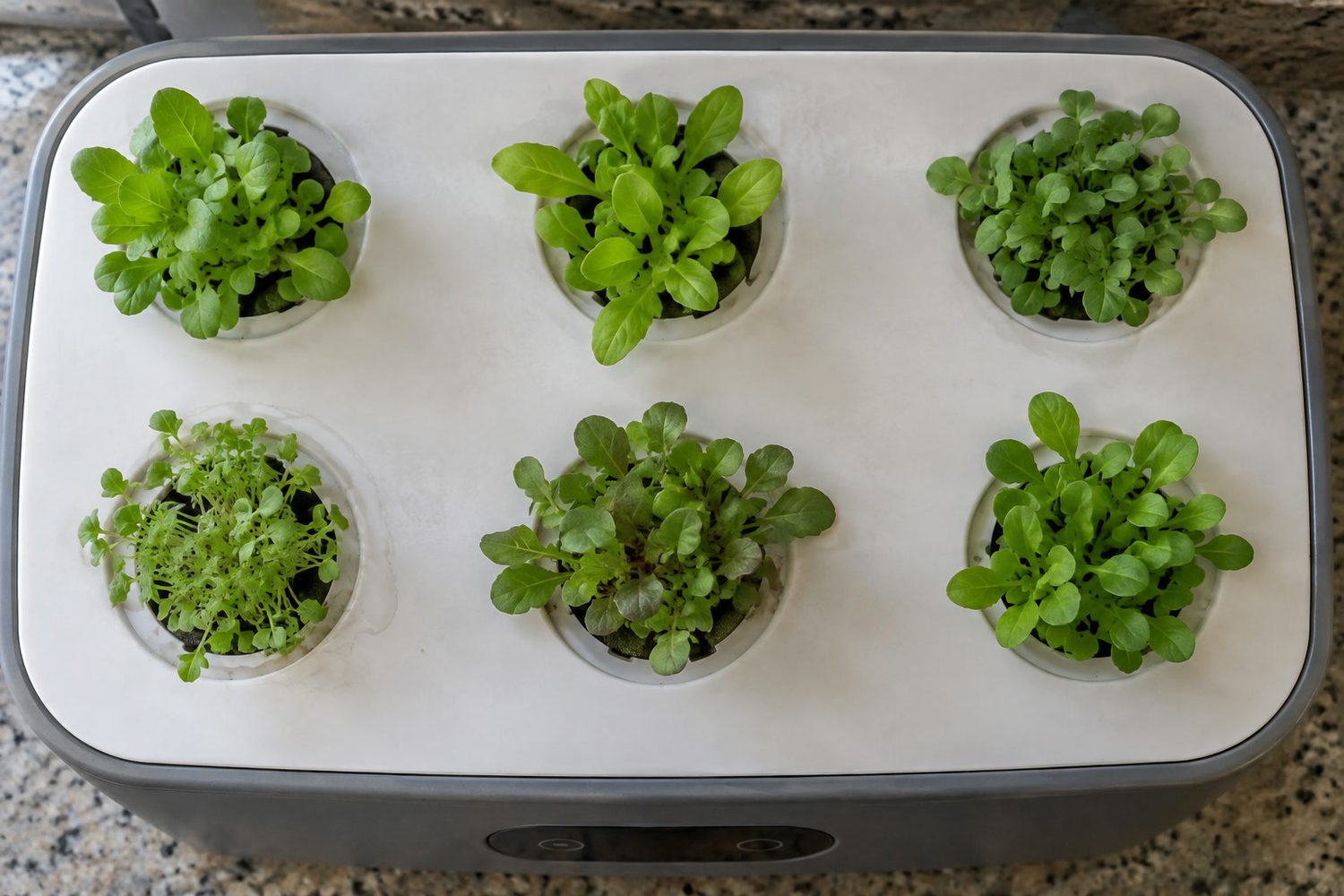
That's why owners who grow microgreens without the kit mostly leave the pods alone and put a tray beside the lamp.
Set up a tray beside your garden's light
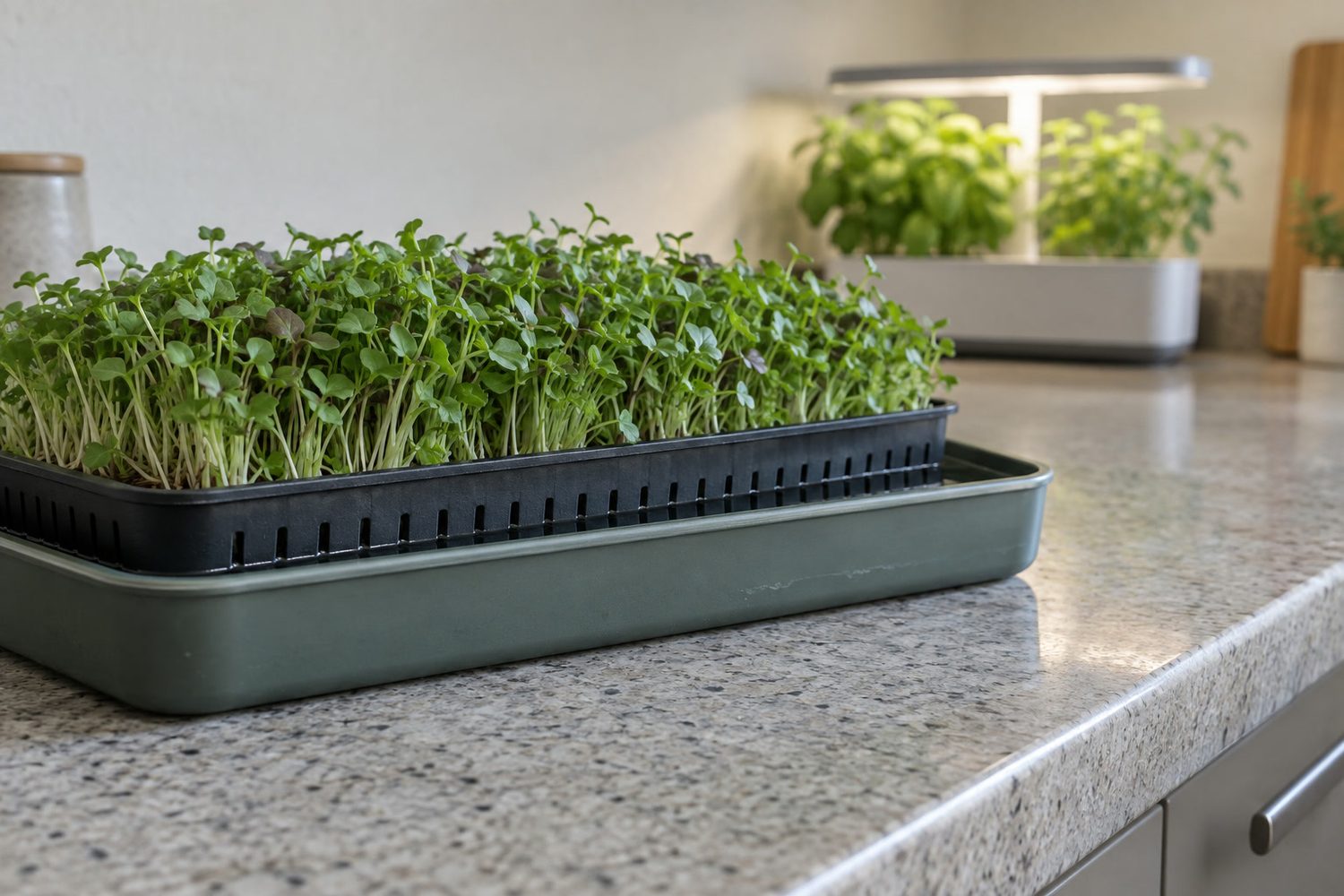
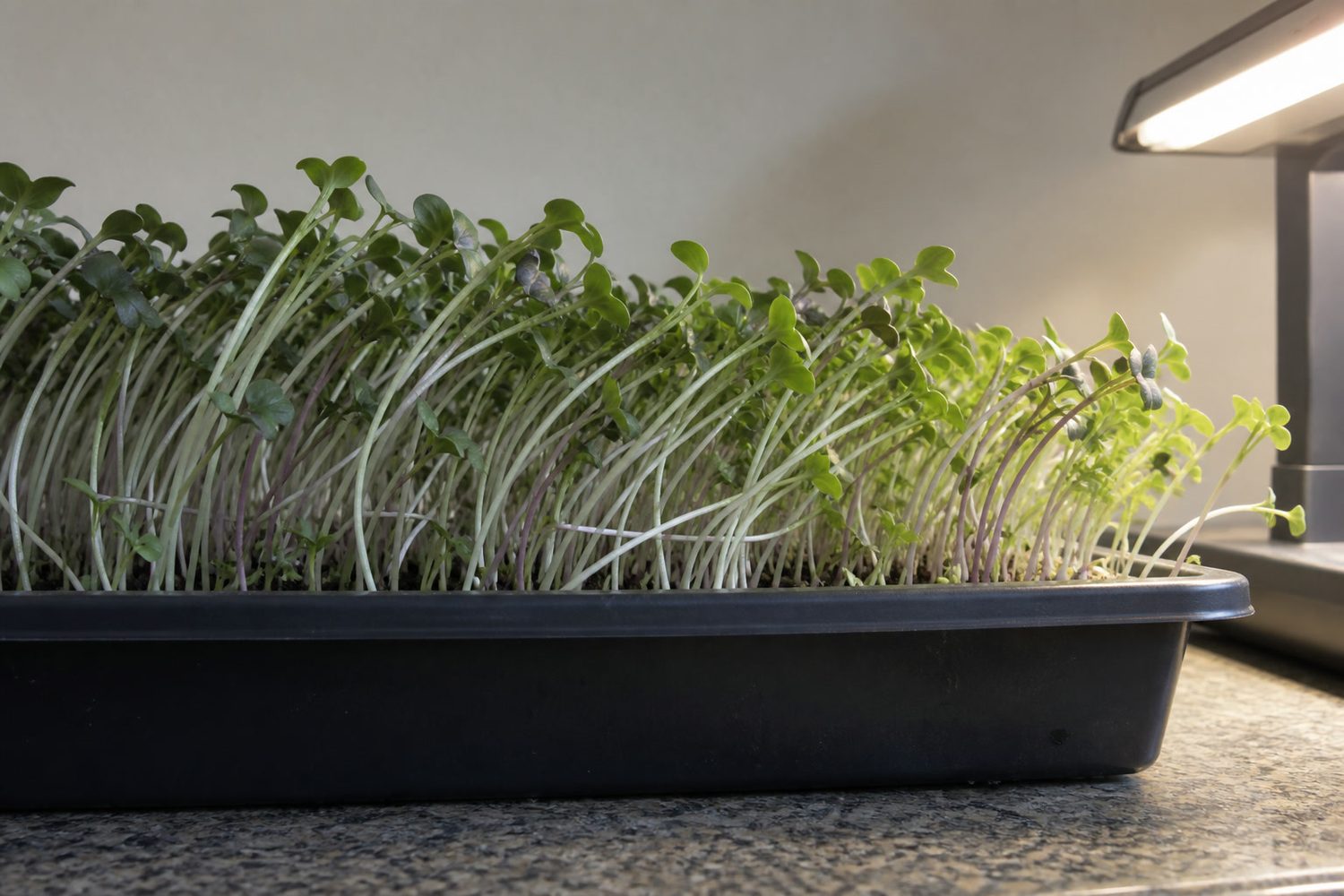
The owner reports line up on a simple arrangement. You set a shallow tray on the counter next to the garden, close enough that the lamp's spill light reaches it, and you water that tray by hand. Owners report using paper towel in the old kit's tray with zero issues, a tray beside a Harvest with good success, and a plastic-lidded tray beside the light. One owner grew two or three trays around a Harvest. These are individual accounts rather than yield data, but they're consistent.
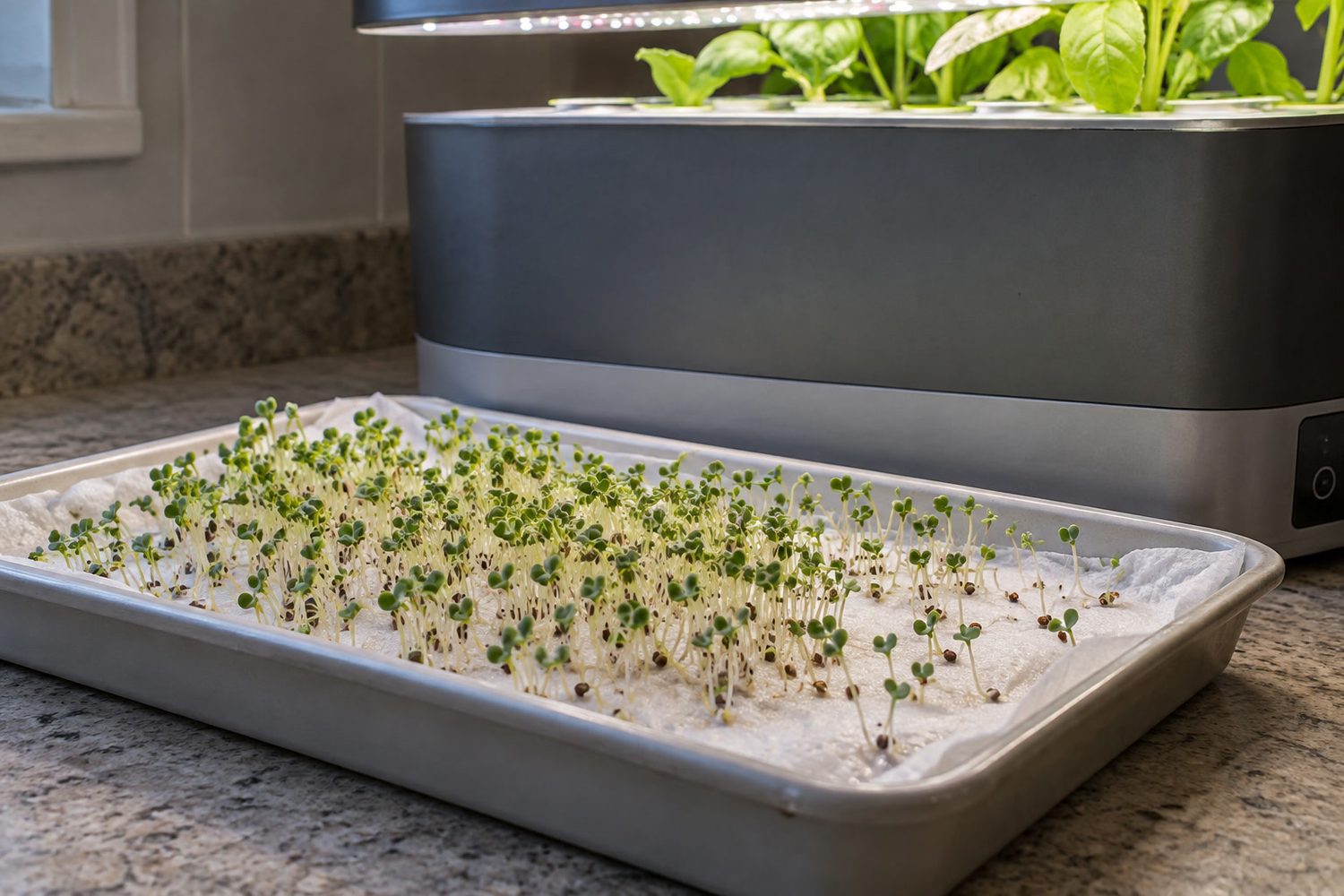
For the tray itself, one owner used a standard On The Grow microgreen tray set beside an AeroGarden light and said it worked well. That kit is a 7 by 14 inch passive bottom-watering tray. It listed at $32.97 but was sold out when we checked on September 12, 2026, and it isn't designed as an AeroGarden insert. Any shallow tray that holds your medium and lets you water without flooding will do the same job.
Owners don't agree on a growing medium. Paper towel, cheesecloth, mesh screen, coco coir, and silicone sheets all have fans, and one owner found the holes in a silicone sheet too big, so the seed fell through. If you're starting out, choose something your seed can't slip through and that stays evenly damp.
Start with one fast, single crop rather than a mix. Cover the tray until the seed germinates, then take the cover off. The kit guides say more seed is not better. For their own trays, the Harvest guide suggested 2 teaspoons per tray side for many sprouts, and the Bounty kit guide says about 4 teaspoons per tray side; one grower who logged her batch used 1 teaspoon per side. Your tray is a different size from the kit's, so treat those as a starting point and adjust after the first batch.
The kit guide told users to raise the lights to their highest level for some extra stretch and, on a Harvest Elite, to pick the Flowers setting for its light cycle. It never published a height in inches, a light-intensity target, or a microgreens-specific schedule, and the current AeroGarden FAQ only says cycles vary by model. With a tray beside the unit, you're working from spill light anyway, so watch the greens and move the tray closer if they stretch and pale.
Keep water and the pump out of trouble
This is where owners report the most problems. The official kit worked by flooding the trays through the garden's pump, and one owner describes water rising through the connector and briefly flooding the trays. Another owner who otherwise had good results lowered the water level because an overactive Harvest pump overflowed. A third found water pooling over a seed-starting tray.
The fixes owners and the manufacturer have on record are all about the kit: lower the water, confirm the irrigation deck sits firmly over the pump nozzle, and use the deck made for the job. None of that shows it's safe to run the pump into some other tray. So, for a freestanding tray, keep it off the AeroGarden's pump entirely and water it yourself. Keep the tray's water away from the base and the cord, too.
Mold and rot came up about as often as flooding. Owners reported a smelly half tray, rot at the base, and a first freestanding tray that molded. One owner who had mold used a 3-day blackout period and a diluted food-grade hydrogen peroxide spray on the next batch and reported no visible mold. That's one person's result, not a tested fix, but it points at the same thing as the flooding reports: don't let the tray sit wet.
Turn the tray, and don't expect to share the deck
Two practical limits shape how you use the garden. First, the kit's deck appears not to allow pods and microgreens at the same time; one owner asked whether half and half was possible because the system didn't seem to permit it. A tray beside the unit avoids that, since your herbs stay in the bowl.
Second, light beside the garden isn't even. An owner growing trays outside a Bounty says to turn the tray daily because the greens reach toward the lamp. Give it a quarter or half turn each day so the whole mat grows upright.
When the beside-the-light tray is the better choice
Put a tray beside the garden rather than chasing a kit if any of these describe you:
- You don't have an original compatible deck.
- You own a Sprout, Harvest 360, Slim, or 2.0, or an older Harvest where fit is uncertain.
- You want to keep herbs growing in the bowl.
- You want more than a snack-size harvest.
- You're willing to rotate a tray for uneven light.
A tray also keeps a dense root mat away from the garden's normal deck and pump, and it makes your growing area visible and easy to measure. Owners specifically say the kit ties up the garden and that tray space is more efficient.
What a tray can produce, and how to track yours
For scale, our own numbers on what a tray actually yields show a median published yield of 7.055 oz for a 10 by 20 inch tray across 39 crops, and a median seed cost of $1.08 per tray across 50 crops. Add the cost of whatever medium you use; the $1.08 is seed only. A 10 by 20 tray is 200 square inches. By comparison, a Harvest's whole outside footprint is 10.5 by 6 inches, or 63 square inches, and the seedable area is smaller than that. A tray that fits beside your garden won't match a full 10 by 20 tray, so read those figures as what a full-size tray produces, not as a promise.
No owner report gives crop, harvest weight, measured growing area, and days all together. The best logged batch from the old kit gave 4 to 5 cups after eight full days, with no crop name and no weight. Since there's no pod-garden figure to work from, make your own: note the crop, the seed amount, the tray's inside length and width, and the day you cut, then put the harvest on a kitchen scale and write down the ounces. After two or three batches, you'll know what your setup gives you.
How long it takes and what owners grow
The kit guide says to start snipping at 5 to 7 days. One owner harvested a spicy mix in 6 days, and the logged batch above was cut after eight. For ordinary trays, Utah State Extension lists arugula at 6 to 8 days, broccoli, kale, and radish at 8 to 12, pea at 8 to 10, basil at 12 to 16, and cilantro at 21 to 28 days from sowing, and Virginia Tech gives similar ranges. The AeroGarden reports fall in the same range as fast brassicas in trays; they don't show faster growth.
Owners report success with the Superfood and spicy mixes, mustard, cat grass, wheatgrass, watercress, and unnamed microgreens. The kit's Superfood mix was broccoli, purple kohlrabi, arugula, cabbage, red cabbage, and kale. Failures happen too: one owner's first watercress shriveled, and another had a tray with under half the seed growing. A fast brassica like arugula or radish is a sensible first crop.
Cleaning up and the warranty
AeroGarden's Sprout product page says to clean and sanitize the garden after each planting. Unplug it first and keep the electrical parts dry. If you've used an old kit, remove the used mat and roots, put the standard deck back before herbs, empty and wash the bowl the way your model's guide directs, rinse, dry the base, refill, and reset the cycle. Follow your own model's manual on details.
The limited warranty doesn't say microgreens void coverage. It does exclude damage from unauthorized modifications or attachments, non-AeroGrow seed pods, improper maintenance, and use contrary to the documentation. Using the original kit as instructed is a different thing from drilling the deck, forcing a mismatched one, or plumbing an improvised tray into the pump. A tray on the counter beside the garden doesn't touch the unit at all.
Frequently asked questions
These cover the questions owners keep asking that the sections above don't fully answer.
How much electricity does a week of growing use?
If you treat the listed LED wattage as the full draw and run 15 hours a day for 7 days, a 20 W Harvest uses about 2.10 kWh and a 40 W Bounty about 4.20 kWh. At the EIA's June 2026 US residential average of 18.34 cents per kWh, that's roughly $0.39 and $0.77. The light schedule is your own setting; the one example AeroGarden publishes, in its FAQ, runs a Bounty 17 hours a day, which puts the Bounty at about 4.76 kWh and $0.87 a week. The pump and adapter aren't counted, so plug in a meter if you want your real figure.
Can I run the original kit on a Harvest 360, Slim, or 2.0?
The kit was made for the Harvest, Harvest Elite, and Bounty family, and owners distinguish the original Harvest from those later versions. Owners report fit and overflow problems even on older Harvest units. If a used kit isn't clearly listed for your model, a tray beside the light is the lower-risk route.
How many batches can I get in a month?
On a 6 to 10 day cycle, that works out to roughly 3 to 5 crops in 30 days, assuming you reset immediately and lose nothing. It's a planning figure worked out from owner reports, not a published capacity. Slower crops, cleaning time, and a failed tray will bring it down.
Is there a microgreens accessory for Click & Grow, LetPot, or iDOO gardens?
No official microgreen tray, mat, or kit from Click & Grow, LetPot, or iDOO showed up on their product pages when we looked. That doesn't prove none exists, so check the maker's current accessories or ask their support about your exact model. Meanwhile, the beside-the-light tray method works the same way next to any countertop lamp.
Where to go next
Stop hunting for pods and set up a shallow tray beside your garden's light this week. Start with a single fast crop, keep the tray off the pump, turn it daily, and put what you cut on a scale so your second batch is based on your own numbers. If you're reading this before buying a pod garden, our countertop pod garden review covers whether one is worth the money for microgreens in the first place.
Sources
Prices, stock and specifications are as the linked pages showed them on 2026-09-12.
- AeroGarden setup and shop page
- out of stock back in 2021
- eBay, other used marketplaces, or a 3D-printed substitute
- listing for the Harvest kit
- launched the MicroGreens Kit on May 26, 2021
- launch email from August 2021
- Harvest kit guide
- Bounty kit guide
- warning about fit and overflow
- Sprout thread
- zero issues
- grew two or three trays around a Harvest
- On The Grow microgreen tray set
- worked well
- used 1 teaspoon per side
- AeroGarden FAQ
- rising through the connector and briefly flooding the trays
- pooling over a seed-starting tray
- asked whether half and half was possible
- trays outside a Bounty
- spicy mix in 6 days
- Utah State Extension
- Virginia Tech
- under half the seed growing
- Sprout product page
- limited warranty
Keep reading
The journal
Can You Use Your Own Seeds in an AeroGarden?
Yes, you can use your own seeds in an AeroGarden. See current sponge and pod prices, seed counts per position, and sprouting times for your own crop.
Read Can You Use Your Own Seeds in an AeroGarden?The journal
AeroGarden Bounty Review: Basic, Bounty and Elite Specs
This AeroGarden Bounty review compares the Basic, Bounty and Elite by watts, features, price, stock, running cost estimates, and warranty terms.
Read AeroGarden Bounty Review: Basic, Bounty and Elite SpecsThe journal
AeroGarden Farm Review: Specs, Price and What It Grows
This AeroGarden Farm review breaks down the Plus and Basic models, last known list prices, running costs, warranty terms, and owner-reported problems.
Read AeroGarden Farm Review: Specs, Price and What It GrowsThe journal
AeroGarden vs LetPot: Specs, Warranty and Running Costs
See AeroGarden vs LetPot lined up on price, pod count, light hours, monthly power cost and warranty terms to match a garden to your kitchen and crops.
Read AeroGarden vs LetPot: Specs, Warranty and Running Costs