Can You Use Your Own Seeds in an AeroGarden?
Cal HewittPublished Checked
- aerogarden
- pod gardens
- seed
- growing
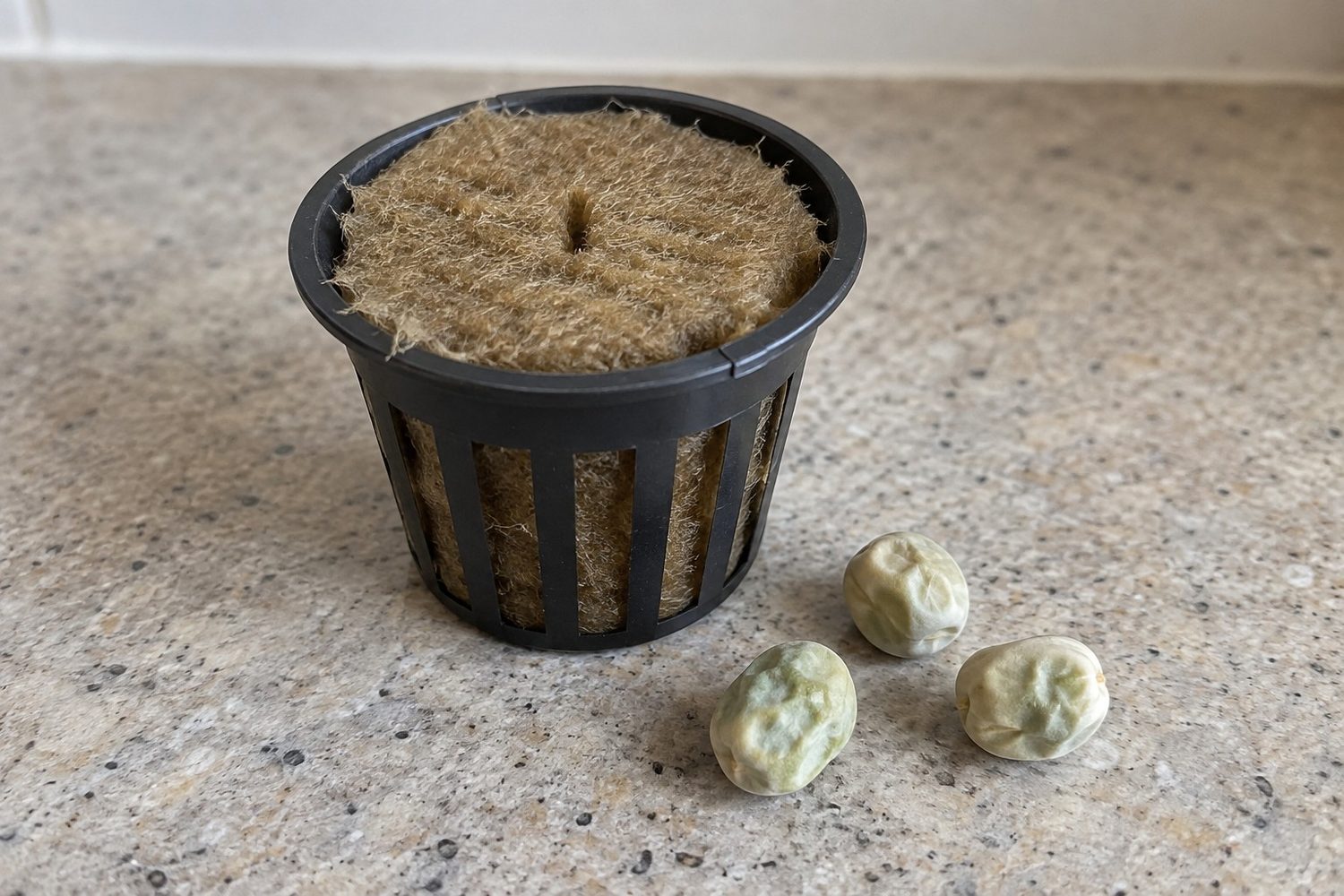
Yes. You plant your own seed in an AeroGarden with a blank pod: a grow sponge set in a plastic grow basket, with a label on top. AeroGarden sells these as the Grow Anything Seed Pod Kit, at $21.95 for 9 pods, which works out to $2.44 per growing position, and third-party sponges from LetPot and Ahopegarden cost well under a dollar per position.
For most herbs and flowers, put 2 to 3 seeds in each sponge; for a large seed like a pea or bean, put in one. When the seedlings come up, thin to the strongest. Most herbs sprout in 5 to 14 days.
What you give up is AeroGrow's germination guarantee, which does not cover seed you supply.
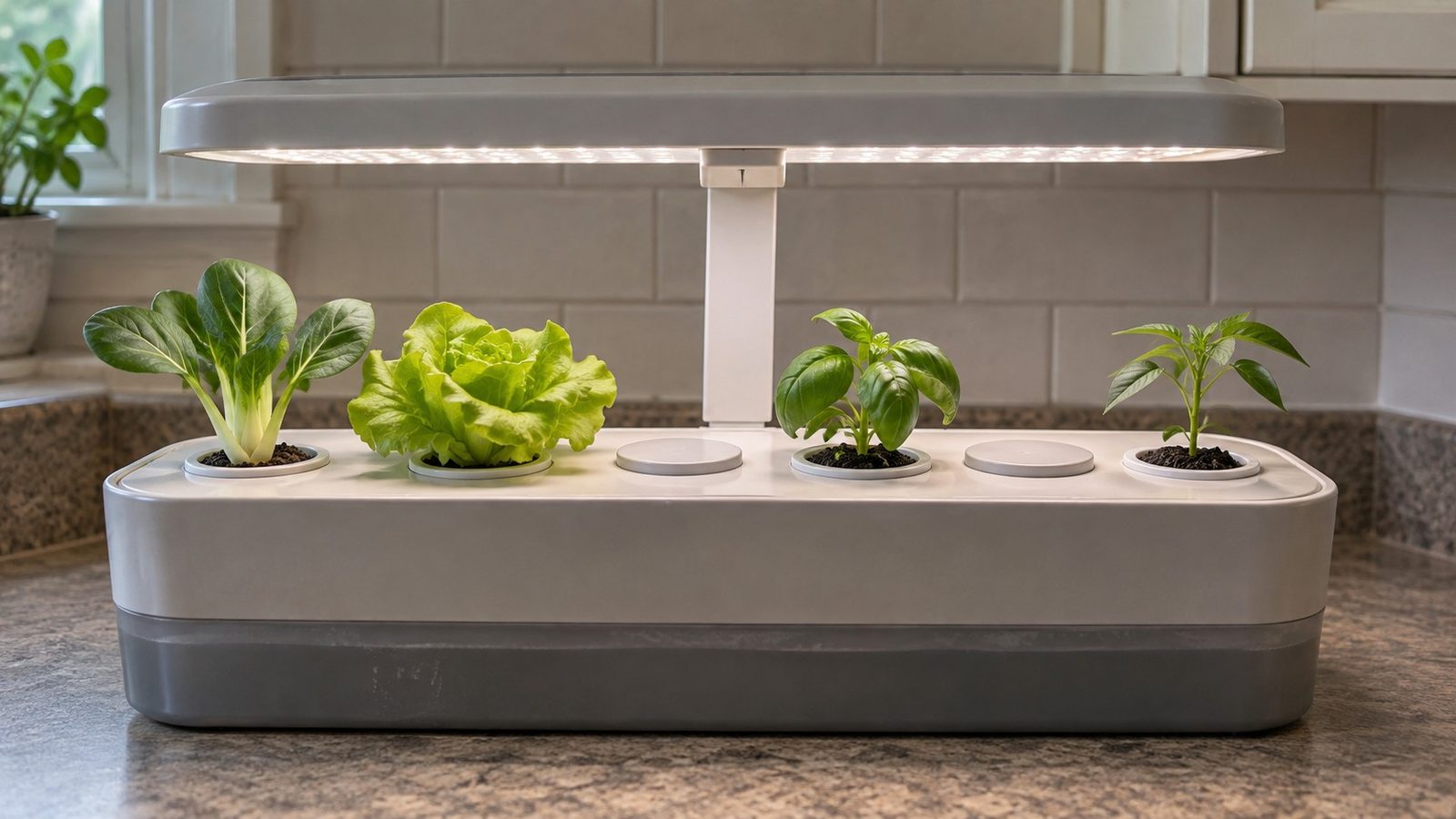
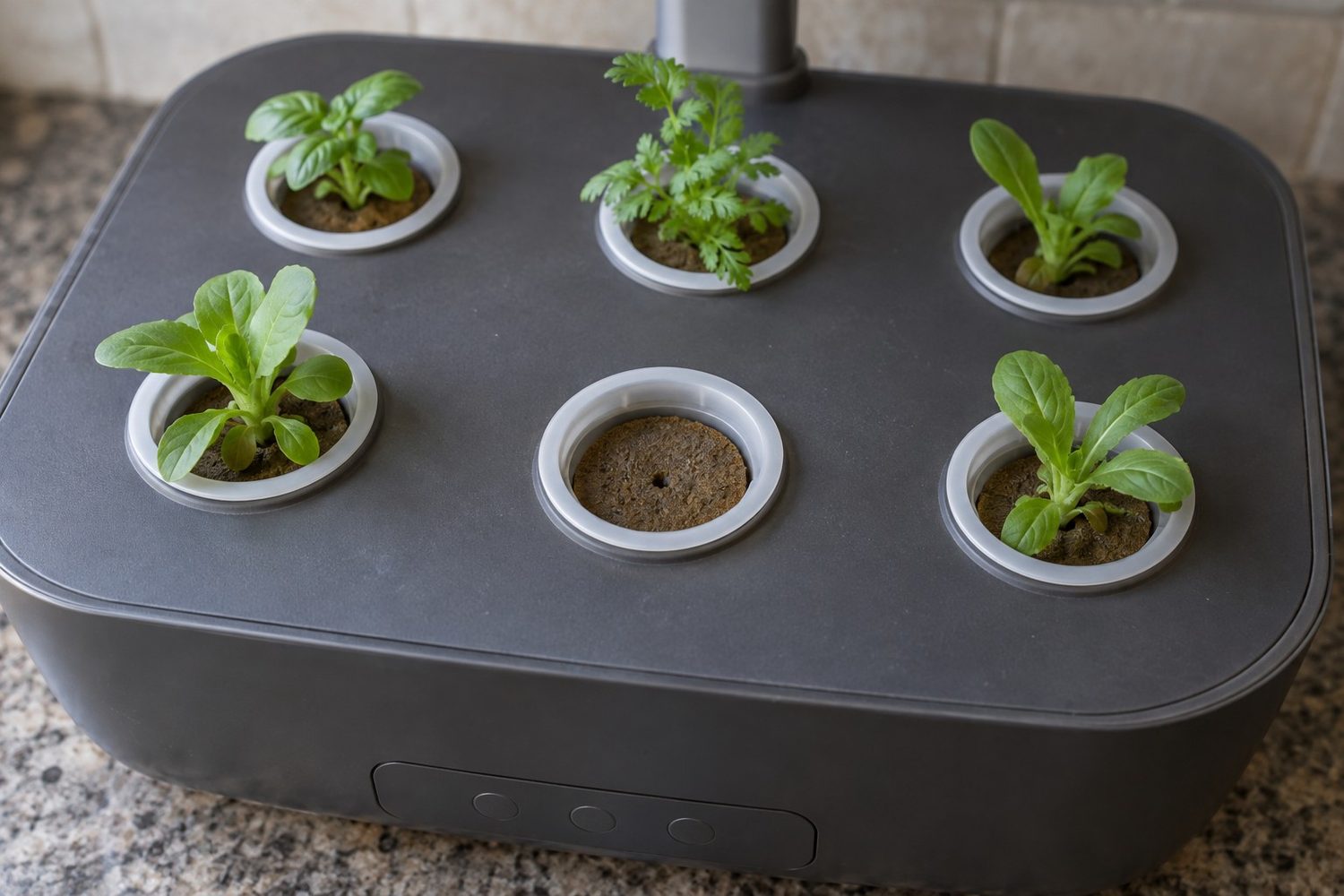
Each hole in the deck holds one separated plant, whether that is basil, a head of lettuce or a dwarf tomato. If what you have in hand is a packet of microgreen seed, that is a different setup, and growing microgreens in an AeroGarden covers it.
What you need before you plant
The Grow Anything listing puts it simply: "Use your own seeds to grow your favorite flowers, vegetables, or herbs." The 9-pod kit comes with 9 grow sponges, 9 grow baskets and 9 pod labels, plus one 3 fl oz bottle of AeroGarden Liquid Plant Food and a growing guide. Seed is not included. The listing says the sponges are made from Canadian sphagnum peat, and that the sponges and baskets are for use in AeroGarden units only.
Beyond the pod, you need your seed, a paper towel if you plan to start larger seed ahead of time, and the plant spacers that came with your garden for any holes you leave empty.
What a growing position costs
Prices below were read on September 13, 2026, before shipping and tax. The per-position figure is the pack price divided by the number of sponges or pods.
Hover or tap a row to highlight it.
| Option | What is in it | Price | Per growing position |
|---|---|---|---|
| AeroGarden Grow Anything, 9-pod | 9 sponges, 9 baskets, 9 labels, one 3 fl oz bottle of plant food | $21.95 | $2.44 |
| AeroGarden Grow Anything, 6-pod | Same kit, 6-pod size | $16.95 | $2.83 |
| AeroGarden Heirloom Salad Greens, pre-seeded | 3, 6 or 9 seeded pods | $13.95 / $16.95 / $21.95 | $4.65 / $2.83 / $2.44 |
| LetPot 172-piece pod kit | 60 sponges, 60 domes, 25 baskets, 60 stickers, two A/B plant food bottles | $26.89 | $0.45 |
| LetPot 200-pack | 100 peat sponges and 100 stickers | $24.99 | $0.25 |
| Ahopegarden 50 sponges | 50 coconut-shell-fiber sponges | $13.99 | $0.28 |
Every size of the Heirloom Salad Greens pods was listed as not available on September 13, 2026, so treat those prices as a comparison point rather than something you could order that day. At the 9-pod size, the pre-seeded pods and the blank Grow Anything kit come to the same $2.44 per position. The difference is that one arrives with seed and a germination guarantee, and the other takes your seed and leaves the testing to you.
The third-party packs are much cheaper per position, and they ask more of you. The LetPot 200-pack is sponges and stickers only, so you reuse baskets you already own. The 172-piece kit includes baskets, domes, stickers and plant food, but only 25 baskets for its 60 sponges. LetPot says its sponges fit AeroGarden gardens, and Ahopegarden calls its kits compatible without giving a sponge diameter on the listing. No maker publishes a fit check against each AeroGarden model, so buy the smallest pack first and try a few sponges in your own deck before you commit to a larger one.
Seed is the small part of the bill. A Botanical Interests Italian Genovese basil packet is $2.99 for about 700 seeds, which at 2 to 3 seeds per pod is roughly 233 to 350 sowings, though not every seed will come up. For what the garden itself costs over a first year, see how much an AeroGarden costs.
How to plant your own seed, step by step
These steps follow AeroGarden's Grow Anything workflow, with LetPot and Ahopegarden advice where it adds something.
- Check your seed first. Saved seed and store packets work in a pod; what matters is whether the seed is still alive. UVM Extension suggests rolling 10 seeds in a damp paper towel. If fewer than half sprout, it says to consider replacing the packet.
- Start larger or slower seed ahead of time, if you like. LetPot says to pre-germinate spinach, beet and cilantro on a moist paper towel and then move the sprout into a sponge (LetPot FAQ). Ahopegarden says to soak large seeds for 6 to 12 hours and sow small seed directly (Ahopegarden user guide).
- Place the seed in the sponge. The Grow Anything listing says to place "one of your own seeds (or a few, if they're small) into a grow sponge." For a large seed such as a pea, AeroGarden's Grow Anything planting guide says to cut the opening half an inch deep and insert one or two seeds. For depth on anything else, follow the packet.
- Set the sponge in its basket and add the label. The label sits over the sponge and keeps light off the wet medium, which Ahopegarden recommends for the same reason.
- Put the pod in the deck and cover every empty hole. AeroGarden says to "Cover any exposed spots of the grow deck with plant spacers to block light from reaching the water reservoir" (AeroGarden seed-kit page).
- Add water and plant food as your garden's maker directs. The Grow Anything listing says to add water and the recommended amount of plant food after the pods are in.
- Remove any clear dome once seedlings emerge, then thin. When the seedlings have their first few leaves, keep the strongest and remove the rest, as the next section explains.
How many seeds go in one sponge
Start with the maker's count for a sponge. AeroGarden's Grow Anything listing says, "For larger seeds, like peas or beans, one seed per pod is perfect. For smaller seeds, like most herbs and flowers, we suggest placing 2-3 seeds in each pod." LetPot's FAQ and Ahopegarden's user guide both say 2 to 3 seeds as well.
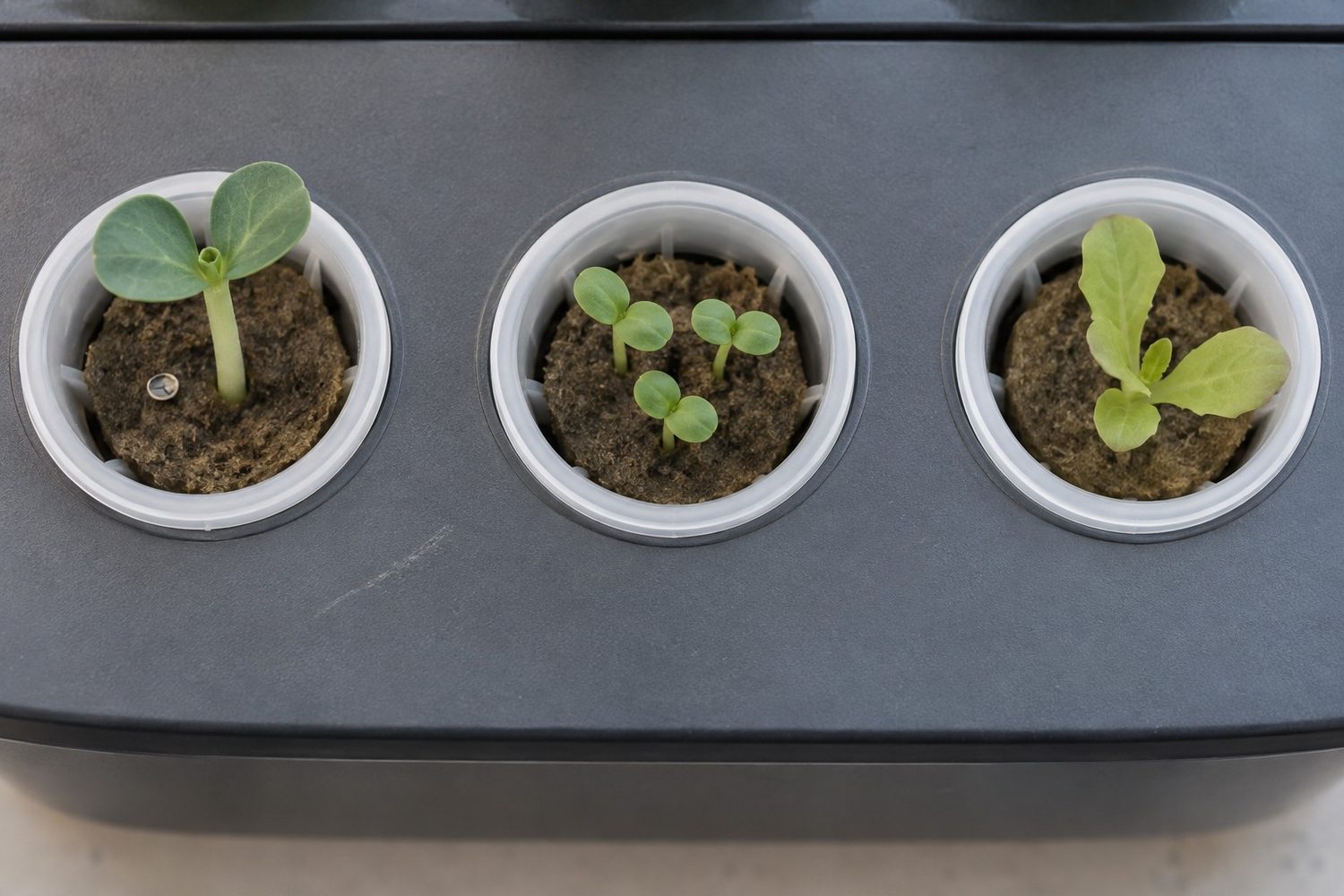
Thinning is where the one-plant-per-position rule comes in. LetPot says to wait until seedlings have 2 to 3 leaves, then keep the best tomato seedling, or 1 to 2 seedlings for smaller herbs. Arizona Extension advises thinning seedlings to one per cell or pot. Snip the extras at the base with small scissors instead of pulling them, so you do not tear the roots of the one you are keeping.
Two owner accounts, each from one person, show both approaches. One owner, writing in July 2026, planted their own Baker Creek seed in Grow Anything pods and grew lush Tatsoi and Hedou Tiny bok choy from one seed per pod. Another owner, writing in April 2025, uses generic sponges with their own seed for lettuce, kale, bok choy and mustard greens, sows 2 to 3 seeds, then thins and moves the thinned seedling into another sponge rather than throwing it away.
Which seeds suit a countertop garden
AeroGarden's own seed kits are herbs, salad greens, tomatoes, peppers and flowers, which is a good guide to what fits under the light. The Grow Anything listing recommends "avoiding root vegetables (like carrots) and large plants that vine, like squash or melons." Gardyn's own-seed guide says determinate varieties, which stop growing at a set size, are easier to work with than indeterminate ones that keep going, and asks you to check each variety's time to maturity, light needs and root habit before you plant. It also says garlic, onions and potatoes do poorly in its cubes.
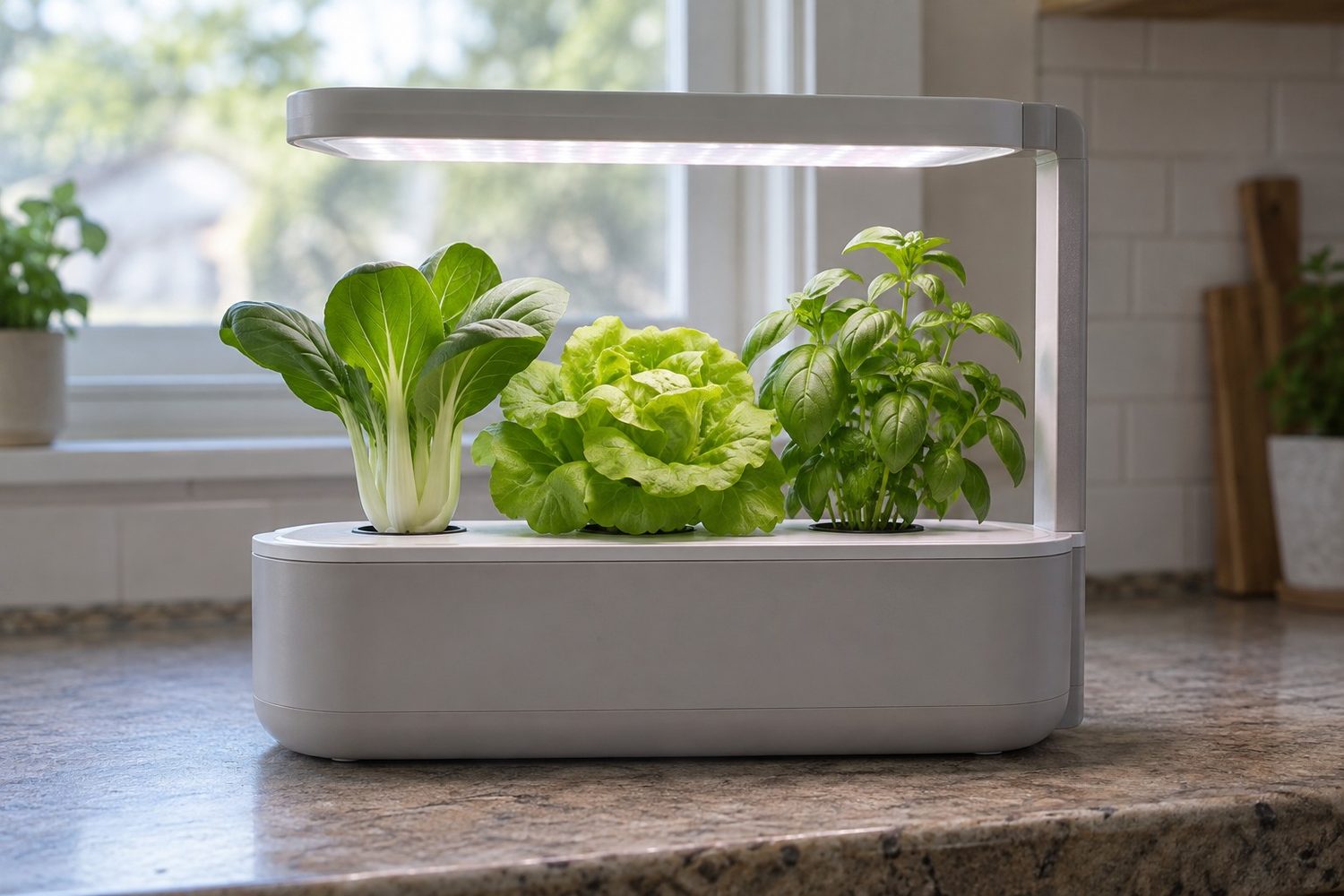
Height is the other limit. Ahopegarden's 12-pod garden, for example, has a light that raises to 14.17 inches, and the maker tells owners whose plant outgrows it to prune it or move it out (Ahopegarden FAQ). Check how high your own garden's light goes, then pick compact or dwarf varieties that finish below it. To compare gardens by size, see our countertop unit reviews, and if you grow microgreens as well, buying microgreen seed covers that side.
How long your seeds take to sprout
AeroGarden's seed-kit page says most herbs sprout in 5 to 14 days, and that some seeds, like tomatoes and thyme, can take up to three weeks. Gardyn says lettuce may sprout "in a matter of days" and reach full size in 3 to 4 weeks (Gardyn FAQ).
No maker publishes a sprouting rate or timeline for your own seed in a pod, crop by crop. The way to get that number is to keep it yourself: write the date, the variety and the number of seeds on each pod label or in a notebook, then count what comes up. Give tomatoes and thyme the full three weeks before you call a pod bare.
What the guarantee and warranty cover when the seed is yours
AeroGrow's Guarantee to Germinate covers AeroGrow seed pod kits bought from authorized US sellers for 90 days from purchase (from delivery in California), with a possible replacement or refund. To use it, you contact AeroGrow after three weeks and have your receipt. It expressly excludes "germination of seeds not provided by AeroGrow." The Grow Anything listing says the same in plain terms: "Since you are using your own seeds, our germination guarantee does not apply to this kit." That is true even though the sponge and basket are AeroGarden's own.
The AeroGrow Limited Warranty, effective September 30, 2025, applies to AeroGarden products excluding seed kits and accessories, so sponges and baskets are outside it. It does not cover a product or components damaged by unauthorized modifications or tampering, including "unauthorized parts or attachments, such as non-AeroGrow seed pods," and it says unauthorized use "may invalidate" the warranty. In practical terms, damage caused by a non-AeroGrow pod is not covered, and using one may affect your coverage. If your garden is still under warranty, that clause is a reason to consider AeroGarden's own Grow Anything pods over third-party ones, even at the higher price per position.
If you own a LetPot, its warranty policy gives one year of coverage and excludes modifications or repairs made with unauthorized parts or accessories. It does not name seed or sponges separately.
Fixing a bare pod, mold and algae
Most own-seed problems fall into four groups, and each has a plain fix.
A pod that stays bare
Wait out the maker's window first: up to three weeks for slow seed like tomatoes and thyme. If nothing has come up by then, pull the pod, test the rest of the packet in a damp paper towel, and resow in a fresh sponge. Pre-germinating slow seed, as LetPot and Ahopegarden suggest, lets you move only seed that has already sprouted into the deck. Some seed takes more than one try. One owner, writing in November 2022, had to try a few times to get basil going, while a tomato sprouted on the first seed.
White fuzz on the sponge
AeroGarden's seed-kit page says white fuzz on grow sponges "is typically mold from excess moisture" and "should go away once your plant grows above the label and shades the grow sponge." If it spreads or the seed never comes up, LetPot says to discard the contaminated sponge and clean the tank, baskets and lids, and it points to seed storage and seed quality as causes. Use fresh sponge medium for each sowing, take domes off as soon as seedlings emerge, and keep air moving around the garden. If the fuzz is on the roots of a sprouted seed rather than the sponge, check whether it is mold or root hairs before you throw anything out.
Green water or green sponges
Green growth in the tank or on the sponge is algae, and it needs light. Ahopegarden says light getting into the tank through uncovered holes causes it, and tells owners to cover unused holes, keep the garden out of direct sun, change the water and clean the tank. LetPot says its green light-blocking sticker over each pod prevents algae. Keep a label or sticker on every pod, a spacer in every empty hole, and a clean tank.
Tall, thin seedlings
Leggy seedlings that stretch and flop are a light problem. Oklahoma State Extension attributes them to inadequate light.
Frequently asked questions
Can I reuse the sponges and baskets?
Reuse the baskets, not the sponges. LetPot says not to reuse sponges because performance may drop and old medium can carry bacteria or disease, but to clean and reuse its white baskets and clear covers. Ahopegarden says its sponge is for single use only.
How old can my saved seed be?
It depends on the crop and how the seed was stored. UVM Extension gives tomato and kale seed as usually good for about four years, and corn and pepper about two. Run the 10-seed paper towel test on anything older than that before you fill a deck with it.
Do I need plant food before the seeds sprout?
Ahopegarden says, "No nutrients are needed before seed germination," and has you add them after. LetPot gives 5 mL each of its A and B nutrients per liter of water. For an AeroGarden, follow the Grow Anything instructions to add the recommended amount of AeroGarden plant food with the water.
Can I start seeds in the AeroGarden and move them outdoors?
Yes. AeroGarden's planting guide says root crops should not be planted in an AeroGarden unless you plan to transplant them soon after they sprout. Illinois Extension says to start hardening seedlings off about two weeks before transplanting, beginning with 2 to 3 hours outside during the warm part of the day and working up to 10 to 12 hours, and to hold tomatoes and peppers until your frost risk has passed.
Can I grow microgreens in a pod?
A pod holds one separated plant, so a microgreens crop needs a tray instead of a deck hole. For hydroponic setups built for dense sowing, see hydroponic microgreens systems, and for how long that seed keeps, see how long microgreen seeds last.
Getting your first pods started
For the least risk, start with Grow Anything pods and tested seed. If cost per position matters more, try a small pack of LetPot or Ahopegarden sponges in your own deck first. Either way, sow 2 to 3 seeds, label each pod with the date and seed count, cover every empty hole, and give slow seed its full three weeks before you resow.
Sources
Prices, stock and specifications are as the linked pages showed them on 2026-09-13.
- Grow Anything Seed Pod Kit
- AeroGarden Heirloom Salad Greens, pre-seeded
- LetPot 172-piece pod kit
- LetPot 200-pack
- Ahopegarden 50 sponges
- Botanical Interests Italian Genovese basil packet
- UVM Extension
- LetPot FAQ
- Ahopegarden user guide
- Grow Anything planting guide
- Arizona Extension
- writing in July 2026
- writing in April 2025
- own-seed guide
- Ahopegarden FAQ
- Gardyn FAQ
- Guarantee to Germinate
- Limited Warranty
- warranty policy
- writing in November 2022
- Oklahoma State Extension
- Illinois Extension
Keep reading
The journal
Can You Grow Microgreens in an AeroGarden? What Owners Do
The AeroGarden MicroGreens Kit is hard to find. Learn how owners still grow microgreens in an AeroGarden with a simple tray beside the light.
Read Can You Grow Microgreens in an AeroGarden? What Owners DoThe journal
AeroGarden Bounty Review: Basic, Bounty and Elite Specs
This AeroGarden Bounty review compares the Basic, Bounty and Elite by watts, features, price, stock, running cost estimates, and warranty terms.
Read AeroGarden Bounty Review: Basic, Bounty and Elite SpecsThe journal
AeroGarden Farm Review: Specs, Price and What It Grows
This AeroGarden Farm review breaks down the Plus and Basic models, last known list prices, running costs, warranty terms, and owner-reported problems.
Read AeroGarden Farm Review: Specs, Price and What It GrowsThe journal
AeroGarden vs LetPot: Specs, Warranty and Running Costs
See AeroGarden vs LetPot lined up on price, pod count, light hours, monthly power cost and warranty terms to match a garden to your kitchen and crops.
Read AeroGarden vs LetPot: Specs, Warranty and Running Costs