How to Choose a Hydroponic System for Microgreens
Cal HewittPublished Checked
- growing
- equipment
- comparison
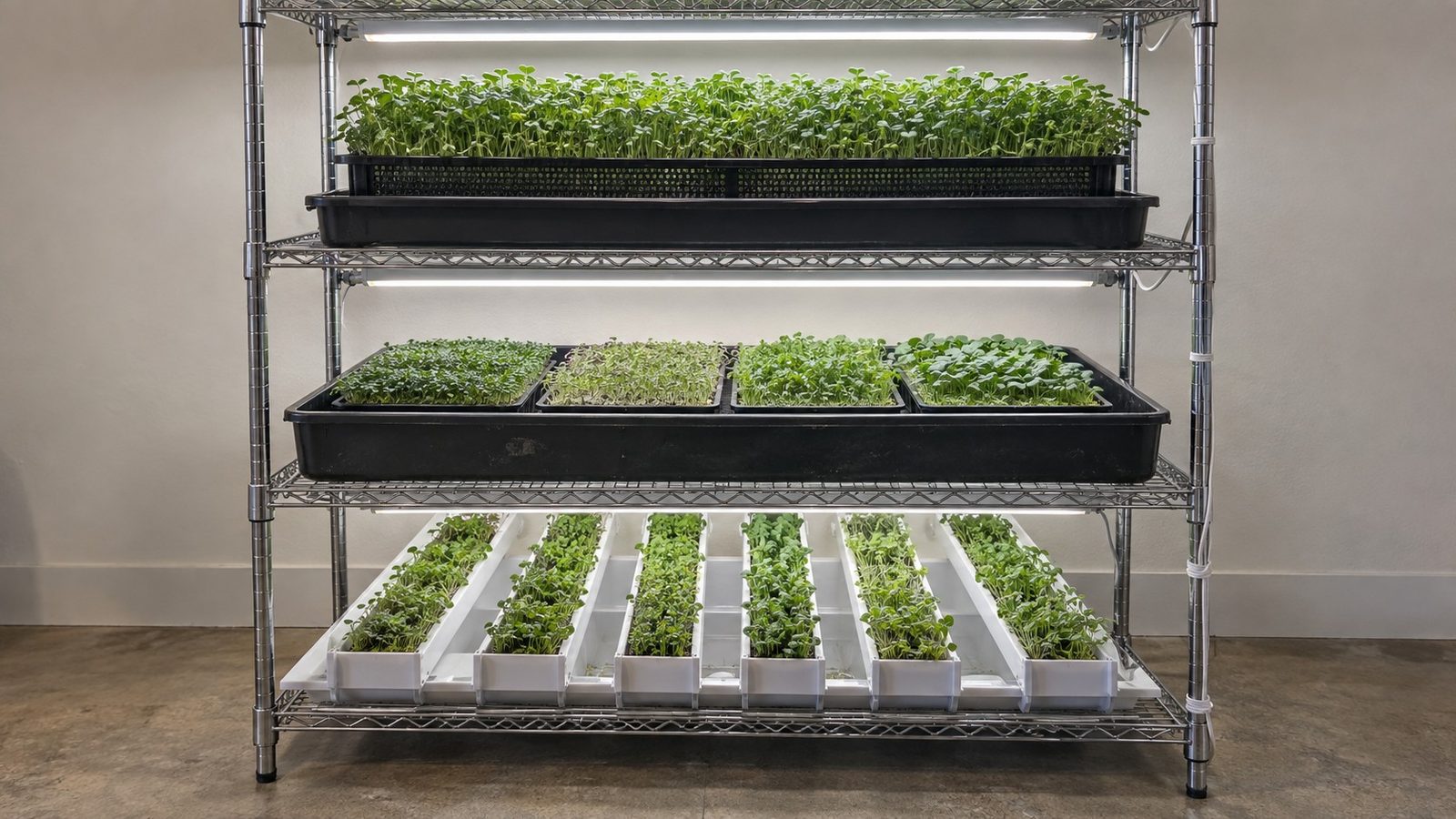
If you want one or two trays with no pump and no timer, a still-water tray run Kratky style is the cheapest way in: On The Grow sells a 10-by-20 kit for $39.97 (listing, checked September 12, 2026).
If you have steady power, room for a table or rack, and time to test EC and pH on a schedule, an ebb-and-flow table or NFT channels can carry more trays, but they cost more, need a pump and timer, and send every tray's water back to one reservoir, which makes cleaning part of the job.
No microgreen study has separated yield differences between these setups from the growing medium itself, so choose on space, budget and upkeep, then put your own trays on a scale to judge the harvest.
What each system does with the water
The three systems differ mainly in how nutrient solution reaches the roots. Oklahoma State Extension describes ebb and flow as temporarily flooding a grow tray and draining it back to the reservoir, usually with a timed submerged pump. Missouri Extension describes NFT, the nutrient film technique, as solution that flows continuously over the roots. Kratky is the passive one: New Mexico State University Guide H-180, dated July 2022, calls it a closed system that does not recirculate, with nothing added after setup and the reservoir drawn down by harvest (NMSU Guide H-180).
For microgreens specifically, Virginia Cooperative Extension (VCE) names NFT and ebb and flow among the systems in use. Whichever you pick, the mat under the seed has to suit the way water arrives; VCE's main test is matching the medium's water-holding capacity to the irrigation system, along with reusability, cost and pathogen risk. Our growing medium reviews compare mats for each setup, and the hydroponic and soil-free overview covers the basics of growing without soil.
The still-water tray, run Kratky style
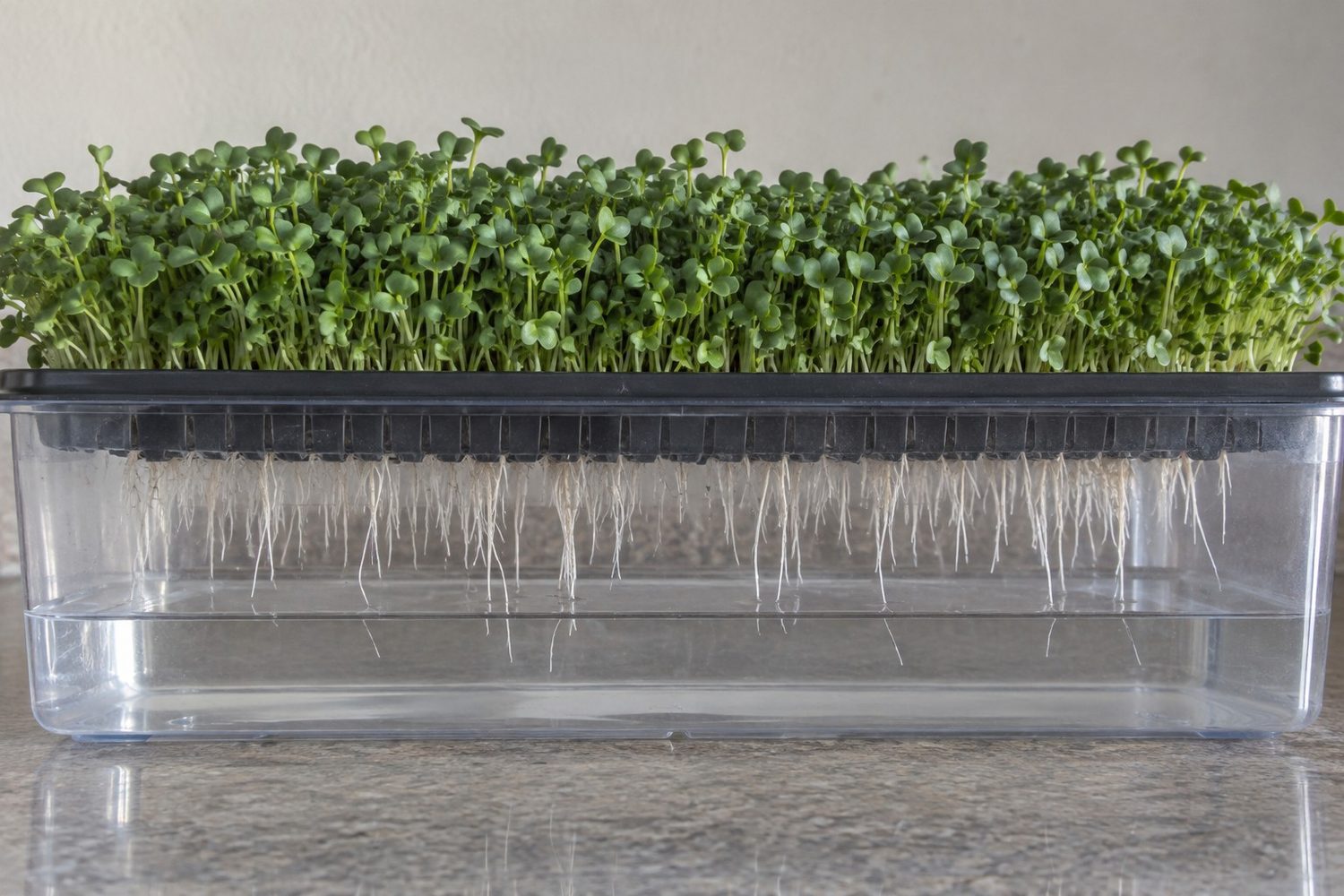
A still-water tray is a mesh tray sitting over a shallow reservoir. The On The Grow kit includes a 10-by-20 no-hole tray that serves as the reservoir, a mesh tray with 0.1475-inch holes, a 2.5-inch reservoir depth, two reusable silicone sheets and labels. You sow onto the sheet, keep the tray under blackout for 3 to 5 days while the seed germinates, then set it over the reservoir so the roots grow down into the solution while an air space remains above it. On The Grow says its 14-cup reservoir lasts 2 to 8 days between refills (On The Grow).
Keep in mind where those numbers come from. Every microgreen figure for a Kratky tray on this page is a seller's, from On The Grow. Kratky's own guide from the University of Hawaii covers lettuce transplants grown over 4 to 6 weeks and does not mention microgreens (Kratky 2010, CTAHR VC-1). So, treat your first few trays as the test. Write down how much solution the reservoir loses each day, how deep the air gap is, and whether the mat grows as well at the edges as in the center.
The air gap is the part to protect. As the roots grow down and the level drops, the space between the solution and the mat holds the humid air the roots use for oxygen. Topping the reservoir up high enough to submerge that gap works against the system. Kratky's guide says a raised solution level submerges the "oxygen roots" in the air zone and plants can wilt or die. That was written about lettuce, but a microgreen tray relies on the same mechanism, so when you refill, bring the level up without covering the roots hanging in the air.
What tends to go wrong in a still-water tray is the still water. Oklahoma State identifies shallow, stagnant, nutrient-rich water as the condition that promotes algae, which can compete for nutrients and attract shore flies and fungus gnats; it recommends keeping light out with lids or black plastic (OSU algae control). If fuzzy growth appears on the mat, check whether you are looking at mold or root hairs with our mold or root hair guide before you throw a tray out. With no pump, there is no pump electricity; your running costs are solution, replacement media and time.
The ebb-and-flow table
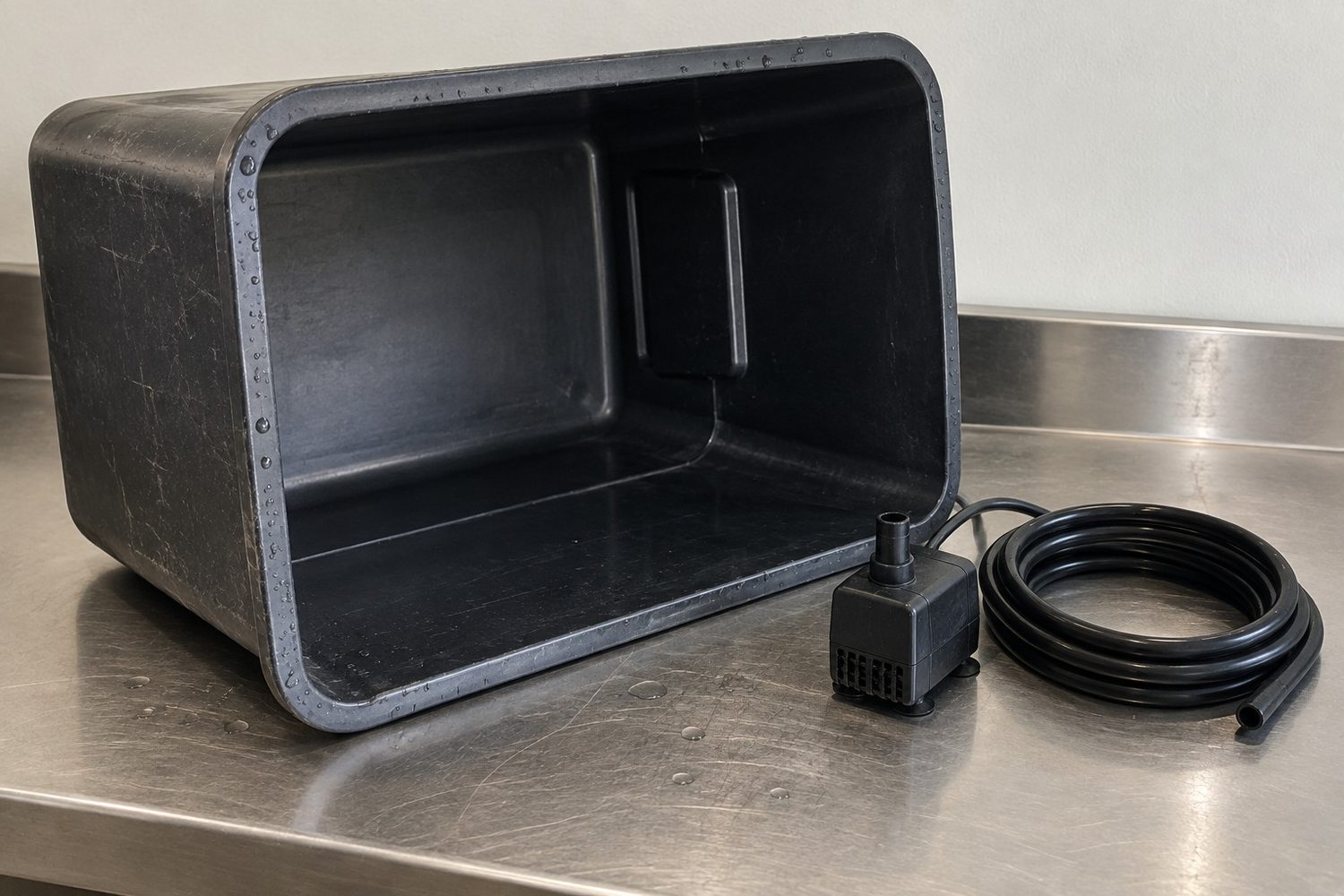
An ebb-and-flow table floods on a timer and then drains. Beyond the tray, a working table needs the flood table, a submersible pump, a timer, a bulkhead fitting, a reservoir, a fill hose and return plumbing, plus the growing trays and mat that sit on it.
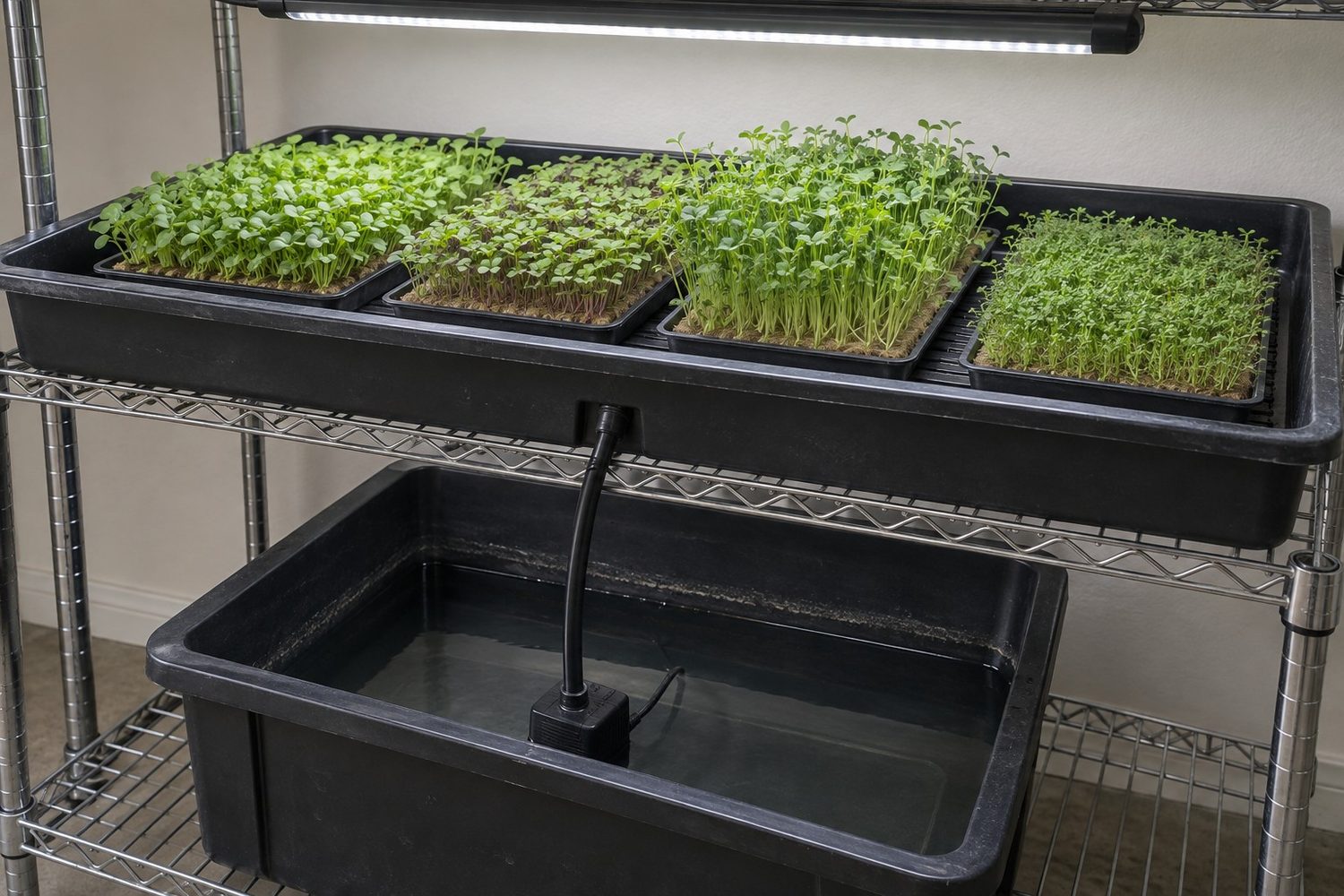
Two priced parts give you a baseline as of September 12, 2026. A Botanicare 2-by-4 rack tray was $68.65 at GrowersHouse, and a 400-gph Active Aqua submersible pump was $32.17 at HydroBuilder, for $100.82 together. The tray listing calls it a runoff tray and says the bulkhead fitting is sold separately, so it is not a complete flood-and-drain kit. Price the fitting, reservoir, timer, hose, return plumbing and shipping, add them to the $100.82, and compare that total against the other two systems.
How often to flood depends on your mat; Oklahoma State says timers are set several times daily according to plant, temperature, humidity and medium. One microgreen experiment grew basil in rockwool flooded once a day, let the excess drain away, harvested at day 21, and topped up the solution as the plants used it rather than fully replacing it (2026 basil study). It did not report how long each flood lasted, so time it yourself: note how many minutes the tray sits under solution and how long the mat stays wet afterward, then adjust and write down how the crop looks the next morning.
Running that 25-watt pump for 10 minutes three times a day works out to about $0.06 a month at the 2025 US residential average of 17.30 cents per kWh (EIA). That schedule is borrowed from VCE's NFT practice, so treat the figure as arithmetic; your timer and your local rate set the bill.
Because the drained solution returns to the reservoir, ebb and flow is a recirculating system and shares the water-safety concern covered below. VCE says recirculating systems need EC and pH checked and adjusted on a schedule ranging from daily to at least twice weekly, depending on the system and crop age.
NFT channels
NFT runs a thin film of solution down a sloped channel beneath the roots, usually returning it to a reservoir. For microgreens, the channel is lined with a mat that holds the seed and spreads the film. VCE reports successful NFT production on hemp and burlap mats, has used a timer program of 10 minutes three times daily, and stresses that frequency changes with substrate and crop stage. Its NFT operation holds solution at EC 1.0 mS/cm and pH 5.9 after most seedlings germinate (VCE).
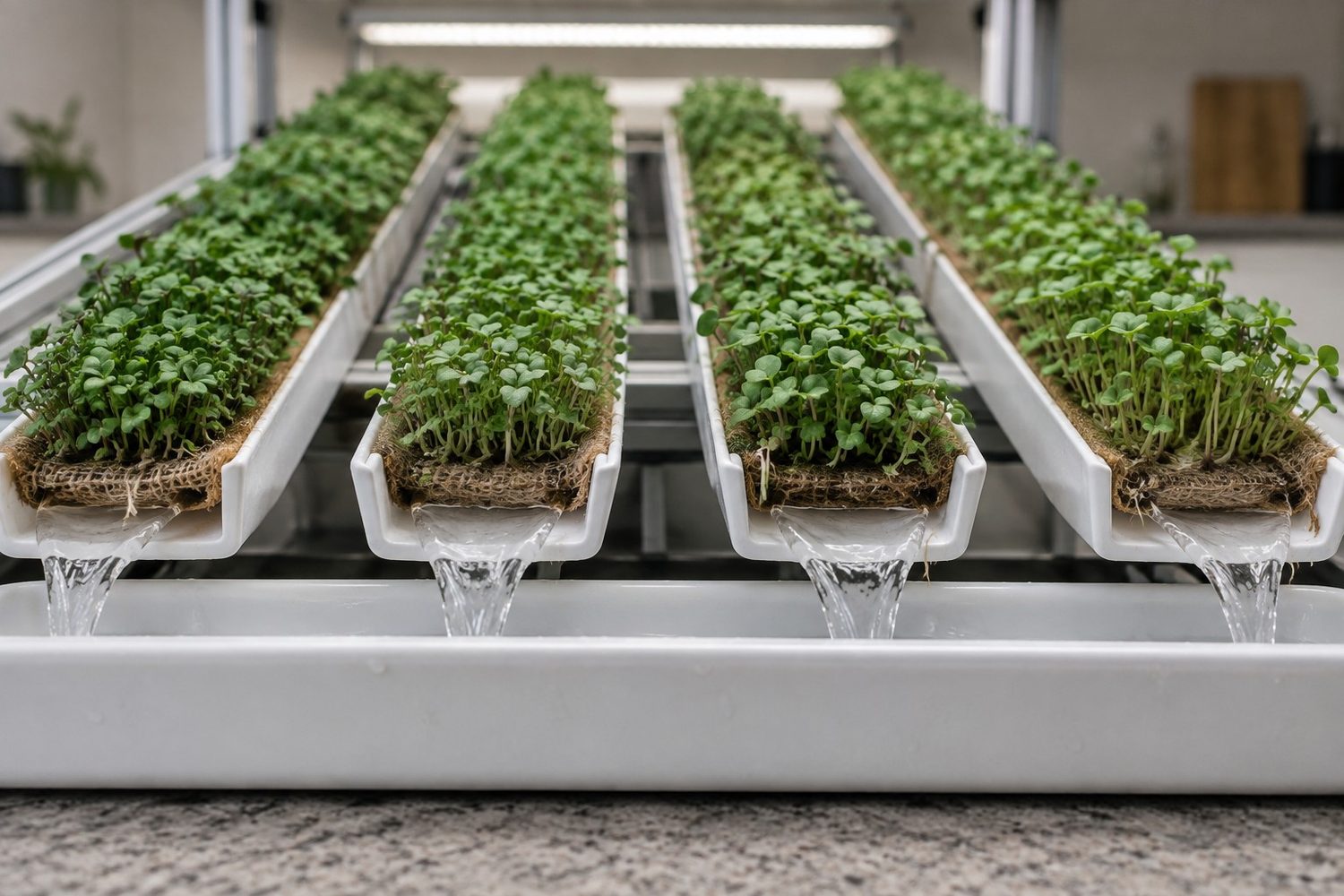
At rack scale, a Virginia Tech graduate project report dated December 2018 describes microgreens grown at George Mason University's Presidents Park Greenhouse in Fairfax, Virginia. The PVC channels were 25 cm wide, 3.7 m long and 5 cm high, lined with 1-mm burlap, and irrigated for 2 to 5 minutes every 1 to 2 hours as needed. The reservoir was cleaned and refilled about weekly or every two weeks, and EC fell from 1.2 to 0.8 dS/m by day 5 and to 0.6 by day 8 (Nolan project report), so test EC during the crop, not only at mixing.
For slope, Missouri Extension gives 1 to 2 percent, or 0.12 to 0.24 inch per foot, for conventional NFT crops. Start a microgreen channel in that range and compare growth at the inlet, middle and outlet ends; if the far end lags, adjust slope or flow one change at a time.
Cost is where NFT pulls away from the other two. CropKing's $199 desktop NFT unit is an eight-plant lettuce system: two channels with eight 1-inch square planting sites, a 70-gph pump, a feed line, a 2.5-gallon reservoir, fertilizer and 100 one-inch rockwool cubes, sold with lettuce seeds (CropKing, checked September 12, 2026). A channel setup built for microgreens is a different parts list. On The Grow's DIY NFT build guide put its 12-channel microgreen system at roughly $1,537.50 in components in 2019, not counting tools, and notes that prices have shifted since (On The Grow build guide). A 25-watt, 400-gph pump left on around the clock adds about $3.11 a month at the 17.30-cent average.
What goes wrong with NFT is usually the pump or a line. Missouri Extension says NFT plants may immediately wilt if a pump fails or lines clog. Before you trust a timer with a full rack, stop the flow on a spare channel and note how long the mat takes to dry at the outlet end, so you know how much margin a power cut gives you.
What kind of harvest to expect
Choose your system for fit, not for a yield promise. Because no microgreen study has separated yield differences between these setups from the growing medium itself, there is no basis for ranking Kratky, ebb and flow and NFT by harvest. In a 2023 study of floating hydroponics on perlite, fresh yield was 0.85 kg/m² for alfalfa, 2.69 for red cabbage, 0.72 for yellow beet and 0.22 for fennel (2023 study). Those are species results from one floating system, not figures for any of the three setups here.
So, build your own numbers. For each tray, record the crop, seed amount, mat, system, nutrient strength, harvest day and fresh weight, and compare trays over several crops. Our post on what a tray actually yields covers tray harvests in more detail.
Keeping recirculating water clean
The shared reservoir that makes ebb and flow and NFT efficient also connects every tray on it. In a 2016 study, researchers grew kale and mustard on mats in a recirculating NFT system and added a murine norovirus surrogate to the water on day 8. The virus reached edible tissue within hours: at two hours they measured 3.47 log PFU per sample in the edible tissue of both crops (Wang and Kniel 2016).
That was deliberate contamination with a surrogate, not a farm survey, but it shows the route: what gets into recirculating water can reach the part a person eats. The same study found contamination carried over to the next crop when the system was reused without washing and disinfecting.
That is why water changes and cleaning belong in the routine for either system. Oklahoma State recommends removing debris and then sanitizing tanks, emitters, media, rafts and trays between crops, with a 1:100 bleach solution (about 1.3 oz per gallon) as one option (OSU algae control). Follow the product label and food-contact requirements for whatever sanitizer you use. OSU also warns that Fusarium and Verticillium can spread quickly through hydroponic systems (OSU hydroponics). For the water going into your reservoir, see our page on water quality.
If you sell what you grow, FDA defines agricultural water in part as water intended or likely to contact covered produce or food-contact surfaces (FDA FAQ), and it does not categorically exclude root-contact hydroponic water. In FDA's October 2015 final environmental impact statement, the root-only argument came from a public commenter, and FDA's reply was conditional: water not intended or likely to contact the harvestable portion would not be agricultural water under the rule (FDA final EIS). Work out where water in your system touches the crop, and take coverage questions to FDA, whose 2024 rule requires annual pre-harvest water assessments for covered farms (FDA rule).
Which system fits your space, budget and volume
The choice usually comes down to how many trays you want and whether you will keep a pump and shared reservoir in good order.
Hover or tap a row to highlight it.
| Still-water tray | Ebb-and-flow table | NFT channels | |
|---|---|---|---|
| Scale | One to a few trays on a shelf | A table of trays | Channels on a rack |
| Power | None | Pump and timer | Pump and timer |
| Parts baseline | $39.97 kit (Sept. 12, 2026) | $100.82 for tray and pump only (Sept. 12, 2026) | About $1,537.50 for 12 channels (2019) |
| Water | Still, not recirculated | Recirculated | Recirculated |
| Main habits | Blackout, refill without drowning the air gap, keep light out | Set flood timing to the mat, test EC and pH, sanitize between crops | Check flow end to end, test EC during the crop, sanitize between crops |
| Main risk | Algae and damp growth in standing water | Contamination carried through shared water | Wilting after a pump failure or clog; shared water |
A home grower who wants no pump can start with a still-water tray and measure how evenly it feeds a dense mat on their own shelf. A small commercial grower with reliable power, a sanitation plan and the habit of checking EC and pH can consider NFT or ebb and flow, since VCE documents microgreen use of both. For pumps, timers and fittings, see our watering systems reviews.
If you already sell microgreens from a tray routine that works, keep it running while you test. Set up one rack of the new system alongside it and switch only once it matches your current trays on germination, evenness, cleanliness and harvest for the crops you sell.
Frequently asked questions
These come up once a system is chosen and running.
Do pea shoots and sunflower grow in hydroponic systems?
VCE lists pea shoots and sunflower among common microgreens and does not say they fail in hydroponics. Seed size alone is not a reason to rule either out of Kratky, NFT or ebb and flow. Run a side tray and record germination, how well the mat anchors, how evenly water reaches it, disease and saleable weight.
What EC and pH should I start with?
VCE recommends a starting EC of at least 1.0 mS/cm and pH 5.5 to 6.0 for hydroponic microgreens. Oklahoma State's range of pH 5.0 to 6.0 and EC 1.5 to 3 dS/m covers hydroponic crops broadly, so start from VCE's microgreen figures. Our fertilizer and nutrients page covers mixing solution.
Can I run plain water instead of nutrient solution?
You can, but expect a smaller harvest for some crops. In one 2021 trial in peat-based media, replacing quarter-strength Hoagland solution with distilled water cut yield by 7.9% in cabbage, 12.0% in Brussels sprouts and 47.4% in rocket (El-Nakhel et al. 2021). Those figures do not carry across to other species or systems, so compare a fed tray and an unfed tray of your own crop.
Where to go next
Once you have picked a system, work out what the seed sits on with growing medium, then set up the reservoir with fertilizer and nutrients and water quality. If something fuzzy appears on a tray, check mold or root hair before you act, and keep a record of every tray so your next choice rests on your own harvest numbers.
Sources
Prices, stock and specifications are as the linked pages showed them on 2026-09-12.
- listing
- Oklahoma State Extension
- Missouri Extension
- NMSU Guide H-180
- Virginia Cooperative Extension
- Kratky 2010, CTAHR VC-1
- OSU algae control
- GrowersHouse
- HydroBuilder
- 2026 basil study
- EIA
- Nolan project report
- CropKing
- On The Grow build guide
- 2023 study
- Wang and Kniel 2016
- FDA FAQ
- FDA final EIS
- FDA rule
- El-Nakhel et al. 2021
Keep reading
The journal
Grow or Buy Microgreens? The Answer Is an Hourly Rate, and It Is $23.64
Seed alone makes home growing look eleven times cheaper. Add medium, power, a failure rate and your own time at $20 an hour and the saving against the cheapest retail is 8 percent.
Read Grow or Buy Microgreens? The Answer Is an Hourly Rate, and It Is $23.64The journal
Microgreen Grow Kits Against DIY: The Cheapest Kit Is the Most Expensive
Priced per unit of growing area, the ranking inverts: the $60 kit is the cheapest and the $20 kit is nearly the dearest. Against assembling it yourself, the sample runs 6 to 40 times.
Read Microgreen Grow Kits Against DIY: The Cheapest Kit Is the Most ExpensiveThe journal
Microgreens vs Baby Greens: Same Seed, Same Tray, and the Only Difference Is When You Cut
These are harvest stages of one plant, not three foods. USDA and Maryland disagree on where microgreens end, 17 of 61 crops with a published harvest window break the day counts, and the yield result everyone cites is a density experiment.
Read Microgreens vs Baby Greens: Same Seed, Same Tray, and the Only Difference Is When You CutThe journal
What Is a Microgreen? A Young Seedling, Cut Above the Soil at First True Leaf
A young edible seedling, grown densely and cut above its medium at about the first true leaf, usually 1.5 to 3 inches and 7 to 21 days. That cut is what separates it from a sprout.
Read What Is a Microgreen? A Young Seedling, Cut Above the Soil at First True Leaf