Grow or Buy Microgreens? The Answer Is an Hourly Rate, and It Is $23.60
Cal HewittPublished Checked
- comparison
- economics
- growing
- buying
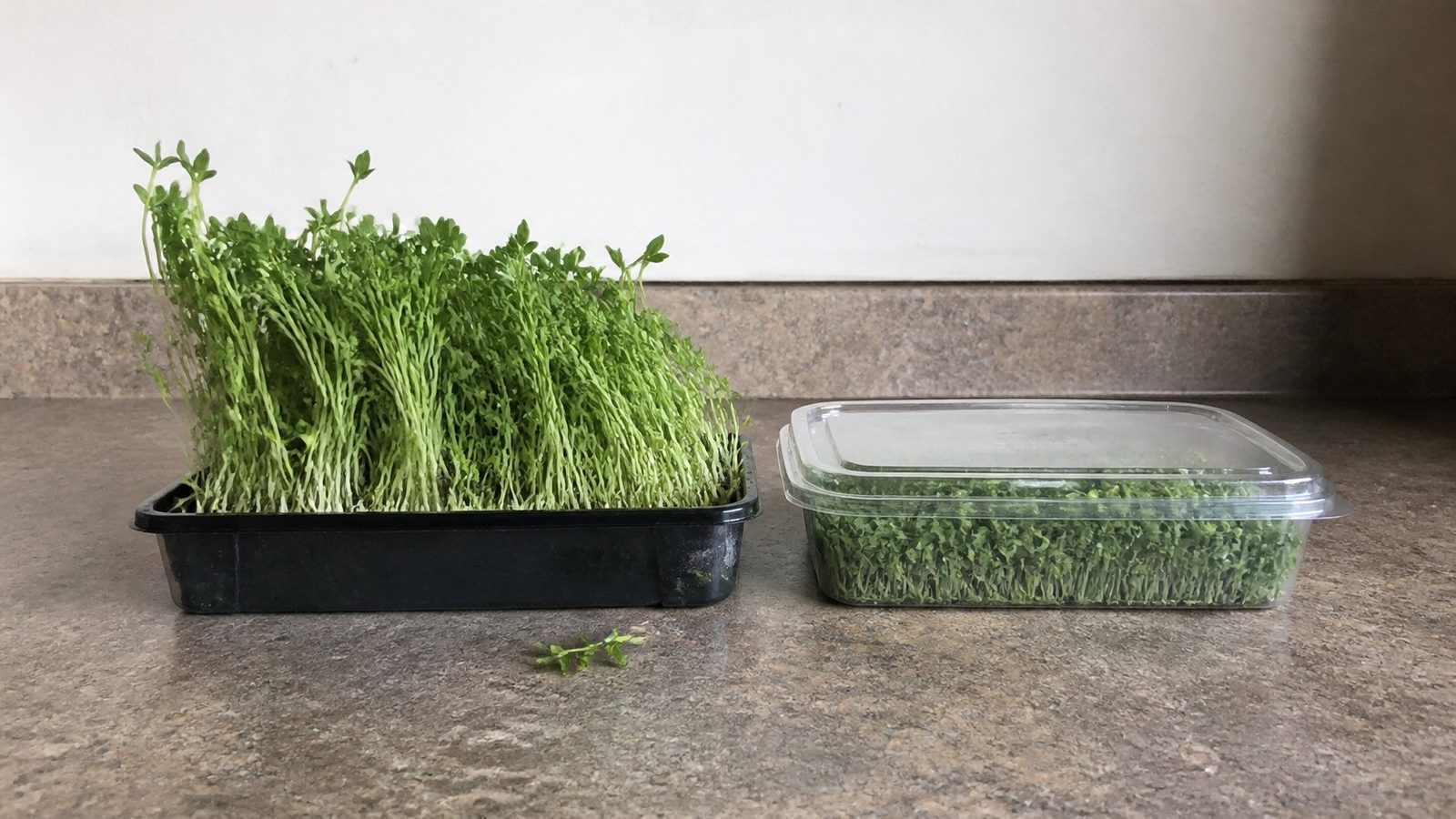
Compare seed to a shop price and home growing looks eleven times cheaper. Add the lines that comparison leaves out and the saving against the cheapest retail drops to 8 percent.
Here is the same tray, costed one line at a time.
What to actually do
- Work out your own hourly rate first. If your time is worth much more than about $24 an hour and you are doing this purely to save money, buy the cheap end of retail.
- If you are growing for freshness, flavor or the pleasure of it, the economics barely matter and this page has answered a question you were not asking.
- Weigh your first few trays. Published yields for the same crop differ threefold, and yours is the only one that matters.
- Count the medium, the power and the failures. They turn an 11-fold saving into a 2-fold one before your time is priced at all.
- Amortize the equipment. Nobody in the sample did, and lights and shelving are the largest single outlay.
- Compare per ounce, on the same crop. Not tray against clamshell, and never against a pack whose weight is not printed.
- Do not expect a nutrition advantage either way. Nothing published supports one.
The saving, as you add the lines nobody adds
Using the median figures: a tray yielding 7.055 ounces with $1.08 of seed.
Hover or tap a row to highlight it.
| What is included | Per tray | Per ounce | Against the cheapest retail |
|---|---|---|---|
| Seed only | $1.08 | $0.15 | 11.0x cheaper |
| Seed and medium | $4.08 | $0.58 | 2.9x cheaper |
| Seed, medium and electricity | $4.82 | $0.68 | 2.5x cheaper |
| Plus a 1 in 5 failure rate | $6.02 | $0.85 | 2.0x cheaper |
| Plus your own time at $20 an hour | $11.02 | $1.56 | 1.1x cheaper |
The observed retail band runs $1.69 to $3.50 an ounce. So the same decision is a 91% saving or an 8% saving depending entirely on which lines you count.
The break-even is the useful number. At the assumptions above, home growing exactly equals the cheapest observed retail when your time is worth $23.60 an hour. Below that, growing saves money. Above it, buying the cheap end of retail wins on pure economics.
And that figure is generous to the home side, because the ladder above stops before equipment. Lights, trays and shelving are real money and are not in it.
Every assumption in that table, stated
Every one of these is a choice, so here they all are in the open:
- Yield 7.055 oz and seed $1.08 are the medians, from 39 crops that publish a yield and 50 that publish a seed cost.
- Medium $3.00 is a 10 by 20 coir mat.
- Electricity $0.74 assumes a 100 watt fixture, 16 hours a day, 10 days, serving four trays, at the EIA average of 18.44 cents per kilowatt-hour. Change the fixture or the trays per fixture and this line moves a lot.
- A 1 in 5 failure rate is an assumption, not a measurement, because nobody publishes one. It raises costs by 25%.
- Labor at 15 minutes a tray and $20 an hour is a commercial extension budget's assumption, not a household's.
- No equipment amortization at all, which is a deliberate omission and is discussed below.
Change any of these and the answer moves, which is why every one of them is listed.
What the usual comparison leaves out
Of three cost comparisons checked, none calculates equipment depreciation and none includes a failure rate.
One says trays and domes are reusable indefinitely. One lists initial items without amortizing them. One's per-tray total contains only seed and soil. All three sell something: a starter kit, seeds, or both.
The characteristic error is an unmatched comparison: an asserted home yield and cost set against an unlocated "store price", or against a retail pack of unknown weight, with crop, cultivar, fresh-weight yield, harvest stage, light, medium, electricity, failure, amortization and labor all undisclosed.
A supermarket listing that gives only a pint makes the point. A container volume cannot become a price per ounce without a labeled net weight, which is exactly the trap the buying guide warns about.
For contrast, a genuine costing model exists and it is commercial rather than domestic: a university extension budget that carries seed, medium, fertilizer, electricity, labor, repairs, depreciation, interest and overhead. It shows what a full ownership cost looks like, and it is worked through separately.
The yields being compared do not agree either
A greenhouse trial reports 3.74 to 7.09 ounces for small-seed crops under its stated conditions. A seed seller asserts 9 to 12 ounces from a broccoli tray with no comparable protocol on the page.
That is a nearly threefold difference in the number the whole comparison rests on, and it decides the outcome before any cost is counted. If you assume 12 ounces where you will actually get 5, every per-ounce figure you calculate is less than half of what you will really pay.
Use your own weighed yield after a few cycles. It is the single input most worth measuring, and it is the one you can measure most easily.
What growing actually costs in attention
The evidence is clear that this is not plant-and-forget. Extension guidance calls microgreens labor-intensive, notes the dense seeding, the need to avoid stretching and disease, and recommends keeping leaves and stems dry through sub-irrigation. Another extension service reports mold with overwatering, says trays need daily attention, and advises washing trays between batches.
That daily attention is what the $20 an hour line is pricing. Whether it is a cost or a hobby is a question about you rather than about microgreens, and it is why the answer comes out as an hourly rate rather than a verdict.
Freshness and shelf life, where home has a real edge
This is where growing wins on something other than money.
Cut and packaged mustard microgreens held good sensory quality for 14 days at 5°C, four days at 10°C, and two days at 15°C. Another study across six genotypes put fresh-cut shelf life at no more than 10 days at 5°C.
A home tray is cut when you want it. That is a genuine advantage and it is about timing rather than nutrition: the same work found that at 5°C antioxidant activity did not change significantly over the storage period, while warmer storage shortened sensory life sharply. Time and temperature change quality; there is no published universal nutrient loss rate.
And nobody has shown home-grown is more nutritious. Composition varies by genotype and growing conditions, which is not the same as either route winning on a fresh-weight serving.
Safety, where neither route wins
Both are raw produce and neither is categorically safer on the evidence.
Commercial microgreens are covered produce under the federal Produce Safety Rule unless an exemption applies, so a grower operates under a food-safety framework a household does not have. A household controls harvest timing and its own kitchen hygiene, while retail adds handling and cold-chain time. Both of those are plausible process differences and neither is a measured net-risk result.
One documented retail incident exists: a 2022 voluntary recall of 1.75 oz organic micro greens across seven states after a supplied soil tested positive for Salmonella, with no illnesses associated. No documented outbreak from a household tray was located, which is not evidence of zero risk, because a home case would rarely be traceable.
Do not import sprout statistics into this. Federal guidance explicitly distinguishes later-stage, substrate-grown, cut microgreens from sprouts, and the warning that seed-borne bacteria multiply even under sanitary home conditions is written about sprouts.
On washing, the label decides. Products marked pre-washed or ready-to-eat have been washed before packaging; an unwashed farmers-market listing says plainly to wash before use. Washing under running water reduces bacteria and cannot eliminate them, and soap, detergent and bleach are not for produce.
What is still genuinely unknown
- Any home failure rate. The 1 in 5 above is an assumption because no source publishes one.
- A matched home-against-retail comparison holding crop, cultivar, yield conditions and household experience constant. Nobody has done it.
- Any measured net safety difference between a home tray and a retail pack.
- Whether either route is more nutritious on a fresh-weight serving basis.
- A universal nutrient loss rate over shelf life. The measured work covers specific crops, packaging and temperatures.
- Real household labor time, as opposed to a commercial budget's 15 minutes a tray.
Terms on this page
Tap a term to see what it means.
Amortization. Spreading the cost of equipment across the trays it will produce. The line every comparison page examined here omits.
Sources
Opened 2026-08-12. The cost ladder is arithmetic performed for this page. Its yield and seed figures are this directory's own medians; its medium, electricity, failure and labor lines are assumptions, each stated in full above so they can be replaced.
- Penn State Extension on growing microgreens - that microgreens are labor-intensive, the dense seeding, avoiding stretching and disease, the sub-irrigation recommendation, damping-off under warm humid conditions, the roughly 12 by 20 inch standard tray, and the greenhouse yields of 3.74 to 7.09 oz for small-seed crop examples.
- Colorado State Extension, Pueblo County, on growing sprouts and microgreens at home - mold with overwatering, that trays need daily attention, and washing trays between batches. Plus the Colorado State home guide (PDF) for the 2 to 3.5 inch container depth, light seed-starting mix and the microgreen against sprout distinction.
- University of Missouri Extension microgreens budget (PDF) - the full commercial costing carrying seed, medium, fertilizer, electricity, labor, repairs, depreciation, interest and overhead, and the source of the 15 minutes at $20 an hour labor assumption used above.
- Mustard microgreen storage study - good sensory quality for 14 days at 5°C against four days at 10°C and two at 15°C, and that antioxidant activity did not change significantly at 5°C across the storage period. Plus a six-genotype packaged microgreen study putting fresh-cut shelf life at no more than 10 days at 5°C.
- A 17-species controlled-environment mineral and yield study - composition differing by genotype and conditions, which is why neither route can be called more nutritious on a fresh-weight serving.
- FDA produce safety guidance (PDF) - that raw produce can be contaminated in soil or water, after harvest or during preparation, that home handling reduces but cannot eliminate bacteria, that pre-washed and ready-to-eat products need no re-washing, and that soap, detergent and bleach are not for produce.
- FDA microgreen and sprout guidance (PDF) - the explicit distinction between later-stage substrate-grown cut microgreens and sprouts, and the coverage of commercial microgreens as produce under the Produce Safety Rule.
- FDA recall notice, December 2022 - the voluntary recall of 1.75 oz organic micro greens across seven states after a supplied soil tested positive for Salmonella, with no associated illnesses.
- Retail observations used for the buy side: an online farm listing spanning $2.50 an ounce for common crops to $8.99 for nasturtium, a farmers-market listing applying a flat clamshell price across different weights and telling buyers to wash before use, and a supermarket listing that gives only a pint, which is why a container price cannot become a price per ounce.
- The three comparison pages audited, all of which sell something and none of which amortizes equipment or includes a failure rate: a starter-kit seller's cost comparison, a seed seller asserting a 9 to 12 oz broccoli tray at $3.40 of seed and soil, and a seed company's economics page.
Keep reading
The journal
Bulk Microgreen Seeds: Cost Per Tray by Bag Size
Buying bulk microgreen seeds cuts cost per tray, but only if the bag gets used fast enough. Compare 5 and 25 pound prices, shipping, and weekly tray needs.
Read Bulk Microgreen Seeds: Cost Per Tray by Bag SizeThe journal
Microgreen Grow Kits Against DIY: The Cheapest Kit Is the Most Expensive
Priced per unit of growing area, the ranking inverts: the $60 kit is the cheapest and the $20 kit is nearly the dearest. Against assembling it yourself, the sample runs 6 to 40 times.
Read Microgreen Grow Kits Against DIY: The Cheapest Kit Is the Most ExpensiveThe journal
Herb Microgreens: Slower and Harder, and They Use Less Seed Than Everything Else
Herb-family crops take a median 19 days against 11.5 for everything else, and 8 of the 9 hardest crops are herbs. They also sow lighter, so the premium is bench time, not seed.
Read Herb Microgreens: Slower and Harder, and They Use Less Seed Than Everything ElseThe journal
Microgreens vs Mushrooms: On Labor Per Pound the Two Overlap, and the Farm-to-Farm Spread Is 10.9-Fold
Put both crops on labor hours per pound and they land on top of each other. The variation between mushroom farms is 10.9-fold, which is larger than any gap between the crops, so the operator decides this and not the crop.
Read Microgreens vs Mushrooms: On Labor Per Pound the Two Overlap, and the Farm-to-Farm Spread Is 10.9-Fold