Microgreens Equipment List: What to Buy at Every Scale
Cal HewittPublished Checked
- equipment
- buying
- beginner
- comparison
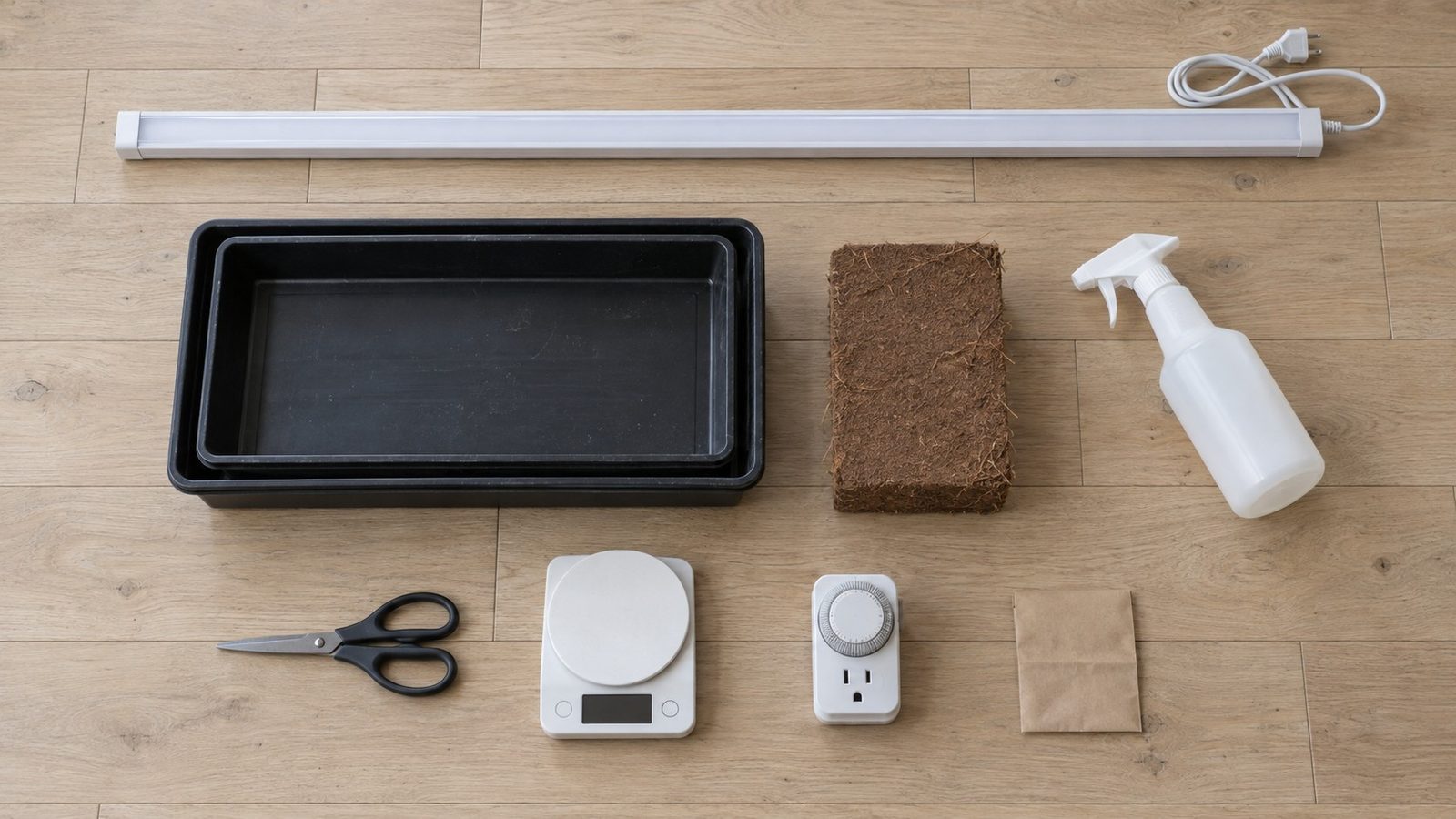
To grow microgreens you need seed, a shallow container that drains with something under it to catch the water, a growing medium or mat, water, light and a clean cutting tool. Everything else can wait until your setup gives you a reason to buy it.
On a windowsill that list costs about $1.12 in broccoli seed plus medium, because your kitchen covers the rest. One lit shelf running two trays comes to $90.08 before water and tax. A first rack of 16 trays comes to $352.95 before the rack itself, water and tax. Every price below is as listed on 13 September 2026.
The short list every setup starts from
Five extension services word the essentials a little differently, and they land in nearly the same place. University of Maryland Extension (page updated 8 May 2026) says seeds, reusable food-grade containers or flats, growing media, water, heat and light are what you need. University of Illinois Extension (2021) lists a shallow container with drainage, seeds, a growing medium, light and plant food, though its own text treats fertilizer as a possible small addition rather than a required purchase.
SDSU Extension (2022) says a sunny windowsill or supplemental lights, ordinary pots or shallow 1020 flats, and a soilless mix will do the job. Colorado State University Extension adds a spray bottle, a lid or plastic wrap over the seed during germination, and scissors. Penn State Extension lists a small kitchen scale or measuring cups, a spray bottle and a pitcher, and a sharp knife or scissors.
Seed, a draining container, medium, water, light and a clean cutter are the necessary column. A cover, a scale and a heat mat are optional, a gentle fan is the one extra two of the guides treat as routine, and much of both lists is already in your kitchen.
What your kitchen already covers
Check the cupboards before you order anything. Illinois accepts a washed food container or a pie tin as the growing tray, as long as you add drainage holes. A second container underneath catches what drains through and lets you bottom water: you pour water into the lower container and the medium draws it up. A saved lid, or another tray set on top, works as the germination cover. Measuring spoons stand in for a scale, a pitcher does the job of any watering system, and clean kitchen scissors handle the harvest.
A shelf you already own can carry a lit setup too, provided it takes the whole tray without an unsafe overhang and keeps water away from anything plugged in.
Scale one: a windowsill trial for about the cost of seed
If you want to find out whether you like growing microgreens before buying hardware, start at a window. You need a reused container with holes, a second container under it, a household cover, a pitcher and scissors you already own, seed and medium. There is no light hardware to buy.
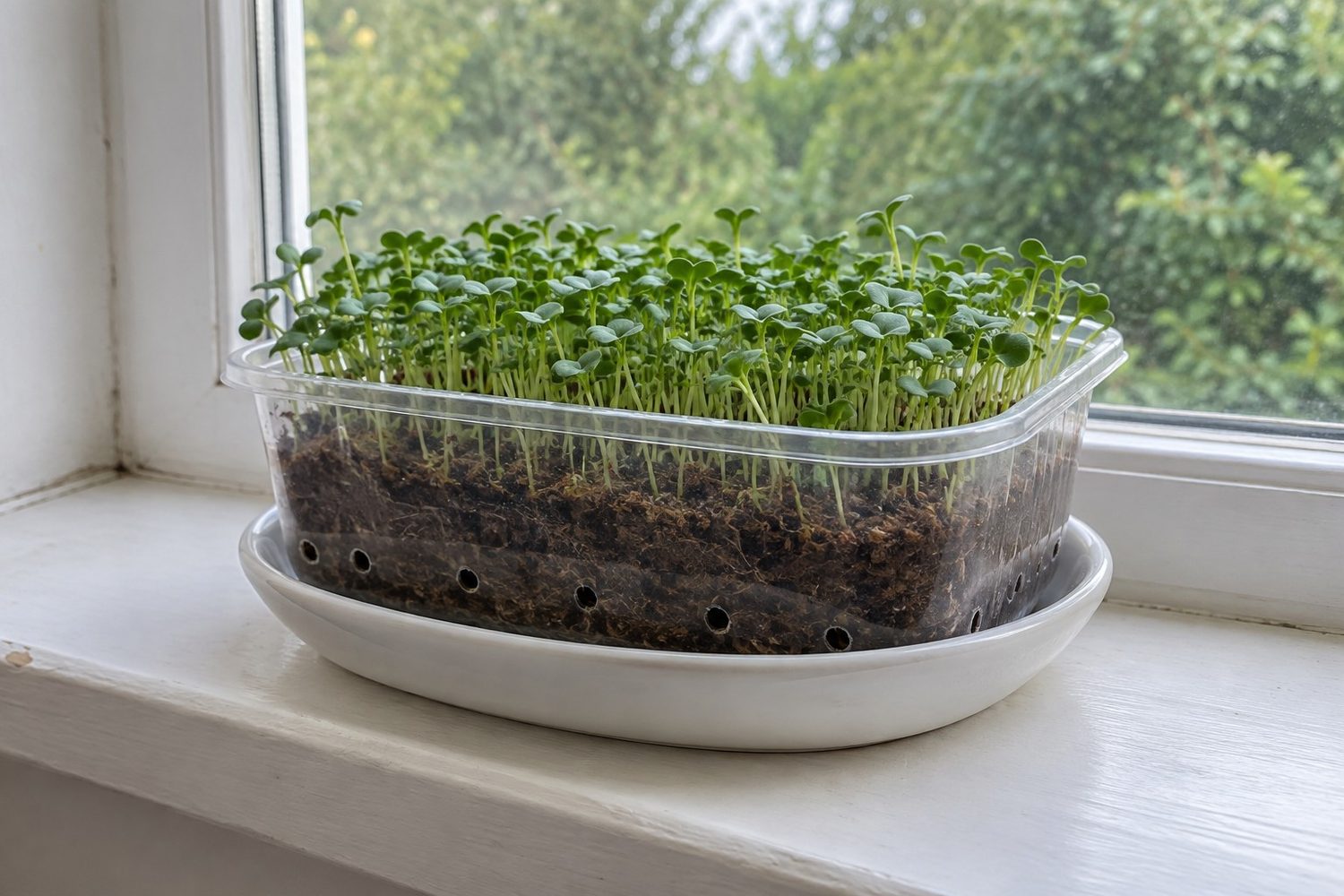
For seed, Utah State University Extension puts broccoli at 28 grams and $1.12 for a full 1020 tray, at its bulk price for 5 pounds or more as of 8 January 2026. A small first packet costs more per gram, and a small container takes less seed than a full tray, so write down what you sow and what it cost you. There's more on buying seed by the pound in bulk microgreen seeds. For medium, a Bootstrap Farmer coco coir brick is $11.99, and the seller says one brick fills three shallow 1020 trays, so a single brick goes a long way in a kitchen container. The growing medium reviews compare coir, mixes and mats.
The window is the part to judge. Illinois recommends 6 to 8 hours of light a day for the best home growth and prefers a sunny, south-facing window. Penn State says natural light behind a window is generally enough, while Maryland says a sunny window may do in some cases but microgreens generally grow best under grow lights. Weigh a windowsill tray against a lit one to see the difference for yourself. The OSU Extension tip sheet says dim light makes microgreens lean toward the light and grow leggy, though they stay edible. If yours lean hard, a light is your next purchase.
Scale two: one lit shelf with two trays for $90.08
A single lit shelf keeps two trays growing through the seasons without depending on your window. Each tray position is a nested pair: a mesh tray with drainage holds the medium inside a solid tray with no holes that holds the water. Bootstrap Farmer says its mesh trays sit inside no-hole trays of the same depth, so both trays below are the shallow style.
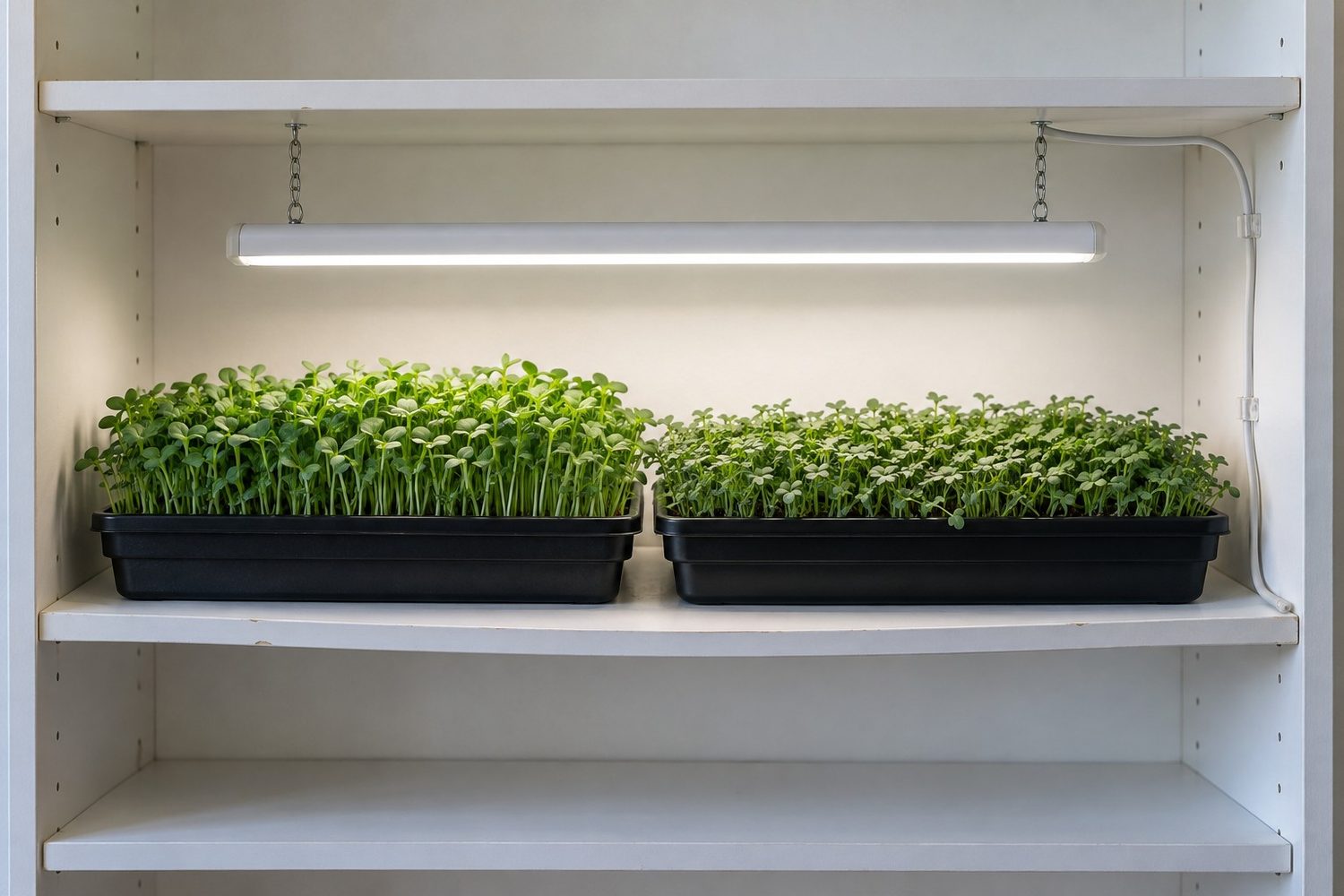
The basket below prices two tray positions under one light, on a shelf you already own.
Hover or tap a row to highlight it.
| Item | What it does | Product | Price |
|---|---|---|---|
| 2 inner trays | Hold medium and seed, drain excess water | Bootstrap Farmer 1 in shallow mesh 1020 tray | $11.90 ($5.95 each) |
| 2 outer trays | Hold water for bottom watering | Bootstrap Farmer Extra Strength shallow 1020 tray, no holes | $11.98 ($5.99 each) |
| Light | Lights both trays | Feit Electric 4 ft 55 W 5,000 lumen LED shop light, Home Depot | $39.97 |
| Timer | Switches the light on a schedule | Outlet timer, Microgreen Manager's approximate price | about $12.00 |
| Medium | Fills the inner trays | Bootstrap Farmer coco coir brick | $11.99 |
| Seed | Sows two trays | Broccoli at Utah State's $1.12 a tray | $2.24 |
| Total | $90.08 |
Add water and tax to that figure. The tray reviews, grow light reviews and timer reviews cover alternatives to each item. The Feit fixture is sold as a motion-sensor light with an on/off override, so check how that override works before you hand the schedule to a timer.
How long to run the light is where the extension guides differ. Maryland says total light should be about 16 hours a day, Utah State runs grow lights on a timer for 18 hours, the OSU tip sheet calls 15 hours ideal, and Illinois gives 6 to 8 hours for optimum growth at home. Pick one schedule, keep it steady, and note how the greens look at harvest.
Running that one 55 W fixture 16 hours a day for 30 days costs $4.22 a month at an assumed electricity rate of $0.16 a kWh, or $2.11 a month at 8 hours. Swap in the rate from your own bill before you rely on either number.
How many trays a shelf holds, measured
The trays sold as 1020s are named for a nominal size, so measure with the outside dimensions instead. The Bootstrap Farmer Extra Strength 1020 measures 21.1 by 11.0 inches outside. On a shelf 18 inches deep, a tray set front to back leaves about 3 inches hanging off the edge.
Shelf counts mislead in the same way. The Huluwat four-shelf unit at Home Depot, $89.00, measures 23.6 by 13.7 inches. A 21.1 by 11.0 inch tray fits one per shelf, so the whole unit holds four trays, not four per shelf. For comparison, one commenter on Reddit in August 2022, describing their own setup, said four trays fit on a 4 ft shelf with 2 to 4 tube lights. Take a tape measure to any shelf before you buy it, and check its load rating too. The shelving and rack reviews list dimensions for each unit.
Scale three: a first rack of 16 trays
A rack makes sense once you're sowing trays on a schedule and want a steady supply, not while you're still deciding whether you like the crop. The plan below runs four growing shelves at four trays each, with two four-foot lights per shelf, the count Microgreen Manager uses.
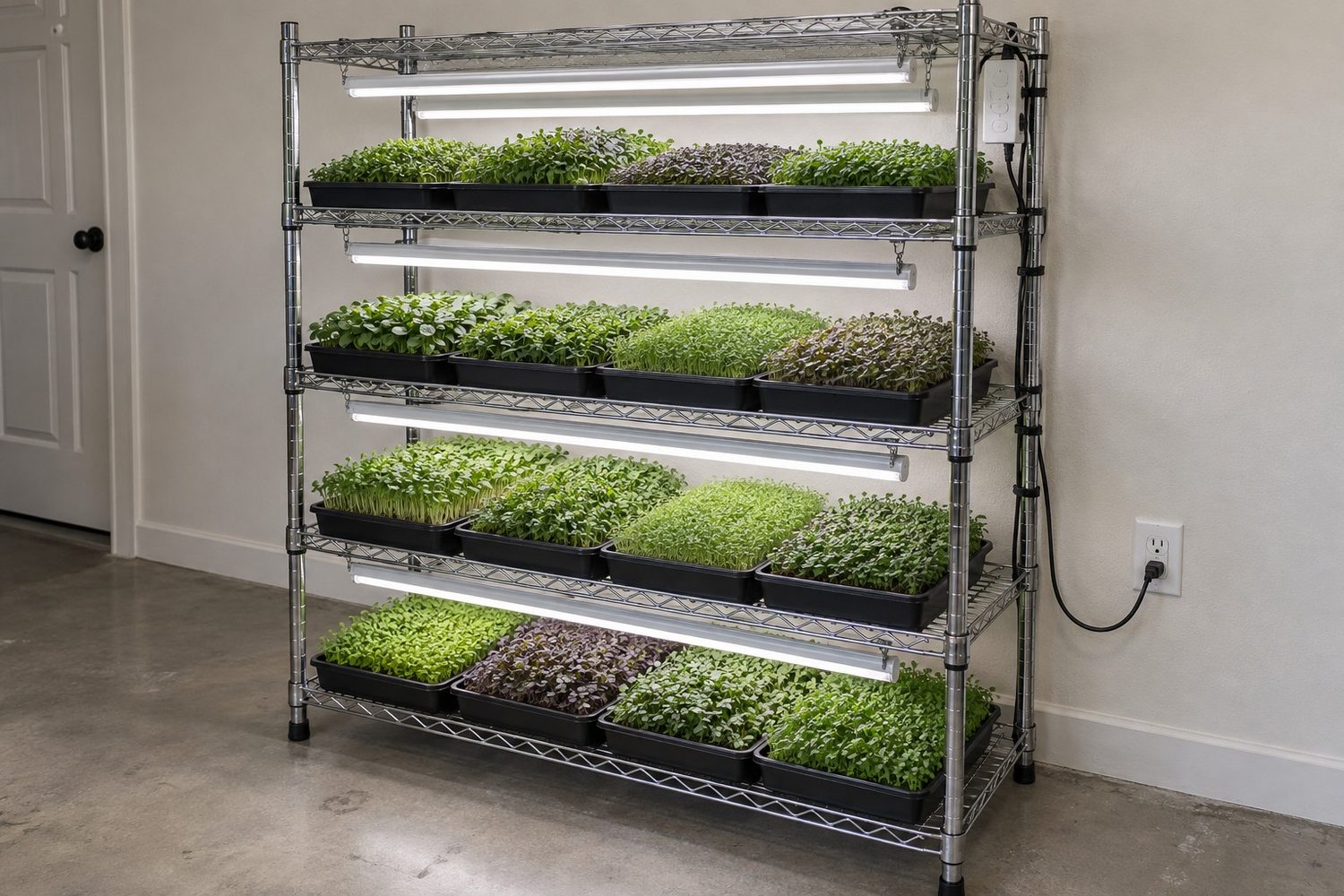
This basket leaves out the rack itself, which you'll need to price locally to fit the tray dimensions above.
Hover or tap a row to highlight it.
| Item | Quantity and product | Price |
|---|---|---|
| Inner trays | 16 Bootstrap Farmer shallow mesh 1020 trays at $5.95 | $95.20 |
| Outer trays | 16 Bootstrap Farmer Extra Strength shallow no-hole trays at $5.99 | $95.84 |
| Lights | 8 four-foot lights, two per shelf, bought as two six-packs at about $34 each (four spare) | $68.00 |
| Timer | Outlet timer, about $12 | $12.00 |
| Power strip | Six-outlet 15 A strip, about $15 | $15.00 |
| Seed | 16 broccoli trays at $1.12 | $17.92 |
| Medium | Bootstrap Farmer ten-brick coir pack (seller says 30 shallow trays) | $48.99 |
| Total | $352.95 |
The light, timer and strip figures are Microgreen Manager's approximate prices, and lights come in whole packs, which is where the four spares come from. Add the rack, water and tax. Microgreen Manager puts a wire rack at about $100 to $130, which brings the setup to $452.95 to $482.95.
Wiring is the part of a rack to get right before the first tray goes on. Plug the power strip straight into a wall receptacle. The Electrical Safety Foundation International says multi-plug outlets must be plugged directly into mounted receptacles and cannot be chained together, and that a cord or strip must be rated for the load it carries. Use a timer rated for the load of the lights it switches, and keep strips and plugs above splash level so tray runoff can't reach them. The grow light rack electrical safety post walks through the layout, and a local electrician is the person to ask about adding or changing an outlet.
The extras: what to buy now and what can wait
Most add-ons earn their place only after a tray shows you a problem. The table sorts them by when to buy.
Hover or tap a row to highlight it.
| Item | When to buy | Example price |
|---|---|---|
| Gentle fan | From the start | Any small fan you own |
| Cover or dome | Germination only; a lid or tray works | $0 if improvised |
| Heat mat | Only if the room runs cold | Buy when needed |
| Thermometer and hygrometer | After a room problem shows up | Buy when needed |
| Dehumidifier | Only after measuring a persistent damp room | Buy when needed |
| Kitchen scale | When you want repeatable seed rates | $13.99 to $24.95 |
| Kitchen shears | If yours aren't clean and sharp | $1.78 |
| Salad spinner | Optional convenience | $18.00 |
| Hemp mats | If you'd rather skip loose medium | $28.99 for 10 |
The fan is the one extra to treat as routine. Utah State says plants need constant airflow from a gentle fan, especially near a sunny window, and Maryland says a gentle breeze from a nearby fan keeps air moving around the dense planting and discourages disease. The air circulation reviews cover small clip and desk fans.
A cover belongs on the tray only through germination; Colorado State says to remove it once the seeds sprout. The humidity dome reviews help if a household lid doesn't fit your tray.
A heat mat can wait for a cold room. Illinois says microgreens grow best at about 70°F and tolerate 50°F with slower growth. A hygrometer and dehumidifier wait for a measured problem: Utah State's targets are 74°F while germinating, 72°F with the lights on and 68°F with them off, and a thermometer and hygrometer tells you whether your room is close.
Penn State accepts measuring cups in place of a scale. When you want the same seed rate every time, Walmart lists a Greater Goods kitchen scale at $13.99 and a Brod & Taylor 0.1 g scale at $24.95. The scale reviews compare them. For cutting, Mainstays 8.6 in kitchen shears are $1.78 at Walmart, and a SANDY'S KITCHEN 2.5 qt salad spinner is $18.00 if you want one. Both are in the harvest and washing reviews.
Mats are a swap, not an extra purchase on top of medium. Maryland says mats of hemp, wood fiber, coir, bamboo or jute replace potting mix, with seed germinating on top and rooting into the mat. Bootstrap Farmer hemp mats are $28.99 for 10, about $2.90 a tray, and hemp and jute mats are also sold in packs on Amazon.
Kit or pieces: how the prices line up
True Leaf Market lists its kits at these starting prices: the Windowsill Self Watering kit from $16.36, the Self Watering kit from $40.73, the Soil-Based Starter from $81.36, the Hydroponic Starter from $81.44 and the Deluxe from $166.78.
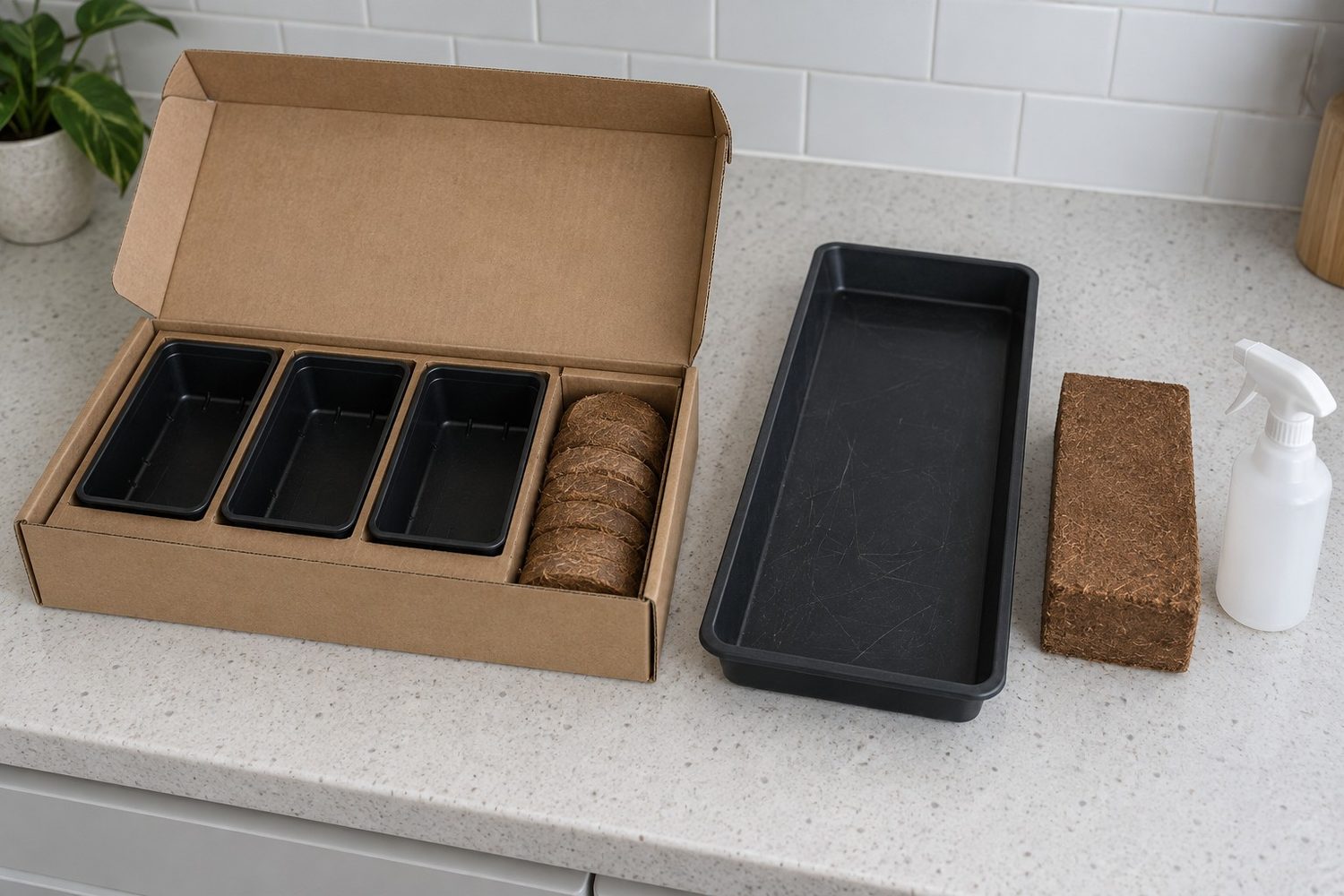
The Deluxe kit includes 5 trays with holes, 5 without, 10 grow pads, soil for 5 plantings, pH test strips, a spray bottle and seed. The Windowsill kit includes coir soil disks, a humidity dome, a spray bottle, a holding tray and seed for 3 harvests. None of the Deluxe, the Hydroponic Starter or the Windowsill kit lists a light, a timer or a rack.
That changes the comparison. The $90.08 lit shelf includes a $39.97 light and a $12 timer; the $166.78 Deluxe kit has more trays and seed but still leaves you to buy both if your window falls short. At the small end, the $16.36 Windowsill kit bundles the choices a reused container trial asks you to make, for about $1.12 in seed plus medium. A kit suits a first contained try when you'd rather not pick parts; the pieces suit you once you want repeated 1020 crops and already have a shelf. The best microgreen growing kits roundup and grow kits against DIY go further into both routes.
What each tray costs once the gear is paid for
Equipment cost per tray depends on how often you use it, so set a pace and do the arithmetic. At one finished tray every 14 days per position, a two-tray shelf turns out 52 trays a year. Its equipment and first medium, $87.84 without the seed, comes to about $1.69 a tray over that year. The 16-tray rack turns out 416 trays a year; its $335.03 in equipment and first medium, before the rack, is about $0.81 a tray, or $1.05 to $1.12 with a $100 to $130 rack.
On top of that come the running costs. Broccoli seed is $1.12 a tray at Utah State's bulk price. Light for a 10-day broccoli crop under one 55 W fixture at 16 hours and $0.16 a kWh is about $1.41, or about $0.70 a tray when two trays share the light. Coir runs $1.63 to $4.00 a tray if the seller's figure of three trays a brick holds for you. Water depends on your local rate, so check your bill. Utah State gives broccoli 8 to 12 days to harvest, so a 14-day pace leaves room for a slow crop; log your own dates and the numbers will tighten.
Questions before you buy
These come up once the shopping list is settled and the first tray is close.
Do I need to buy fertilizer?
The extension guides split on this. Maryland says no fertilizer is needed for such a short crop because the seed supplies the early nutrients, while SDSU advises feeding seedlings with a half-strength water-soluble fertilizer such as 20-20-20. Start without it, and add it only if you follow SDSU's method.
Should I wash microgreens after harvest?
SDSU says you can rinse the harvest in a colander, pat it dry with paper towels or spin it gently, and keep it in a bag or container in the refrigerator for about a week. Colorado State gives 5 to 6 days in airtight refrigeration. Penn State's food safety page, written for growers who sell, advises against washing unless it is necessary because washing can spread contamination.
How do I clean trays between crops?
SDSU says to use new or sanitized flats and clean knives or scissors. Penn State's food safety guidance says to clean with soap and water first, then use a food-safe sanitizer by its label directions on a regular schedule. Colorado State's household method disinfects containers with a 10% solution of chlorine bleach.
Is used shelving or lighting worth buying?
It can be, so compare local listings yourself to see what you save. Before buying, check that the shelf fits a 21.1 by 11.0 inch tray, has no wobble, corrosion or sharp edges, and still shows a load label. ESFI says never to use a damaged cord, so pass on any light with a cracked or frayed one.
Choosing your starting scale
If you're not sure you'll enjoy it, start at the window with a reused container and about $1.12 of seed plus medium, and let the first tray show you whether your light is enough. If you want two trays going all year and have a shelf, build the lit shelf at $90.08 before water and tax. If you already sow on a schedule and have a dry spot near a wall outlet, the 16-tray rack at $352.95 plus the rack, water and tax is the next step. Whichever you pick, use a gentle fan from the start, keep the kitchen tools you own, and hold off on the rest until a tray gives you a reason.
Sources
Prices, stock and specifications are as the linked pages showed them on 2026-09-13.
- University of Maryland Extension
- University of Illinois Extension
- SDSU Extension
- Colorado State University Extension
- Penn State Extension
- Utah State University Extension
- Bootstrap Farmer coco coir brick
- OSU Extension tip sheet
- Bootstrap Farmer 1 in shallow mesh 1020 tray
- Bootstrap Farmer Extra Strength shallow 1020 tray, no holes
- Feit Electric 4 ft 55 W 5,000 lumen LED shop light
- Microgreen Manager's approximate price
- Bootstrap Farmer Extra Strength 1020
- Huluwat four-shelf unit
- one commenter on Reddit in August 2022
- Electrical Safety Foundation International
- Greater Goods kitchen scale
- Brod & Taylor 0.1 g scale
- Mainstays 8.6 in kitchen shears
- SANDY'S KITCHEN 2.5 qt salad spinner
- Bootstrap Farmer hemp mats
- True Leaf Market
- Deluxe kit
- Windowsill kit
- Hydroponic Starter
- Penn State's food safety page
Keep reading
The journal
Best Sprouting Trays and Jars for Home Sprouting
Compare the best sprouting trays, jars, sacks and automatic sprouters by format, price and cleaning needs, plus which seeds and buyers each one suits.
Read Best Sprouting Trays and Jars for Home SproutingThe journal
Microgreen Labels: Printers, Cost, and Cold Storage
Compare direct thermal, thermal transfer, color inkjet, and printed rolls for microgreen labels, with cost per label, adhesive tips, and barcode fees.
Read Microgreen Labels: Printers, Cost, and Cold StorageThe journal
Best Tasting Microgreens: 233 Consumers Ranked Them, and Bull's Blood Beet Won
Preference has been measured on 233 consumers across three panels. Bull's Blood beet topped the only 0-to-100 ranking, pea shoots and Swiss chard led the other two, and milder crops won throughout.
Read Best Tasting Microgreens: 233 Consumers Ranked Them, and Bull's Blood Beet WonThe journal
Microgreens vs Sprouts: The Difference Is a Cut, Not a Nutrient, and It Decides Which Federal Rule Applies
A sprout is eaten whole, a microgreen is cut above its roots, and that cut decides whether FDA's sprout rule applies. The nutrition claim used to rank them was measured on mature vegetables.
Read Microgreens vs Sprouts: The Difference Is a Cut, Not a Nutrient, and It Decides Which Federal Rule Applies