Best Sprouting Trays and Jars for Home Sprouting
Cal HewittPublished Checked
- equipment
- buying
- comparison
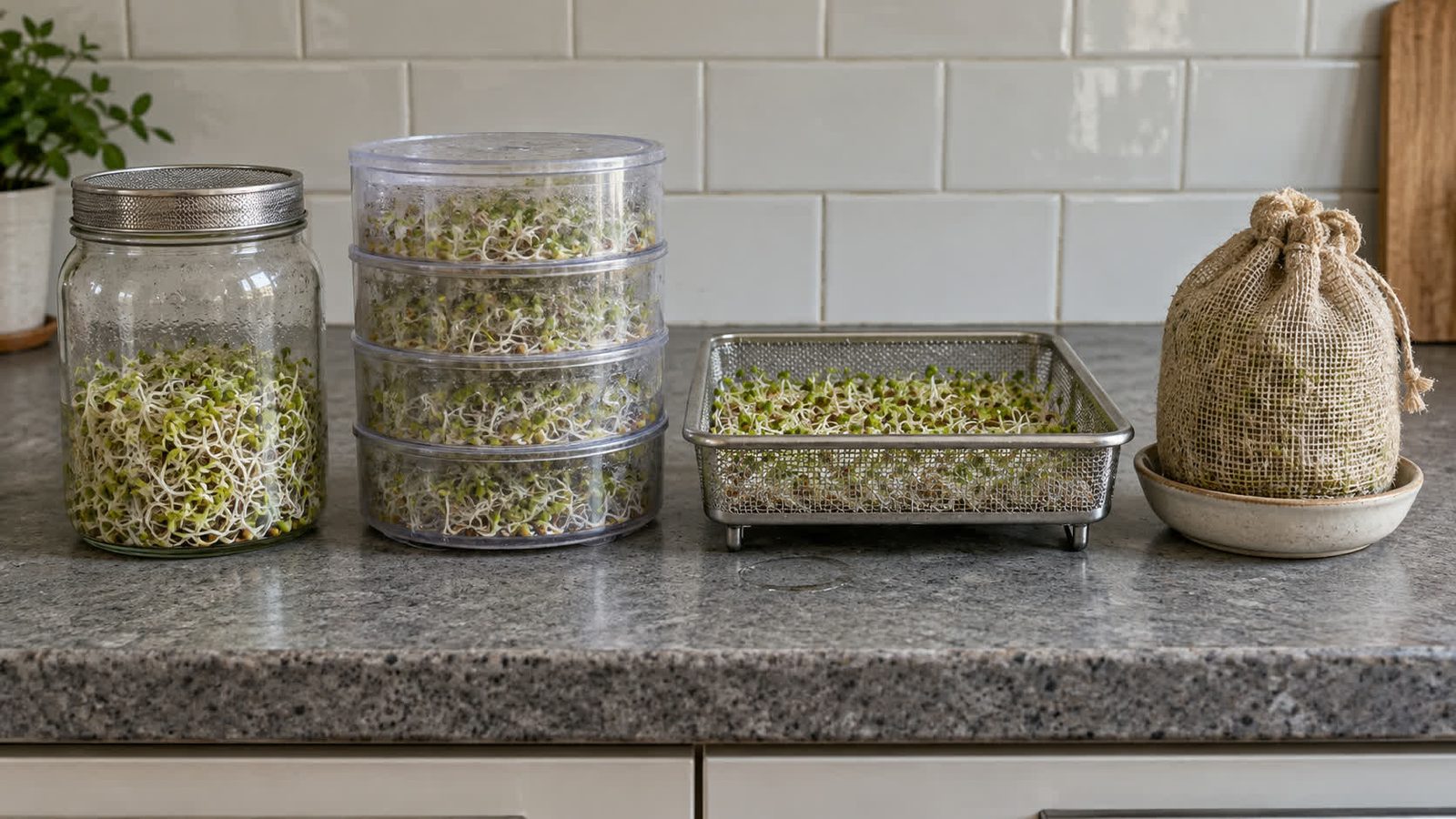
For most home sprouting, a wide-mouth glass jar with a screen lid is the place to start. On September 12, 2026, Mumm's listed a 1-L jar at CAD$8.99 (shown as sold out that day) and a screen lid at CAD$4.99 (Mumm's equipment), and a jar handles alfalfa and broccoli as long as you prop it upside down at an angle so it drains.
Move to a one-piece sprouter, a tray, a hemp bag or an automatic unit when your seed, batch size or available time calls for it. Whichever vessel you pick, FDA says children, older adults, pregnant people and people with weakened immune systems should avoid raw or lightly cooked sprouts of any kind (FDA).
The formats side by side
What separates these vessels is how water leaves them. Prices were shown on September 12, 2026, in each store's currency; Mumm's prices are Canadian dollars, so convert before setting them beside a US price.
Hover or tap a row to highlight it.
| Format | How water leaves | Extra gear | Price shown Sept. 12, 2026 |
|---|---|---|---|
| Jar and screen lid | Screen, jar inverted at an angle | Rack, bowl or dish drainer | Jar CAD$8.99 (sold out), lid CAD$4.99 (Mumm's) |
| Easy Sprout | Cup drains into a solid base | None beyond its parts | $16.30 USD (Sproutpeople) |
| Kitchen Crop 4-Tray | Through tray holes to a collection tray | A straight pin for plugged holes | $19.99 USD (Grow Organic) |
| Stainless mesh tray | Through fine mesh, then tilted and tapped | Two of your own plates | Small $22.00 USD (Sproutpeople) |
| Hemp bag | Gravity, once hung | Somewhere to hang it | CAD$16.99 (Mumm's) |
| Terracotta tower | Down through porous tiers | Counter space | CAD$82.99 (Mumm's) |
| Tribest Freshlife 3000 | Pump and spinning sprinkler | An outlet and 11 x 11 x 14.5 in of space | $159.95 USD (Tribest) |
Start with the seed you plan to eat
The seed narrows the choice fastest. Small seeds such as alfalfa, clover and broccoli can plug tray holes and hold water after rinsing, so they want a fine screen or a small-seed insert. Mumm's calls the jar and the Easy Sprouter the best methods for alfalfa (Mumm's alfalfa) and lists broccoli as a jar, Easy Sprouter or tray crop (Mumm's broccoli). Beans, lentils and peas are less likely to block holes but need more room. Sproutpeople recommends a jar, Easy Sprout, screens or its stainless tray for mung beans (Sproutpeople mung).
Buy seed sold for sprouting. If you are still deciding between sprouts and microgreens, microgreens vs. sprouts covers the difference.
Mason jar and screen lid: the baseline
A jar has no drain of its own. Seed sits loose inside, and water only leaves through the screen when the jar is upside down. Mumm's directions are to drain it well and set it inverted at an angle on a sprouting rack, a bowl or a dish drain rack, noting that drier sprouts store better (Mumm's alfalfa). For broccoli, they add tapping and rotating the jar to push out moisture (Mumm's broccoli). A jar left upright keeps its rinse water pooled in the bottom, which is the standing water you are trying to avoid.
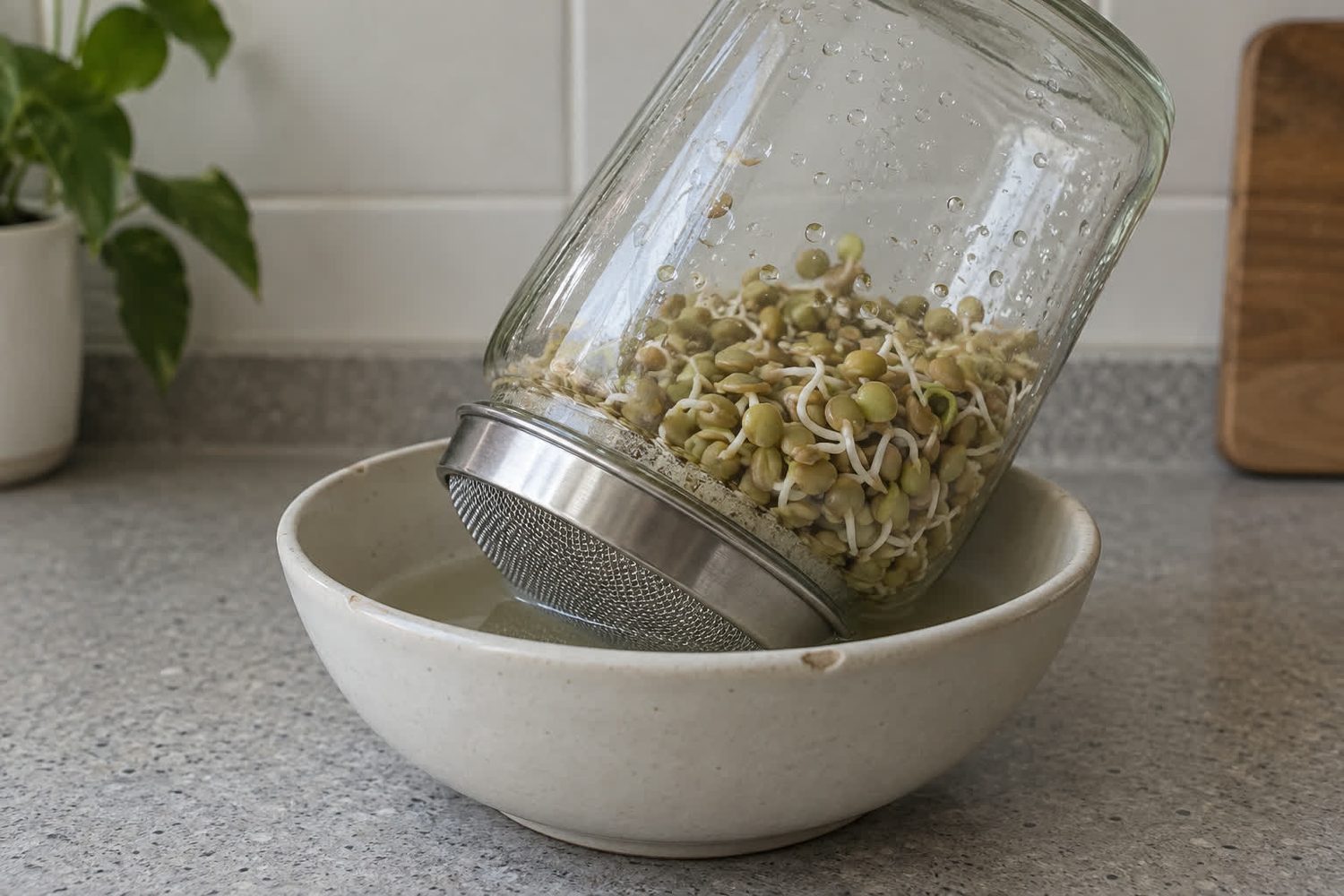
The full kit is a wide-mouth jar, a screen lid and something to prop it on, plus a bowl if you want to sort out hulls. Mumm's lid is a metal ring with a stainless screen for an 84 mm (3.3-inch) wide-mouth opening, and Mumm's advises keeping it out of the dishwasher (Mumm's lid). The Masontop Bean Screen is two BPA-free plastic lids with silicone gaskets and inverted spouts that let the jar sit upside down to drain, and the seller calls them dishwasher-safe (Masontop).
Mumm's suggests 1 to 2 tablespoons of alfalfa in a wide-mouth jar and says 1 tablespoon makes 1.5 to 2 cups of sprouts. Leafy sprouts can clump, and Mumm's advice is to separate them while you rinse (Mumm's alfalfa). A jar suits a first small batch and anyone who will tip and rotate it each rinse.
One-piece jar sprouters like Easy Sprout
Easy Sprout removes the propping by giving rinse water somewhere to go. A perforated growing cup sits in a solid base, and excess rinse water falls into that base (Sproutpeople Easy Sprout). It holds 1 quart (1 liter), stands 7 inches tall, measures 4.5 inches across the top and 3.25 inches at the base, and is made of HDPE. The parts are a solid base, growing vessel, dome lid, small-seed insert, storage lid and vented travel lid. The insert snaps in for alfalfa, clover and broccoli, and the maker calls the unit dishwasher-safe.
Against the baseline, you pay a little more for a contained footprint. At Mumm's on September 12, 2026, Easy Sprout was CAD$17.99, against CAD$13.98 for a 1-L jar and screen lid together (both the Easy Sprout and the jar showed as sold out that day) (Mumm's EasySprout, Mumm's equipment). The trade is more pieces to wash and a base you empty after each rinse. It suits someone who wants small seeds on a tidy counter without a rack. Sproutpeople advises against trying microgreens in it, so skip it if that is your plan.
Stacked plastic trays
A tray tower grows several batches at once. The Kitchen Crop (Victorio) 4-Tray has four trays, each 6 inches in diameter and 1.75 inches deep, standing 8 inches high assembled, with a collection tray, lid, manual and 1 oz of alfalfa seed. It was $19.99 USD at Grow Organic on September 12, 2026 (Grow Organic). Water poured into the top runs down through the holes and collects at the bottom, and Harris Seeds says you can grow one large batch or four varieties (Harris Seeds).
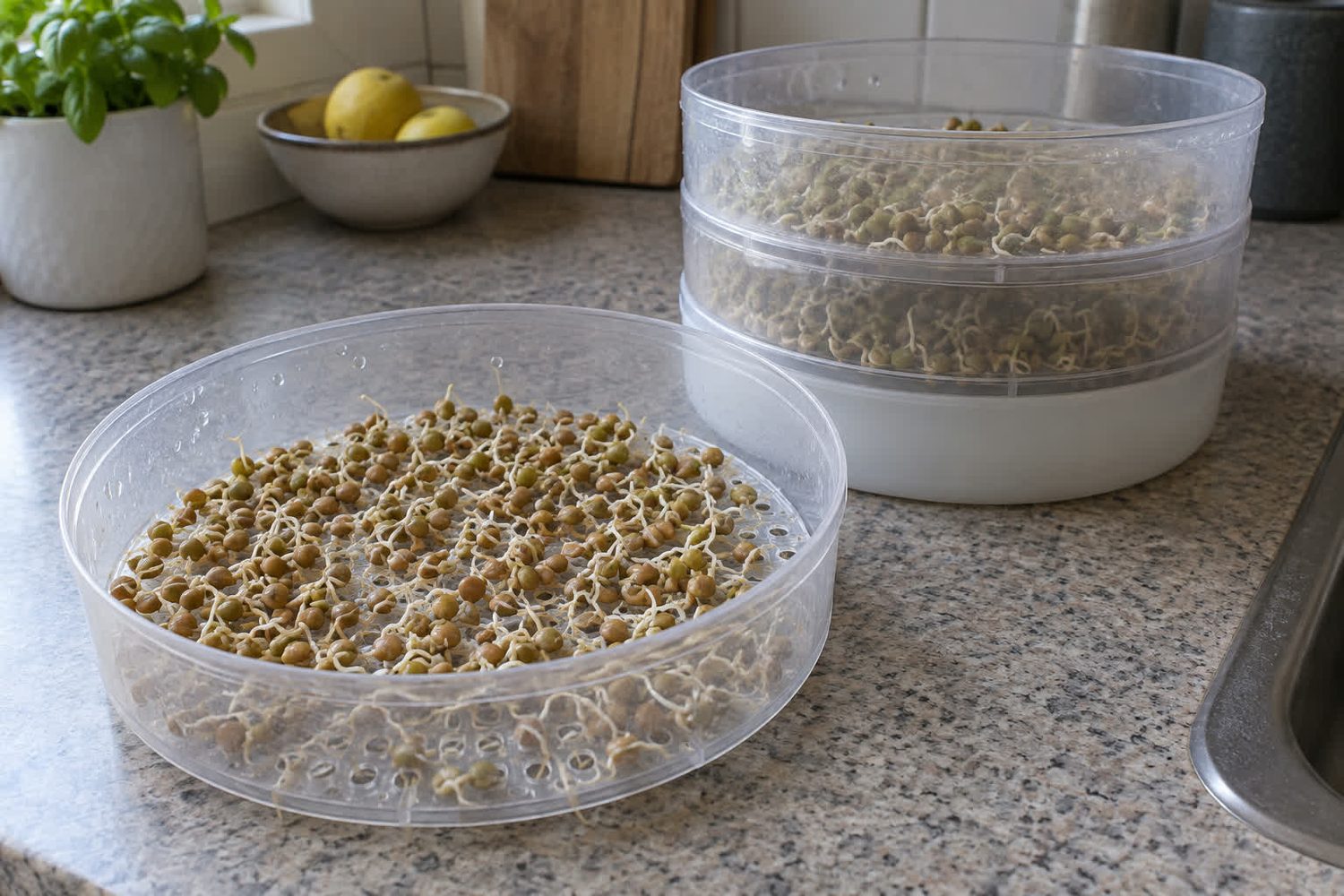
The drain holes are the weak spot. The Kitchen Crop manual says tiny seeds can plug them, that soaking helps, and that a straight pin clears a blocked hole (Kitchen Crop manual). It treats up to 1 tablespoon of retained water as normal, and if mold appears, it directs you to water less and make sure the trays drain. Tiers do not always behave alike. In a 2012 grow test, Food Republic had most seed germinate in two days, but the top tray dried out in summer heat while the lower trays molded from poor air circulation (Food Republic). Check the top tray for dryness and the lower trays for mold every day.
The maker allows the top rack of the dishwasher only, with the trays removed before the dry cycle (Grow Organic). A stack suits someone who wants separate batches going at once and will keep the holes clear. If you are also shopping for microgreen trays, see our tray reviews.
Stainless mesh trays
Sproutpeople's Stainless Steel Tray Sprouter is a circle 7.5 inches wide and 2 inches tall with a fine stainless screen bottom, rated for one quart (Sproutpeople stainless tray). It has no base or cover, so you supply two household plates. Rinse it for 15 to 20 seconds under a faucet or sprayer, then tilt, tap and bounce the tray until water stops leaving. Small leafy and brassica seed holds water even after that and needs extra bouncing, and the maker caps brassicas at 3 tablespoons. Big seeds drain more easily.
On September 12, 2026, the small tray was $22.00 USD and the large $26.50 USD (Sproutpeople); the maker says the small one is dishwasher-safe. Stainless can also double for microgreens. Sproutpeople says it grows grass and microgreens on a coconut coir and earthworm castings mix, with the caution that roots can damage the screen at harvest (Sproutpeople stainless tray).
One 2020 r/Sprouting grower found broccoli germinated first in mesh trays but declined around days 5 to 7, while one seed lot did well in a jar (r/Sprouting), so test a small batch of your seed before scaling up.
Hemp sprouting bags
A bag drains itself once it hangs. Mumm's hemp bag measures 7 x 11 inches dry and was CAD$16.99 on September 12, 2026 (Mumm's hemp bag, Mumm's equipment). The current listing says to dip the bag to water the sprouts and hang it to dry. An April 2025 capture of the older listing said to dampen the bag, fill it with soaked seed, rinse 2 to 3 times a day and hang it over a sink or bowl, and named beans, lentils, mixed beans and mung as suitable (Wayback capture).
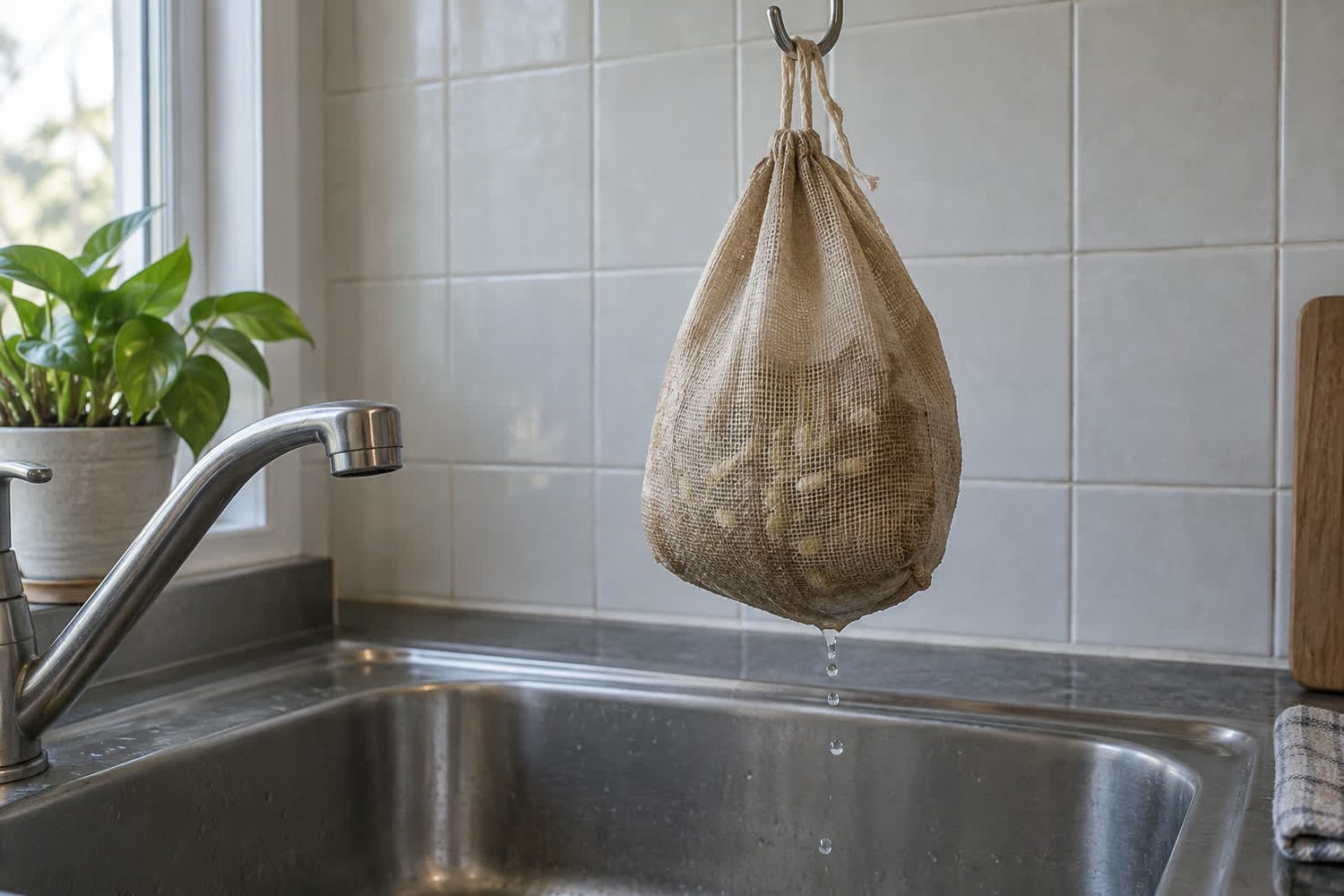
You need a hook or spot above a sink or bowl, so skip a bag if you have nowhere to hang it. Fabric is porous, and USDA FSIS describes dishwasher sanitizing for dishwasher-safe, non-porous utensils (USDA FSIS), so follow the bag's care directions and replace it once it tears or will not come clean.
Terracotta towers
A terracotta tower is a stack of porous clay trays that drain from tier to tier. Mumm's Geo Terracotta 4-Tier Tower was CAD$82.99 on September 12, 2026 (Mumm's equipment), more than nine times the CAD$8.99 price of a 1-L jar at the same store. The FDA Food Code favors food-contact surfaces that are smooth, free of cracks, chips and pits, and easy to reach for cleaning, because imperfections can hold biofilm (FDA Food Code). Before buying, read the tower's care directions and confirm every tier separates for scrubbing, and replace a tier that cracks or chips.
Automatic sprouters like the Tribest Freshlife 3000
An automatic sprouter replaces hand rinsing with a pump, but not your cleaning. The Tribest Freshlife 3000 has a sprouter barrel with two trays, a water barrel, a spinning sprinkler head, a water tube and a pump with a timer (Tribest manual). It is 11 x 11 x 14.5 inches, and the US model runs on 120V, 60Hz at 15 W (Tribest). Target says its cycle waters for five minutes, then rests for 25 (Target).
Tribest's manual says to change the water in the water barrel at least once daily, wash and sterilize the trays and barrels, clean the tubes and sprinkler head, and clear a clogged sprinkler head. If no fountain appears, reseat the barrel, and keep the unit out of direct sunlight above 90°F (Tribest manual). So, the daily job shifts from rinsing seeds to changing water and scrubbing water passages.
On September 12, 2026, Target showed it at $159.95 USD on sale from $199.95 USD regular (Target), and Tribest listed it at $159.95 USD (Tribest), against $8.35 USD for a 1-quart jar at Sproutpeople (Sproutpeople). It suits someone with counter space, a nearby outlet and the patience to clean a reservoir, tube and sprinkler head; log each cleaning and clog to learn your unit's routine.
Keeping any sprouter clean
Every format follows the same order: take it apart, wash, rinse, sanitize, and air-dry before storing. Wash your hands for at least 20 seconds before handling produce, and wash utensils and counters with soap and hot water (FDA). USDA FSIS separates washing, which removes soil and some bacteria, from sanitizing, which kills germs. For food-contact utensils, its homemade sanitizer is 1 tablespoon of unscented liquid chlorine bleach per gallon of water, used after cleaning (USDA FSIS).
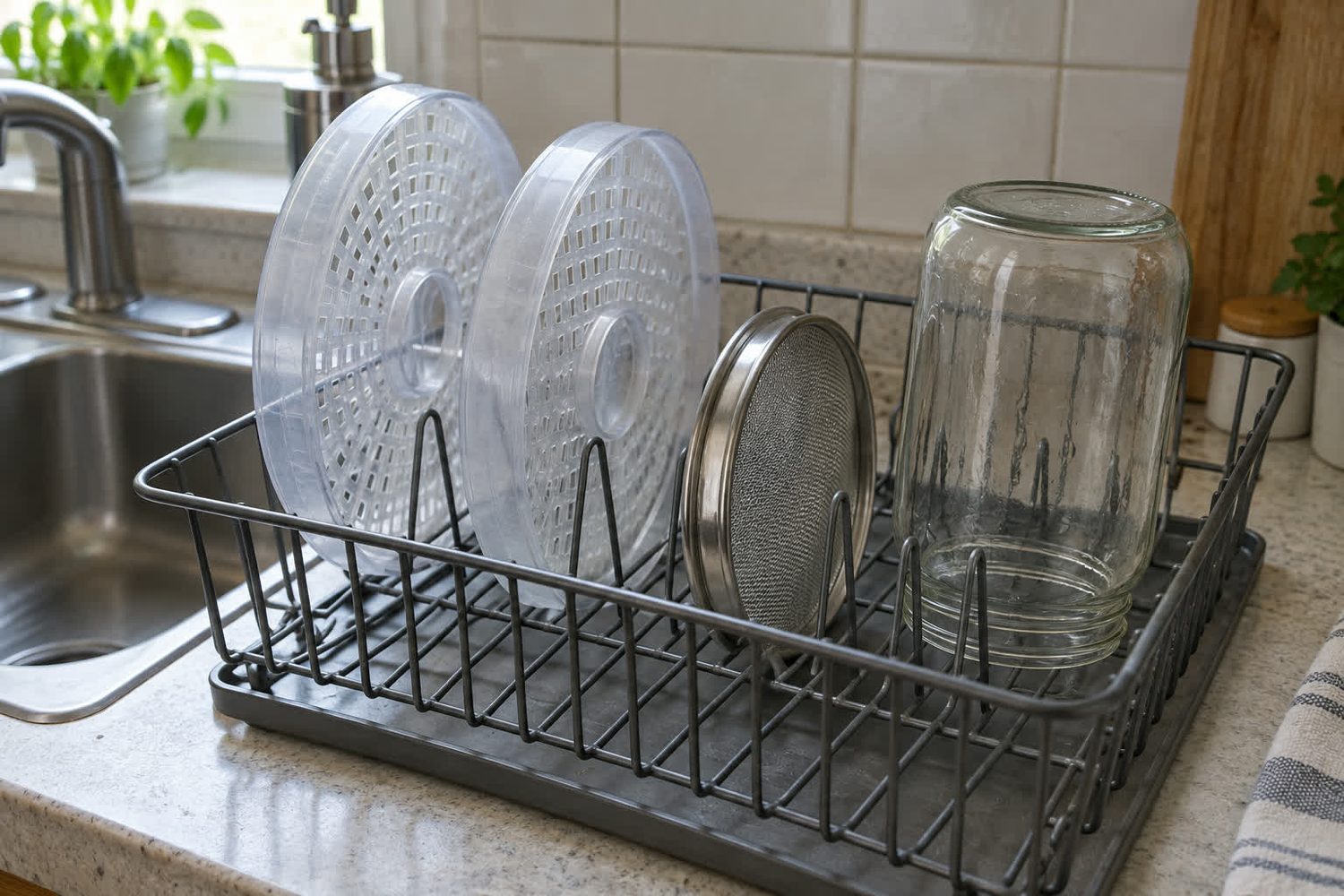
A jar and lid have the least to scrub, a tray stack adds joins and holes, and an automatic unit adds a pump and water passages. Look over screen holes, tray joins, seals and pump passages each time, and replace any part that cracks.
"Dishwasher-safe" tells you a part survives the maker's advised cycle. FSIS says a dishwasher can clean and sanitize dishwasher-safe, non-porous utensils (USDA FSIS), so follow each component's instructions and check for residue when you unload. Our cleaning and sanitation page covers the same routine for microgreen gear. If you plan to sell sprouts, FDA's September 2023 guidance requires covered operations to clean and then sanitize trays or drums before they touch seeds or sprouts, recommending at least daily (FDA sprout guidance); see microgreens vs. sprouts under Subpart M.
Are raw sprouts a fit for your household?
Clean equipment helps, but it does not remove the risk that starts in the seed. FDA says the warm, humid conditions that sprout seeds are also ideal for Salmonella, Listeria and E. coli, and that a small number on or in the seed can grow to high levels even under sanitary conditions at home (FDA). Health Canada adds that no treatment can make seeds pathogen-free, because organisms can shelter in cracks in the seed coat (Health Canada).
The vessel does not settle it either way. Pao et al. (2005) measured Bacillus cereus in sprouts grown in a glass jar and in a Freshlife Model 2000. Radish and broccoli rose significantly in both, and radish in the jar passed 10^5 CFU/g within two days despite twice-daily rinsing. Alfalfa and lentil showed no significant increase in either, while mung rose in the automatic unit but not the jar (study PDF). An August 2026 FDA outbreak investigation involving alfalfa sprouts and a radish sprout mix identified a seed lot, not sprouting equipment (FDA outbreak page).
FDA says children, older adults, pregnant people and people with weakened immune systems, including transplant patients and people with HIV/AIDS, cancer or diabetes, should avoid raw or lightly cooked sprouts of any kind, including onion, alfalfa, clover, radish and mung bean sprouts (FDA). That holds whatever vessel grew them. If someone in your home is in one of those groups, a sprouter for raw eating is not a fit. Otherwise, keep finished sprouts in a clean refrigerator at 40°F (4°C) or below.
Frequently asked questions
These tend to come up once a sprouter is on the counter.
Can I grow microgreens in a sprouter?
Sometimes, but a sprouter does not turn sprouts into microgreens on its own. Mumm's describes broccoli jar sprouts at 4 to 5 days and tray-grown microgreens at 7 to 10 days on a growing medium, cut above the bed (Mumm's broccoli). If microgreens are the goal, start with our microgreen growing kit picks.
Does a different vessel give a bigger harvest?
Supplier yield figures are given per seed, not per vessel. Sproutpeople gives mung at 2:1 and broccoli at 4:1 by weight (mung, broccoli), and Mumm's says 1/2 cup of black lentils makes 2.5 cups (Mumm's lentils). To compare two vessels, start the same seed lot at the same amount and rinse schedule in each, and write down what you harvest.
Does "BPA-free" mean the plastic is safer or mold-proof?
It means the item was not made with bisphenol A, not that it is sterile, antimicrobial or mold-resistant. FDA's BPA guidance covers food-contact materials in general rather than sprouters (FDA BPA Q&A). Clean a BPA-free sprouter the same way as any other.
Where to start
Match the vessel to your seed and your time. For alfalfa, broccoli or clover in small batches, a jar with a screen lid or an Easy Sprout with its small-seed insert covers it. For beans and lentils, a hanging bag drains without propping. A tray stack earns its place when you want several varieties at once and will keep the holes clear, and an automatic unit only saves effort if you will change its water daily and keep the sprinkler clean. For tight kitchens, see growing in small spaces and jars. Settle the household safety question first, then buy the simplest vessel that fits the seed you eat.
Sources
Prices, stock and specifications are as the linked pages showed them on 2026-09-12.
- Mumm's equipment
- FDA
- Sproutpeople
- Grow Organic
- Tribest
- Mumm's alfalfa
- Mumm's broccoli
- Sproutpeople mung
- Mumm's lid
- Masontop
- Sproutpeople Easy Sprout
- Mumm's EasySprout
- Harris Seeds
- Kitchen Crop manual
- Food Republic
- Sproutpeople stainless tray
- r/Sprouting
- Mumm's hemp bag
- Wayback capture
- USDA FSIS
- FDA Food Code
- Tribest manual
- Target
- FDA sprout guidance
- Health Canada
- study PDF
- FDA outbreak page
- broccoli
- Mumm's lentils
- FDA BPA Q&A
Keep reading
The journal
Microgreen Labels: Printers, Cost, and Cold Storage
Compare direct thermal, thermal transfer, color inkjet, and printed rolls for microgreen labels, with cost per label, adhesive tips, and barcode fees.
Read Microgreen Labels: Printers, Cost, and Cold StorageThe journal
Microgreens Equipment List: What to Buy at Every Scale
See a microgreens equipment list priced at three scales, from one windowsill tray to a full rack, with what to buy, skip, or borrow from the kitchen.
Read Microgreens Equipment List: What to Buy at Every ScaleThe journal
AeroGarden vs LetPot: Specs, Warranty and Running Costs
See AeroGarden vs LetPot lined up on price, pod count, light hours, monthly power cost and warranty terms to match a garden to your kitchen and crops.
Read AeroGarden vs LetPot: Specs, Warranty and Running CostsThe journal
How to Choose a Hydroponic System for Microgreens
Compare a still-water tray, ebb-and-flow table and NFT channel hydroponic system for microgreens, with setup costs, what each needs and problems to expect.
Read How to Choose a Hydroponic System for Microgreens