Microgreens Trays: A Water Management Tool, Not a Yield Upgrade
Cal HewittPublished Checked
- trays
- equipment
- buying
- watering
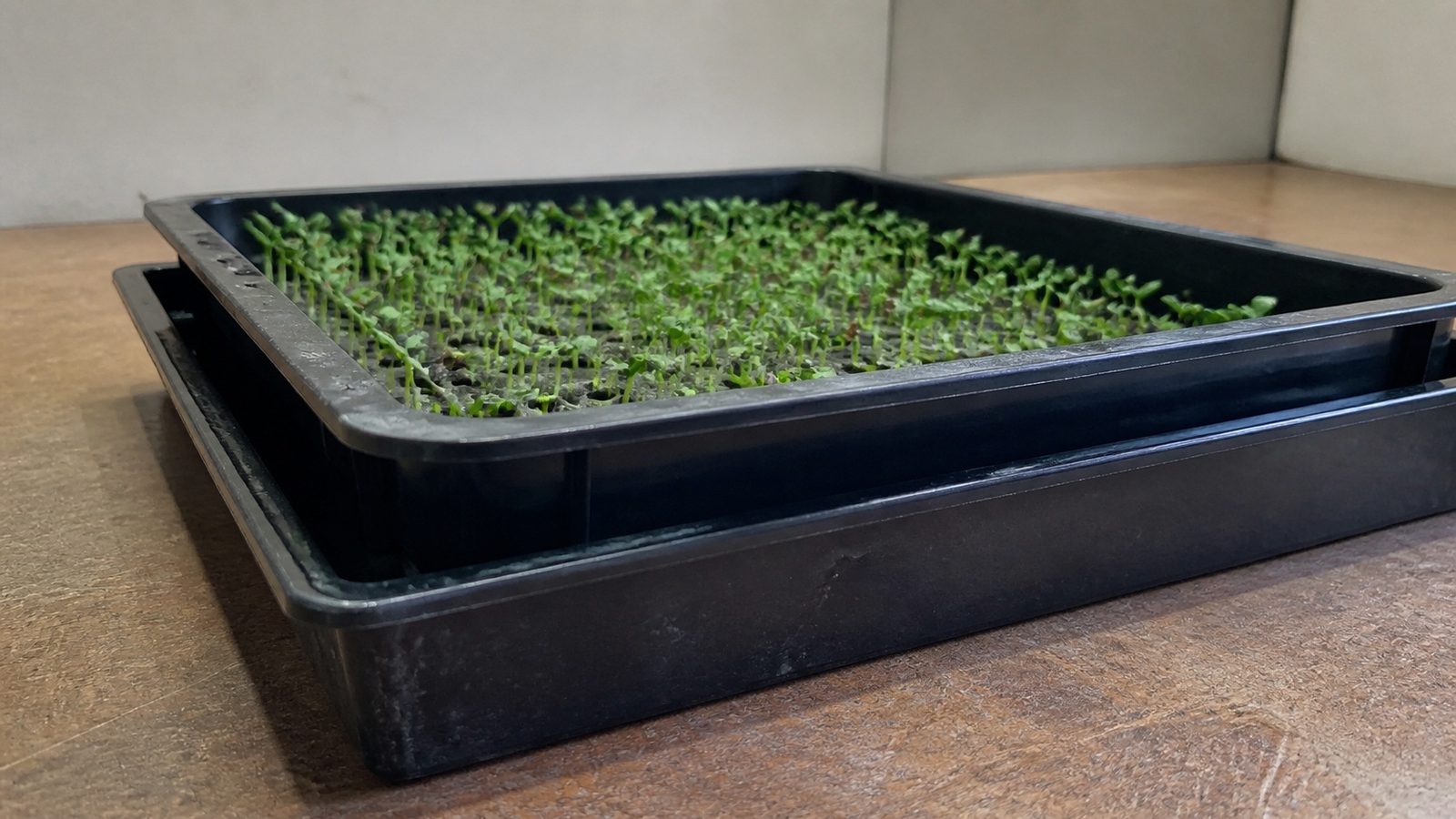
Buy two matched shallow 1020s, one perforated and one solid, and stop. That pair is the whole system: the perforated tray holds the crop, the solid one underneath holds the water, and bottom watering works. On the listings checked here it starts at $5.78 for the pair.
No independent source shows a premium tray raises yield or delivers a stated number of extra cycles. A tray is a water-management and handling tool rather than a production lever.
The order to buy in
What to buy, and when to stop
Hover or tap a card to highlight it.
Two compatible shallow 1020s
One perforated grow tray, one solid reservoir. This is the whole system for most growers and it costs under $12.
Identical pairs, once the schedule is real
A uniform matched fleet is what makes shelving, blackout stacks, watering, cleaning and scheduling repeatable. Uniformity is the actual benefit, not the brand.
1010s or 5 by 5 inserts, only for segmentation
Small batches, or live trays sold to a customer in portions. Not a general upgrade.
Heavier nursery trays, only when thin ones fail YOU
When trays flex under your actual wet load, or when breakage and handling labor become material at your volume.
Stop before the mega heavy fleet
A deep or mega heavy propagation class is hard to justify without frequent loaded handling or automated nursery equipment.
The premature purchase is a deep or mega-heavy fleet bought before the rack dimensions, crop mix, washing process and sales volume are settled. No independent lifespan comparison shows a faster upgrade pays back.
Against a fixed first setup budget, trays rank below seed quality, adequate light, airflow, a clean water-management method and basic shelving. Once those exist, a matched two-tray system is a low-cost reliability purchase.
What is claimed, against what has been measured
Hover or tap a row to highlight it.
| The claim | Who says it | What it actually establishes |
|---|---|---|
| 1.8 to 2.0 mm polypropylene, 36 drain holes, 1.25 inch deep | Bootstrap Farmer | Fit, water routing and material thickness. Not how many cycles it survives |
| 0.038, 0.060 and 0.088 inch starting gauge across heavy, extra heavy and mega heavy | T.O. Plastics, via Greenhouse Megastore | The same, in different units and with no stated measurement location |
| Claimed 50 lb capacity | True Leaf Market | Incomplete without span, temperature, duration, motion, load distribution, and whether permanent bending counts as failure |
| Two year replacement warranty for cracks under normal use, photo required | Bootstrap Farmer | The most concrete thing in this table. A limited remedy beats an unspecified durability promise |
| "Heavy duty", "built to last years", "strongest", "won't bend or break" | Across the category | Nothing checkable. No test, no conditions, no failure criterion |
| "Food safe", "BPA-free", resin code #5 | Across the category | See below. None of these is a food-contact certification |
Nobody has published cycles-to-crack for any named tray. No independent laboratory or extension comparison exists for flex strength after repeated washing, or for migration under microgreen conditions. The warranty and the capacity figure are seller and retailer claims.
The specs do not compare with each other. One brand reports wall thickness in millimeters, the other reports starting gauge in inches with qualitative strong, stronger, strongest tiers. Neither defines resin formulation, test temperature, loaded cycle count, cleaning chemistry, or whether the thickness is measured at the rim, the wall or the base.
The food-safe claim is the one worth understanding
This is the part of the category most likely to mislead you.
FDA is explicit that food-contact status depends on the individual components of the finished article and their intended conditions of use. A resin identification code such as #5 is not a certification. BPA-free is not a certification either. Neither supplies a formulation, intended-use conditions, or compliance documentation.
That does not mean the trays are unsafe. It means the label most buyers treat as the answer is not answering the question. A meaningful claim ties the exact finished article, including its pigments and any recycled content, to its food-contact basis. A thicker tray can be more rigid and have no published food-contact documentation at all; an identified food-contact polymer can still crack. They are separate questions and the category sells them as one.
What actually fails
The owner reports support four failure modes and not one of them comes with a time figure.
Thin trays flex and break under handling. That is the most repeated complaint across the tray discussions, and growers consistently link greater rigidity with surviving the move while loaded.
Trays of the same nominal size do not always nest. Incompatible slopes make stacking awkward, and a pair that will not seat properly defeats the entire point of buying a pair.
Mesh bases are harder to clean. Owners report more root and media cleanup than a standard hole pattern, which is a labor cost rather than a defect.
Heat and sun deform empty trays, which T.O. Plastics warns about directly. That is ordinary environmental wear when the seller has told you not to do it.
The microgreen-specific stress is one the seed-starting market does not have. Using a tray as a weighted blackout lid, per Utah State's 2 to 5 lb method, puts repeated edge loads on a rim that a propagation tray was never asked to carry. Nesting a perforated tray inside a solid reservoir every cycle, and lifting a saturated crop plus its medium, do the same. Whether any particular tray tolerates that for a stated number of cycles is unpublished, and one grower's recent thread is specifically the worry that a weighted blackout stack will eventually crack a tray.
Drain-hole tearing and first-stack failure are plausible, and no named, dated public report with a figure attached exists for either.
What they cost
Prices move. Every figure here is what that listing showed on the check date at the top of this page, and this page is rechecked at least every two months.
Hover or tap a row to highlight it.
| Option | Price seen | Seen at | Worth knowing |
|---|---|---|---|
| T.O. Plastics extra heavy 1020, ten pack | $28.90, or $2.89 each | Greenhouse Megastore | The cheapest working pair, $5.78. No published food-contact claim for this item |
| Bootstrap Farmer shallow 1020, single | $5.99 | Bootstrap Farmer | 1.25 inch deep, the two year crack warranty, and a food-contact claim. Pair from $11.98 |
| Bootstrap Farmer shallow, ten pack | $55.64, or $5.56 each | True Leaf Market | The same tray through a retailer, with the claimed 50 lb capacity |
| Johnny's 5 by 5 inserts, five count | $8.95 | Johnny's, direct only | 40 small inserts. A segmentation accessory for small batches or live-tray sales |
| T.O. Plastics mega heavy 1020 | from $16.75 | Greenhouse Megastore | The collection page showed no selected configuration, so this is not comparable to the row above |
The spread on a working pair is $5.78 against $11.98, and what the extra buys is handling stiffness, consistent nesting, a manufacturer food-contact statement and a crack warranty. It does not buy a published increase in germination or yield, because no such figure exists for any tray.
Both marketplace links pay this site a commission, and for plenty of readers the first answer pays nothing at all: the containers you already own. An Associated Press home-growing guide specifically permits a roughly two-inch lidded takeout container with holes plus a drip tray. The 1020 is a borrowed seedling standard rather than a biological requirement, and it became common because trays, shelves and lights are all built around it.
What it costs to be wrong
Small, and it compounds with fleet size. A cracked $2.89 tray costs $2.89 and a cracked $5.99 tray costs $5.99. The mistake that actually stings is buying a mismatched pair that will not nest, which forces a re-buy of one half.
The bigger cost is not the tray. It is a wet crop spilled during a one-handed lift, or avoidable labor at cleaning and harvest. No published figure exists for either, because it varies by medium, crop, stage and sales channel.
One widely repeated claim has nothing behind it. A retailer's guide asserts that stainless trays pay for themselves within a year for commercial growers. The article offers no purchase price, no replacement-cycle data, no labor calculation and no independent test, and none of the sources located publish any. Treat it as an editorial recommendation, not a finding.
Who should skip this entirely
Skip dedicated trays for a first small crop, for one or two kitchen batches, or when clean shallow food containers and a drip tray already fit the space you have.
Skip the deep and mega-heavy trays unless you regularly move wet loaded trays or run automated propagation equipment. A deep tray adds cutting reach and medium volume that a short-harvest crop does not use.
Skip mesh unless you are growing large-seeded crops or running flood and drain, because the cleanup cost is real and reported by the people using it.
What is still genuinely unknown
- How many crop and wash cycles each candidate tray survives under a real wet load and a real lifting style, before cracking, deforming or losing nesting function.
- Whether a loaded tray flexes enough to spill medium when lifted one-handed from its actual grip points.
- Whether the hole and no-hole pair nests, separates and carries blackout weight without binding, light leaks or rim damage.
- How long root and media cleanup takes per tray for solid, hole and mesh bases in a real process.
- Whether any tray warps after a specific wash temperature, sanitizer, drying location or summer storage routine.
- The food-contact basis for each exact SKU, color and recycled-content version.
The first of those needs a fatigue protocol with a stated wet load, lift method, wash and sanitizer exposure, cycle count and failure definition. The last needs a manufacturer declaration tying the finished article to its food-contact basis. Neither exists in public for any tray named here.
The terms on this page, in plain words
Tap a term to see what it means.
1020. The nominal 10 by 20 inch horticultural tray footprint. Exact inside and outside dimensions vary by manufacturer, which is why same-size trays do not always nest.
Sources
Every price below was seen on the check date at the top of this page, and the prices on this page are rechecked at least every two months.
- FDA, determining the regulatory status of food-contact material components - food-contact status depends on the individual components and their intended-use limitations, which is why a resin code or a BPA-free label is not a certification.
- Utah State University Extension, grow your own microgreens - covering a seeded 1020 and placing 2 to 5 lb on top during dark germination, the load that stresses a tray rim.
- Bootstrap Farmer, microgreen trays - $5.99 single, 1.25 inch depth, 1.8 to 2.0 mm polypropylene, 36 holes, the food-safe BPA-free #5 claim, and the two year replacement warranty for cracks with a photo required.
- Bootstrap Farmer, what trays do you need - the shallow pair nesting for bottom watering, published by the seller.
- True Leaf Market, Bootstrap Farmer 1020 trays - $55.64 for ten, the claimed 50 lb capacity and the limited two year warranty.
- Greenhouse Megastore, T.O. Plastics extra heavy duty 1020 - $28.90 for ten, 2.44 inch depth, 0.060 inch starting gauge, and the warning that heat and direct sun can deform empty containers.
- Greenhouse Megastore, T.O. Plastics collection - mega heavy from $16.75, listed without a selected configuration, which is why it is not compared here.
- Johnny's Selected Seeds, 5 by 5 inserts - $8.95 for five flats, 40 inserts, marketed for small plantings and live presentation.
- Associated Press, growing microgreens at home - a roughly two inch lidded takeout container with holes plus a drip tray, as a legitimate first setup.
- Wind River Greens, best trays and containers - the stainless-pays-for-itself-within-a-year claim, published by a retailer with no cost or lifespan data behind it.
- True Leaf Market, best trays and containers - seller support article, drainage and two-tray guidance.
- A discussion on the perfect tray - inexpensive disposable trays described as flimsy and prone to breaking, and low-profile trays as easier to clean.
- A discussion on tray depth - rigidity linked to surviving a loaded move, and incompatible tray slopes making stacking awkward.
- A weighted blackout cover discussion - the concern that a weighted blackout stack will eventually crack a tray.
- A mesh tray discussion - mesh reported as harder to clear of roots.
- A discussion on the 1020 format - the 1020 described as common because trays, shelves and lights are readily available, rather than because the crop requires it.
Keep reading
The test bench
Microgreens Watering Systems: Bottom Water With Two Trays, and What to Buy
A perforated tray over a solid one, filled by hand, from about $11. No source publishes water volume per tray per day for any crop or any product, so every cup figure you have been given is one grower's habit.
Read Microgreens Watering Systems: Bottom Water With Two Trays, and What to BuyThe test bench
AeroGarden and Countertop Pod Gardens for Microgreens: Is It Worth It?
Pod count is holes for separated mature plants, not dense tray area. A $30 tray kit gives you more sowing surface for microgreens than a $250 pod garden.
Read AeroGarden and Countertop Pod Gardens for Microgreens: Is It Worth It?The journal
AeroGarden Bounty Review: Basic, Bounty and Elite Specs
This AeroGarden Bounty review compares the Basic, Bounty and Elite by watts, features, price, stock, running cost estimates, and warranty terms.
Read AeroGarden Bounty Review: Basic, Bounty and Elite SpecsThe journal
AeroGarden Farm Review: Specs, Price and What It Grows
This AeroGarden Farm review breaks down the Plus and Basic models, last known list prices, running costs, warranty terms, and owner-reported problems.
Read AeroGarden Farm Review: Specs, Price and What It Grows