Microgreens Watering Systems: Bottom Water With Two Trays, and What to Buy
Cal HewittPublished Checked
- watering
- bottom watering
- equipment
- buying
- troubleshooting
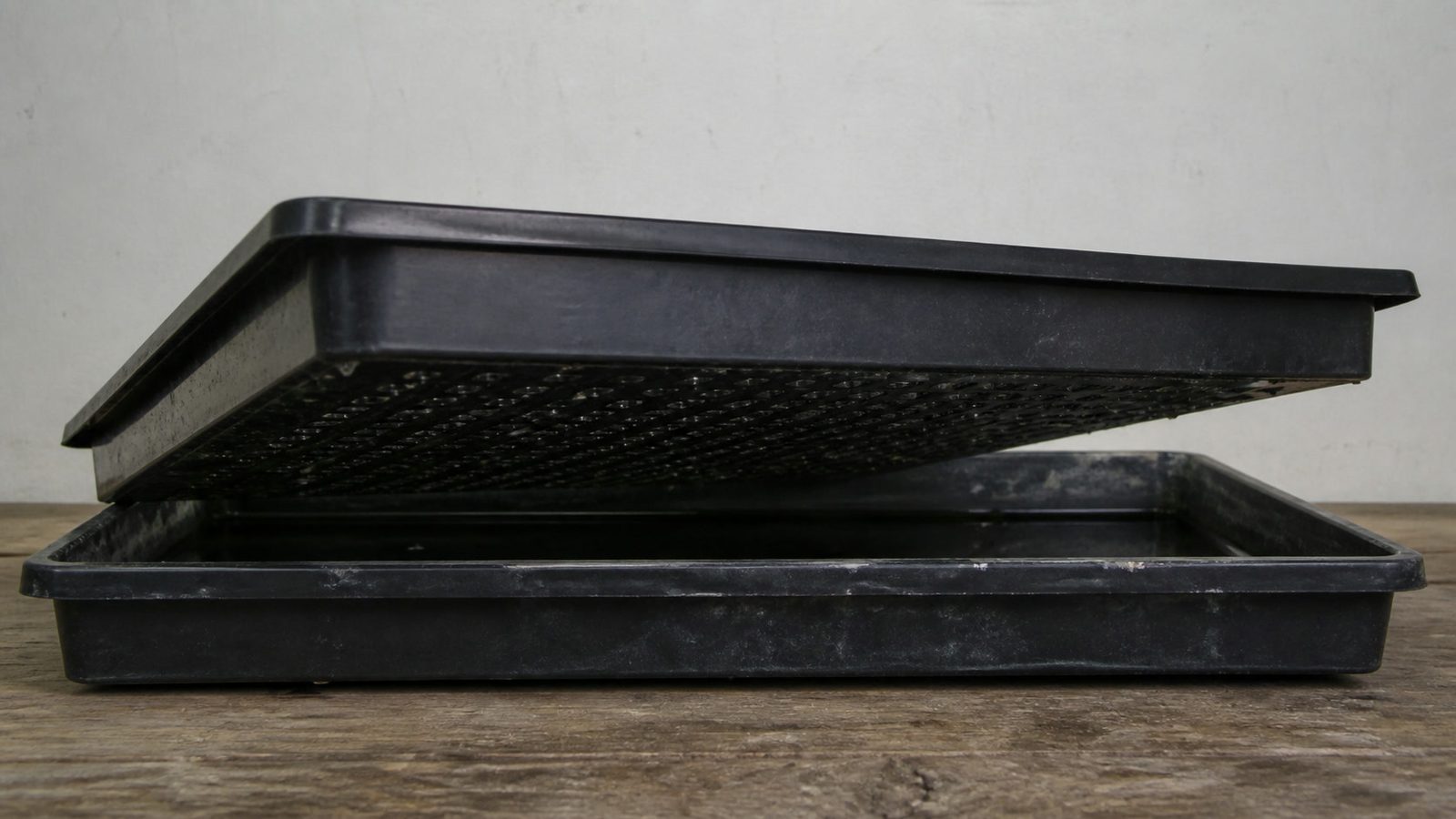
Buy a perforated growing tray and a solid tray to sit it in, and water it by hand. That is the system. The lower tray is the reservoir, the crop drinks from below, and it works without a pump, a timer, a wick or anything with the word hydroponic on the box. The two halves start at about $5.25 and $5.95.
The specification that would actually help you does not exist. What a grower needs is water volume per tray per day, for a named crop at a named seed density in a named medium, by growth stage. No independent source publishes that for any retail watering product, and none publishes it for any crop either. Reservoir capacity, pump flow and timer intervals are the three numbers sellers do publish, and not one of them measures what the roots take up.
That is why the advice you have read conflicts. It is not that some growers are wrong. It is that everyone is quoting their own tray.
The order to buy in
What to buy, and when to stop
Hover or tap a card to highlight it.
A perforated tray over a solid tray
About $11 for the pair, or less if you already own a rimmed pan. This is the whole system for one to a few trays and it needs nothing else.
A gentle way to apply water
A hand sprayer or a jug you can pour slowly with. The goal is wetting the medium without flattening a seedling.
A written water record, which costs nothing
Volume in, minutes to absorb, what was left, per crop and medium. This is the number no product will give you and the one that ends the guessing.
A larger passive reservoir or a wick setup
Only when how OFTEN you can look at the trays is the actual constraint. Check that the crop bridges the wick, because growers report it suits thirsty crops and not all of them.
Timer, pump or ebb-and-flow
Last, and only after you have documented the volumes and can lay out a wet area with safe electrical separation. Automation delivers a schedule, not a measurement.
Stop before a countertop kit for 1020 production
The format is the point of those products, and it is not your format.
The premature purchase in this category is automation, and it is premature for a specific reason: a pump flow rate and a timer interval are not substitutes for knowing what the crop takes. Automating an unmeasured dose just applies the wrong amount reliably.
Against a fixed first budget, watering hardware sits behind light, sound trays and a rack, seed, medium, sanitation and airflow. The function is essential and the cheap manual route performs it. Johnny's puts air movement, clean media and water, and correct density alongside watering as the safeguards that actually matter.
The cup figures all disagree, and here is why
The most repeated question in the grower discussions is not which brand to buy. It is how much water to put in the bottom tray and whether to leave it there. The answers do not agree.
Hover or tap a row to highlight it.
| The advice | Check window | Source type |
|---|---|---|
| One cup, add another half cup if needed | Not stated | A grower, in discussion |
| One to two cups, then inspect | About 20 minutes | A grower, in discussion |
| One to two cups reported as saturating the tray | 15 to 30 minutes, then dump the excess | A different grower, same subreddit |
| One and a half to two cups | Minutes to a day | A third grower |
| About a quarter inch of water | 15 to 30 minute uptake check | Wind River Greens, a seller |
| Discard whatever is left at the end of the day | End of day | Associated Press consumer guide |
Two growers using the same phrase, one to two cups, describe opposite outcomes. One treats it as the working dose and one reports it saturating the tray. Nothing in either account is bad advice; the crop, the medium, the depth and the room are all different and none of them were stated.
So, there is no cup number to give you, and be suspicious of any page that offers one. Extension guidance is explicit that irrigation rate varies with the system and the substrate and changes between sowing and harvest, which means a fixed daily figure is wrong at both ends of the crop even when it is right in the middle.
No published study establishes a volume or a frequency for any crop, which is also why "water less" fails as a universal rule: trays collapse that nobody would call overwatered, and "it is late because you overwatered" is folklore rather than a diagnosis.
What works instead is unglamorous. Pour, wait, look. If water is still standing after 15 to 30 minutes, you poured too much for that tray, and now you know the number for that crop in your medium. Write it down. That record is the thing no product can sell you.
What the research actually establishes
One controlled study is worth knowing about, and it is about moisture setpoints rather than hardware. Tavan et al. ran a soilless microgreen experiment across five moisture setpoints expressed as a percentage of effective container volume. The best performing setpoint, 17.5 percent, reached a water-use efficiency of 88 grams of fresh biomass per liter, about 30 percent better than its gravimetric comparator, with 11.5 percent higher fresh yield.
Read what that does and does not tell you. It establishes that managing moisture to a measured setpoint beats watering by habit, which is a real result and an argument for paying attention. It is a system-level finding in a research rig. It is not liters per day for a Johnny's tray, a Bootstrap Farmer tray or a True Leaf kit, and it does not validate any product you can buy.
Nothing else in the category has been measured. There is no independent comparison of top watering against bottom watering against wicking against timed irrigation, scored on sellable weight, harvest day, mold incidence, labor or cleanup. Every recommendation you will read on the subject, including the sensible ones, rests on somebody's practice.
What the sellers publish, and what it establishes
Hover or tap a row to highlight it.
| The claim | Who says it | What it establishes |
|---|---|---|
| Two-cup water-holding capacity | True Leaf, on its kit | How much the container holds. Not how much the crop takes |
| "Most crops need 0 to 2 refills" | True Leaf, on its small trays | A seller estimate with no crop, medium, room or refill threshold attached |
| "Self-watering", "perfect moisture", "minimal risk of under or overwatering" | Across the category | Not falsifiable as written. No crop, no conditions, no failure rate |
| 15 minutes to 12 hours, 125 V, 15 A, 1875 W, ETL listed to UL 917 | BN-LINK, on its timer | Genuine and useful electrical facts. Nothing about irrigation volume or uniformity |
| Rated pump flow | Pump sellers | Movement under stated head conditions. Not demand at the roots |
| "Prevents mold" | Across the category | Too broad to check. Disease pressure also moves with seed sanitation, density, temperature, medium and airflow |
| "Food safe", "BPA-free" | Across the category | Material positioning. No bearing on water delivery |
A timer is not an irrigation controller and it is not a wet-location device. An ETL listing against UL 917 tells you the electrical product was evaluated to that standard. It does not say the thing is safe to have splashed on a wet rack, and a plug-in countdown timer supplied without a pump, reservoir, tubing or an installation method is a component rather than a system.
Two compatibility traps that cost real money
Johnny's microgreens reservoir tray does not fit a standard 1020 flat, and Johnny's says so on the product page. It is a 22 by 11 inch tray with its own matching growing tray sold separately. If you already own a rack of standard 1020s and you buy this expecting it to nest with them, it will not. That is the single most expensive mistake available in this category, because it is a whole purchase that cannot be used.
True Leaf's self-watering kit trays are 7 by 5.25 inches. That is a countertop product, and it is a perfectly reasonable one. It is not 1020 scale, and buying it to service a 1020 production plan is buying the wrong size of the right thing.
A mesh tray is the upper half only. Bootstrap Farmer's shallow mesh tray from $5.95 is a growing tray. Budget for a solid lower tray or you have bought a colander.
What they cost
Prices move. Every figure here is what that listing showed on 2026-08-11, and this page is rechecked at least every two months.
Hover or tap a row to highlight it.
| Option | Price seen | Seen at | Worth knowing |
|---|---|---|---|
| Johnny's microgreens reservoir tray #6797 | $5.25 | Johnny's | 22 x 11 x 1⅛ in. Does not fit standard 1020 flats. Growing tray sold separately |
| Bootstrap Farmer 1020 mesh shallow, extra strength | From $5.95 | Bootstrap Farmer | 1 inch deep. Upper half only |
| **A working two-tray pair** | From about $11 | Various | The whole system. No pump, no timer, no kit |
| Chapin 48 oz handheld sprayer | $14.99 | Amazon | $12.07 each in a 2-pack. The gentle applicator, and the only other thing worth buying |
| Handy Pantry self-watering trays, small, five sets | $29.06 | True Leaf Market | Five tray, reservoir and wick combinations. Small format |
| Gardener's Supply capillary matting, 3 yards | $29.99 | Gardener's Supply | Seed-starting equipment, not microgreen-specific |
| BN-LINK 12-hour mechanical countdown timer, two pack | $19.99 | BN-LINK direct | A timer only. No pump, reservoir, tubing or wet-location installation |
| True Leaf self-watering microgreens kit, hydroponic | $40.73 | True Leaf Market | Two 7 x 5.25 in trays, medium, seed and a mist sprayer. Not 1020 scale |
| Small pumps | No price | - | No opened retailer page supplied a current price, so none is asserted |
The sprayer this category keeps naming is a Chapin 48 oz handheld, at $14.99 on Amazon or $12.07 each in a two-pack, with a 1009 multi-purpose 48 oz at $24.99. No retailer page opened carried a current price for it, and the model numbers differ between listings, so treat those as a size class rather than as the same item.
The floor is about $11 and it is a genuine system, not a compromise. A perforated tray over a solid tray is the arrangement the extension guidance describes for small 1020 production, and it is what most of the growers in those discussions are actually using. A rimmed baking sheet or a food container will do the reservoir job at small scale, which the Associated Press guide explicitly permits.
The timer and the pump are not linked here. They would pay a commission like anything else, and automating a dose nobody has measured is the premature purchase in this category. The two links above are the tray pair and the sprayer, which is what the advice comes down to.
Nothing here is a subscription. Trays, reservoirs, sprayers, timers, pumps and capillary mats are reusable equipment. The recurring costs are medium, seed, any nutrient solution, and replacement wicks or mats. A manual two-tray setup has no electrical operating cost at all, and no watt-hour-per-tray figure has been published for the powered alternatives.
What goes wrong
The real risk is not a cracked tray, it is a shared root zone. A densely seeded 1020 grows a continuous canopy over one connected mass of medium. University of Minnesota Extension reports that damping-off pathogens favor cool wet conditions, move through shared irrigation water, and can kill large sections or entire seedling trays. Johnny's names dense planting, saturated media and poor airflow together as the conditions associated with it.
A houseplant survives uneven root-zone moisture. A microgreen tray can lose its whole saleable crop. That is the difference this category is actually about, and it is why recirculating water without a sanitation routine is a worse idea here than in most growing.
It is still not simply overwatering. The mold or root hair page sets out why: a moisture meter cannot prove overwatering, and Rhizoctonia turns up in warmer and drier trays as well as wet ones. Wet is a condition to check, not a verdict to reach.
Misting wets the canopy, which is the mechanism behind the advice to water from below after germination. The seller guide that makes this argument does not publish a comparative mold rate, so the reasoning is sound and the effect size is unmeasured.
Nothing has a published service life. No source gives a time to failure for tray cracks, wick degradation, mineral clogging, pump failure or a timer sitting on a wet rack. One owner on an unrelated growing forum reported two BN-LINK digital timers failing within months. That is a single anecdote, from a different use, about a different model line, and it cannot establish a defect rate. It is recorded here only because it is the sole failure report located in the entire category.
Warranties are thin. Johnny's offers a satisfaction guarantee, replace or refund, rather than a timed warranty on that page. True Leaf shows free returns without a durable-equipment warranty term. No substantiated owner report of a successful warranty claim on any microgreen watering product was located.
The disagreement nobody has settled
Should the leaves stay dry after germination, or can you mist carefully?
One commercial grower guide strongly discourages top watering once the crop is up. Another permits careful top watering and misting after the roots establish. Neither publishes a controlled comparison, and both are selling something adjacent. Johnny's own guidance says either top or bottom watering can suit the system.
The related open question is whether to leave a residual reservoir under mature roots. Growers split on it, and the outcomes people worry about, algae, odor and root disease against simply healthier growth, have not been measured against each other.
Neither is settled, because the evidence to settle them has not been generated. Bottom watering has a clear mechanism behind it and it is what most growers converge on. That is a reason to start there. It is not a measured result.
Who should skip this entirely
Skip dedicated watering hardware if you run a few trays, can look at them daily, and own a solid lower tray or a rimmed pan.
Skip pumps, timers and recirculating systems until somebody has measured what your site actually needs. Also skip them if the rack has no safe electrical separation from water, or if a cleaning and sanitation routine is not yet a habit. Recirculated water is a route between trays, which is the one mechanism in this category that can take out more than one crop at a time.
Skip a countertop self-watering kit if you are planning 1020 production. Its trays are 7 by 5.25 inches.
Skip capillary matting unless you have checked that your crop and medium bridge it evenly. It is propagation equipment, and a seedling platform is not designed around a densely seeded tray.
Do not skip drainage. A grow tray with no holes cannot bottom water at all, which is the one genuine hardware requirement on this page.
What is still genuinely unknown
- Milliliters per 1020 tray per day, for a named crop at a named density and medium, at germination, blackout, first light and final growth. This is the central number in the category and nobody has published it.
- How long each crop and medium combination takes to absorb a bottom watering, and how much leftover is safe to leave rather than drain.
- Whether top, bottom, wick or timed watering changes sellable weight, harvest day, mold and damping-off incidence, stem damage or cleanup time. No comparison exists.
- Which crops bridge a wick reliably and which develop dry edges or waterlogged zones.
- Whether a reservoir left under mature roots produces healthier growth, or algae, odor and root disease, or no measurable difference.
- Whether a given sprayer's droplets flatten seedlings or leave the canopy wet long enough to matter.
- For any pump and timer, whether delivered water matches the programmed schedule across every tray after deposits and clogging, at both high and low reservoir levels.
- What fails first under repeated cleaning and production, and after how many cycles.
A trial that answered these would need replicated 1020s across at least two contrasting crops, a brassica and a large-seeded shoot, at fixed density and medium, with randomized top, manual bottom, wick and timed treatments, logging input water, remainder, runoff, yield, harvest day, canopy wetness duration, disease incidence, labor, faults and electricity. Nobody has run it.
The terms on this page, in plain words
Tap a term to see what it means.
Bottom watering. Putting water in a lower tray and letting the medium draw it up through the drainage holes. The default method here, on mechanism rather than measurement.
Sources
Every price above was seen on 2026-08-11, and the prices on this page are rechecked at least every two months.
- Virginia Tech Extension SPES-756 - hand bottom irrigation for 1020 trays and timer or drip automation as the small-production options, and the statement that irrigation method and rate vary with system and substrate and change from sowing to harvest.
- Tavan et al., water-use efficiency at five moisture setpoints - a soilless microgreen experiment across five setpoints as a percentage of effective container volume, with 17.5% reaching 88 g fresh biomass per liter, about 30 percent better than the gravimetric comparator, and 11.5 percent higher fresh yield.
- University of Minnesota Extension, preventing damping-off - the pathogens favoring cool wet conditions, movement through shared irrigation water, and the capacity to kill large sections or entire trays.
- Johnny's Selected Seeds, microgreens grower guide (PDF) - dense planting, saturated media and poor airflow named together as the conditions behind damping off, that either top or bottom watering can suit the system, and air movement, clean media and water and correct density as the safeguards.
- Johnny's Selected Seeds, microgreens reservoir tray #6797 - $5.25, 22 x 11 x 1⅛ inches, the separate matching growing tray, the seller's own statement that it is not compatible with standard 1020 flats, and the satisfaction guarantee rather than a timed warranty.
- Bootstrap Farmer, mesh trays - the 1020 mesh shallow extra strength tray from $5.95, one inch deep, sold as the upper half.
- True Leaf Market, Handy Pantry self-watering growing trays, small - $29.06 for five tray, reservoir and wick sets, the 5.5 x 4 x 2 inch dimensions, and the "0 to 2 refills" and "perfect moisture" claims.
- True Leaf Market, self watering microgreens kit - $40.73 in the hydroponic configuration, two 7 x 5.25 inch trays, medium, seed and a mist sprayer, the two-cup capacity, the medium-for-six-plantings claim, and free returns without a stated equipment warranty.
- Gardener's Supply, seed starting supplies - capillary matting at $29.99 for three yards, sold as propagation equipment.
- BN-LINK, 12-hour mechanical countdown timer - $19.99 for two, 15 minutes to 12 hours, 125 V, 15 A, 1875 W, and the ETL listing conforming to UL 917.
- Associated Press, growing microgreens indoors - a container with holes over a drip tray as a legitimate setup, discarding water left at the end of the day, and a fan for mold prevention.
- On The Grow, how to water microgreens - the case for a lower reservoir tray and against canopy wetness, and the discouragement of top watering after germination. A grower and seller guide with no comparative mold rate published.
- Wind River Greens, watering schedule guide - about a quarter inch of water and a 15 to 30 minute uptake check, and careful top watering permitted once roots establish, which is the direct disagreement with the guide above.
- A discussion on holes and no-holes tray setups - the perforated-over-solid arrangement described by an owner, and cup amounts including one cup plus a half cup if needed.
- A discussion on 1020 trays and bottom watering - one to two cups then inspect after about 20 minutes, and reducing the amount if water remains.
- A discussion on how to bottom water - one to two cups reported as saturating the tray, dumping the excess after 15 to 30 minutes, and wicking described as working for thirsty crops but not all microgreens.
- A timer reliability report on an unrelated growing forum - two digital timers reported failing within months. A single anecdote, in a different use, on a different model line, and the only failure report located in this category.
Keep reading
The test bench
Microgreens Trays: A Water Management Tool, Not a Yield Upgrade
Two matched 1020s, one with holes and one without, from $5.78. Nobody has published reuse-cycle evidence showing when a premium tray pays for itself, and BPA-free is not a food-contact certification.
Read Microgreens Trays: A Water Management Tool, Not a Yield UpgradeThe test bench
AeroGarden and Countertop Pod Gardens for Microgreens: Is It Worth It?
Pod count is holes for separated mature plants, not dense tray area. A $30 tray kit gives you more sowing surface for microgreens than a $250 pod garden.
Read AeroGarden and Countertop Pod Gardens for Microgreens: Is It Worth It?The journal
AeroGarden Bounty Review: Basic, Bounty and Elite Specs
This AeroGarden Bounty review compares the Basic, Bounty and Elite by watts, features, price, stock, running cost estimates, and warranty terms.
Read AeroGarden Bounty Review: Basic, Bounty and Elite SpecsThe journal
AeroGarden Farm Review: Specs, Price and What It Grows
This AeroGarden Farm review breaks down the Plus and Basic models, last known list prices, running costs, warranty terms, and owner-reported problems.
Read AeroGarden Farm Review: Specs, Price and What It Grows