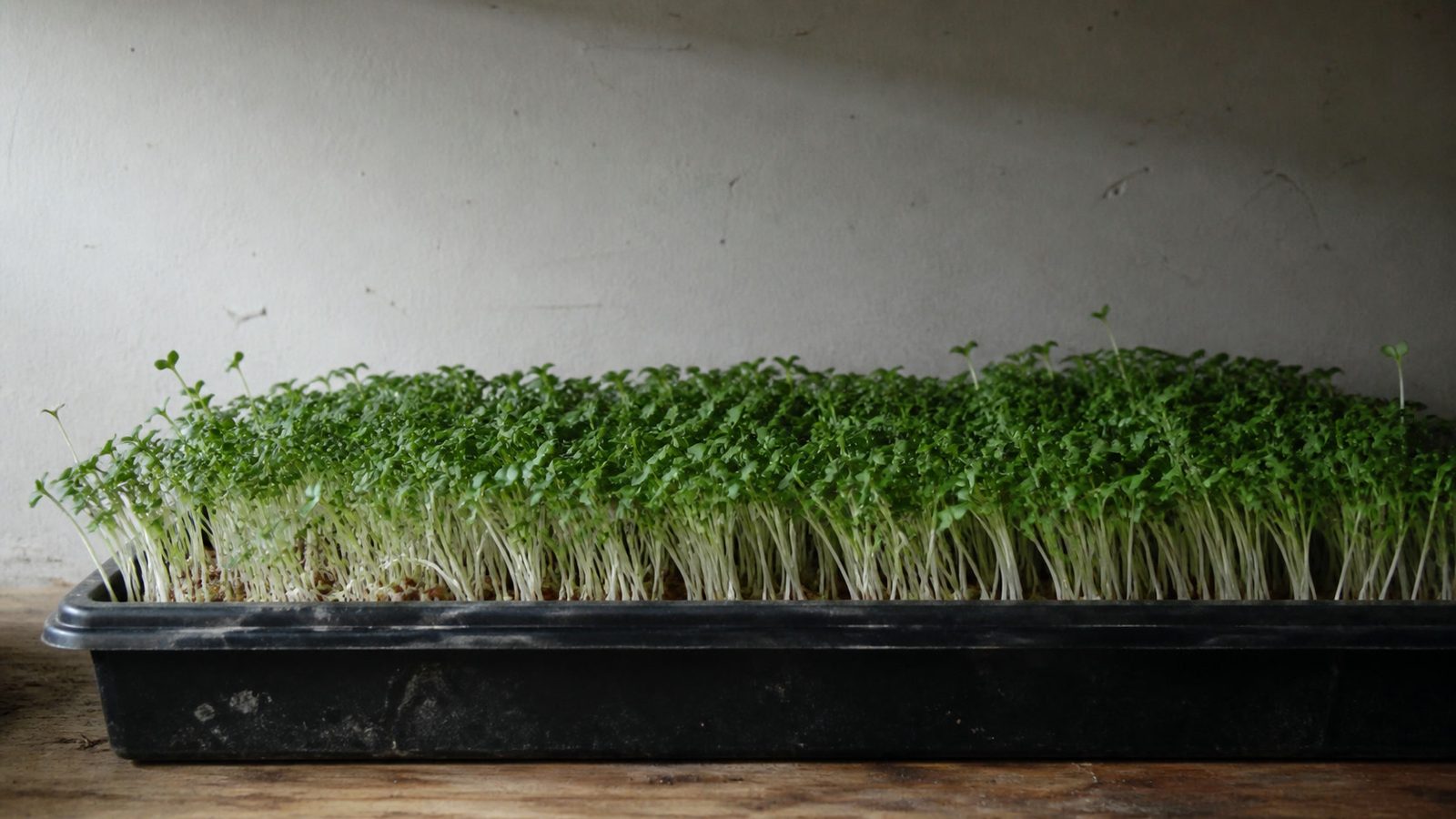
The cue is the leaf, not the calendar.
Almost every answer to this question gives you a number of days. Days are the least reliable thing you can go on: published ranges run from 6 days to 23 across crops, and they move with temperature, light and cultivar. A tray does not know what day it is.
What a tray does show you is its developmental stage, and that you can read in about two minutes without any equipment.
The distinction the whole question turns on
Two kinds of leaf, and telling them apart is most of the skill.
Cotyledons against true leaves
Hover or tap a card to highlight it.
Cotyledons
The first pair. Simple, rounded, often nothing like the adult plant, because they came pre-packed in the seed. On most crops these open first and are what you see filling a tray.
True leaves
The next ones, emerging BETWEEN the cotyledons. Smaller at first, and shaped like a miniature version of the grown plant. On broccoli they look like tiny broccoli leaves.
Why it matters
The most consequential mistake on this subject is reading cotyledons as true leaves and then applying a day count on top. Get this backwards and every other judgment inherits the error.
A microgreen is conventionally cut with stem, cotyledons and emerging first true leaves, which puts it between a sprout and a baby green. University of Maryland Extension gives a typical range of 2 to 3 inches tall and 7 to 21 days from sowing, and Virginia Cooperative Extension defines the crop as harvested soon after the first true leaves emerge.
That is a window, not a switch. There is no biological moment where the crop becomes ready.
The five-minute test at the tray
This is the part worth memorizing, because it replaces the calendar entirely.
The stage sample, step by step
- 1
Take ten representative seedlings
Not ten from the best patch. Center, edge, and any area that is visibly running ahead. A tray is rarely uniform and the edge tells you the most.
- 2
Find the cotyledons
They should be OPEN and turgid. Folded, still stuck in the seed hull, or limp are all different problems and none of them is "ready".
- 3
Look between them for the true leaf
Small, and shaped like the adult plant. This is the marker. On a tray at the right stage you will see it on some plants and not others, which is normal.
- 4
Count how many of the ten have it
This is the number that decides, and it is the one figure in this whole subject with a controlled trial behind it.
- 5
At about seven or eight of ten, cut
For BROCCOLI and RADISH that is the tested best balance of yield, chlorophyll and storage quality. For other crops treat it as the general window and write down what your own tray did.
- 6
At fewer, wait a day and look again
An early tray is not a failed tray. Provided the plants are upright and clean, nothing is wrong and no intervention is called for.
The one thing that test cannot do is diagnose disease, and that is the other half of the question.
The only trial that actually tested harvest stage
Almost everything published about harvest timing is practice. One controlled study measured it.
USDA-ARS researchers grew broccoli and radish hydroponically at 25°C under a 16 hour light and 8 hour dark cycle, harvested at different stages, and measured what came out.
Hover or tap a row to highlight it.
| Broccoli | Radish | |
|---|---|---|
| First true leaves emerged | Day 10 | Day 7 |
| Best tested harvest | Day 13 | Day 10 |
| Yield against earlier harvest | 20% higher | 20% higher |
| Chlorophyll | Higher | Higher |
| Visible decay in storage at 4°C | Less | Less |
| The catch | Anthocyanins fell significantly by day 11 |
Their recommendation is about 75 percent first-true-leaf emergence, which is where the seven or eight out of ten above comes from.
Two limits on that, both important. It is two cultivars under one set of conditions, so it is not an all-crop rule, and the site treats it as the best available answer rather than a settled one. And the radish anthocyanin result is the honest complication: waiting longer raised yield and lowered the pigment compounds. Later is not simply better. It is a trade, and which side you want depends on whether you are selling weight or color.
Day ranges disagree with each other, which is the point
Here is the strongest evidence that a day count cannot answer this question. Below are the ranges researched crop by crop, each from that crop's own sources, set against Virginia Cooperative Extension's compiled estimates for the same crops.
Hover or tap a row to highlight it.
Two of eight agree exactly. Three are close. Three disagree substantially, and beet disagrees in the direction that matters most: one source has it finishing before the other says it starts becoming possible.
Neither source is wrong. They are different growing systems, cultivars, temperatures and harvest definitions, which is exactly why a day count travels so badly. Arugula spanning 6 to 19 days in our own directory is not sloppy research; it is an honest range for a crop that genuinely behaves that differently between setups.
Use the numbers in the left column to know when to start looking. Use the leaf to decide.
Cabbage-family crops run faster than beet-family crops, and basil and cilantro are slow. Pea shoots are their own case: extension guidance has them harvested taller, at two or more sets of true leaves, which is later than the rule above.
Not ready, or failing? They are not the same tray
This is the distinction that costs people good trays, in both directions.
A tray that is simply early looks healthy and small: upright stems, clean color, cotyledons that have not finished opening. Nothing is wrong with it and it needs nothing but time.
A tray that is failing looks collapsed at the base. Damping-off, caused by Pythium, Rhizoctonia and relatives, rots seedlings at or below the medium line, and it can kill them before they ever emerge. That is a crop-health failure and no amount of waiting fixes it.
"It is late because you overwatered" is folklore, not a diagnosis. It is the most repeated sentence in microgreen troubleshooting and the pathology says otherwise: some Pythium species favor cool wet conditions while Rhizoctonia and other Pythium occur in drier, warmer ones. Moisture alone does not identify the organism, and it does not explain a slow tray either.
What to do, by what you are looking at
Hover or tap a row to highlight it.
| The tray | What to do | What you get back |
|---|---|---|
| Healthy but early | Leave it under normal conditions and recheck tomorrow | Full quality. No misting, no peroxide, no extra water; none of that is an evidence-backed intervention |
| Healthy and at stage | Cut now, with clean sharp tools, above the medium | The tested best balance of yield and keeping quality |
| Healthy but late | Cut and use it promptly | Usable, as a later, larger green. Do not promise the same texture, flavor or storage |
| Collapsing or rotting | Segregate it, remove affected material, clean tools and surfaces | Nothing, as a raw crop. This is not a harvest-timing problem |
Five things you will read that do not hold up
Advice that fails the evidence check
Hover or tap a card to highlight it.
"Never water for 12 to 24 hours before harvest"
No published preharvest dry-down duration or volume was found. It is grower practice, and following it far enough to let a healthy crop wilt costs you more than it saves.
"Harvest every crop at cotyledons, before true leaves"
Directly contradicted by the one trial that tested it, which favored about 75 percent true-leaf emergence for both crops it measured.
"Day N means ready"
Contradicted by ranges of 6 to 23 days across crops, and by the fact that the same crop moves with temperature and light.
"Wash it to fix a questionable harvest"
Postharvest washing appears ineffective and may INCREASE contamination risk by damaging tissue. Washing cannot repair a crop-health failure.
"Too much water is the cause"
Different damping-off organisms favor different moisture and temperature conditions. Diagnose the symptom, not the slogan.
Both sides of this argument are live right now
Sampled from public posts and videos, July to August 2026. Every line links what it is quoting. How often something is repeated is not evidence that it is true, so every line also says what the sources actually establish.
Hold off watering for 12 to 24 hours before you cut, so they hold less water and keep better
Circulating u/EveningCandle862 in r/microgreens, 7 upvotes
PRACTICE with no published basis. This is the preharvest dry-down this page flags above: no source establishes a duration or a shelf-life benefit, and taken too far it wilts a healthy crop.
I do not go by the calendar, I go by the leaves
Circulating u/Due-Apple4105 in r/microgreens, 3 upvotes
PRACTICE, and it is the same conclusion the evidence on this page reaches independently. Answering a first-time grower asking at day 6, they judged the tray by leaf stage rather than day count.
Getting an even tray next time, which is the real fix
Most harvest-timing trouble is really unevenness: half the tray is ready and half is not, so whenever you cut you are wrong about something.
Seeding density is where that starts. Illinois Extension gives a starting point for a 10 by 20 inch flat of 2 to 2.5 tablespoons for radish, 0.5 to 1 tablespoon for small brassica mixes, or roughly 6 to 8 large seeds per square inch and 10 to 12 small ones, and says specifically to use a lower density when you intend to grow on to first true leaf.
Crowding is not free. A 2026 study of cress, rocket and pea found maximum yield at 12 seeds per square centimeter for cress and rocket but only 2 for pea, and in cress the total aerobic bacterial count rose from 7.04 to 7.94 log10 CFU/g as density went from 6 to 14 seeds per square centimeter. That measures microbial load rather than readiness, and it is still a reason not to crowd a tray on instinct.
The rest is ordinary: level and lightly firm the medium before broadcasting, sow evenly, and use sound untreated seed, since seed-applied dyes, fungicides and insecticides can be present in the shoots you eat.
Uncover on majority germination, typically 2 to 5 days depending on species, not on a day count from a video. Leaving a cover on emerged seedlings to gain length is not maturing them, it is etiolating them, and a stretched pale tray is a different problem wearing the same clothes.
What is not established
Being straight about the gaps, because they are wider than the confident advice suggests.
Nobody has measured how often growers cut early or late, at home or commercially. No study has tied growing medium, tray depth or system to the visual readiness cue itself. There is no universal air temperature, humidity, airflow rate or light intensity established for readiness, and the frequently quoted "under 50 percent humidity" and "68 to 72°F" are practical targets reported by extension staff rather than trial results. No published water volume or frequency links watering to a readiness or shelf-life outcome.
And the harvest-stage finding itself rests on two crops in one study. The most useful thing anybody could do is repeat it across more crops.
The short version
Look at the leaves, not the calendar. Sample ten plants from across the tray, find the true leaf emerging between the cotyledons, and cut when roughly three quarters of them have it. Use the day ranges to know when to start checking.
If you want the crop the research actually used, that is broccoli microgreen seed or radish, and both are among the fastest and most forgiving things in the directory.
And write down what your own tray did, on your own bench, at your own temperature. That number beats every published range on this page, because it is the only one measured in your conditions.
Terms on this page
Tap a term to see what it means.
Cotyledon. The seed leaf. The first pair to open, simple in shape, and packed inside the seed before it ever germinated. Not a true leaf.
Sources
- Ortiz et al., 2024, Technology in Horticulture (PDF) - the only located controlled trial of harvest STAGE: broccoli and radish grown hydroponically at 25°C under 16/8 h; first true leaves at day 10 and day 7; best tested harvest at day 13 and day 10 giving 20% higher yield, higher chlorophyll and less visible decay at 4°C; a recommendation of about 75% true-leaf emergence for these two crops; and radish anthocyanins falling significantly by day 11.
- Virginia Cooperative Extension SPES-756 - the crop defined as harvested soon after first true leaves emerge; days from sowing for radish 6 to 10, broccoli 8 to 13, kale 8 to 14, arugula 6 to 14, sunflower 9 to 12, amaranth 10 to 17, beet 12 to 23 and carrot 14 to 20; uncovering on majority germination at typically 2 to 5 days; DLI targets of 9 to 16 mol/m²/day; and the statement that substrate affects yield and nutritional quality.
- University of Maryland Extension - the cotyledon and true-leaf sequence, the 2 to 3 inch and 7 to 21 day typical range, cabbage-family crops running faster than beet-family, basil and cilantro slow, and harvesting with clean sharp tools above the medium.
- UC IPM, damping-off - Pythium and Rhizoctonia rotting seedlings at or below the medium line, death before emergence, and different species favoring different moisture and temperature conditions, which is why "too much water" is not a diagnosis.
- University of Illinois Extension (PDF) - seeding rates for a 10 by 20 flat: radish 2 to 2.5 tablespoons, small brassica mixes 0.5 to 1 tablespoon, roughly 6 to 8 large or 10 to 12 small seeds per square inch, and the instruction to use a lower density when growing to first true leaf.
- Seeding density, yield and microbial load in cress, rocket and pea - maximum yield at 12 seeds/cm² for cress and rocket and 2 for pea, with cress total aerobic bacteria rising from 7.04 ± 0.09 to 7.94 ± 0.17 log10 CFU/g as density rose from 6 to 14 seeds/cm².
- University of Nevada, Reno Desert Farming Initiative (PDF) - postharvest washing appearing ineffective and potentially increasing contamination risk through tissue damage, and the sanitation steps after a diseased tray.
- South Dakota State University Extension - untreated seed, because seed-applied dyes, fungicides and insecticides may be present in the shoots, and the humidity-then-open germination method.
- Purdue Extension - pea shoots harvested taller at two or more true-leaf sets, and the humidity and temperature figures reported as practical targets rather than trial results.
- Iowa State University Extension - watering from below after germination.
Keep reading
Growing guides
Do microgreens regrow after cutting?
A normal microgreen cut removes the growing point, so there is usually nothing left to regrow from. Roots do not make a new shoot; a surviving node does. The one documented path takes 3 to 4 weeks, about twice as long as sowing a fresh tray.
Read Do microgreens regrow after cutting?Growing guides
Stuck hulls: one fix has evidence, and it costs you yield
Six pages, six techniques, five causal explanations and not one study between them. The only controlled result says weight during blackout reduces attached hulls, and that more of it reduces the harvest.
Read Stuck hulls: one fix has evidence, and it costs you yieldGrowing guides
Why do my microgreens taste bitter? Usually because that crop is supposed to
Roughly three quarters of microgreen crops are described as sharp, peppery or bitter in their own tasting notes, so check the crop before you look for a fault. Plus why turning the lights down is a guess.
Read Why do my microgreens taste bitter? Usually because that crop is supposed toGrowing guides
How fast do microgreens grow? Take the number from your crop, not from a general range
Of the 61 microgreen crops that publish a harvest range, only 15 fit entirely inside the usual 7 to 14 days. The real spread is 4 to 35 days, and the shelf cost between the fastest and slowest crop is 36.6-fold.
Read How fast do microgreens grow? Take the number from your crop, not from a general range