Cilantro microgreens
Cal HewittPublished Updated Checked
- herb
- moderate
- measured yield
- needs soaking
- mold prone
At a glance
Slow, irregular emergence from a husked fruit that usually holds two seeds, and a long moist germination that turns clumps and retained hulls into the mold problem its own growers call the crop's number one killer.
- Botanical name
- Coriandrum sativum
- Also sold as
- Cilantro Microgreen Seed, Leisure, split seed, Leisure, whole seed, Santo, Monogerm
- Family
- herb
- Difficulty
- Moderate
- Days to harvest
- 13 to 25 days
- Harvest window
- No published figure
- Seed per 1020 tray
- 20 to 26 g
- Soak
- 4 to 8 hours
- Blackout
- 6 days
- Germination temperature
- No published figure
- Mold risk
- High
- Hull shedding
- some
- Shelf life
- 7 to 10 days
- Eaten as
- raw
- Seed cost per tray
- $1.10
26 g at $19.25/lb, Johnny's cilantro microgreen seed, listed 2026-08-08. Seed only, excludes medium, tray, labor, light and loss.
Any field name above ranks every variety by it. No published figure means we researched it and nobody has established one, which is different from not yet researched. Every figure here is sourced at the bottom of the page. Compare every variety side by side.
Cilantro is slower and lower yielding than almost anything else you could put on the same rack. Johnny's measured 26 grams of seed per 1020 tray returning 6 ounces at first true leaf, at a trial average of 20 days. Broccoli returns nearly twice the weight in half the time.
That is not an argument against growing it. It is the argument for being clear-eyed about why you would: cilantro earns a tray on flavor alone, because nothing else tastes remotely like it. Work the arithmetic below before you commit a rack slot, because for most growers the answer is to grow something else and buy the cilantro.
What growers are saying right now
Sampled from public posts and videos, 9 July to 8 August 2026. Every line links what it is quoting. How often something is repeated is not evidence that it is true, so every line also says what the sources actually establish.
They grow in just 10 days
Circulating The claim on the widest-reach cilantro microgreen post of the month, 5,927 views, pitching the crop to farmers on speed and restaurant demand
Ten days is below every documented figure for this crop. Johnny's trial averaged 20 days and its product page gives 16 to 25. The most detailed commercial grower method calls day 13 a quick harvest and prefers 17 to 21 for a fuller leaf. Cilantro is slow, and a speed claim is the one thing to distrust about it. Where each number comes from
Ready in 18 days
Circulating A grower posting a finished tray in the same window, at a fraction of the reach
And this one checks out. Eighteen sits comfortably inside Johnny's 16 to 25 day range and just above its 20 day average. Two people posted the same crop in the same month at 10 days and 18 days. The quieter post is the accurate one, which is a useful thing to know about how this category's numbers travel.
Don't grow cilantro, it bolts almost immediately
Circulating The highest engagement ratio of any cilantro post in the window, 87 likes on 573 views, from a zone 9a gardener describing summer heat and pests
True of the garden crop, and the reason to grow it this way. Bolting is a maturity behavior. A microgreen is cut at 16 to 25 days, long before the plant has any concept of running to seed. The thing that makes cilantro miserable in a summer garden is the exact thing a tray sidesteps. Is it worth growing
Nobody is asking about cilantro at all
Circulating A month of help posts on r/microgreens covers sunflower, broccoli, monsoon mold across a whole setup and a general setup question, and not one is cilantro
Do not read that quiet as a crop without problems. A 16 to 25 day herb whose own growers call mold its number one killer is simply not the tray a beginner reaches for. An absence of beginner questions is an absence of beginners.
Why carry an odd crop at all
Circulating A market grower on the Friday farmers-market thread, asked how he likes the cress he is growing, gives the whole answer for specialty crops: "Its not bad. Its honestly different than anything I have tried before. I do have a few customers that are looking forward to having it so really that is why I have it."
He is talking about cress, and he has stated the cilantro business case exactly. At 6 oz per tray in 20 days the rack economics are poor by any measure. It earns its slot when named customers ask for it, and it does not earn its slot on any other basis. The arithmetic
What it is, and how to tell you grew it right
Cilantro microgreens are seedlings of Coriandrum sativum, the same plant sold as coriander when it goes to seed, cut above the medium at first true leaf. There is one species here and no cultivar confusion worth worrying about. What there is instead is a choice of seed form, which matters more on this crop than the cultivar does on most others, and which the next section covers.
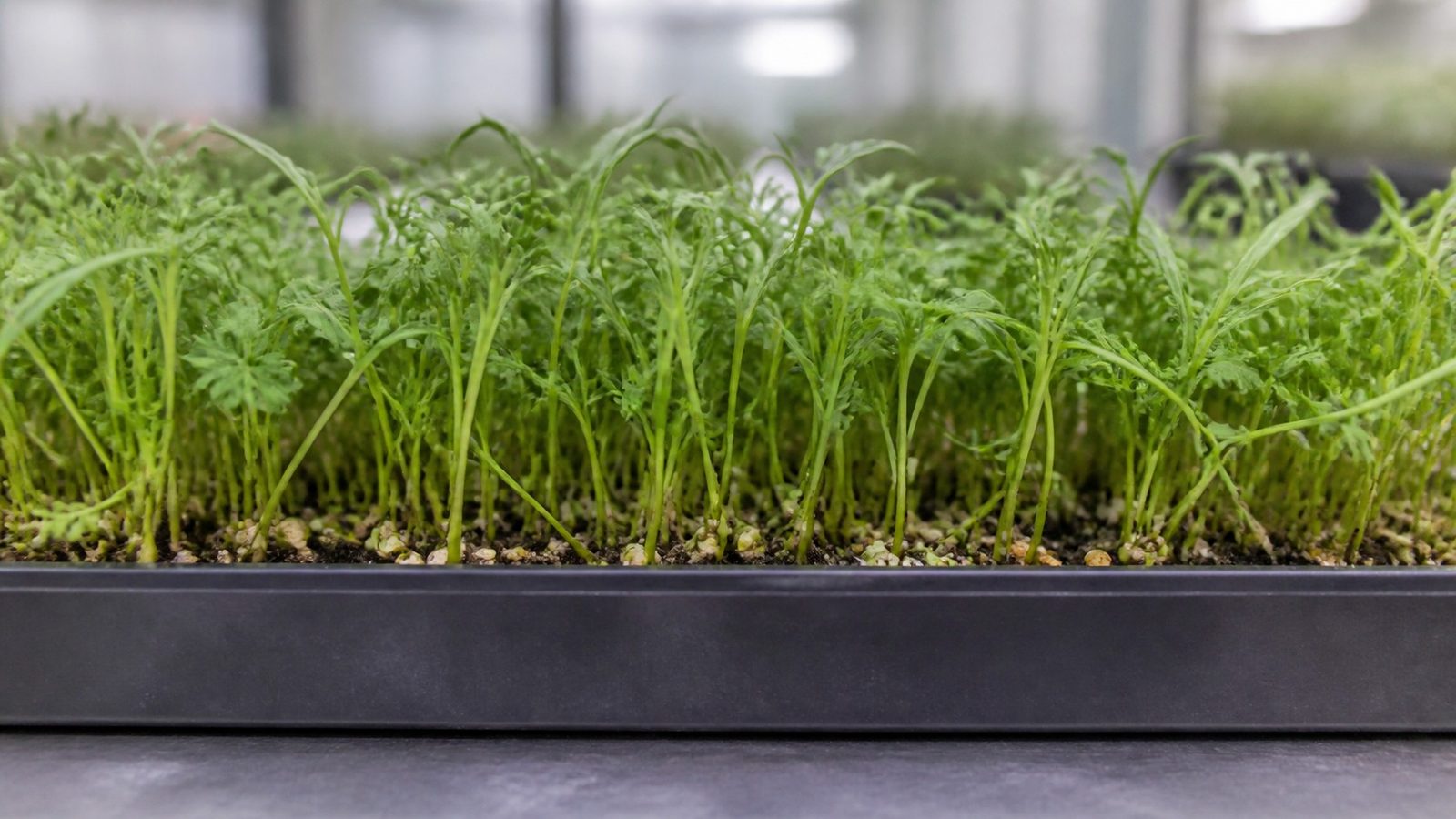
A correct tray reads as tall, slender medium-green stems carrying long, narrow, strap-shaped cotyledons, with the first true leaves coming in scalloped. It will look visibly less even than a brassica tray, and that is not a failure. Cilantro emerges on a staggered schedule because the seed is a husked fruit that usually contains two seeds, so a stand with a spread of heights is what a correct tray looks like. At the medium you should see a dense root mat and a scattering of round tan husks. Nobody publishes a plant height or stem diameter for it, so anyone quoting you one is estimating.
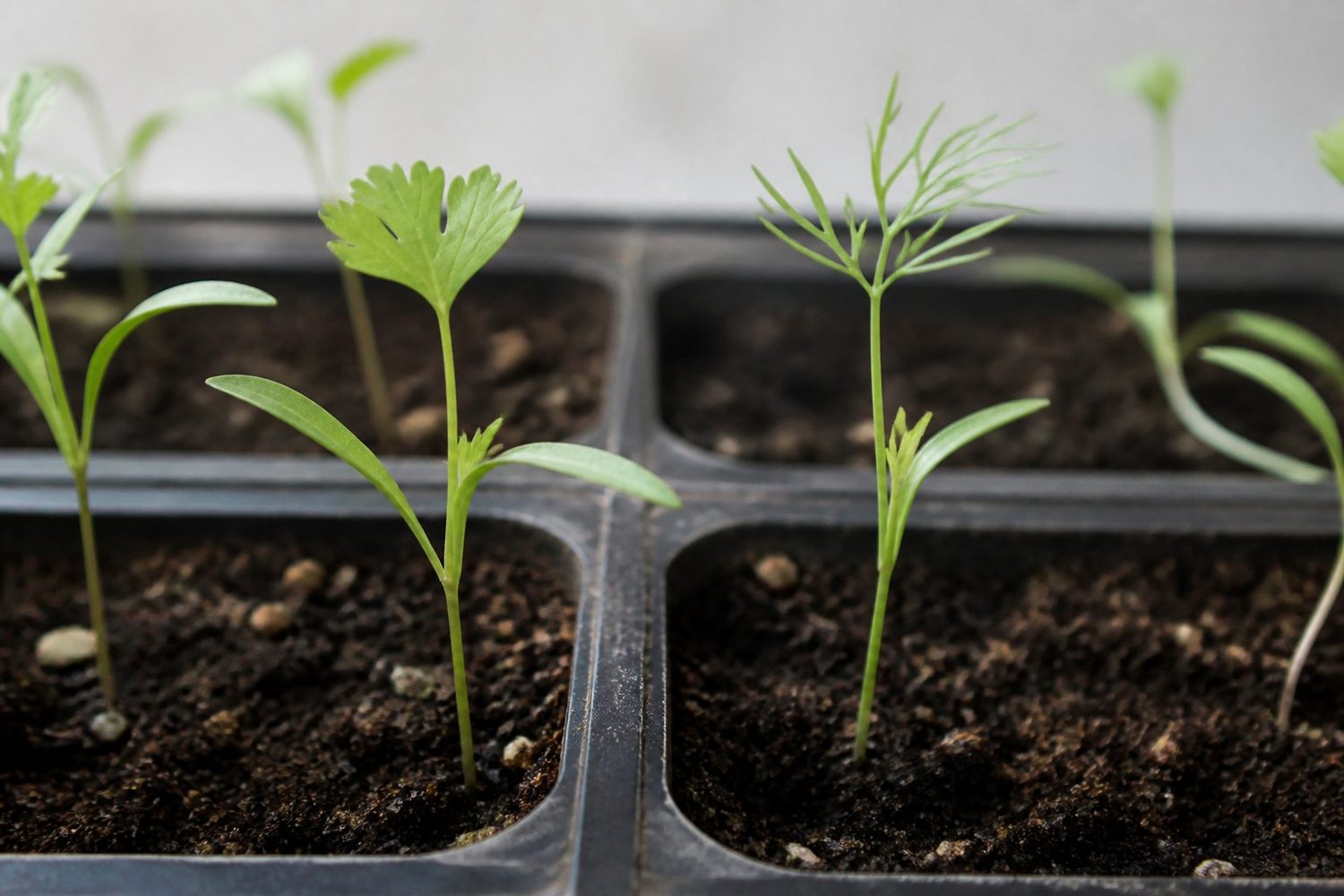
It is confused with dill, and the true leaf settles it instantly. Cilantro's first true leaf is scalloped. Dill's is feathery. That is the whole test, and it is reliable. Do not try to identify either by smell before you cut, because both are aromatic and neither smells like itself at cotyledon stage.
What it tastes like, and what to do with it
Bright, citrusy and unmistakably cilantro. This is not a crop with a subtle herbal hint; it is the herb itself, in a smaller and more tender form. Johnny's positions it for Mexican, Asian and fusion dishes and for fish and seafood, which is exactly right. The one documented flavor lever is timing: taking the tray to day 17 to 21 for fuller, frillier true leaves gives you a little more flavor than cutting at day 13.
Use it where a small amount of bright herb needs to read clearly. It finishes fish and seafood, tacos, salsa verde, rice and grain bowls, pho and other Asian soups. Its slender stems and low bulk make it a flavor layer rather than a base, and it is the wrong crop when you need volume, in which case pea or sunflower does that job and cilantro will just get lost.
And then there is the part no other entry has to deal with. A meaningful share of people experience cilantro as soapy, and the microgreen form does not soften that at all. This is not fussiness. A genome-wide association study of 14,604 people of European ancestry, replicated in a further 11,851, found a variant near a cluster of olfactory receptor genes associated with detecting a soapy taste in cilantro, with OR6A2 the candidate receptor for the aldehydes involved. If your customer is in that group, no growing technique will help you, and offering them something else is better business than trying to convert them. What the study does not establish is what proportion of any particular market that is, so do not extrapolate a number from it.
Using it in the kitchen, and the soap question nobody has settled
Cilantro is the crop where a real proportion of the people you cook for will actively dislike it, and it is the only crop where that objection has a named gene attached. Start there, because it decides whether the rest of this section is any use to you.
Does the microgreen taste soapy too? Two growers, two opposite answers
Some people taste cilantro as soap. The usual explanation is a variant of the OR6A2 receptor gene that makes them more sensitive to the aldehydes in the plant, and it is not a matter of getting used to it.
On whether the microgreen escapes that, the published sources flatly contradict each other:
- One farm says it may be more acceptable, on the grounds that its cilantro microgreens measure lower in aldehydes and higher in floral terpenes than the mature herb.
- One supplier says it will not be, on the grounds that the same flavor chemistry is present and somebody who dislikes mature cilantro will probably dislike this too.
Neither of them ran a tasting. One is a farm describing its own crop and the other is a seller giving a practical opinion, and there is no blinded study on either side. So, the honest answer is that nobody knows, and the practical instruction follows from the uncertainty rather than from a result: if you are cooking for somebody who tastes cilantro as soap, leave it out and put it on the table separately. Do not bury it in a hot dish hoping the heat fixes it. Whether heat changes anything here has never been tested either.
That is worth saying plainly because it is the single most common question about this ingredient, and the two pages a reader will find answer it in opposite directions with equal confidence.
The amounts
Hover or tap a row to highlight it.
| Amount | Dish | When it goes in |
|---|---|---|
| 2 oz | Salsa verde | Blended cold |
| 2 oz, as 1 oz chopped plus 1 oz to top | Guacamole | Half blended, half scattered |
| 2 oz across two bowls, so 1 oz a bowl | Pho | After the broth is ladled, at the table |
| 1 cup | Lime rice | Folded into cooled rice |
| 1/2 cup | Chimichurri with parsley, garlic, vinegar and chili | Blended cold |
| 1/2 cup, packed and divided | Guacamole | Raw |
| 1/4 cup, loosely packed | Tacos | On the cooked filling, after heat |
The pho line is the most useful instruction in the set, because it gives a per-bowl amount and an exact moment: one ounce, after the broth is in. Almost nothing else in this whole category is that specific.
What a tray gives you
A 1020 tray of cilantro is 6 oz from 20 to 26 g of seed at $1.10, which is about 170 grams. So, one tray is:
- Three batches of the 2 oz salsa verde or guacamole.
- Six bowls of pho at an ounce each.
- About 68 servings at the 2.5 g garnish weight, at roughly 1.6 cents of seed each.
The number that matters is not the count but the bench time behind it. Set cilantro against broccoli, the crop most people run beside it: broccoli returns 11.5 oz in 7 to 15 days for 79 cents, against cilantro's 6 oz in 13 to 25 days for $1.10. That is nearly twice the crop, in about half the time, for less money. Cilantro is not expensive because of the seed. It is expensive because it sits on the shelf.
A grower's harvest, and what it says about sowing heavier. One grower reported 120 g off a 10x10 tray sown with 20 g of seed. A 10x10 is half a 1020, so that is double this site's seeding density per unit area, and it returned about 1.4 times the yield. Twice the seed for four tenths more crop is the shape of diminishing returns, and it is about as clear an illustration as you will find of why sowing heavier is rarely the answer.
Heat, and a claim to treat carefully
Every reliable use above is raw, cold-blended, or added after the heat is off. Two growers say so explicitly: best enjoyed raw, added just before serving, and used as a soup or curry garnish at the table rather than during cooking.
One supplier states that heat destroys cilantro aroma above 158°F. That number is stated with no method, no study and no measurement, and it should be read as a seller's assertion rather than a finding. It is plausible, since the aroma is carried by volatile aldehydes and volatiles are what heat drives off, but plausible is not measured. Nobody has run the test. The wider cooking evidence is here.
The instruction is the same either way, and it does not need the number to justify it: the aroma is the entire product, so it goes on at the end.
Buying it and keeping it
Cut cilantro keeps 7 to 10 days, which is middling. Store it unwashed and cold, and wash only what you are about to eat.
Cilantro microgreen seed on Amazon is the convenient route, and the seed section matters here, because cilantro seed is sold split and whole and that decision changes the crop.
If you are deciding whether to grow it at all, the honest comparison is against buying a bunch of mature cilantro, which is cheap and everywhere. This crop earns its bench time on presentation and on a milder, more delicate leaf, not on cost. It is slow, and it is the herb most growers give up on.
Growing it: only what differs from the standard method
Everything general about trays, medium, light and watering is on the standard tray method for growing microgreens. Cilantro departs from it more than any brassica does, and every departure comes back to the same fact: the seed is a big husked fruit and the crop is slow.
Buy split seed, or accept a slower and less even tray. A coriander fruit normally holds two seeds inside a round husk. Split seed has been mechanically divided, and it emerges faster and more evenly than whole seed. This is the single most consequential purchasing decision on the crop and it is not a cultivar question at all.
Soak for 4 to 8 hours if you want faster, more even germination. The commercial method that documents this does not state a water temperature, so use potable room-temperature water rather than inventing a figure. It is optional rather than required, and no source establishes a safe upper limit, so treat long soaks as untested rather than as a technique.
Sow 20 to 26 grams, and level the medium first. Johnny's trial measured 26 g per 1020 at about one flat per ounce of seed. A commercial grower runs 20 to 25 g specifically to avoid the moisture-trapping clumps that are this crop's downfall. Level carefully, because large round fruits roll into low spots and clump there, and a clump is where the mold starts.
Cover the seed thinly, in two layers. The documented method is seed, then just enough coco coir or soil to hide it, lightly pressed and misted. The thin covering is a hull-management tool, not a depth requirement. Nobody publishes a numeric seed depth for cilantro, and burying it is not the answer.
Weight it heavily and expect about six days in the dark. Roughly 10 to 15 lb for about six days is the documented method, which is a heavier and longer blackout than almost any other crop wants. The weight is for strong even rooting and close seed-to-medium contact, not for stretching the crop. Take it off when seedlings visibly push up and small yellow cotyledons appear. Leaving cilantro dark past that point makes it leggy and prone to falling over, and a collapsed stand does not recover.
Keep it cool, and skip the heat mat. This is the one crop here that explicitly wants it cooler: the crop-specific guidance is that cilantro germinates better under 70°F and does not need a heat mat. That is a ceiling rather than a range, and nobody has published an actual cilantro germination range, so aim under 70°F and do not work from a specific optimum you found elsewhere.
Give it more airflow than the schedule suggests it needs. The crop is in the tray for two to three times as long as a brassica, with husks holding moisture the whole time. Airflow is the main control, and no source gives a number for it.
A cilantro tray, day by day
- 1
Day 0, soak
4 to 8 hours in potable room-temperature water. Optional, and it buys faster and more even emergence. Split seed benefits most.
- 2
Day 0, sow in two layers
20 to 26 g on carefully leveled medium, then a thin covering of coco coir or soil just enough to hide the seed, lightly pressed and misted. Level matters: round fruits roll into low spots and clump.
- 3
Days 1 to 6, weighted and dark
About 10 to 15 lb for roughly six days, heavier and longer than almost any other crop wants. Keep it under 70°F and do not put it on a heat mat.
- 4
Day 6 or so, uncover on the signal
When seedlings visibly push up and small yellow cotyledons show. Held longer it goes leggy and falls, and it does not recover.
- 5
Days 7 onward, light and air
Bottom water so the tall stems stay dry and the medium does not splash. Airflow matters more here than on any fast crop, because the husks hold moisture for another fortnight.
- 6
Days 13 to 25, cut
Day 13 is the quick harvest. Day 17 to 21 gives fuller scalloped true leaves and a little more flavor. Johnny's trial averaged 20 days to first true leaf.
What goes wrong with cilantro specifically
Mold is this crop's number one killer, and it is a scheduling problem rather than a hygiene problem. The reason is structural: a long crop cycle plus husked seed plus any clumping gives moisture somewhere to sit for three weeks. High humidity, low airflow and clumped seed are the recurring conditions. Everything below follows from that.
Before emergence: slow, patchy germination. Some fruits sit inert while others come up. The causes are whole seed rather than split, old seed, or uneven moisture. It is partly recoverable if the late seedlings still have room, but the tray finishes uneven either way.
During blackout: retained hulls and mold in the clumps. Wet, tightly packed seed pockets, or fuzzy growth around husks. Trapped moisture and restricted airflow. Small localized patches can be dealt with; a tray with spreading disease cannot.
At uncovering: lanky, falling stems. Stems lengthening without supporting themselves, from blackout held too long or light too far away. Move to light at the push-up signal. A badly collapsed stand will not regain a marketable shape.
After emergence: damping-off. Water-soaked or constricted tissue at the medium line, then collapse. Pythium and Rhizoctonia are the usual agents, and none of this is cilantro-specific except that the long cycle gives it more time to happen.
One diagnostic caution on this crop. The mist test for root hairs against mold, which works on broccoli and radish, is not verified for cilantro by anything opened here, so do not rely on it. Judge by the accompanying signs instead: spreading wetness, rot at or below the medium line, missing seedlings, or collapsed stems mean disease. Fuzz on healthy roots with sound stems and no spread does not.
Hulls stay on, and it is a finishing job. The round husk can ride up on the young plant. It is edible and it is crunchy, and it is not what a customer wants to find. Split seed, an even two-layer sowing, and adequate germination moisture all reduce it. Nobody publishes a retention percentage, so budget cleanup time rather than expecting a number.
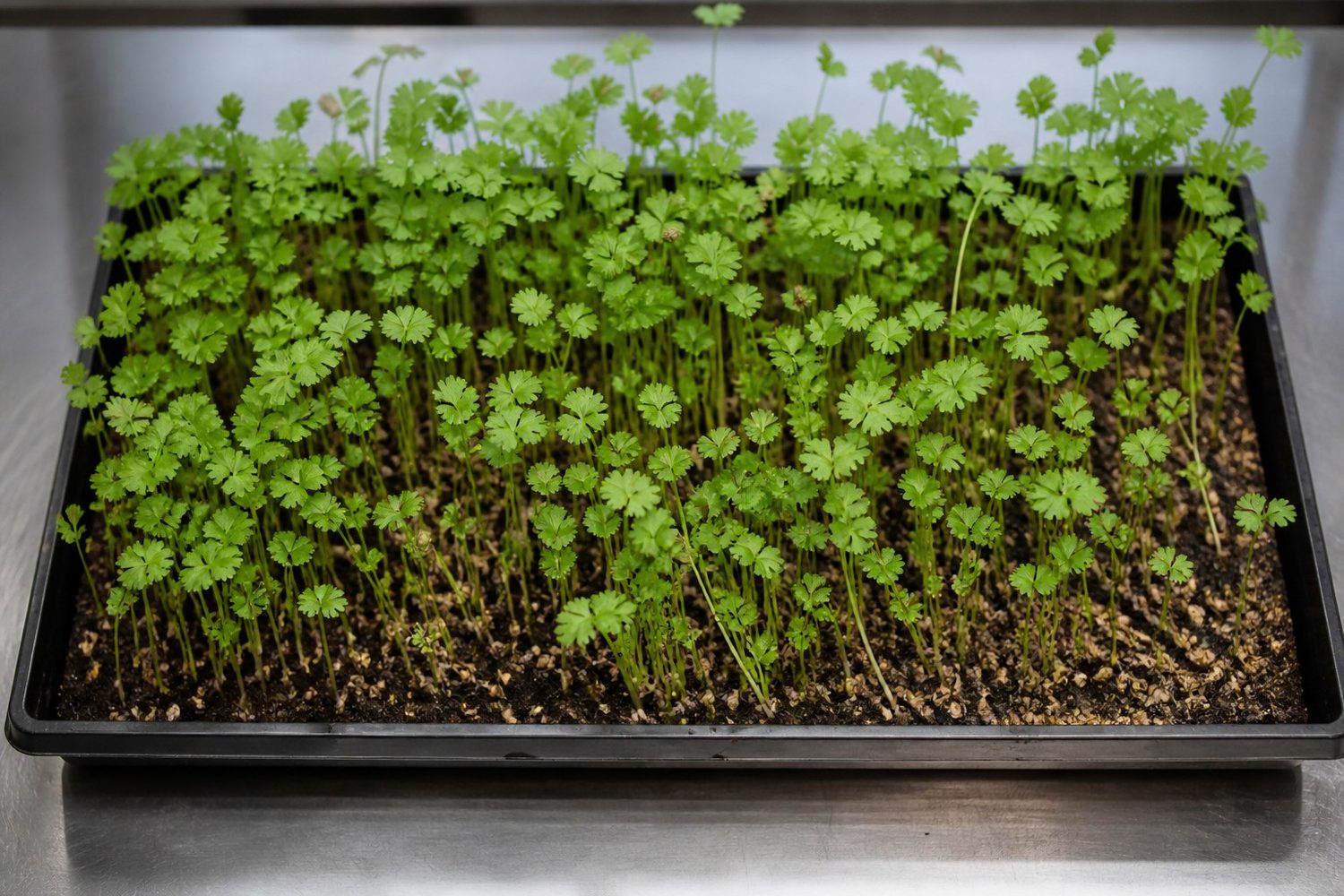
Late is a choice, not a failure. Moving from day 13 to day 17 to 21 gives more developed frilly leaves and stronger flavor. What nobody has measured is a point where the crop turns tough, bitter or unsaleable.
Nutrition, and what is actually established
USDA FoodData Central returns zero results in every data type for both "cilantro microgreens" and "coriander microgreens", searched 2026-08-08. There is no FDC record for this crop as a microgreen, and mature cilantro values are not a stand-in.
But cilantro has something most microgreens do not: a genuine, sourced, positive finding. Xiao and colleagues (2012) analyzed 25 commercially available microgreens for ascorbic acid, carotenoids, phylloquinone and tocopherols, measured on cotyledon leaves on a fresh-weight basis. Cilantro came out highest in carotenoids of all 25: the most lutein plus zeaxanthin, at 10.1 mg per 100 g fresh weight, the most violaxanthin, at 7.7 mg, and 11.7 mg of beta-carotene (Xiao et al., 2012). Its vitamin C, at 40.6 mg per 100 g, sat well below red cabbage's 147.0, the highest in the study. That is a real result, from a peer-reviewed comparison, about this crop specifically.
It is worth being precise about what it is not. These are single-study values per 100 g from one comparison of 25 species, not a milligrams-per-serving figure. What those carotenoids mean for your eyes is its own question. There is also work showing coriander microgreens take up iodine in a dose-dependent way when grown in iodine-enriched nutrient solution, which demonstrates that composition responds to production method and is not a claim that ordinary cilantro microgreens are iodine-rich.
So, the supportable claim is specific: in the one study that compared 25 microgreens head to head, cilantro led on carotenoids, the pigments behind vitamin A and eye health. No composition record exists for its calcium, iron or phosphorus.
Which seed to buy
Seed form is the decision, and it is unusual in being more important than the cultivar.
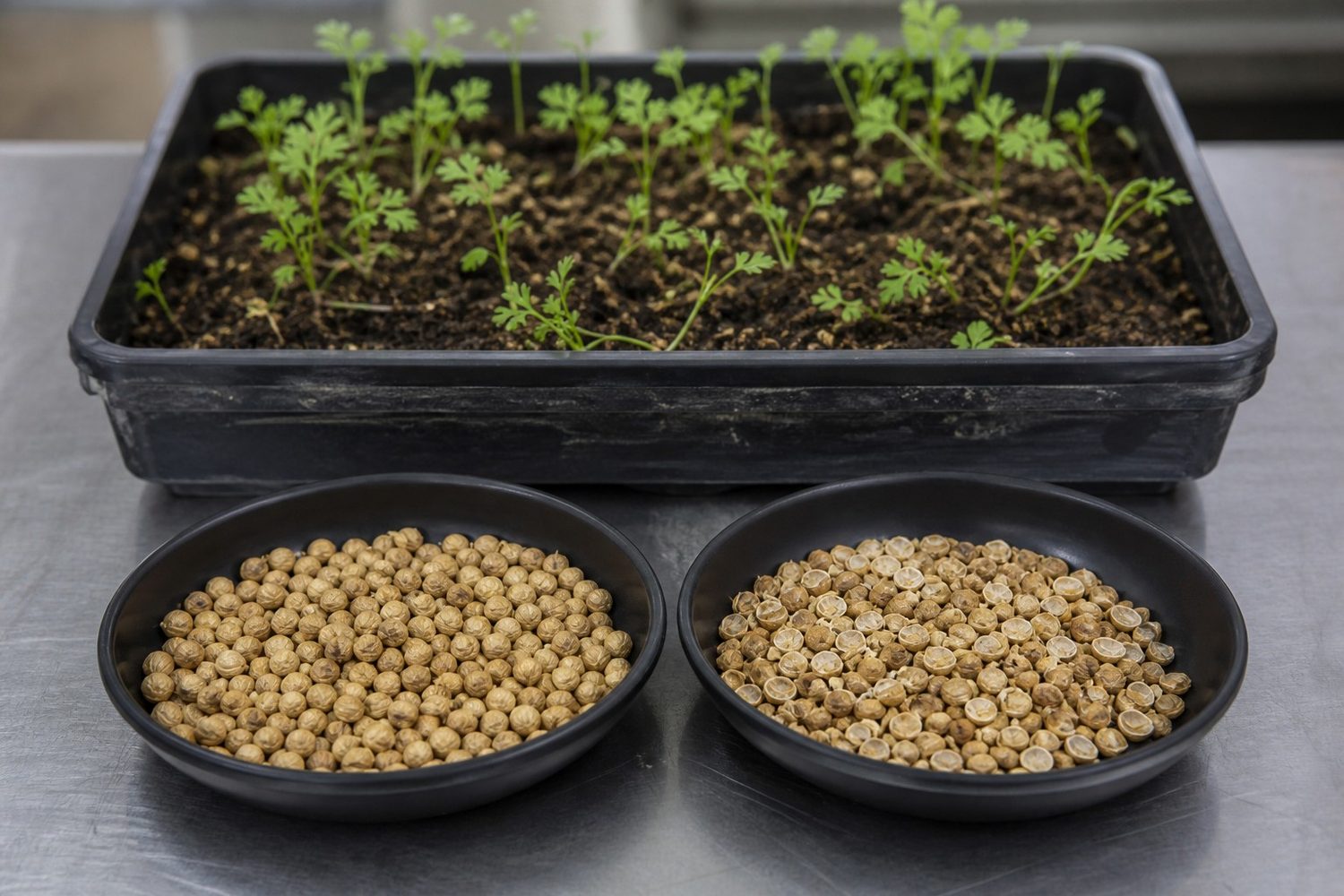
Split seed, sometimes sold as cracked, is coriander fruit mechanically divided so each piece carries one seed. It emerges faster and more evenly, and it reduces the retained-hull problem. Whole seed is the intact husked fruit holding two seeds. It works, and it is slower and less even, and every hull it brings is one you handle later. Monogerm describes seed selected to produce a single seedling. If you are growing cilantro commercially and buying whole seed, you are choosing a harder crop for no benefit anyone has documented.
Split or whole? The decision in five lines
Hover or tap a card to highlight it.
What the seed actually is
A coriander fruit is a husked shell that normally holds TWO seeds. Split seed has been mechanically divided so each piece carries one.
What splitting buys
Faster and more even emergence, which on a crop that emerges over several days is the difference between a stand and a patchwork.
What it also buys
Fewer retained husks riding up on the plants, so less finishing labor and less crunch in the pack.
What whole seed costs you
A slower, less even tray, more hulls, and more moisture-trapping clumps, on the crop whose growers already call mold its number one killer.
The cultivar question, honestly
Leisure and Santo are both sold, and no opened source measures stem length, color, days or yield for either. Choose the seed FORM on evidence and treat the cultivar as untested.
Specify Coriandrum sativum sold for microgreens or food use, name the seed form, ask for the lot number and germination percentage with test date where the supplier publishes them, and require untreated and uncoated seed. Penn State is explicit about why: dyes, fungicides and insecticides applied to seed may be present in the young shoots, and the shoots are the product.
A bad lot on this crop looks like slow scattered emergence rather than an even canopy, which is exactly what whole seed and uneven moisture also look like. That ambiguity is the real cost: you get a mixed-age tray where some plants are ready and late seedlings are still occupying space, and you cannot easily tell whether to blame the seed, the sowing or yourself.
Cilantro microgreen seed on Amazon is the convenient route for a home grower. If you are selling, buy where the seed form and the lot are both named.
Is it worth growing?
For most people, no, and it is worth saying that plainly before you spend three weeks finding out.
The numbers are not close. Cilantro returns 6 oz from a tray in about 20 days. Broccoli returns 11.5 oz in 12.5 days from the same tray at less seed. On rack turnover, the currency that actually matters when your constraint is bench space, cilantro produces 0.30 oz per tray-day against radish's 1.21. It is a quarter of the crop per day of rack time, and it carries about the highest mold risk of any microgreen while it sits there.
It is worth growing for exactly one reason, and it is a good one: nothing else tastes like it. No brassica substitutes for cilantro on a taco or beside a piece of fish. If a chef or a market customer asks for cilantro by name, the crop pays because they are not asking for greens, they are asking for that flavor, and you are the person who has it. That is the market grower on r/microgreens explaining why he carries cress: a few customers are looking forward to it, and that is why he has it.
So: grow it if you are selling flavor and presentation to people who requested it, and price it from the measured 6 oz rather than from optimism. Do not grow it as a first tray, because the failure modes are slow to appear and expensive to learn from. Do not grow it speculatively hoping it moves, because 20 days of bench space is a lot to gamble.
Its real competitor for the slot is not another herb but a fast brassica, and the brassica wins on every axis except the only one that matters here. Against dill, the other fine Apiaceae garnish, the choice is flavor and leaf shape rather than economics; dill is not a visual substitute and does not taste remotely the same.
A note on the numbers above
Hover or tap a row to highlight it.
| Figure | Value | Source | What kind of number it is |
|---|---|---|---|
| Seed per 1020 | 26 g | Johnny's 2017 trial | Measured, at first true leaf |
| Seed per 1020 | 20 to 25 g | On The Grow protocol | Commercial practice, to avoid clumping |
| Yield per 1020 | 6 oz | Johnny's 2017 trial | Measured, at first true leaf, three-plus seedings |
| Days to harvest | 20 average | Johnny's 2017 trial | Measured, to first true leaf |
| Days to harvest | 16 to 25 | Johnny's product page | Published range |
| Days to harvest | 13, or 17 to 21 | On The Grow protocol | A harvest CHOICE: speed against fuller leaf |
| Days to harvest | 10 | A TikTok pitching the crop | Below every documented figure |
| Soak | 4 to 8 hours | On The Grow | No water temperature stated |
| Blackout | About 6 days, 10 to 15 lb | On The Grow | The longest and heaviest in this directory |
| Germination temperature | Better under 70°F | On The Grow | A CEILING, and no range published |
| Shelf life | 7 to 10 days | On The Grow | Unwashed, breathable container, no temp stated |
| Harvest window | No published figure | Nobody | Day 13 vs 17 to 21 is a choice, not a window |
| Seed cost per 1020 | $1.10 | Calculated, Johnny's price | 26 g at $19.25/lb, listed 2026-08-08 |
The provisional correction runs the same way as every other crop so far, 50 to 70 g down to a measured 26. What is different here is the yield: the old page said 6 to 10 oz and the measured figure is 6, so the bottom of the old range was right and the top of it was aspiration. On a crop this slow, the difference between 6 and 10 ounces is the difference between a tray that pays and one that does not.
Two fields are blank on purpose, and the temperature one is unusual. Nobody has measured how long a cilantro tray holds a good cut, so the harvest window is unpublished. And there is no published germination range for cilantro at all: the single crop-specific finding is a ceiling, that it does better under 70°F and wants no heat mat, and turning the generic 65 to 75°F microgreen guidance into a cilantro optimum would be manufacturing a number. The ceiling is the useful part anyway, because it makes cilantro the one crop here you should deliberately keep cool.
The ten-day claim deserves one more sentence. Every documented source puts this crop at 13 days at the absolute earliest and 16 to 25 as the normal band. A ten-day cilantro harvest is not a technique anyone has published, and the post making the claim was the widest-reaching cilantro content of the month.
Hover or tap a row to highlight it.
| Crop | Seed per 1020 | Yield | Days | Cost per tray | Oz per $1 | Oz per tray-day |
|---|---|---|---|---|---|---|
| Chervil | 18.9 to 20 g | 3 to 5 oz | 9 to 12 | $1.00 | 4.0 | 0.38 |
| Cilantro | 26 g | 6 oz | 20.0 | $1.10 | 5.4 | 0.30 |
| Parsley, Italian flat-leaf | 15 to 20 g | 6.25 oz, area-converted | 21 to 35 | $0.50 to $0.66 | 9.5 to 12.5 | 0.30 at 21 days |
| Dill | 10 g | 3 to 5 oz | 15 to 20 | $0.52 | 7.7 | 0.23 |
| Carrot | 6.2 to 9.4 g | 2.0 oz | 20.0 | $0.44 to $0.66 | 3.0 to 4.5 | 0.10 |
All 62 crops, sortable, on the microgreen comparison.
The two columns disagree, and that disagreement is the most useful thing in this table. Ranked by seed cost, mizuna wins outright at about 25 oz per dollar and radish looks poor at 5.7. Corrected twice as the table grew: this sentence named broccoli at 14.5 when eleven crops were researched, arugula took it at 20.8, and mizuna took it on 2026-08-09. Ranked by rack time, radish wins at 1.21 oz per tray-day and broccoli drops to 0.92. Both are true. Radish is expensive in seed and cheap in time; broccoli is cheap in seed and slower to clear the bench. Which one you should grow depends entirely on whether your binding constraint is seed budget or bench space, and nobody in this category tells you that, because nobody has researched enough crops to the same standard to notice.
Cilantro is the one crop that loses on both columns, 5.4 oz per dollar and 0.30 oz per tray-day, and it is still worth growing for the reason above. Prices move, so the dollar column is dated rather than permanent. The rankings are the durable part.
Terms on this page
Tap a term to see what it means.
Coriander fruit. What you are actually sowing. A round husked shell that normally holds two seeds, which is why cilantro emerges unevenly and sheds hulls.
Sources
- Johnny's Selected Seeds, cilantro microgreen seed - Coriandrum sativum, open-pollinated with no cultivar stated, 16 to 25 days, positioning for Mexican, Asian and fusion dishes and for fish and seafood, the generic 75°F then 60°F growing information, and the $19.25/lb price behind the cost calculation, listed 2026-08-08.
- Johnny's microgreens yield trial results (PDF) - cilantro at 26 g per 1020, 6 oz average yield, 20 days to first true leaf, about one flat per ounce of seed, and the rounding and variation caveats.
- Johnny's microgreens yield trial, method and discussion - the 2017 greenhouse method, first-true-leaf harvest standard, and the warning that one grower's yields are unlikely to translate to another system.
- On The Grow, how to grow cilantro microgreens - split against whole seed and their emergence difference, 20 to 25 g per 1020, the 4 to 8 hour soak, the two-layer thin covering, roughly 10 to 15 lb for about six days, the push-up and yellow-cotyledon removal signal, better germination under 70°F with no heat mat, day 13 against day 17 to 21, mold as the crop's number one killer, retained husks, twice-daily bottom watering in coco coir, 7 to 10 days refrigerated unwashed, and no second cut.
- Harris Seeds, microgreens - Leisure and Santo sold as named cilantro cultivars, with no microgreen performance comparison published.
- Penn State Extension, The ABCs of Microgreens - the 7 to 8 day figure for common brassicas that sets cilantro's slowness in context, checking lot number and germination test date, and why treated seed is unacceptable on a crop eaten as young shoots.
- Penn State Extension, a step-by-step guide for growing microgreens at home - the default sowing method cilantro departs from, the general 8 to 12 hour presoak for hard-shelled seed, and washing immediately before use because washing shortens shelf life.
- Virginia Tech Extension SPES-756 (PDF) - general microgreen production environment and airflow, and damping-off as the leading disease concern.
- SDSU Extension, growing microgreens at home - untreated seed requirements for a crop eaten raw.
- UC IPM, damping-off - Pythium and Rhizoctonia, pre- and post-emergence death, and symptoms at or below the medium line.
- Xiao et al., 2012, Journal of Agricultural and Food Chemistry - 25 commercially available microgreens analyzed for ascorbic acid, carotenoids, phylloquinone and tocopherols on cotyledon leaves, fresh-weight basis, with cilantro highest of the 25 in lutein plus zeaxanthin (10.1 mg per 100 g) and violaxanthin (7.7 mg), 11.7 mg of beta-carotene, and 40.6 mg of ascorbic acid against red cabbage's leading 147.0.
- Ciriello et al., 2023, iodine biofortification of microgreens - dose-dependent iodine enrichment of coriander and three other microgreen species at 4 and 8 µM, demonstrating that composition responds to production method.
- Eriksson et al., 2012, Flavor - a genome-wide association study of 14,604 participants replicated in 11,851 more, a variant near olfactory receptor genes associated with soapy-taste detection, and OR6A2 as the candidate receptor.
- USDA FoodData Central - searched 2026-08-08 for both cilantro microgreens and coriander microgreens, zero results in every data type.
Keep reading
The variety directory
Basil microgreens
Basil is the slow one: 19 to 25.5 days to first true leaf against a brassica's twelve, on 6.5 g of seed, and the purple cultivars cost you another week. Three cultivars, three sets of measured numbers.
Read Basil microgreensThe variety directory
Nasturtium microgreens
A three-week tray that returns 5.64 oz and costs $5.74 of seed, so it earns its keep as a garnish and not by weight. Also the crop whose own name belongs to a different plant: search nasturtium in USDA's database and you get watercress.
Read Nasturtium microgreensThe variety directory
Fennel microgreens
The only umbellifer anybody measured, and the measurement is brutal: about 1 oz after 25 days, 0.04 oz per tray-day, on seed that costs more than most. Grown for aroma, not for weight.
Read Fennel microgreensThe variety directory
Shiso microgreens
A slow, light, expensive tray bought for aroma rather than weight: 11.5 g in, 6.5 oz out, sixteen days, $3.94 of seed. Cut it at first true leaf, because cotyledons throw away most of the wait.
Read Shiso microgreens