Microgreens and Eye Health: What the Lutein Numbers Show
Cal HewittPublished Checked
- health
- nutrition
- evidence
Disclosure: Microgreens Guru may earn a commission or a sale when you buy through some links on this site. It does not change what we write about a product.
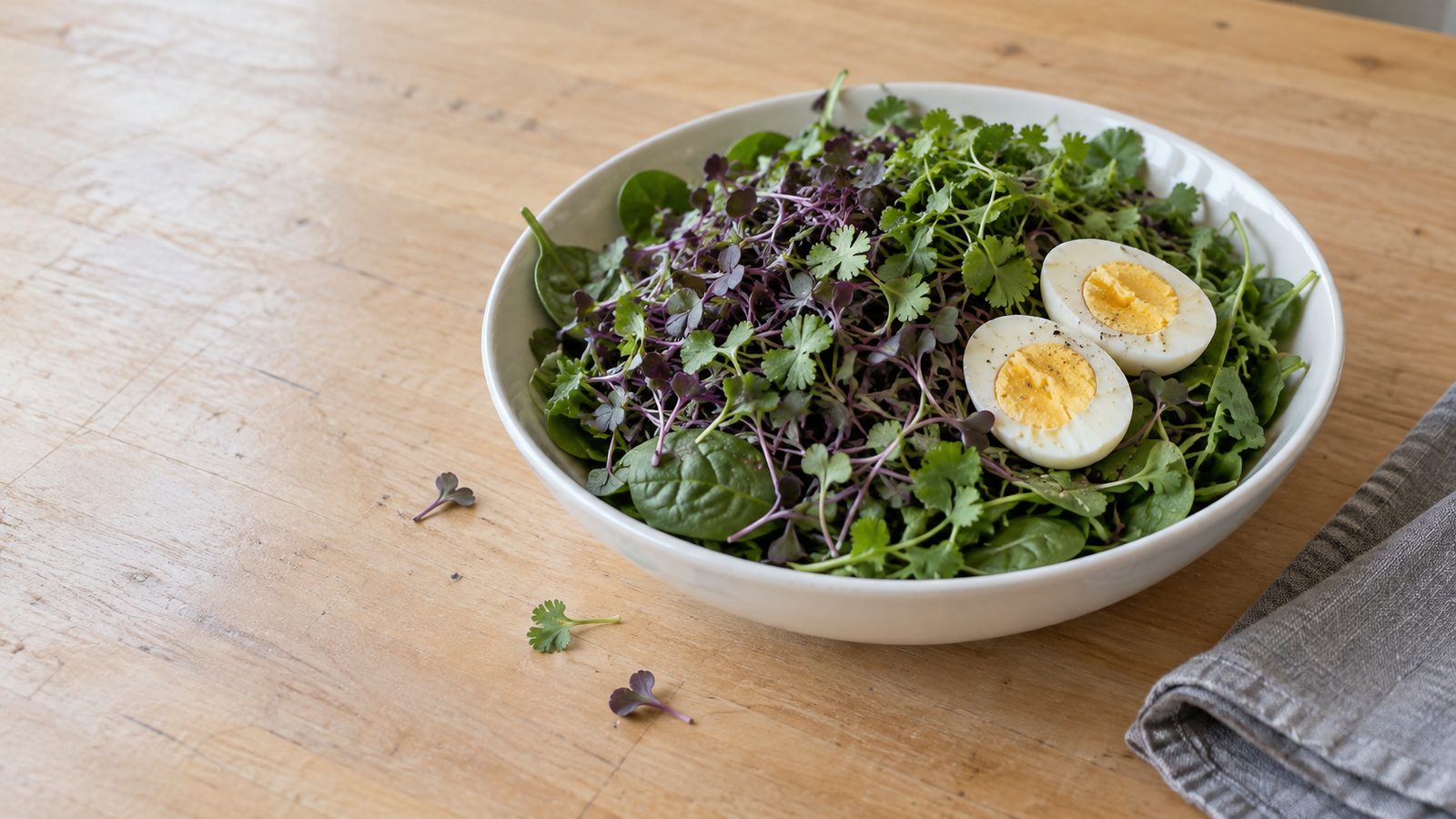
Microgreens do carry lutein and zeaxanthin, the two plant pigments that collect in the macula of your eye. In the one study that measured them, cilantro microgreens came out highest at 10.1 mg per 100 g fresh weight. A normal serving of 10 to 30 g gives you about 1 to 3 mg, which is less than the 12 mg in the AREDS2 supplement, and raw mature spinach carries more per gram than any microgreen measured. No human study has yet tested whether eating microgreens changes anything in the eye. If you have macular degeneration, or a family history of it, your eye doctor is the person to plan with; what follows is the arithmetic so you can judge scale for yourself.
The one study that measured lutein in microgreens
Every crop figure on this page comes from a single paper: Xiao, Lester, Luo and Wang, from the University of Maryland and the USDA Agricultural Research Service, published in the Journal of Agricultural and Food Chemistry in 2012. The team tested 25 commercially grown microgreens, all bought from one grower in San Diego between May and July 2011. Most were grown in soil in an unheated greenhouse under ordinary daylight, and they were cut without roots and shipped overnight on ice.
That is worth holding onto as you read the numbers. One grower and one season means each figure is a single data point for that crop, grown one way, measured once in 2011. Your own tray, grown under your lights with your seed, could come out higher or lower, and nobody has published a current set of measurements to check it against.
The lab method also could not separate lutein from zeaxanthin, so the paper reports the two together. The results, in mg per 100 g fresh weight, as the mean plus or minus standard error of three samples (study PDF):
Hover or tap a row to highlight it.
| Crop | Lutein + zeaxanthin, mg/100 g fresh weight |
|---|---|
| Cilantro | 10.1 ± 0.3 |
| Red sorrel | 8.8 ± 0.2 |
| Red cabbage | 8.6 ± 1.0 |
| Garnet amaranth | 8.4 ± 0.1 |
| Peppercress | 7.7 ± 0.4 |
| Pea tendrils | 7.3 ± 1.2 |
| Green basil | 6.6 ± 0.3 |
| Wasabi | 6.6 ± 0.3 |
| Purple mustard | 6.4 ± 1.9 |
| Opal radish | 5.5 ± 0.9 |
| Red beet | 5.5 ± 0.0 |
| Arugula | 5.4 ± 0.2 |
| Opal basil | 5.3 ± 0.3 |
| Mizuna | 5.2 ± 0.3 |
| Celery | 5.0 ± 0.1 |
| China rose radish | 4.9 ± 0.4 |
| Red mustard | 4.9 ± 0.3 |
| Green daikon radish | 4.5 ± 0.1 |
| Bull's blood beet | 4.3 ± 0.7 |
| Sorrel | 4.2 ± 0.8 |
| Purple kohlrabi | 4.0 ± 0.1 |
| Red orach | 3.9 ± 0.2 |
| Magenta spinach | 3.2 ± 0.2 |
| Golden pea tendrils | 2.7 ± 0.0 |
| Popcorn shoots | 1.3 ± 0.1 |
If lutein is your reason for growing, the top of that list is where to start: cilantro, red sorrel, red cabbage and garnet amaranth. The two crops grown in the dark, golden pea tendrils and popcorn shoots, sit at the bottom. These are amounts in the plant, not amounts your body absorbs, and not a measure of any eye benefit. For how these crops rank on other nutrients, see which microgreen is most nutritious.
How that compares with mature spinach and other vegetables
Against their own grown-up versions, the top microgreens look strong. The study set its cilantro microgreens (10.1 mg) beside the USDA's value for mature cilantro (0.9 mg per 100 g), about 11.2 times as much, and its red cabbage microgreens (8.6 mg) beside mature red cabbage (0.3 mg), about 28.6 times as much. Those mature values came from a database, not from plants grown alongside the microgreens, so they show a difference between two datasets rather than a rule for every crop. For how far that kind of multiple stretches, see the 40 times figure.
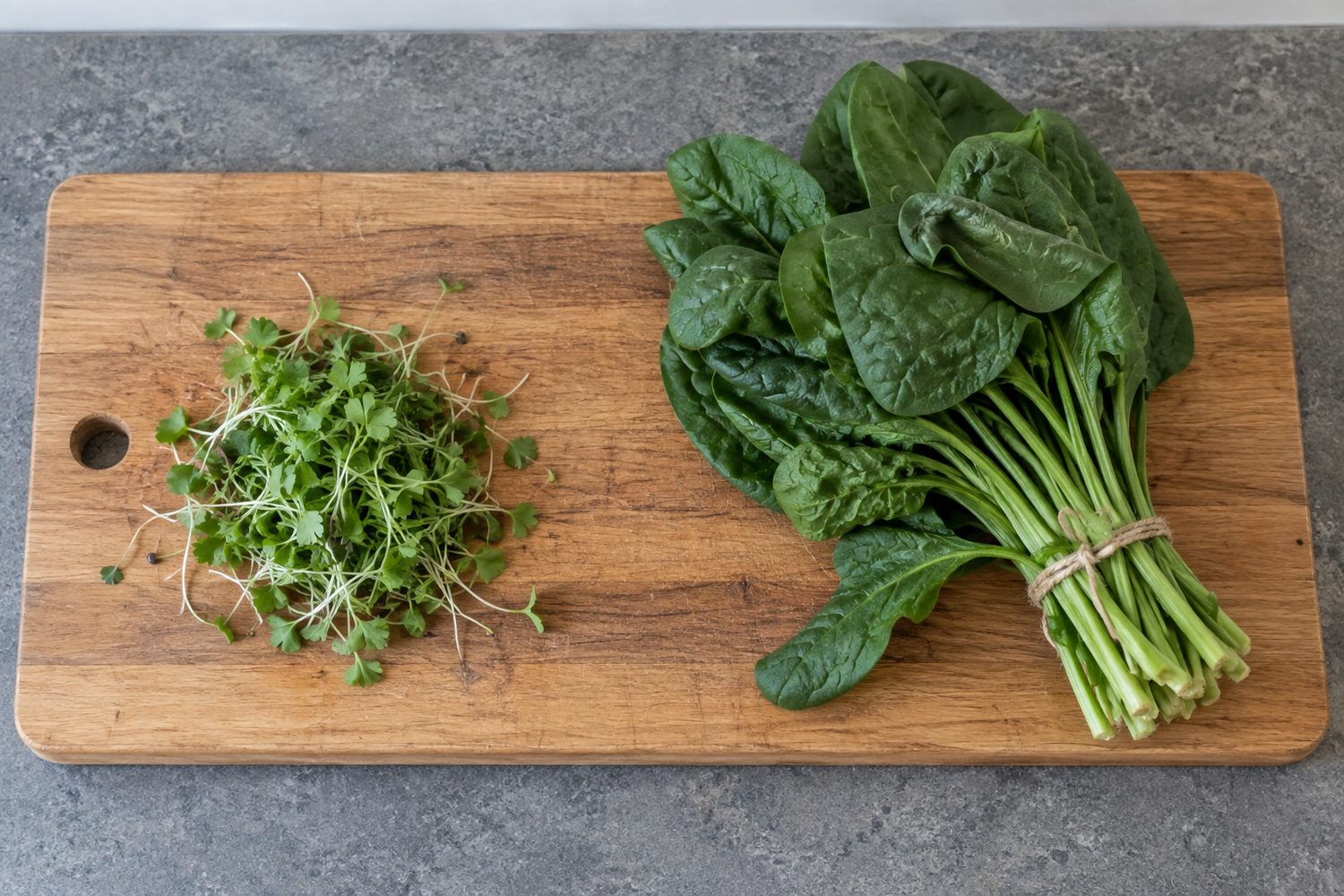
Spinach is the comparison that matters most for eyes, because it is the leafy green most people already know for lutein. The USDA's current SR Legacy value for raw spinach is 12.2 mg of lutein plus zeaxanthin per 100 g. That is above every one of the 25 microgreens measured, including cilantro. Microgreens are a good lutein food, but on these numbers they are not the richest one, and a bag of ordinary spinach from the grocery store holds more per gram.
Beta carotene, the other carotenoid in the table
The same study measured beta carotene, which your body can turn into vitamin A. Lutein and zeaxanthin cannot be turned into vitamin A; they are a separate group. Red sorrel had the most beta carotene, 12.1 mg per 100 g, with cilantro, red cabbage and peppercress close behind. Golden pea tendrils and popcorn shoots had the least, 0.6 mg each.
Hover or tap a row to highlight it.
| Crop | Beta carotene, mg/100 g fresh weight |
|---|---|
| Red sorrel | 12.1 ± 0.6 |
| Cilantro | 11.7 ± 1.1 |
| Red cabbage | 11.5 ± 1.2 |
| Peppercress | 11.1 ± 0.6 |
| Garnet amaranth | 8.6 ± 0.3 |
| Wasabi | 8.5 ± 0.2 |
| Green basil | 8.4 ± 0.4 |
| Pea tendrils | 8.2 ± 1.1 |
| Red beet | 7.7 ± 0.1 |
| Mizuna | 7.6 ± 0.4 |
| Arugula | 7.5 ± 0.4 |
| Golden pea tendrils | 0.6 ± 0.0 |
| Popcorn shoots | 0.6 ± 0.1 |
For red cabbage, the size of the gap over the mature vegetable depends on which mature figure you use. The USDA value for raw red cabbage is 0.670 mg per 100 g, which puts the microgreen at about 17 times as much. The study compared against a much lower figure from a 2006 paper, so its gap came out far larger. For cilantro, the USDA value for raw leaves (3.93 mg) gives about 3 times as much, matching the study.
The paper did not report vitamin A activity for any crop; the FAQ below works through an estimate.
What a serving actually gives you
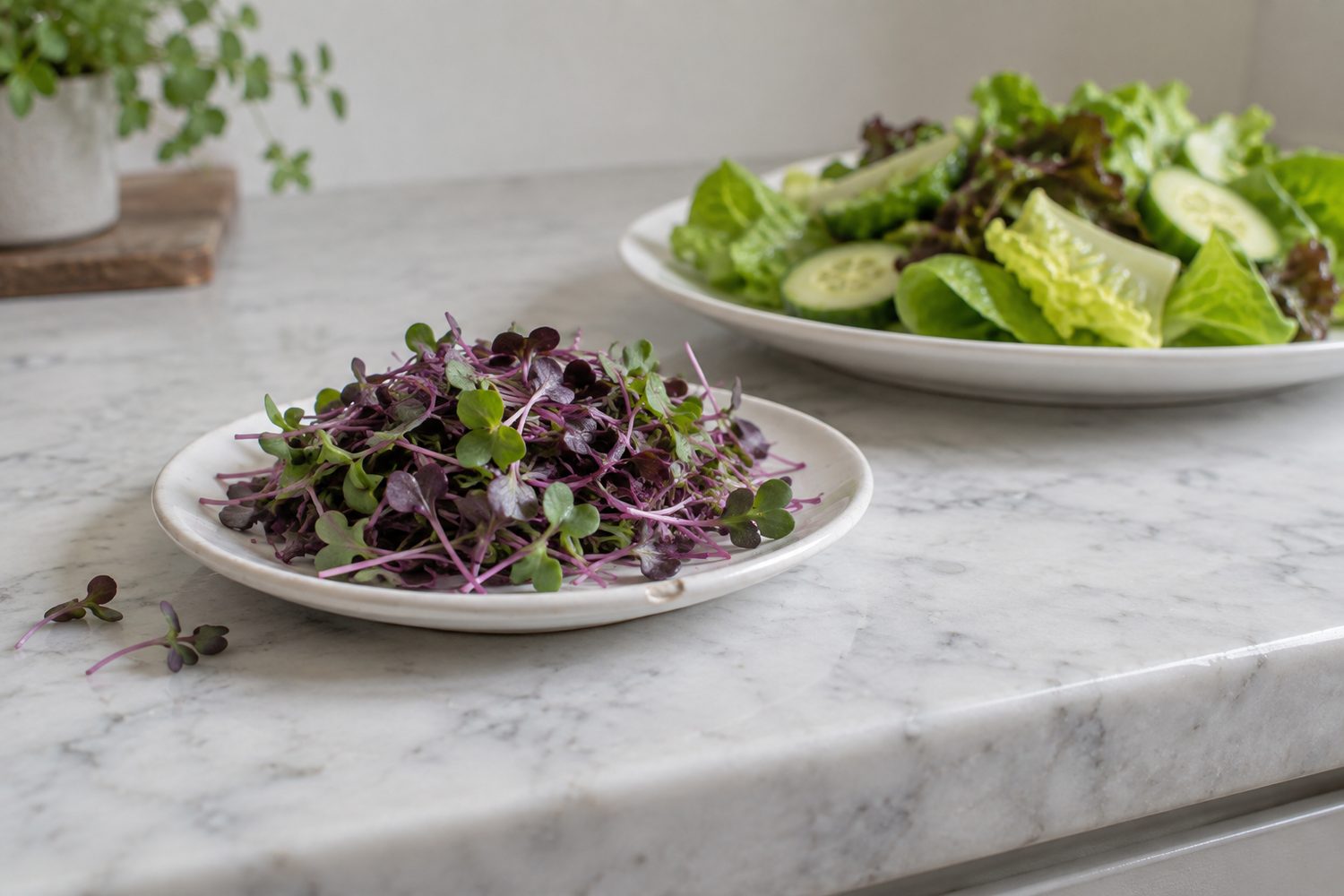
The table below gives the lutein plus zeaxanthin in 10, 20 and 30 g of the three highest crops, worked from the 2012 figures, with raw mature spinach at the USDA value for scale. Weigh a serving on your own kitchen scale once and you will know which row you are eating; serving size and cost has more on what those weights look like on a plate.
Hover or tap a row to highlight it.
| Food | 10 g | 20 g | 30 g |
|---|---|---|---|
| Cilantro microgreens (10.1 mg/100 g, 2012 study) | 1.01 mg | 2.02 mg | 3.03 mg |
| Red sorrel microgreens (8.8 mg/100 g, 2012 study) | 0.88 mg | 1.76 mg | 2.64 mg |
| Red cabbage microgreens (8.6 mg/100 g, 2012 study) | 0.86 mg | 1.72 mg | 2.58 mg |
| Raw mature spinach (12.2 mg/100 g, USDA SR Legacy) | 1.22 mg | 2.44 mg | 3.66 mg |
To do it for any other crop, take its figure from the first table, multiply by your serving in grams and divide by 100. Purple mustard at 6.4 mg, for example, gives 1.28 mg in 20 g.
These are amounts in the food before chopping, digestion and absorption, and before the differences between one person and the next. For scale, 30 g of cilantro microgreens holds about a quarter of the 12 mg of lutein plus zeaxanthin in the AREDS2 supplement. Americans are estimated to eat about 1 to 2 mg of lutein a day, according to a 2017 review of lutein food sources, so a 20 g handful of cilantro microgreens adds about as much again as a typical day's intake. For how much to eat in general, see how much microgreens per day.
What the AREDS2 trial found
AREDS2 was a National Eye Institute trial of a supplement, not a food. It enrolled 4,203 adults aged 50 to 85 who already had intermediate macular degeneration in both eyes, or intermediate in one eye and advanced in the other. People without macular degeneration or with only early signs were left out, because the first AREDS trial had shown no benefit for them. Among other things, AREDS2 tested 10 mg of lutein plus 2 mg of zeaxanthin a day.
The headline result, in NEI's words: "adding omega-3 fatty acids or lutein + zeaxanthin to the AREDS formula had no additional overall effect on the risk of advanced AMD." The benefit showed up in a narrower comparison. NEI's AREDS2 FAQ reports that, in the trial, people who took a formula with lutein and zeaxanthin and no beta carotene had an 18% lower risk of progressing to advanced macular degeneration than people who took the original formula with beta carotene. Among the people who ate the least lutein and zeaxanthin in their diets, those given the supplement had a 26% lower risk. A 2023 Cochrane review describes these as exploratory subgroup results, and across 26 studies it concluded that lutein, with or without zeaxanthin, may have little or no effect on progression to late macular degeneration, though it may be a suitable replacement for beta carotene in the formula.
NEI is direct about food and supplements. Its FAQ asks whether diet alone can provide the same levels as the AREDS or AREDS2 formulas, and answers "No." The formula is a specific high-dose mix of vitamin C, vitamin E, zinc, copper, lutein and zeaxanthin. A plate of microgreens is not a substitute for it, and a supplement dose is not a target you need to reach with food.
What food studies show
The evidence about lutein from food is observational: it compares what people eat with what happens to their eyes, without assigning anyone a diet. A 2017 narrative review by Eisenhauer and colleagues reports a 2012 pooled analysis of six cohort studies by Ma and colleagues. People with the highest dietary lutein and zeaxanthin, compared with the lowest, had a relative risk of 0.74 for late macular degeneration and 0.68 for the wet (neovascular) form, and no clear difference for early macular degeneration (0.96, with a range running from 0.78 to 1.17). People who eat more leafy greens may also smoke less or eat better overall, so these figures show an association, not proof that a particular food protects the eye. NEI's FAQ says the same thing in plainer terms: earlier studies suggested that people whose diets are rich in green, leafy vegetables have a lower risk of developing macular degeneration.
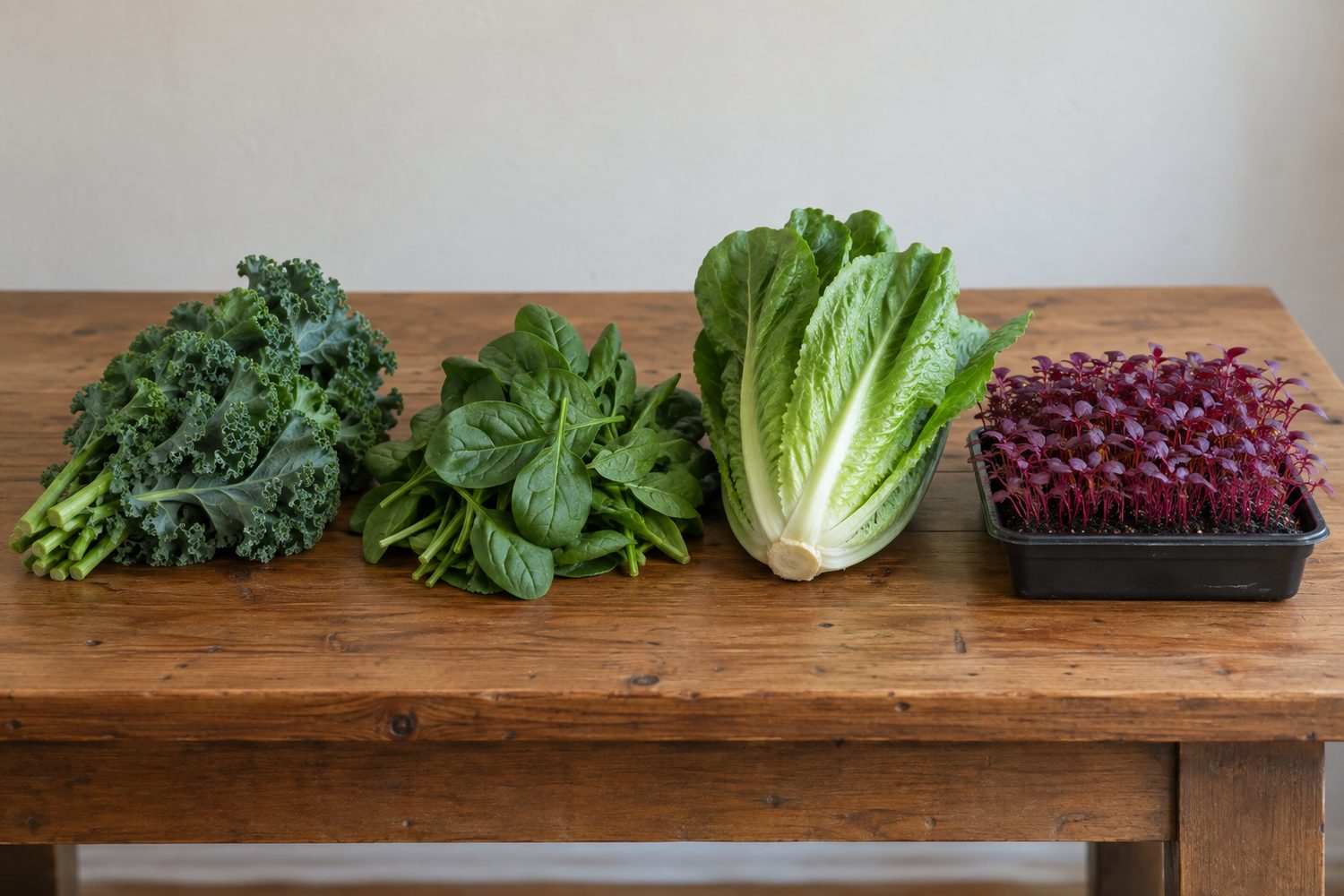
On the amount question, supplement trials in people with macular degeneration have mostly used 10 or 20 mg of lutein a day. A 2019 meta-analysis of nine such trials found macular pigment rose faster at 20 mg than at 10 mg. In people with healthy eyes, a 2021 meta-analysis found macular pigment rose at 5 mg a day and above, but intakes under 5 mg, mostly from diet, did not produce a clear change over 3 to 6 months. Macular pigment is a measurement in the eye, not vision or disease. No dietary amount has been shown to prevent macular degeneration, so there is no food target to hit; what you can do is eat lutein-rich greens as part of a normal diet and leave dosing decisions to your eye doctor.
Microgreens themselves have not been tested on eyes
No human study has measured eye outcomes, or even blood lutein, after people ate microgreens. Two small studies have fed people microgreens. One gave 11 healthy adults a single serving of broccoli microgreens and measured sulforaphane and gut bacteria (Bouranis et al., 2023). The other gave 26 middle-aged and older adults 2 cups a day of bull's blood beet or red cabbage microgreens for two weeks each and measured tolerance, blood vessel function and gut bacteria (Lee et al., 2025). Neither measured carotenoids or eyes.
The only figure on how much carotenoid gets out of microgreens during digestion comes from a lab dish, not a person. In a simulated digestion, de la Fuente and colleagues (2019) found under 0.15% of total carotenoids became available from hydroponic broccoli, kale, red mustard and radish microgreens. The authors note this may reflect the digestion method they used, and it did not measure lutein separately. Until someone runs a feeding study, treat the tables above as what is in the leaf, and nothing more. If you are an older reader thinking about microgreens more broadly, microgreens for seniors covers the rest of what they offer an older eater.
Does eating fat with them help?
It depends on the fat, and the one meal study that tested this did not use microgreens. In a Japanese study of 18 healthy adults (Takeda et al., 2009), blood lutein and zeaxanthin did not change after broccoli alone. Broccoli with mayonnaise raised them over the whole post-meal period, measured against broccoli alone. Broccoli with oil did not come out statistically different from broccoli alone. So, on that evidence, the kind of fat mattered, and no simple rule about dressing a salad follows from it.
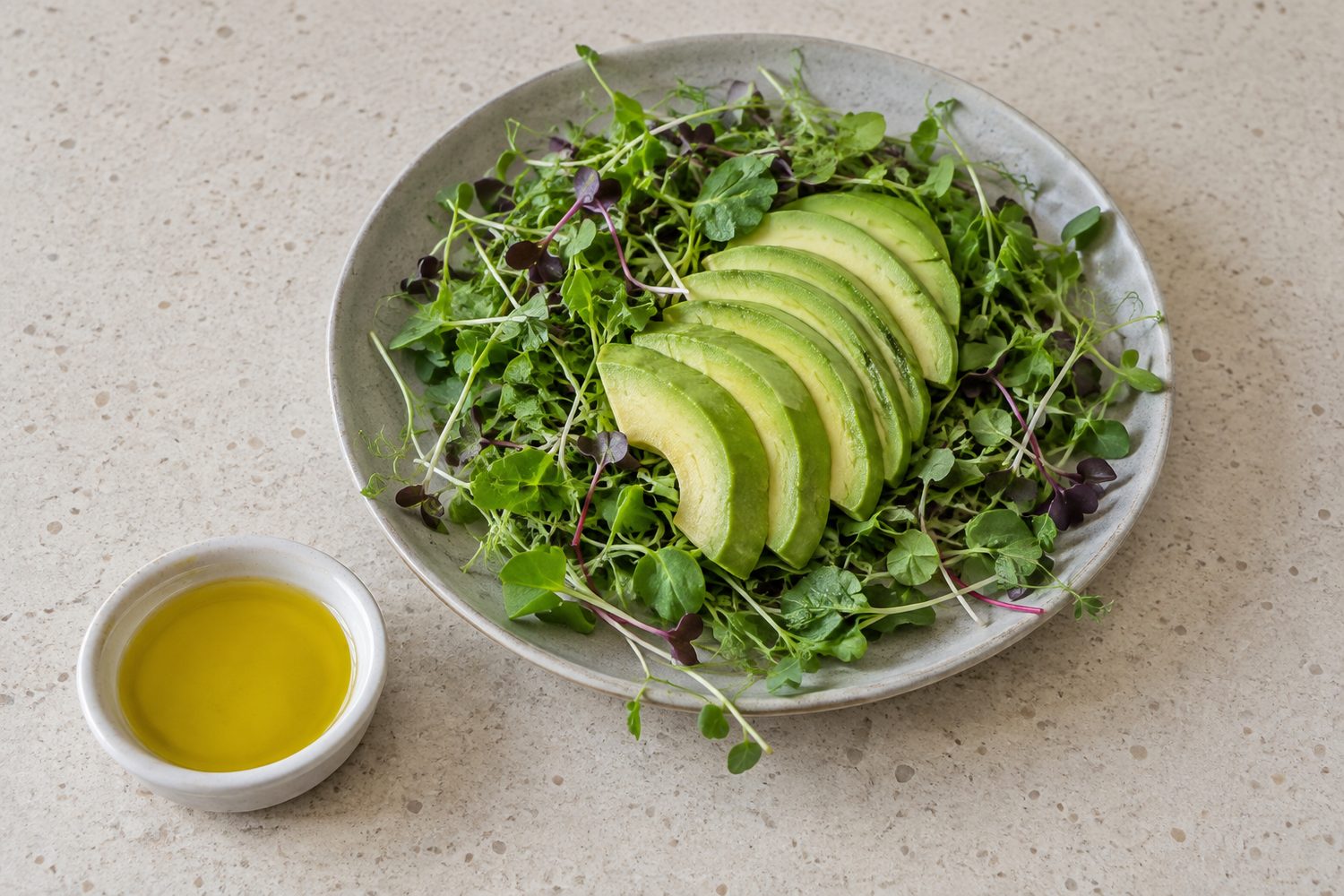
The bigger fat effect in the lutein studies, plasma lutein rising 207% with a 36 g fat spread against 88% with a 3 g spread, came from Roodenburg and colleagues (2000), who gave volunteers 8 mg of lutein as supplement esters with a hot meal. It did not test a vegetable. Eat your microgreens the way you like them; no study has worked out how much or what kind of fat a microgreen serving needs.
If you smoke or used to smoke
This part is about supplements, and NEI's advice is specific. According to NEI's supplement page and its AREDS2 findings, current and former smokers should take the AREDS2 formula and avoid the original AREDS formula, which contains beta carotene. In AREDS2, lung cancer occurred in 2% of people taking a formula with beta carotene against 0.9% of those taking one without, and about 91% of those who developed lung cancer were former smokers. AREDS2 replaced beta carotene with lutein and zeaxanthin for that reason.
The beta carotene in a serving of microgreens is a food amount, not the isolated high dose in a supplement, and the two are not equivalent. If you have macular degeneration, follow your eye doctor on supplements and diet, and do not swap microgreens in for a supplement they have recommended. The full AREDS2 formula also contains high doses of zinc and vitamin E, and the NCCIH notes it may affect digestion and how some drugs are processed, which is one more reason that conversation belongs with your doctor.
FAQ
Which microgreen has the most lutein?
In the 2012 study of 25 crops from one San Diego grower, cilantro was highest at 10.1 mg of lutein plus zeaxanthin per 100 g fresh weight, followed by red sorrel at 8.8 mg and red cabbage at 8.6 mg. Those were single measurements from samples bought in 2011, so your own crop may differ. Raw mature spinach, at 12.2 mg per 100 g in USDA data, carries more than any of them.
Can microgreens replace an AREDS2 supplement?
No. NEI says diet alone cannot provide the levels in the AREDS or AREDS2 formulas, which include vitamins C and E, zinc and copper as well as 10 mg of lutein and 2 mg of zeaxanthin. Anyone with macular degeneration should stay with the plan their eye doctor sets.
Do microgreens give you vitamin A?
Some do, through beta carotene, which your body converts to vitamin A; lutein and zeaxanthin are not converted. Using the NIH factor of 12 to 1, 20 g of red sorrel microgreens works out to about 202 mcg of vitamin A activity, against adult recommended amounts of 700 mcg for women and 900 mcg for men. Conversion varies from person to person, so treat that as an estimate.
Is zeaxanthin measured separately anywhere for microgreens?
Not in the published crop data. The 2012 lab method could not separate the two pigments, so every microgreen figure is lutein and zeaxanthin combined. The AREDS2 supplement, by contrast, lists them separately at 10 mg and 2 mg.
The short version
Cilantro, red sorrel, red cabbage and garnet amaranth were the richest microgreens for lutein and zeaxanthin in the one study that measured them, and a 20 to 30 g serving gives about 2 to 3 mg. That can roughly match or exceed what many Americans eat in a day, sits below a serving of raw spinach, and is well below the AREDS2 supplement dose. Nobody has tested microgreens on eyes, so enjoy them as a good leafy green, and if macular degeneration is part of your life or your family's, take the supplement question to your eye doctor.
Sources
Prices, stock and specifications are as the linked pages showed them on 2026-09-26.
- Xiao, Lester, Luo and Wang
- study PDF
- SR Legacy value for raw spinach
- USDA value for raw red cabbage
- USDA value for raw leaves
- 2017 review of lutein food sources
- NEI's words
- AREDS2 FAQ
- 2023 Cochrane review
- 2019 meta-analysis
- 2021 meta-analysis
- Bouranis et al., 2023
- Lee et al., 2025
- de la Fuente and colleagues (2019)
- Takeda et al., 2009
- Roodenburg and colleagues (2000)
- NEI's supplement page
- NCCIH
Keep reading
The journal
Are Microgreens Anti-Inflammatory? What the Research Really Says
Nobody has fed a person microgreens and measured their inflammation. And when researchers pooled ten broccoli sprout trials, the combined result came out at something that could be zero.
Read Are Microgreens Anti-Inflammatory? What the Research Really SaysThe journal
Best Microgreens for Kidney Health: Potassium by the Serving
See measured potassium and phosphorus for the best microgreens for kidney health, from lowest to highest, plus what your renal dietitian needs to know.
Read Best Microgreens for Kidney Health: Potassium by the ServingThe journal
Do Microgreens Help You Lose Weight? Two Claims, One Answer
One of these claims is probably true and has nothing to do with microgreens. The other was tested by injecting a compound into mice. Here is which is which.
Read Do Microgreens Help You Lose Weight? Two Claims, One AnswerThe journal
Do Microgreens Really Have 40 Times the Nutrients?
The number is real. It belongs to one nutrient in one crop. Used for microgreens as a category it is wrong in both directions, because some pairs run far above 40 and for at least one compound the mature plant is the more concentrated of the two.
Read Do Microgreens Really Have 40 Times the Nutrients?