How Much Microgreens a Day? A Serving and a Dose Differ by Twelve Times
Cal HewittPublished Checked
- eating
- serving size
- oxalate
- evidence
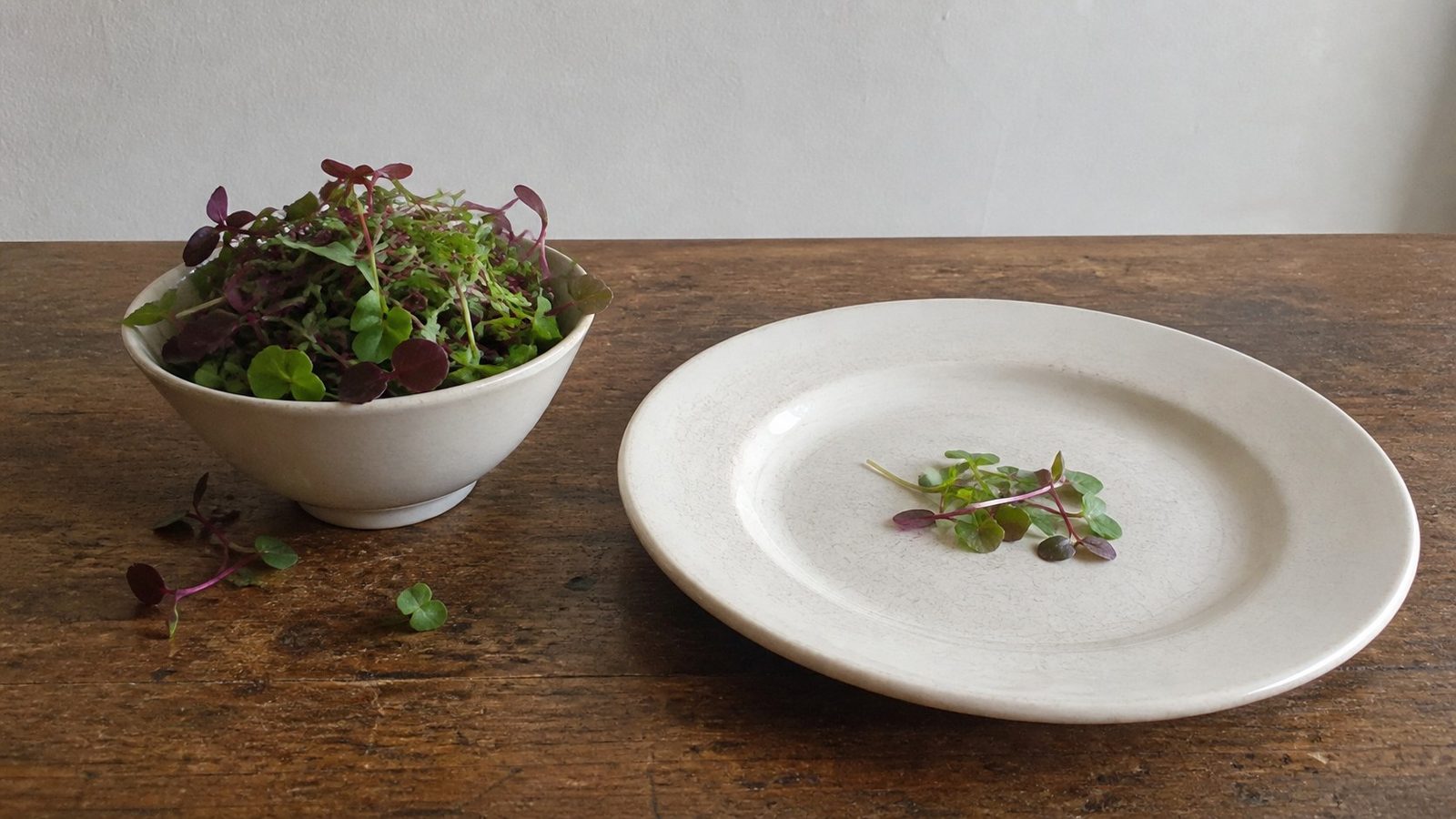
No regulator, dietetic association or government body anywhere sets a recommended daily intake for microgreens. Not the FDA, not the USDA, not the NIH, not Health Canada, not EFSA. That is the starting point for everything below.
What does exist is two human trials and one household convention, and they disagree by an order of magnitude.
What to actually do
- Treat 2.5 grams as a garnish and about 30 grams as the studied daily amount, and know which one you are doing. They differ by twelve times.
- Do not treat 30 grams as a target. The trial that used it measured whether people could stick to it, not whether it helped. It found they could.
- Eat them as raw produce, with the ordinary handling that implies. Washing is covered here.
- If you take warfarin, keep your intake consistent rather than swinging, and tell the person managing it.
- If you form calcium-oxalate stones, ask your clinician, and know that the microgreen oxalate data cover few crops and vary threefold between them.
- Vary the crop. The composition spreads that matter, oxalate and nitrate among them, are crop-specific, so a rotation dilutes any single exposure.
- Ignore any cup or gram figure that does not name its source. The most repeated one on the internet traces to an uncited sentence and a seed seller.
The gap nobody has closed
The only weighed garnish serving anybody publishes is 2.5 grams a person, and the one feeding trial below weighed its two-cup daily amount at about 30 grams. The 2.5 grams is a garnish, and it is what the culinary world means by a serving of microgreens.
The only trials that fed people microgreens every day used 28 to 30 grams.
Hover or tap a row to highlight it.
| Quantity | What it is | Against the 2.5 g serving |
|---|---|---|
| 2.5 g | The only weighed serving published | 1x |
| 16 g once | A 2023 single-dose study, 11 healthy adults | 6.4x |
| 28.1 g a day | A 2025 trial's Bull's Blood beet arm, 14 days | 11.2x |
| 30.4 g a day | The same trial's red cabbage arm, 14 days | 12.2x |
A serving and a dose are not the same object here, and the distance between them is about twelve times. Nobody has reconciled them, and the practical consequence is that "eat microgreens daily" means something very different depending on which number you picked up.
In tray terms: the median published yield is 200 grams. At the trial dose that is 6.6 to 7.1 days for one person. At the published serving it is 80 servings. Same tray.
What the two trials actually did
2023, single dose. Oregon State's Linus Pauling Institute fed 11 healthy adults 16 grams of fresh broccoli microgreens once, with breakfast. It measured urine and stool sulforaphane metabolites and the microbiome. It found bioavailable sulforaphane metabolites and no significant microbiome change.
2025, fourteen days. A randomized open-label crossover feasibility trial enrolled 26 healthy middle-aged and older adults, of whom 24 completed both periods. Each ate 2 cups a day for 14 days, weighed at 30.4 g of red cabbage or 28.1 g of Bull's Blood beet, with a 14-day washout between.
Its endpoints were adherence and tolerance, not benefit. Compliance was 95.6%, there was no major gastrointestinal or bowel-pattern harm, and no hemodynamic or microbiota change.
Read that carefully. It shows that about 30 grams a day is tolerable in healthy adults aged 45 to 70 for a fortnight. It does not show a benefit, it does not show that more is better, and it does not establish a recommended amount. The authors chose two cups because it is the standard leafy-green serving and because no microgreen serving size was established.
Where "one to two cups a day" actually comes from
It does not trace to a regulator. Followed back, the chain ends in two places:
- An article that calls 1 to 2 loose cups, "about 30 to 60 g", a practical recommendation and supplies no citation for the quantity. The chain ends at that uncited assertion.
- A seller's page that recommends one to two handfuls and says researchers use 30 to 100 g a day, on the same page as a $24.99 starter kit and $3.99 seed. It does not link those numbers to any named trial.
The two-cup figure has a legitimate origin and it is not a recommendation. It is the household measure the 2025 study borrowed from leafy greens because nothing microgreen-specific existed.
And the food-group convention is real but is not a dose. USDA MyPlate gives 2 cups of fresh raw leafy greens as 1 cup-equivalent of vegetables. That is sensible accounting for a leafy microgreen. MyPlate does not name microgreens, and the conversion is not a measured gram figure for every crop.
Oxalate, which is this page's job
Microgreens are not on the standard high-oxalate lists, and the reason is partly that nobody has measured enough of them.
A controlled study measured 19.16 to 58.94 mg of oxalate per 100 g fresh weight across selected microgreens, with red amaranth lowest and Sango radish highest. That is a 3.1-fold spread between crops, and they are results for particular crops under particular growing conditions rather than universal values. An earlier paper measured oxalate in ten culinary microgreens and described them as low in oxalate, but its crop-by-crop values are not exposed in what could be opened.
At the trial dose of about 30 grams a day, that range delivers roughly 5.8 to 17.7 mg of oxalate.
Nobody has turned any of this into a ceiling. The National Kidney Foundation recommends individualized plans by stone type and names mature spinach, beets and Swiss chard among high-oxalate foods. It does not name microgreens at all.
So, the honest position for a calcium-oxalate stone former is: the measured amounts in microgreens are small in absolute terms, the crop-to-crop spread is threefold, the data cover a handful of crops, and your plan is individualized by a clinician rather than by a webpage. Settling it properly would need a validated crop-by-crop composition table plus urinary oxalate measured in stone formers.
Who should be more careful, and why
Two different kinds of caution get muddled here, and separating them matters.
Food-safety vulnerability applies to pregnant people, young children, older adults and people with weakened immune systems, who are identified in published food-safety sources as more vulnerable to foodborne illness generally. Note that federal avoidance advice for raw or lightly cooked produce of this kind is written about sprouts, not microgreens, which is a real distinction and worth holding onto. One provincial government page is unusual in naming both.
Compound and medication caution is a different thing entirely and is not about microbes:
- Warfarin and other vitamin K antagonists. The issue is high and variable vitamin K affecting management. Consistency matters more than avoidance, and it is a conversation with whoever manages your anticoagulation.
- Calcium-oxalate stones. As above: individualized, and the microgreen data are thin.
- Nitrate, which is a quantified exposure with an acceptable daily intake and is crop-dependent. Nitrate and heavy metals have their own page.
Kidney-stone formers and people on warfarin are not food-safety populations. Their concern is composition, and the answer is consistency and a clinician rather than a gram figure from a blog.
What is still genuinely unknown
- Any recommended daily intake, from anybody. No regulator or dietetic body has set one for microgreens as a category or for a named crop.
- Whether a daily amount does anything. The 14-day trial measured tolerance and found no hemodynamic or microbiota change. The single-dose study measured absorption.
- A dose response. Nobody has fed several weighed amounts and compared outcomes, which is what a recommendation would require.
- A validated oxalate table across named crops, and urinary oxalate in stone formers eating them.
- Whether the sprout food-safety advice should extend to microgreens. Federal guidance addresses sprouts; the two are not the same product.
- Anything beyond a fortnight. The longest feeding period published here is 14 days in 24 people.
Terms on this page
Tap a term to see what it means.
Serving. A culinary portion. On this crop the only weighed one published is 2.5 g, which is a garnish rather than a vegetable portion.
Sources
Opened 2026-08-11 and 2026-08-12. The ratios between servings, doses and a tray are arithmetic performed for this page on the published weights below and the median tray yield.
- Oregon State University Linus Pauling Institute, sulforaphane bioavailability from a single serving of fresh broccoli microgreens, 2023 - the study record for the 16 g single dose in 11 healthy adults, the urine and stool sulforaphane metabolites and the absence of a significant microbiome change. The full article at PMC was reCAPTCHA-blocked after opening, so the participant and dose details come from its returned record.
- Lee and colleagues, randomized open-label crossover feasibility trial, 2025 - 26 healthy middle-aged and older adults with 24 completing both periods, 2 cups a day for 14 days weighed at 30.4 g red cabbage or 28.1 g Bull's Blood beet, a 14-day washout, 95.6 percent compliance, and no major gastrointestinal, bowel-pattern, hemodynamic or microbiota change. It states explicitly that it chose two cups because no microgreen serving size was established.
- USDA MyPlate vegetable guidance, accessed 2026-08-11 - the 2 cups of fresh raw leafy greens to 1 cup-equivalent conversion, and the absence of any mention of microgreens. Cited by name because the research behind this page recorded the guidance without capturing a page URL.
- Assessment of oxalate in selected microgreens - the 19.16 to 58.94 mg per 100 g fresh weight range with red amaranth lowest and Sango radish highest. The page was reCAPTCHA-blocked after opening and the range comes from its returned search record, which is why no crop-by-crop table is reproduced here.
- Ghoora and colleagues on ten culinary microgreens - the 2020 paper describing the crops examined as low in oxalate. It returned an internal error after opening, so only its abstract-level description is used.
- National Kidney Foundation kidney stone diet plan - that advice is individualized by stone type, and that mature spinach, beets and Swiss chard are named among high-oxalate foods while microgreens are not named at all.
- FDA on selecting and serving produce safely - raw-produce handling, the vulnerable populations, and the sprout-specific warning, plus the FDA Produce Safety Rule sprout guidance (PDF), which is where sprouts and microgreens are distinguished in rule coverage. This is the basis for the point that the federal avoidance advice addresses sprouts rather than microgreens.
- FoodSafety.gov on children under five and Health Canada on sprout food safety - the vulnerable groups named above. Quebec's page covering both sprouts and microgreens returned a 403 after opening and is noted only as the unusual case that names both products.
- NIH Office of Dietary Supplements vitamin K fact sheet (PDF) - the consistency advice for people on vitamin K antagonists. The page returned an internal error after opening, so the advice comes from its returned record.
- Practice sources, traced to show where the popular figure comes from rather than to support it: an article recommending 1 to 2 loose cups or about 30 to 60 g with no citation for the quantity, and a seller's research guide recommending one to two handfuls and citing researchers using 30 to 100 g a day without linking a named trial, on a site selling a $24.99 starter kit and $3.99 seed.
Keep reading
The journal
Are Microgreens Low FODMAP? What Monash Research Shows
Are microgreens low FODMAP? Learn what Monash sprouting research shows, which crop families deserve extra caution, and how reintroduction testing works.
Read Are Microgreens Low FODMAP? What Monash Research ShowsThe journal
Best Microgreens for Kidney Health: Potassium by the Serving
See measured potassium and phosphorus for the best microgreens for kidney health, from lowest to highest, plus what your renal dietitian needs to know.
Read Best Microgreens for Kidney Health: Potassium by the ServingThe journal
Can You Cook Microgreens? Yes, and Pea Shoots Are the One With Real Evidence
Yes, and the technique is the whole answer: add them late. Every documented method adds them at or near the end, and pea shoots are the one crop with a real cooked recipe behind it.
Read Can You Cook Microgreens? Yes, and Pea Shoots Are the One With Real EvidenceThe journal
Can You Freeze Microgreens? What Survives Drying and Freezing, and What Does Not
A microgreen is 87 to 94 percent water, so a whole tray dries down to a couple of spoonfuls. Drying is not a kill step, freezing does not make greens keep their crunch, and only one crop has ever been measured.
Read Can You Freeze Microgreens? What Survives Drying and Freezing, and What Does Not